
A complete issue · 44 pages · 1914
Life — August 27, 1914
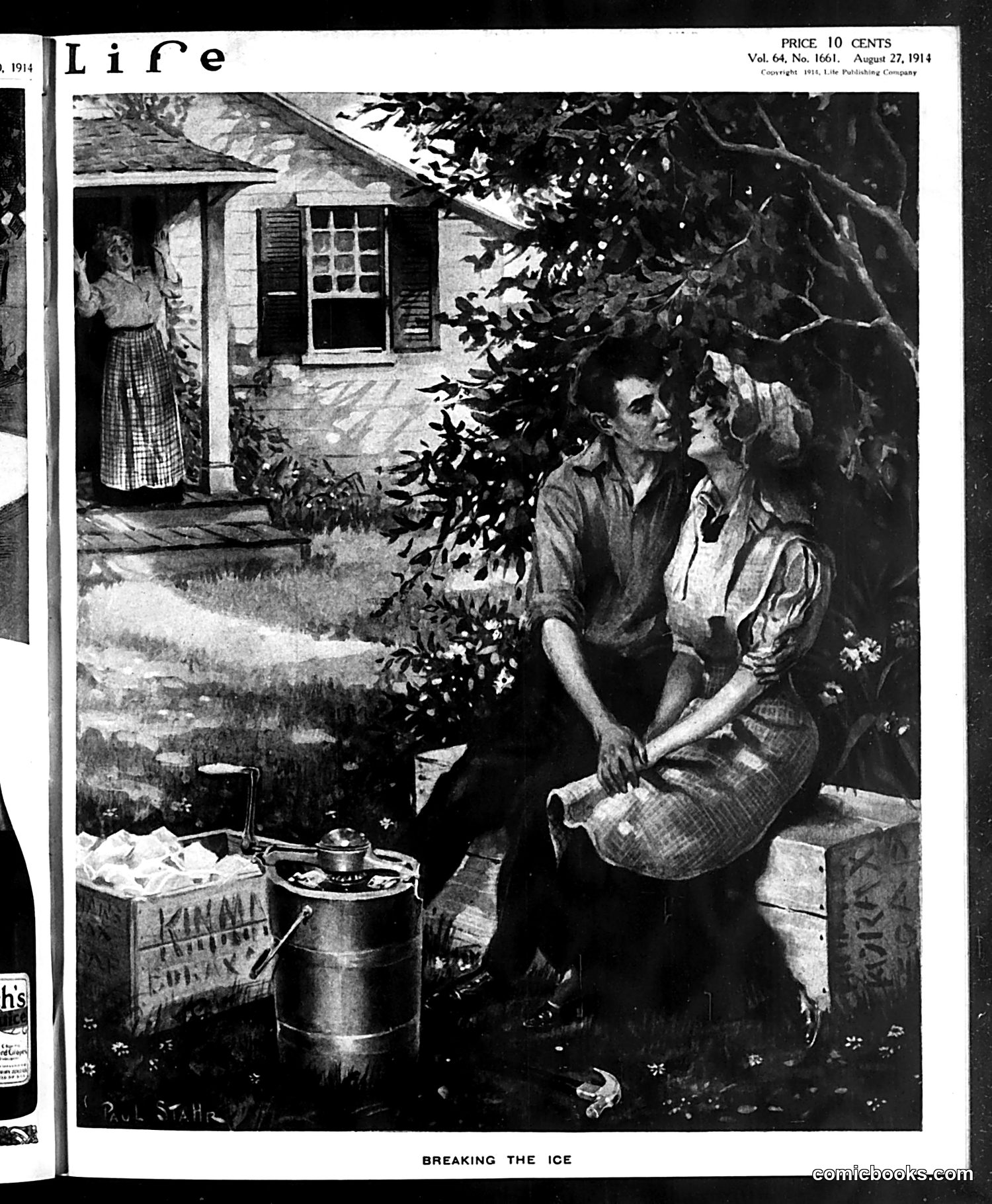
This illustration depicts a domestic scene with the caption "Breaking the Ice." Two people sit together under a vine-covered arbor in a backyard setting, while a woman watches from the house doorway. A cooking pot and supplies sit nearby. The phrase "breaking the ice" typically means overcoming initial awkwardness between people. The romantic rural setting—with the couple in an intimate moment under natural cover while being observed—suggests this is a humorous take on courtship or romantic tension. The woman's presence indoors watching the scene adds a layer of social observation or disapproval, playing on Victorian-era anxieties about proper courtship behavior and chaperonage norms of the early 1900s.
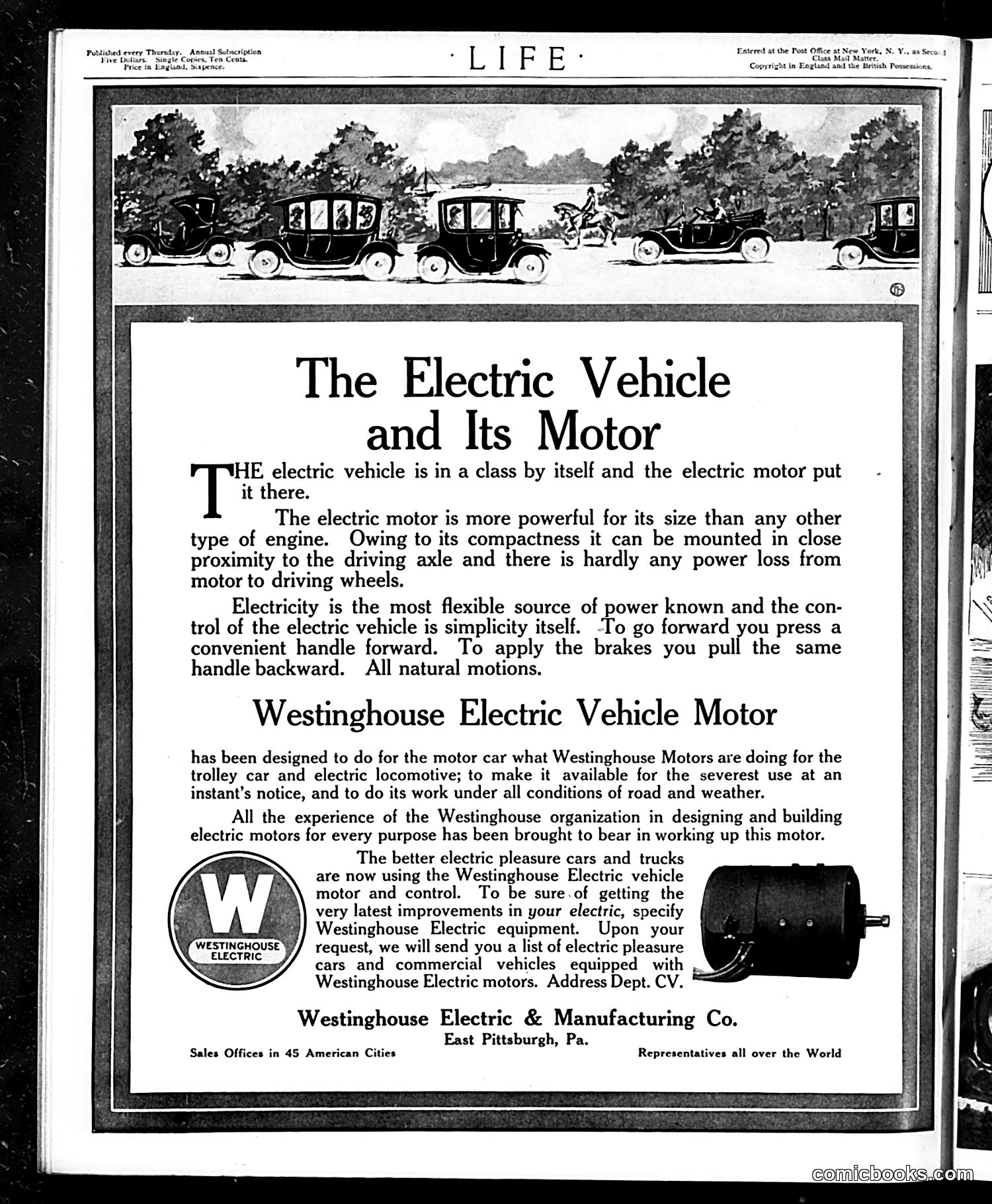
This page is **primarily an advertisement**, not satirical content. It promotes Westinghouse Electric & Manufacturing Co.'s electric vehicle motor, published in *Life* magazine. The illustration at the top shows a procession of early electric automobiles, reflecting the period when such vehicles competed seriously with gasoline engines—likely the 1910s-1920s. The advertisement emphasizes the electric vehicle's advantages: compact design, simple controls (forward/backward lever), and reliability in various weather conditions. The text claims electricity is "the most flexible source of power" and positions Westinghouse motors as superior for both pleasure cars and commercial trucks. The company boasts 45 sales offices across America and worldwide representation. There is **no political satire or cartoon humor** on this page—it's straightforward period advertising for what was then cutting-edge automotive technology.
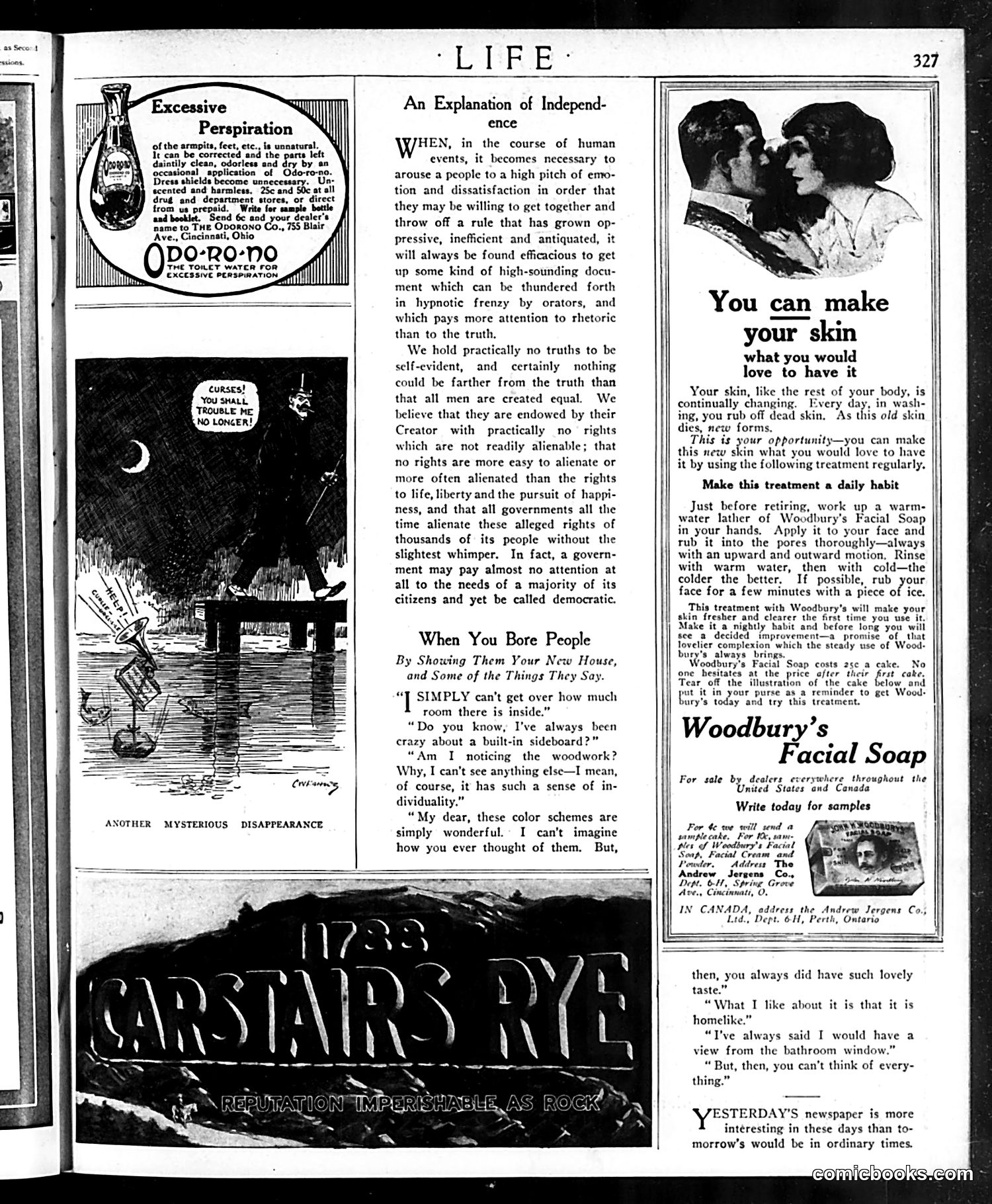
This page is primarily **advertising and editorial content**, not political satire. The main cartoon, titled "Another Mysterious Disappearance," shows a figure vanishing—likely a humorous reference to a contemporary mystery or magic trick, though the specific event is unclear from the image alone. The substantial editorial piece "An Explanation of Independence" discusses democratic principles and equal rights in abstract philosophical terms, advocating for peaceful resolution of disputes rather than revolutionary fervor. The remaining content consists of **product advertisements**: Odo-Ro-Do (antiperspirant), Woodbury's Facial Soap, and Carstairs Rye whiskey. These vintage ads reflect early 20th-century marketing strategies emphasizing personal hygiene and lifestyle products. The page reflects Life magazine's mixed format of light humor, philosophy, and commercial sponsorship typical of the era.
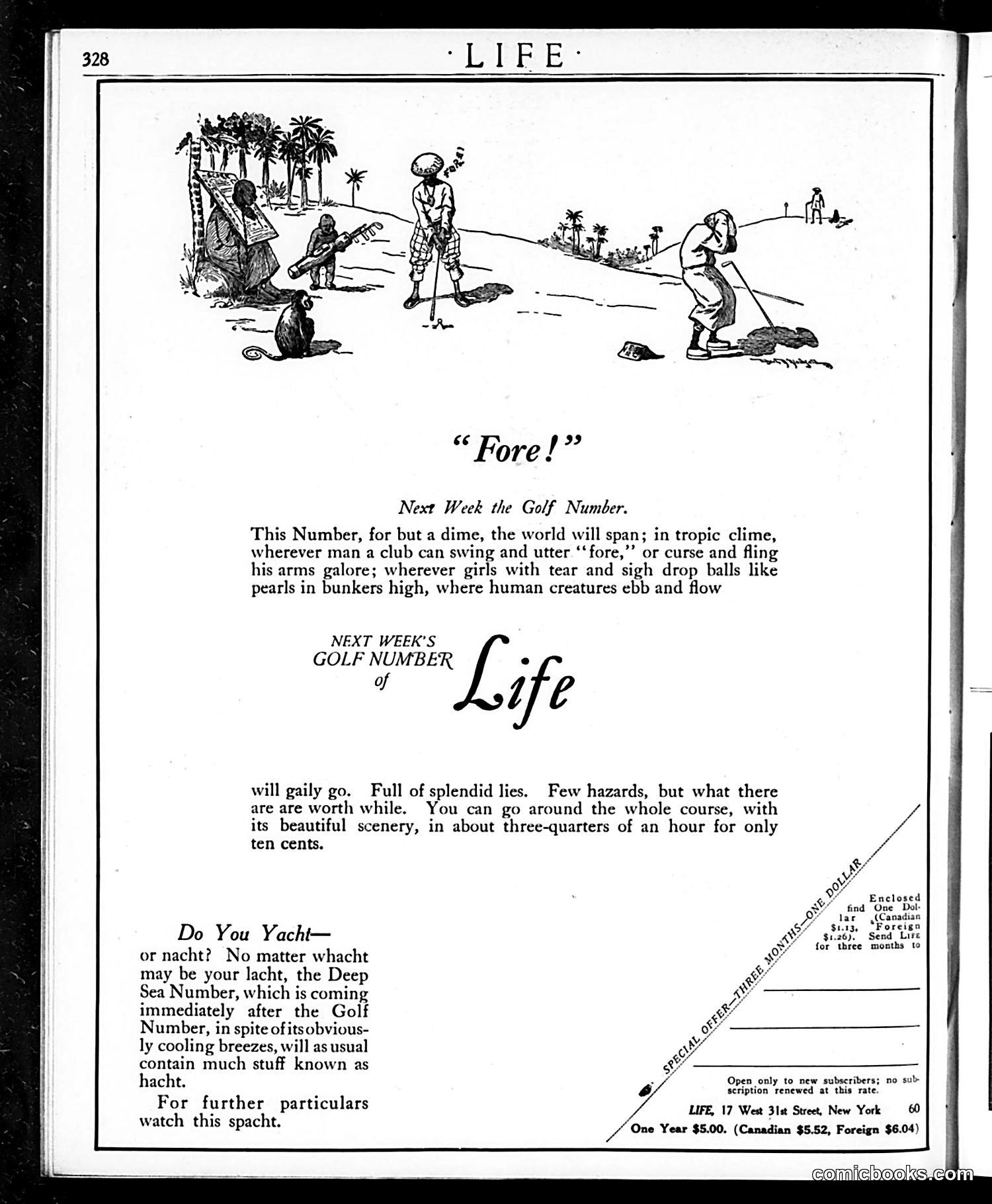
This page advertises an upcoming "Golf Number" of Life magazine. The cartoon depicts golfers on a tropical course, with the caption "Fore!" — the standard warning cry in golf. The humor appears to target golf's popularity and pretensions rather than specific political figures. The illustrated golfers represent various stereotypes: colonial-era figures in tropical dress, suggesting golf's association with leisure, empire, and upper-class recreation. The promotional text humorously exaggerates golf's appeal, claiming it spans "the world" and features "splendid lies" — a pun playing on both golf's literal and figurative deceptions. The satire mocks golf culture's grandiosity and suggests the sport attracts a certain type of leisured person. The page also advertises a coming "Deep Sea Number," indicating Life's pattern of themed special issues.
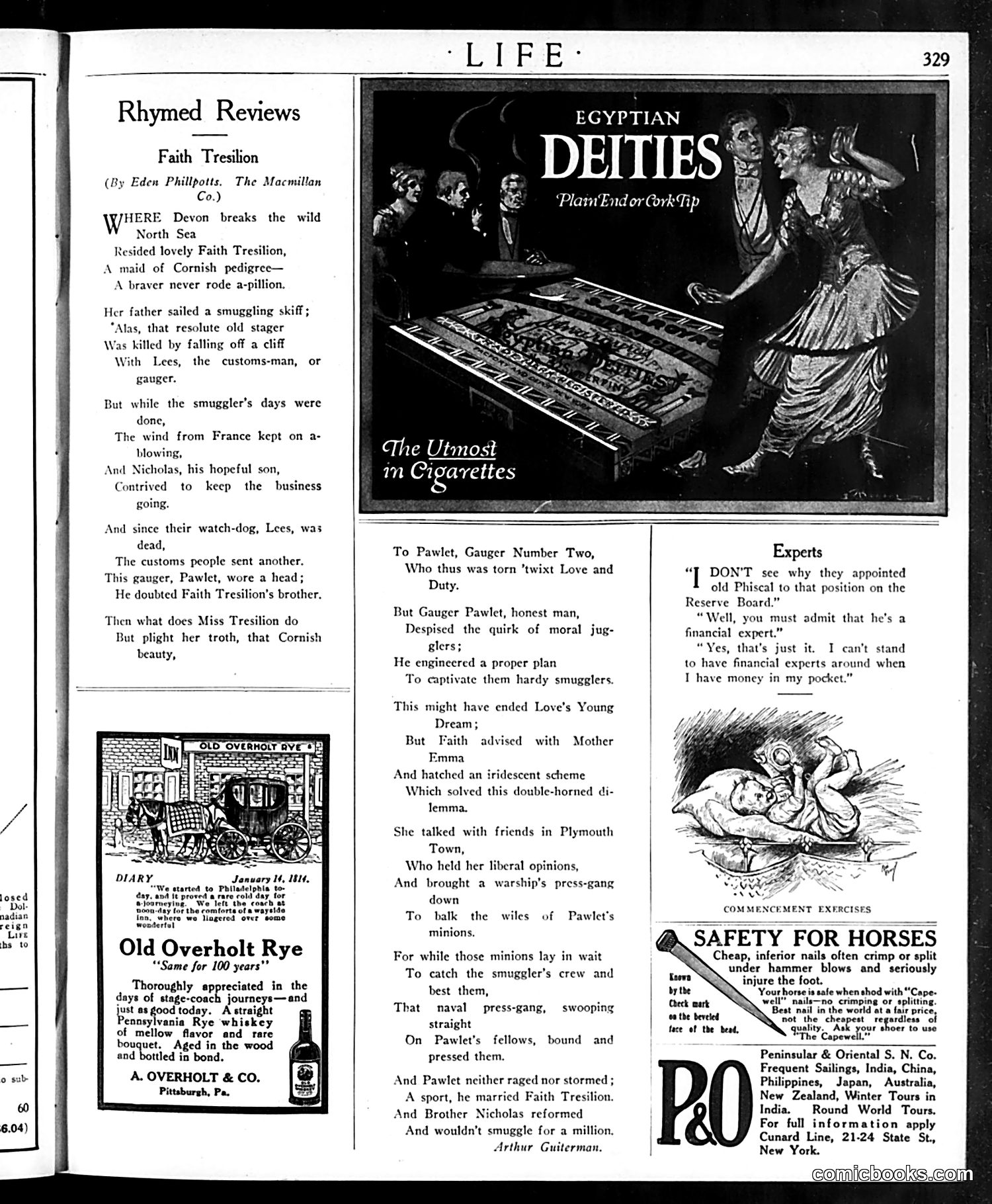
This page contains primarily **advertising and poetry rather than political satire**. The main content includes: 1. **"Faith Tresilian" poem** by Eden Phillpotts—a narrative verse about a Cornish woman whose smuggler father was killed, and how she helps maintain the family's smuggling operation before eventually reforming. 2. **Advertisements**: Old Overholt Rye whiskey (Pennsylvania bourbon), Egyptian Deity cigarettes, P&O shipping line, and horse safety products. 3. **"Experts" cartoon**: A brief satirical exchange mocking financial experts appointed to boards despite lacking practical business sense. The page reflects early 20th-century American magazine content mixing literature, humor, and commerce rather than focused political commentary.
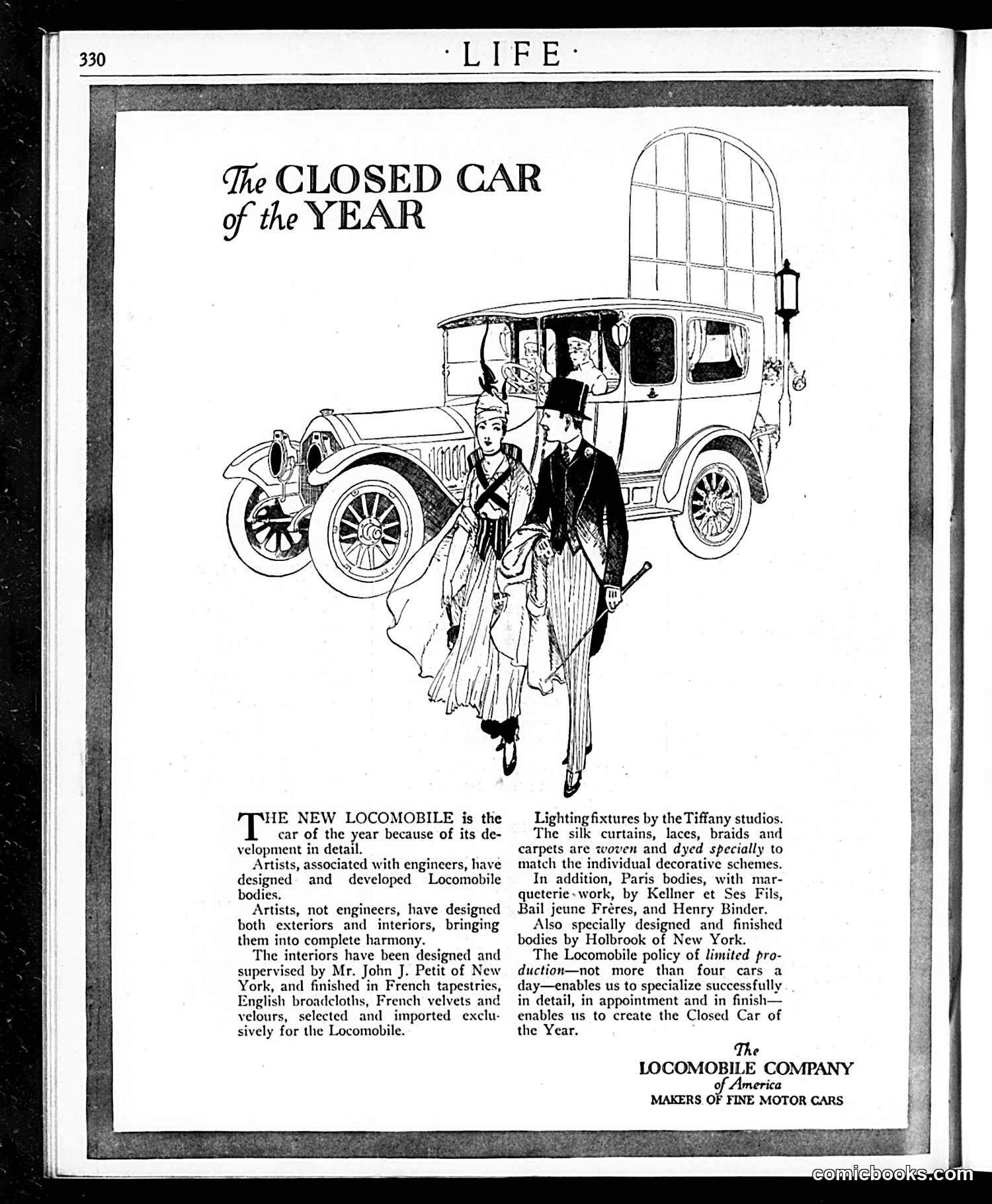
This is primarily a **Locomobile automobile advertisement**, not political satire. The page shows "The Closed Car of the Year" — a luxury automobile with an enclosed cabin, a major innovation for the era. The illustration depicts a well-dressed couple (man in top hat and tails, woman in fashionable dress) admiring the vehicle. The text emphasizes artistic design details: custom lighting by Tiffany studios, imported French fabrics, tapestries, velvets, and specially dyed carpets. Interiors were designed by Mr. John J. Petit of New York. The advertisement positions the Locomobile as a luxury product, highlighting limited production (four cars daily) and specialized craftsmanship. This reflects early automotive marketing targeting wealthy consumers who valued bespoke design and fine materials—treating cars as luxury goods rather than practical transportation.
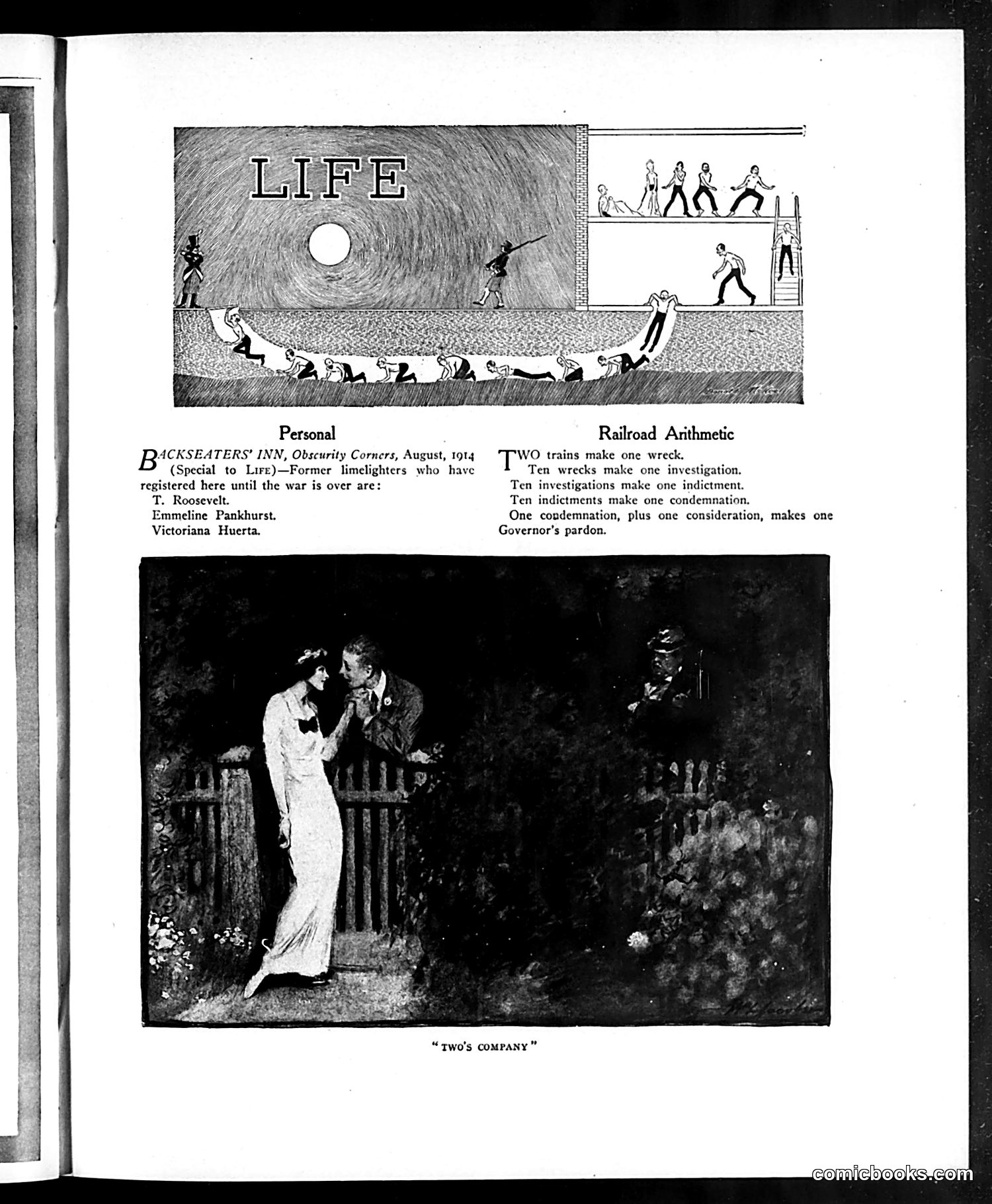
This page contains two distinct sections: **Upper section ("LIFE" masthead):** An abstract/symbolic illustration about the human condition—depicting a spiral (possibly representing the cyclical nature of existence) with figures engaged in various activities across different levels or stages. **Lower section:** A satirical piece titled "Railroad Arithmetic" mocking railroad industry logic. It uses absurdist math (e.g., "Ten weeks make one investigation") to critique how the industry handles accidents and safety violations—suggesting that multiple investigations and indictments merely result in a "Governor's pardon" rather than genuine accountability. **Bottom photograph:** Labeled "Two's Company," this appears to be a still from a film or theatrical production showing a romantic scene between two figures in an elegant garden setting. The page satirizes both existential themes and corporate malfeasance typical of Life's social commentary.
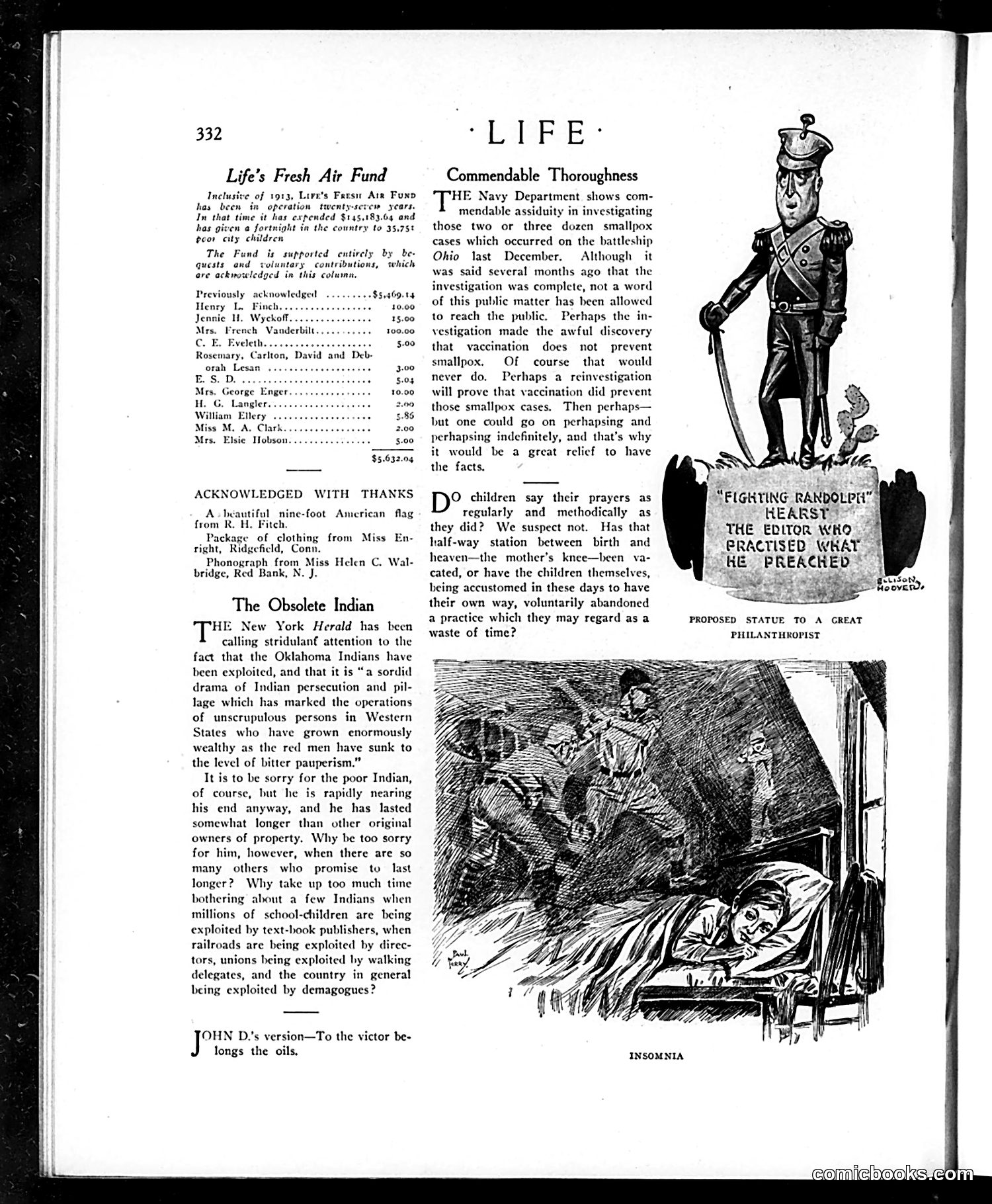
This page contains three distinct articles with illustrations: 1. **"Life's Fresh Air Fund"** - A fundraising notice listing donors who contributed to send poor city children to the countryside. 2. **"Commendable Thoroughness"** - Commentary on a Navy Department investigation into smallpox cases aboard the USS Ohio, questioning whether vaccination prevents the disease and suggesting the investigation should be made public. 3. **"The Obsolete Indian"** - A critique referencing the *New York Herald*'s reporting on exploitation of Native Americans by wealthy Western interests, railroads, and unions. The author sarcastically questions why anyone should worry about "a few Indians" when so many others are being exploited. 4. **Two illustrations**: A proposed statue to a philanthropist and a sketch titled "Insomnia" depicting someone in distress. The page reflects Progressive Era concerns about public health, Native American welfare, and labor exploitation.
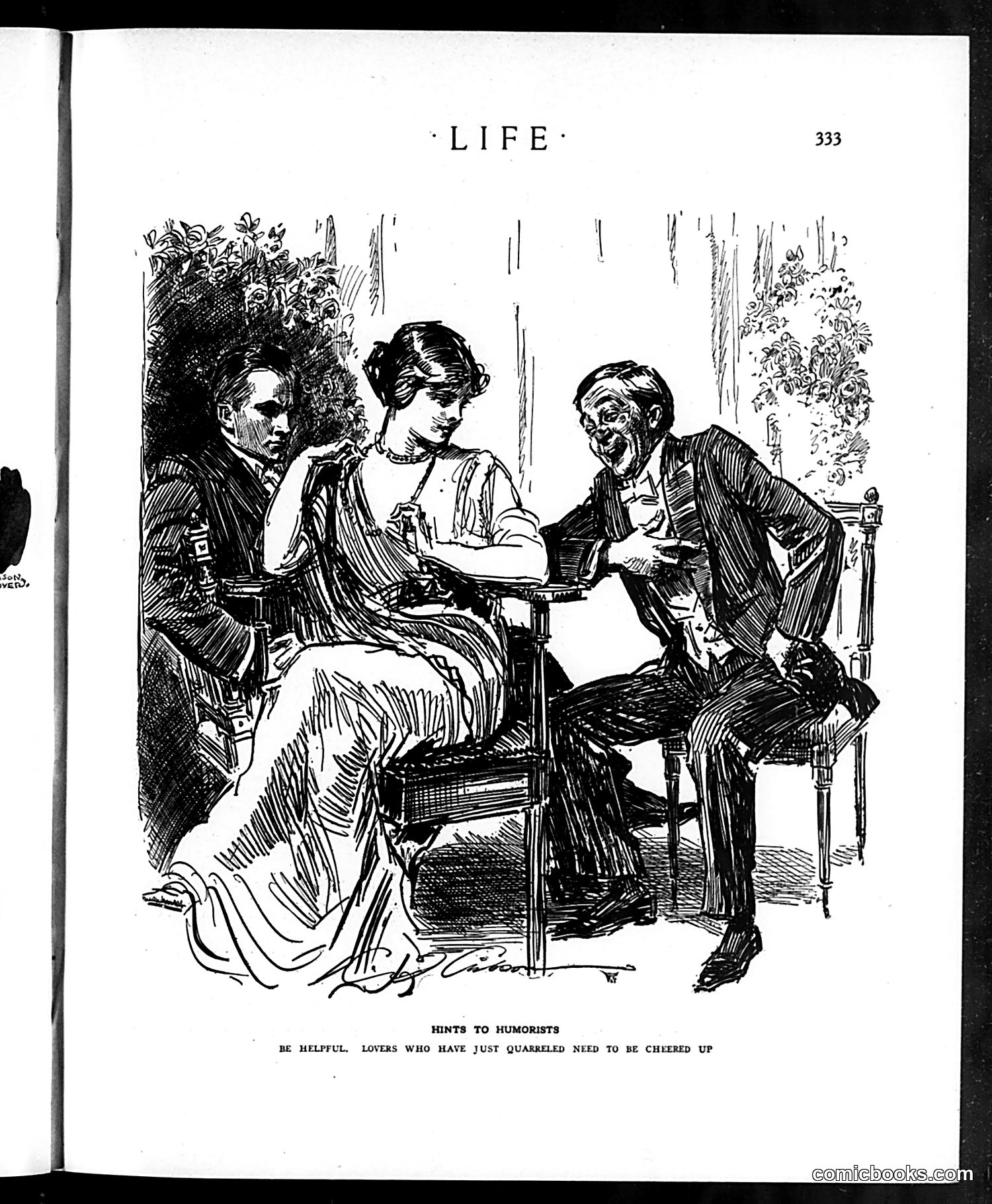
This is a satirical cartoon from *Life* magazine (page 333) titled "Hints to Humorists: Be Helpful. Lovers Who Have Just Quarreled Need to Be Cheered Up." The illustration shows three figures in an interior setting: a woman seated centrally in a flowing dress, a stern-looking man in the background (appearing upset or brooding), and an animated man on the right gesturing expressively. The cartoon satirizes romantic reconciliation by suggesting that a third party—the jovial gentleman—should intervene to lighten the mood between quarreling lovers through humor. The joke targets the social convention of "cheerfulness as medicine" for relationship conflicts. It's gentle domestic satire typical of early 20th-century *Life* magazine humor, mocking both overeager matchmakers and the awkwardness of post-argument tension.
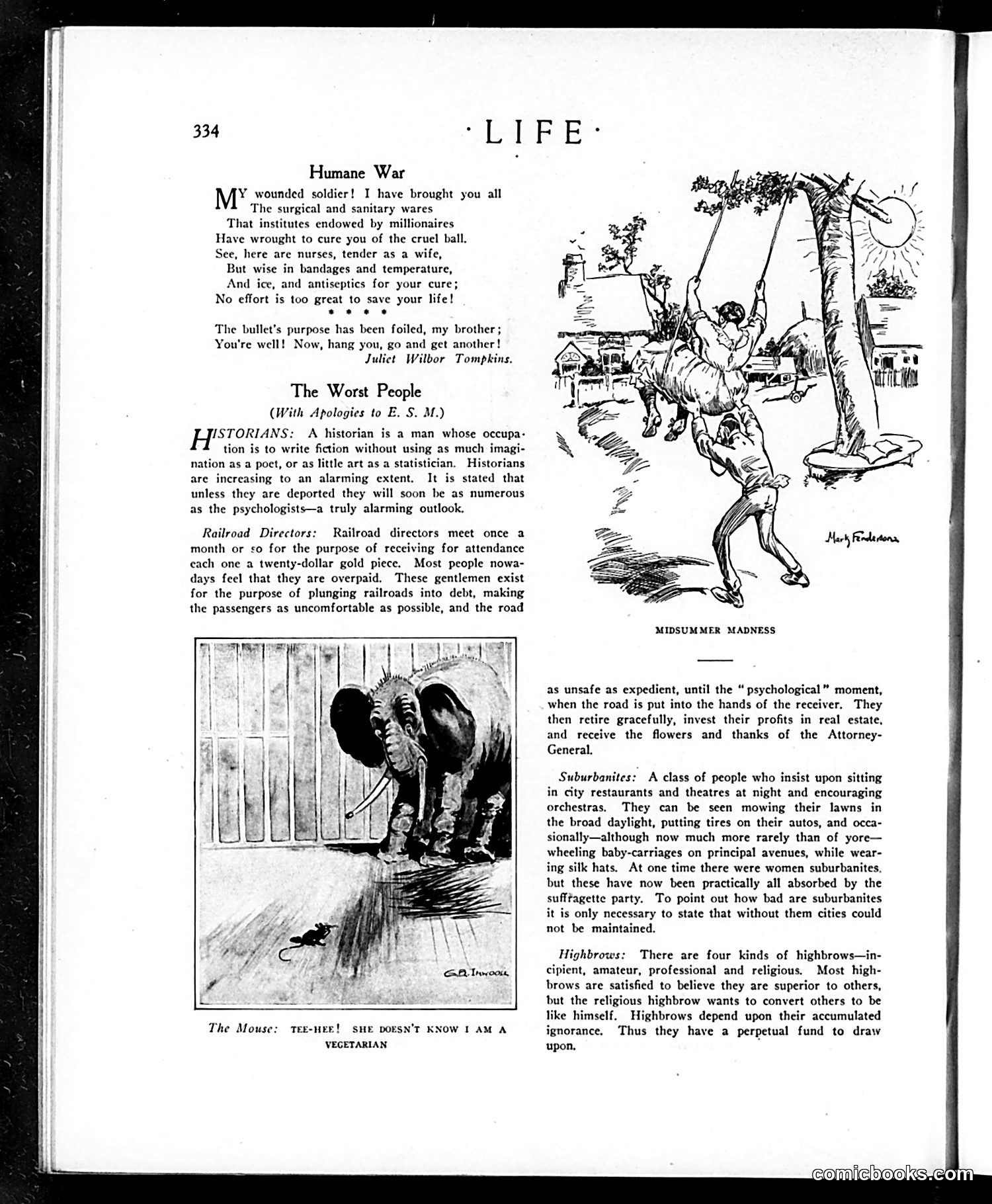
This page from *Life* magazine contains satirical commentary on various social types and professions. The main cartoons and text include: **"Humane War"** - A poem mocking the contradiction between claiming to provide medical care for wounded soldiers while still sending them back to fight. **"The Worst People"** - Definitions satirizing various professions: Historians who write fiction, Railroad Directors who deliberately make railroads unprofitable, and Suburbanites who frequent city entertainments while wearing silk hats (marking pretension). **The Mouse cartoon** - Shows a mouse exclaiming "Tee-hee! She doesn't know I am a vegetarian," apparently satirizing either deception or absurdist humor about the mouse's dietary claims. The page uses biting wit to critique institutional hypocrisy, corporate malfeasance, and social pretension—hallmarks of early 20th-century American satirical humor.
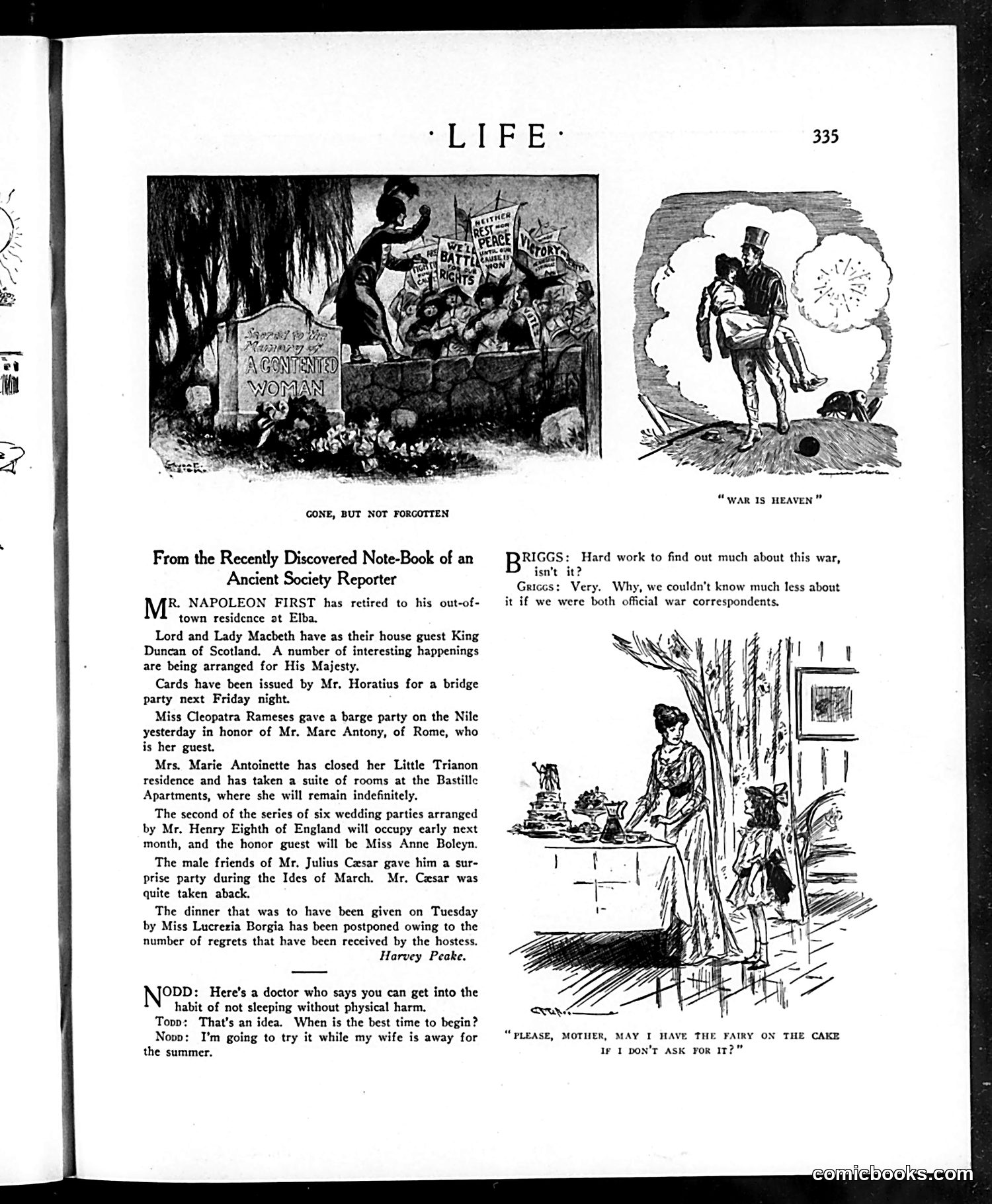
**Top Left Cartoon ("Gone, But Not Forgotten"):** This appears to be a political satire showing a graveside mourning scene with a headstone labeled "A CONTENTED WOMAN," suggesting the cartoon satirizes the concept of a satisfied woman as something extinct or impossible—a commentary on women's discontent, likely related to suffrage or social demands of the era. **Top Right Cartoon ("War is Heaven"):** Depicts an elegant gentleman in a top hat standing amid destruction and cannon fire. The title ironically contrasts the gentleman's composed, refined appearance with the chaos of warfare, satirizing how distant elites distance themselves from war's actual horrors. **Bottom Section:** Contains social gossip and a humorous dialogue between characters "Nodd" and "Todd" about sleep habits, representing typical light satirical humor found in the magazine.
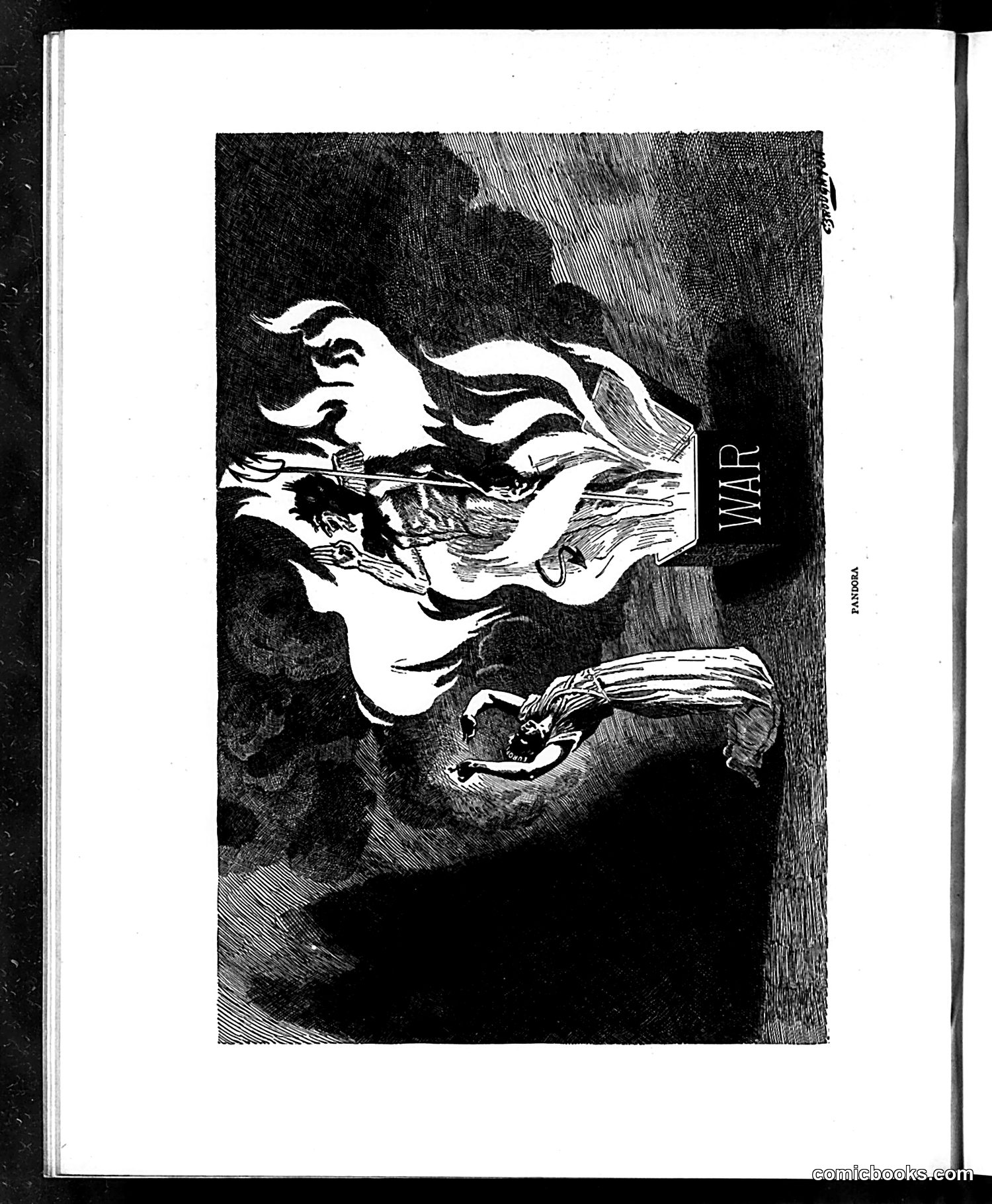
This is a satirical engraving titled "WAR" (visible on the right margin). The image depicts a chaotic scene of conflict with multiple figures engaged in violent struggle. The artistic style—cross-hatching and dramatic contrasts typical of political engravings—suggests this is likely 19th-century commentary on warfare or political conflict. The composition shows figures in dynamic, aggressive poses with flowing garments, suggesting classical allegory. However, without additional context, captions, or visible identifying labels, I cannot definitively identify which specific conflict, political figures, or historical event this satirizes. The page appears designed as standalone satirical commentary on the nature of war itself, using dramatic imagery rather than specific caricatures of identifiable individuals.
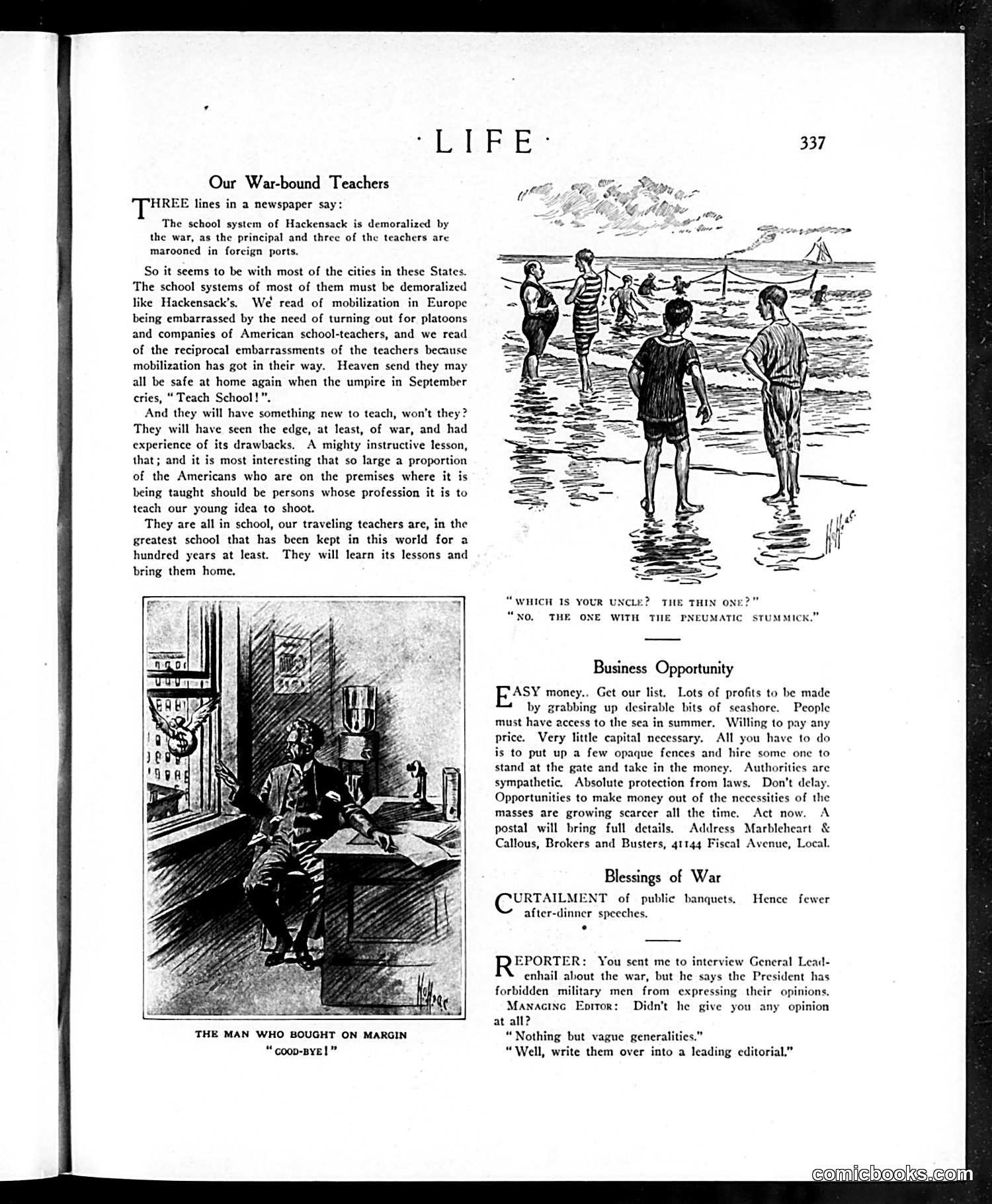
This page contains three distinct pieces of WWI-era satire: **"Our War-bound Teachers"** discusses how American schoolteachers are being deployed to military service, leaving schools "demoralizes." The piece ironically notes teachers will gain valuable experience witnessing war's "drawbacks" before returning to teach children. **"The Man Who Bought on Margin"** (lower left cartoon) depicts financial ruin—a man who purchased stocks using borrowed money facing destitution when the market crashed. **"Business Opportunity"** sarcastically advertises seashore land schemes exploiting wartime shortages and public desperation. **"Blessings of War"** mocks how curtailed public events (fewer banquets, speeches) are presented as societal benefits. The beach scene (top right) with the caption about uncles and a "pneumatic stummick" appears to be unrelated humor about mistaken identity.
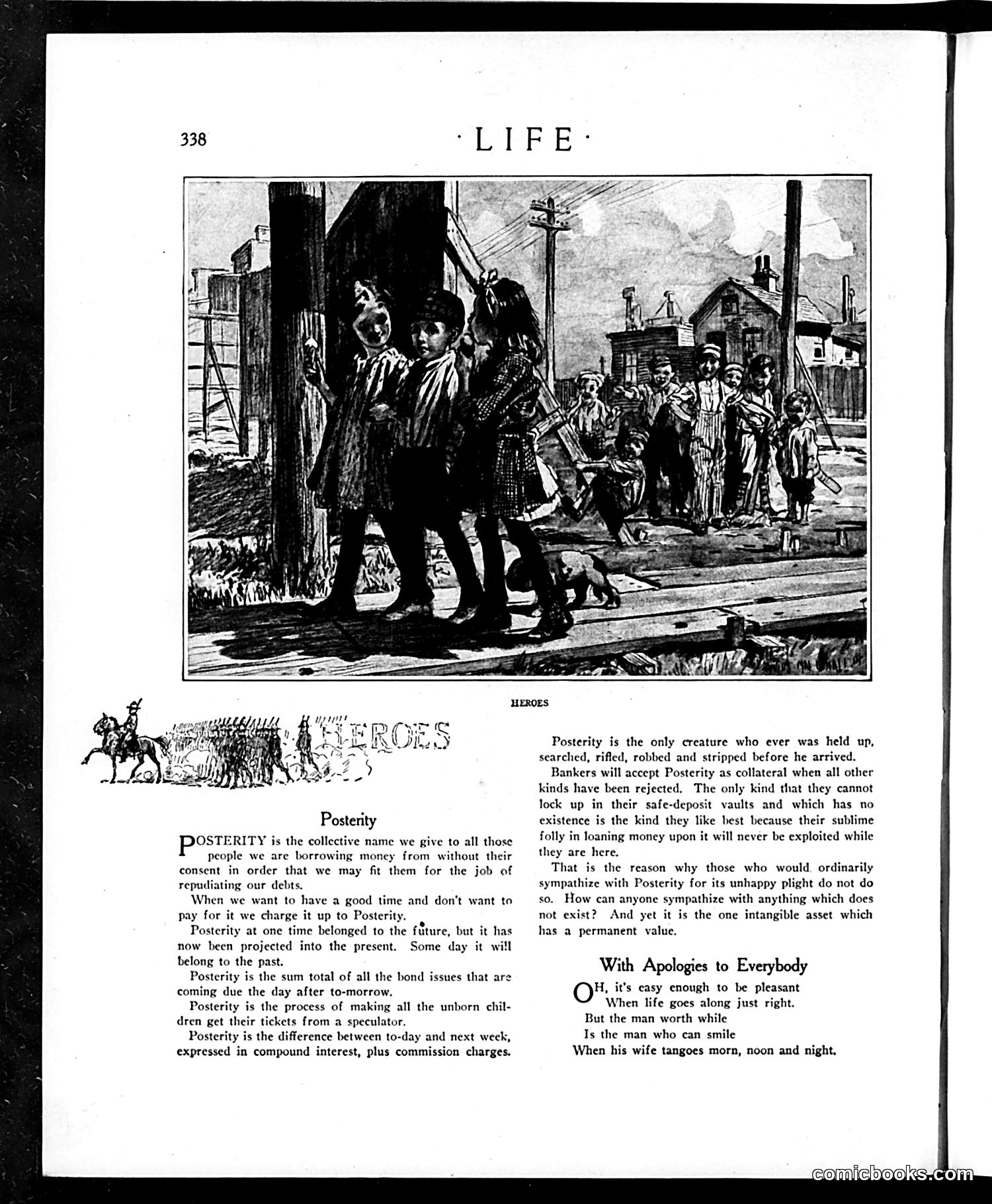
This page satirizes **Posterity** — defined as the collective name for people we borrow money from without consent to pay our debts. The text mockingly explains that Posterity is "the sum total of all the bond issues...coming due the day after to-morrow." The accompanying illustration shows what appears to be **working-class children in an impoverished neighborhood**, likely meant to represent the future generation who will inherit accumulated debt and financial obligations. The satire's target: politicians and financiers who spend money recklessly, deferring costs to future citizens. The "Heroes" heading suggests ironic commentary — those making such decisions present themselves heroically while burdening unborn generations with their fiscal irresponsibility. This reflects Progressive Era criticism of debt-financing policies.
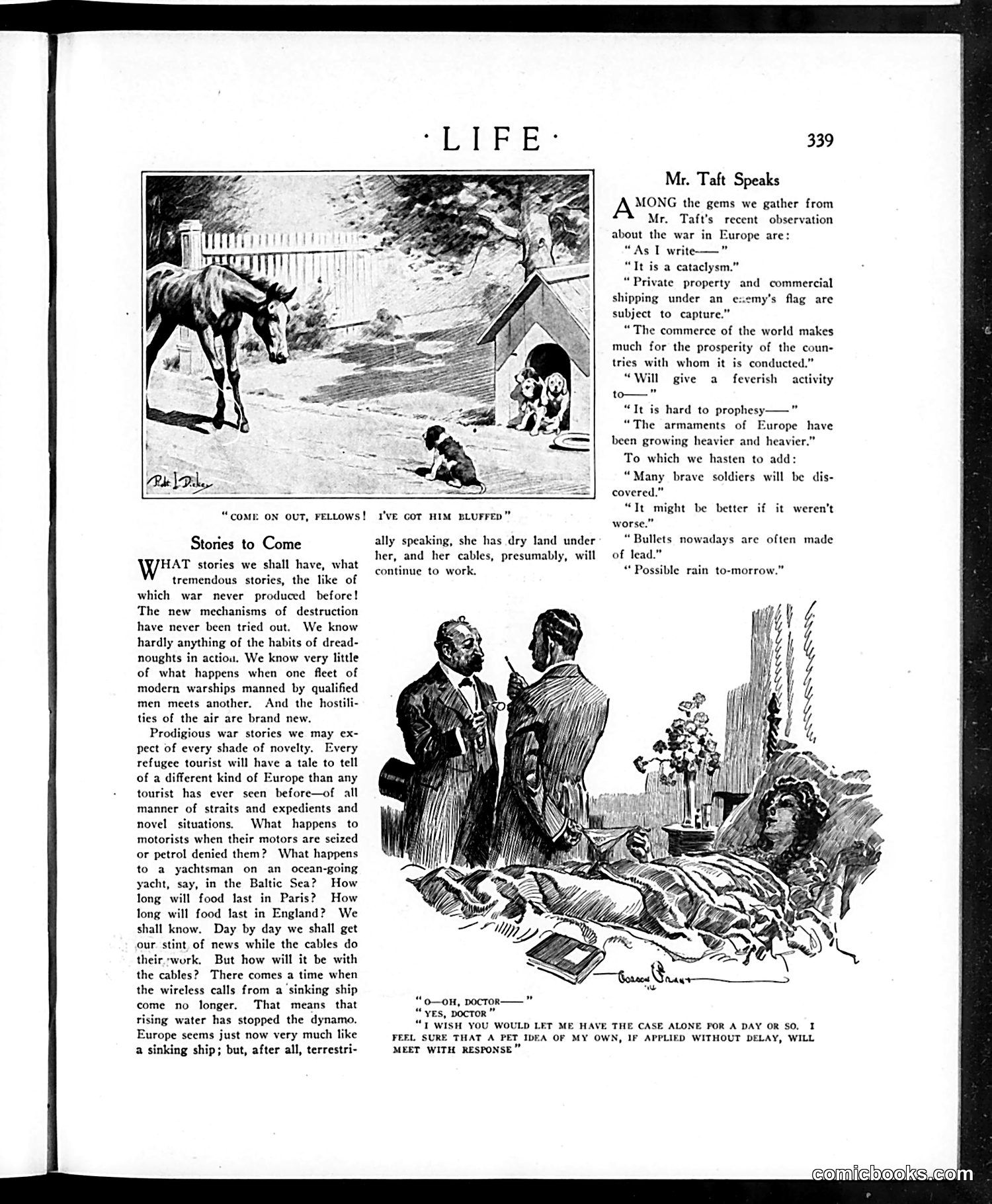
This page satirizes **William Howard Taft's** public commentary on World War I. The right section mocks his obvious, platitudinous observations about the war—that it's a "cataclysm," that armaments are "growing heavier," that bullets are "made of lead," or that "possible rain to-morrow" might occur. The satire suggests Taft's pronouncements are painfully banal and contribute nothing meaningful to understanding the conflict. The left section, "Stories to Come," anticipates the dramatic wartime narratives that will emerge—destroyed ships, food shortages, seized vehicles—while questioning whether communication cables will survive Europe's turmoil. The two cartoons show: (top) soldiers engaged in some kind of bluff or deception; (bottom) a doctor speaking with another figure about applying "a pet idea" to address the crisis. The overall point: Taft's commentary is so obvious and empty that Life juxtaposes it with genuine wartime uncertainties to highlight the gap between political rhetoric and real stakes.
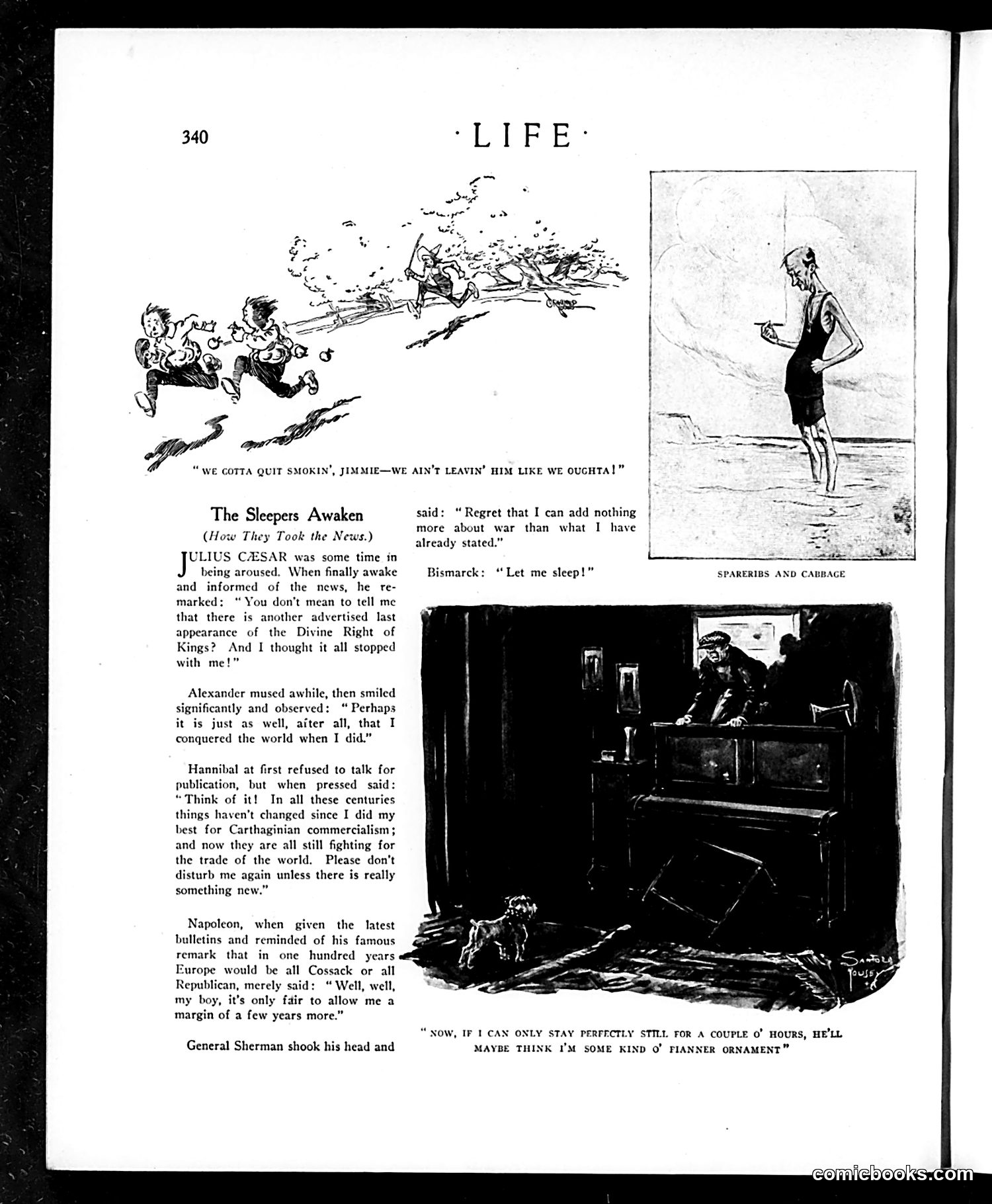
This satirical piece uses historical figures—Julius Caesar, Alexander, Hannibal, Napoleon, and General Sherman—as a commentary on World War I. The conceit is that these great military leaders are being awakened and informed of modern warfare. The joke operates on two levels: **The satire**: Despite centuries passing and humanity's supposed progress, the great powers are *still* fighting over trade and territorial dominance—exactly as they always have. Nothing has fundamentally changed; the wars are repetitive and predictable. **The historical irony**: Each figure responds with world-weary resignation or darkly comic acceptance. Bismarck simply wants to sleep through it all. Napoleon asks for "a margin of a few years more" before his prophecy about Europe fully comes true. The top cartoon shows men frantically leaving, joking they shouldn't abandon "Jimmie" (unclear reference, possibly a draft dodger or reluctant soldier). The page mocks the notion that WWI represents anything genuinely new—it's merely history repeating itself endlessly.
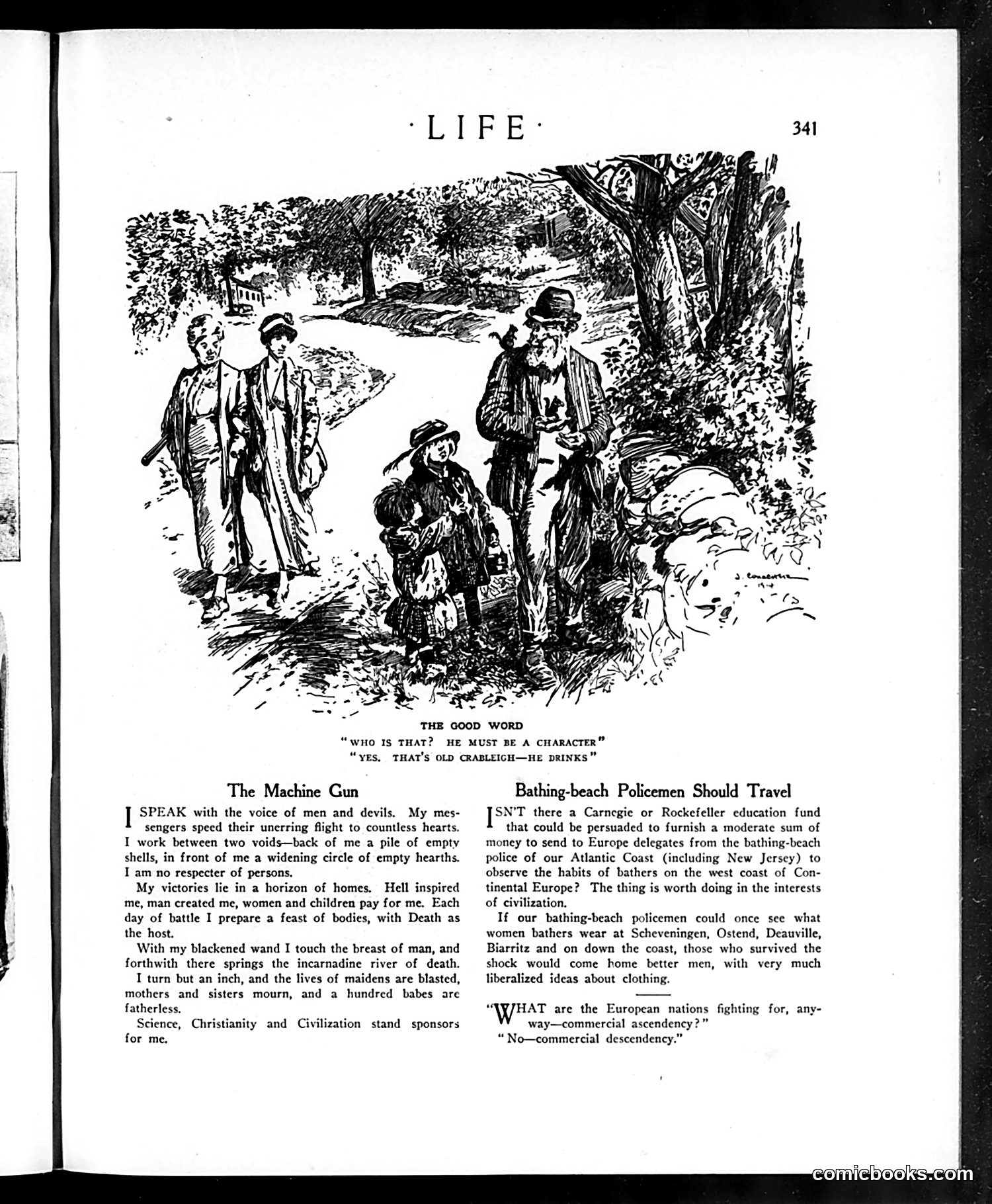
This page contains three distinct satirical pieces: **"The Good Word"** (top cartoon): Shows men gossiping about a drunk character named "Old Crableigh," illustrating how reputations are formed through idle talk. **"The Machine Gun"** (left column): A darkly poetic monologue personifying the machine gun as an instrument of death, sponsored by "Science, Christianity and Civilization." This is anti-war satire, likely from WWI era, condemning mechanized warfare's indiscriminate destruction of civilians—"women and children pay for me." **"Bathing-beach Policemen Should Travel"** (right column): Satirizes American prudishness about women's bathing attire. It suggests sending American beach police to observe European women's less-restrictive swimwear, implying they'd return with "liberalized ideas about clothing." This mocks both American moral rigidity and hints at the absurdity of nations fighting over "commercial descendency" (economic decline) rather than genuine principles. The overall tone critiques American hypocrisy, militarism, and sexual prudishness.
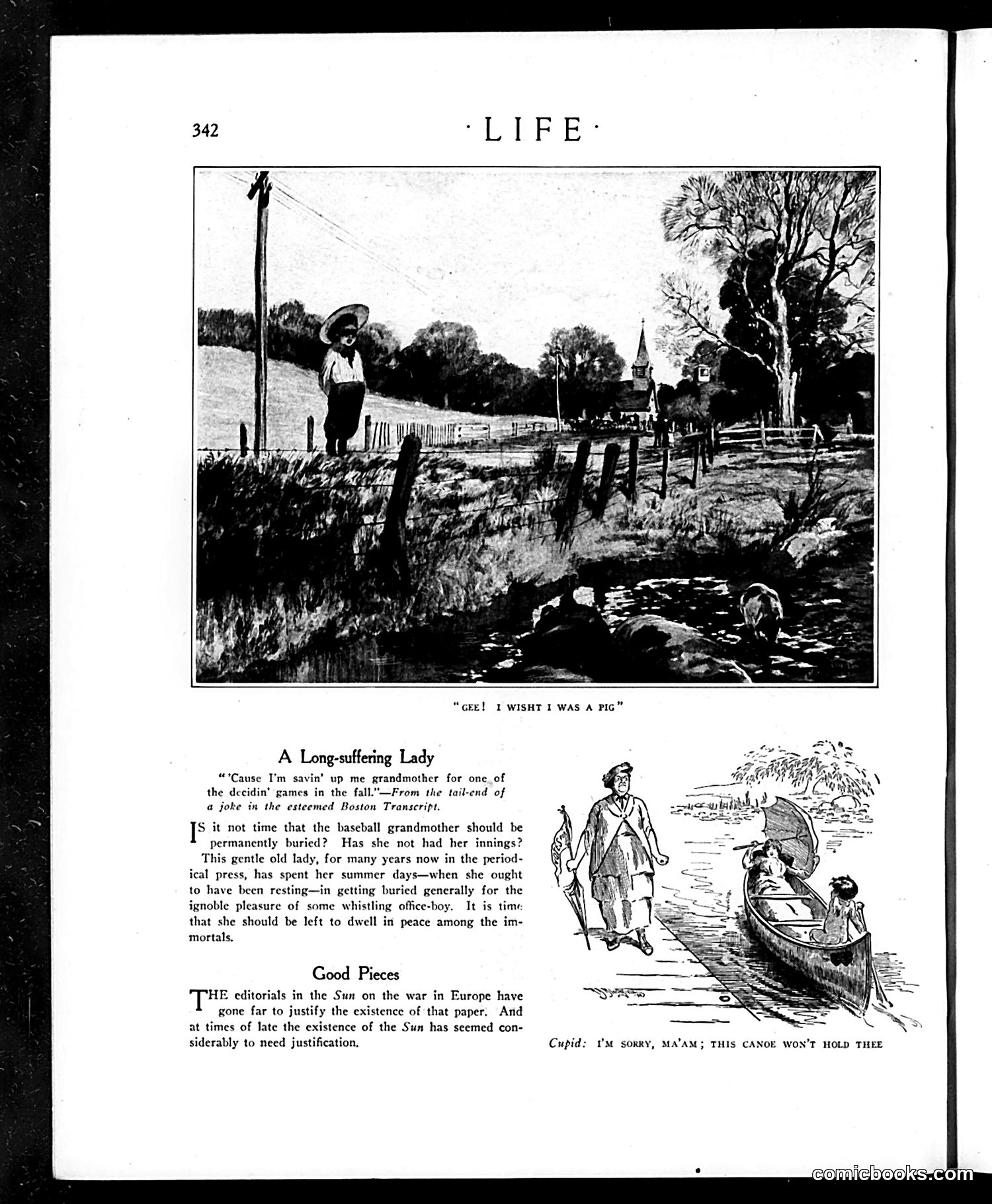
This page contains satirical commentary on two topics: **"A Long-suffering Lady"** critiques a recurring joke trope in American periodicals—the "baseball grandmother" who gets buried as a punchline. The article mocks this worn-out joke, arguing the elderly grandmother character has appeared so repeatedly in the press for years that she deserves to be "permanently buried" (retired from use). The complaint suggests office workers repeatedly recycle this stale humor for cheap laughs. **"Good Pieces"** offers backhanded praise for the *Sun* newspaper's war editorials about Europe, suggesting the paper's existence has needed justification lately—implying its quality or relevance had been questionable until recently. The Cupid cartoon at bottom presents a separate romantic mishap: a boat operator apologizing that his canoe cannot accommodate a couple, subverting the typical cupid-enables-romance trope with practical logistics.
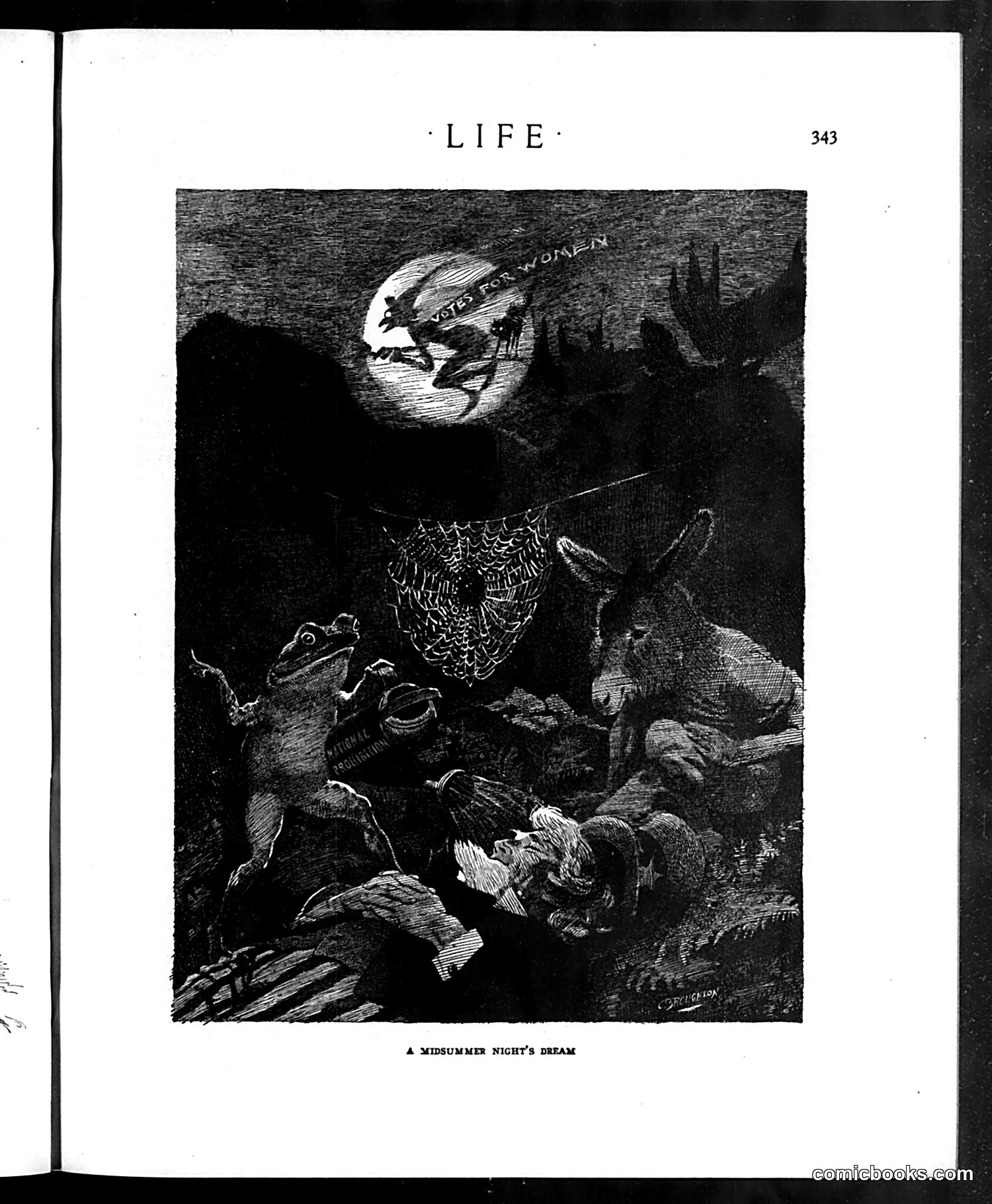
This is an illustration titled "A Midsummer Night's Dream," referencing Shakespeare's famous comedy. The engraving depicts the magical forest scenes central to the play, showing various supernatural and fantastical creatures in a moonlit woodland setting. The image includes what appears to be fairies, sprites, animals, and other enchanted beings characteristic of Shakespeare's play. A prominent moon dominates the upper portion, and a spider web is visible, emphasizing the magical, otherworldly atmosphere. Rather than political satire, this appears to be a straightforward artistic interpretation of the Shakespearean drama, likely published in Life magazine as cultural or literary content. Without additional context or caption text visible, the specific artistic commentary—if any—remains unclear.
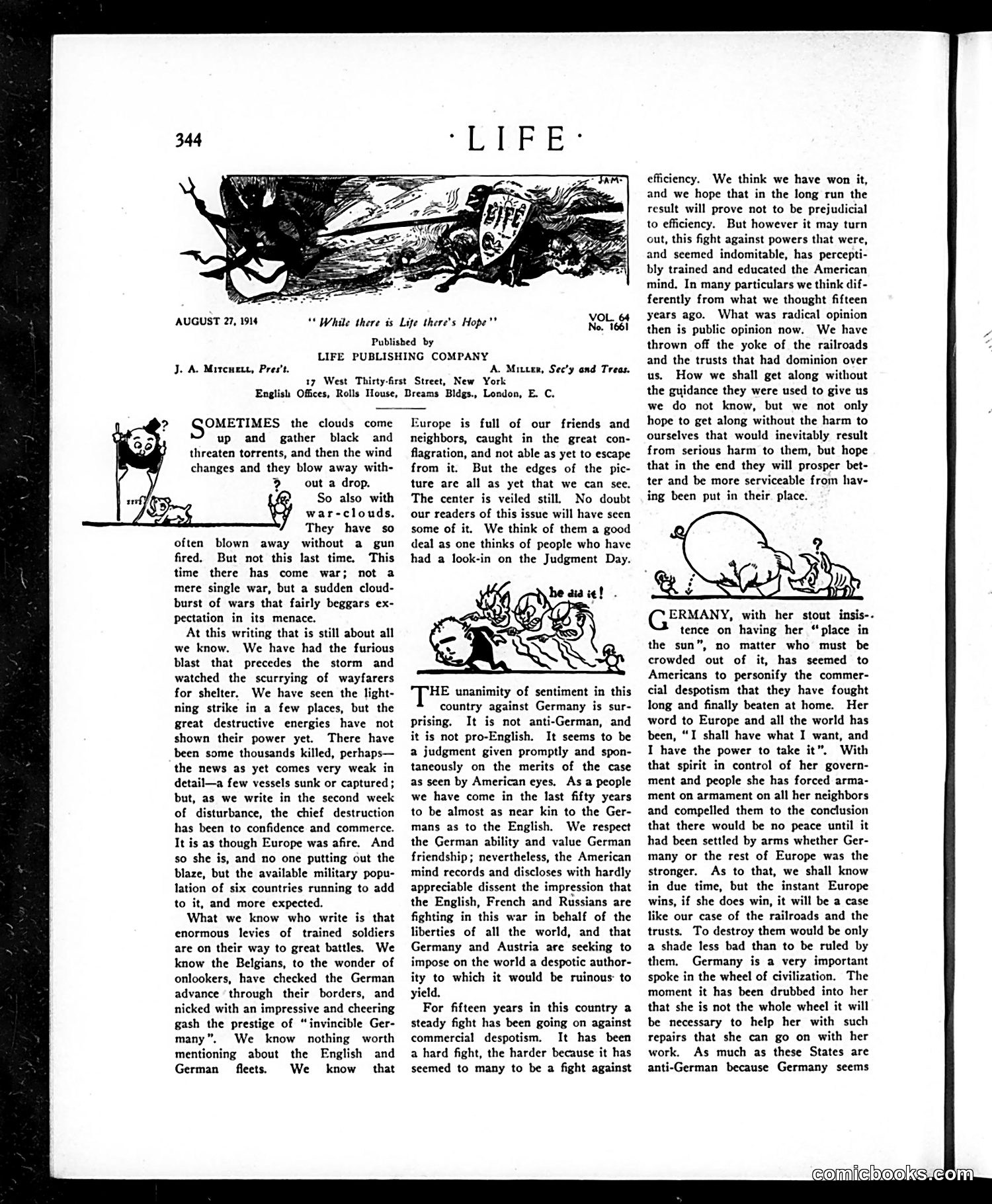
This editorial page addresses World War I, which had just begun weeks earlier. The header cartoon depicts storm clouds and wind—metaphorical imagery for the war's chaos engulfing Europe. The text explains that while wars often pass without firing a shot, this one is different: a catastrophic "cloud-burst" affecting six nations. The editors note they're still in the "second week" with limited information, though they acknowledge thousands killed and vessels sunk. Notably, the editors articulate American sentiment: opposition to Germany is **not** anti-German or pro-English, but rather a judgment that Germany and Austria seek "despotic authority" while England, France, and Russia fight for "liberties of all the world." The piece draws parallels to America's fifteen-year domestic fight against "commercial despotism" (trusts and railroads), suggesting this international conflict aligns with American anti-monopoly values. The overall tone is one of measured analysis during early war uncertainty.
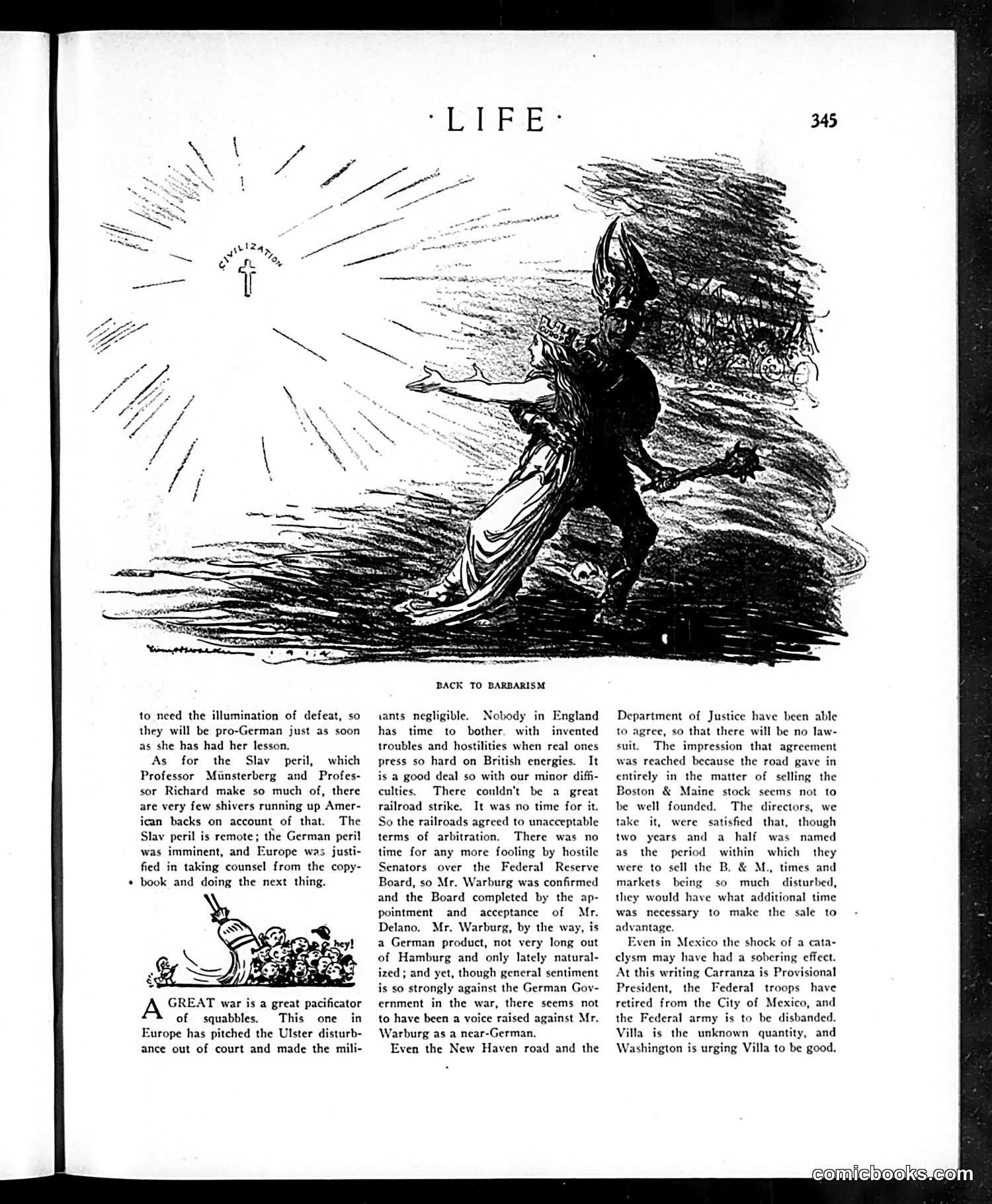
This editorial page argues that World War I has paradoxically resolved American domestic conflicts. The heading "Back to Barbarism" (illustrated by a dramatic figure pointing toward distant conflict) references the war's brutality. The text claims that urgent European threats have made minor American disputes seem trivial: the Ulster crisis in Ireland, railroad strikes, and Federal Reserve Board appointments all proceeded smoothly because wartime urgency overrode normal political opposition. Notably, the author defends appointing Paul Warburg to the Federal Reserve despite his German birth and recent naturalization, arguing that anti-German sentiment hasn't prevented his confirmation—suggesting practical cooperation transcends wartime prejudice. The piece also references Mexican instability (Villa and Carranza), presenting American foreign policy as attempting to maintain order amid global chaos. Overall, it frames WWI's disruption as having temporarily unified Americans around practical necessity over partisan division.
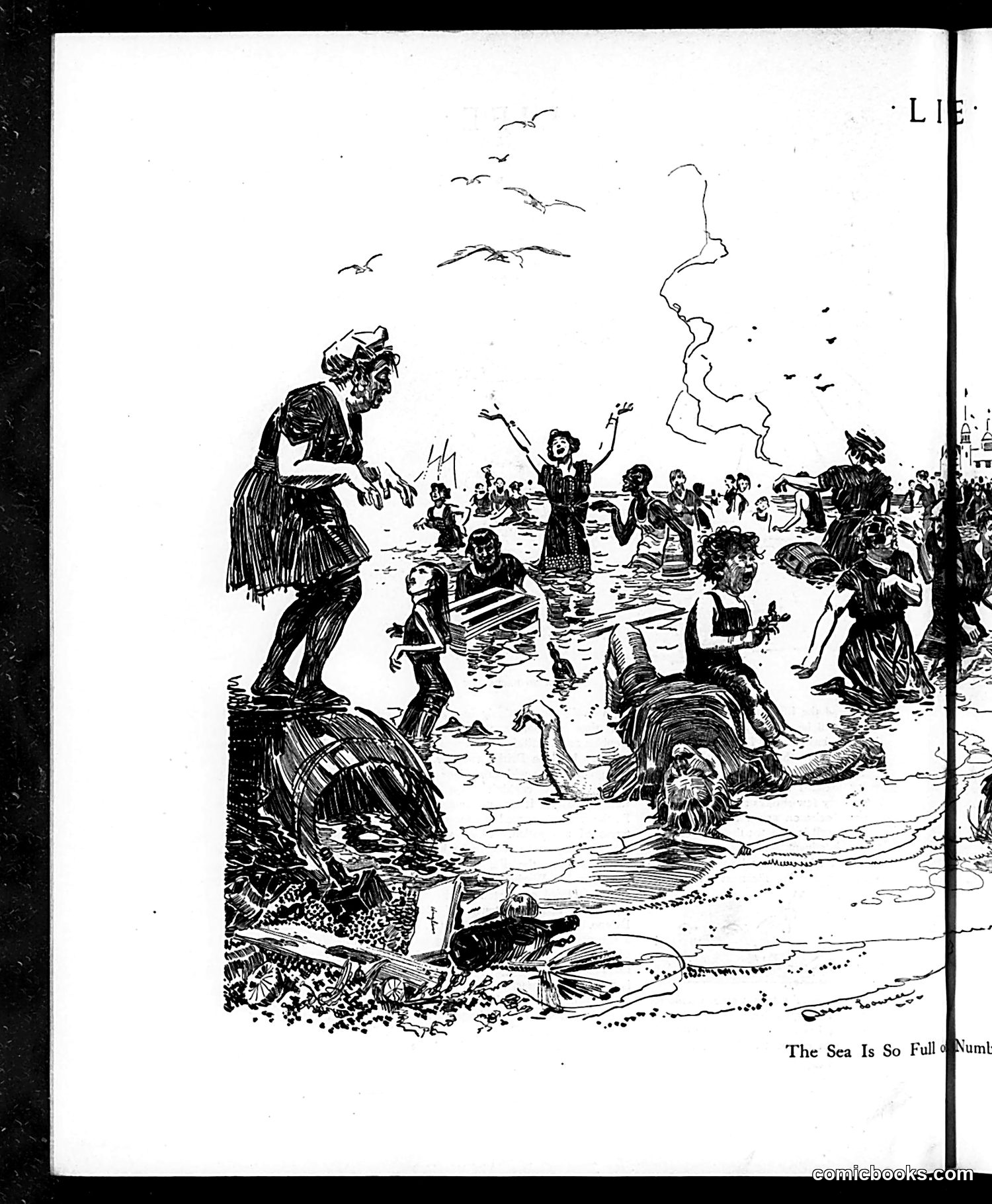
This satirical illustration depicts a beach scene where an adult figure (likely representing authority or parental concern) stands elevated, observing children playing in the water and on the beach. The caption's wordplay—"The Sea Is So Full of Numb[ers]"—appears to be a pun on a children's saying about the sea being "full of" fish or life. The cartoon likely satirizes either parental anxiety about water safety, or possibly references overcrowding at public beaches—a social concern of the era. The exaggerated expressions and the adult's posture suggest alarm or disapproval at the children's unsupervised or uncontrolled behavior. The specific historical context and complete caption text remain unclear without additional information.
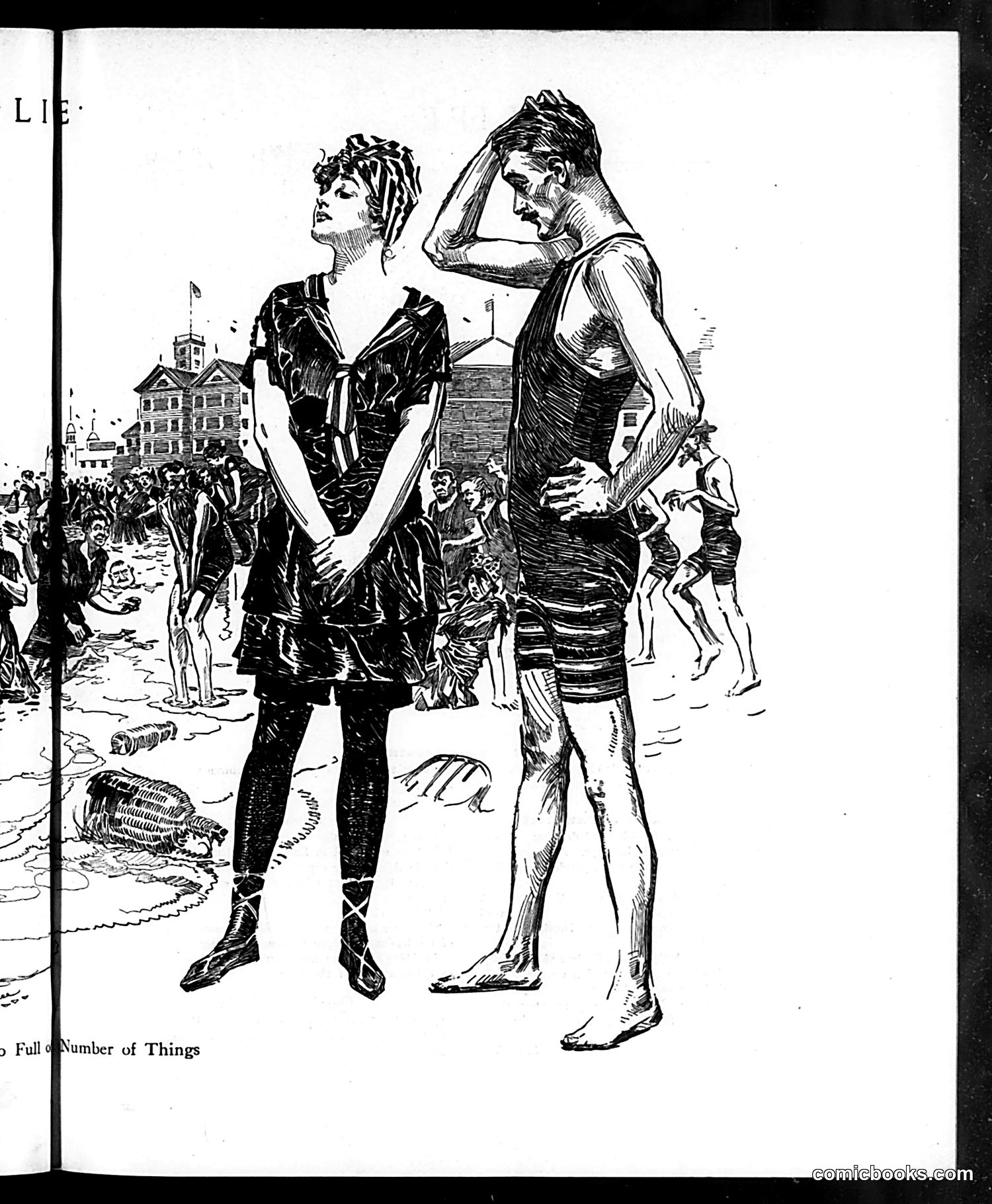
This appears to be a satirical illustration from *Life* magazine depicting a beach scene. Two figures in swimwear are prominently featured—a woman in a fashionable bathing dress with decorative elements and a man in minimal swimming attire. They're positioned before a crowd at what looks like a seaside resort with buildings visible in the background. The page header "LIE" and partial text "Full Number of Things" suggest social commentary, likely about bathing fashions or beach culture of the era. The stark contrast in their swimwear—her elaborate, modest outfit versus his minimal clothing—may satirize contemporary debates over swimming costume propriety and gender norms. The gathered crowd suggests public scrutiny of beachwear standards, a common *Life* magazine concern during the early-to-mid 20th century.
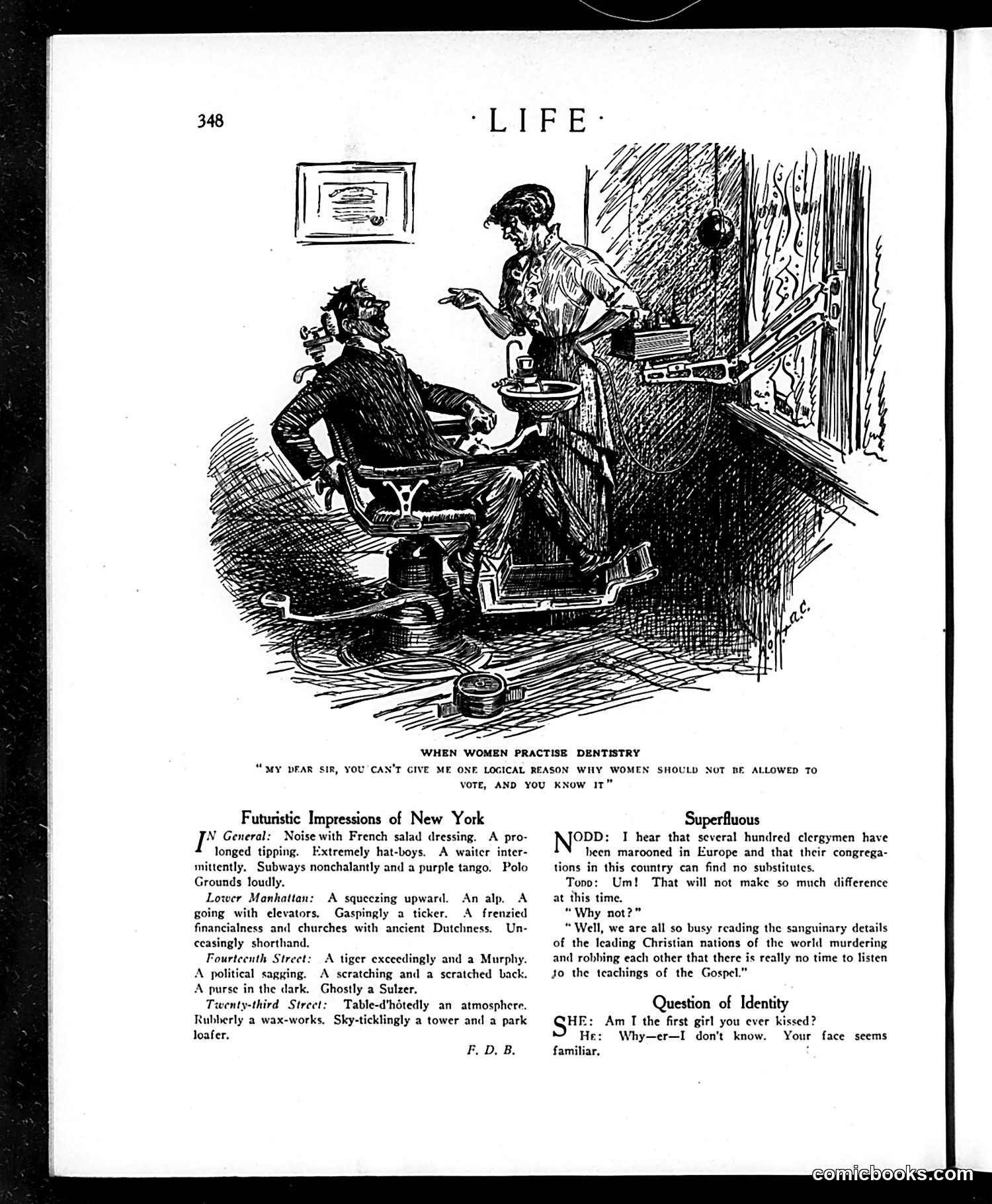
The main cartoon satirizes opposition to women's suffrage. A female dentist treats a male patient while arguing that women deserve voting rights—the humor lies in the irony: the man benefits from her professional competence yet claims women shouldn't vote. This directly mocks anti-suffrage arguments as logically indefensible. Below are shorter satirical pieces. "Futuristic Impressions of New York" absurdly describes Manhattan neighborhoods through fragmented, nonsensical imagery (elevators "gasping," streets with "ghostly" qualities), mocking the city's chaotic modernization. "Superfluous" presents a brief dialogue: clergymen stranded in Europe are irreplaceable—except they're not needed anyway, since people are too distracted by news of Christian nations committing violence and robbery to care about religious teachings. This critiques Christian hypocrisy during wartime. The final piece jokes about uncertain romantic identity between two people.
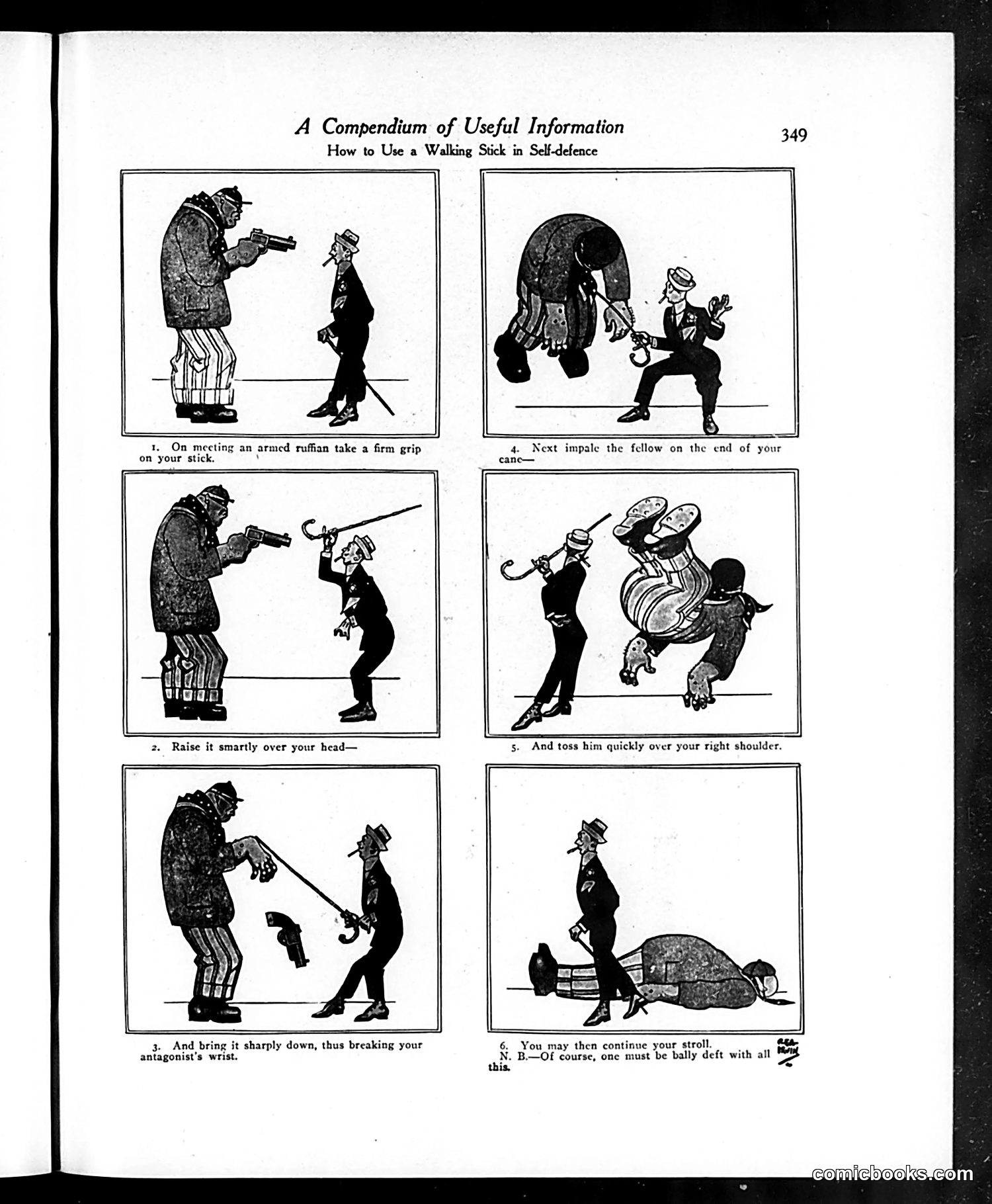
This is a humorous instructional satire from *Life* magazine depicting six sequential steps for using a walking stick as a weapon against an armed attacker. The cartoon mocks both Victorian-era self-defense manuals and the genteel pretensions of upper-class society. The humor operates on multiple levels: the absurdity of casually defeating an armed "ruffian" with a cane; the exaggerated politeness of the language ("bally deft," "continue your stroll"); and the implication that a gentleman could maintain composure and composure while violently subduing an opponent. The final panel's nonchalant conclusion—simply continuing one's walk after incapacitating an assailant—satirizes the stiff-upper-lip British attitude toward violence and danger. This reflects early 20th-century attitudes about class, masculinity, and the supposed superiority of civilized restraint.
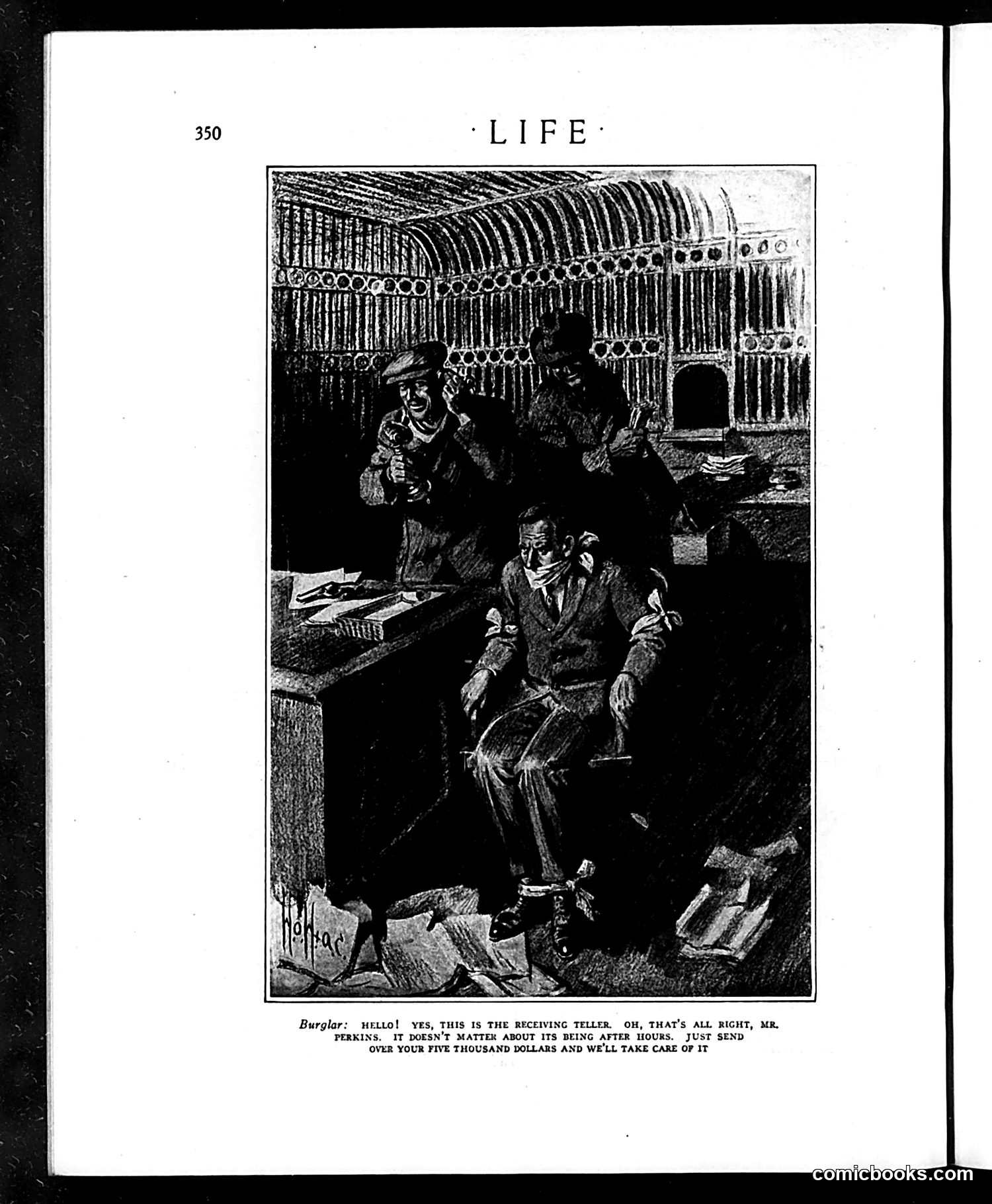
This cartoon satirizes banking corruption and embezzlement. A burglar has phoned a bank's receiving teller, identifying himself as "Mr. Perkins." Rather than refusing an after-hours deposit request, the teller casually agrees to accept five thousand dollars with no questions asked—suggesting the bank routinely handles suspicious transactions without proper oversight. The joke targets two things: the brazen criminality of someone literally robbing a bank, and the implicit corruption of bank employees who facilitate such theft through negligence or complicity. The teller's blasé attitude ("it doesn't matter about its being after hours") implies this is standard practice, not exceptional wrongdoing. This reflects early 20th-century anxieties about financial institutions' lack of accountability during an era before modern banking regulations and auditing standards.
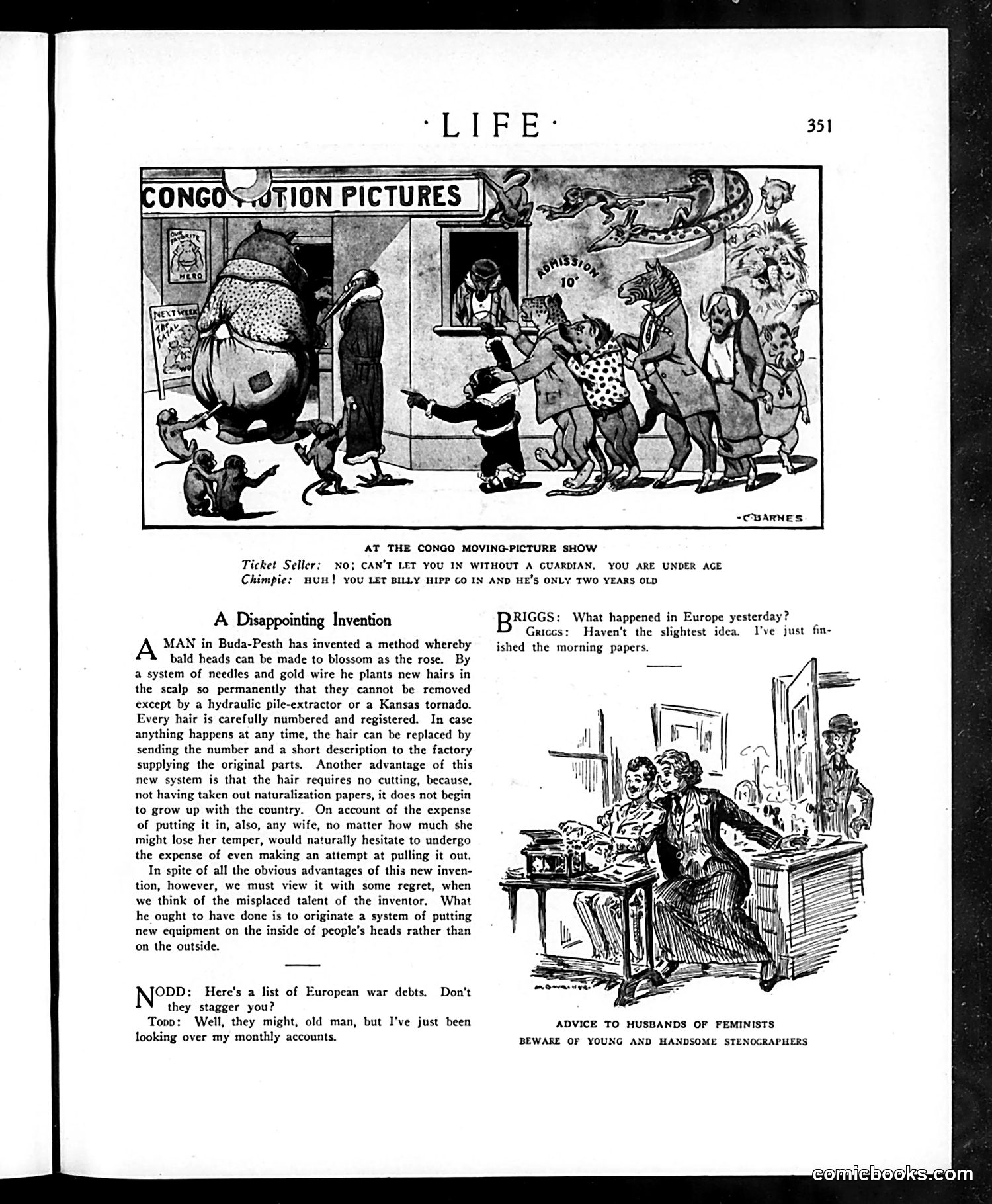
**"Congo Moving-Picture Show"** (top cartoon): A racist caricature depicting a chimpanzee trying to enter a movie theater. The joke relies on dehumanizing imagery common to early 20th-century American entertainment—equating Black Africans with primates. The humor hinges on the absurd scenario of an animal seeking admission. **"A Disappointing Invention"** (middle): Satirizes a reported hair-restoration method from Buda-Pesth (Budapest). The satire mocks both the invention's absurd complexity and—more pointedly—the inventor's misplaced talents. The author suggests such ingenuity should address internal human problems ("equipment on the inside of people's heads") rather than trivial cosmetic concerns. **Bottom exchanges**: Brief satirical dialogue. "European war debts" references post-WWI financial obligations; the joke contrasts public concern with private financial anxieties. The final item mocks husbands worried about wives' feminism and young secretaries—reflecting period anxiety about changing gender roles and workplace dynamics. All content reflects 1920s-era satirical humor and social attitudes.
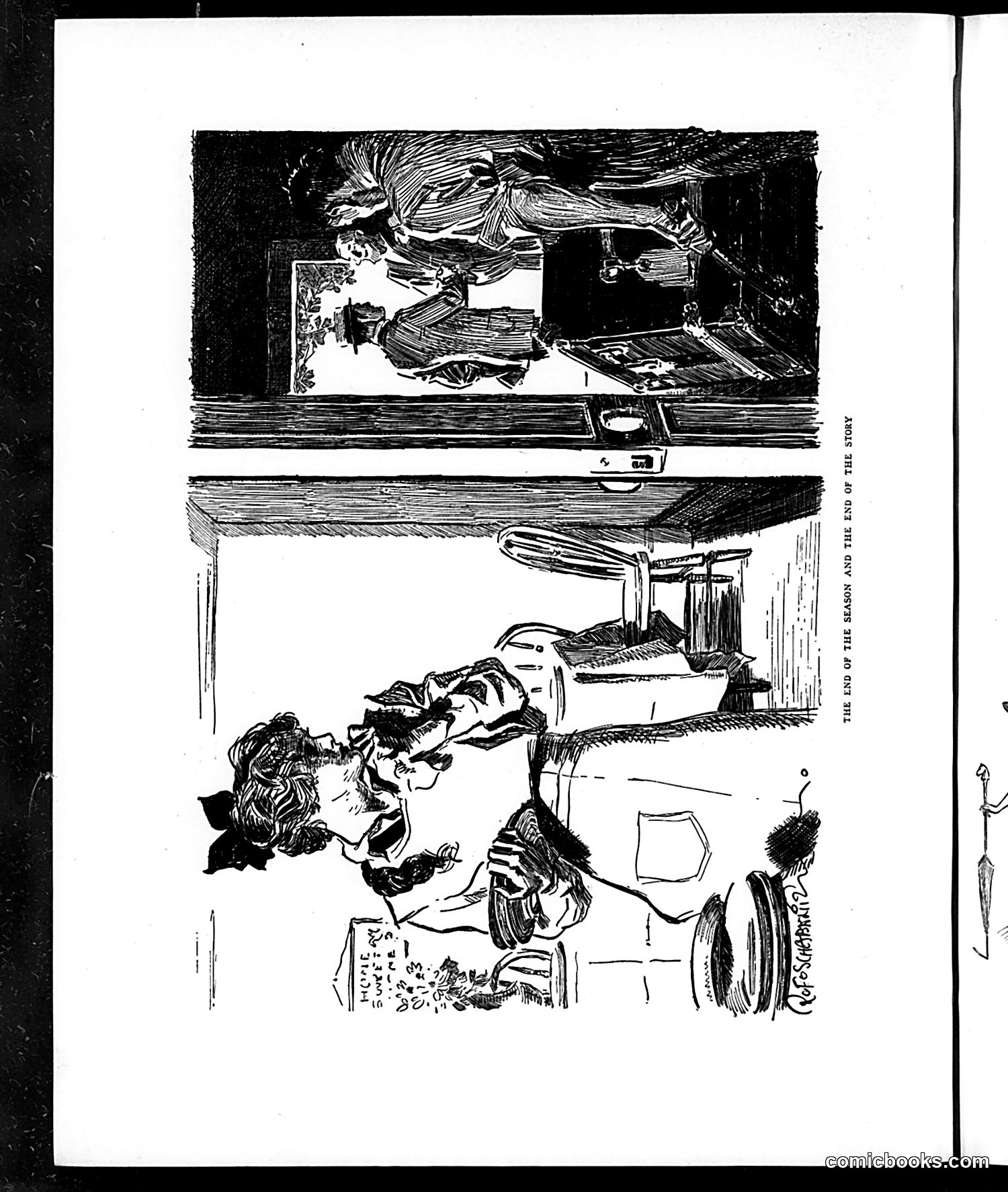
I can see this page contains two ink sketch illustrations arranged vertically, but the OCR text appears corrupted and unreadable (it seems to be gibberish or severely corrupted encoding rather than English). Without legible accompanying text, I cannot reliably identify the specific figures, political references, or satirical intent of these cartoons. The sketches appear to depict interior scenes with multiple figures in what looks like early-to-mid 20th century dress and settings, but I cannot determine the precise subject matter or social commentary intended. To accurately explain these cartoons' meaning for a modern reader, I would need either clearer OCR text or to be able to read any visible captions or titles on the page itself.
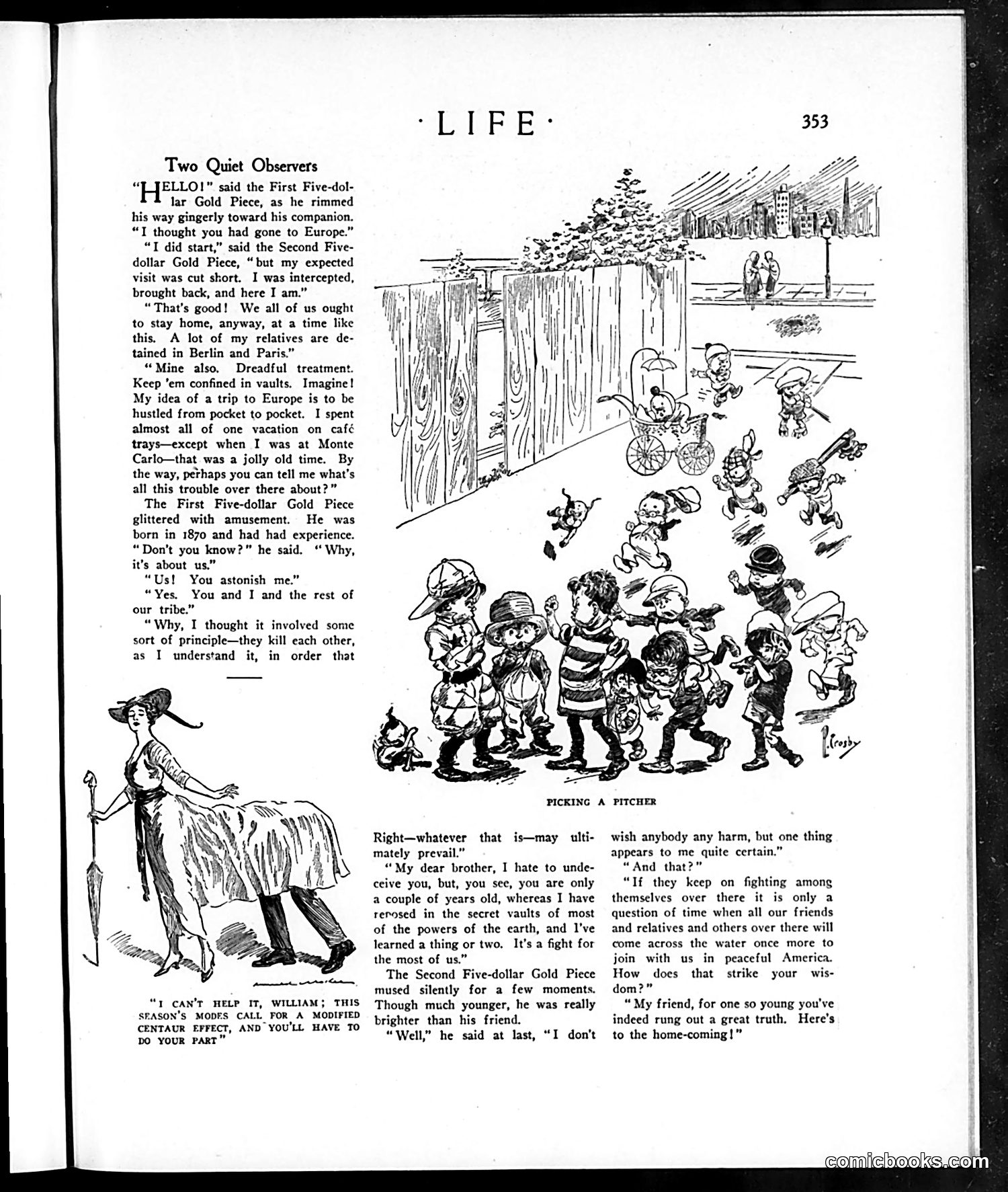
This page satirizes World War I through personified five-dollar gold pieces discussing the European conflict. The joke operates on multiple levels: **The Conceit:** Two American gold coins converse about their "relatives" trapped in European vaults, treating the war as fundamentally about controlling gold and currency rather than principles. **The Satire:** The older coin (born 1870, worldly) cynically explains that the war is "about us"—gold itself—not ideology. The younger coin then observes that if fighting continues, European gold will flee to America for safety, enriching the U.S. **Historical Context:** This reflects 1914-1917 concerns about American financial advantage from European war. Gold inflows to America during WWI did strengthen U.S. economic position, a reality many Americans viewed cynically. **The Point:** The piece mocks both the notion that WWI involved noble principles and suggests American self-interest in the conflict's continuation. The ending toast to "home-coming" gold is darkly humorous commentary on American profit from European suffering.
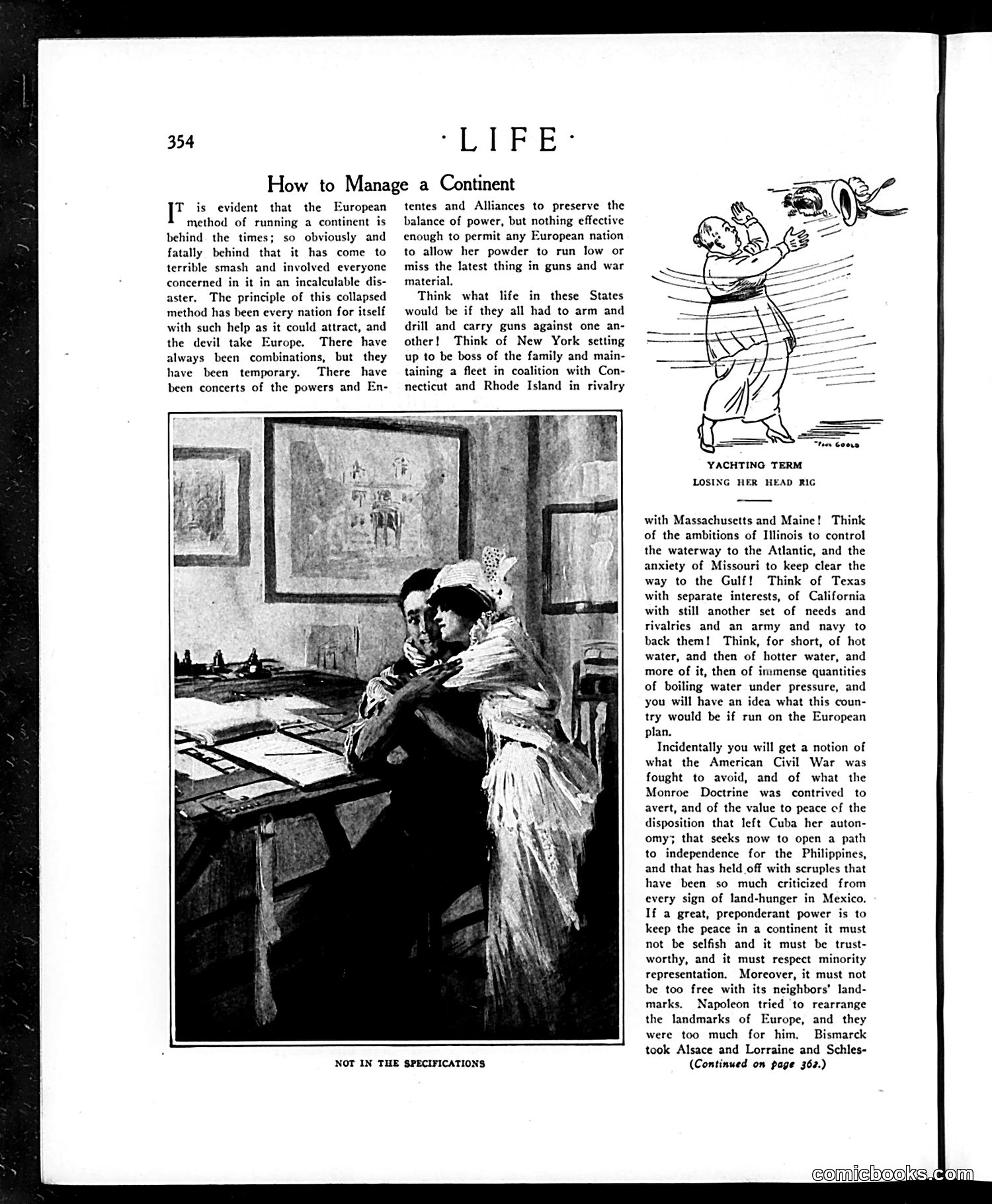
This satirical article argues that European power-politics have failed catastrophically (likely written post-WWI). It contrasts Europe's destructive system—where each nation arms itself against others in temporary, unstable alliances—with America's federal model, where separate states coexist peacefully under unified governance. The humor works by imagining American states behaving like European nations: New York maintaining rival fleets against Connecticut, Texas pursuing separate foreign policy, Illinois and Missouri battling over waterways. This reductio ad absurdum illustrates why European competition is absurd. The accompanying cartoon "LOSING HER HEAD RIG" (a nautical pun) shows a woman losing her balance—likely representing Europe destabilized by power politics. The article celebrates American restraint: the Civil War prevented fragmentation, the Monroe Doctrine prevented foreign interference, and respect for Cuba's autonomy and Philippine independence demonstrate trustworthy leadership. It warns that dominant powers must be unselfish—Napoleon and Bismarck failed by seizing neighbors' territory. The implicit message: America should lead wisely, respecting weaker nations' sovereignty.
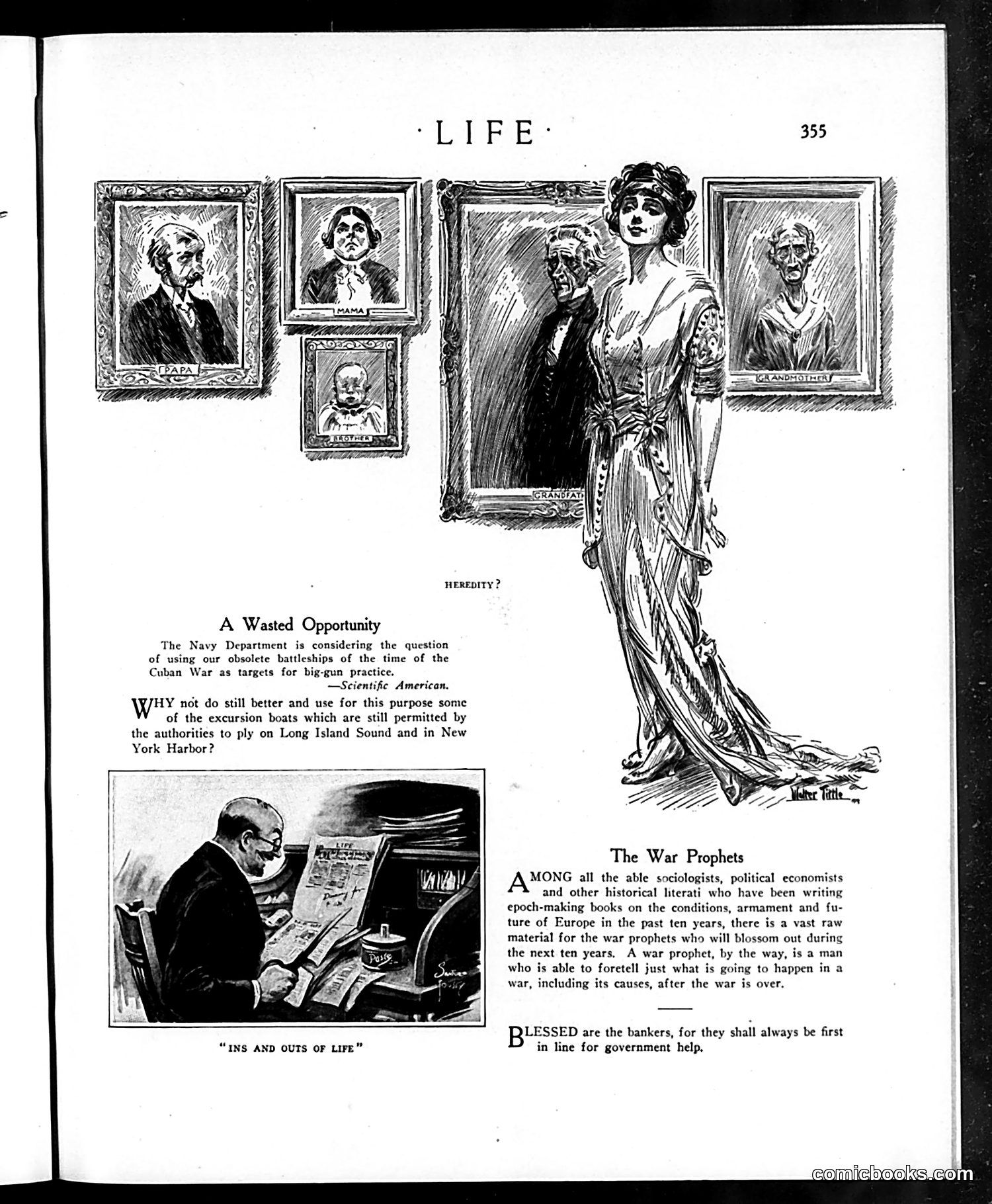
**"A Wasted Opportunity"** satirizes naval safety practices. The Navy planned to sink obsolete battleships from the Spanish-American War as gunnery targets. The cartoonist sarcastically suggests using excursion boats on Long Island Sound instead—implying this would be equally reckless and expose civilians to danger. The joke critiques indifference to public safety. **"Heredity?"** shows a woman viewing family portraits, questioning whether traits pass through generations—a reference to contemporary eugenics debates popular among educated Americans of this era. **"The War Prophets"** mocks self-proclaimed experts predicting Europe's future. The text defines a "war prophet" as someone who makes bold predictions about war's causes and outcomes *after* the war ends—obviously useless hindsight repackaged as foresight. The final jab at bankers receiving government aid suggests wartime profiteering while others suffer. This reflects pre-WWI skepticism toward both intellectuals and financial interests.
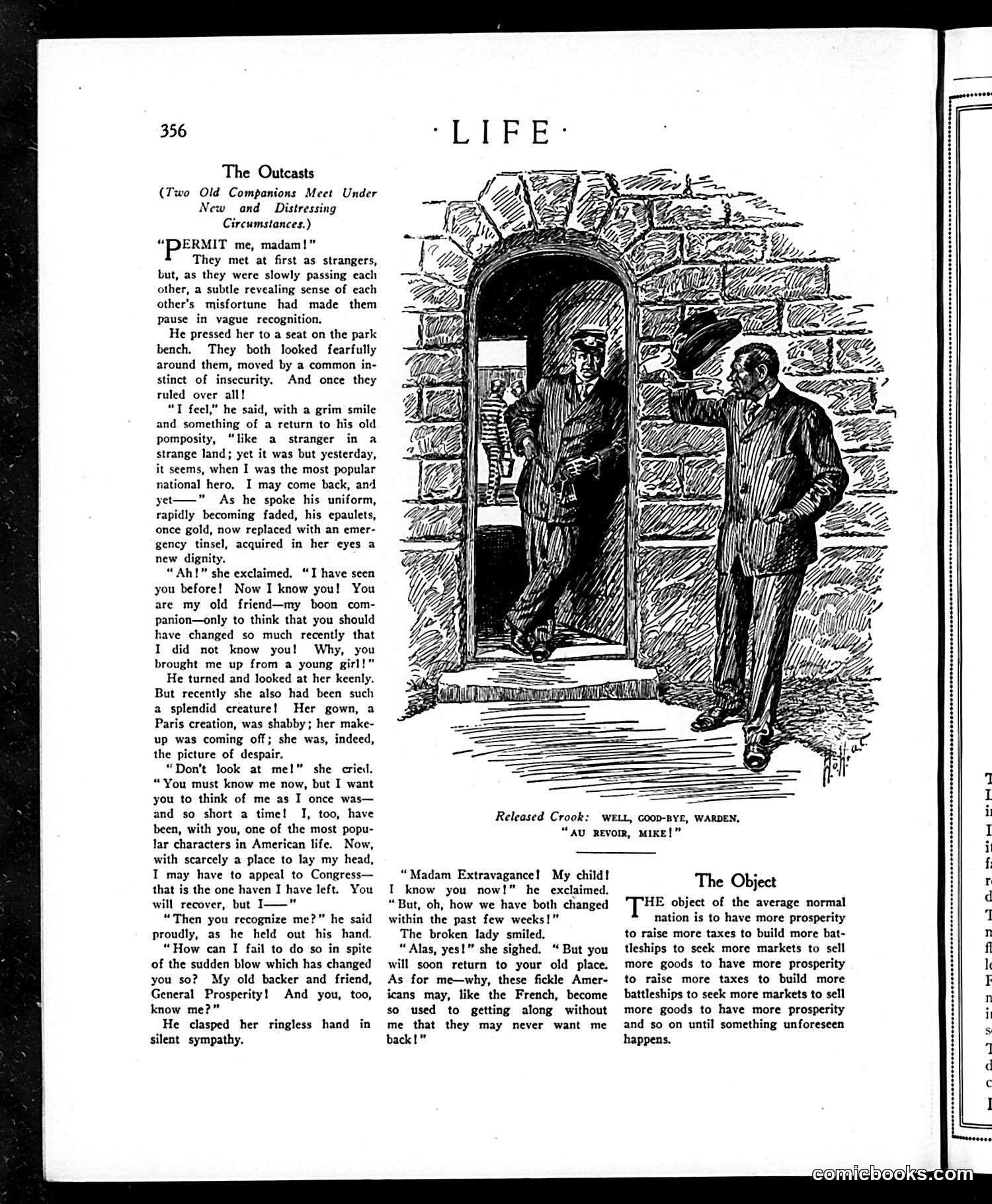
This page contains two satirical pieces from Life magazine, likely from the early 20th century: **"The Outcasts"** depicts an allegorical conversation between two fallen figures: "General Prosperity" (a uniformed military man in faded regalia) and "Madam Extravagance" (an impoverished woman). They were once celebrated national figures but have been reduced to poverty and social disgrace. The satire criticizes excessive spending and economic mismanagement—personified as extravagance—that depletes national prosperity. Their mutual recognition and sympathy, despite ruin, suggests these vices were once culturally celebrated but have become shameful. **"The Object"** is a circular critique of national economic policy, mocking the self-perpetuating cycle of building wealth solely to fund military expansion and consumption, which then requires more wealth-building—an endless, purposeless loop until "something unforeseen happens" (likely economic collapse or war). It satirizes imperialist economics and militarism as fundamentally irrational.
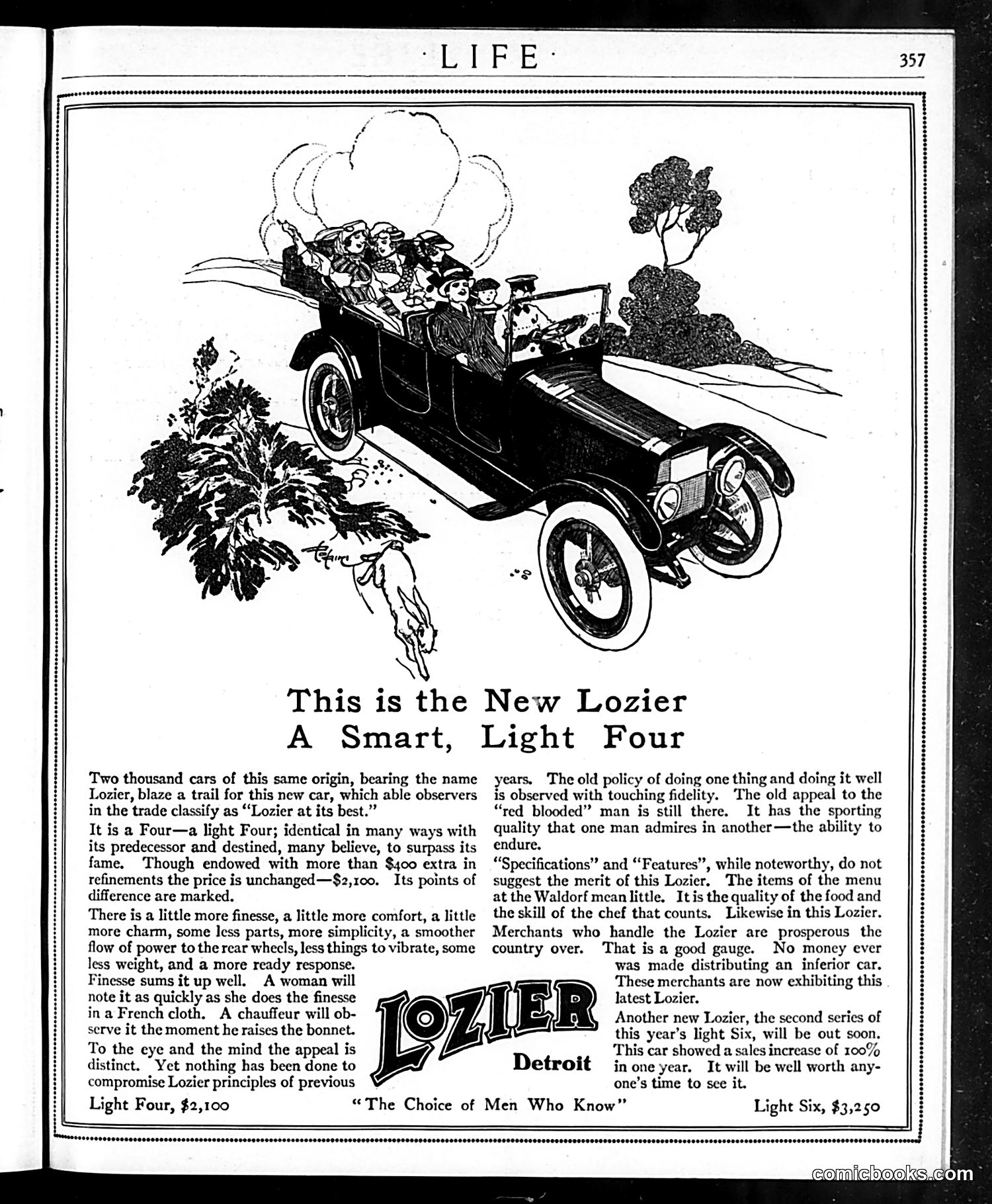
This is a **automobile advertisement**, not political satire. It promotes the Lozier automobile, a luxury car manufactured in Detroit. The illustration depicts a cheerful group of well-dressed passengers in an open-air motorcar, traveling past refined scenery—establishing the vehicle as aspirational and appealing to the wealthy. The advertisement emphasizes that the "New Lozier" Light Four maintains the brand's established reputation while offering refinements at an unchanged price of $2,100. The copy uses sophisticated language ("finesse," appeals to "red blooded" men) to position the car as embodying quality craftsmanship and reliability. The tagline "The Choice of Men Who Know" suggests discerning buyers recognize Lozier's superiority. The mention that "merchants who handle the Lozier are prosperous" serves as social proof of the car's desirability and market success. This reflects early 1900s automotive marketing targeting upper-class consumers.
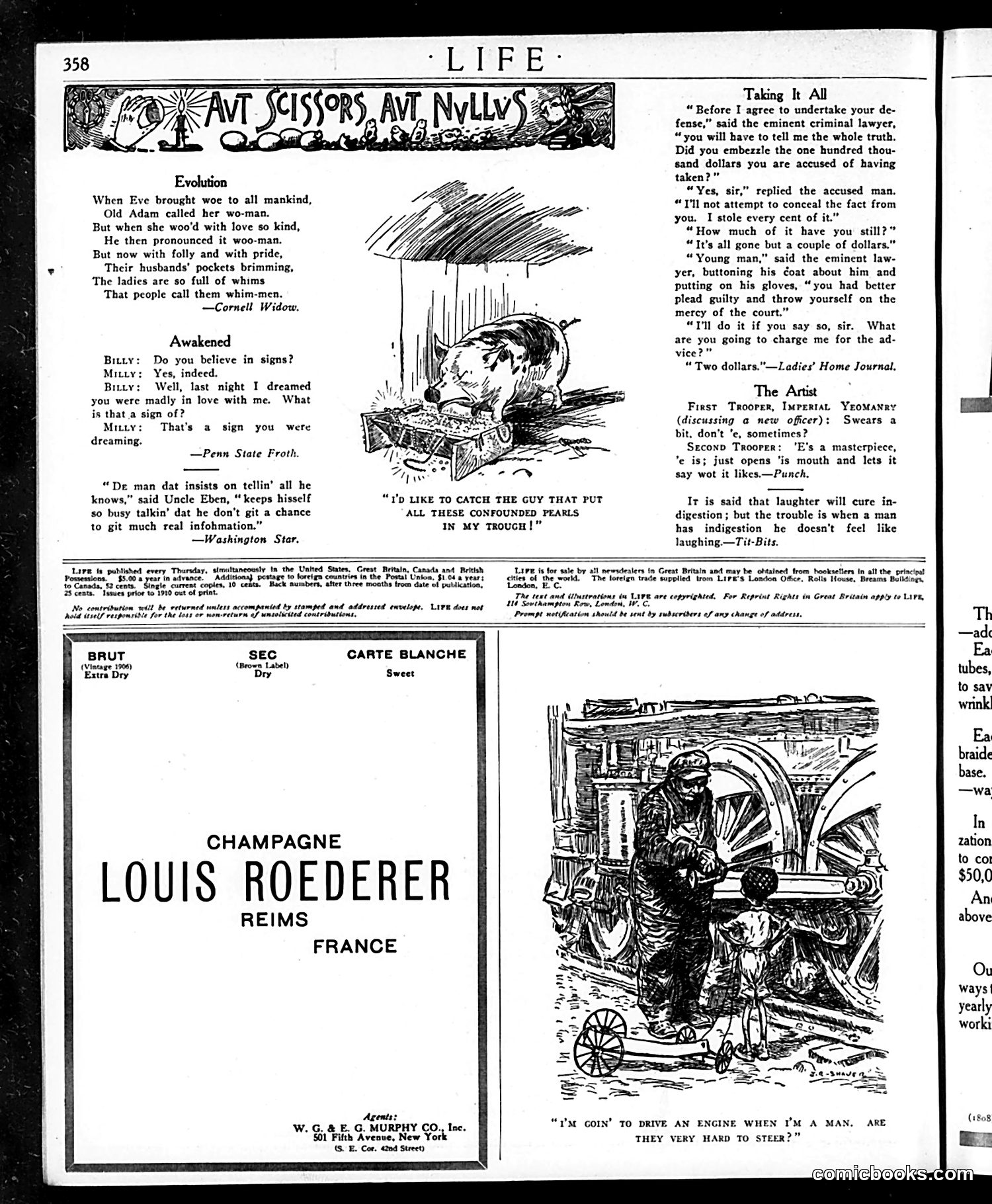
This page from *Life* magazine features humorous short pieces and advertisements typical of early 20th-century American satirical publishing. **The cartoons/jokes:** - "Evolution" mocks women's spending habits, claiming wives have evolved from "wo-man" to "whim-men" due to husbands' full pockets - "Awakened" is a flirtation joke playing on dream interpretation - "Taking It All" satirizes a criminal lawyer who charges a client two dollars for advice to plead guilty—the lawyer essentially profits from the criminal's confession - "The Artist" jokes about a military officer who speaks without thinking - A final cartoon shows a child asking about steering an engine, likely a naive reference to early automobiles **Social context:** These pieces reflect early 1900s attitudes toward women as frivolous spenders, courtship customs, and the novelty of automobiles. The humor relies on wordplay, puns, and gentle social observation rather than political commentary. The *Louis Roederer* champagne advertisement anchors the page commercially.
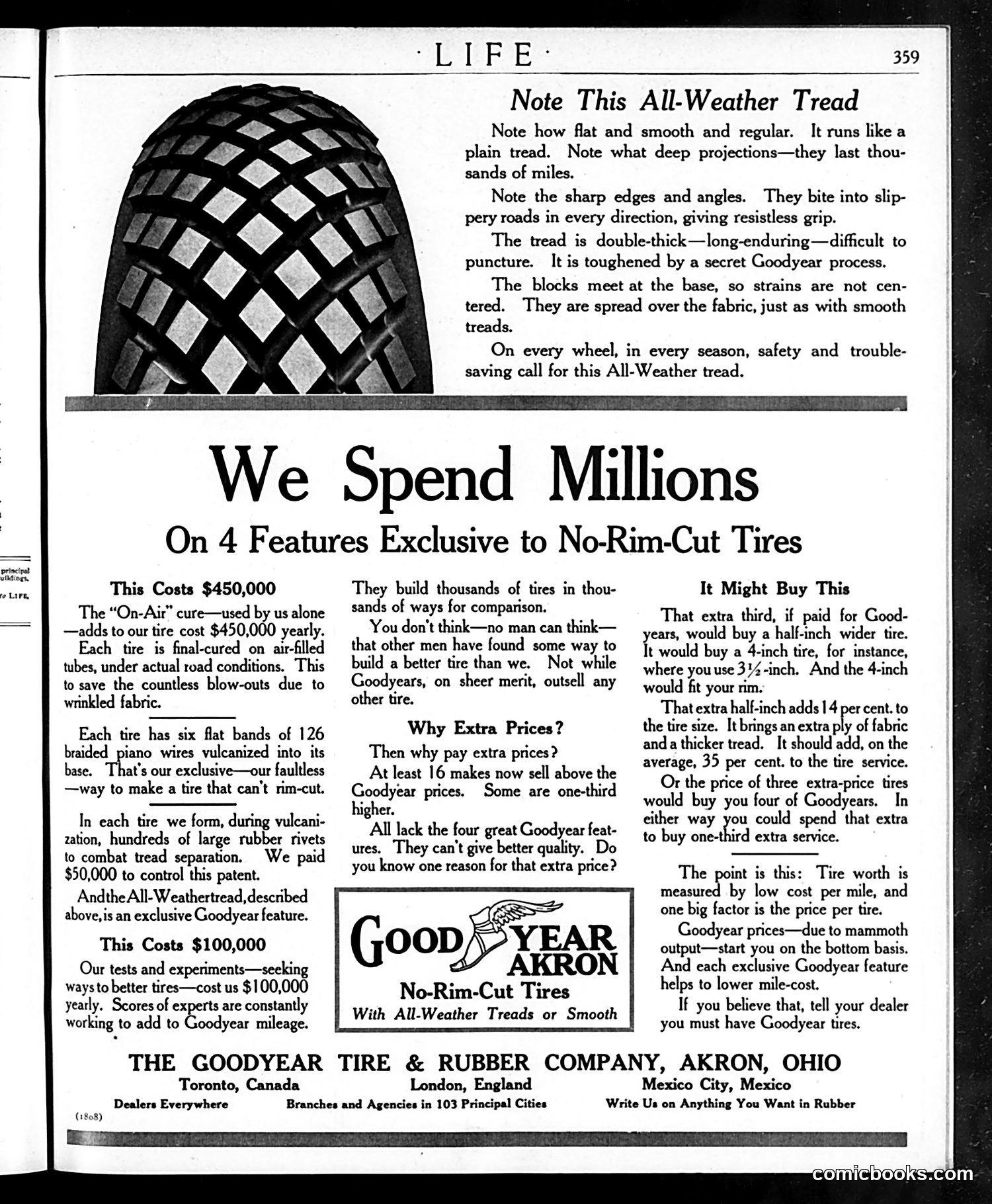
This page is a **Goodyear tire company advertisement**, not satirical content. It appears in *Life* magazine (likely 1920s-1930s based on styling) as paid advertising. The ad makes a straightforward business argument: Goodyear charges premium prices because it invests millions in exclusive tire features—the "All-Weather Tread," air-curing process, reinforced wire bands, and R&D. The copy defends these higher costs by arguing that competing brands charging even *more* lack these safety features, making Goodyear's premium justified by value-per-mile. The large tire image at top showcases the tread pattern. The text uses repeated cost figures ($450,000, $100,000, $50,000) to build credibility through specificity. There is **no cartoon, caricature, or satirical point**—this is straightforward product marketing emphasizing technical superiority and reasonable pricing relative to competitors.
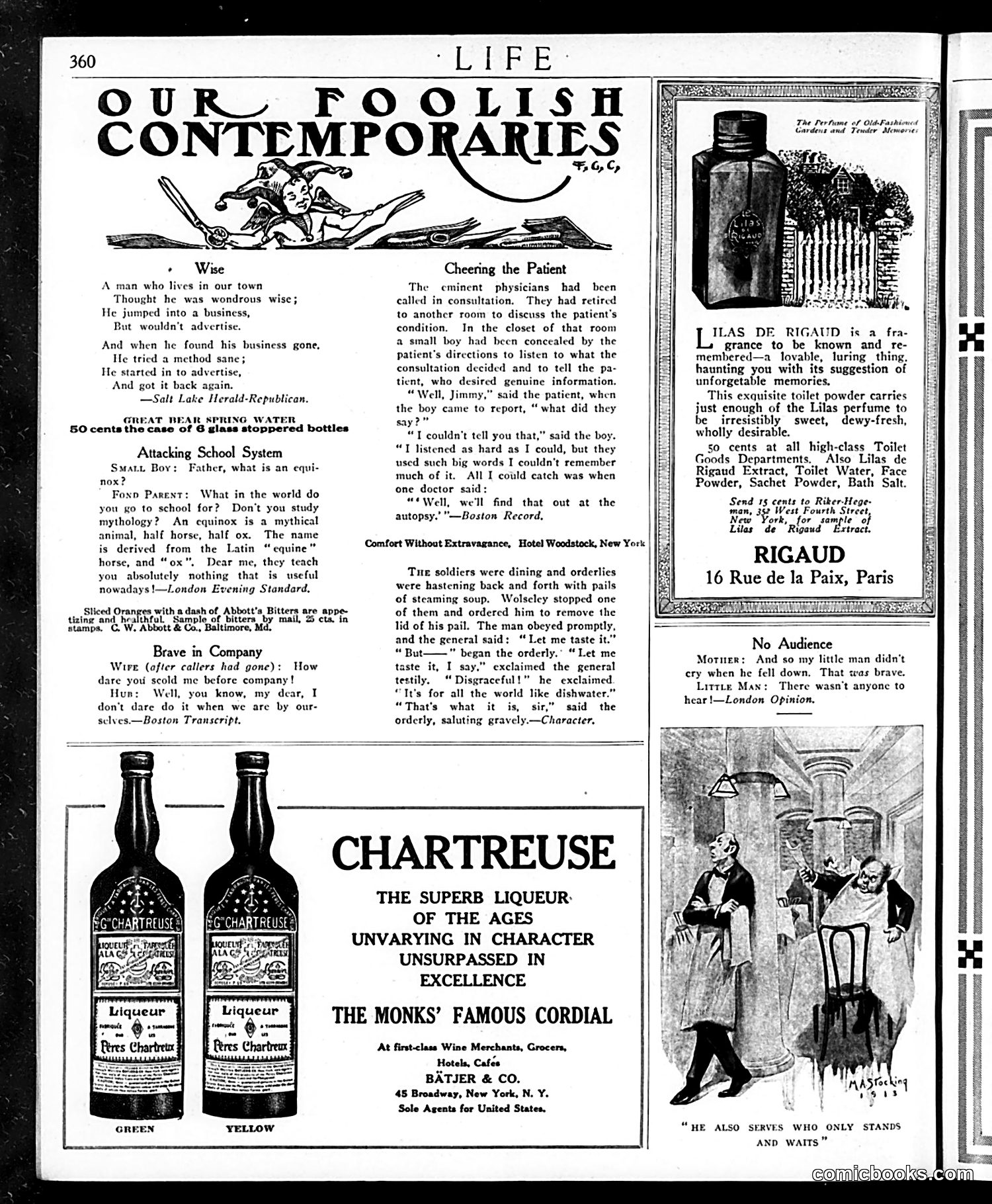
This page mixes brief satirical humor pieces with advertisements, typical of *Life* magazine's format. **"Our Foolish Contemporaries"** contains four short jokes: 1. **"Wise"**: A businessman ignores advertising, fails, then succeeds by advertising—mocking stubborn refusal of obvious solutions. 2. **"Attacking School System"**: A father, asked about an "equinox," confidently gives a nonsense definition (a mythical half-horse, half-ox creature). The joke satirizes parental arrogance and poor education—he teaches his child falsehoods while blaming schools. 3. **"Brave in Company"**: Married couple humor—the husband admits he only scolds his wife in public because he lacks courage when alone. 4. **"No Audience"**: A child claims bravery for not crying after falling, but admits he only acted brave because nobody witnessed it. The bottom cartoon (uncaptioned) shows a waiter serving two seated figures. The caption "He also serves who only stands and waits" (from Milton) appears to joke about service industry humility or obsequiousness. The page is primarily **advertising** for Chartreuse liqueur, Lilas de Rigaud perfume, and other products.

This page is a **product advertisement** for the Delco electric ignition and starting system, not a political cartoon or satirical content. The Delco company (Dayton Engineering Laboratories Company, based in Dayton, Ohio) is marketing their automotive electrical system—cranking, lighting, and ignition—to potential car buyers. The advertisement emphasizes "simplicity" as its key selling point, showing a wiring diagram and explaining how the system's single-unit design with minimal wiring represents an innovation. The marketing claim is that Delco pioneered electric car starting (mentioning "154,000 owners" already using it), positioning the company as revolutionary in automobile technology. This reflects the early automotive era when electric starting was still a competitive advantage—before it became standard on all vehicles. The ad targets middle-class car owners interested in modern, reliable vehicle technology.
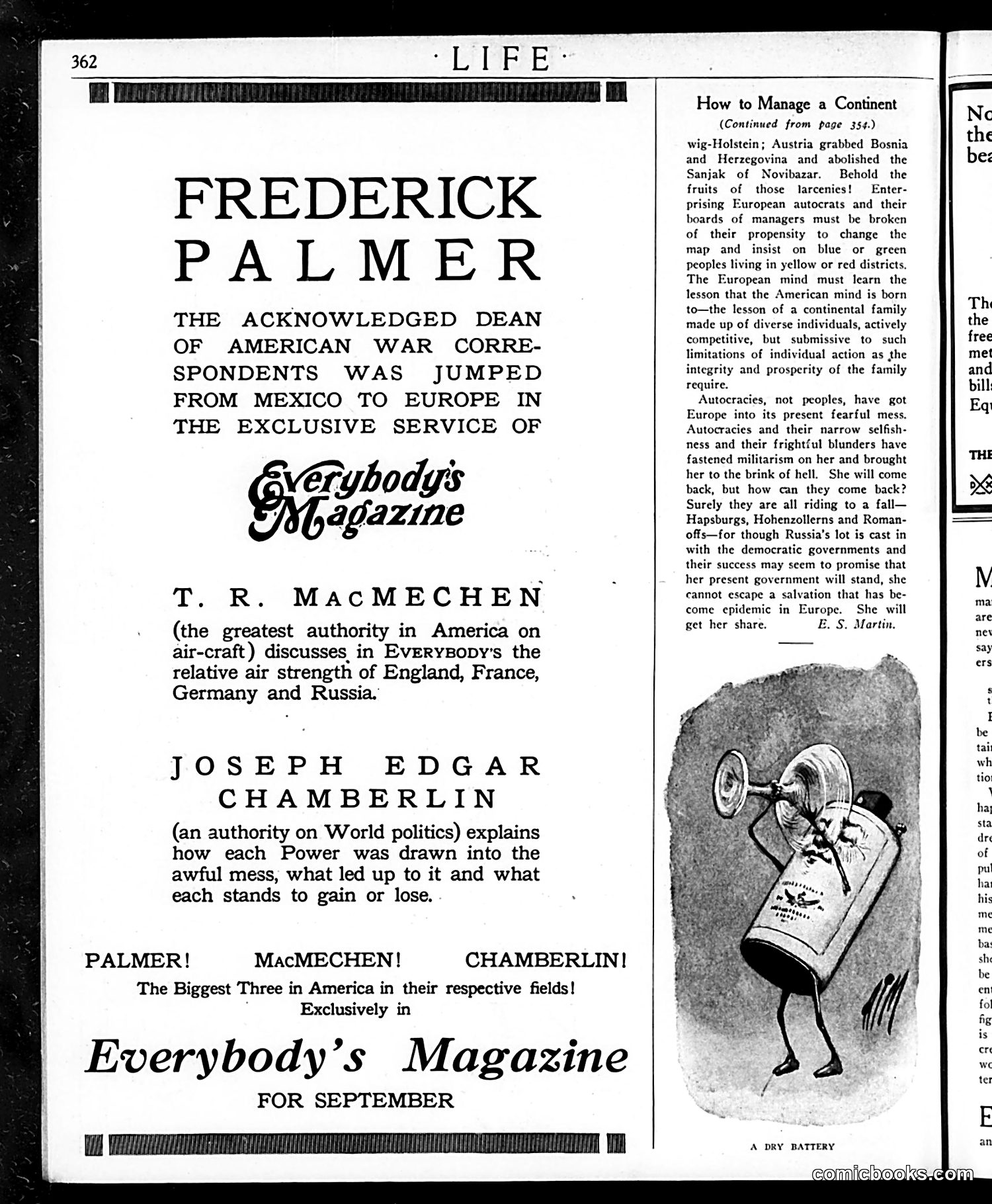
This is primarily an **advertisement for Everybody's Magazine** (September issue), not a political cartoon. The page promotes three prominent contributors: - **Frederick Palmer**: War correspondent covering the European theater - **T.R. MacMechen**: Aviation expert discussing air strength of major powers - **Joseph Edgar Chamberlin**: Political analyst explaining how nations entered "the awful mess" (World War I) The accompanying article fragment ("How to Manage a Continent") argues that **European autocracies**—particularly Austria-Hungary, Germany, and Russia—caused the war through territorial aggression and militarism. It contrasts this with American democratic principles of diverse peoples coexisting peacefully within federal structures. The small cartoon at right shows a "dry battery" (electrical device)—likely a visual pun on energetic reporting or power, though its exact satirical meaning is unclear from this context alone. **Context**: This reflects 1914-1915 American perspective on WWI's origins, blaming hereditary monarchies rather than systemic imperial competition.
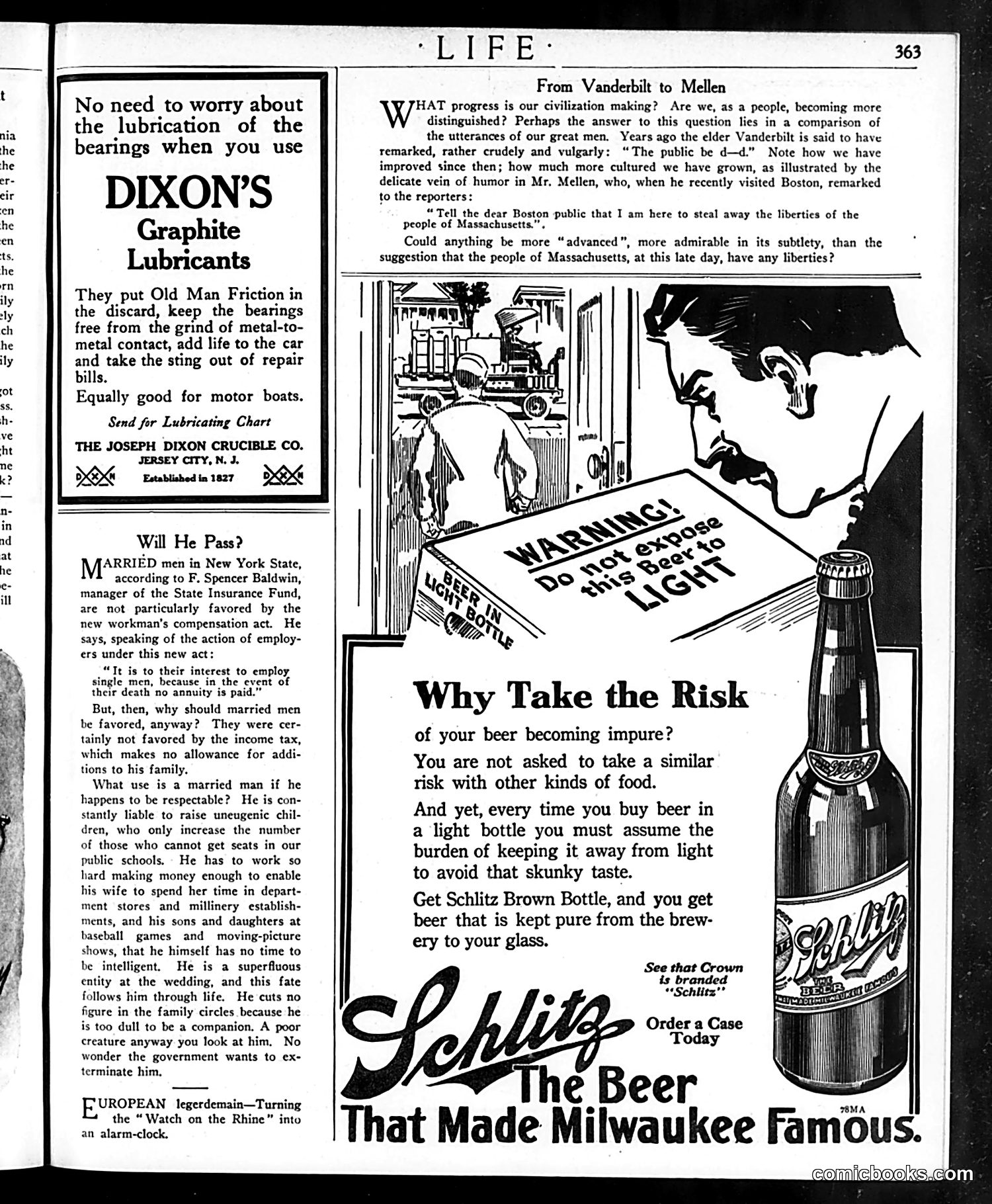
This page mixes product advertisements with sharp social commentary typical of early 20th-century Life magazine. The main satirical piece, "From Vanderbilt to Mellen," compares two wealthy industrialists' contemptuous remarks about the public. It contrasts the elder Vanderbilt's blunt "The public be d—d" with Charles Mellen's (a railroad executive) supposedly more "refined" statement that he's come to "steal away the liberties" of Massachusetts citizens. The satire's point: Mellen's polite phrasing masks the same arrogant disregard for ordinary people, suggesting society hasn't actually become more cultured—just more hypocritical. A secondary piece, "Will He Pass?," sarcastically attacks workman's compensation laws that favor unmarried workers, using bitter humor to critique both government policy and married men's lack of social value. The advertisements (Dixon's lubricants and Schlitz beer) occupy the remaining space—standard commercial content typical of the magazine.
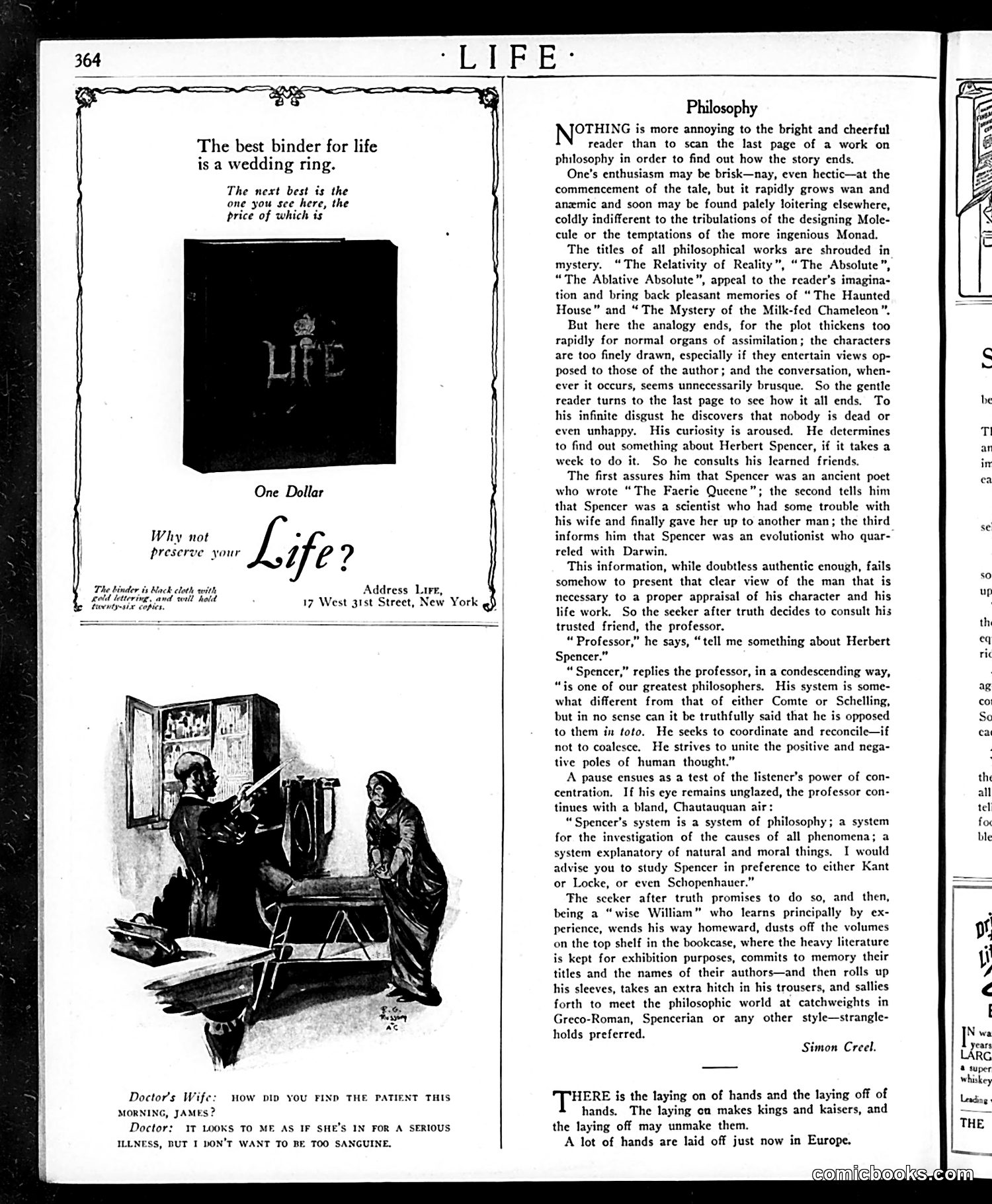
This page contains two unrelated pieces of satire typical of LIFE magazine's format: **Top Left - Advertisement Parody:** A mock ad for a book binder shaped like a wedding ring, priced at one dollar. The joke plays on the phrase "binder for life"—literalizing the marital commitment as a tool to preserve Life magazine issues. It's gentle satire on wedding sentimentality and consumerism. **Bottom Left - Doctor's Joke:** A brief comic sketch mocking medical jargon. A doctor uses the word "sanguine" (optimistic) when discussing a serious illness, creating dark humor through the doctor's inappropriate word choice—he doesn't want to be "too optimistic" about the patient's dire condition. **Right Column - Philosophy Essay:** Simon Creel satirizes philosophical writing's opacity and how readers desperately seek understanding. The essay mocks both pretentious philosophy titles and professors who speak in impenetrable jargon about Herbert Spencer, Kant, and others. The humor targets academic pomposity and the futility of seeking clarity from professorial "wisdom."
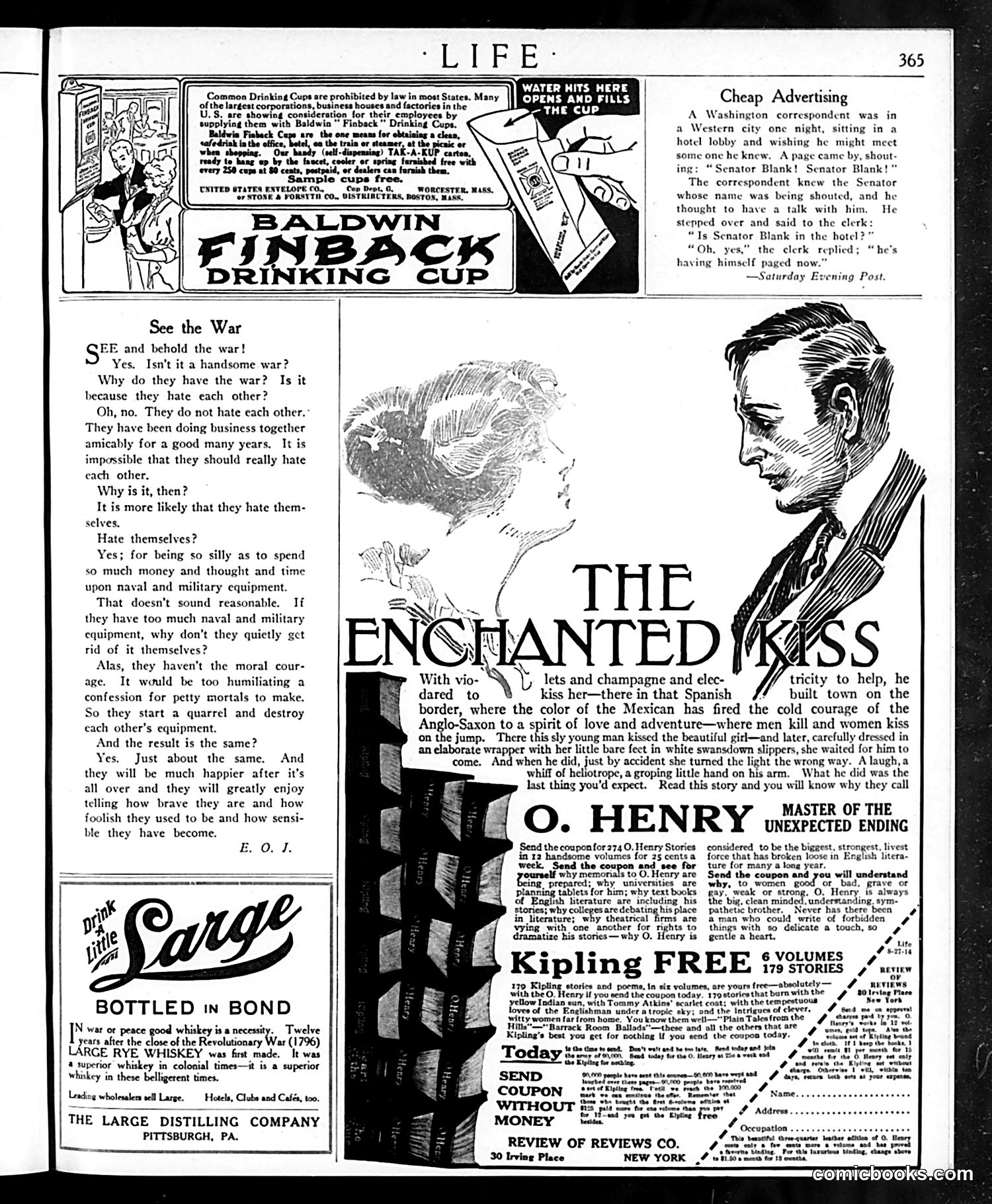
This page features a sardonic commentary on warfare, likely referencing World War I. The dialogue piece "See the War" satirizes the absurdity of international conflict by suggesting nations don't actually hate each other—they've been business partners for years. Rather, the author argues, they hate *themselves* for their own foolishness in accumulating expensive military equipment they can't bring themselves to discard without humiliation. The solution: start a war to destroy each other's equipment, then claim victory and moral improvement afterward. The satire mocks both the irrationality of warfare and the hypocrisy of nations pretending noble motives when economic waste and pride drive conflict. The piece is credited to "E.O.J." (likely E.O. James) and appears in *Life*, known for acerbic political commentary during the WWI era.
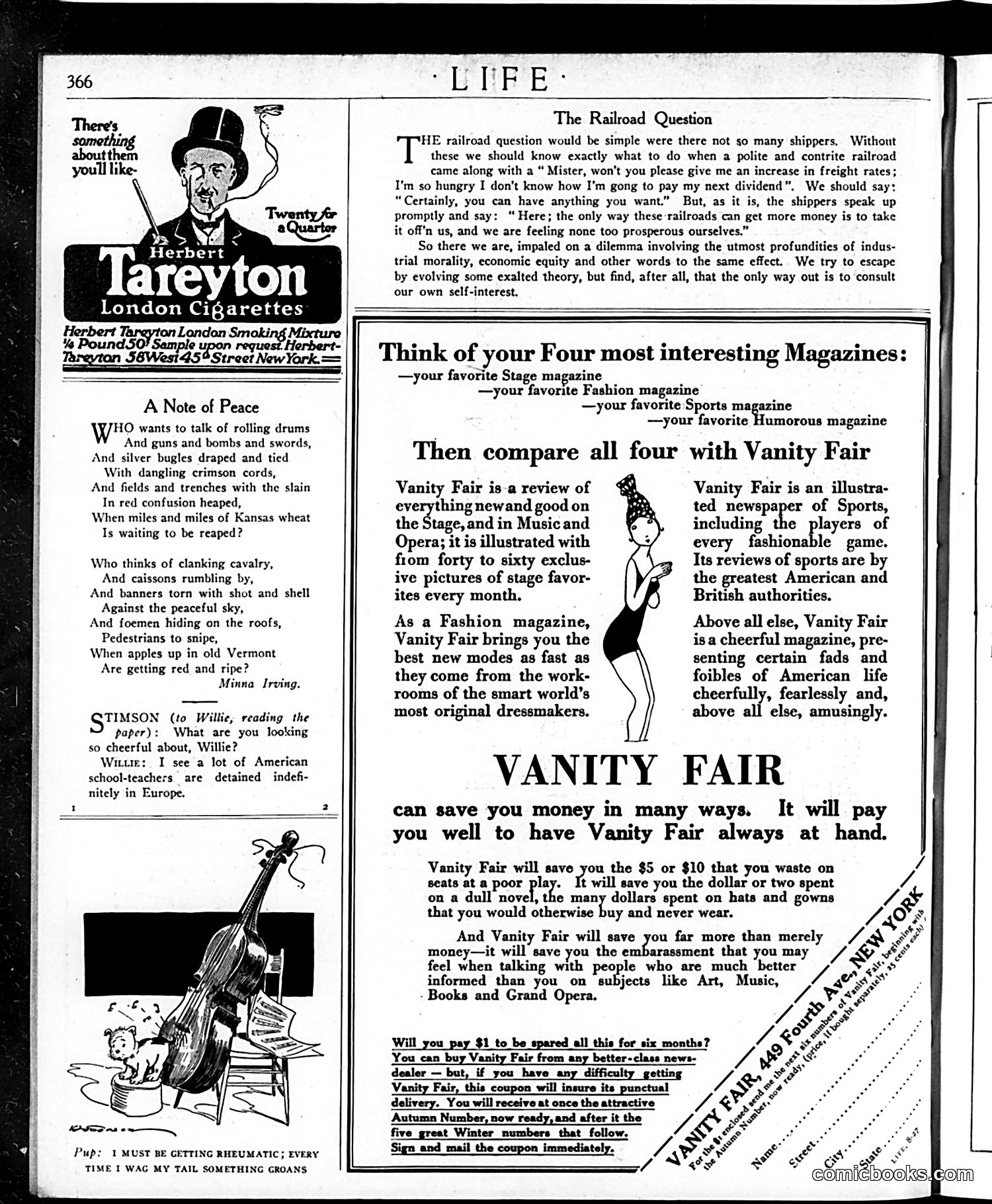
This page contains **three distinct satirical pieces** reflecting early 20th-century American concerns: 1. **"A Note of Peace"** (poem): Anti-war sentiment, contrasting the horror of military conflict with peaceful domestic abundance (Kansas wheat, Vermont apples). Written during an era of global conflict, likely WWI, it questions war's relevance to ordinary Americans' concerns. 2. **The Stimson-Willie cartoon**: A dark joke about American school-teachers "detained indefinitely in Europe"—likely referring to Americans trapped abroad during wartime instability. Willie's cheerfulness about this misfortune is the satirical point. 3. **"The Railroad Question"** editorial: Commentary on railroad regulation debates. The piece satirizes the impossible position of balancing railroad profit demands against shipper interests, concluding cynically that self-interest trumps moral or economic theory—relevant to Progressive Era regulatory debates. The rest is **advertising**: Herbert Tareyton cigarettes and Vanity Fair magazine promotion emphasizing cultural sophistication and financial savings.
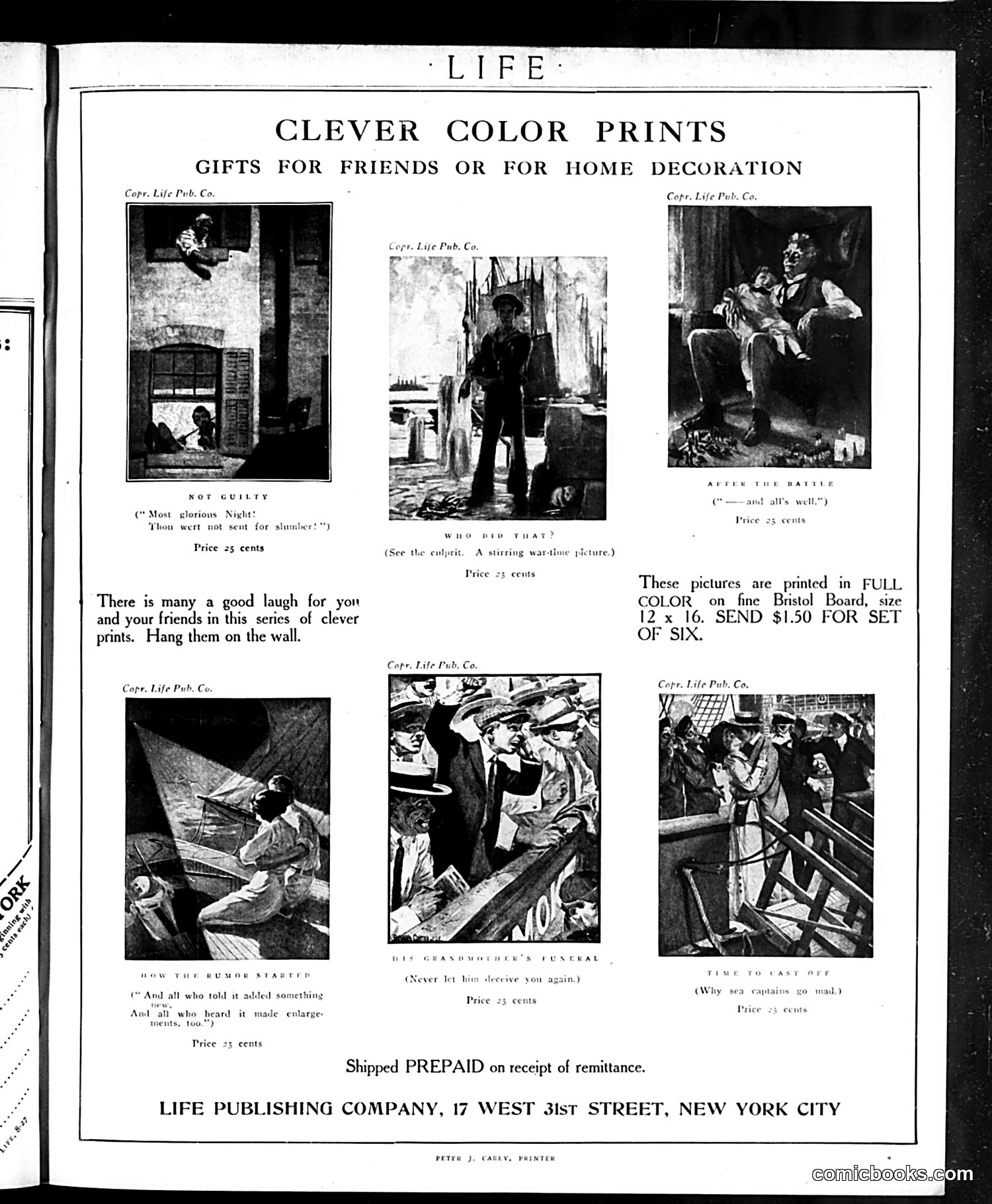
This is an advertisement page selling six humorous color prints (12x16 inches) for $1.50 per set from Life Publishing Company. The six cartoons use satirical titles and quotes to mock human behavior and wartime situations: - **"Not Guilty"** mocks false innocence with a Shakespeare quote - **"Who Did That?"** appears to reference wartime destruction or blame-shifting - **"After the Battle"** depicts post-conflict consequences - **"How the Rumor Started"** satirizes how gossip grows through repeated telling—each person adds embellishment - **"His Grandmother's Funeral"** uses dark humor (subtitle: "Never let his deceive you again") - **"Time to Vase Off"** makes a visual pun about seasickness ("Why sea captains go mad") The page doesn't identify specific political figures or reference particular events—instead offering generic social satire about human nature, rumor-mongering, and wartime experiences. These were marketed as decorative prints for home display or gifts.
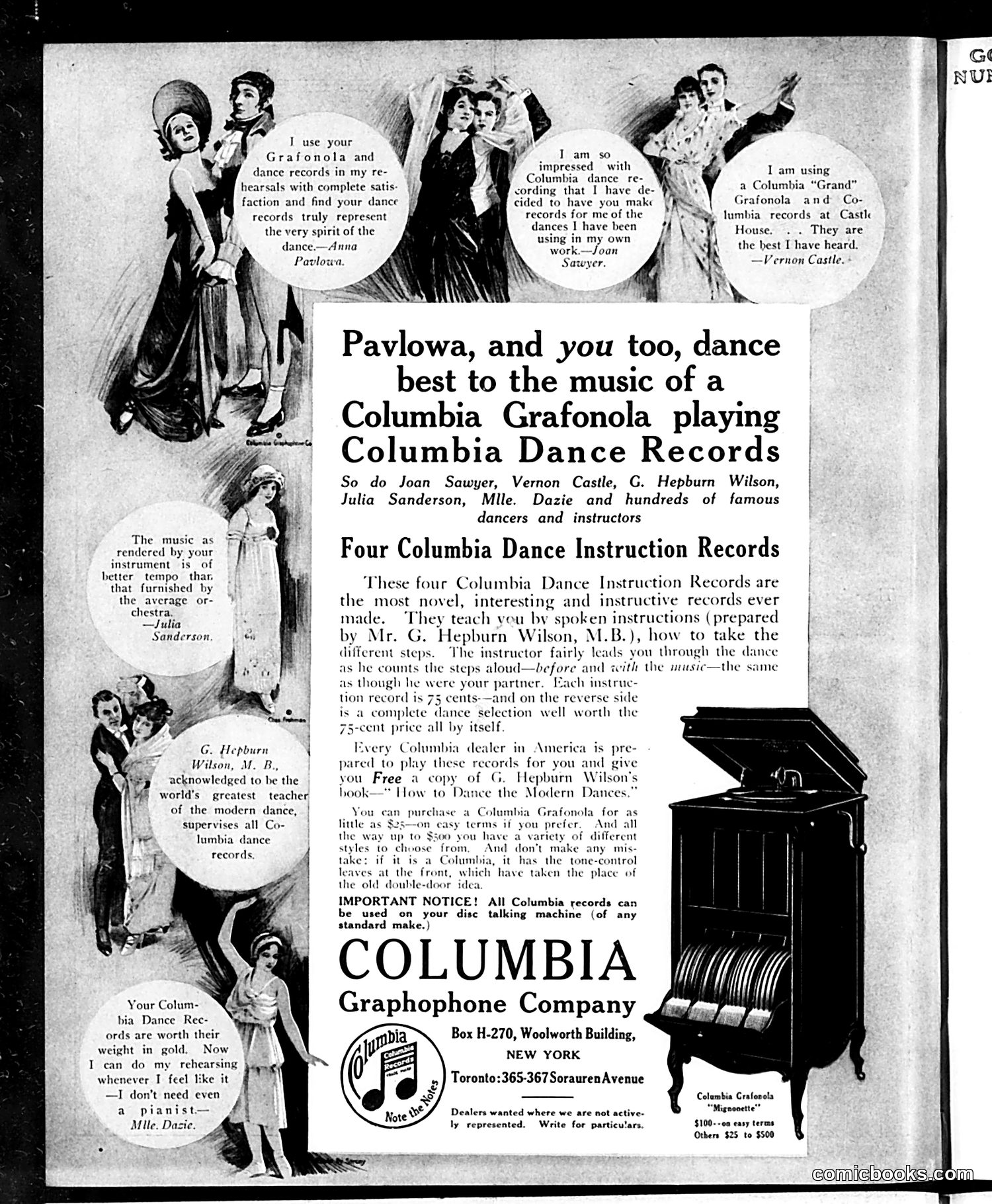
This is a **full-page advertisement**, not satire or political commentary. It promotes Columbia's phonograph (grafonola) and dance records to the modern dancing public of the 1910s-1920s. The page features testimonials from **actual famous dancers of the era**: Anna Pavlova (Russian prima ballerina), Vernon Castle (ballroom dance innovator), Joan Sawyer, and others endorsing Columbia records for rehearsal and instruction. G. Hepburn Wilson, identified as "the world's greatest teacher of modern dance," provides credibility. The advertisement highlights **four instructional dance records** where Wilson provides spoken step-by-step guidance—a novel concept then. The grafonola itself is pictured (right side), priced $25-$300 with financing available. The social context: this targets the "modern dance" craze sweeping America, where jazz-influenced social dancing (the foxtrot, one-step) was revolutionizing entertainment and courtship. The ads position the grafonola as enabling home practice and instruction without hiring a live pianist—practical and economical.