
Life, 1914-08-27 · page 20 of 44
Life — August 27, 1914 — page 20: what you’re looking at
What you’re looking at
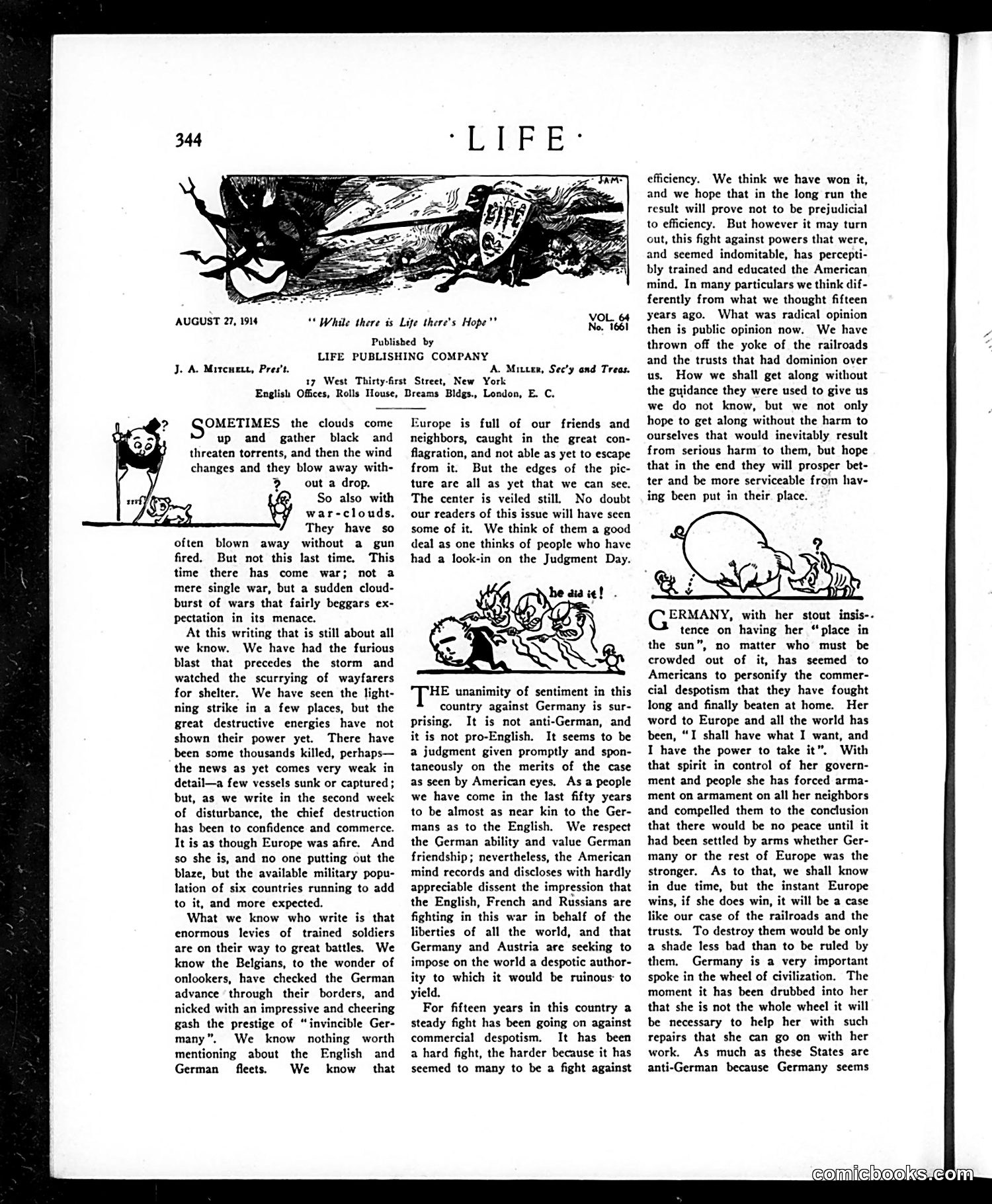
This editorial page addresses World War I, which had just begun weeks earlier. The header cartoon depicts storm clouds and wind—metaphorical imagery for the war's chaos engulfing Europe. The text explains that while wars often pass without firing a shot, this one is different: a catastrophic "cloud-burst" affecting six nations. The editors note they're still in the "second week" with limited information, though they acknowledge thousands killed and vessels sunk. Notably, the editors articulate American sentiment: opposition to Germany is **not** anti-German or pro-English, but rather a judgment that Germany and Austria seek "despotic authority" while England, France, and Russia fight for "liberties of all the world." The piece draws parallels to America's fifteen-year domestic fight against "commercial despotism" (trusts and railroads), suggesting this international conflict aligns with American anti-monopoly values. The overall tone is one of measured analysis during early war uncertainty.
📄 Transcribed text from this page (OCR, searchable)
Machine-transcribed from the original scan — historical spelling and the odd misread are preserved.
AUGUST 27, 1914 “* While there is Lite there's Hope"* No. 1661 Published by LIFE PUBLISHING COMPANY J. A. Mircuent, Pres’t. A. Mitten, Sec’y and Treas. 17 West Thirty-first Street, New York English Offices, Rolls House, Breams Bldgs., London, E. C. OMETIMES the clouds come up and gather black and threaten torrents, and then the wind changes and they blow away with- >? out a drop. So also with war-clouds. They have so often blown away without a gun fired. But not this last time, This time there has come war; not a mere single war, but a sudden cloud- burst of wars that fairly beggars ex- Pectation in its menace. At this writing that is still about all we know. We have had the furious blast that precedes the storm and watched the scurrying of wayfarers for shelter. We have seen the light- ning strike in a few places, but the great destructive energies have not shown their power yet. There have been some thousands killed, perhaps— the news as yet comes very weak in detail—a few vessels sunk or captured; but, as we write in the second weel of disturbance, the chief destruction has been to confidence and commerce. It is as though Europe was afire. And so she is, and no one putting out the blaze, but the available military popu- lation of six countries running to add to it, and more expected. What we know who write is that enormous levies of trained soldiers are on their way to great battles, We know the Belgians, to the wonder of onlookers, have checked the German advance through their borders, and nicked with an impressive and cheering gash the prestige of “invincible Ger- many”. We know nothing worth mentioning about the English and German fleets. We know that Europe is full of our friends and neighbors, caught in the great con- flagration, and not able as yet to escape from it. But the edges of the pic- ture are all as yet that we can see. The center is veiled still, No doubt our readers of this issue will have seen some of it. We think of them a good deal as one thinks of people who have had a look-in on the Judgment Day. TH unanimity of sentiment in this country against Germany is sur- prising. It is not anti-German, and it is not pro-English. It seems to be a judgment given promptly and spon- taneously on the merits of the case as seen by American eyes. Asa people we have come in the last fifty years to be almost as near kin to the Ger- mans as to the English. We respect the German ability and value German friendship; nevertheless, the American mind records and discloses with hardly appreciable dissent the impression that the English, French and Russians are fighting in this war in behalf of the liberties of all the world, and that Germany and Austria are seeking to impose on the world a despotic author- ity to which it would be ruinous to yield, For fifteen years in this country a steady fight has been going on against commercial despotism. It has been a hard fight, the harder because it has seemed to many to be a fight against efficiency. We think we have won it, and we hope that in the long run the result will prove not to be prejudicial to efficiency. But however it may turn out, this fight against powers that were, and seemed indomitable, has percepti- bly trained and educated the American mind. In many particulars we think dif- ferently from what we thought fifteen years ago. What was radical opinion then is public opinion now. We have thrown off the yoke of the railroads and the trusts that had dominion over us. How we shall get along without the guidance they were used to give us we do not know, but we not only hope to get along without the harm to ourselves that would inevitably result from serious harm to them, but hope that in the end they will prosper bet- ter and be more serviceable from hav- ing been put in their place. ERMANY, with her stout insis-- tence on having her “place in the sun”, no matter who must be crowded out of it, has seemed to Americans to personify the commer- cial despotism that they have fought long and finally beaten at home. Her word to Europe and all the world has been, “I shall have what I want, and I have the power to take it”. With that spirit in control of her govern- ment and people she has forced arma- ment on armament on all her neighbors and compelled them to the conclusion that there would be no peace until it had been settled by arms whether Ger- many or the rest of Europe was the stronger. As to that, we shall know in due time, but the instant Europe wins, if she does win, it will be a case like our case of the railroads and the trusts. To destroy them would be only a shade less bad than to be ruled by them. Germany is a very important spoke in the wheel of civilization. The moment it has been drubbed into her that she is not the whole wheel it will be necessary to help her with such repairs that she can go on with her work. As much as these States are anti-German because Germany seems