
Life, 1914-08-27 · page 40 of 44
Life — August 27, 1914 — page 40: what you’re looking at
What you’re looking at
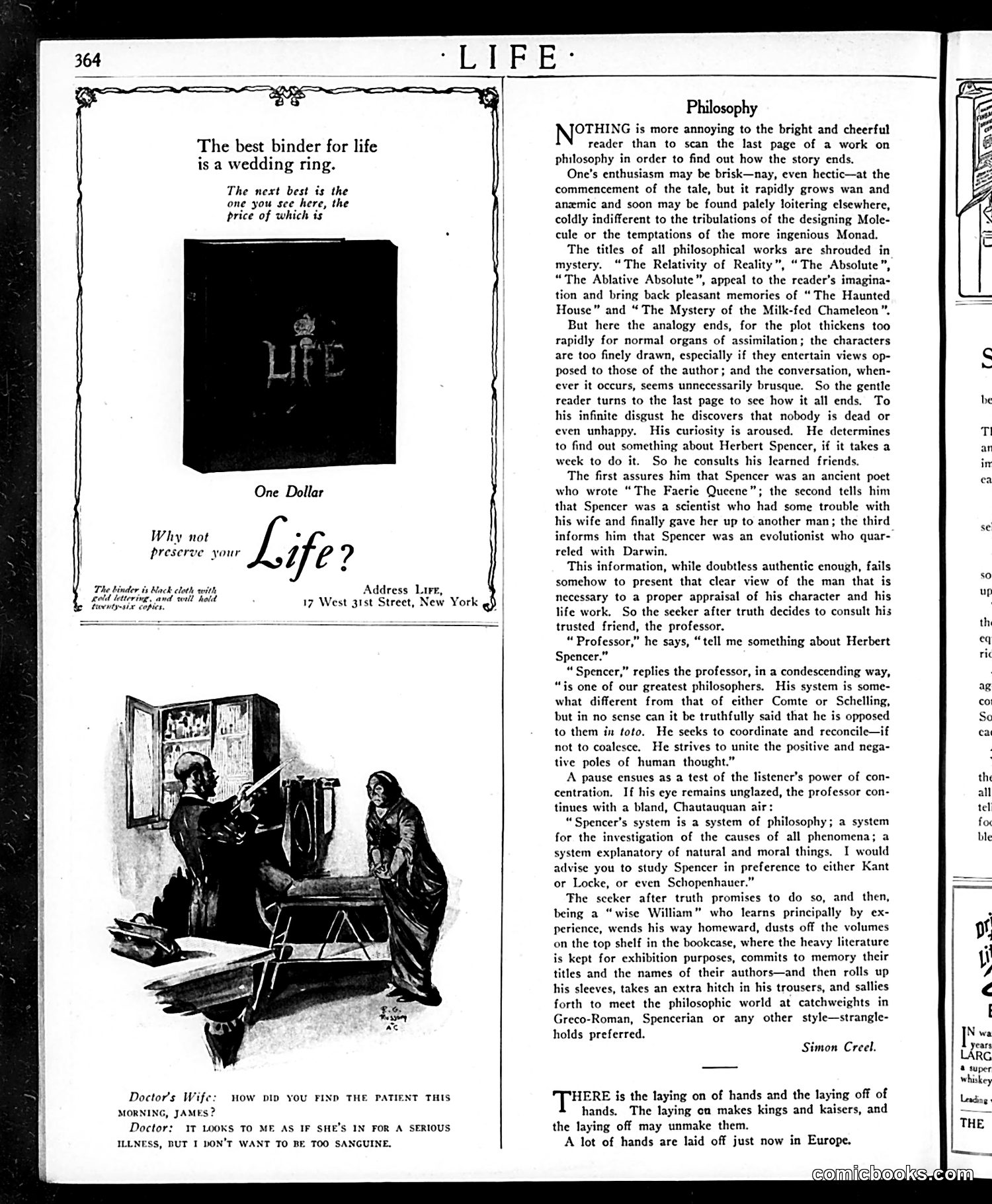
This page contains two unrelated pieces of satire typical of LIFE magazine's format: **Top Left - Advertisement Parody:** A mock ad for a book binder shaped like a wedding ring, priced at one dollar. The joke plays on the phrase "binder for life"—literalizing the marital commitment as a tool to preserve Life magazine issues. It's gentle satire on wedding sentimentality and consumerism. **Bottom Left - Doctor's Joke:** A brief comic sketch mocking medical jargon. A doctor uses the word "sanguine" (optimistic) when discussing a serious illness, creating dark humor through the doctor's inappropriate word choice—he doesn't want to be "too optimistic" about the patient's dire condition. **Right Column - Philosophy Essay:** Simon Creel satirizes philosophical writing's opacity and how readers desperately seek understanding. The essay mocks both pretentious philosophy titles and professors who speak in impenetrable jargon about Herbert Spencer, Kant, and others. The humor targets academic pomposity and the futility of seeking clarity from professorial "wisdom."
📄 Transcribed text from this page (OCR, searchable)
Machine-transcribed from the original scan — historical spelling and the odd misread are preserved.
The best binder for life is a wedding ring. The next best is the one you see here, the brice of which is One Dollar Why not :. reserve yo! y preserve your ife ? The binder is Nack cloth with gold lettering, and woul hold tiventy-six copies. Address Lire, 17 West 31st Street, New York HOW DID YOU FIND THE PATIENT THIS MORNING, JAME Doctor: 17 LOOKS TO ME AS IF SHE'S IN FOR A SERIOUS ILLNESS, BUT I DON'T WANT TO BE TOO SANGUINE. Philosophy OTHING is more annoying to the bright and cheerful reader than to scan the last page of a work on philosophy in order to find out how the story ends. One’s enthusiasm may be brisk—nay, even hectic—at the commencement of the tale, but it rapidly grows wan and anzmic and soon may be found palely loitering elsewhere, coldly indifferent to the tribulations of the designing Mole- cule or the temptations of the more ingenious Monad. The titles of all philosophical works are shrouded in mystery. “The Relativity of Reality”, “The Absolute”, “The Ablative Absolute”, appeal to the reader’s imagina- tion and bring back pleasant memories of “The Haunted House” and “ The Mystery of the Milk-fed Chameleon”. But here the analogy ends, for the plot thickens too rapidly for normal organs of assimilation; the characters are too finely drawn, especially if they entertain views op- posed to those of the author; and the conversation, when- ever it occurs, seems unnecessarily brusque. So the gentle reader turns to the last page to see how it all ends. To his infinite disgust he discovers that nobody is dead or even unhappy. His curiosity is aroused. He determines to find out something about Herbert Spencer, if it takes a week to do it. So he consults his learned friends. The first assures him that Spencer was an ancient poet who wrote “The Faerie Queene”; the second tells him that Spencer was a scientist who had some trouble with his wife and finally gave her up to another man; the third informs him that Spencer was an evolutionist who quar- reled with Darwin, This information, while doubtless authentic enough, fails somehow to present that clear view of the man that is necessary to a proper appraisal of his character and his life work. So the seeker after truth decides to consult his trusted friend, the professor. “Professor,” he says, “tell me something about Herbert Spencer.” “ Spencer,” replies the professor, in a condescending way, “is one of our greatest philosophers. His system is some- what different from that of either Comte or Schelling, but in no sense can it be truthfully said that he is opposed to them in toto. He seeks to coordinate and reconcile—if not to coalesce. He strives to unite the positive and nega- tive poles of human thought.” A pause ensues as a test of the listener’s power of con- centration, If his eye remains unglazed, the professor con- tinues with a bland, Chautauquan air: “Spencer's system is a system of philosophy; a system for the investigation of the causes of all phenomena; a system explanatory of natural and moral things. I would advise you to study Spencer in preference to cither Kant or Locke, or even Schopenhauer.” ‘Fhe sceker after truth promises to do so, and then, being a “wise William” who learns principally by ex- perience, wends his way homeward, dusts off the volumes on the top shelf in the bookcase, where the heavy literature is kept for exhibition purposes, commits to memory their titles and the names of their authors—and then rolls up his sleeves, takes an extra hitch in his trousers, and sallies forth to meet the philosophic world at catchweights in Greco-Roman, Spencerian or any other style—strangle- holds preferred. Simon Creel. "THERE is the laying on of hands and the laying off of hands. The laying on makes kings and kaisers, and the laying off may unmake them. A lot of hands are laid off just now in Europe. th N wa years LARG &@ super | whiskey | Leading : THE