
Life, 1914-08-27 · page 21 of 44
Life — August 27, 1914 — page 21: what you’re looking at
What you’re looking at
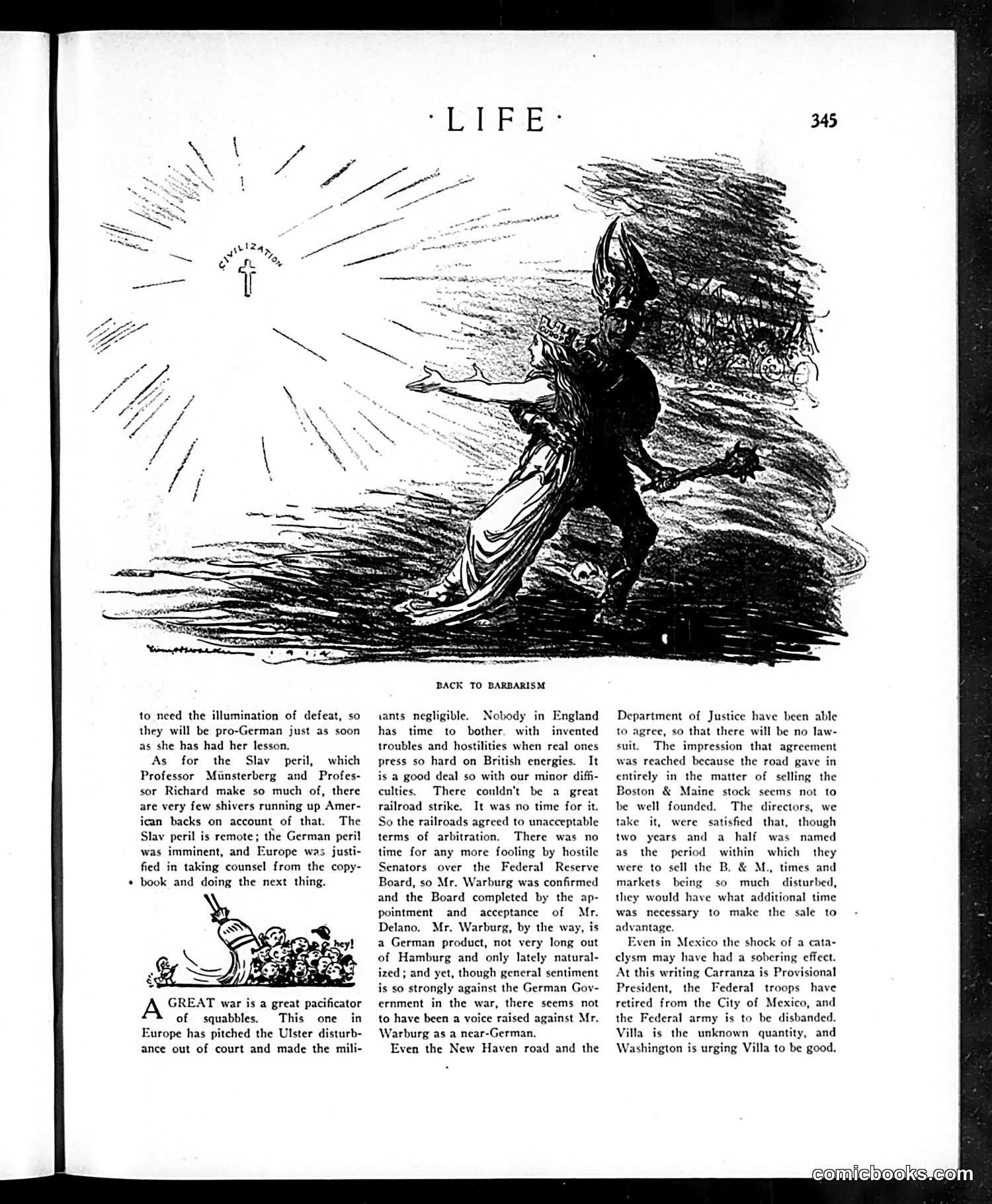
This editorial page argues that World War I has paradoxically resolved American domestic conflicts. The heading "Back to Barbarism" (illustrated by a dramatic figure pointing toward distant conflict) references the war's brutality. The text claims that urgent European threats have made minor American disputes seem trivial: the Ulster crisis in Ireland, railroad strikes, and Federal Reserve Board appointments all proceeded smoothly because wartime urgency overrode normal political opposition. Notably, the author defends appointing Paul Warburg to the Federal Reserve despite his German birth and recent naturalization, arguing that anti-German sentiment hasn't prevented his confirmation—suggesting practical cooperation transcends wartime prejudice. The piece also references Mexican instability (Villa and Carranza), presenting American foreign policy as attempting to maintain order amid global chaos. Overall, it frames WWI's disruption as having temporarily unified Americans around practical necessity over partisan division.
📄 Transcribed text from this page (OCR, searchable)
Machine-transcribed from the original scan — historical spelling and the odd misread are preserved.
to nced the illumination of defeat, so they will be pro-German just as soon as she has had her lesson. As for the Slav peril, which Professor Miinsterberg and Profes- sor Richard make so much of, there are very few shivers running up Amer- ican backs on account of that. The Slav peril is remote; the German peri! was imminent, and rope was justi- fied in taking counsel from the copy- book and doing the next thing. GREAT war is a great pacificator of squabbles. This one in Europe has pitched the Ulster disturb- ance out of court and made the mili- BACK TO BARBARISM tants negligible. Nobody in England has time to bother. with invented troubles and hostilities when real ones press so hard on British energies. It is a good deal so with our minor diffi- culties. There couldn't be a great railroad strike, It was no time for it. So the railroads agreed to unacceptable terms of arbitration. There was no time for any more fooling by hostile Senators over the Federal Reserve Board, so Mr. Warburg was confirmed and the Board completed by the ap- pointment and acceptance of Mr. Delano. Mr. Warburg, by the way, is a German product, not very long out of Hamburg and only lately natural- ized ; and yet, though general sentiment is so strongly against the German Gov- ernment in the war, there seems not to have been a voice raised against Mr. Warburg as a near-German. Even the New Haven road and the Department of Justice have been able to agree, so that there will be no law- suit. The impression that agreement was reached because the road gave in entirely in the matter of selling the Boston & Maine stock seems not to be well founded. The directors, we take it, were satisfied that, though two years and a half was named as the period within which they were to sell the B, & M., times and markets being so much disturbed, they would have what additional time was necessary to make the sale to advantage. Even in Mexico the shock of a cata- clysm may have had a sobering effect. At this writing Carranza is Provisional President, the Federal troops have retired from the City of Mexico, and the Federal army is to be disbanded. Villa is the unknown quantity, and Washington is urging Villa to be good.