
Life, 1914-08-27 · page 29 of 44
Life — August 27, 1914 — page 29: what you’re looking at
What you’re looking at
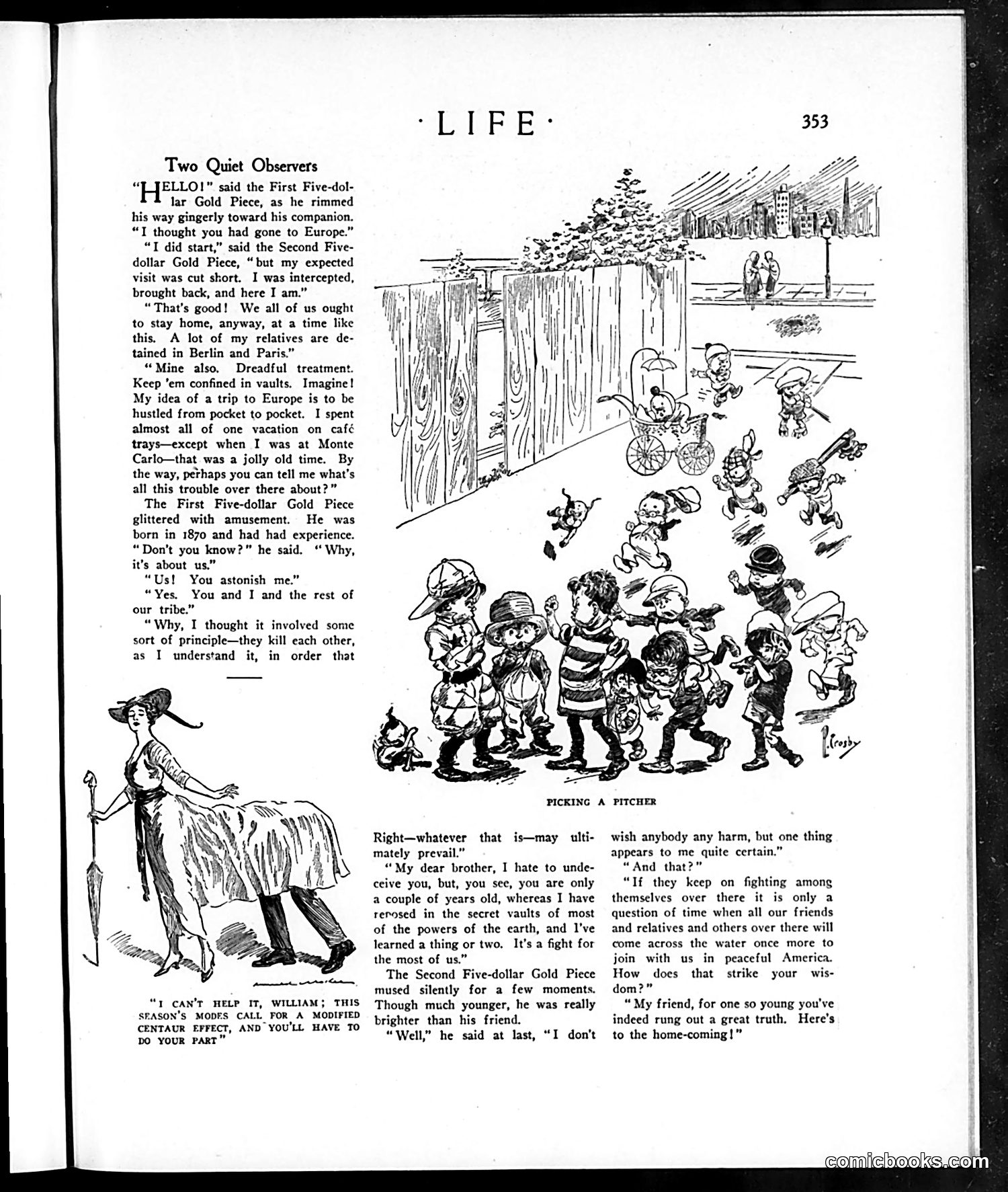
This page satirizes World War I through personified five-dollar gold pieces discussing the European conflict. The joke operates on multiple levels: **The Conceit:** Two American gold coins converse about their "relatives" trapped in European vaults, treating the war as fundamentally about controlling gold and currency rather than principles. **The Satire:** The older coin (born 1870, worldly) cynically explains that the war is "about us"—gold itself—not ideology. The younger coin then observes that if fighting continues, European gold will flee to America for safety, enriching the U.S. **Historical Context:** This reflects 1914-1917 concerns about American financial advantage from European war. Gold inflows to America during WWI did strengthen U.S. economic position, a reality many Americans viewed cynically. **The Point:** The piece mocks both the notion that WWI involved noble principles and suggests American self-interest in the conflict's continuation. The ending toast to "home-coming" gold is darkly humorous commentary on American profit from European suffering.
📄 Transcribed text from this page (OCR, searchable)
Machine-transcribed from the original scan — historical spelling and the odd misread are preserved.
Two Quiet Observers “LJELLO!” said the First Five-dol- lar Gold Piece, as he rimmed his way gingerly toward his companion. “TI thought you had gone to Europe.” “TI did start,” said the Second Five- dollar Gold Piece, “but my expected visit was cut short. I was intercepted, brought back, and here I am.” “That's good! We all of us ought to stay home, anyway, at a time like this. A lot of my relatives are de- tained in Berlin and Paris.” “Mine also, Dreadful treatment. Keep 'em confined in vaults. Imagine! My idea of a trip to Europe is to be hustled from pocket to pocket. I spent almost all of one vacation on café trays—except when I was at Monte Carlo—that was a jolly old time. By the way, perhaps you can tell me what's all this trouble over there about?” The First Five-dollar Gold Piece glittered with amusement. He was born in 1870 and had had experience. “Don't you know?” he said. ‘“ Why, it’s about us,” “Us! You astonish me.” “Yes. You and I and the rest of our tribe.” “Why, I thought it involved some sort of principle—they kill each other, as I understand it, in order that “T CAN'T HELP IT, WILLIAM; THIS SEASON'S MODES CALL FOR A MODIFIED CENTAUR EFFECT, AND YOU'LL HAVE TO DO YOUR PART” PICKING A PITCHER Right—whatever that mately prevail.” “My dear brother, I hate to unde- ceive you, but, you see, you are only a couple of years old, whereas I have rerosed in the secret vaults of most of the powers of the earth, and I’ve learned a thing or two. It’s a fight for the most of us.” The Second Five-dollar Gold Piece mused silently for a few moments. Though much younger, he was really brighter than his friend. “Well,” he said at last, “I don't is—may ulti- wish anybody any harm, but one thing appears to me quite certain.” “And that?” “If they keep on fighting among themselves over there it is only a question of time when all our friends and relatives and others over there will come across the water once more to join with us in peaceful America. How does that strike your dom?” “ My friend, for one so young you've indeed rung out a great truth. Here's to the home-coming!”