
Life, 1914-08-27 · page 15 of 44
Life — August 27, 1914 — page 15: what you’re looking at
What you’re looking at
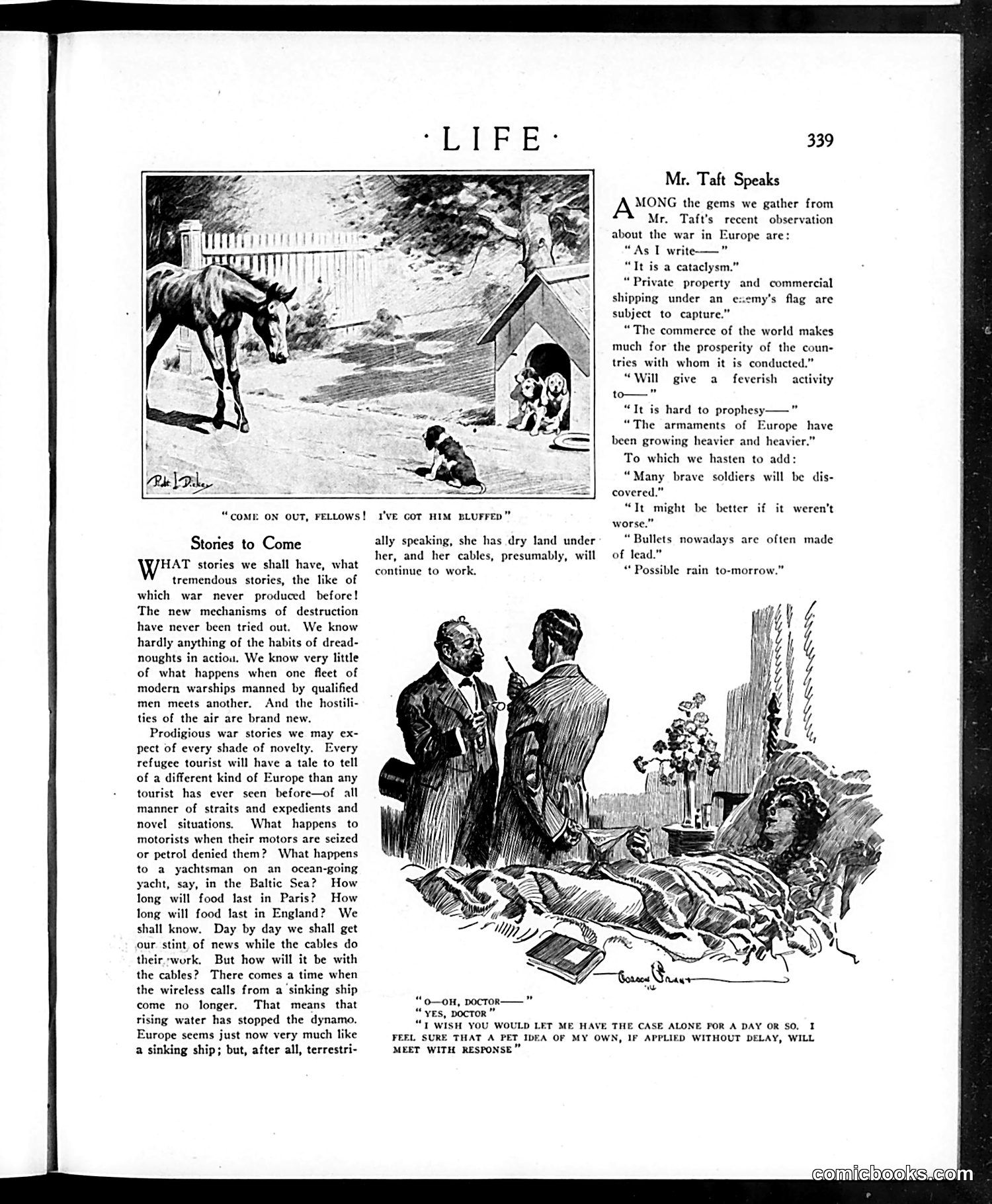
This page satirizes **William Howard Taft's** public commentary on World War I. The right section mocks his obvious, platitudinous observations about the war—that it's a "cataclysm," that armaments are "growing heavier," that bullets are "made of lead," or that "possible rain to-morrow" might occur. The satire suggests Taft's pronouncements are painfully banal and contribute nothing meaningful to understanding the conflict. The left section, "Stories to Come," anticipates the dramatic wartime narratives that will emerge—destroyed ships, food shortages, seized vehicles—while questioning whether communication cables will survive Europe's turmoil. The two cartoons show: (top) soldiers engaged in some kind of bluff or deception; (bottom) a doctor speaking with another figure about applying "a pet idea" to address the crisis. The overall point: Taft's commentary is so obvious and empty that Life juxtaposes it with genuine wartime uncertainties to highlight the gap between political rhetoric and real stakes.
📄 Transcribed text from this page (OCR, searchable)
Machine-transcribed from the original scan — historical spelling and the odd misread are preserved.
Pe \Piles “COME ON OUT, FELLows! Stories to Come HAT stories we shall have, what tremendous stories, the like of which war never produced before! The new mechanisms of destruction have never been tried out. We know hardly anything of the habits of dread- noughts in actiou. We know very little of what happens when one fleet of modern warships manned by qualified men meets another, And the hostili- ties of the air are brand new. Prodigious war stories we may ex- pect of every shade of novelty. Every refugee tourist will have a tale to tell of a different kind of Europe than any tourist has ever seen before—of all manner of straits and expedients and novel situations. What happens to motorists when their motors are seized or petrol denied them? What happens to a yachtsman on an_ ocean-going yacht, say, in the Baltic Sea? How long will food last in Paris? How long will food last in England? We shall know. Day by day we shall get our stint of news while the cables do their.;work, But how will it be with the cables? There comes a time when the wireless calls from a ‘sinking ship come no longer. That means that rising water has stopped the dynamo. Europe seems just now very much like a sinking ship; but, after all, terrestri- I'VE COT HIM BLUFFED” ally speaking, she has dry land under her, and her cables, presumably, will continue to work. “o—oH, pocrork— ” “WISH YOU WOULD LET ME HAVE 339 Mr. Taft Speaks ZA MONG the gems we gather from Mr. Taft's recent observation about the war in Europe are: “As T write—” “Tt is a cataclysm.” “Private property and commercial shipping under an exemy's flag are subject to capture.” “The commerce of the world makes much for the prosperity of the coun- tries with whom it is conducted.” “Will give a feverish activity to—”" “It is hard to prophesy — “The armaments of Europe have been growing heavier and heavier.” To which we hasten to add: “Many brave soldiers will be dis- covered.” “Tt might be better if it weren't worse.” “Bullets nowadays are often made of lead.” “ Possible rain to-morrow.” HE CASE ALONE POR A DAY OR SO, 1 FEEL SURE THAT A PET IDEA OF MY OWN, IF APPLIED WITHOUT DELAY, WILL MEET WITH RESPONSE”