
Life, 1914-08-27 · page 32 of 44
Life — August 27, 1914 — page 32: what you’re looking at
What you’re looking at
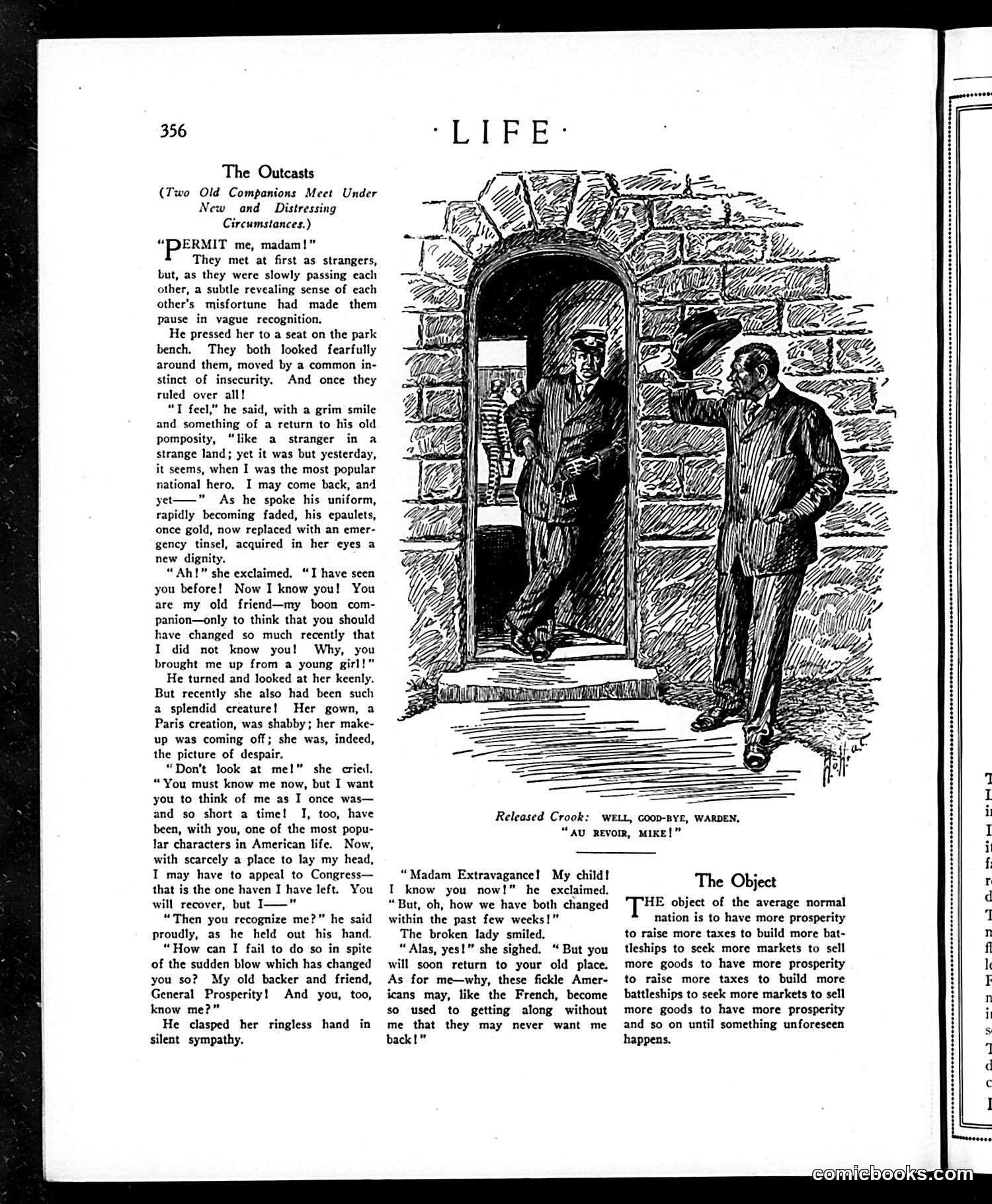
This page contains two satirical pieces from Life magazine, likely from the early 20th century: **"The Outcasts"** depicts an allegorical conversation between two fallen figures: "General Prosperity" (a uniformed military man in faded regalia) and "Madam Extravagance" (an impoverished woman). They were once celebrated national figures but have been reduced to poverty and social disgrace. The satire criticizes excessive spending and economic mismanagement—personified as extravagance—that depletes national prosperity. Their mutual recognition and sympathy, despite ruin, suggests these vices were once culturally celebrated but have become shameful. **"The Object"** is a circular critique of national economic policy, mocking the self-perpetuating cycle of building wealth solely to fund military expansion and consumption, which then requires more wealth-building—an endless, purposeless loop until "something unforeseen happens" (likely economic collapse or war). It satirizes imperialist economics and militarism as fundamentally irrational.
📄 Transcribed text from this page (OCR, searchable)
Machine-transcribed from the original scan — historical spelling and the odd misread are preserved.
356 The Outcasts (Two Old Companions Meet Under New and Distressing Circumstances.) “DERMIT me, madam!” They met at first as strangers, but, as they were slowly passing each other, a subtle revealing sense of each other’s misfortune had made them pause in vague recognition. He pressed her to a seat on the park bench. They both looked fearfully around them, moved by a common in- stinct of insecurity. And once they ruled over all! “T feel,” he said, with a grim smile and something of a return to his old pomposity, “like a stranger in a strange land; yet it was but yesterday, it seems, when I was the most popular national hero, I may come back, and yet——”" As he spoke his uniform, rapidly becoming faded, his epaulets, once gold, now replaced with an emer- gency tinsel, acquired in her eyes a new dignity. “Ah!” she exclaimed. “I have seen you before! Now I know you! You are my old friend—my boon com- panion—only to think that you should have changed so much recently that I did not know you! Why, you brought me up from a young girl!” He turned and looked at her keenly. But recently she also had been such a splendid creature! Her gown, a Paris creation, was shabby; her make- up was coming off; she was, indeed, the picture of despair. “Don't look at me!” she cried. “You must know me now, but I want you to think of me as I once was— and so short a time! I, too, have been, with you, one of the most popu- lar characters in American life. Now, with scarcely a place to lay my head, I may have to appeal to Congress— that is the one haven I have left. You will recover, but I——” “Then you recognize me?” he said proudly, as he held out his hand. “How can I fail to do so in spite of the sudden blow which has changed you so? My old backer and friend, General Prosperity! And you, too, know me?” He clasped her ringless hand in silent sympathy. Released Crook: WELL, GOOD-BYE, WARDEN, “AU REVOIR, MIKE!” “Madam Extravagance! My child! I know you now!” he exclaimed. “But, oh, how we have both changed within the past few weeks!” The broken lady smiled. “Alas, yes!" she sighed. “ But you will soon return to your old place. As for me—why, these fickle Amer- icans may, like the French, become so used to getting along without me that they may never want me back!” The Object TH object of the average normal nation is to have more prosperity to raise more taxes to build more bat- tleships to seek more markets to sell more goods to have more prosperity to raise more taxes to build more battleships to seek more markets to sell more goods to have more prosperity and so on until something unforeseen happens,