
A complete issue · 40 pages · 1914
Life — July 9, 1914
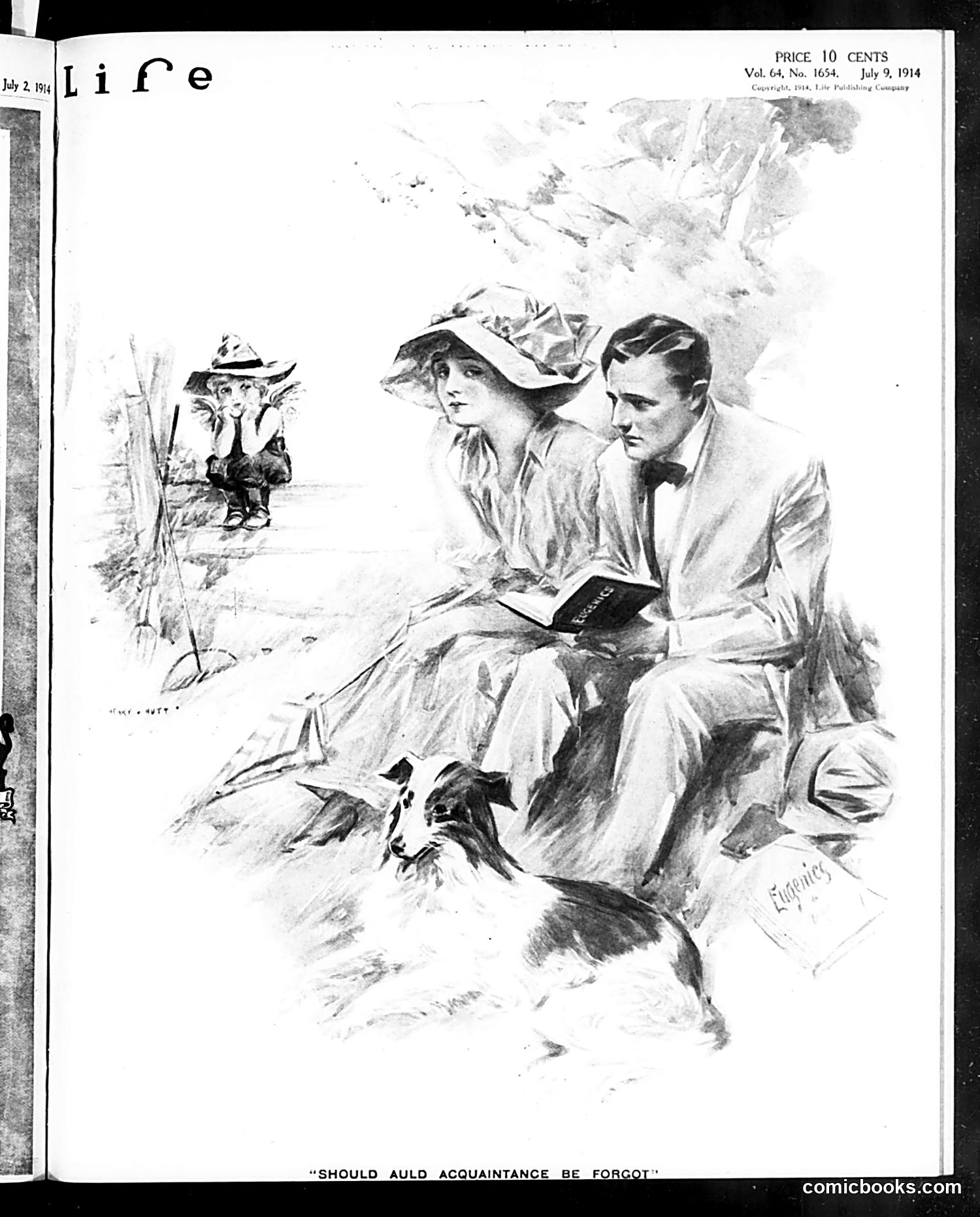
This July 1914 *Life* cartoon depicts a couple reading together outdoors while a small child watches from a distance. The title references the Scottish song "Auld Lang Syne" (old times/old friendships). The satire appears to concern **romantic rekindling or renewal of acquaintance**—the couple is absorbed in reading (likely literature or poetry) while apparently ignoring or excluding the child observer. The joke likely plays on the tension between nostalgic romance between adults and domestic responsibilities (the child). Published just before World War I's outbreak, the specific historical context remains unclear from the image alone, though the timing suggests possible commentary on social priorities or changing relationships during that turbulent period.
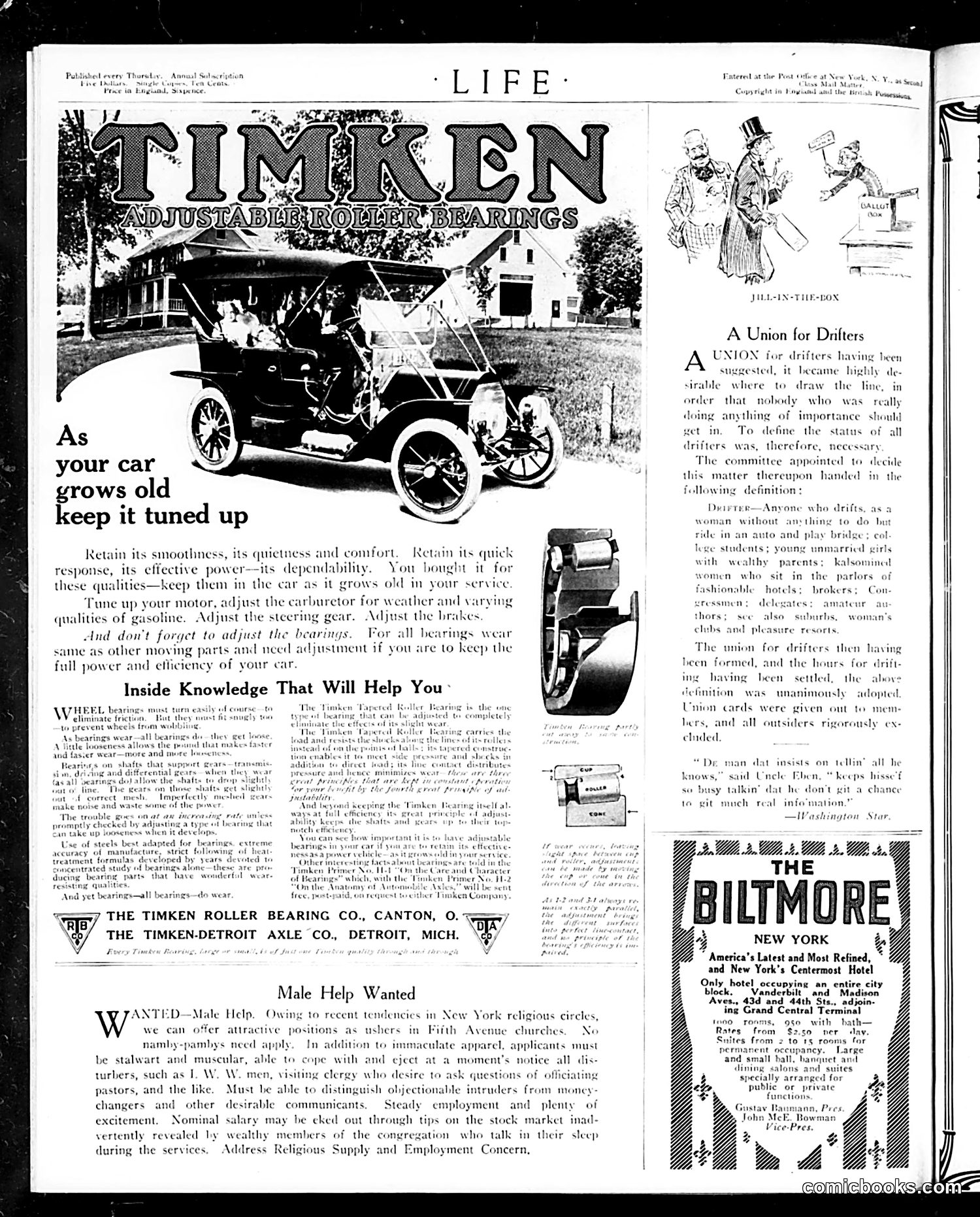
This page is primarily **advertising and practical content** rather than political satire. The main elements include: 1. **Timken Adjustable Roller Bearings ad** - Dominates the left side with an automobile image and technical information about maintaining car bearings as vehicles age. 2. **"A Union for Drifters"** - A brief satirical piece defining social categories (wealthy parents, bohemians, students, etc.) who "drift" without direction, proposing they form a union and receive membership cards. 3. **"Male Help Wanted"** - A help-wanted advertisement seeking male staff for religious positions, likely ushers or clergy assistants for New York churches. 4. **Biltmore Hotel advertisement** - Promotes this New York hotel. The page reflects 1920s concerns: automotive maintenance, social mobility anxieties, employment, and upscale hospitality advertising.
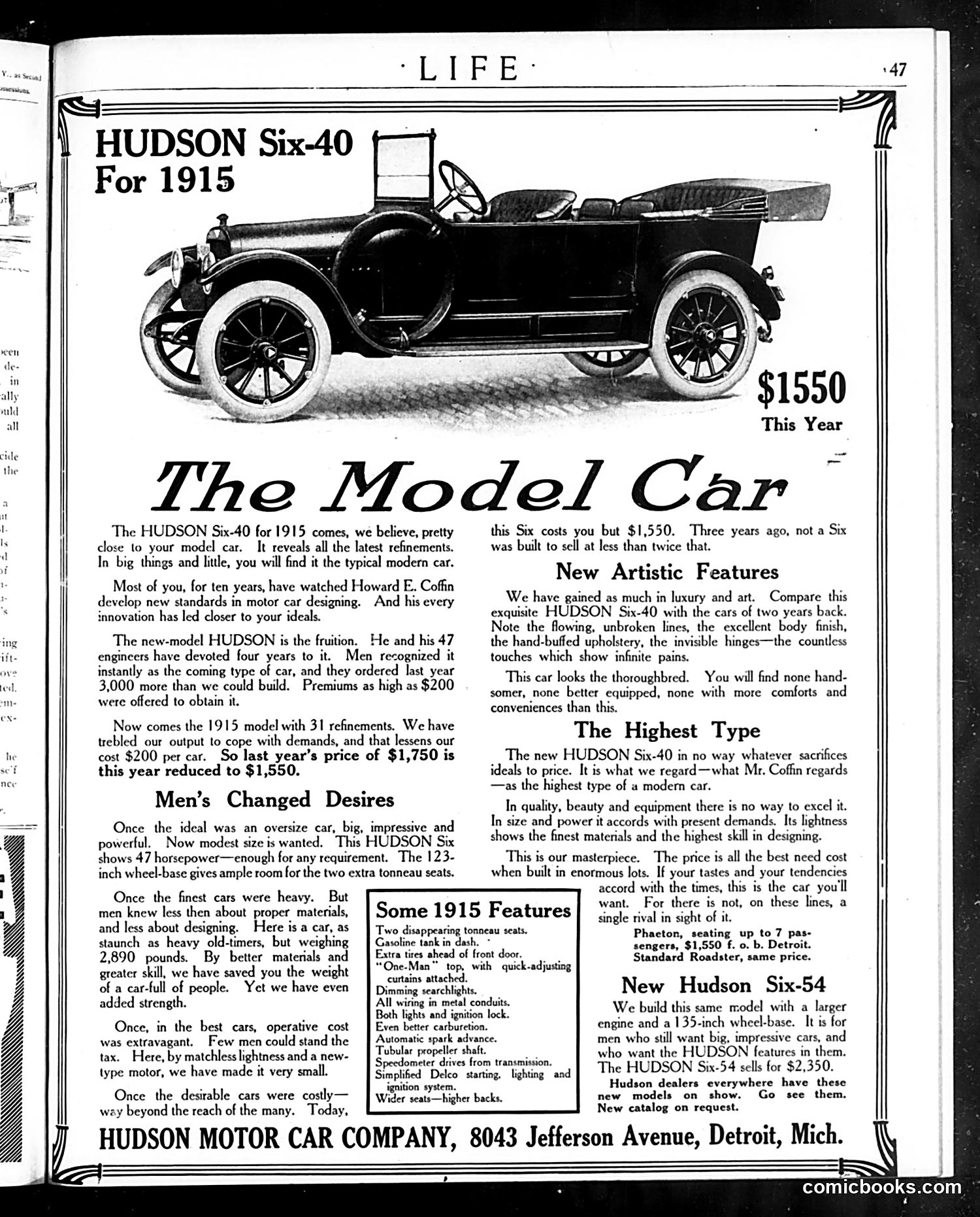
This page is **not a political cartoon or satirical content** — it's a straightforward automobile advertisement from *Life* magazine, page 47. The ad promotes the **Hudson Six-40 for 1915**, priced at $1,550. The text emphasizes practical features appealing to early automotive buyers: modest size (replacing the desire for oversized cars), lightweight construction, and affordability. Key selling points highlighted include "31 refinements," luxurious details (upholstery, hinges, body finish), and reliability. The ad also mentions a companion model, the Hudson Six-54, at $2,350. This reflects early-1900s automotive culture where manufacturers competed on engineering improvements and value rather than styling. The page demonstrates how *Life* magazine monetized through paid advertising alongside editorial content.
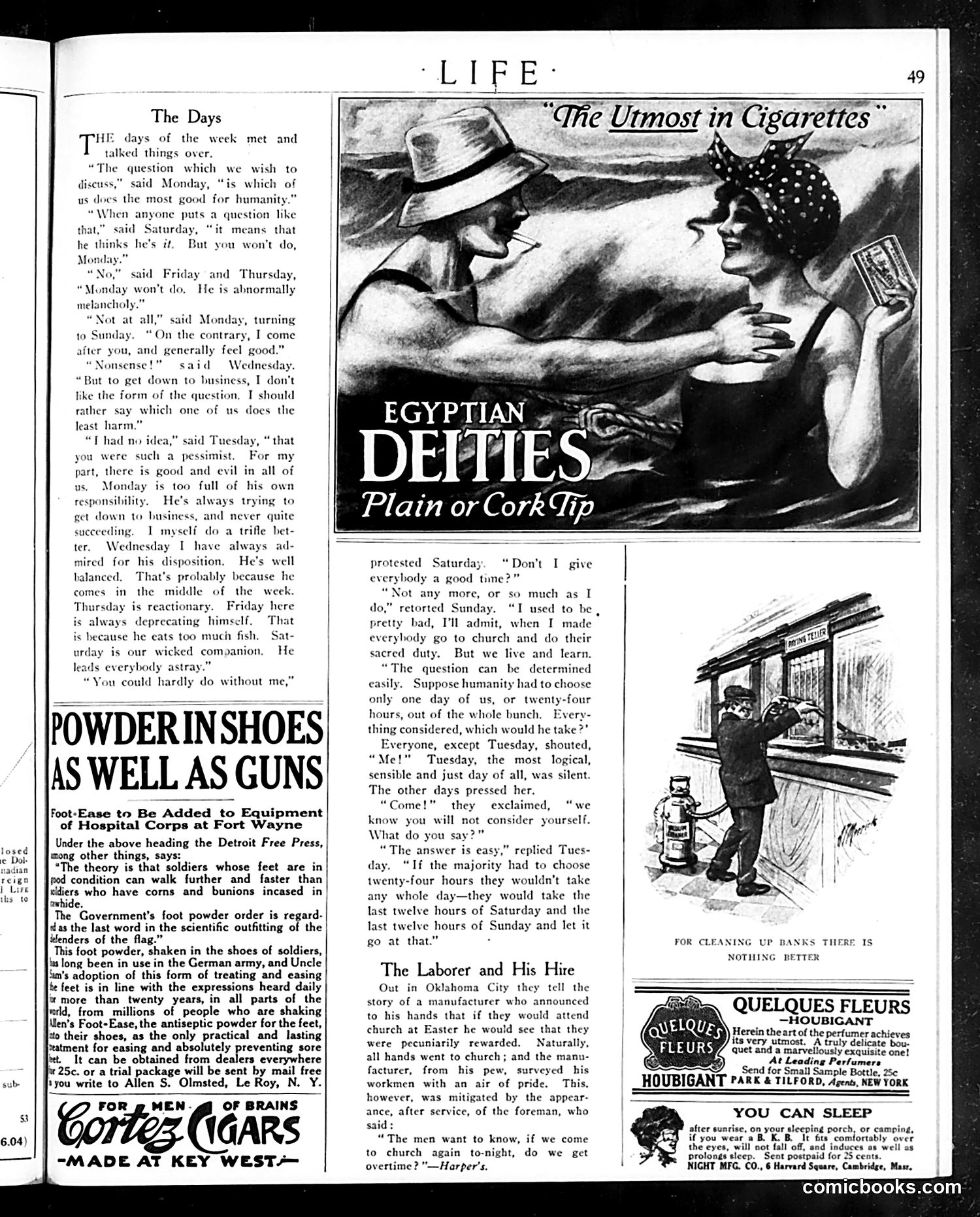
This advertisement features two figures in Egyptian-style dress (headdresses, jewelry) in what appears to be an ancient Egyptian setting. The cartoon promotes "Egyptian Delties" cigarettes in "Plain or Cork Tip." The humor relies on visual pun: the figures are depicted as Egyptian "deities" (gods/goddesses), but the product name "Delties" suggests "delights." The exoticized Egyptian aesthetic was a common marketing device of this era, capitalizing on 1920s fascination with ancient Egypt (likely boosted by Tutankhamun's tomb discovery in 1922). The joke conflates luxury cigarettes with divine status—smoking these cigarettes positions consumers as sophisticated and elevated. This page is primarily advertising rather than political satire.
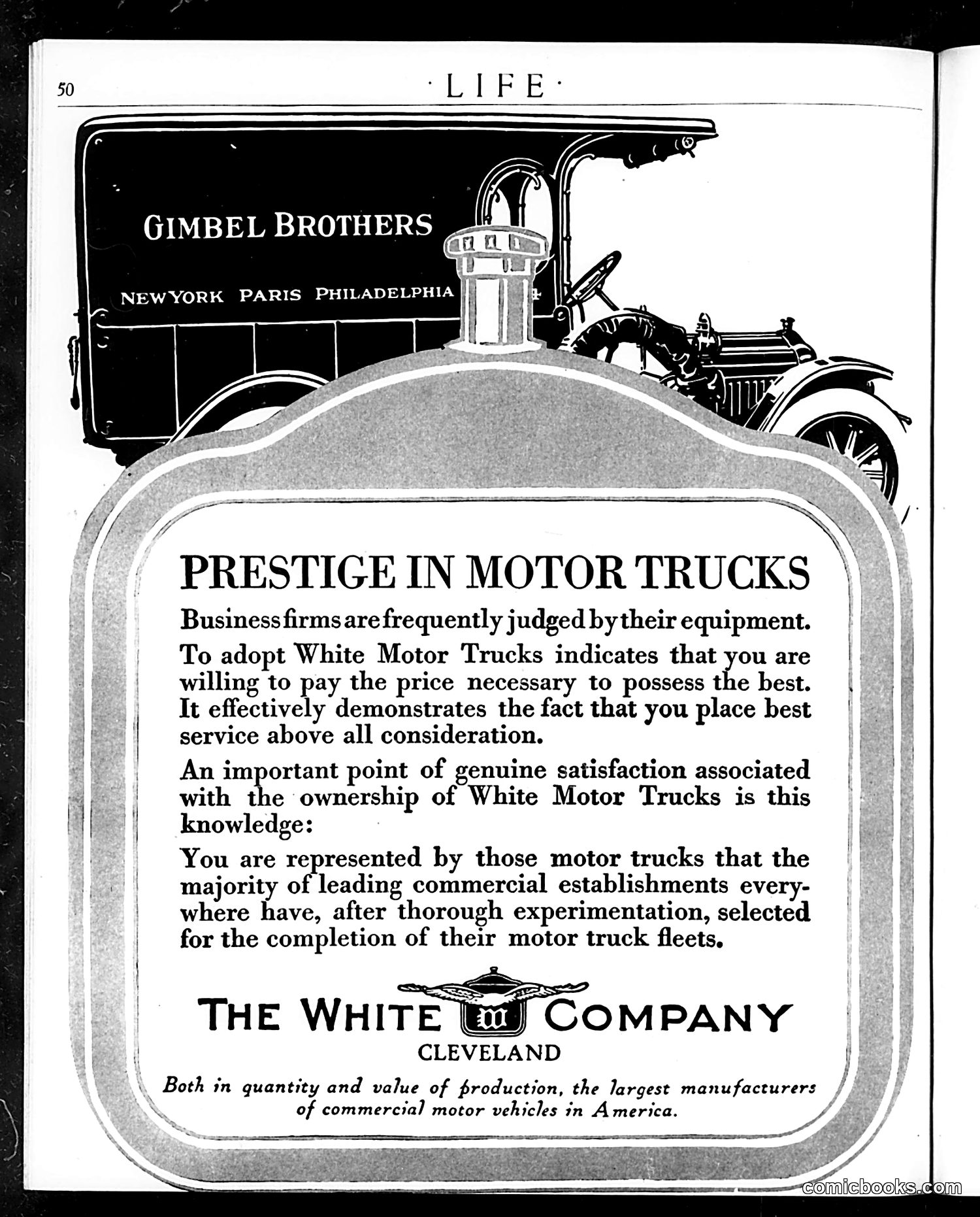
This page is **primarily an advertisement**, not satire or political commentary. It's a full-page ad for White Motor Trucks, placed in *Life* magazine. The ad features an illustration of a delivery truck for "Gimbel Brothers" (a major department store chain) at the top, followed by marketing copy emphasizing that choosing White trucks signals business prestige and quality. The text argues that adopting White trucks demonstrates a company's commitment to excellence. The Gimbel Brothers truck serves as a **real-world endorsement example**—suggesting that prestigious retailers had already chosen White trucks, which would encourage other businesses to do the same. This reflects early automotive advertising strategy: using recognizable brand partnerships to build consumer confidence in commercial vehicles.
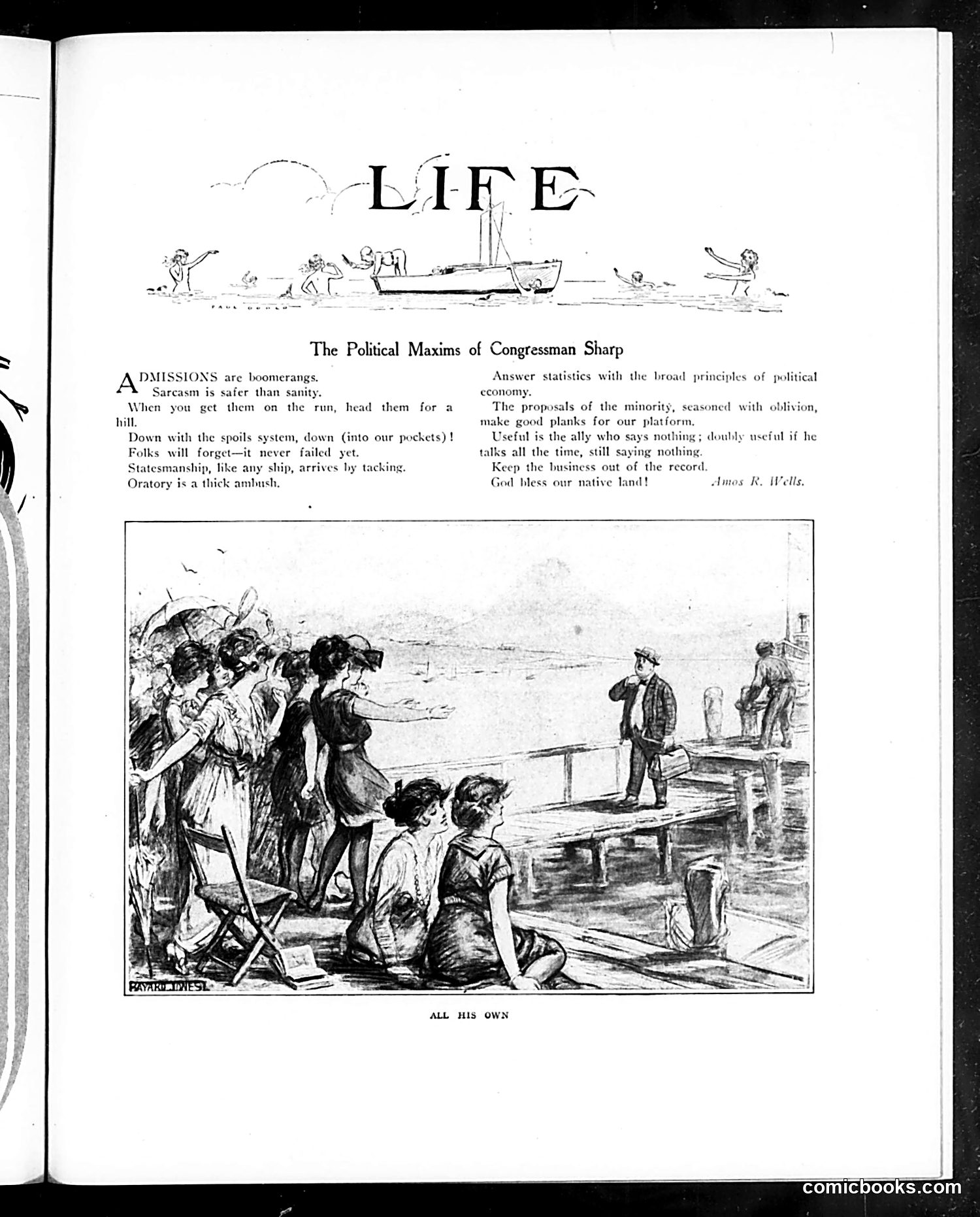
This satirical piece mocks a politician named Congressman Sharp through a series of cynical political observations. The text ridicules common political tactics: treating admissions as "boomerangs," using sarcasm instead of honesty, and employing obfuscation ("oratory is a thick ambush"). The accompanying illustration shows Sharp on a dock, apparently avoiding a group of constituents or petitioners on the left while conducting business on the right. The caption "ALL HIS OWN" suggests he's operating independently, possibly ignoring public input. The satire criticizes politicians who use rhetorical tricks and patronizing gestures ("useful is the ally who says nothing") while deflecting accountability. This reflects early-20th-century *Life* magazine's regular satirizing of political corruption and evasiveness.
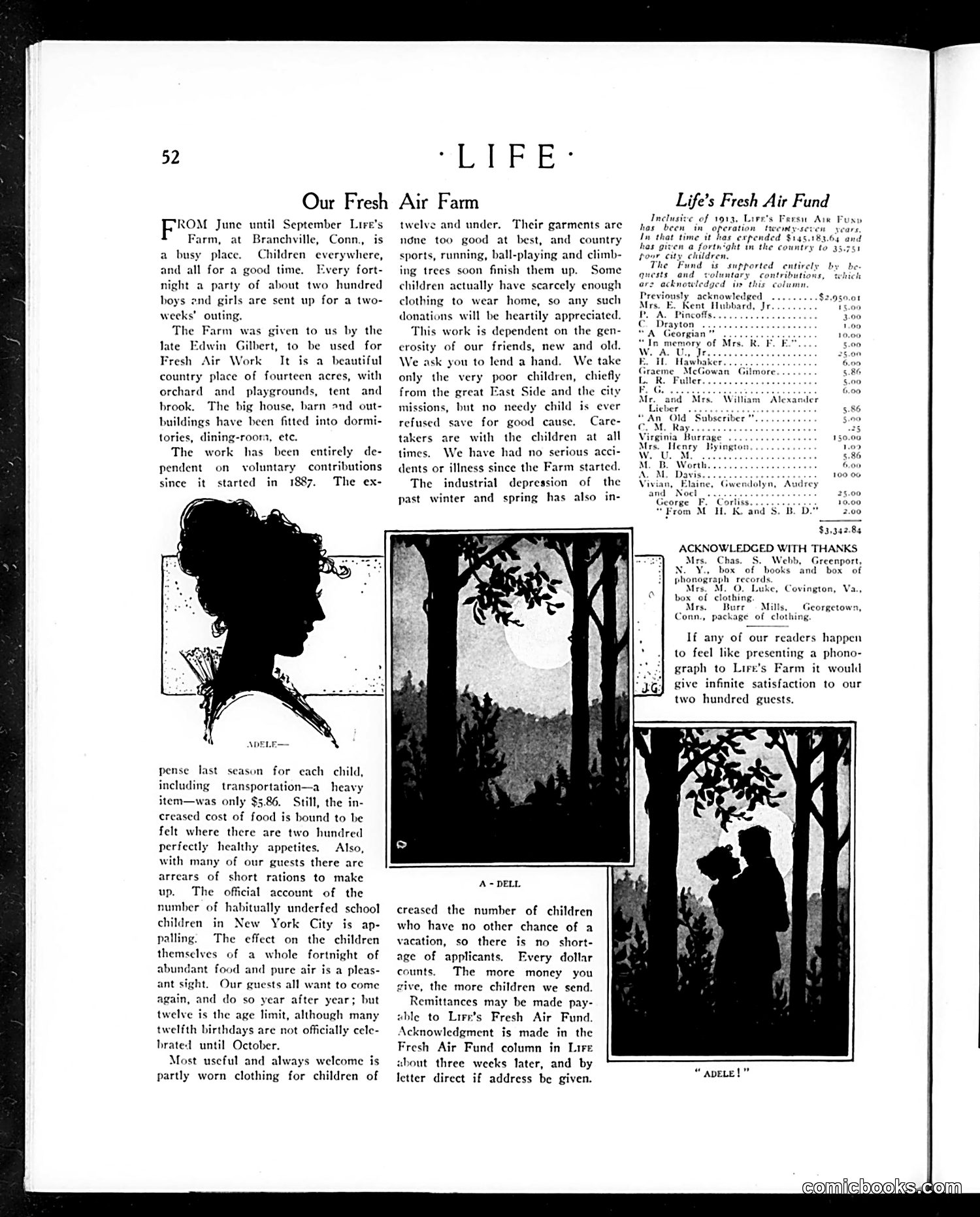
This page contains **no political cartoon or satire**. Instead, it's primarily editorial content about "Life's Fresh Air Farm," a charitable program operating since 1887 that provided summer vacations for underprivileged children from New York City's tenements. The three images are **atmospheric illustrations** rather than satirical cartoons—silhouettes of children enjoying outdoor activities (labeled "NOBLE," "A BELL," and "ADELE"). They depict the Farm's purpose: giving poor urban children access to nature, fresh air, and recreation they couldn't otherwise afford. The right column lists **donors and contributions** to the Fresh Air Fund. This is essentially a **charitable advertisement/acknowledgment page**, not satirical content. Its "satire" purpose, if any, is implicit: highlighting social inequality by showcasing children who need charity to experience basic outdoor life.
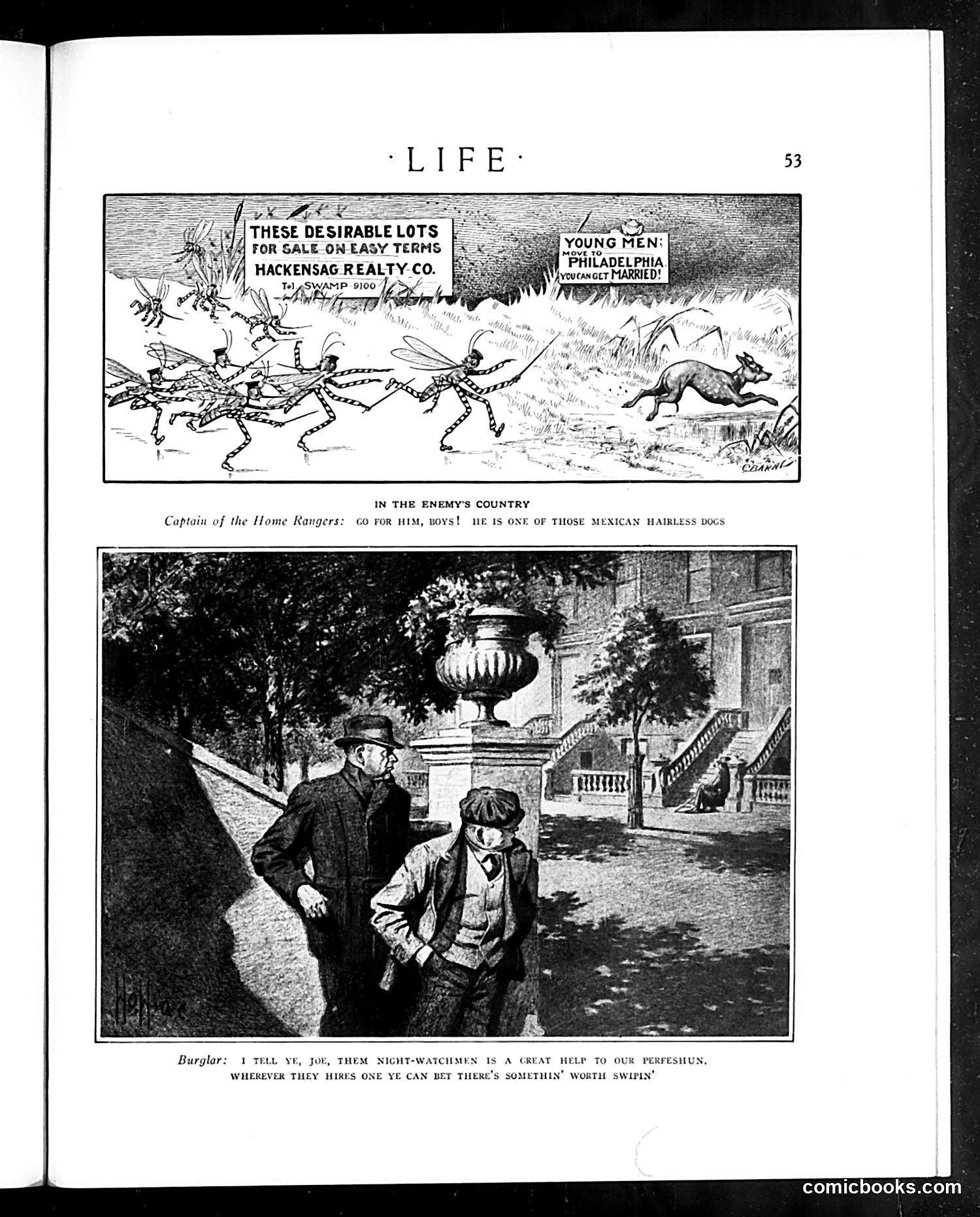
**Top Cartoon**: A satirical advertisement parody showing skeletal figures chasing a dog across a swamp landscape. Real estate signs advertise "desirable lots" and "Young Men Philadelphia - You've Got Married." The skeleton figures appear to represent the grim consequences of hasty real estate investment or marriage—suggesting these ventures are as dangerous as chasing a wild dog through a swamp. The joke mocks both predatory real estate sales and the perils of young married life. **Bottom Image**: Depicts two men discussing burglary prevention. The caption references hiring night-watchmen as protection, with a cynical punchline suggesting watchmen themselves might steal ("there's somethin' worth swipin'"). This satirizes the irony of hiring security who may be as criminal as the burglars they're meant to stop—a commentary on urban crime and corruption.
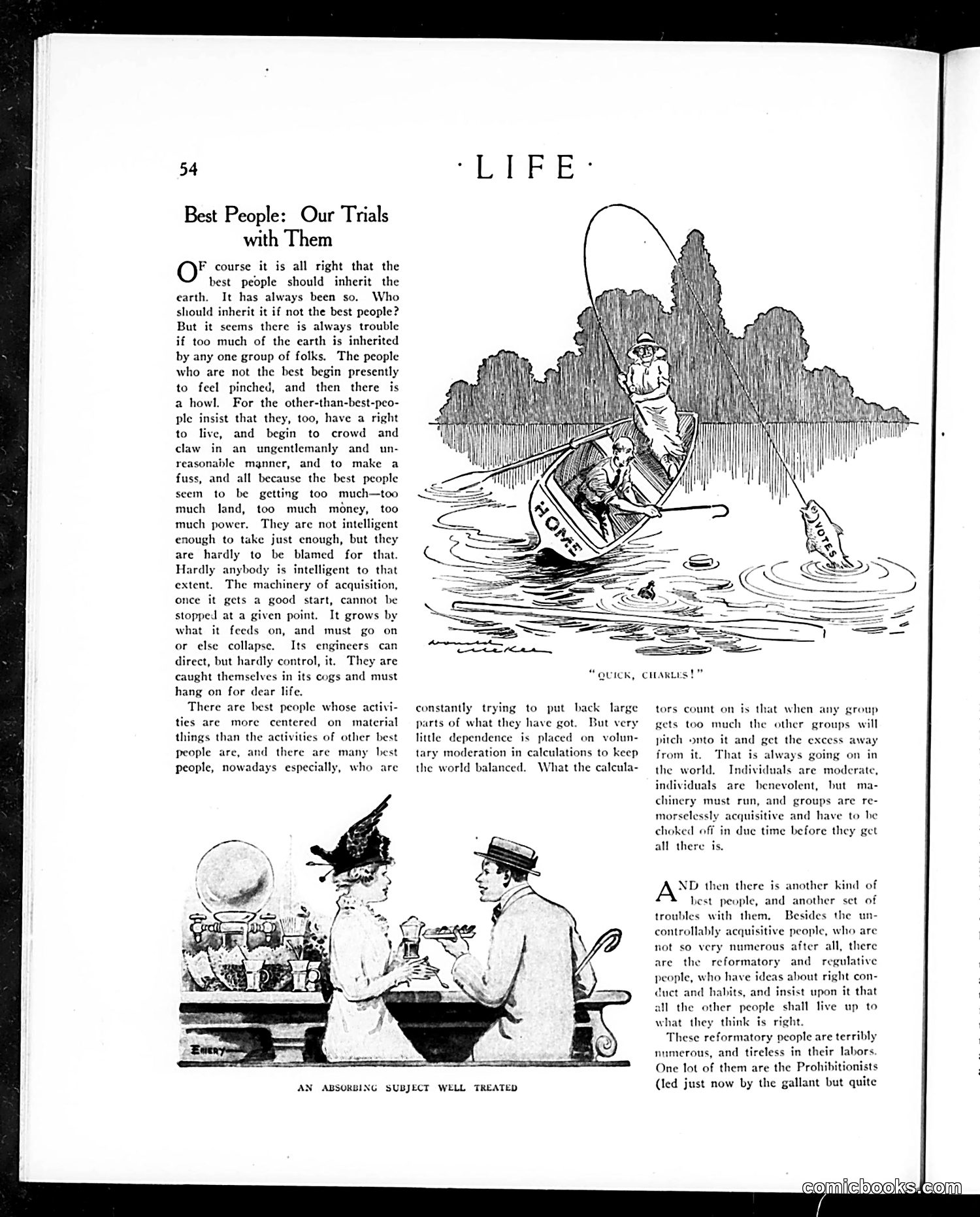
This page satirizes wealth inequality and social classes. The article "Best People: Our Trials with Them" critiques the wealthy elite who inherit fortunes and resist redistribution, while simultaneously mocking reformers and regulators who demand equality. The top cartoon shows a man fishing while a woman holds his catch—likely satirizing how the wealthy effortlessly accumulate resources ("Quick, Charles!"). The bottom cartoon depicts a woman serving food to two wealthy gentlemen at a lavish table ("An Absorbing Subject Well Treated"), suggesting the article's point: wealthy people are preoccupied with material excess while dismissing those—particularly Prohibitionists and reformers—who challenge their dominance. The satire cuts both ways, mocking both acquisitive elites and tiresome moral reformers.
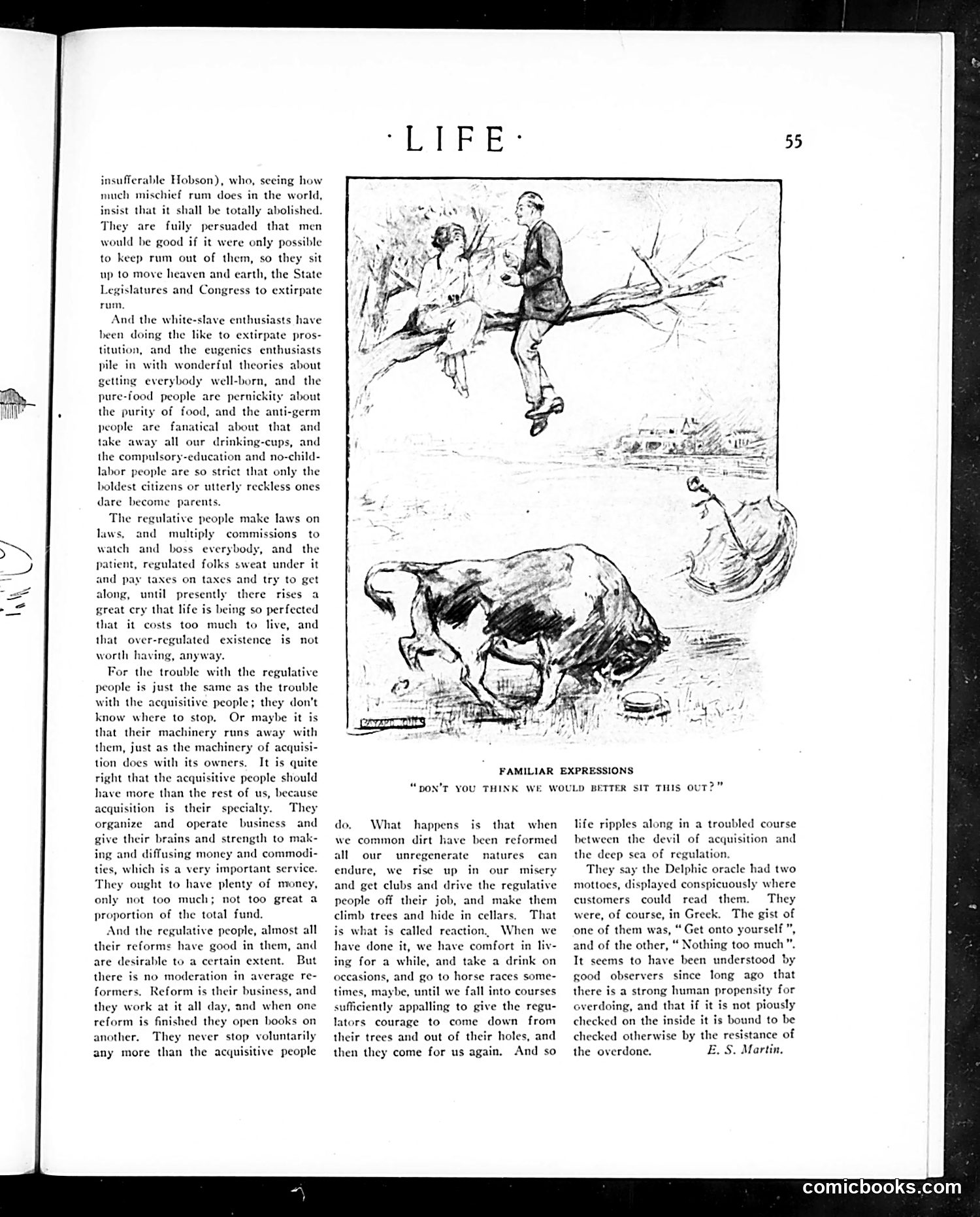
This cartoon satirizes regulatory reformers and social activists of the Progressive Era. The illustration shows two figures balanced precariously on a branch over water—one appears to be a gentleman, the other a woman—suggesting they're in an unstable, compromising position. The accompanying text criticizes "regulative people" who create excessive laws and commissions. The article argues that reformers' constant interventions create a pendulum effect: initial reforms work, but eventually provoke backlash ("reaction"), forcing reformers to swing back into action. The cartoon suggests such endless reform cycles leave society unstable and exhausted—hence the implicit advice to "sit this out" rather than perpetually agitate for change.
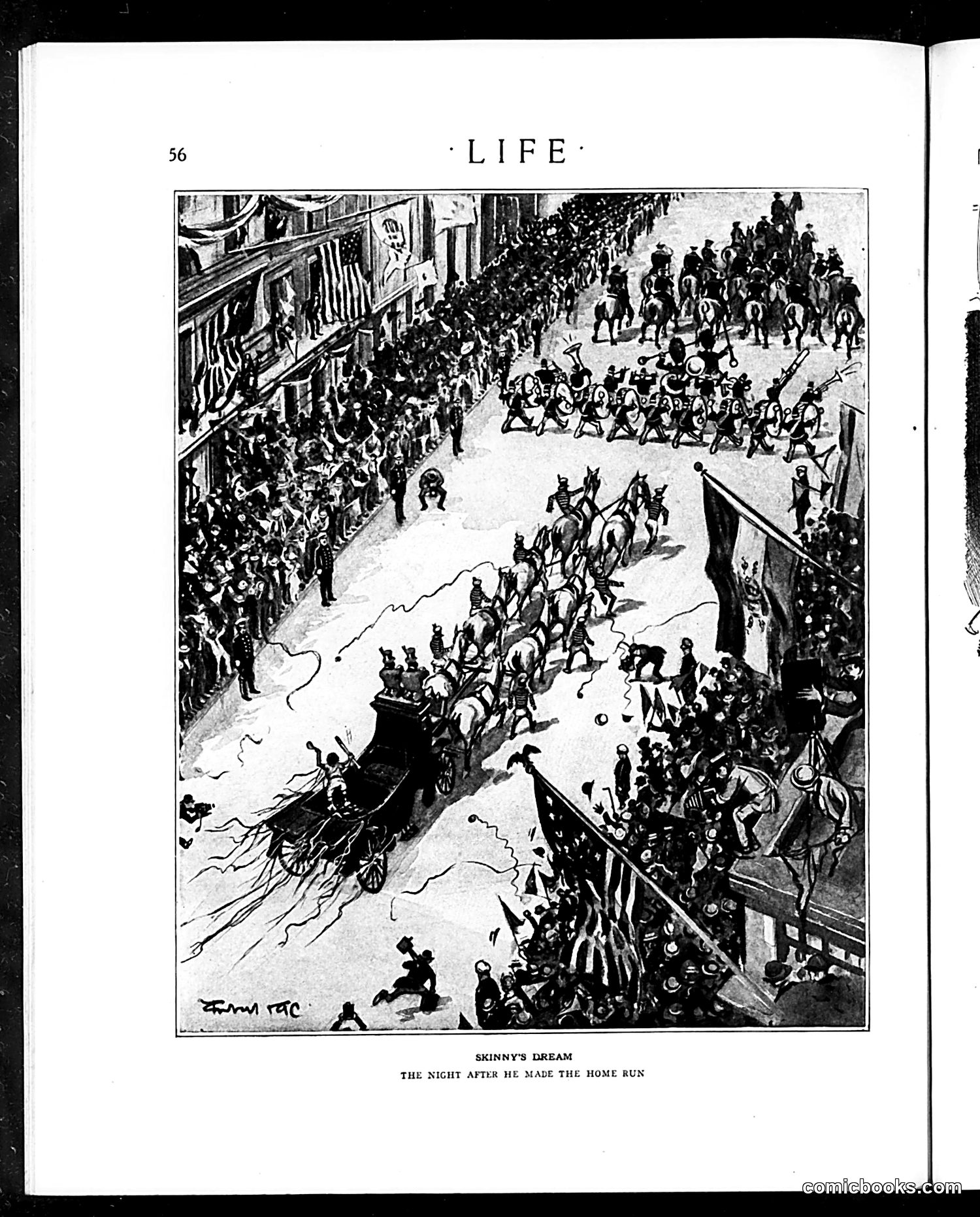
This is a satirical cartoon about baseball celebrity and public adulation. "Skinny" appears to be a baseball player who has just hit a home run—a significant achievement that would have made him a local hero. The cartoon depicts his fantasy of the celebration that follows: massive crowds lining the streets, military processions, flags, and civic pageantry typically reserved for war heroes or major political figures. The satire lies in the exaggeration—showing how baseball stardom in early 20th-century America could elevate an ordinary player to celebrity status rivaling military or political heroes, with corresponding public celebrations and adoration. The joke mocks both the excessive glorification of sports athletes and the public's enthusiasm for such spectacles.
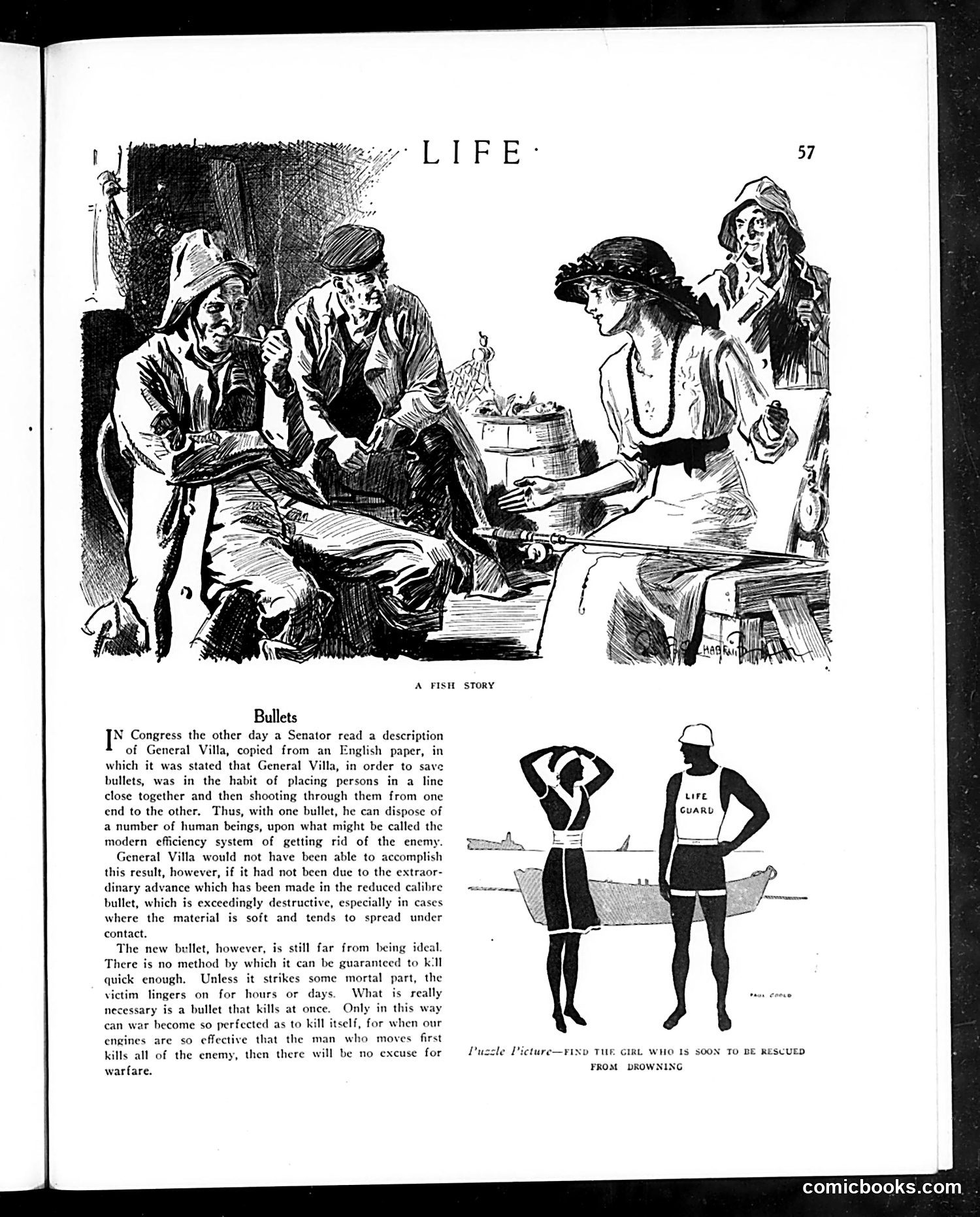
This Life magazine page contains two distinct pieces: **"A Fish Story"** (top): A sketch showing what appears to be working-class men and a woman at a table with a barrel, likely depicting a humorous anecdote or domestic scene. The exact narrative is unclear from the image alone. **"Bullets"** (bottom): An article discussing General Villa (likely Pancho Villa, the Mexican revolutionary general) and bullet effectiveness in warfare. The text debates whether bullets are sufficiently lethal, arguing that modern warfare requires ammunition that kills instantly rather than leaves victims lingering. This appears to be satirical commentary on military efficiency and the brutal calculus of warfare. **"Puzzle Picture"** (right): An illustration showing two figures in swimwear with the caption about finding "the girl who is soon to be rescued from drowning"—a visual puzzle for readers. The page reflects early 20th-century American satirical commentary on military matters and popular entertainment.
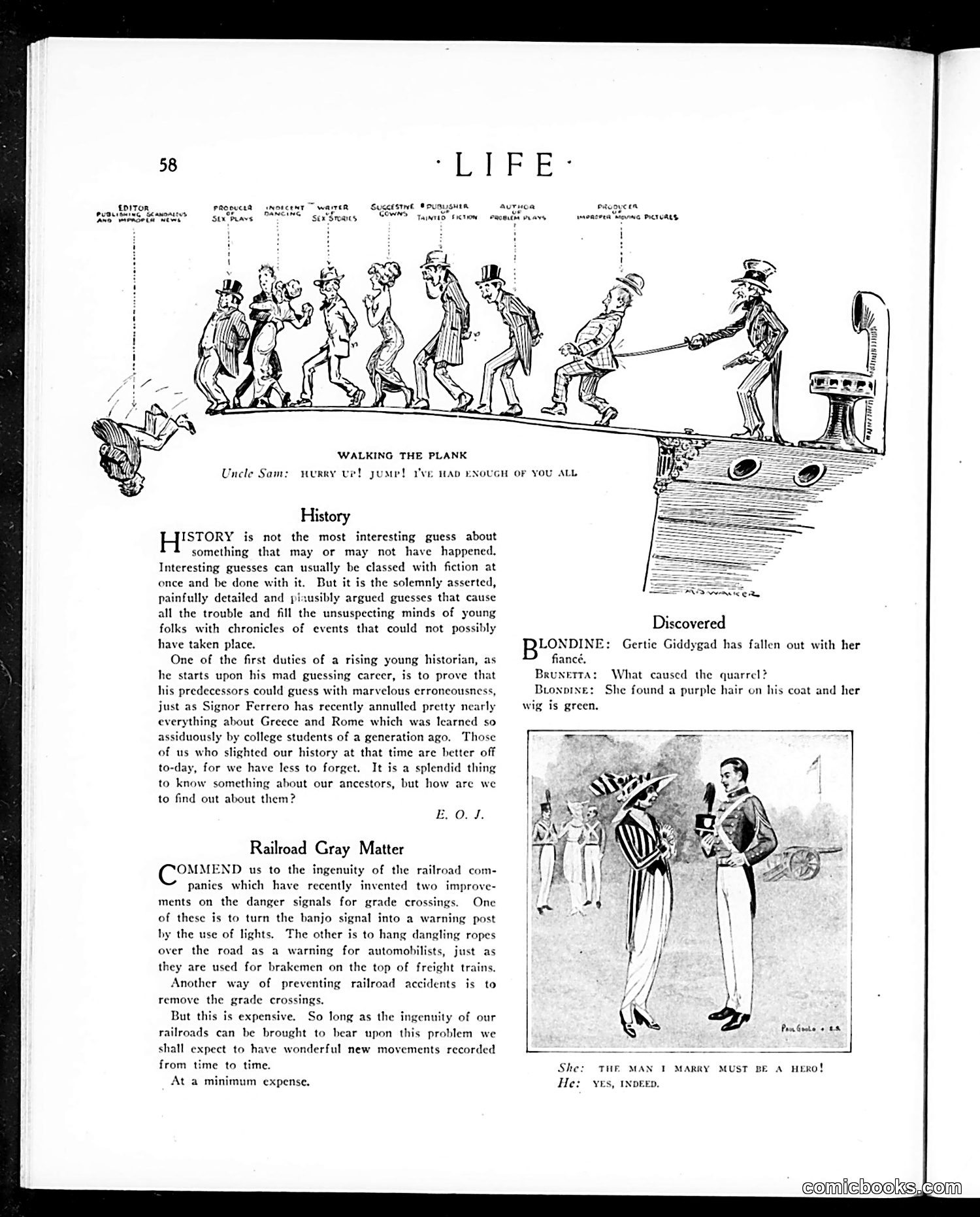
**Top Cartoon - "Walking the Plank":** This political cartoon depicts the evolution of a figure from left to right, labeled with various roles (Editor, Prohibitionist, Vagrant, etc.), culminating in being forced to "walk the plank" off a ship. The caption quotes Uncle Sam demanding the figure "hurry up! jump! I've had enough of you all." This appears to be satirizing a specific political figure or faction being pressured out of American society, likely referencing Prohibition-era politics or an unpopular political movement. **Lower Content:** The page includes a brief article on historical accuracy, a section on railroad safety innovations, and a small cartoon captioned "The man I marry must be a hero!" depicting romantic/matrimonial satire typical of Life's social commentary.
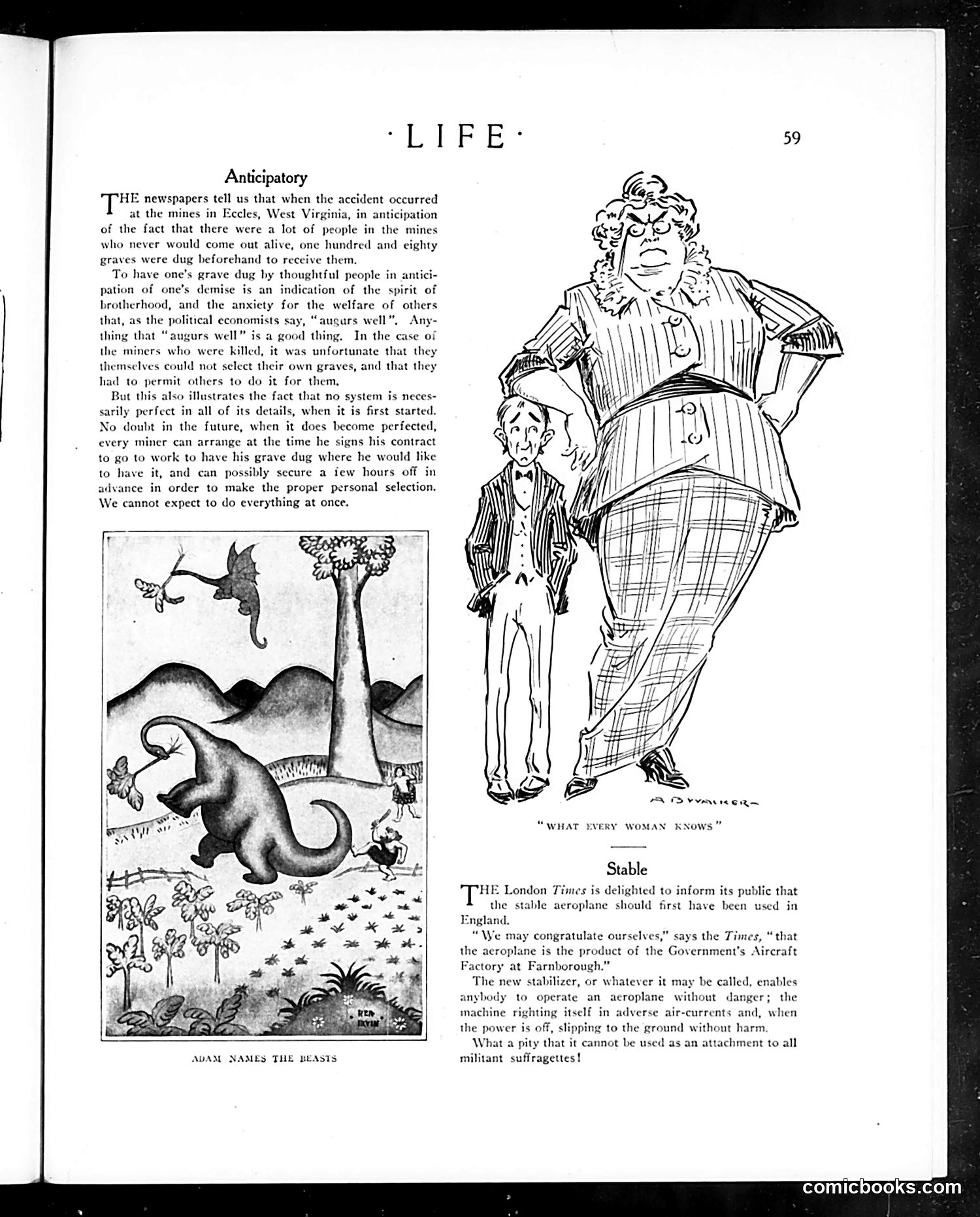
**"Anticipatory"** section: This piece satirizes the pre-digging of 180 graves for miners in Eccles, West Virginia, following a mining disaster. Life sardonically praises this as demonstrating "brotherhood" while mocking the grim practicality—miners couldn't even choose their own burial sites. The satire critiques both the mining industry's deadly conditions and the hollow "political economist" language used to justify inadequate safety systems. **"Stable"** section: This targets British nationalism and the suffragette movement. It celebrates a new airplane stabilizer developed at England's Farnborough factory, then delivers a cutting final line: the writer wishes this safety device could be "attached to all militant suffragettes"—sarcastically suggesting suffragettes are as dangerous and uncontrollable as unstable aircraft. This reflects anti-suffragette sentiment common in 1910s satirical publications. Both pieces use dark irony to critique contemporary social institutions.
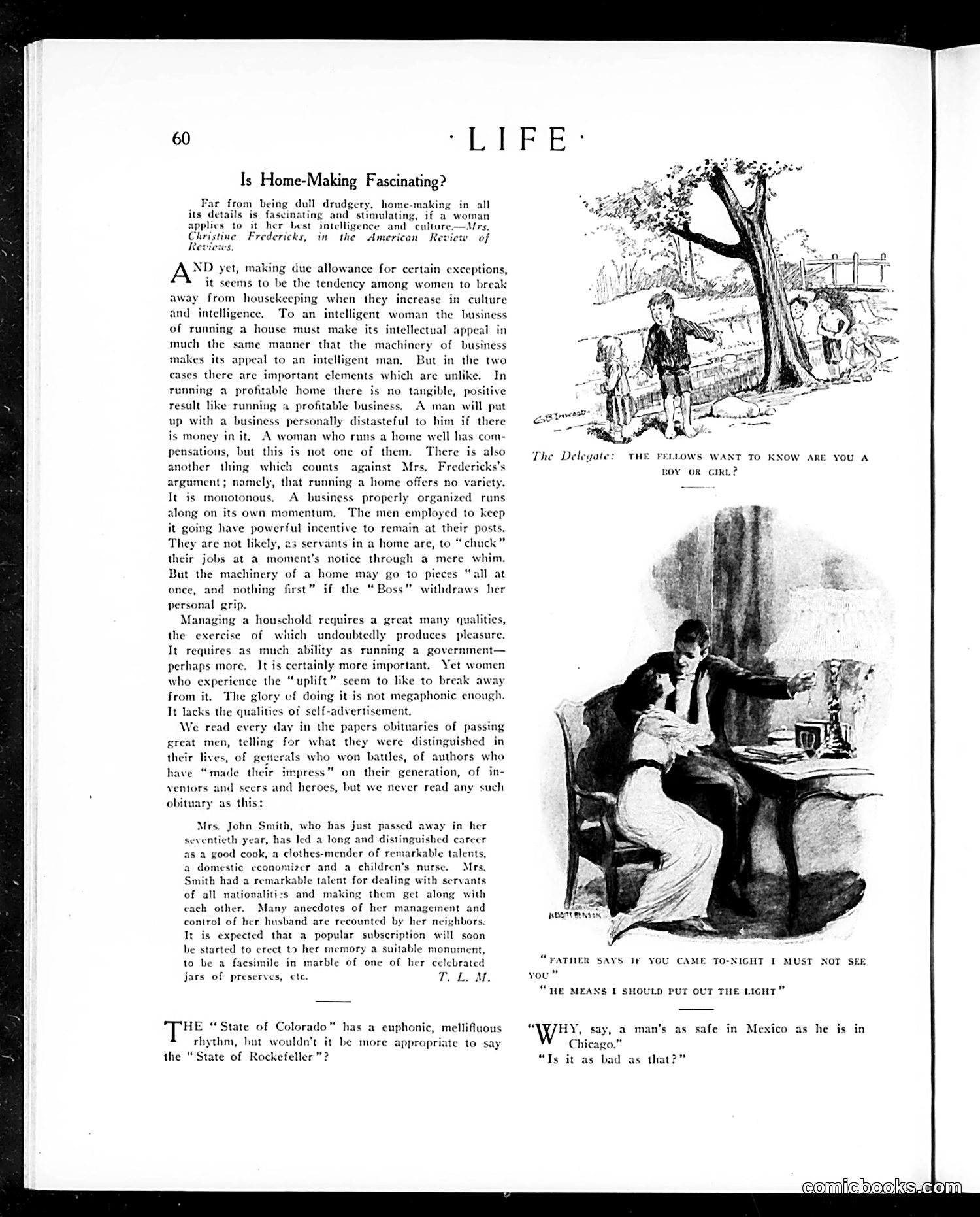
This page critiques the tension between women's domestic roles and their intellectual aspirations, circa early 1900s. **Main Article:** "Is Home-Making Fascinating?" argues against Christine Frederick's claim that housekeeping satisfies intelligent women. The author contends that housework lacks the tangible rewards and public recognition of business—men won't run unprofitable ventures, but women managing homes get no financial compensation or social acclaim. The satirical "Mrs. John Smith" obituary mocks society's refusal to honor domestic achievements; her marble monument would be a pickle jar, not a statue. **Top Cartoon:** Two boys ask a delegate (possibly political) "Are you a boy or girl?"—likely satirizing perceived weakness or indecision in leadership. **Bottom Cartoon:** Depicts a domestic scene where "Father" warns someone not to visit tonight or he'll "put out the light," with a reply about safety in Mexico versus Chicago—appears to reference dangers (possibly romantic or criminal) in American cities versus abroad. The page reflects Progressive Era anxieties about women's education, ambition, and traditional roles.
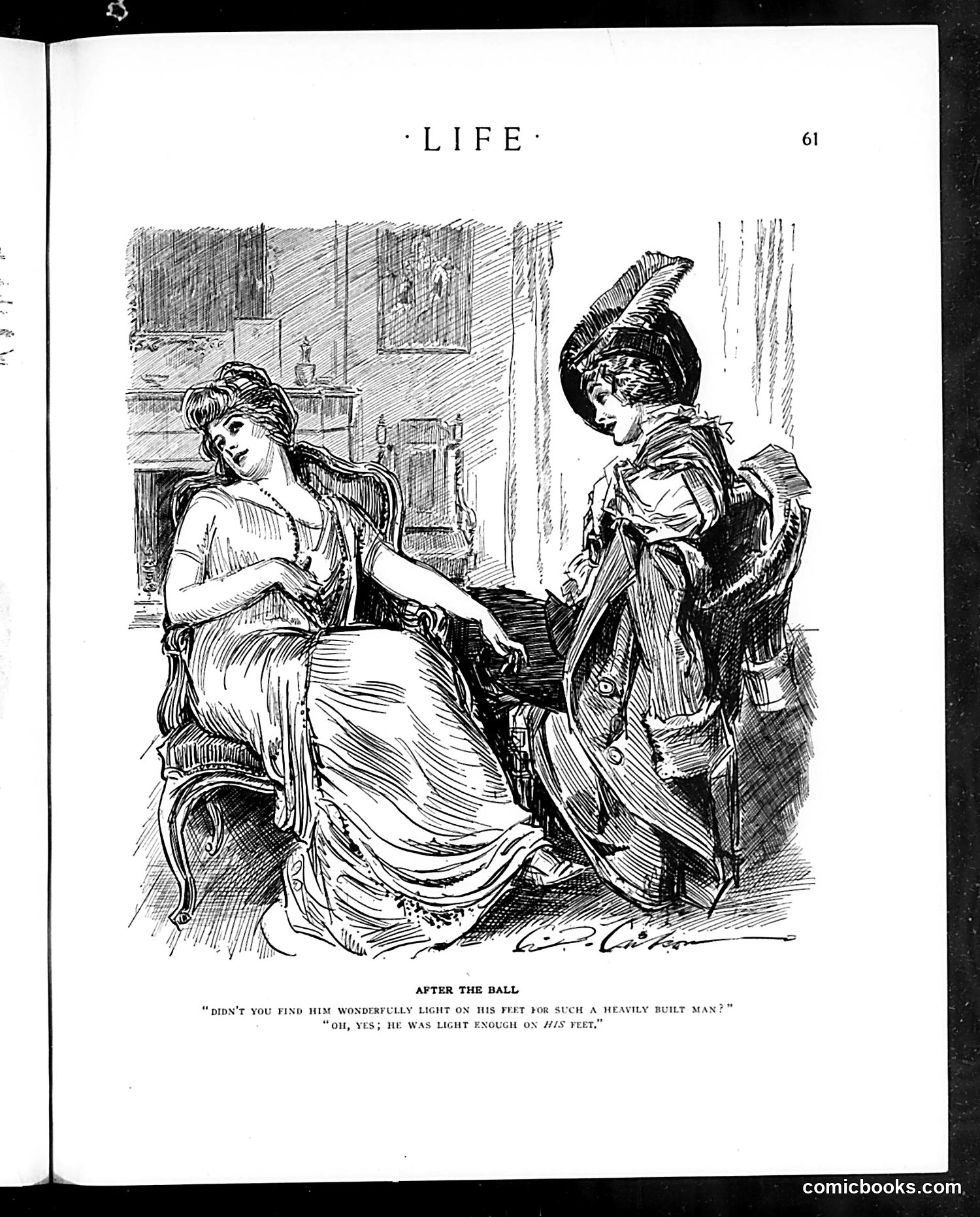
This illustration satirizes a conversation between two women discussing a man's dancing ability at a formal ball. The humor operates on a double meaning: one woman compliments how "light on his feet" a heavy man was while dancing, implying graceful movement. The other woman's reply—"he was light enough on *his* feet"—contains a witty, possibly insinuating secondary meaning, suggesting the man was either frivolous, unfaithful, or otherwise morally "light" in his conduct. The satire likely mocks upper-class social pretense and the coded language women used when discussing men's character flaws in polite society. The elaborate period clothing and interior setting establish the formal social context where such subtle insults could be delivered behind courteous facades.
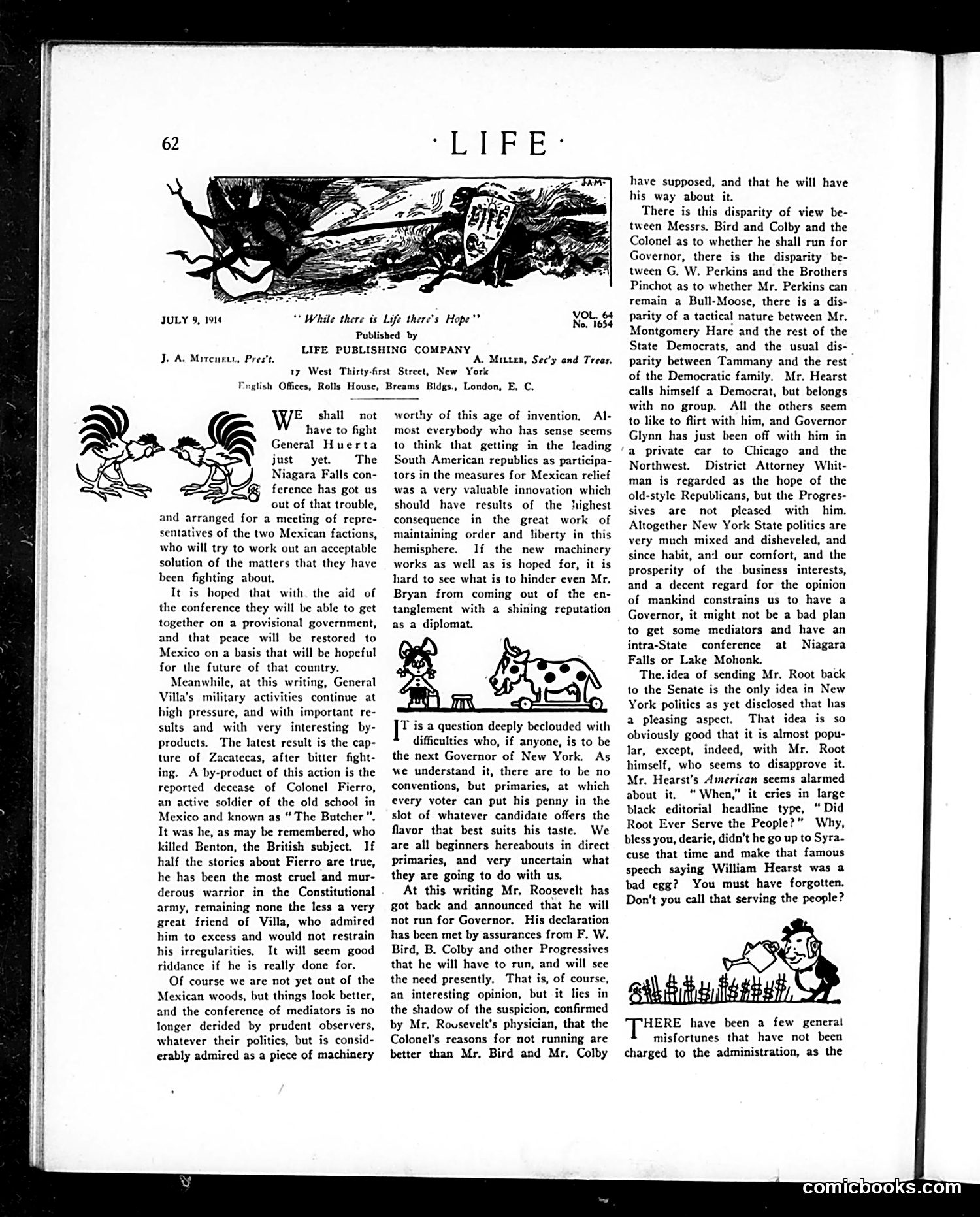
This page discusses two major American political issues of 1914: **Mexico**: The Niagara Falls conference temporarily eased tensions with General Huerta's government. The text celebrates this diplomatic success and reports Villa's military victories, including the capture of Zacatecas and the apparent death of Colonel Fierro ("The Butcher"), a notorious brutal officer. **New York Governor's Race**: The article addresses confusion over the new direct primary system for selecting candidates. Theodore Roosevelt has announced he won't run for Governor, but Progressive leaders (F.W. Bird, B. Colby) publicly insist he'll reconsider. The text notes Roosevelt's physician has confirmed his reasons for declining, suggesting health concerns. The piece also references tensions within Progressive circles between G.W. Perkins and the Pinchot brothers over party allegiance. The cartoons (roosters fighting, cow on platform) appear to illustrate political conflict and uncertainty, though their specific references are unclear from this page alone.
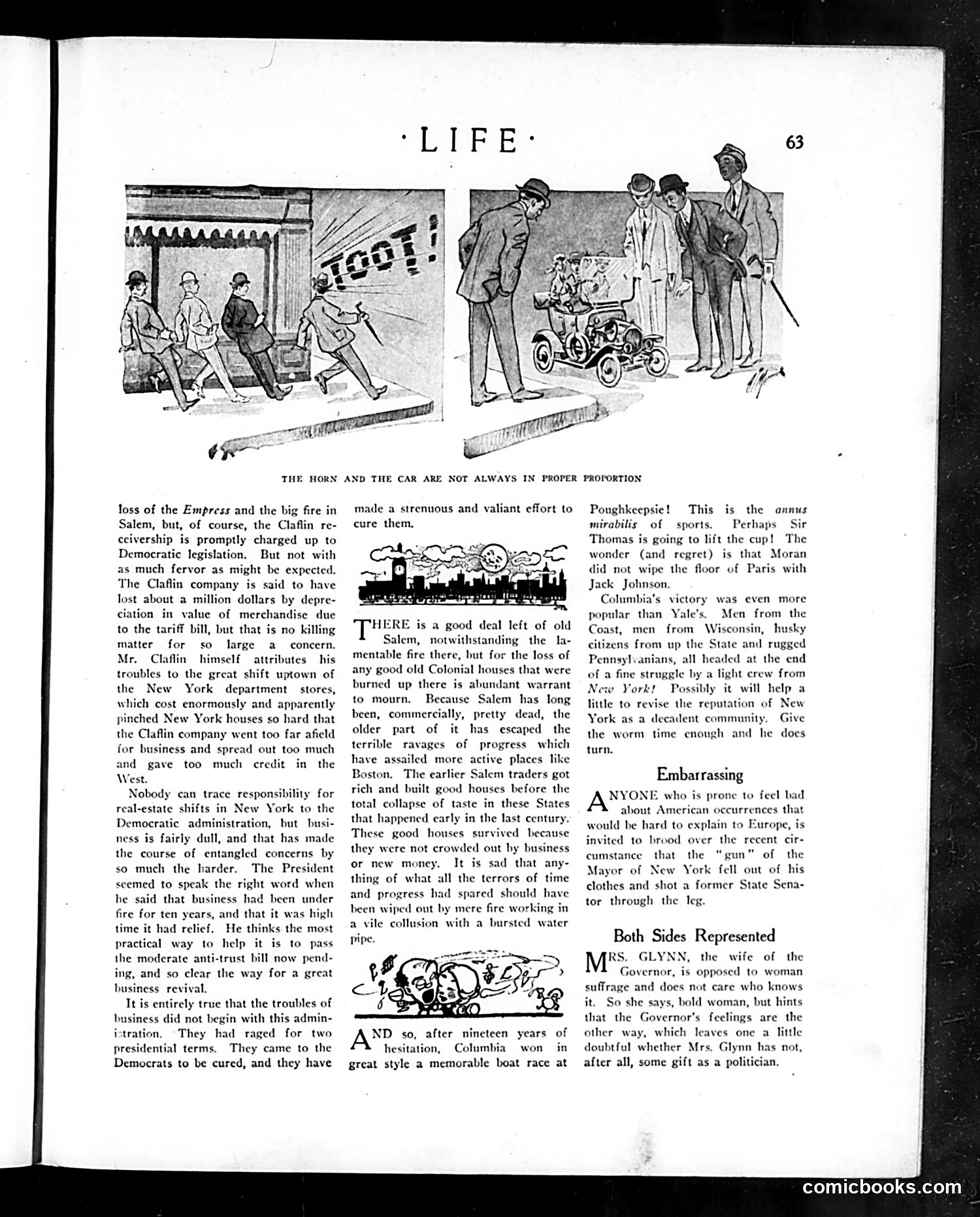
This page contains three distinct satirical pieces from Life magazine: **Top cartoons**: "The Horn and the Car Are Not Always in Proper Proportion" depicts men reacting with exaggerated concern to a child's toy car—a visual joke about adults overreacting to minor matters. **Main text**: Discusses business troubles attributed to the Democratic administration, particularly the Claflin company's financial collapse. The author argues these problems predate the current administration and stem from real-estate shifts and economic conditions, not necessarily Democratic policy. He suggests an anti-trust bill could help business recovery. **Salem fire commentary**: Laments the loss of Colonial-era buildings in Salem, noting older structures survived because they weren't displaced by commercial development—unlike more prosperous cities. **Sports note**: Celebrates Columbia University's rowing victory at Poughkeepsie, contrasting favorably with Jack Johnson's boxing match in Paris (likely referencing contemporary boxing scandals). **Embarrassing incident**: References a New York official accidentally shooting a former senator. **Mrs. Glynn item**: Notes the Governor's wife publicly opposes women's suffrage while hinting her husband supports it—satirizing political contradiction.
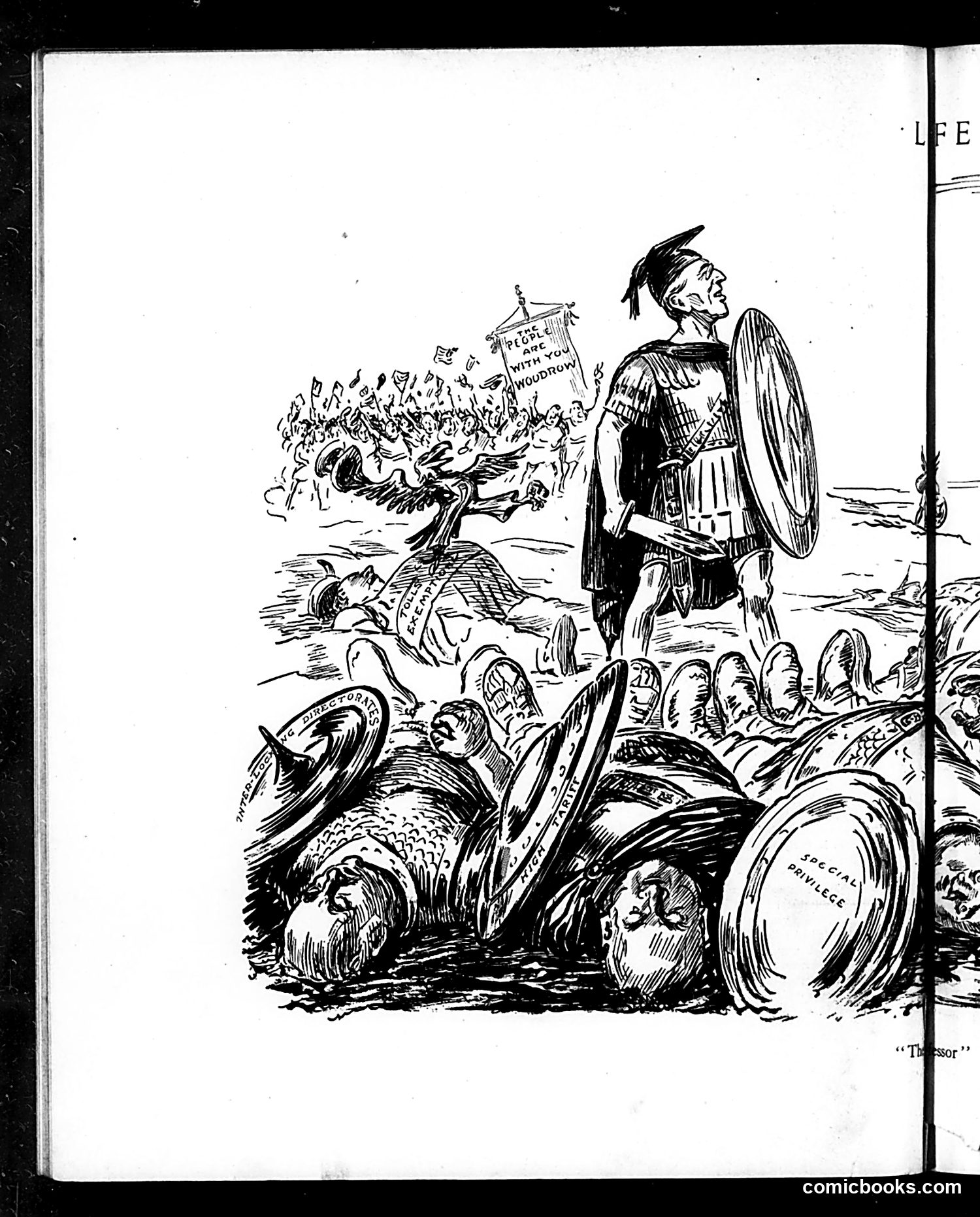
This is a satirical cartoon depicting a stern military or authority figure standing guard over fallen bodies labeled with terms like "SOCIAL PRIVILEGE." In the background, a crowd carries a banner reading "RECEDE AND WITHDRAW" while chaos ensues. The cartoon appears to criticize how those in power maintain authority and privilege even as populations demand change or reform. The military figure represents entrenched institutional power, while the bodies at his feet suggest that social privileges persist despite public pressure for reform (indicated by the crowd's demands to "recede"). The satire suggests that those holding power refuse to yield their advantages despite popular opposition, using military or state force to protect their status. The artist's signature appears to read "Thestor."
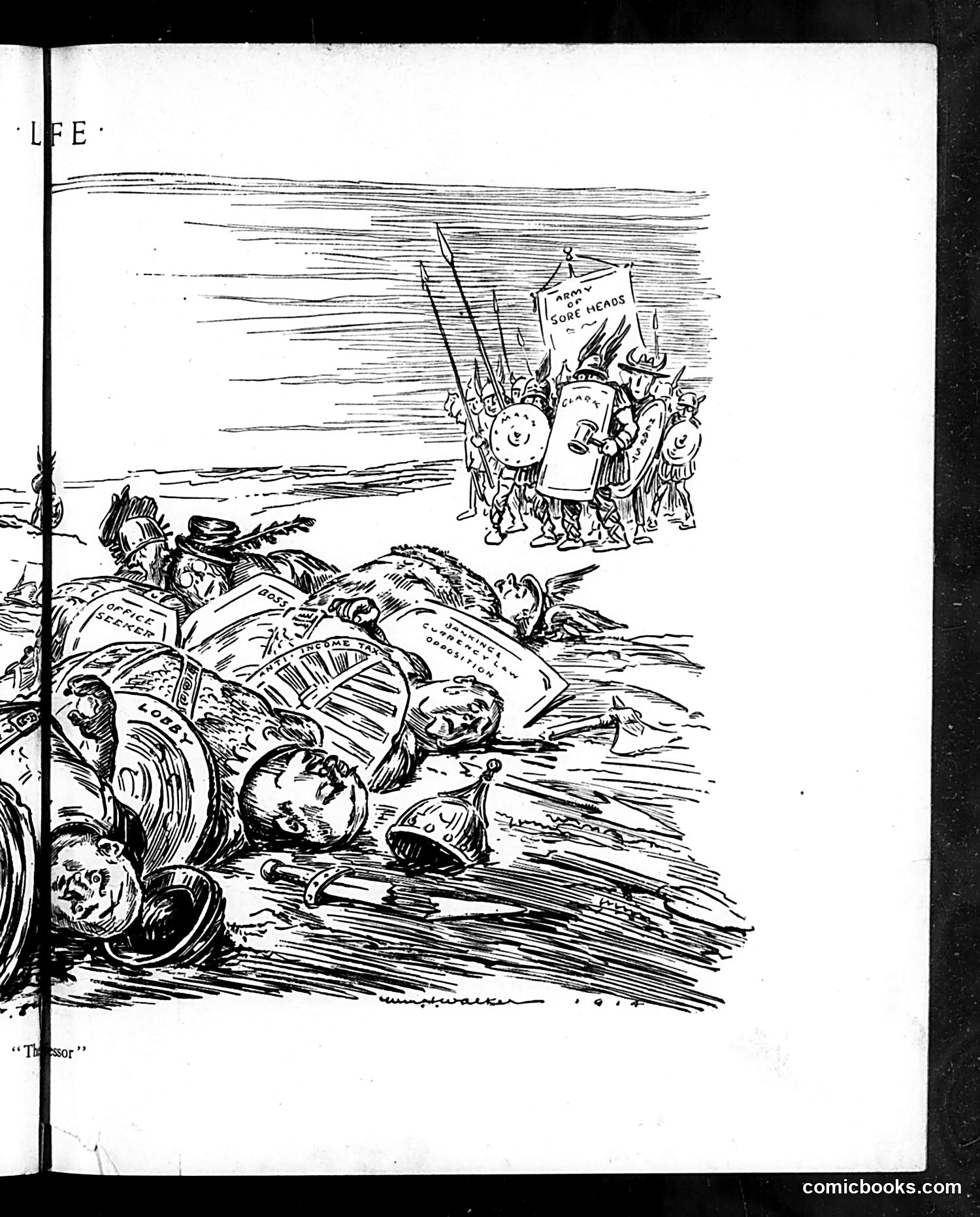
This political cartoon depicts a stark contrast: in the foreground, a pile of severed heads labeled with names like "SPENCER" and other identifiable figures; in the background, a triumphant procession carrying a banner reading "ARMY OF SORE HEADS [?]." The cartoon appears to satirize political purges or executions—the dead "heads" suggest eliminated rivals or opponents. The marching "army of sore heads" likely mocks surviving political figures who claim victimhood or grievance after their colleagues' removal. Without clearer date visibility or complete text, the specific historical event remains uncertain—this could reference Russian Revolution purges, internal political conflicts, or another contemporaneous bloodletting. The title "Tosssor" is unclear in meaning.
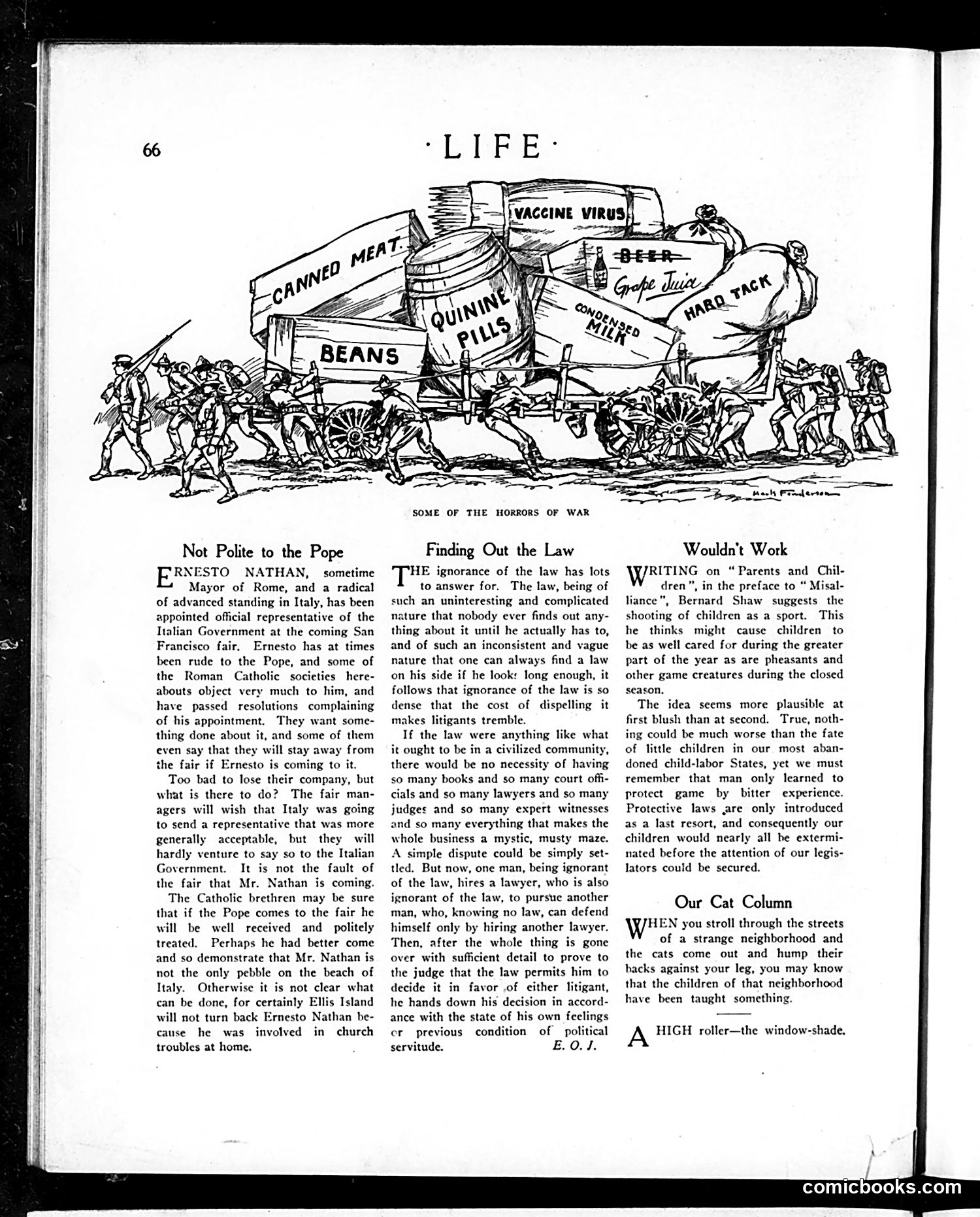
**Main Cartoon ("Some of the Horrors of War"):** A massive wagon laden with wartime goods—canned meat, beans, quinine pills, vaccine virus, beer, grape juice, condensed milk, hard tack—is pulled by soldiers like draft animals. This satirizes how war reduces soldiers to beasts of burden, forcing them to transport supplies that often prove inadequate or harmful to their health. **"Not Polite to the Pope":** Reports on Ernesto Nathan, a radical Italian mayor appointed to represent Italy at San Francisco's fair. Catholic organizations object because Nathan has previously been antagonistic to the Pope, even threatening to boycott. The piece wryly notes the fair managers cannot refuse him without offending the Italian government. **"Finding Out the Law":** Criticizes legal system complexity—ignorant clients hire ignorant lawyers to sue other ignorant defendants, who hire more lawyers. The satirist (E.O.J.) argues the law's deliberately obscure nature enriches the legal profession while ordinary disputes remain expensive and uncertain. **"Wouldn't Work":** Dismisses George Bernard Shaw's joking proposal to shoot children as "sport" to improve child welfare, arguing protective laws only emerge after public outcry—by then, most children would be dead.
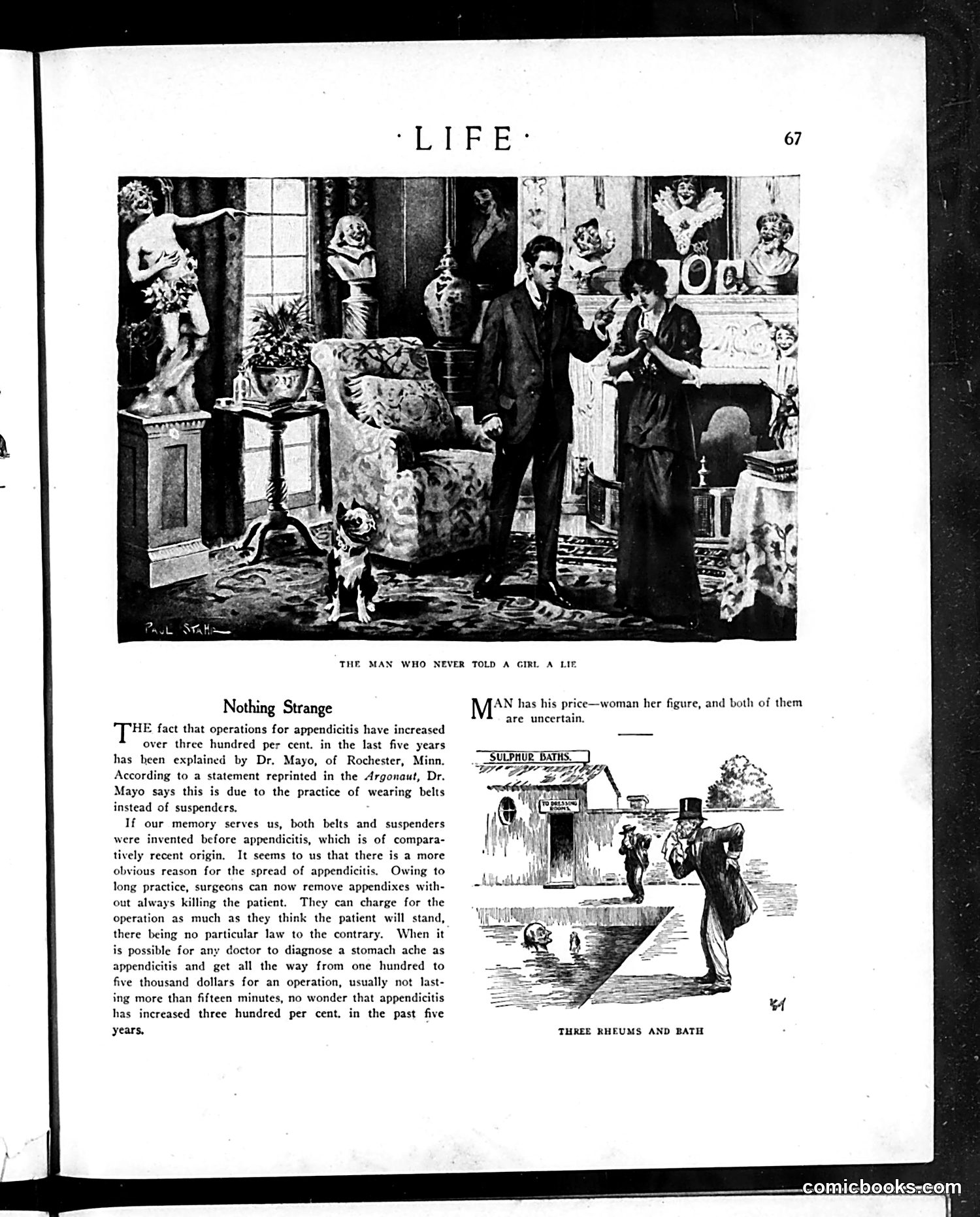
This page contains satirical commentary on two medical issues: **"Nothing Strange"** critiques the explosion in appendicitis diagnoses and operations. The text sarcastically dismisses Dr. Mayo's claim that belts cause appendicitis, instead suggesting the *real* reason: financial incentive. The author argues that because surgeons can now perform appendectomies safely and charge $100-$5,000 for a 15-minute procedure with minimal legal oversight, doctors are diagnosing stomach aches as appendicitis to profit. The satire implies unnecessary surgeries have tripled in five years due to greed rather than medical necessity. **"The Man Who Never Told a Girl a Lie"** (top illustration) and the accompanying text below it appear unrelated to the appendicitis piece. The caption and illustration suggest commentary on courtship or romantic deception, though details are unclear from this page alone. **"Three Rheums and Bath"** (bottom sketch) appears to be advertising or illustrative content, its meaning unclear from the visible portion. The page exemplifies early 20th-century *Life* magazine's practice of mixing medical/social criticism with humor and advertisements.
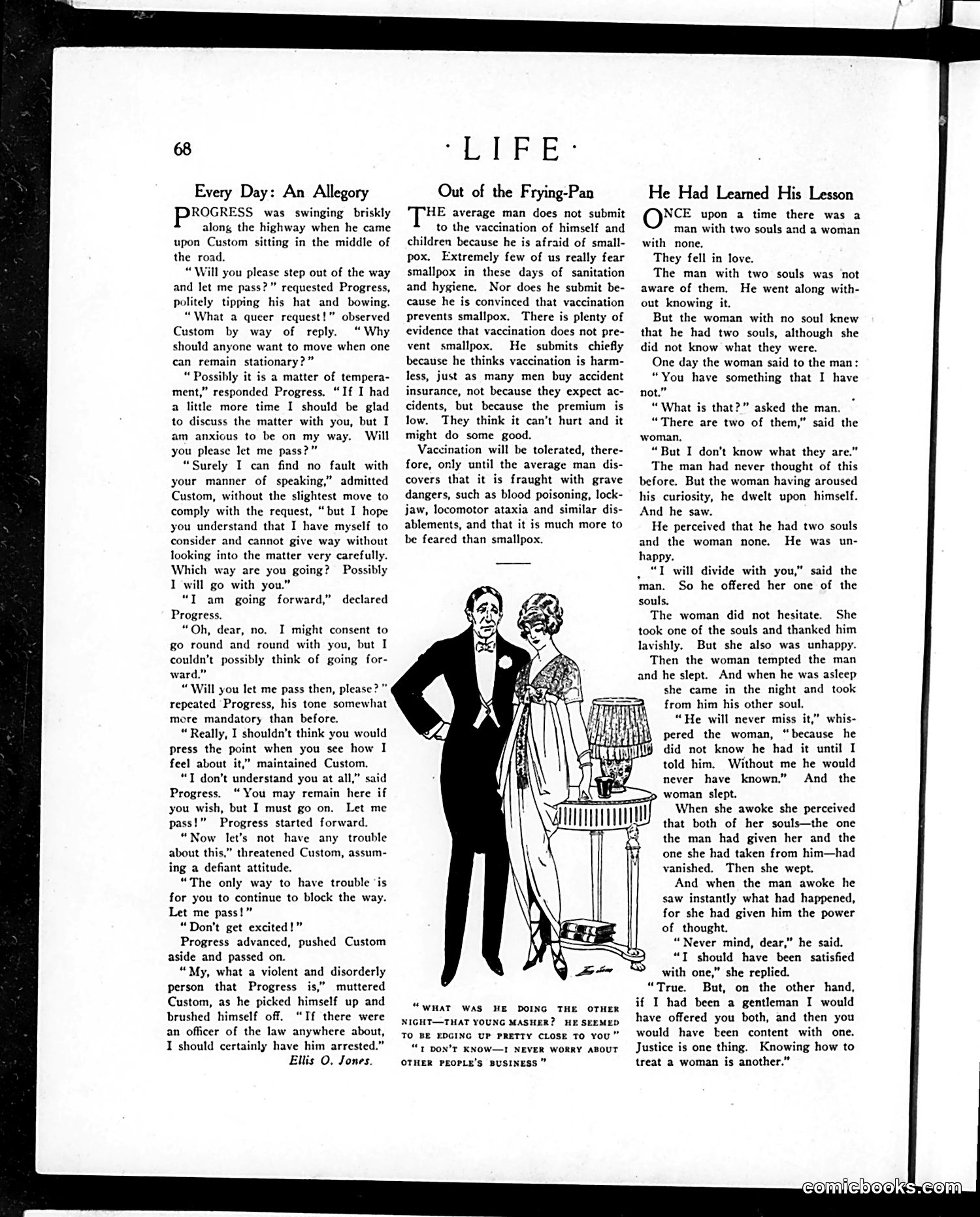
This page contains three distinct pieces of satirical content: **"Every Day: An Allegory"** (main story with illustration) uses personified characters—Progress and Custom—to satirize resistance to social change. Progress seeks to move forward while Custom blocks the road, stubbornly refusing to yield. When Progress physically pushes past, Custom complains of being "violent and disorderly," threatening legal action. The satire criticizes how established tradition resists innovation and then claims victimhood when forced aside—a commentary on early 20th-century debates over modernization. **"Out of the Frying-Pan"** argues that people accept vaccination not from fear of disease or belief in prevention, but because they think it's harmless. The piece predicts tolerance will end once people discover alleged serious side effects (blood poisoning, lockjaw, locomotor ataxia). This reflects contemporary anti-vaccination sentiment. **"He Had Learned His Lesson"** is a brief allegorical fable about a man discovering his own "souls" (consciousness/identity) through a soulless woman's observation—exploring self-awareness through romantic entanglement.
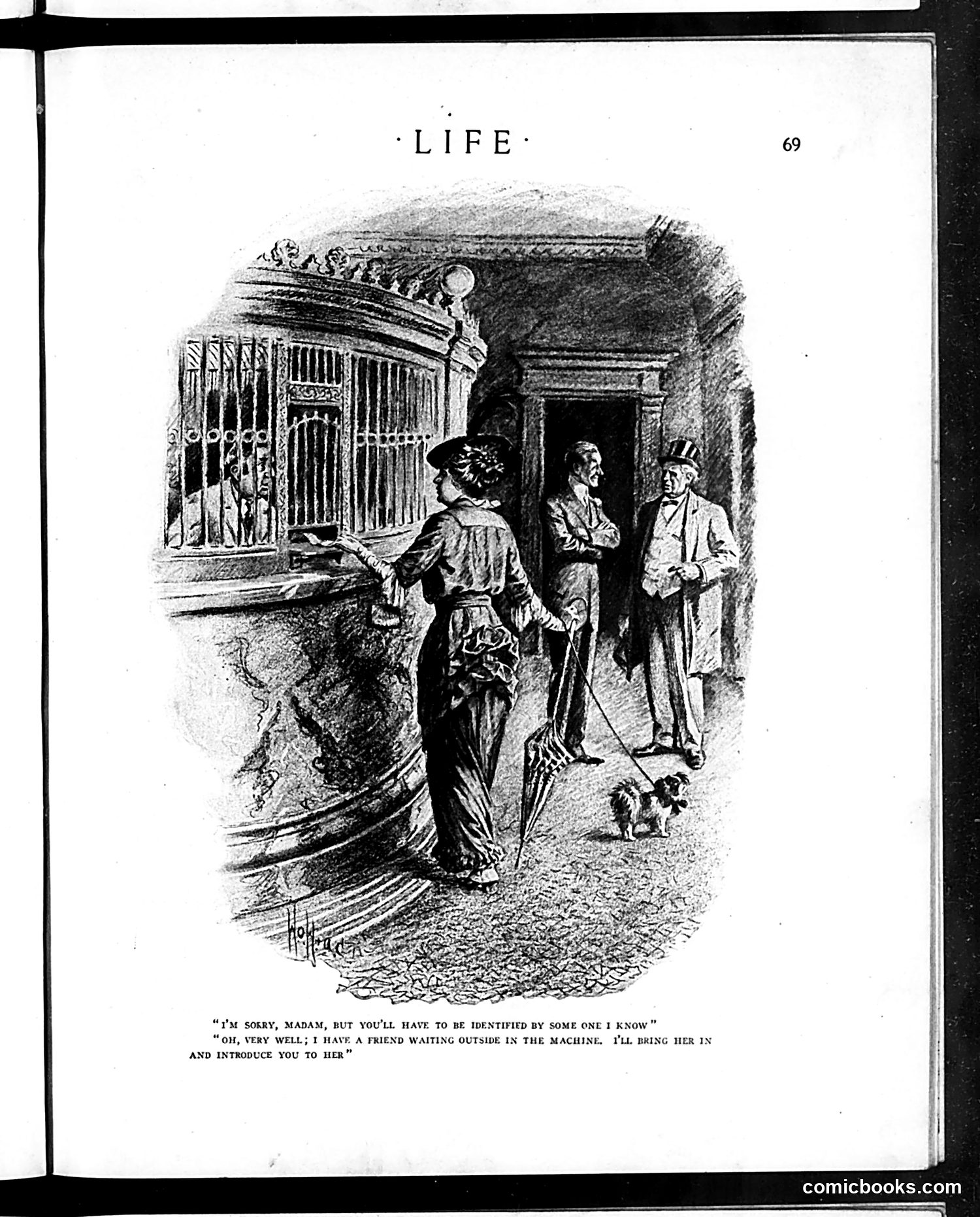
This cartoon satirizes overly strict identification procedures at what appears to be an official institution or secure location (possibly a jail, courthouse, or government building, suggested by the barred window visible on the left). A woman at the entrance is told she cannot enter without being identified by someone known to the official. Her solution—bringing in a friend from "the machine" (a car) to vouch for her—exposes the absurdity of the security measure: if the official doesn't know the first woman, he presumably won't know her friend either, making the identification process meaningless. The humor targets bureaucratic inefficiency and the illogical application of rules by officials who follow procedures without considering their actual purpose.
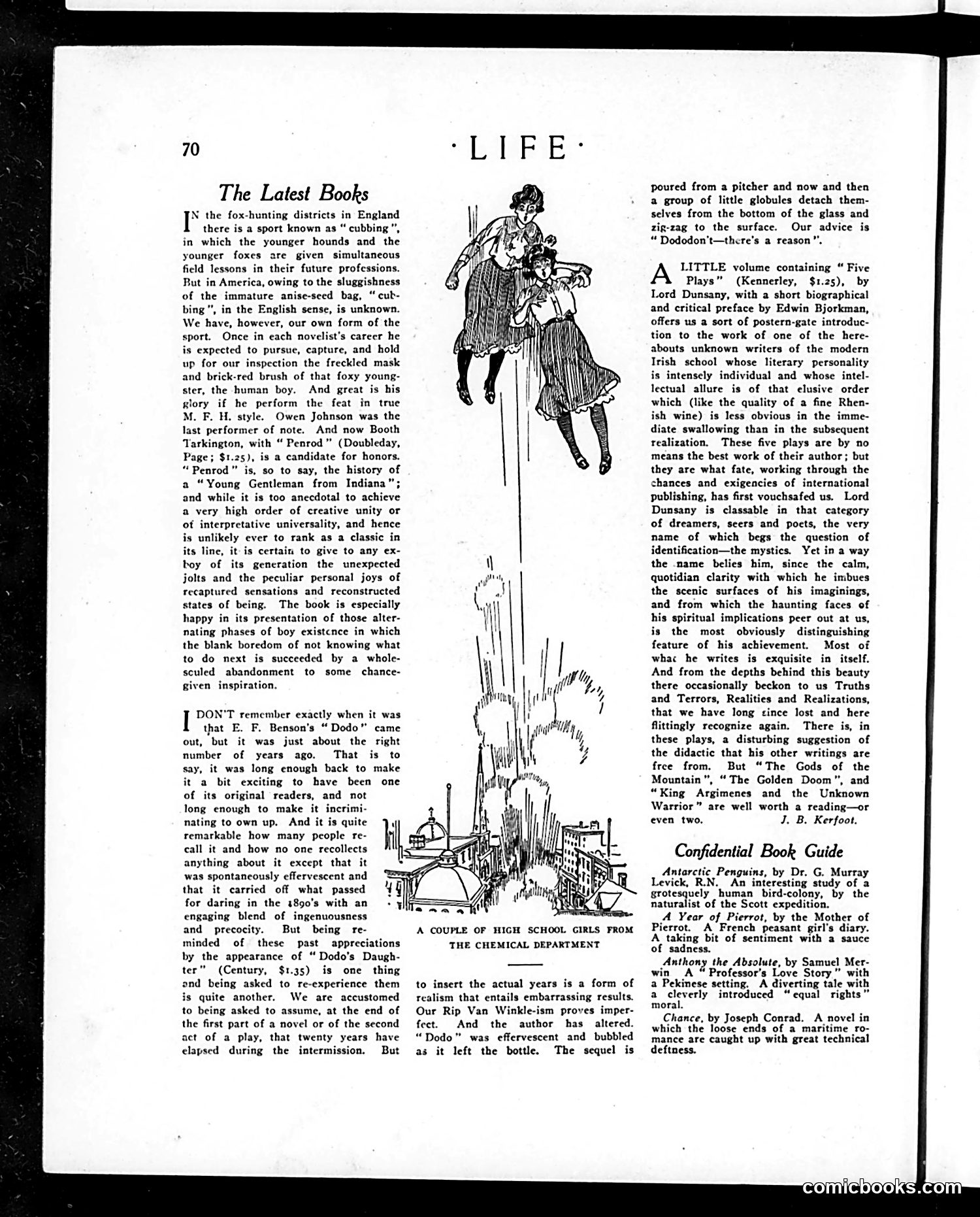
This page contains literary reviews, not political cartoons. The main illustration shows two high school girls from a chemistry department, likely accompanying a humorous anecdote about their experiment (the caption reads "A Couple of High School Girls From The Chemical Department"). The reviews discuss contemporary novels: Booth Tarkington's *Penrod* (about a mischievous Indiana boy), E.F. Benson's *Dodo's Daughter* (a sequel to an 1890s novel), and Lord Dunsany's *Five Plays*. The critic dismisses *Dodo's Daughter* as flat compared to the original, using a clever metaphor: the original "bubbled" when "left the bottle" but the sequel is merely "poured from a pitcher"—a witty way of saying the sequel has lost its sparkle. The page reflects early 20th-century American literary culture and satirizes how sequels rarely match their predecessors.
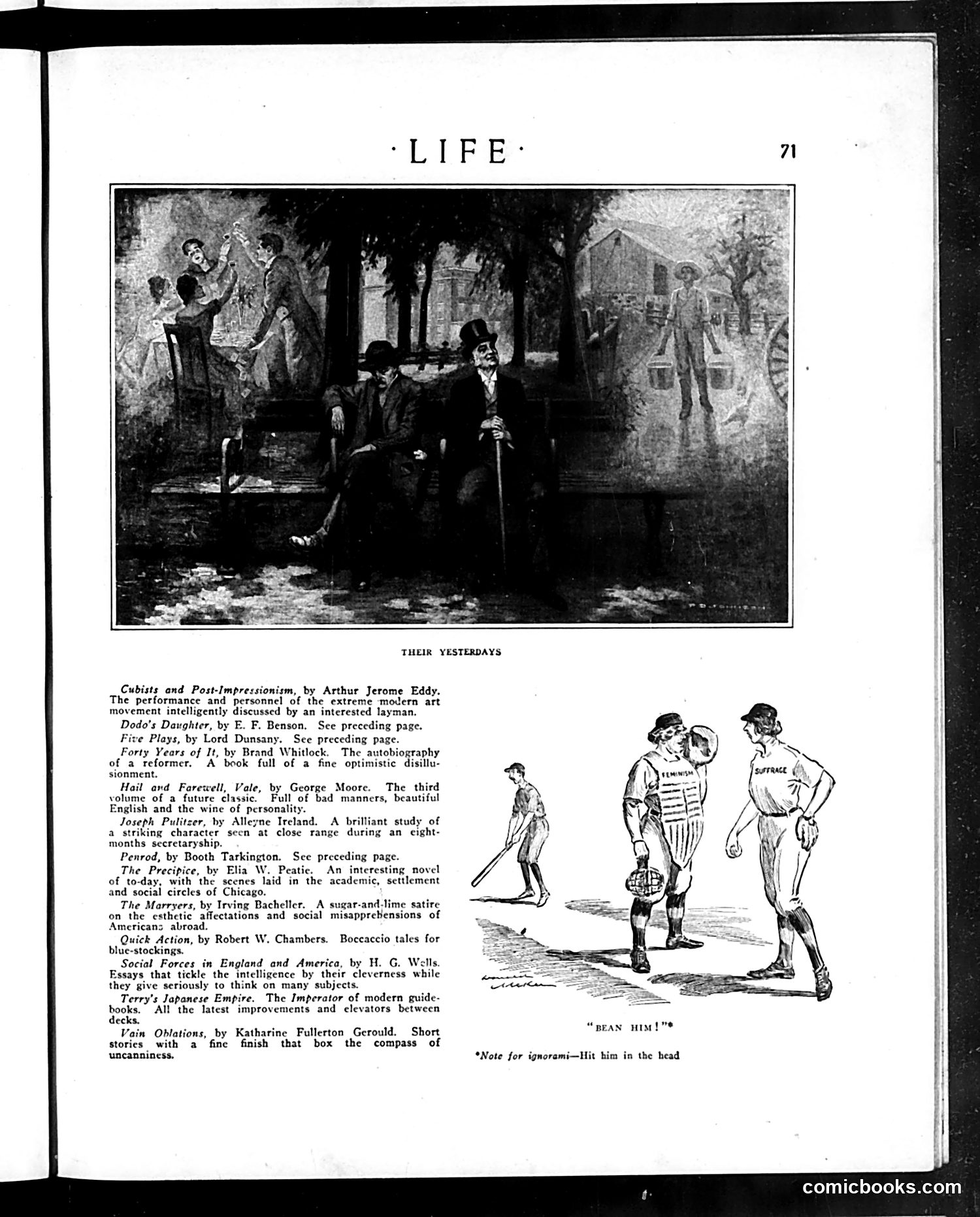
This page is primarily a **book review section** titled "Their Yesterdays," listing new publications from the early 1900s, including works by George Moore, H.G. Wells, and Booth Tarkington. The small illustration at bottom depicts a **baseball scene**—three players in vintage uniforms, with the caption "BEAN HIM!" The accompanying note explains this slang term: "Hit him in the head." This is satirizing the crude violence sometimes encouraged in baseball crowds, contrasting brutish fan behavior with the sophisticated literary works reviewed above. The upper photograph appears to show a **theatrical or social gathering scene**, likely illustrating one of the reviewed books' themes (possibly relating to aestheticism or social commentary, given references to "esthetic affectations"). The humor lies in the juxtaposition: refined literary culture above versus base sports culture below—a commentary on American social contrasts that Life magazine frequently explored for its educated readership.
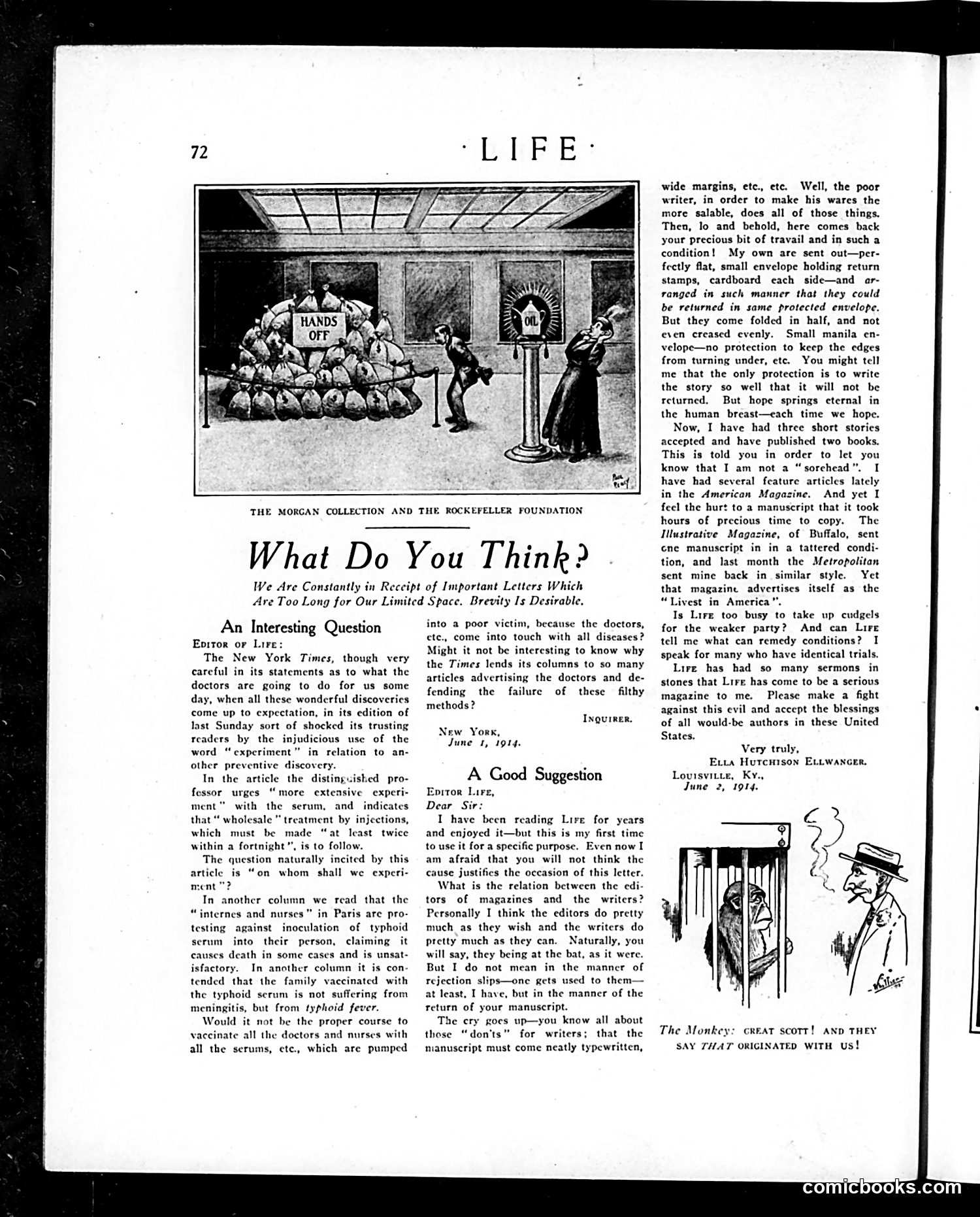
## Main Cartoon: "The Morgan Collection and the Rockefeller Foundation" The cartoon depicts wealthy industrialists' massive art collections being protected by guards marked "HANDS OFF," while ordinary people are kept at a distance. This satirizes the tension between private wealth accumulation and public access to cultural treasures during the Gilded Age. J.P. Morgan and John D. Rockefeller were notorious for amassing enormous art collections; the cartoon mocks how these cultural assets remained largely unavailable to the general public they could have enriched. ## Letters Section The page features two reader letters addressing contemporary concerns: 1. **Medical ethics**: A writer criticizes the New York Times for promoting experimental medical treatments on poor patients while doctors and nurses refuse the same procedures—a pointed critique of unequal medical standards. 2. **Writer treatment**: A published author complains that magazines demand pristine manuscript submissions but return rejected work in damaged condition, revealing editorial hypocrisy. Both letters highlight class disparities and institutional double standards of 1914 America.
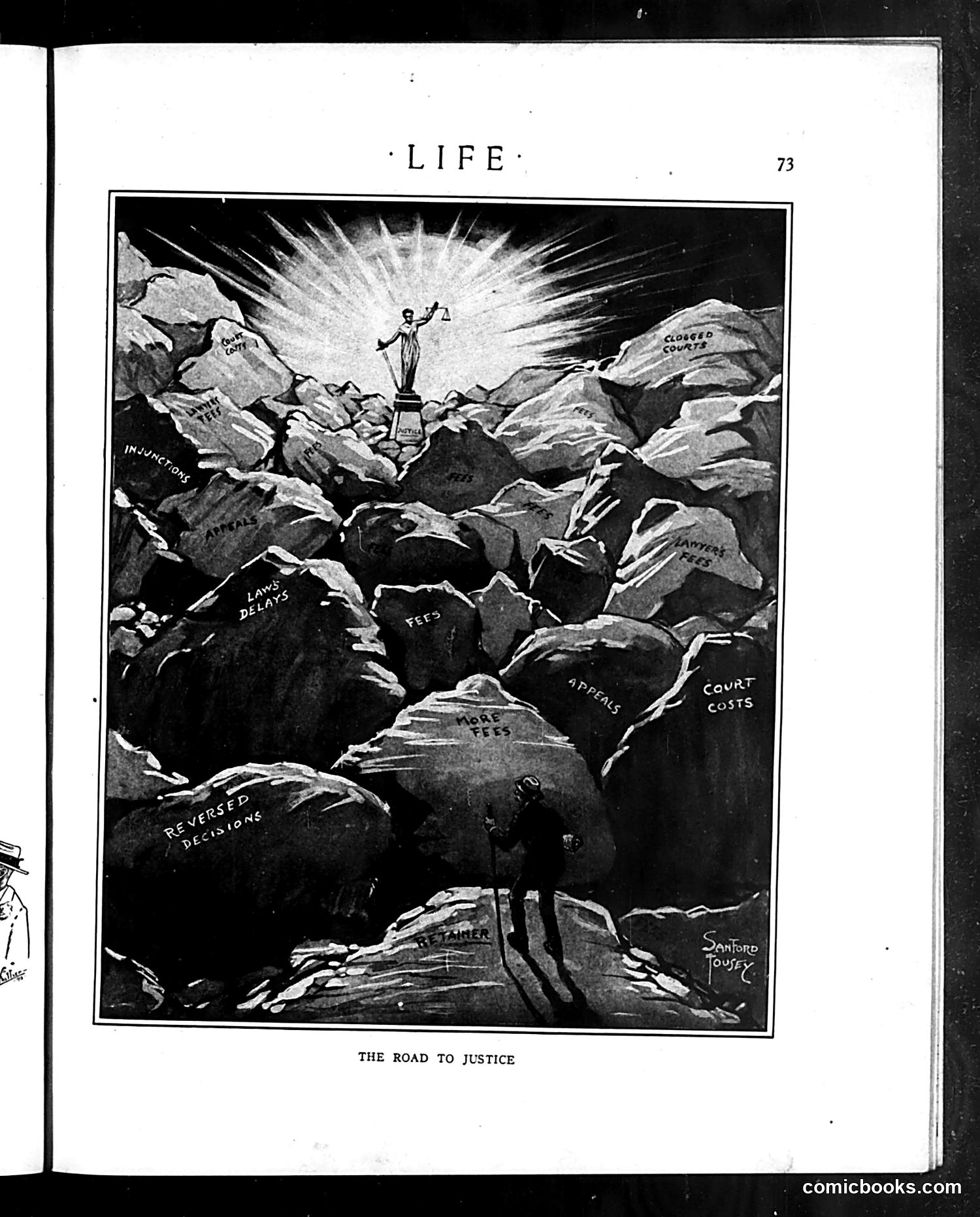
This satirical cartoon depicts the obstacles facing someone (represented by the glowing figure at the summit) pursuing justice through the legal system. The rocky terrain is labeled with various impediments: "INJUNCTION," "LAWS DELAYS," "PETS" (likely "COSTS"), "APPEALS," "COURT COSTS," "MORE FEES," "REVERSED DECISIONS," and "CLOGGED DOCKETS." The cartoon critiques how the American legal system, despite its promise of justice, presents numerous practical and financial barriers to those seeking it. The arduous mountain climb symbolizes the difficult journey, while the radiant figure represents justice itself—presented as nearly unreachable. This reflects early 20th-century Progressive Era concerns about legal reform and accessibility to justice for ordinary citizens.
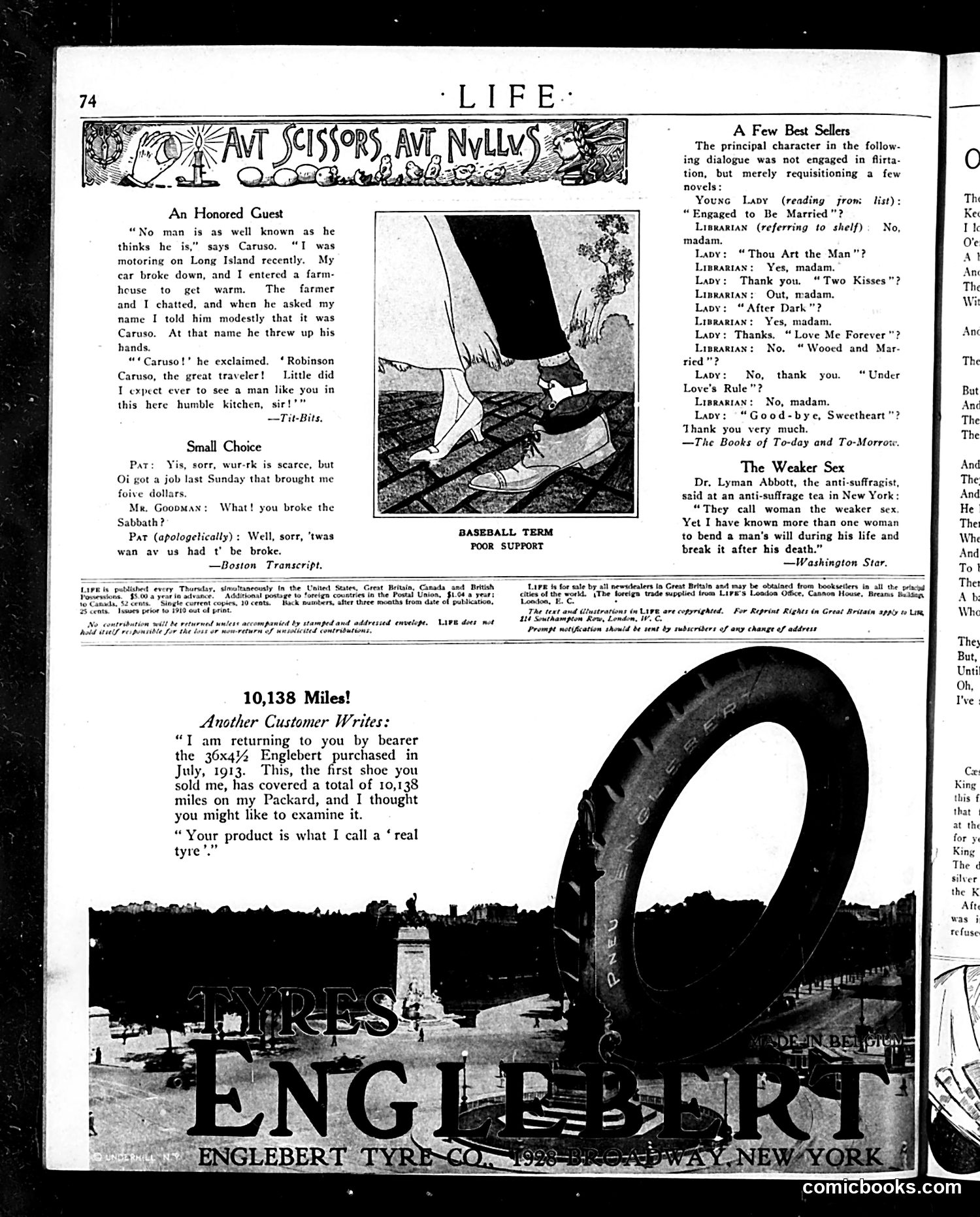
This page contains four separate humor pieces typical of Life's satirical content: **"An Honored Guest"**: Enrico Caruso (famous Italian opera singer) jokes about anonymity—a farmer mistakes him for "Robinson Crusoe" rather than recognizing the renowned performer, deflating celebrity ego. **"Small Choice"**: Irish immigrant "Pat" admits breaking the Sabbath for work, explaining poverty forced the choice between religious observance and survival—gentle satire of working-class desperation. **"Baseball Term/Poor Support"**: A brief quip suggesting a struggling relationship lacks adequate "support" (double meaning). **"The Weaker Sex"**: Anti-suffragist Dr. Lyman Abbott's ironic argument against women's voting rights—women are "weaker" yet control men's wills during life and inherit their estates after death. The satire mocks his contradiction. The page also features an **Englebert Tire advertisement** showing a worn tire that allegedly traveled 10,138 miles, endorsing product durability.
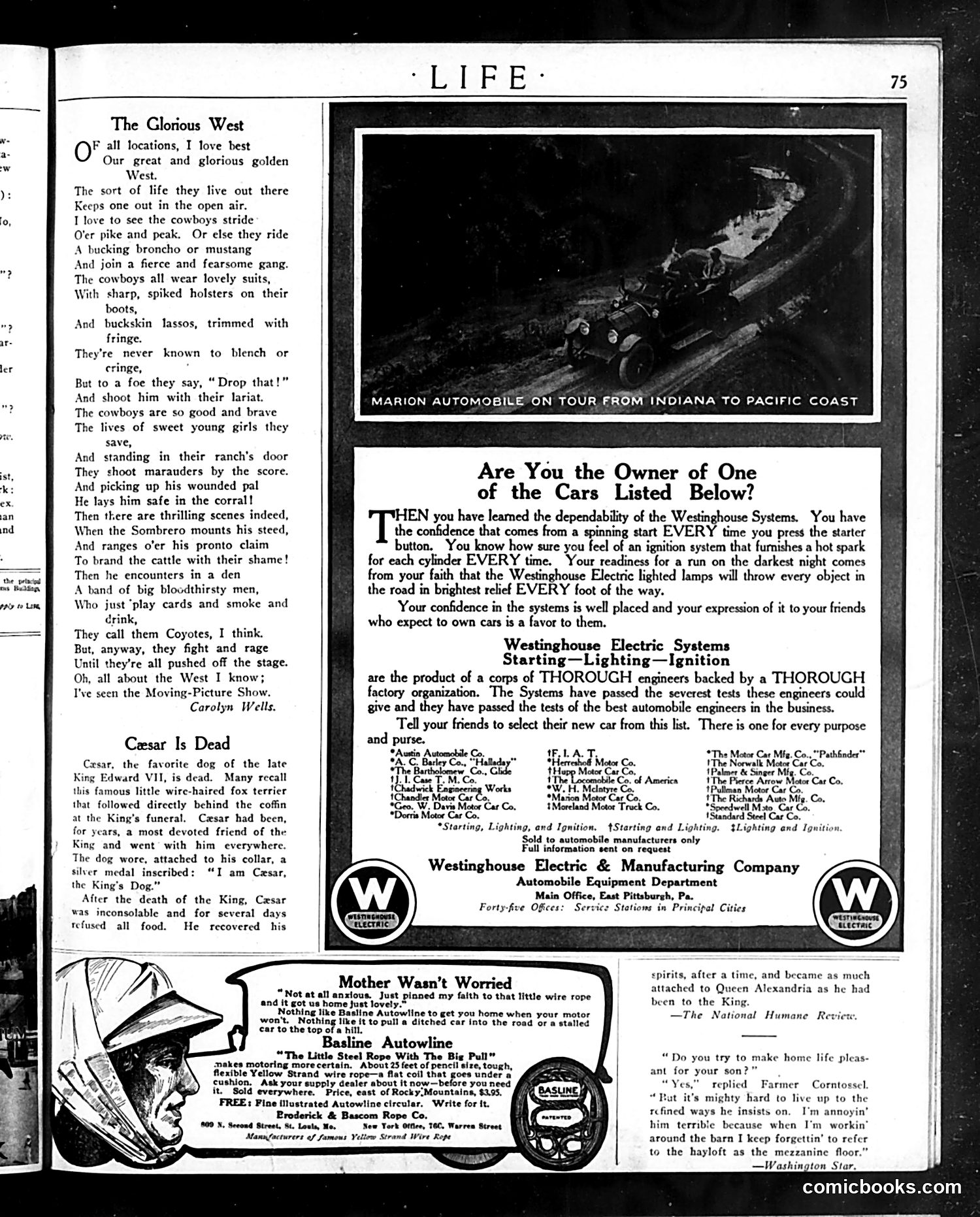
This page contains primarily **advertising** alongside lighter editorial content. The left column features "The Glorious West," a humorous poem by Carolyn Wells satirizing romanticized Western mythology—exaggerating cowboys as noble, quick-drawing heroes who rescue maidens and fight villains. It's gentle mockery of dime-novel Wild West tropes popular in early cinema. "Cesar Is Dead" is a brief tribute to King Edward VII's wire-haired terrier, noting the devoted dog's grief after the king's death and eventual recovery—a sentimental human-interest piece. The dominant content is a **Westinghouse Electric Systems advertisement** promoting automobile electrical components (starters, lighting, ignition) by listing affiliated car manufacturers. The Marion automobile photograph at top serves this promotional purpose. A secondary ad for "Basline Autoline" and "Mother Wasn't Worried" complete the page. There is no political satire here—this is primarily a magazine page balancing light entertainment with period automotive advertising.
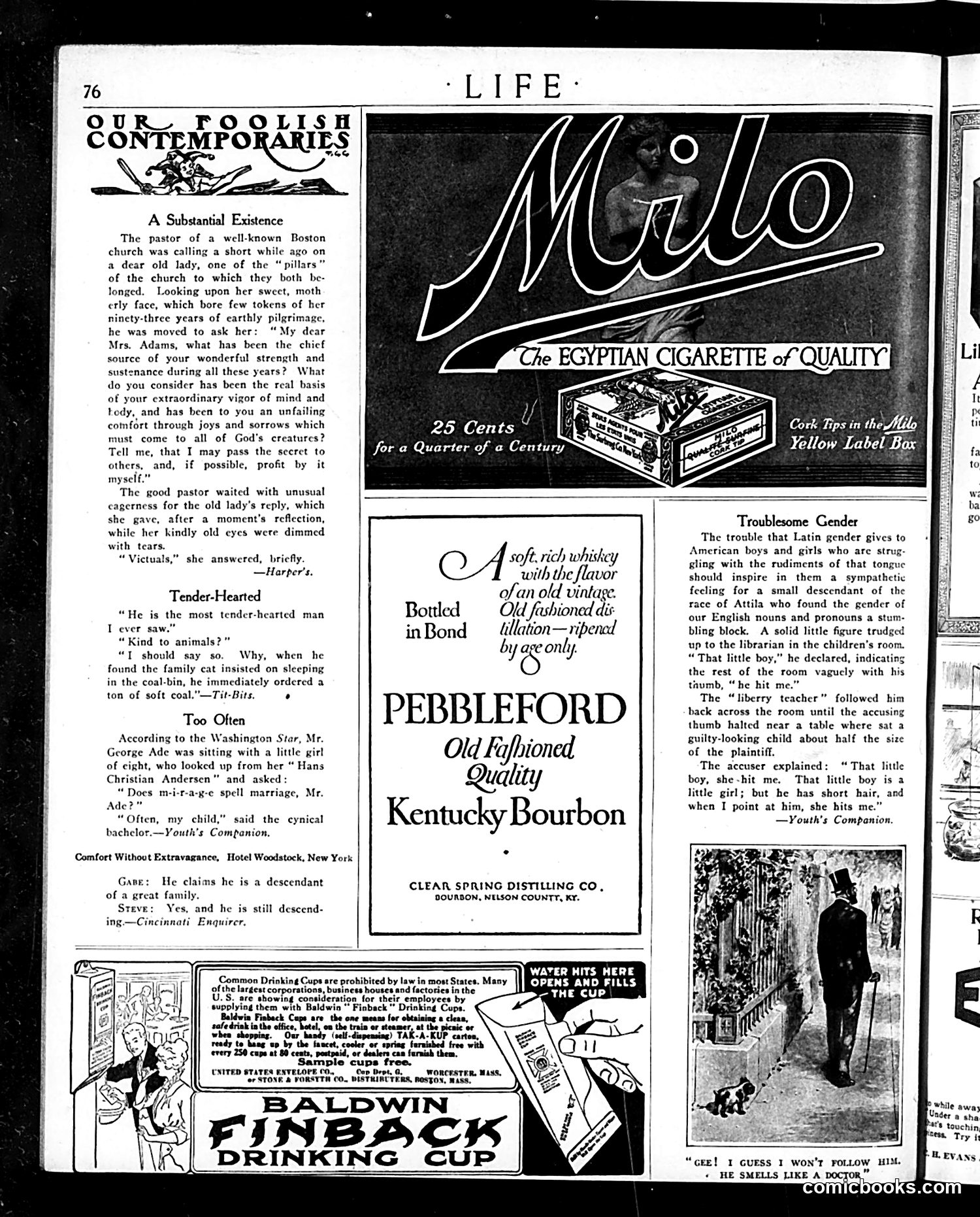
This page contains **humorous anecdotes and advertisements** rather than political cartoons. The satirical content mocks American social conventions and language: **Key Jokes:** 1. **"A Substantial Existence"**: A Boston pastor asks a 93-year-old woman the secret to her vigor. Her blunt reply—"Victuals" (food)—satirizes sentimental religiosity by reducing spiritual comfort to plain eating. 2. **"Tender-Hearted"**: Mocks false sentimentality; a man who lets his cat sleep in coal, then orders soft coal instead, shows absurd rather than genuine kindness. 3. **"Too Often"**: Cynical wordplay—George Ade's quip that "mitigate" (actually "migrate"?) spells marriage "often" suggests marriage frequently ends in separation. 4. **"Troublesome Gender"**: A child struggles with Latin grammar's gendered nouns, confusing pronouns—satirizing the impracticality of classical education for American schoolchildren. The **advertisements** (Mallo cigarettes, Pebbleford bourbon, Baldwin drinking cups) occupy significant space, typical of Life's revenue model.
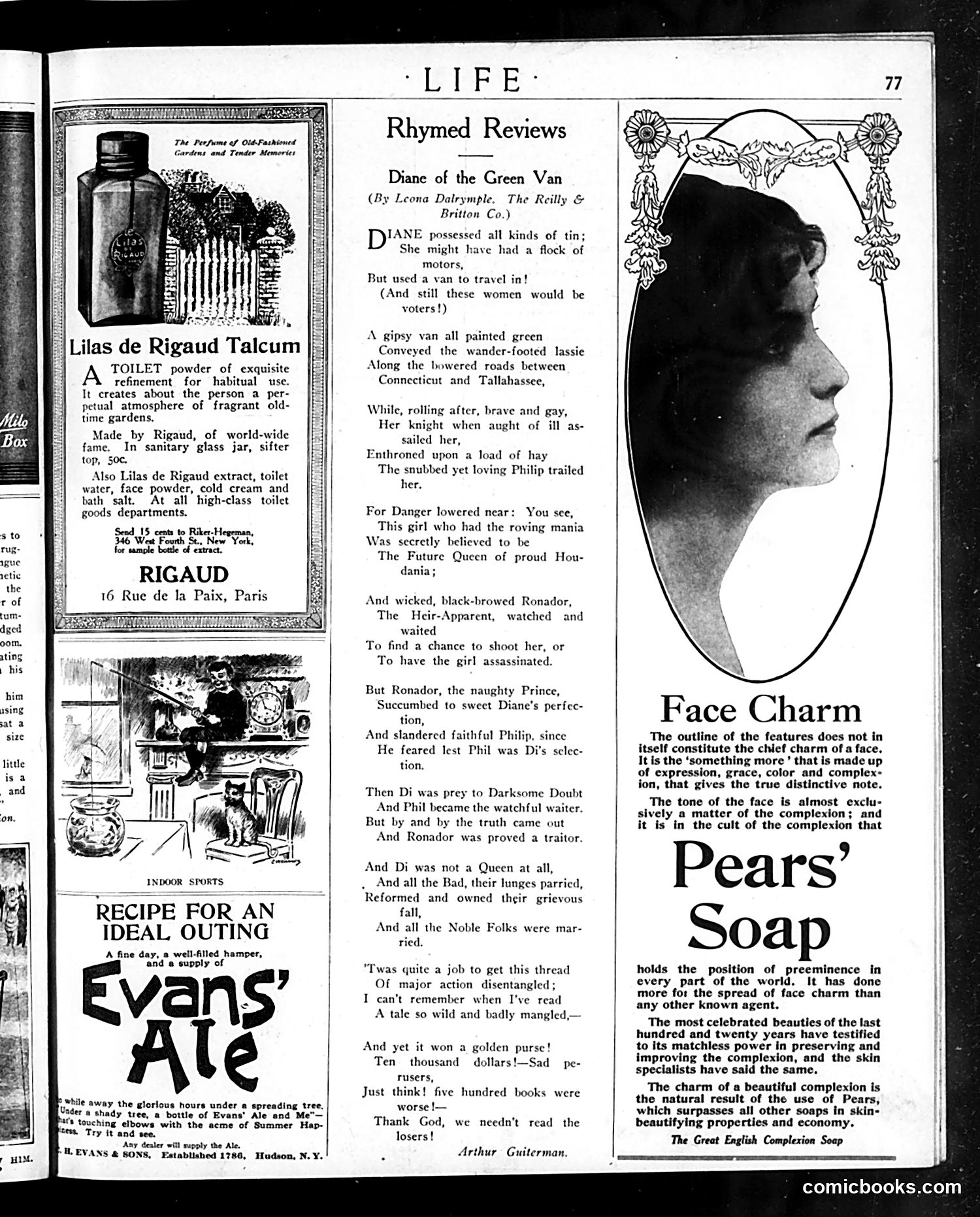
This page from *Life* magazine contains primarily **advertisements and a book review**, not political satire. **Content:** - **Lilas de Rigaud Talcum** ad: luxury French toilet powder marketed to wealthy women - **Evans' Ale** ad: positioned as ideal for leisure outings - **"Diane of the Green Van" review** by Arthur Guiterman: a humorous verse critique of a popular novel by Leona Dalrymple. Guiterman mocks the book's convoluted, melodramatic plot involving a woman traveling in a van, a rival prince, assassination attempts, and romance. He notes it won a $10,000 prize despite being poorly constructed—a satirical jab at literary taste. - **Pears' Soap** ad: claims superiority for women's complexion care The page reflects early 20th-century consumer culture targeting affluent women, with advertising dominating the space. Guiterman's review provides light satire of popular romantic fiction rather than political commentary.
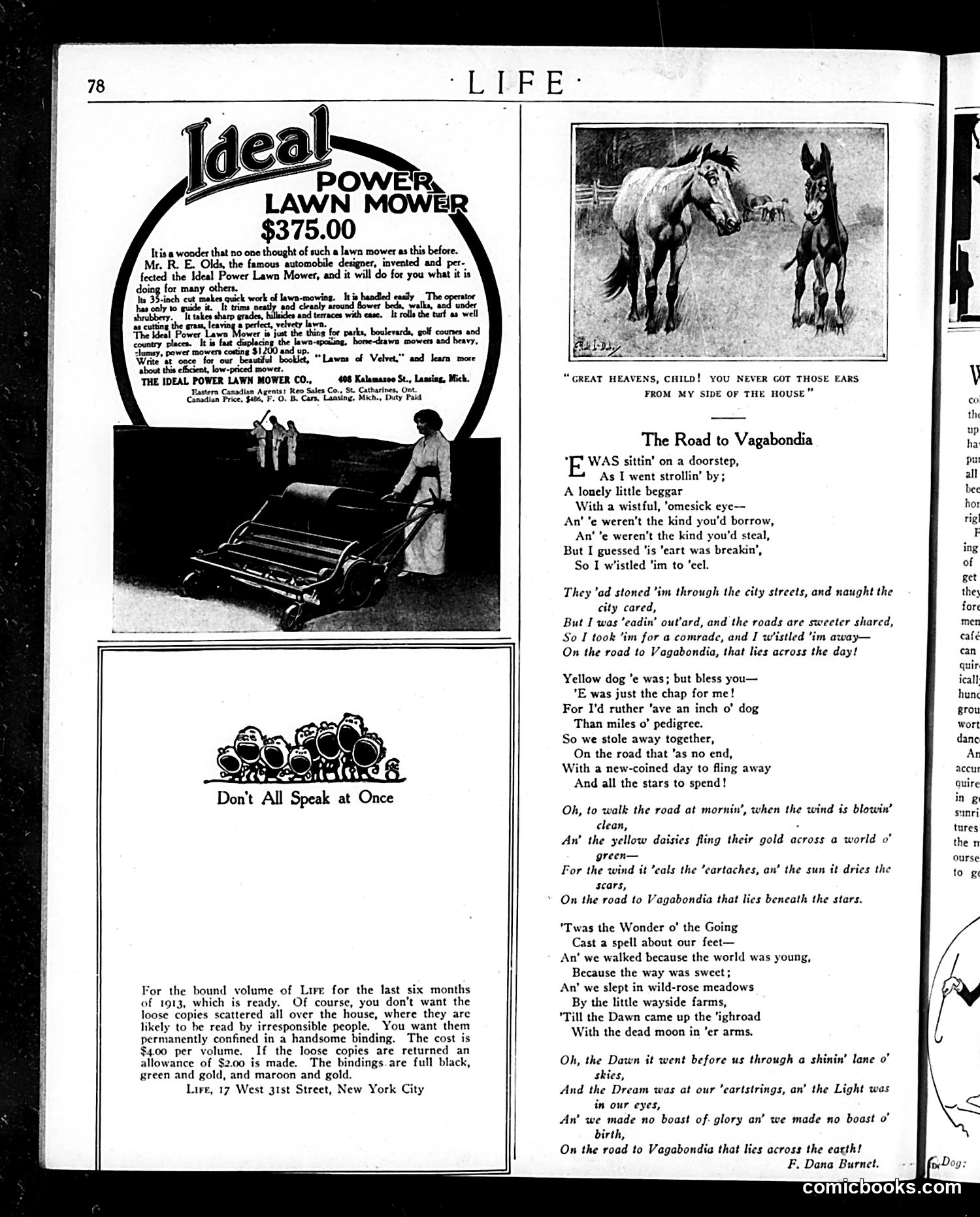
This page contains primarily **advertising and poetry**, not political satire. The **Ideal Power Lawn Mower advertisement** (top left) promotes a motorized mower priced at $375—a luxury item for the era. It emphasizes labor-saving convenience for middle-class homeowners, capitalizing on the automobile industry's innovations. The **cartoon captioned "Great Heavens, Child!"** (top right) shows two horses with exaggerated ears, depicting a parent's humorous complaint that offspring inherited undesirable traits from the other parent's side of the family—a genteel domestic joke about heredity. **"Don't All Speak at Once"** (bottom left) appears to be a caption or section header with decorative imagery, context unclear from this excerpt. **"The Road to Vagabondia"** (right side) is a sentimental poem by F. Dana Burnet celebrating wanderlust and companionship with a stray dog—romanticizing vagabond life and freedom from societal constraints. This reflects early 20th-century literary interest in escape from urban/industrial life.
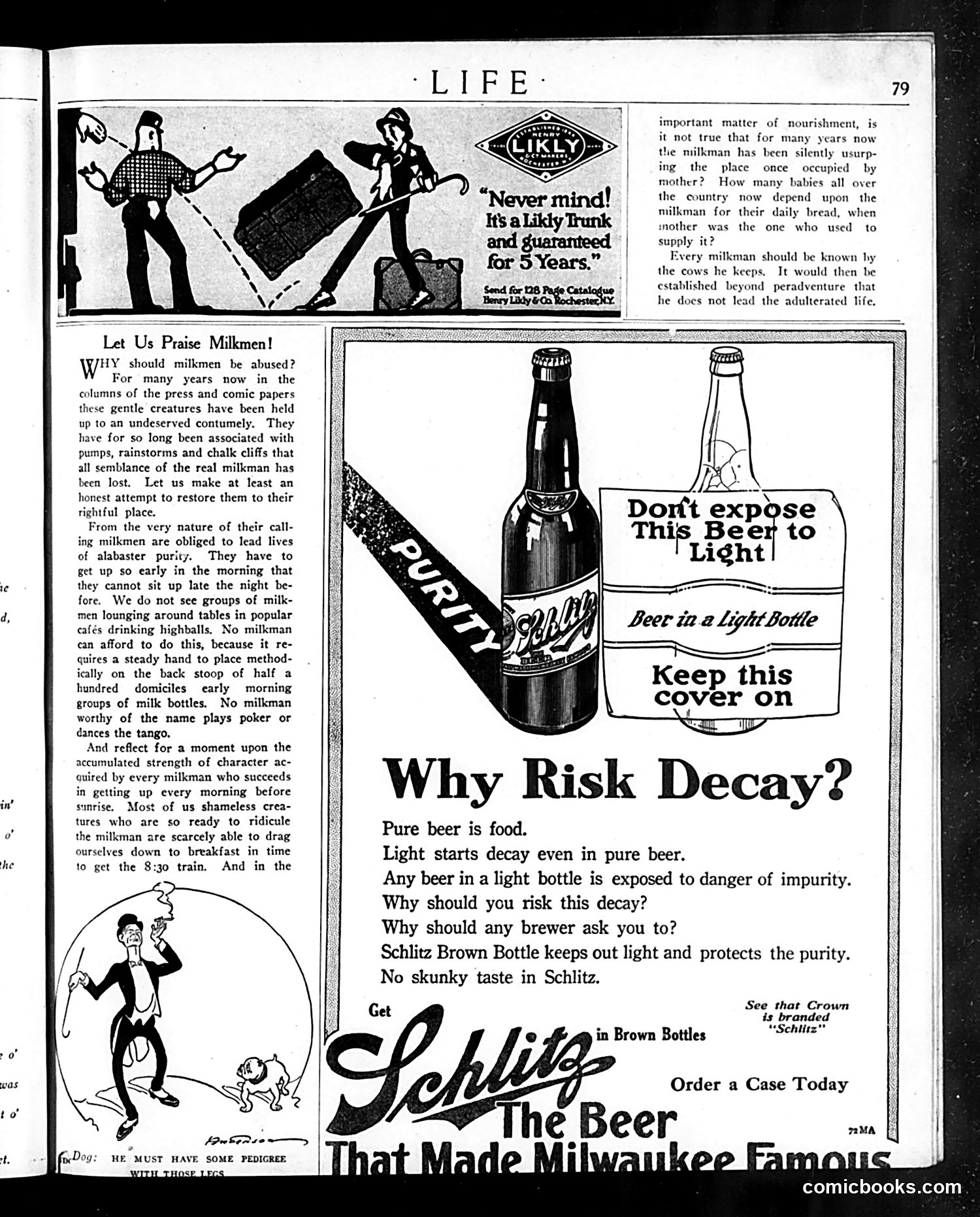
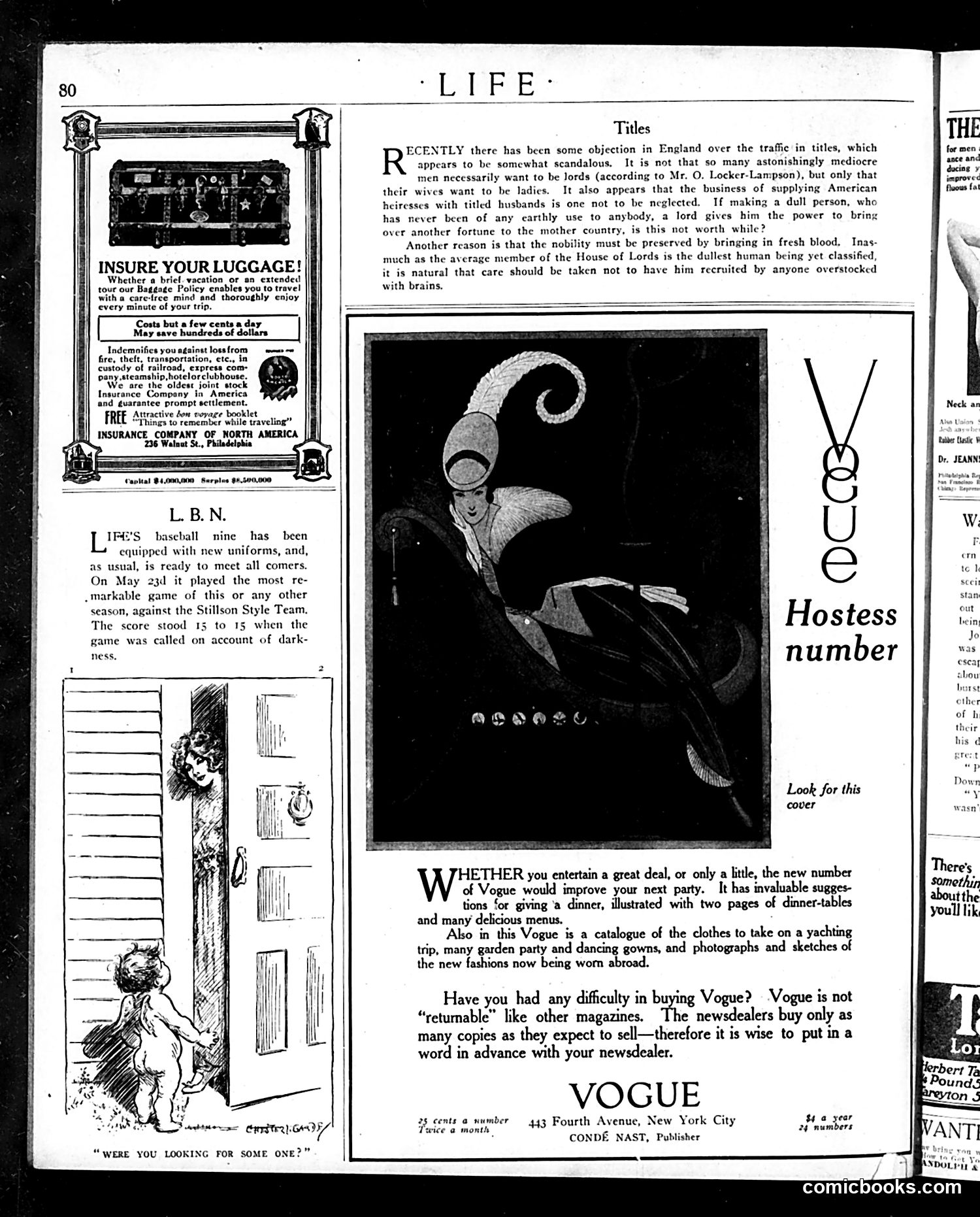
This page contains a satirical essay critiquing the British nobility's practice of selling titles to wealthy Americans. The text argues that English lords marry American heiresses specifically to acquire their fortunes, suggesting this is justified as "preserving" the aristocracy with "fresh blood." The accompanying cartoon depicts a grotesque figure—likely representing either a dull British nobleman or the transaction itself—with an exaggerated curved horn or ornament atop their head. The figure appears bloated and absurd, visually reinforcing the essay's mockery of aristocrats who gain wealth through marrying American heiresses rather than through merit or accomplishment. The satire targets both British snobbery and American wealth, suggesting that the buying and selling of titles is equally ridiculous on both sides of the Atlantic. The cartoon's grotesque imagery emphasizes the moral emptiness of trading titles for money.
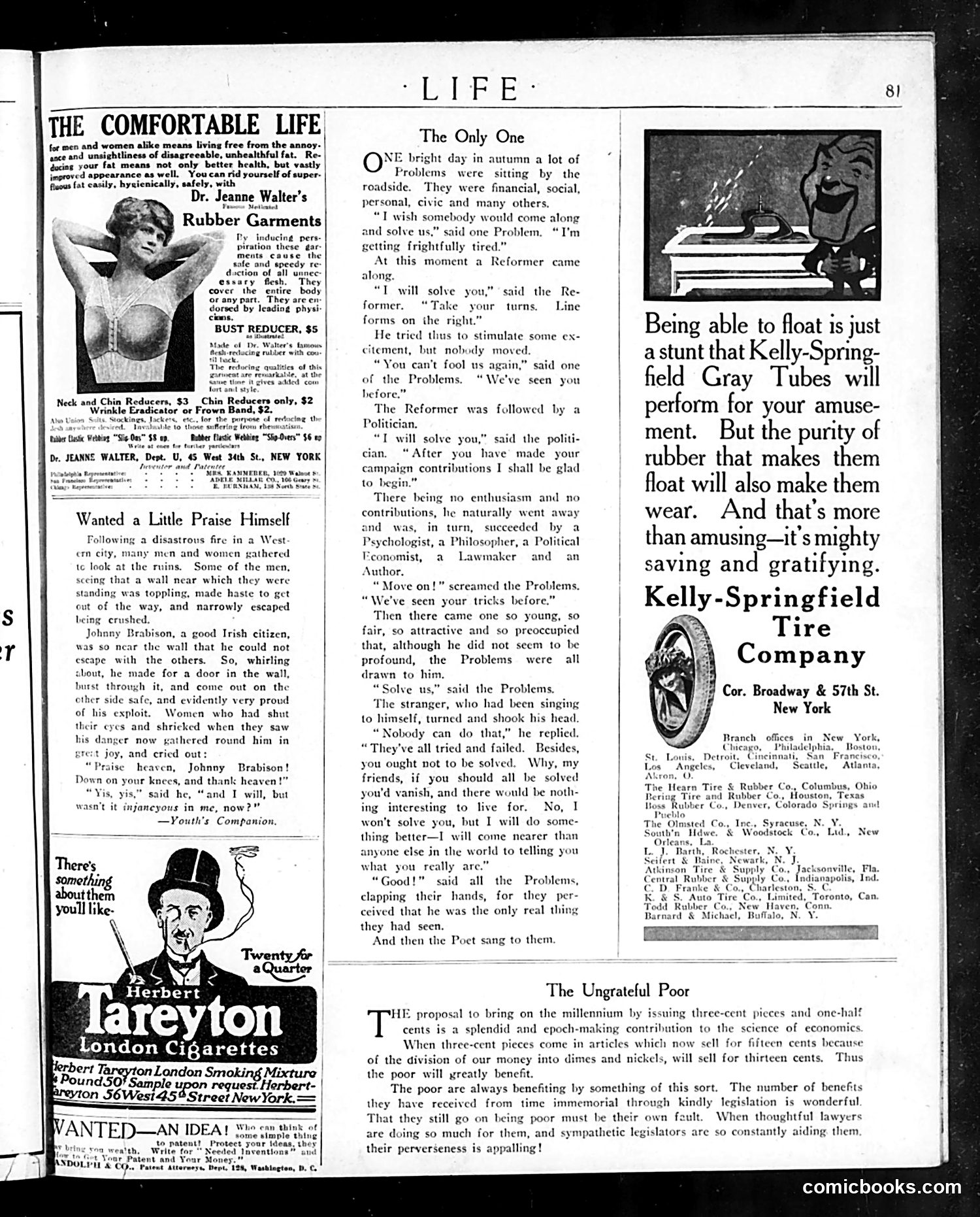
This story mocks various professional and intellectual classes' inability to solve society's problems. A series of would-be problem-solvers—a Reformer, Politician, Psychologist, Philosopher, Economist, Lawmaker, and Author—each claim they can help but fail to generate interest. Each represents a predictable, self-serving approach: the Politician demands campaign contributions before acting; others simply repeat tired rhetoric. Only a young Poet succeeds, not by offering solutions but by honest acknowledgment that problems cannot be "solved"—they're inherent to existence and worth living with. The satire suggests that early 20th-century reformers and politicians were frauds offering false panaceas, while only Art/Poetry offered authentic insight into human condition. The page also includes period advertisements (Jeanne Walter's weight-reduction garments, Tareyton cigarettes) and an anecdote about an Irishman seeking praise for basic self-preservation—minor satirical commentary on vanity.
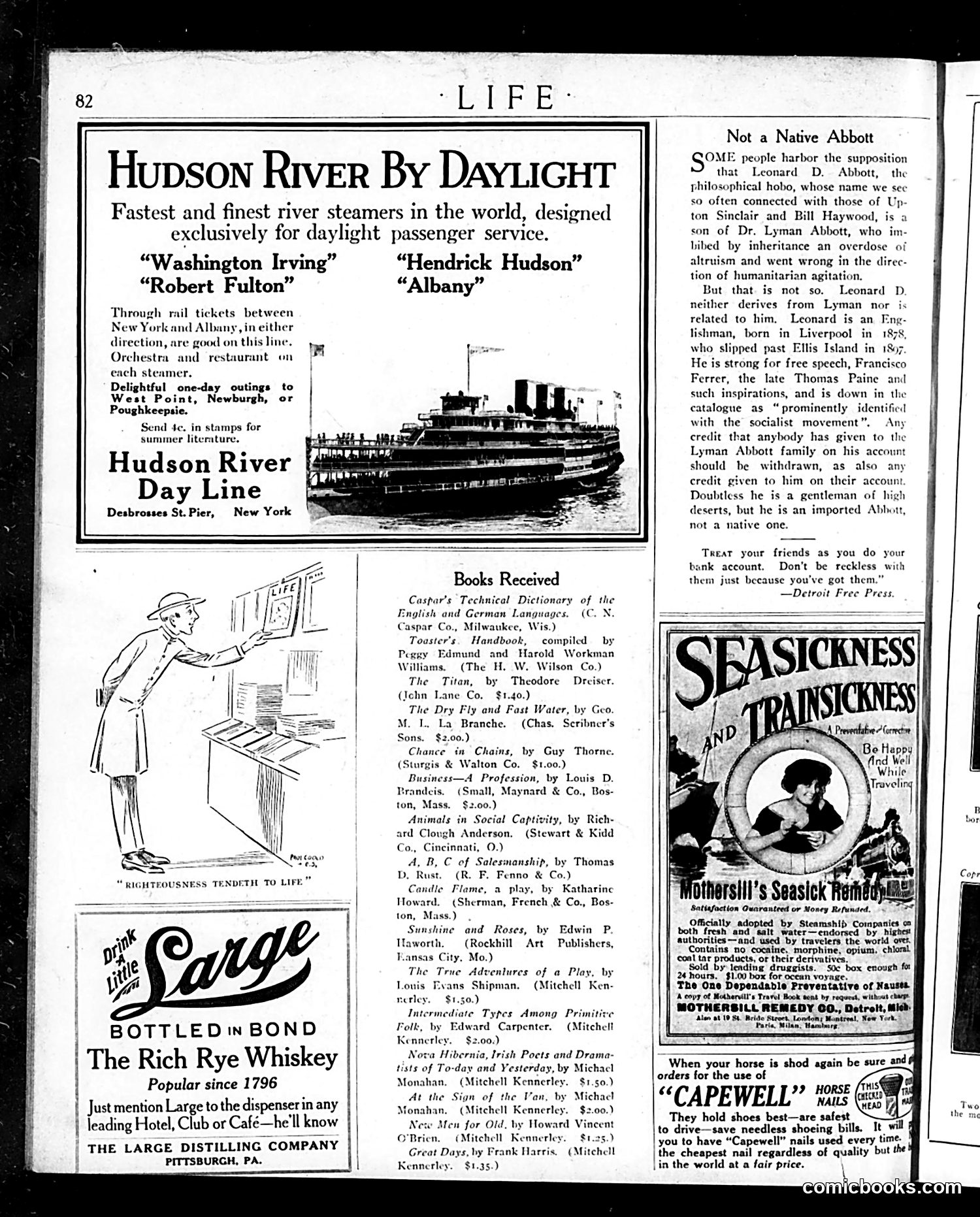
This page is primarily **advertisements and book reviews** with one brief satirical article. The main satirical piece, "Not a Native Abbott," clarifies that Leonard D. Abbott—a political activist associated with socialism, free speech advocacy, and figures like Francisco Ferrer and Thomas Paine—is *not* related to the prominent Abbott family (specifically Dr. Lyman Abbott, a respectable religious figure). The joke targets assumptions that radical activists must come from established American families. Abbott is actually an English immigrant who "slipped past Ellis Island" in 1857. Life's satirical point: Leonard Abbott deserves no inherited credibility from the Abbott name, and the Abbott family should receive no credit for his radical activities—he's an "imported" radical, not a homegrown one. This reflects early-20th-century American anxieties about foreign-born socialists and anarchists. The rest of the page contains period advertisements (steamships, whiskey, patent medicines) and a "Books Received" section listing contemporary publications.
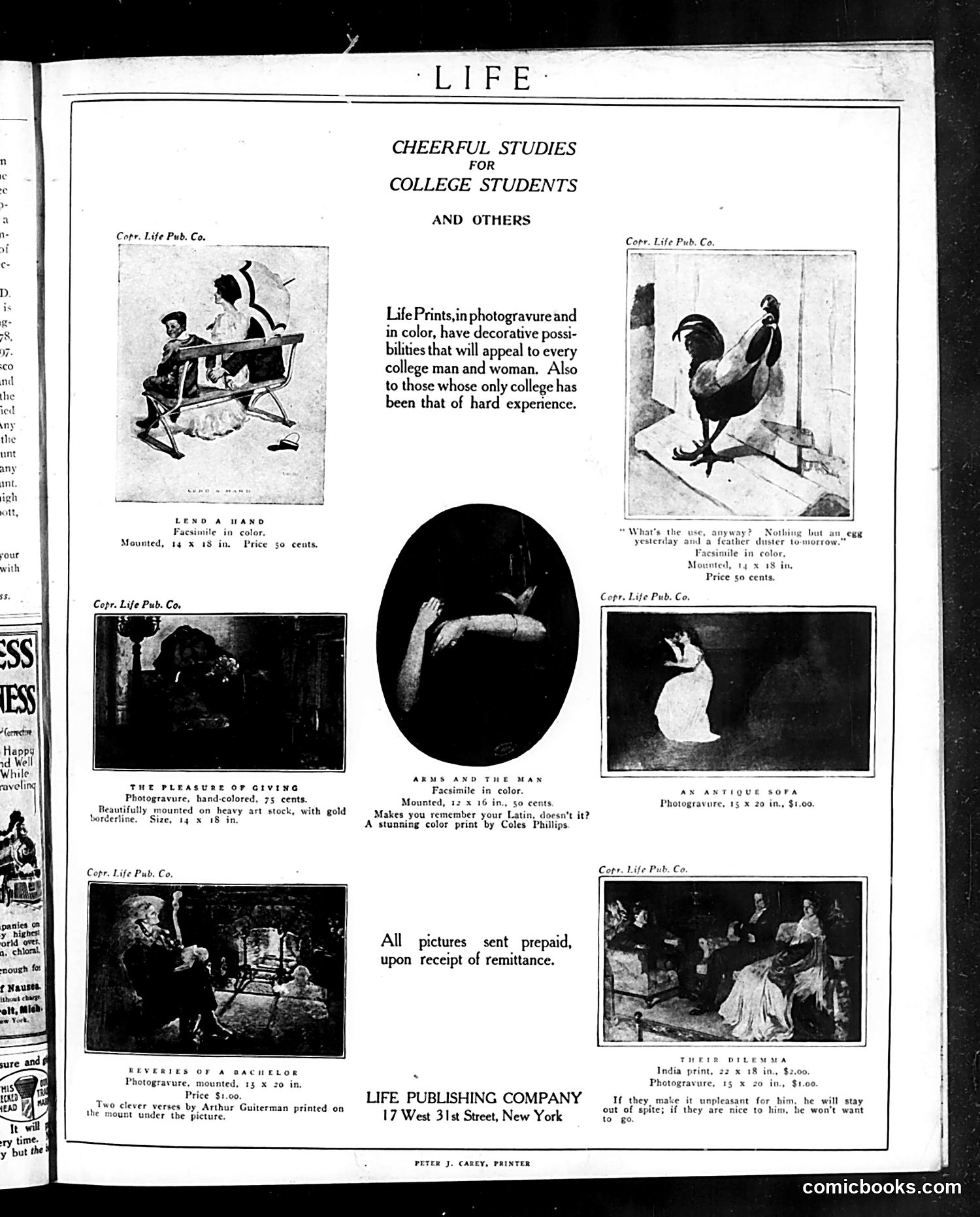
This is primarily an **advertisement page**, not satirical content. Life Publishing Company is marketing decorative art prints—photogravures and hand-colored reproductions—aimed at college students and young adults. The prints advertised include works by **Coles Phillips** (a popular illustrator of the era), featuring titles like "Lend a Hand," "The Pleasure of Giving," "Reveries of a Bachelor," and "Arms and the Man." The humor is gentle and indirect: the ad copy includes light jokes, such as noting that "Arms and the Man" will "make you remember your Latin" and a caption suggesting a woman with a feather duster is "yesterday's sofa furniture to-morrow." The page's subtitle, "Cheerful Studies for College Students and Others," frames these prints as affordable, decorative items suitable for dorm rooms or homes. There's mild social commentary suggesting college comes from both formal education and "hard experience," but this is marketing-speak rather than sharp satire. This reflects early 20th-century American taste in domestic decoration and Life's role as a lifestyle magazine.
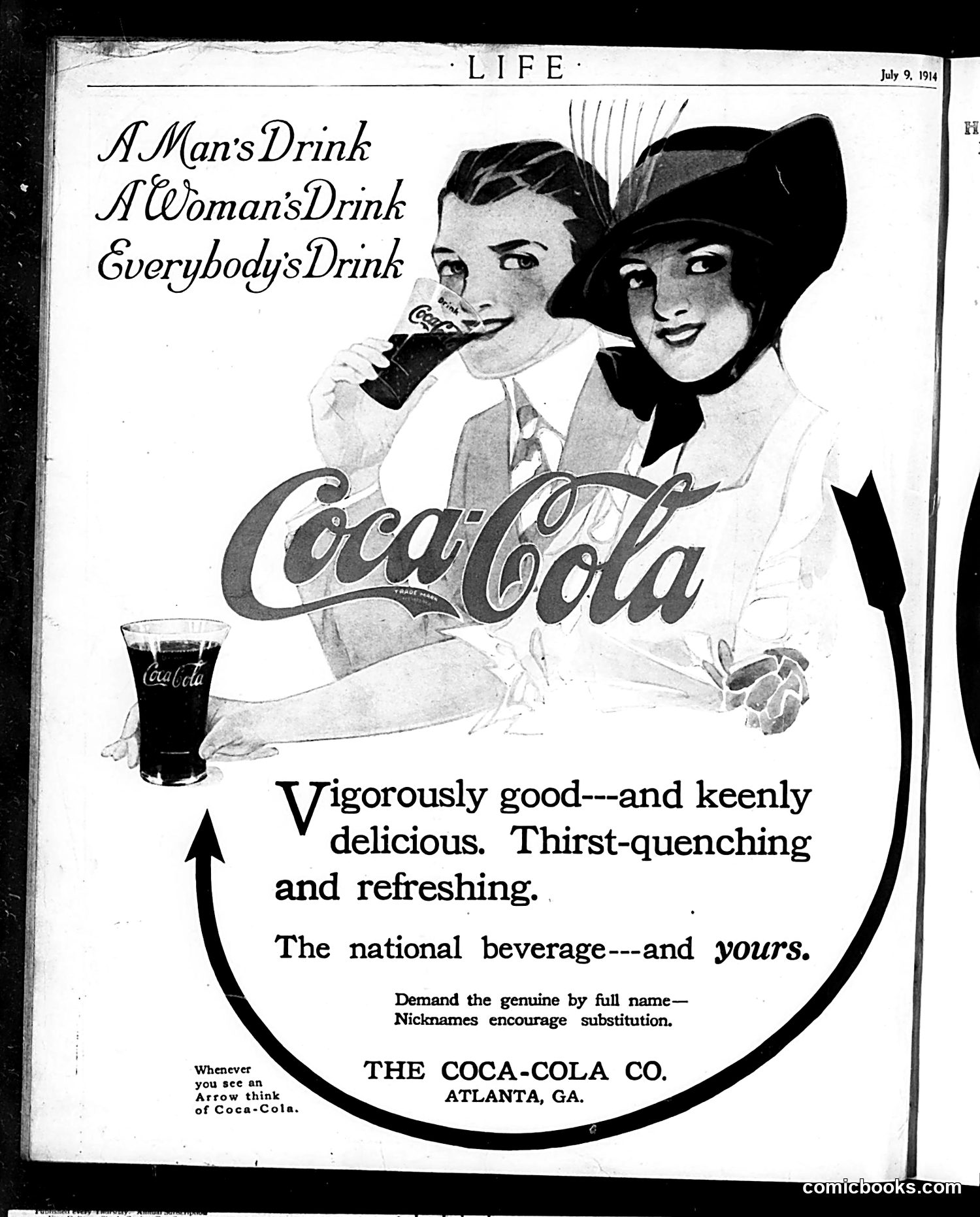
This is a Coca-Cola advertisement from *Life* magazine (July 9, 1914), not a political cartoon. It depicts a well-dressed man and fashionably-dressed woman sharing a Coca-Cola, emphasizing the drink's broad appeal across genders and social classes. The ad's key messaging includes: - "A Man's Drink / A Woman's Drink / Everybody's Drink" — positioning Coca-Cola as universally acceptable - Claims of being "vigorous," "delicious," and "thirst-quenching" - A warning to "demand the genuine by full name" to avoid counterfeit substitutes, reflecting early-20th-century concerns about product imitation - The arrow logo and instruction to associate it with Coca-Cola The advertisement reflects early marketing strategy targeting middle and upper-class consumers during the Progressive Era.