
Life, 1914-07-09 · page 22 of 40
Life — July 9, 1914 — page 22: what you’re looking at
What you’re looking at
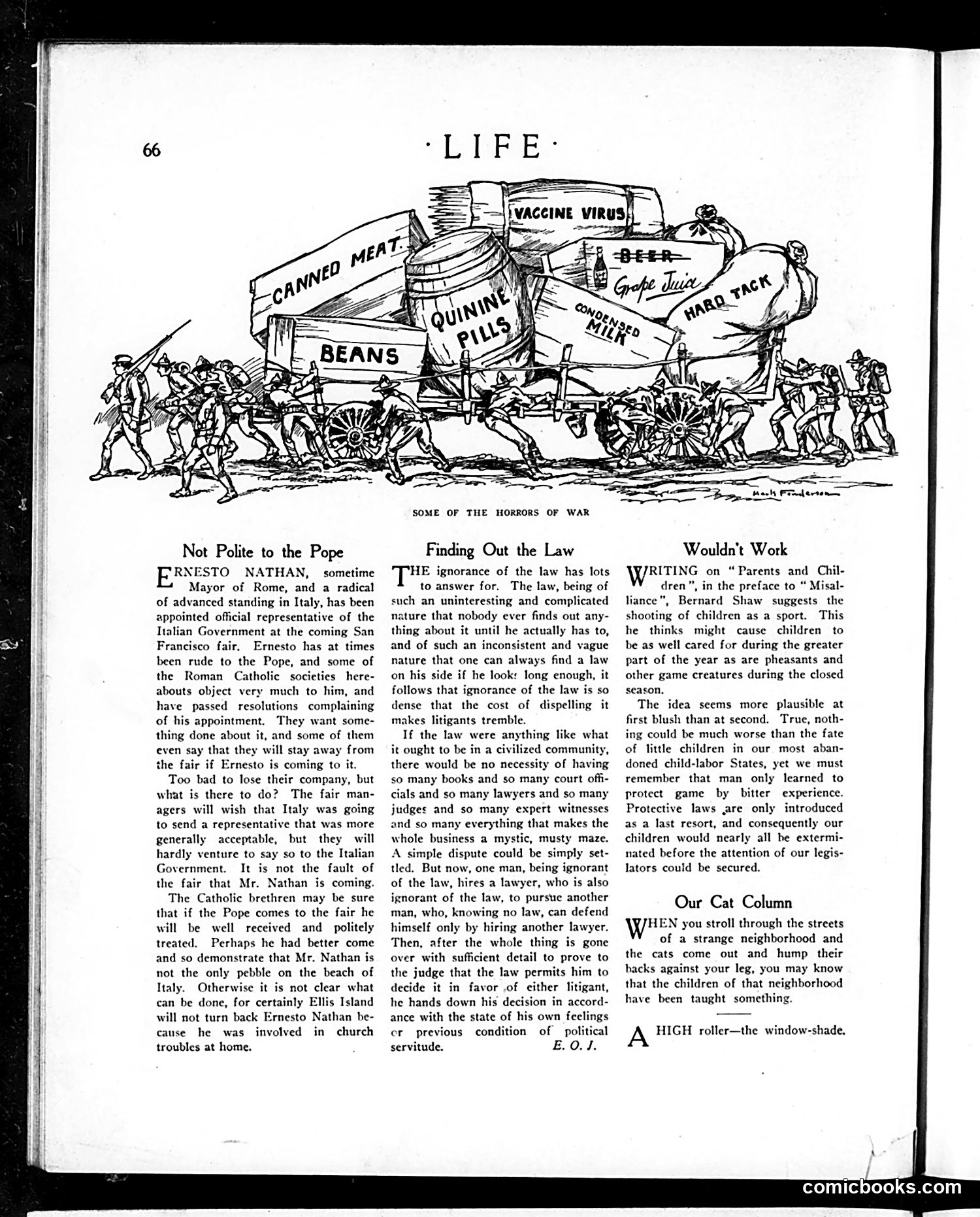
**Main Cartoon ("Some of the Horrors of War"):** A massive wagon laden with wartime goods—canned meat, beans, quinine pills, vaccine virus, beer, grape juice, condensed milk, hard tack—is pulled by soldiers like draft animals. This satirizes how war reduces soldiers to beasts of burden, forcing them to transport supplies that often prove inadequate or harmful to their health. **"Not Polite to the Pope":** Reports on Ernesto Nathan, a radical Italian mayor appointed to represent Italy at San Francisco's fair. Catholic organizations object because Nathan has previously been antagonistic to the Pope, even threatening to boycott. The piece wryly notes the fair managers cannot refuse him without offending the Italian government. **"Finding Out the Law":** Criticizes legal system complexity—ignorant clients hire ignorant lawyers to sue other ignorant defendants, who hire more lawyers. The satirist (E.O.J.) argues the law's deliberately obscure nature enriches the legal profession while ordinary disputes remain expensive and uncertain. **"Wouldn't Work":** Dismisses George Bernard Shaw's joking proposal to shoot children as "sport" to improve child welfare, arguing protective laws only emerge after public outcry—by then, most children would be dead.
📄 Transcribed text from this page (OCR, searchable)
Machine-transcribed from the original scan — historical spelling and the odd misread are preserved.
Not Polite to the Pope RNESTO NATHAN, sometime Mayor of Rome, and a radical of advanced standing in Italy, has been appointed official representative of the Italian Government at the coming San Francisco fair. Ernesto has at times been rude to the Pope, and some of the Roman Catholic societies here- abouts object very much to him, and have passed resolutions complaining of his appointment. They want some- thing done about it, and some of them even say that they will stay away from the fair if Ernesto is coming to it. Too bad to lose their company, but what is there to do? The fair man- agers will wish that Italy was going to send a representative that was more generally acceptable, but they will hardly venture to say so to the Italian Government. It is not the fault of the fair that Mr. Nathan is coming. The Catholic brethren may be sure that if the Pope comes to the fair he will be well received and politely treated. Perhaps he had better come and so demonstrate that Mr. Nathan is not the only pebble on the beach of Italy. Otherwise it is not clear what can be done, for certainly Ellis Island will not turn back Ernesto Nathan be- cause he was involved in church troubles at home. SOME OF THE HORRORS OF WAR Finding Out the Law ‘HE ignorance of the law has lots to answer for. The law, being of such an uninteresting and complicated nature that nobody ever finds out any- thing about it until he actually has to, and of such an inconsistent and vague nature that one can always find a law on his side if he look: long enough, it follows that ignorance of the law is so dense that the cost of dispelling it makes litigants tremble. If the law were anything like what it ought to be in a civilized community, there would be no necessity of having so many books and so many court offi- cials and so many lawyers and so many judges and so many expert witnesses and so many everything that makes the whole business a mystic, musty maze. A simple dispute could be simply set- tled. But now, one man, being ignorant of the law, hires a lawyer, who is also ignorant of the law, to pursue another man, who, knowing no law, can defend himself only by hiring another lawyer. Then, after the whole thing is gone over with sufficient detail to prove to the judge that the law permits him to decide it in favor .of either litigant, he hands down his decision in accord- ance with the state of his own feelings cr previous condition of political servitude. E.0.J. —————o Bie ant Fert Wouldn't Work RITING on “Parents and Chil- dren”, in the preface to “ Misal- liance", Bernard Shaw suggests the shooting of children as a sport. This he thinks might cause children to be as well cared for during the greater part of the year as are pheasants and other game creatures during the closed season, The idea seems more plausible at first blush than at second. True, noth- ing could be much worse than the fate of little children in our most aban- doned child-labor States, yet we must remember that man only learned to protect game by bitter experience. Protective laws are only introduced as a last resort, and consequently our children would nearly all be extermi- nated before the attention of our legis- lators could be secured. Our Cat Column WHen you stroll through the streets of a strange neighborhood and the cats come out and hump their backs against your leg, you may know that the children of that neighborhood have been taught something. A HIGH roller—the window-shade, comicbooks.com