
Life, 1914-07-09 · page 28 of 40
Life — July 9, 1914 — page 28: what you’re looking at
What you’re looking at
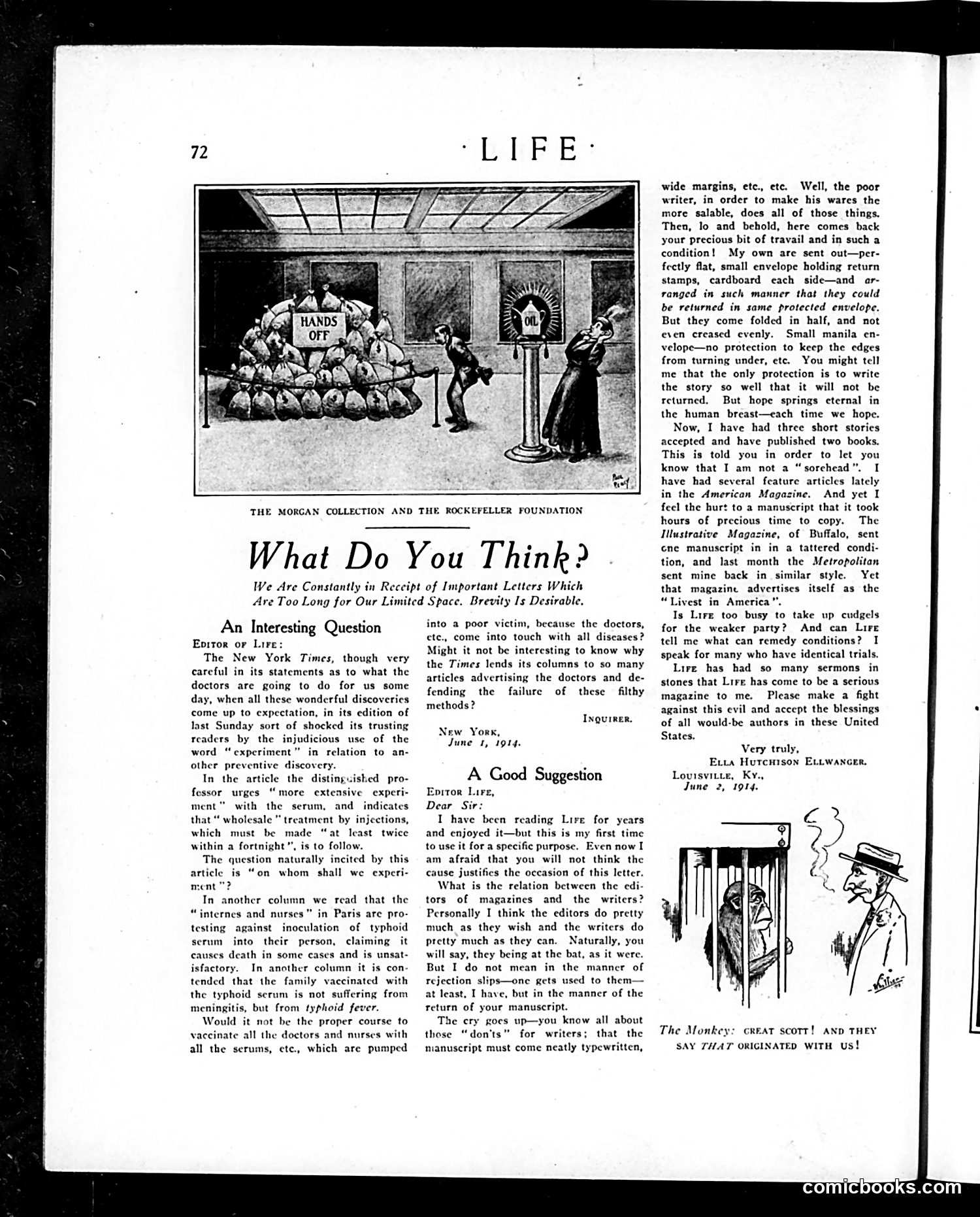
## Main Cartoon: "The Morgan Collection and the Rockefeller Foundation" The cartoon depicts wealthy industrialists' massive art collections being protected by guards marked "HANDS OFF," while ordinary people are kept at a distance. This satirizes the tension between private wealth accumulation and public access to cultural treasures during the Gilded Age. J.P. Morgan and John D. Rockefeller were notorious for amassing enormous art collections; the cartoon mocks how these cultural assets remained largely unavailable to the general public they could have enriched. ## Letters Section The page features two reader letters addressing contemporary concerns: 1. **Medical ethics**: A writer criticizes the New York Times for promoting experimental medical treatments on poor patients while doctors and nurses refuse the same procedures—a pointed critique of unequal medical standards. 2. **Writer treatment**: A published author complains that magazines demand pristine manuscript submissions but return rejected work in damaged condition, revealing editorial hypocrisy. Both letters highlight class disparities and institutional double standards of 1914 America.
📄 Transcribed text from this page (OCR, searchable)
Machine-transcribed from the original scan — historical spelling and the odd misread are preserved.
THE MORGAN COLLECTION AND THE ROCKEFELLER FOUN What Do You Think? We Are Constantly in Receipt of Important Letters Which Are Too Long for Our Limited Space. Brevity Is Desirable. An Interesting Question Eortor or Lire: The New York Times, though very careful in its statements as to what the doctors are going to do for us some day, when all these wonderful discoveries come up to expectation, in its edition of last Sunday sort of shocked its trusting readers by the injudicious use of the word “experiment” in relation to an- other preventive discovery. In the article the distingui fessor urges “more extens ment" with the serum, and that “ wholesale " treatment by injections vhich must be made “at least twice in a fortnight”, is to follow. The question naturally incited by this article is “on whom shall we experi- ment "? In another column we read that the “internes and nurses” in Paris are pro- testing against inoculation of typhoid serum into their person, claiming it causes death in some cases and is unsat- isfactory. In another column it is con- tended that the family vaccinated with the typhoid scrum is not suffering from meningitis, but from typhoid fever. Would it not be the proper course to vaccinate all the doctors and nurses with all the serums, ete, which are pumped into a poor victim, because the doctors, ete, come into touch with all diseases? Might it not be interesting to know why the Times lends its columns to so many articles advertising the doctors and de- fending the failure of these filthy methods? Inquirer. New York, June 1, 1914. A Good Suggestion Epitor Lire, Dear Sir: I have been reading Lire for years and enjoyed it—but this is my first time to use it for a specific purpose. Even now I am afraid that you will not think the cause justifies the occasion of this letter. What is the relation between the edi- tors of magazines and the writers? Personally I think the editors do pretty much as they wish and the writers do pretty much as they can. Naturally, you will say, they being at the bat, as it were. But I do not mean in the manner of rejection slips—one gets used to them— at least, I have, but in the manner of the return of your manuscript. The ery goes up—you know all about those “don'ts” for writers; that the nianuscript must come neatly typewritten, wide margins, etc. ete. Well, the poor writer, in order to make his wares the more salable, does all of those things, Then, lo and behold, here comes back your precious bit of travail and in such a condition! My own are sent out—per- fectly flat, small envelope holding return stamps, cardboard each side—and ar- ranged in such manner that they could be returned in same protected envelope. But they come folded in half, and not even creased evenly. Small manila en- velope—no protection to keep the edges from turning under, ete. You might tell me that the only protection is to write the story so well that it will not be returned. But hope springs eternal in the human breast—each time we hope. Now, I have had three short storics accepted and have published two books. This is told you in order to let you know that I am not a “sorehead”. I have had several feature articles lately in the American Magazine. And yet I feel the hurt to a manuscript that it took hours of precious time to copy. The Illustrative Magazine, of Buffalo, sent ene manuscript in in a tattered condi- tion, and last month the Metropolitan sent mine back in similar style. Yet that magazine advertises itself as the “Livest in America”. Is Lire too busy to take up cudgels for the weaker party? And can Lire tell me what can remedy conditions? I speak for many who have identical trials. Lire has had so many sermons in stones that Lire has come to be a serious magazine to me. Please make a fight against this evil and accept the blessings of all would-be authors in these United States. Very truly, Etta Hutcnison EnLwancer. Lovisvitte, Ky., June 2, 1914. The Monkey: creat scott! AND THEY SAY THAT ORIGINATED WITH Us! comicbooks.com