
Life, 1914-07-09 · page 11 of 40
Life — July 9, 1914 — page 11: what you’re looking at
What you’re looking at
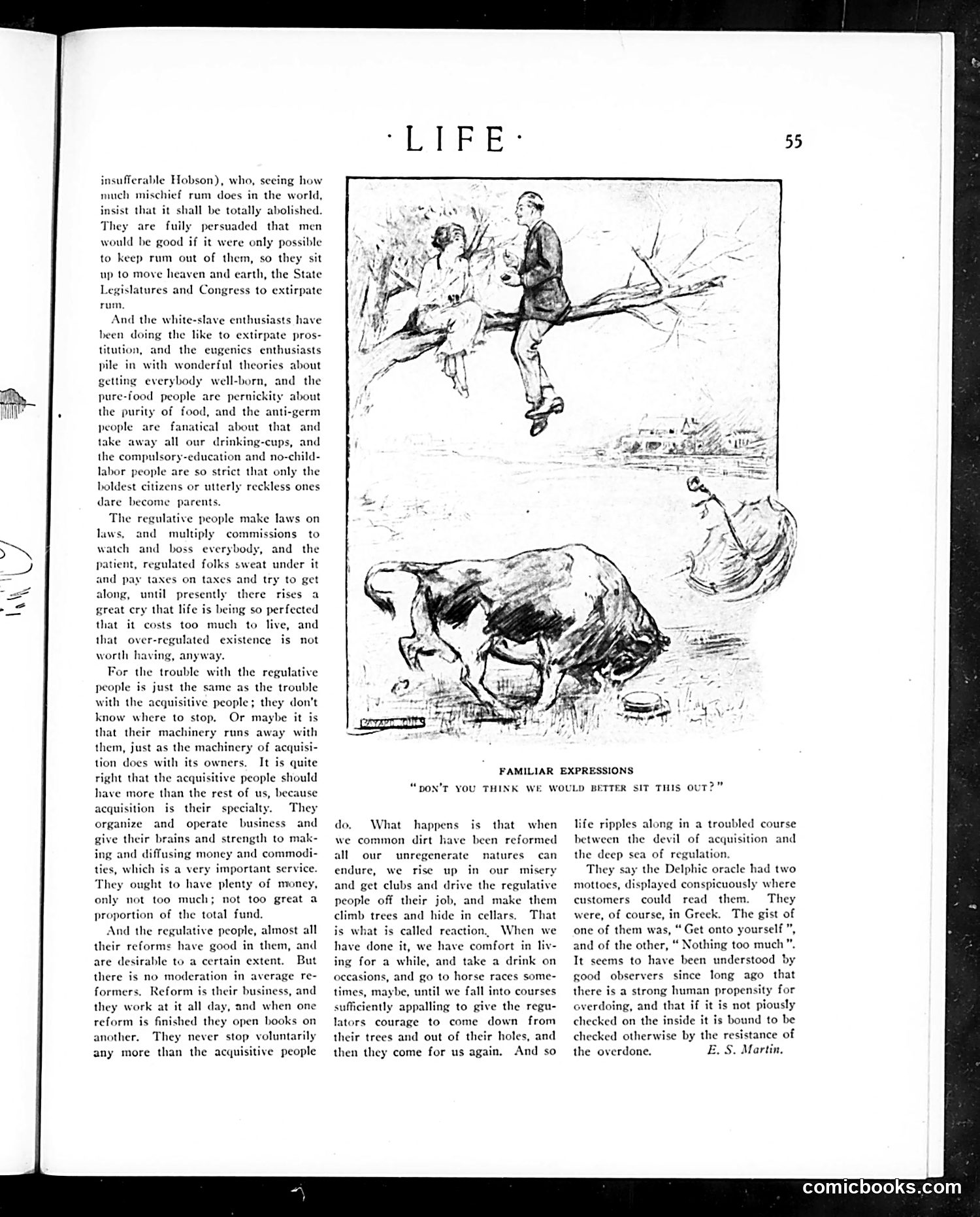
This cartoon satirizes regulatory reformers and social activists of the Progressive Era. The illustration shows two figures balanced precariously on a branch over water—one appears to be a gentleman, the other a woman—suggesting they're in an unstable, compromising position. The accompanying text criticizes "regulative people" who create excessive laws and commissions. The article argues that reformers' constant interventions create a pendulum effect: initial reforms work, but eventually provoke backlash ("reaction"), forcing reformers to swing back into action. The cartoon suggests such endless reform cycles leave society unstable and exhausted—hence the implicit advice to "sit this out" rather than perpetually agitate for change.
📄 Transcribed text from this page (OCR, searchable)
Machine-transcribed from the original scan — historical spelling and the odd misread are preserved.
insufferable Hobson), who, seeing how much mischief rum does in the world, insist that it shall be totally abolished. They are fuily persuaded that men would be good if it were only possible to keep rum out of them, so they sit up to move heaven and earth, the State Legislatures and Congress to extirpate rum. And the white-slave enthusiasts have heen doing the like to extirpate pros- titution, and the eugenics enthusiasts pile in with wonderful theories about getting everybody well-born, and the pure-food people are pernickity about the purity of food, and the anti-germ people are fanatical about that and take away all our drinking-cups, and the compulsory-education and no-child- labor people are so strict that only the boldest citizens or utterly reckless ones dare become parents. The regulative people make laws on laws, and multiply commissions to watch and boss everybody, and the patient, regulated folks sweat under it and pay taxes on taxes and try to get along, until presently there rises a great cry that life is being so perfected that it costs too much to live, and that over-regulated existence is not worth having, anyway. For the trouble with the regulative people is just the same as the trouble with the acquisitive people; they don’t know where to stop. Or maybe it is that their machinery runs away with them, just as the machinery of acqui: tion does with its owners. It is quite right that the acquisitive people should have more than the rest of us, because acquisition is their specialty. They organize and operate business and give their brains and strength to mak- ing and diffusing money and commodi- ties, which is a very important service. They ought to have plenty of money, only not too much; not too great a proportion of the total fund. And the regulative people, almost all their reforms have good in them, and are desirable to a certain extent. But there is no moderation in average re- formers. Reform is their business, and they work at it all day, and when one reform is finished they open books on another. They never stop voluntarily any more than the acquisitive people FAMILIAR EXPRESSIONS “poNn’'T YOU THINK WE WOULD BETTER SIT THIS OUT? do. What happens is that when we common dirt have been reformed all our unregenerate natures can endure, we rise up in our mise and get clubs and drive the regulative people off their job, and make them climb trees and hide in cellars. That is what is called reaction, When we have done it, we have comfort in liv- ing for a while, and take a drink on occasions, and go to horse races some- times, maybe, until we fall into courses sufficiently appalling to give the regu- lators courage to come down from their trees and out of their holes, and then they come for us again. And so life ripples along in a troubled course between the devil of acquisition and the deep sea of regulation. They say the Delphic oracle had two mottoes, displayed conspicuously where customers could read them. They were, of course, in Greek. The gist of one of them was, “Get onto yourself”, and of the other, “ Nothing too much”. It seems to have been understood by good observers since long ago that there is a strong human propensity for overdoing, and that if it is not piously checked on the inside it is bound to be checked otherwise by the resistance of the overdone. E, S. Martin. comicbooks.com