
Life, 1914-07-09 · page 24 of 40
Life — July 9, 1914 — page 24: what you’re looking at
What you’re looking at
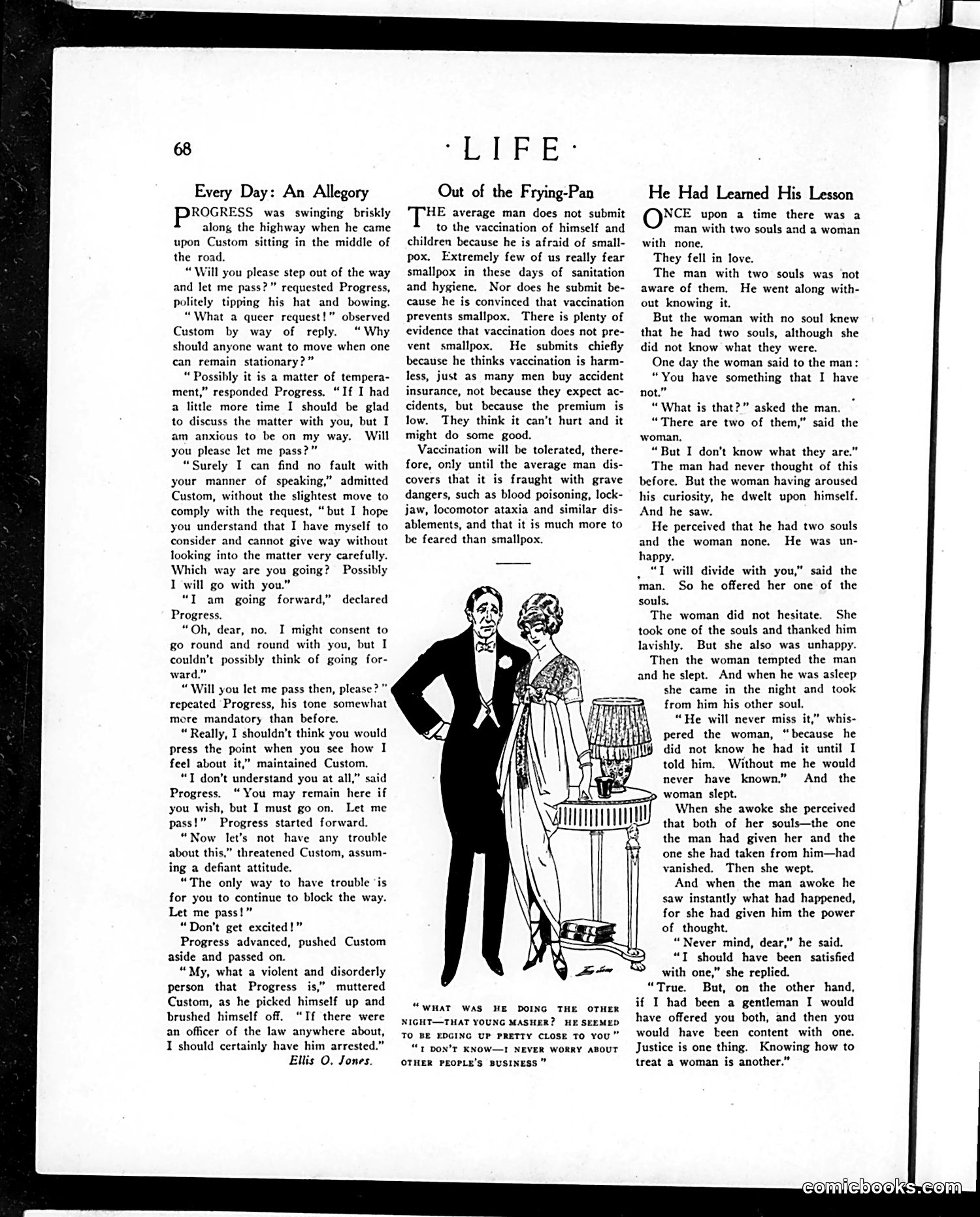
This page contains three distinct pieces of satirical content: **"Every Day: An Allegory"** (main story with illustration) uses personified characters—Progress and Custom—to satirize resistance to social change. Progress seeks to move forward while Custom blocks the road, stubbornly refusing to yield. When Progress physically pushes past, Custom complains of being "violent and disorderly," threatening legal action. The satire criticizes how established tradition resists innovation and then claims victimhood when forced aside—a commentary on early 20th-century debates over modernization. **"Out of the Frying-Pan"** argues that people accept vaccination not from fear of disease or belief in prevention, but because they think it's harmless. The piece predicts tolerance will end once people discover alleged serious side effects (blood poisoning, lockjaw, locomotor ataxia). This reflects contemporary anti-vaccination sentiment. **"He Had Learned His Lesson"** is a brief allegorical fable about a man discovering his own "souls" (consciousness/identity) through a soulless woman's observation—exploring self-awareness through romantic entanglement.
📄 Transcribed text from this page (OCR, searchable)
Machine-transcribed from the original scan — historical spelling and the odd misread are preserved.
68 Every Day: An Allegory ROGRESS was swinging briskly along the highway when he came upon Custom sitting in the middle of the road. “Will you please step out of the way and let me pass?” requested Progress, politely tipping his hat and bowing. “What a queer request!” observed Custom by way of reply. “Why should anyone want to move when one can remain stationary?” “ Possibly it is a matter of tempera- ment,” responded Progress. “If I had a little more time I should be glad to discuss the matter with you, but I am anxicus to be on my way. Will you please Iet me pass?” “Surely I can find no fault with your manner of speaking,” admitted Custom, without the slightest move to comply with the request, “but I hope you understand that I have myself to consider and cannot give way without looking into the matter very carefully. Which way are you going? Possibly I will go with you.” “I am going forward,” declared Progress. “Oh, dear, no. I might consent to go round and round with you, but I couldn’t possibly think of going for- ward,” “ Will you let me pass then, please?” repeated Progress, his tone somewhat more mandatory than before. “Really, I shouldn’t think you would press the point when you see how I feel about it,” maintained Custom. “T don’t understand you at all,” said Progress. you wish, but I must go on. pass!” Progress started forward. ing a defiant attitude. Let me pass!” “Don't get excited!” aside and passed on. person that Progress is, brushed himself off. Ellis O. Jones. “You may remain here if Let me “Now let’s not have any trouble about this,” threatened Custom, assum- “The only way to have trouble ‘is for you to continue to block the way. Progress advanced, pushed Custom “My, what a violent and disorderly muttered Custom, as he picked himself up and “Tf there were an officer of the law anywhere about, I should certainly have him arrested.” “EIRP: Out of the Frying-Pan Rave average man does not submit to the vaccination of himself and children because he is afraid of small- pox. Extremely few of us really fear smallpox in these days of sanitation and hygiene. Nor does he submit be- cause he is convinced that vaccination prevents smallpox. There is plenty of evidence that vaccination does not pre- vent smallpox. He submits chiefly because he thinks vaccination is harm- less, just as many men buy accident insurance, not because they expect ac- cidents, but because the premium is low. They think it can’t hurt and it might do some good. Vaccination will be tolerated, there- fore, only until the average man dis- covers that it is fraught with grave dangers, such as blood poisoning, lock- jaw, locomotor ataxia and similar dis- ablements, and that it is much more to be feared than smallpox. “WHAT WAS NIGHT—THAT YOUNG MASHER? HE SEEMED TO BE EDGING UP PRETTY CLOSE TO You “1 DON’T KNOW—1 NEVER WORRY ABOUT OTHER PEOPLE'S BUSINESS ” ME DOING THE OTHER He Had Leamed His Lesson NCE upon a time there was a man with two souls and a woman with none, They fell in love. The man with two souls was not aware of them. He went along with- out knowing it. But the woman with no soul knew that he had two souls, although she did not know what they were. One day the woman said to the man: “You have something that I have not.” “What is that?” asked the man. “There are two of them,” said the woman, “But I don’t know what they are.” The man had never thought of this before, But the woman having aroused his curiosity, he dwelt upon himself. And he saw. He perceived that he had two souls and the woman none. He was un- happy. “I will divide with you,” said the man. So he offered her one of the souls. The woman did not hesitate. She took one of the souls and thanked him lavishly. But she also was unhappy. Then the woman tempted the man and he slept. And when he was asleep she came in the night and took from him his other soul. “He will never miss it,” whis- pered the woman, “because he did not know he had it until I told him. Without me he would never have known.” And the woman slept. When she awoke she perceived that both of her souls—the one the man had given her and the one she had taken from him—had vanished. Then she wept. And when the man awoke he saw instantly what had happened, for she had given him the power of thought. “Never mind, dear,” he said. “I should have been satisfied with one,” she replied. “True. But, on the other hand, if I had been a gentleman I would have offered you both, and then you would have teen content with one. Justice is one thing. Knowing how to treat a woman is another.”