
Life, 1914-07-09 · page 26 of 40
Life — July 9, 1914 — page 26: what you’re looking at
What you’re looking at
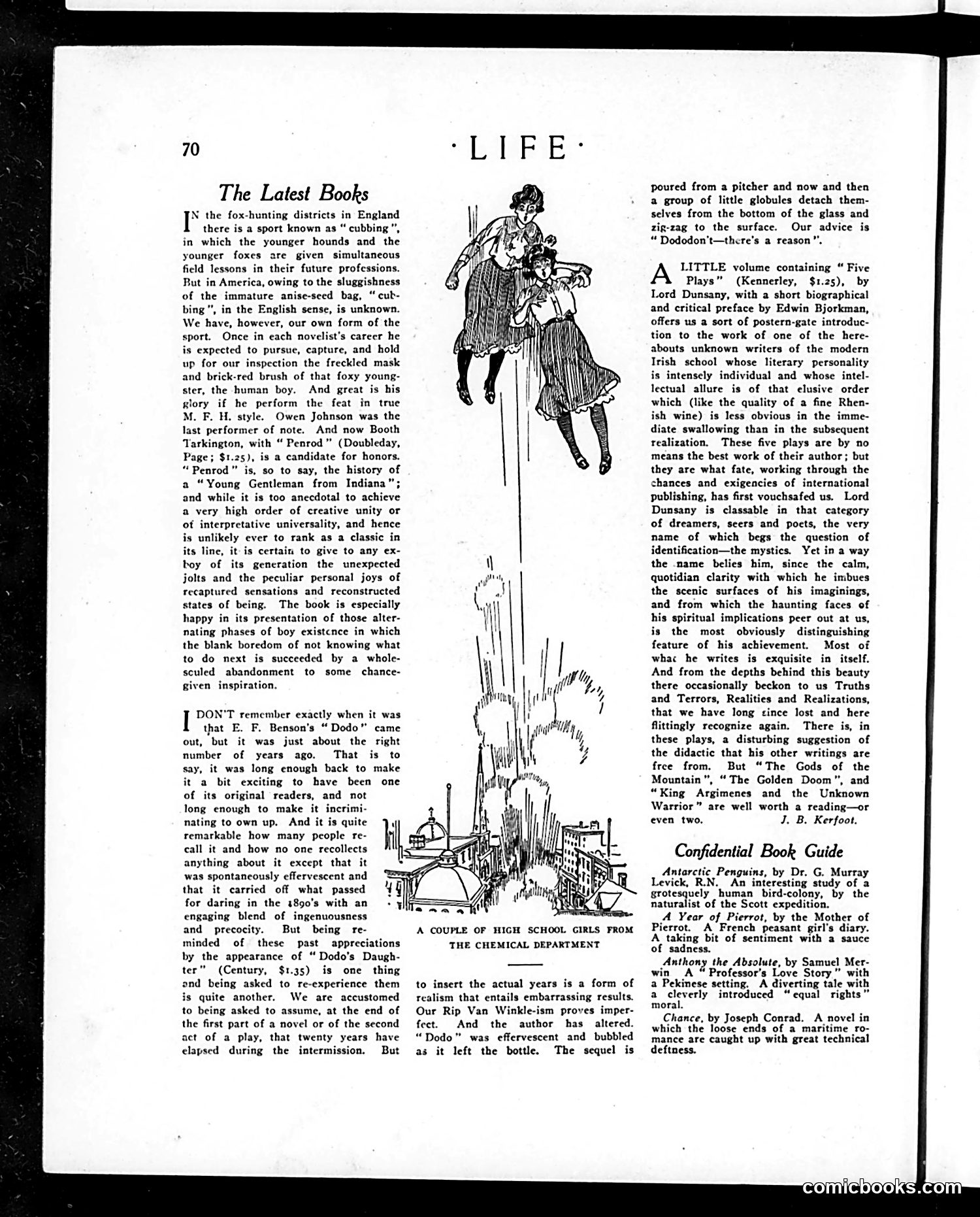
This page contains literary reviews, not political cartoons. The main illustration shows two high school girls from a chemistry department, likely accompanying a humorous anecdote about their experiment (the caption reads "A Couple of High School Girls From The Chemical Department"). The reviews discuss contemporary novels: Booth Tarkington's *Penrod* (about a mischievous Indiana boy), E.F. Benson's *Dodo's Daughter* (a sequel to an 1890s novel), and Lord Dunsany's *Five Plays*. The critic dismisses *Dodo's Daughter* as flat compared to the original, using a clever metaphor: the original "bubbled" when "left the bottle" but the sequel is merely "poured from a pitcher"—a witty way of saying the sequel has lost its sparkle. The page reflects early 20th-century American literary culture and satirizes how sequels rarely match their predecessors.
📄 Transcribed text from this page (OCR, searchable)
Machine-transcribed from the original scan — historical spelling and the odd misread are preserved.
70 The Latest Books N the fox-hunting districts in England there is a sport known as “ cubbing”, in which the younger hounds and the younger foxes are given simultaneous field lessons in their future professions. But in America, owing to the sluggishness of the immature anise-seed bag, “ cub- bing", in the English sense, is unknown. We have, however, our own form of the sport. Once in each novelist’s career he is expected to pursue, capture, and hold up for our inspection the freckled mask and brick-red brush of that foxy young- ster, the human boy. And great is his glory if he perform the feat in true M. F. H. style. Owen Johnson was the last performer of note. And now Booth Tarkington, with “ Penrod” (Doubleday, Page; $1.25), is a candidate for honors. “ Penrod” is, so to say, the history of a “Young Gentleman from Indiana”; and while it is too anecdotal to achieve a very high order of creative unity or ot interpretative universality, and hence is unlikely ever to rank as a classic in its line, it is certain to give to any ex- boy of its generation the unexpected jolts and the peculiar personal joys of recaptured sensations and reconstructed states of being. The book is especially happy in its presentation of those alter- nating phases of boy existcnce in which the blank boredom of not knowing what to do next is succeeded by a whole- sculed abandonment to some chance- given inspiration. DON'T remember exactly when it was that E. F, Benson's “ Dodo” came out, but it was just about the right number of years ago. That is to say, it was long enough back to make it a bit exciting to have been one of its original readers, and not long enough to make it incrimi- nating to own up. And it is quite q remarkable how many people re- hi call it and how no one recollects anything about it except that it was spontaneously effervescent and that it carried off what passed for daring in the 4890's with an engaging blend of ingenuousness and precocity. But being re- minded of these past appreciations by the appearance of “Dodo's Daugh- ter” (Century, $1.35) is one thing ond being asked to re-experience them is quite another. We are accustomed to being asked to assume, at the end of the first part of a novel or of the second act of a play, that twenty years have elapsed during the intermission. But A COUPLE OF HIGH SCHOOL GIRLS FROM THE CHEMICAL DEPARTMENT to insert the actual years is a form of realism that entails embarrassing results. Our Rip Van Winkle-ism proves imper- fect. And the author has altered. “Dodo” was effervescent and bubbled as it left the bottle. The sequel is poured from a pitcher and now and then a group of little globules detach them- selves from the bottom of the glass and zig-zag to the surface. Our advice is “ Dododon't—there’s a reason”. LITTLE volume containing “ Five Plays” (Kennerley, $1.25), by Lord Dunsany, with a short biographical and critical preface by Edwin Bjorkman, offers us a sort of postern-gate introduc- tion to the work of one of the here- abouts unknown writers of the modern Irish school whose literary personality is intensely individual and whose intel- lectual allure is of that elusive order which (like the quality of a fine Rhen- ish wine) is less obvious in the imme- diate swallowing than in the subsequent realization. These five plays are by no means the best work of their author; but they are what fate, working through the chances and exigencies of international publishing, has first vouchsafed us. Lord Dunsany is classable in that category of dreamers, seers and poets, the very name of which begs the question of identification—the mystics. Yet in a way the name belies him, since the calm, quotidian clarity with which he imbues the scenic surfaces of his imaginings, and from which the haunting faces of his spiritual implications peer out at us, is the most obviously distinguishing feature of his achievement. Most of whac he writes is exquisite in itself. And from the depths behind this beauty there occasionally beckon to us Truths and Terrors, Realities and Realizations, that we have long since lost and here flittingly recognize again. There is, in these plays, a disturbing suggestion of the didactic that his other writings are free from. But “The Gods of the Mountain " The Golden Doom”, and “King Argimenes and the Unknown Warrior” are well worth a reading—or even two. J. B. Kerfoot. Confidential Book Guide Antarctic Penguins, by Dr. G. Murray Levick, R.N. An interesting study of a grotesquely human bird-colony, by the naturalist of the Scott expedition. A Year of Pierrot, by the Mother of Pierrot. A French peasant girl's diary. A taking bit of sentiment with a sauce of sadness. Anthony the Absolute, by Samuel Mer- win A “ Professor’s Love Story” with a Pekinese setting. A diverting tale with a cleverly introduced “equal rights” moral. Chance, by Joseph Conrad. A novel in which the loose ends of a maritime ro- mance are caught up with great technical deftness.