
Life, 1914-07-09 · page 16 of 40
Life — July 9, 1914 — page 16: what you’re looking at
What you’re looking at
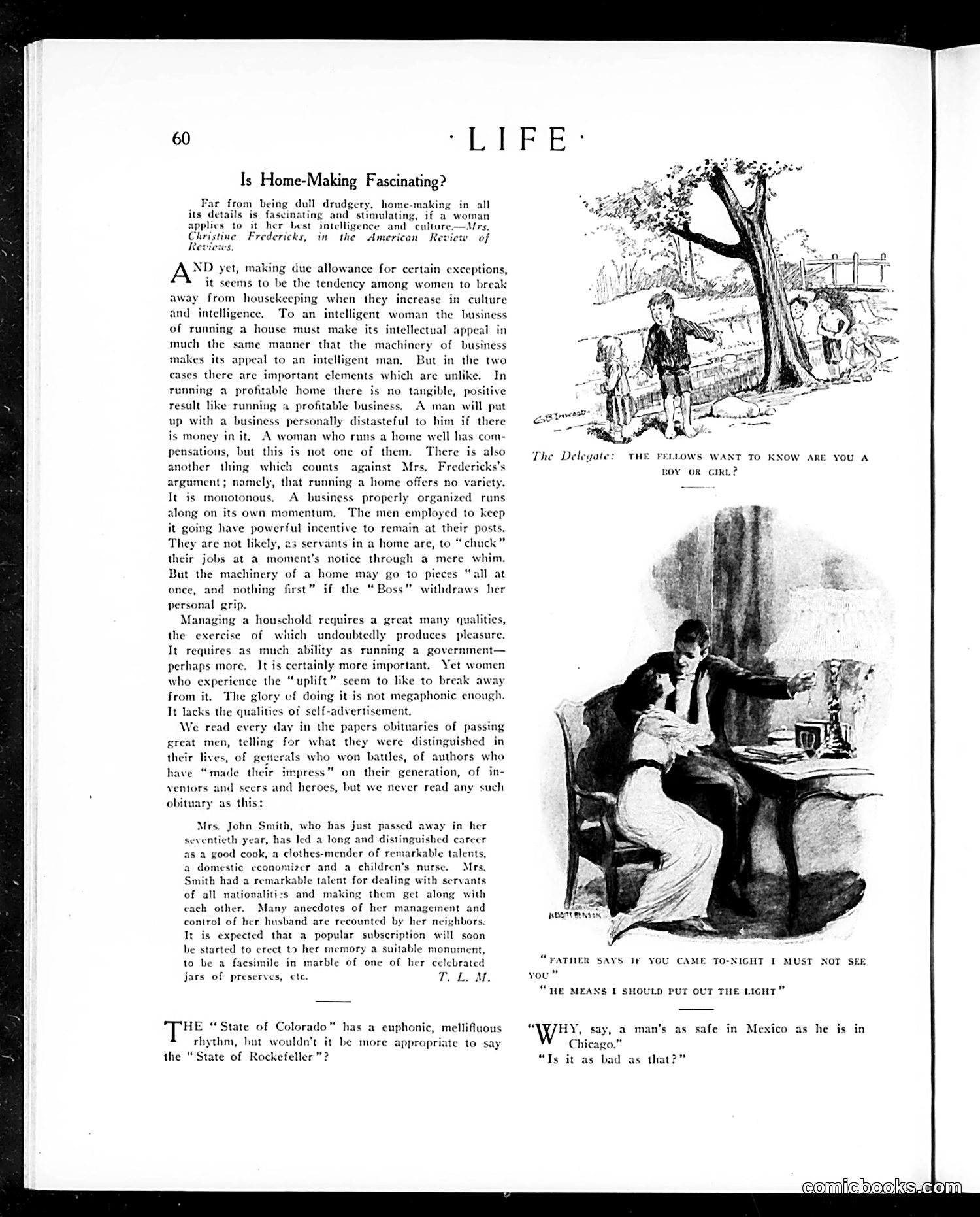
This page critiques the tension between women's domestic roles and their intellectual aspirations, circa early 1900s. **Main Article:** "Is Home-Making Fascinating?" argues against Christine Frederick's claim that housekeeping satisfies intelligent women. The author contends that housework lacks the tangible rewards and public recognition of business—men won't run unprofitable ventures, but women managing homes get no financial compensation or social acclaim. The satirical "Mrs. John Smith" obituary mocks society's refusal to honor domestic achievements; her marble monument would be a pickle jar, not a statue. **Top Cartoon:** Two boys ask a delegate (possibly political) "Are you a boy or girl?"—likely satirizing perceived weakness or indecision in leadership. **Bottom Cartoon:** Depicts a domestic scene where "Father" warns someone not to visit tonight or he'll "put out the light," with a reply about safety in Mexico versus Chicago—appears to reference dangers (possibly romantic or criminal) in American cities versus abroad. The page reflects Progressive Era anxieties about women's education, ambition, and traditional roles.
📄 Transcribed text from this page (OCR, searchable)
Machine-transcribed from the original scan — historical spelling and the odd misread are preserved.
SPP Is Home-Making Fascinating? Far from being dull drudgery, home-making in all its details is fascinating and’ stimulating, if a woman pplics to it her Lest intelligence and culture.—Mrs, Christine Fredericks, in the American Review of Reviews. ND yet, making due allowance for certain exceptions it seems to be the tendency among women to break away from housekeeping when they increase in culture and intelligence. To an intelligent woman the business of running a house must make its intellectual appeal in much the same manner that the machinery of business makes its appeal to an intelligent man. But in the two cases there are important elements which are unlike. In running a profitable home there is no tangible, positive result like running a profitable business, A man will put up with a business personally distasteful to him if there is money in it. A woman who runs a home well has com- pensations, but this is not one of them. There is also another thing which counts against Mrs, Fredericks's argument; namely, that running a home offers no variety. It is monotonous. A business properly organized runs along on its own momentum. The men employed to keep it going have powerful incentive to remain at their posts. They are not likely, 23 servants in a home are, to “ chuck” their jobs at a moment's notice through a mere whim. But the machinery of a home may go to pic “all at once, and nothing first” if the “Boss” withdraws her personal grip. Managing a household requires a great many qualities, the exercise of which undoubtedly produces pleasure. It requires as much ability as running a government— perhaps more. It is certainly more important. Yet women who experience the “uplift” scem to like to break away from it. The glory cf doing it is not megaphonic enough. It lacks the qualities of self-advertisement. We read every day in the papers obituaries of passing great men, telling for what they were distinguished in their lives, of gerterals who won battles, of authors who have “made their impress” on their generation, of in- ventors and seers and heroes, but we never read any such obituary as this Mrs. John Smith, who has just passed away in her seventieth year, has led a long and distinguished career as a good cook, a clothes-mender of remarkable talents, a domestic economizer and a children’s nurse. Mrs. Smith had a remarkable talent for dealing with servants of all nationaliti:s and making them get along with cach other. Many anecdotes of her management and control of her husband are recounted by her neighbors. It is expected that a popular subscription will soon be started to erect t> her memory a suitable monument, to be a facsimile in marble of one of her celebrated jars of preserves, etc T. Lo M. T HE “State of Colorado” has a euphonic, mellifluous thythm, but wouldn't it be more appropriate to say the “State of Rockefeller The Delegate: Te res.0WS WANT TO LOY OR GIKL? BETH RRNS EN “FATHER SAYS If YOU CAME TO-NIGHT you “VYHY, say, a man’s as safe Chicago.” Is it as bad as that?” KNOW ARE YOU A MUST NOT SEE