
A complete issue · 44 pages · 1914
Life — May 28, 1914
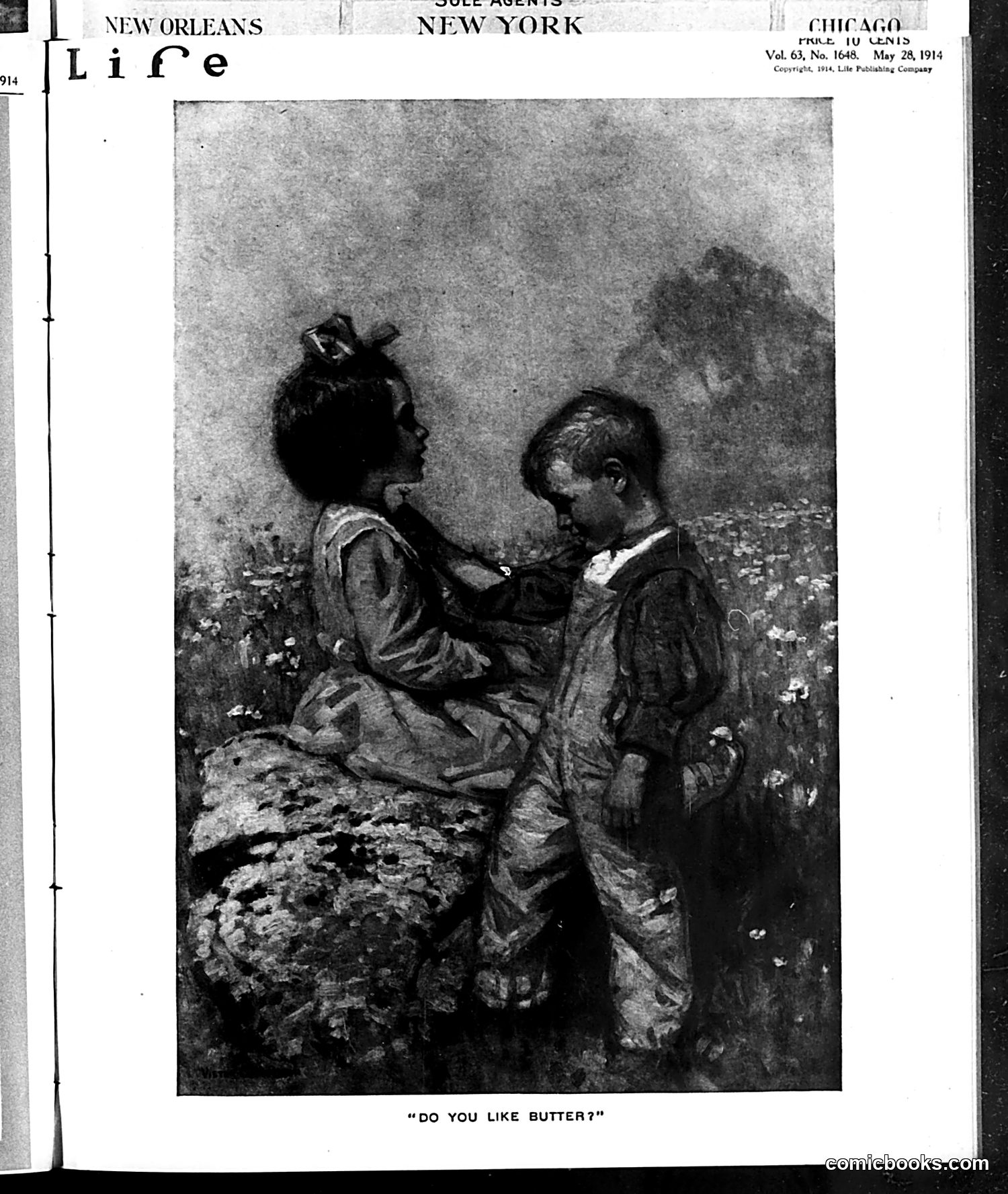
This image from *Life* magazine (May 28, 1914) depicts what appears to be a sentimental or romantic scene between a woman and child in a pastoral setting with flowers. The caption "Do You Like Butter?" references a traditional children's game where a buttercup flower held under the chin supposedly reveals whether someone likes butter. The satire likely comments on sentimentality or innocence in early 20th-century culture. Without additional context from surrounding page content, the exact satirical target remains unclear—it could mock overly sentimental artwork, advertising imagery of the era, or social attitudes toward childhood and romance. The grainy photographic quality suggests this may be reproducing artwork or advertising rather than original editorial cartooning.
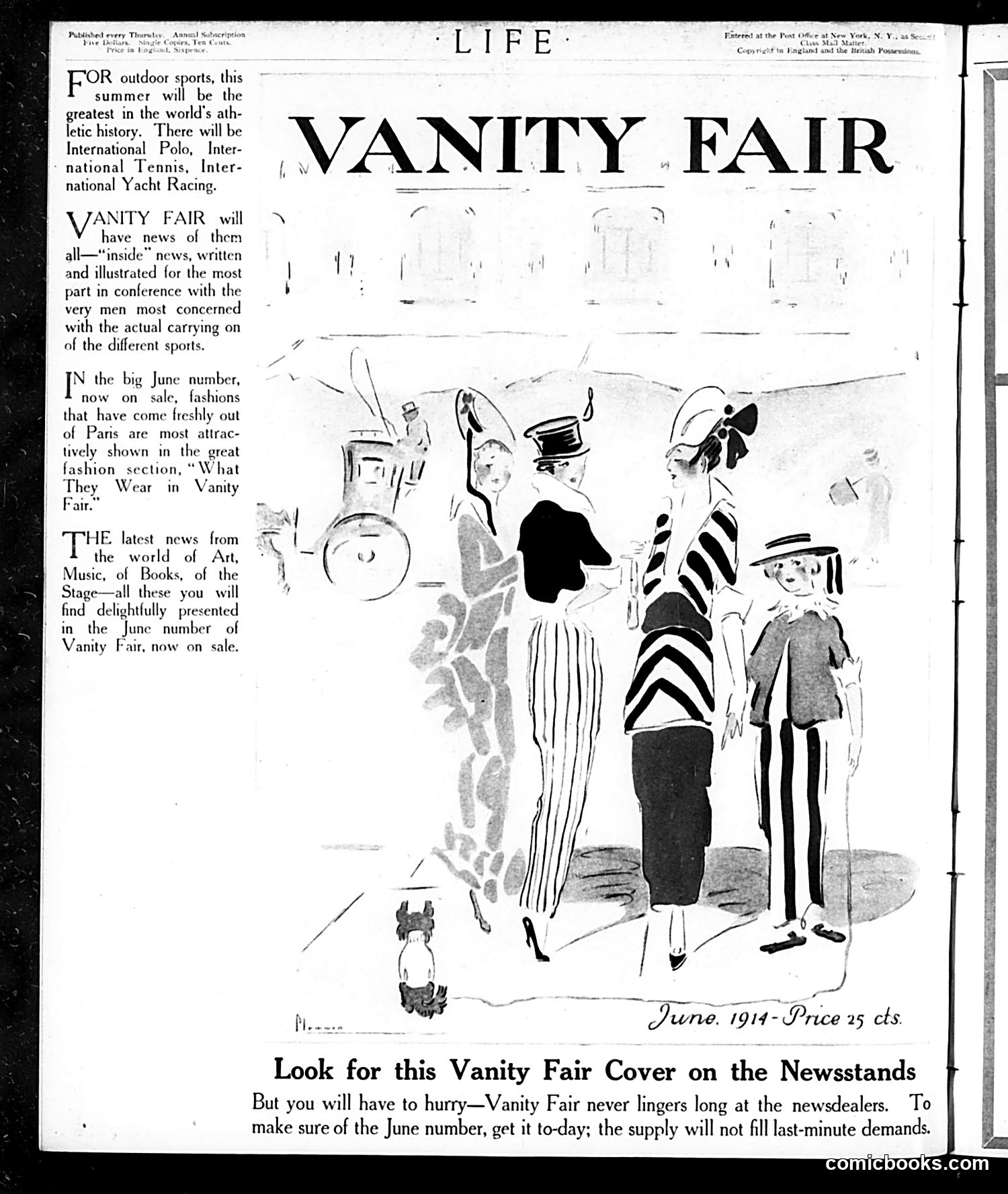
This is primarily a **magazine advertisement** for Vanity Fair's June 1914 issue, priced at 25 cents. The left column promotes the magazine's coverage of major summer sports (Polo, Tennis, Yacht Racing) and fashion coverage from Paris. The illustration depicts five fashionably dressed figures in 1914 summer attire, showcasing the striped, geometric patterns and decorative hats that characterized the era's women's fashion. The cartoon serves as a visual advertisement for Vanity Fair's fashion section titled "What They Wear in Vanity Fair." The bottom text urges readers to buy the issue immediately, warning that Vanity Fair sells out quickly at newsstands and supplies won't meet last-minute demand—a sales tactic emphasizing scarcity.
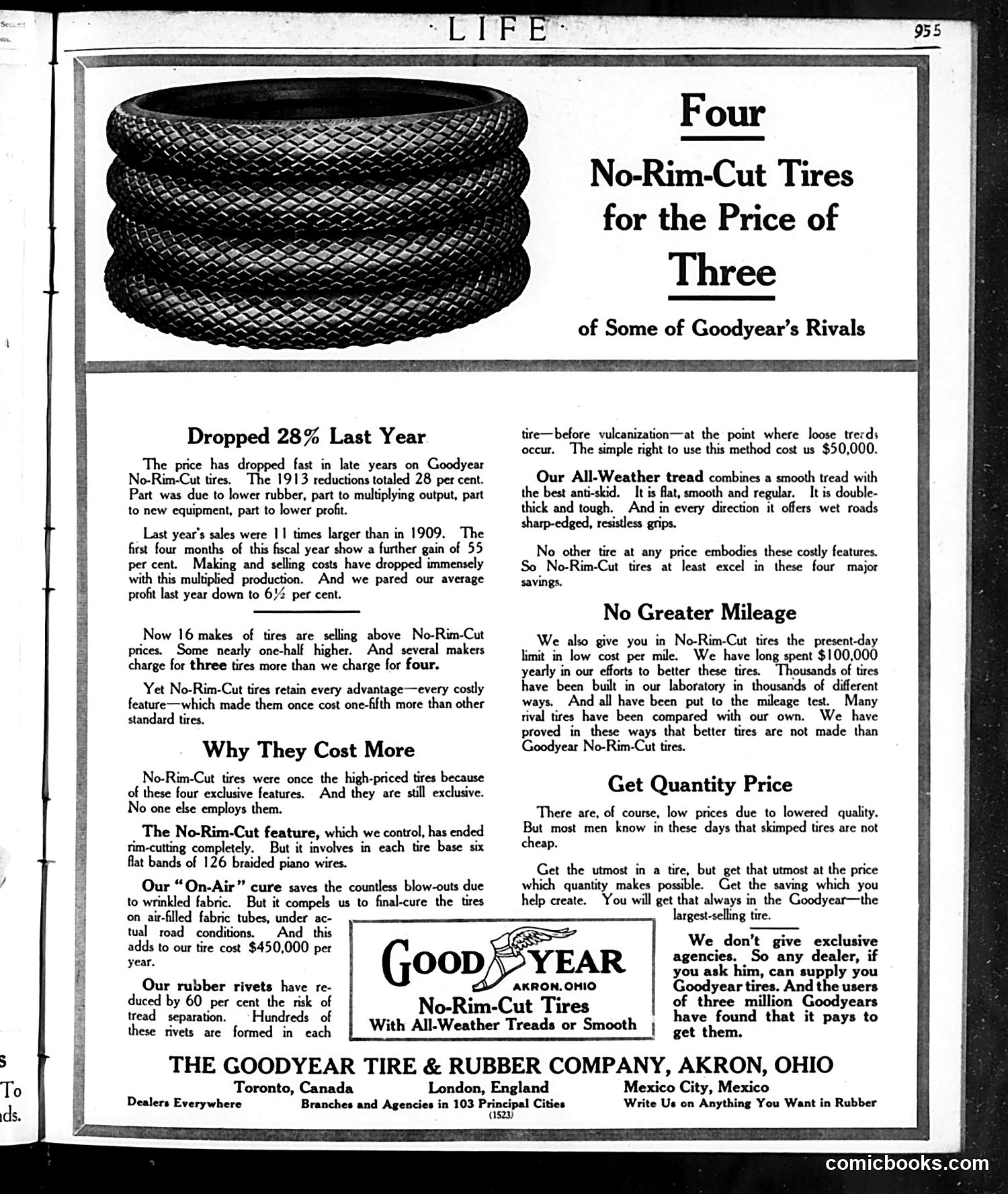
This is a **Goodyear Tire advertisement**, not satire or political commentary. The page promotes Goodyear's "No-Rim-Cut" tires by claiming superior quality and value. The advertisement addresses a specific market situation: competitors were undercutting Goodyear's prices (prices had dropped 28% the previous year). Rather than compete on price alone, Goodyear argues their tires justify higher costs through exclusive features like the "No-Rim-Cut" design, "On-Air" cure process, and rubber rivets that reduce tread separation. The copy emphasizes that cheaper competitors offer inferior quality, and that Goodyear's larger production volume allows them to offer "quantity price" while maintaining standards. **This is straightforward product advertising**, not editorial content requiring historical interpretation.
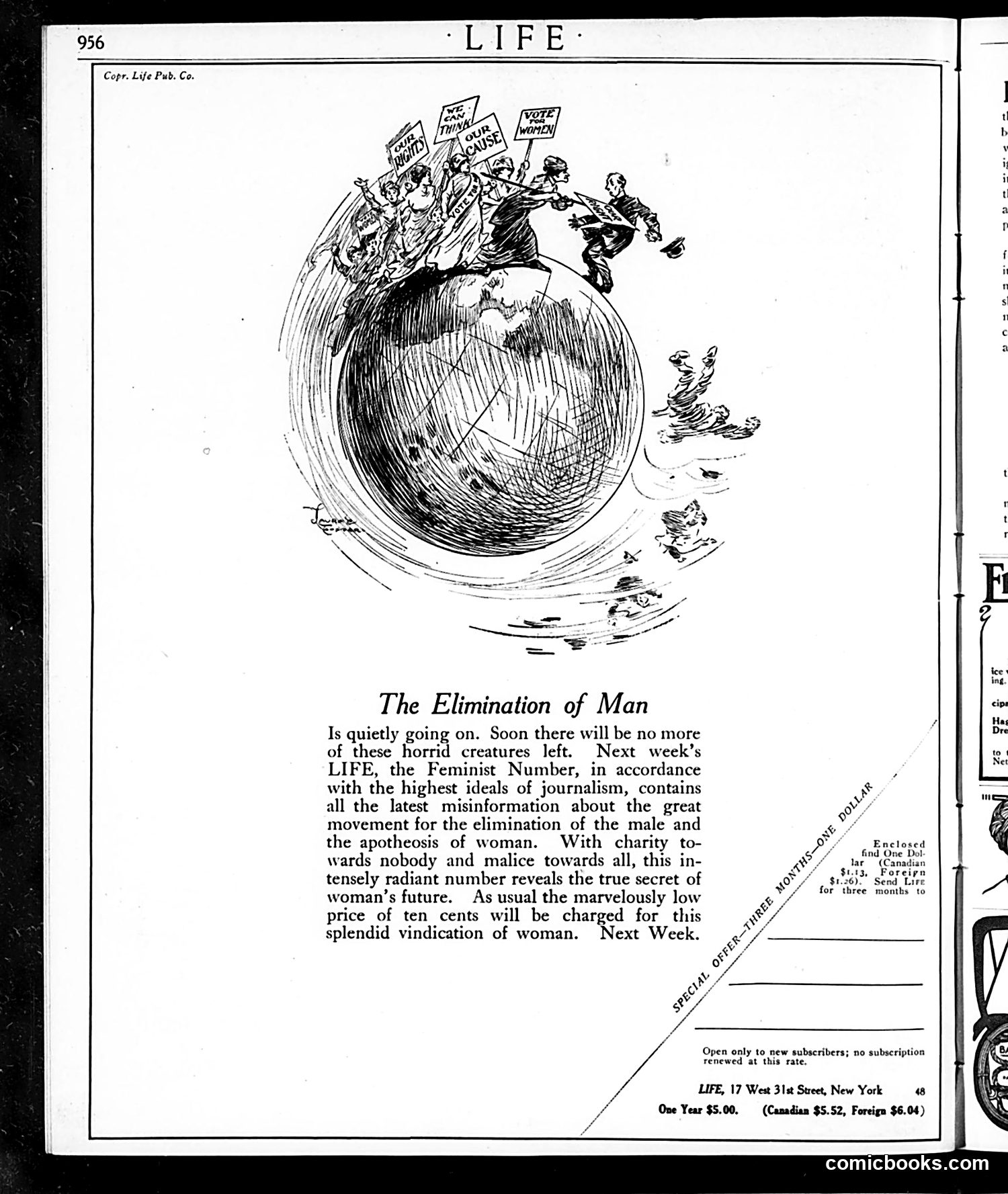
This satirical cartoon mocks early 20th-century feminist activism. The illustration shows figures climbing atop a globe while carrying signs advocating for women's causes (including "Vote for Women"). Some figures appear to be falling or tumbling off the sphere's surface, suggesting chaos or instability. The accompanying text sarcastically announces that *Life* magazine's next issue will feature a "Feminist Number" supposedly revealing "the true secret of woman's future" and "the elimination of the male and the apotheosis of woman." The tone is mocking and dismissive—presenting feminist ambitions as absurd or threatening to established order. This reflects the anti-suffrage and anti-feminist sentiment common in American satirical publications during the women's suffrage movement era (early 1900s-1920).
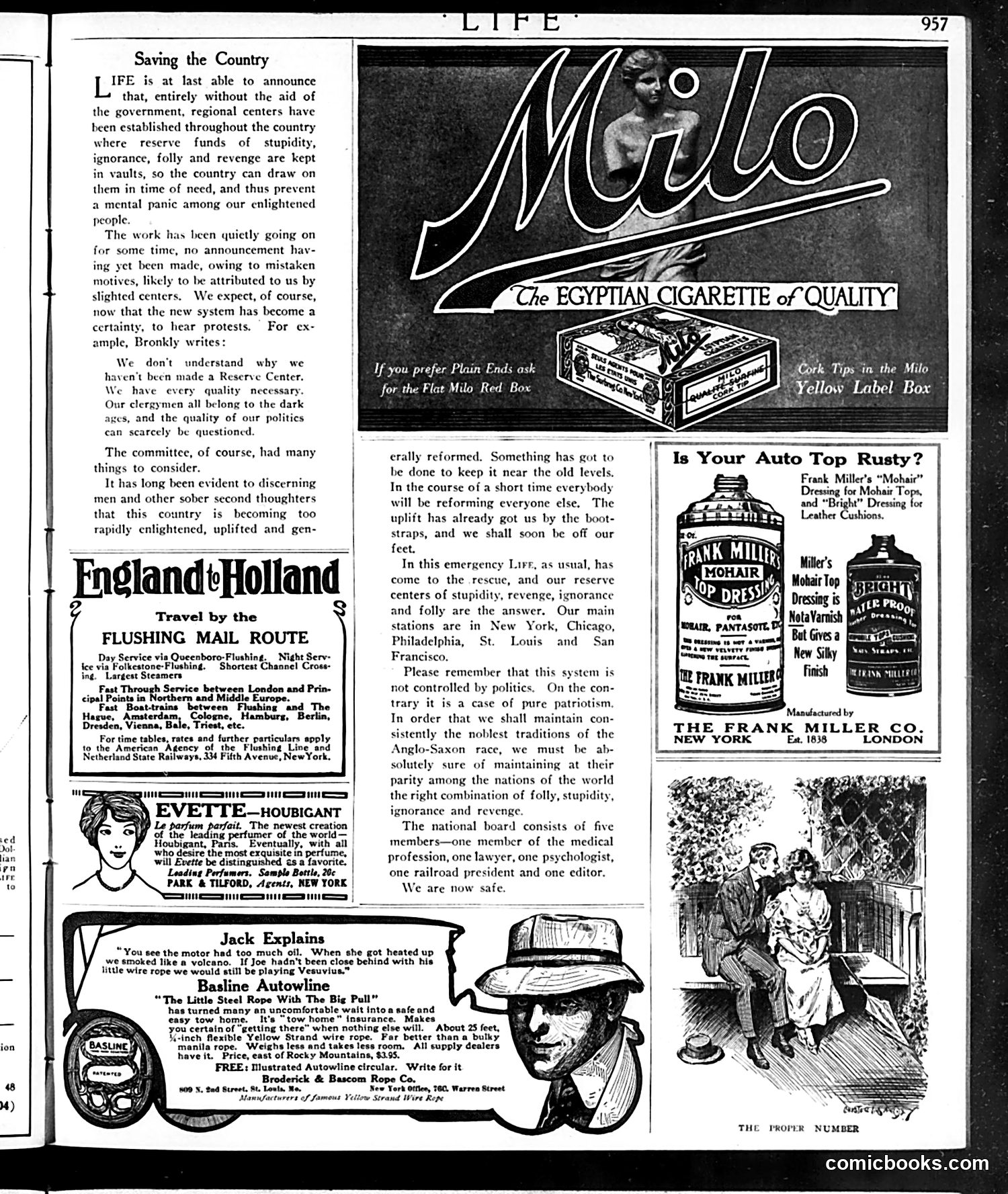
This page is primarily **advertisements** with minimal editorial content. The main article, "Saving the Country," discusses establishing government reserve centers to prevent financial panic—likely referencing post-WWI economic concerns or early 1920s financial stability issues. The advertisements include: - **Milo cigarettes** ("The Egyptian Cigarette of Quality") - **Frank Miller's Mohair auto upholstery dressing** - **England to Holland travel** via mail route - **Evette-Houbigant perfume** - **Basline Autovine** (automotive product) A small illustrated vignette labeled "Jack Explains" features a character discussing the "Basline Autovine," a towing device. The bottom illustration titled "The Proper Number" appears to be a humorous domestic scene but lacks sufficient context for interpretation. The page reflects 1920s consumer culture and early automotive-era products rather than significant political satire.
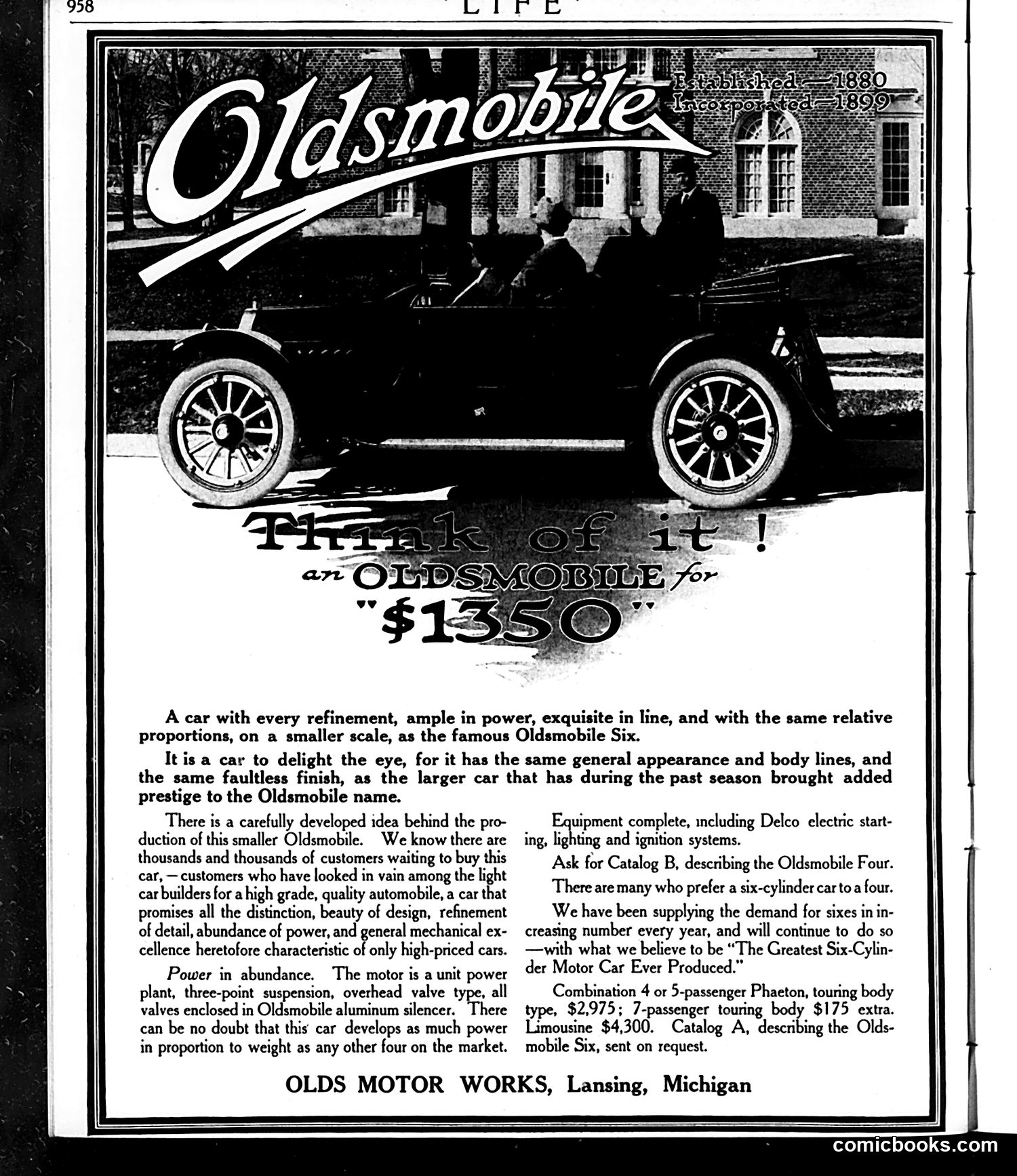
This page is **primarily an advertisement**, not political satire or cartoon content. It's a 1899 Oldsmobile advertisement featuring a photograph of an early automobile with passengers outside a brick building. The ad promotes a smaller, six-cylinder model priced at $1,350—positioned as an affordable alternative to Oldsmobile's famous "Oldsmobile Six." The marketing pitch emphasizes the car's refined engineering, power, and aesthetic appeal comparable to more expensive vehicles. It highlights features like electric starting, enclosed valve mechanisms, and suspension quality. There is **no political cartoon or satirical content** on this page. The "Think of it!" headline is simply advertising copy designed to excite readers about accessible luxury automotive technology during the early automobile era.
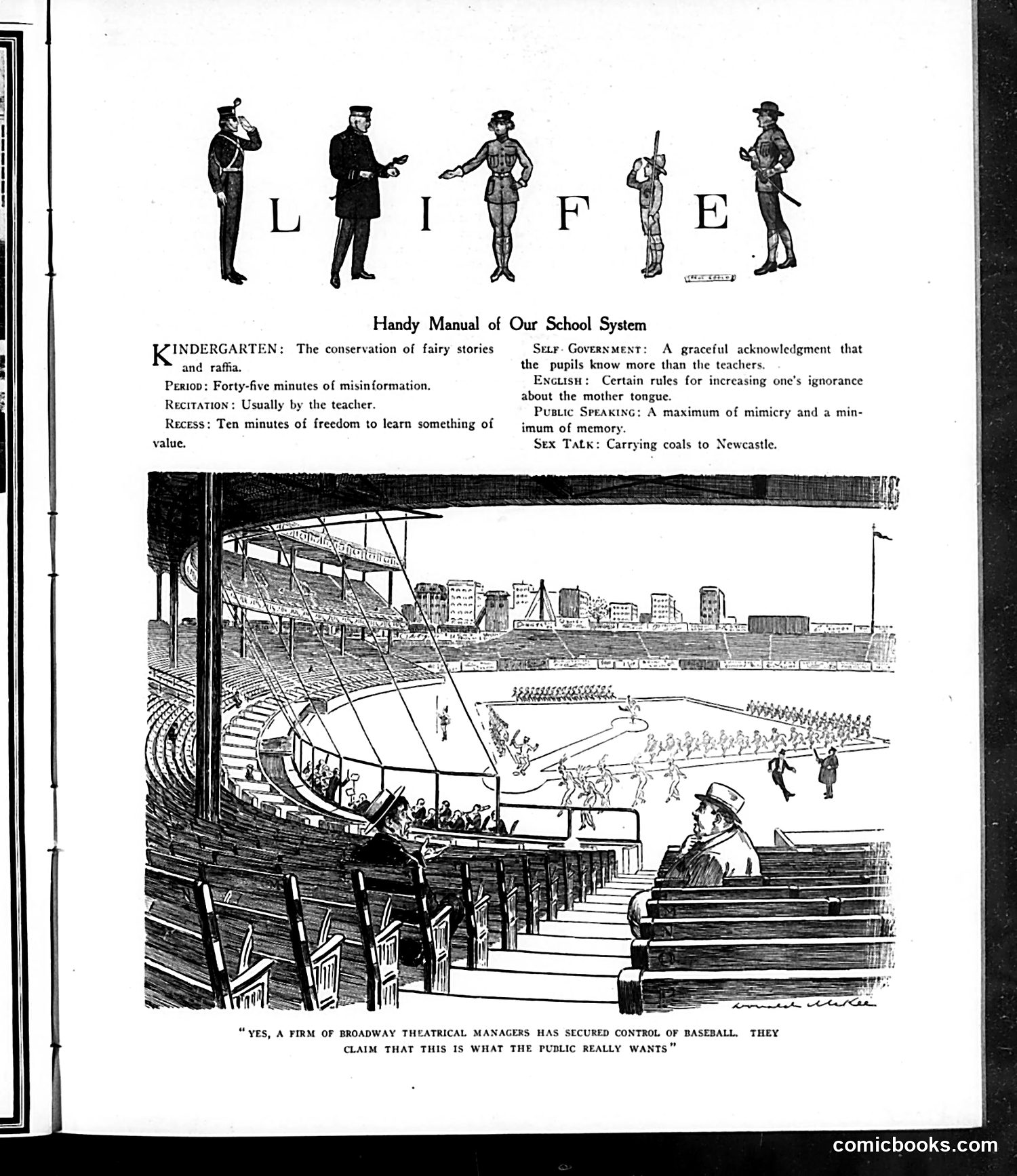
This page satirizes American education and commercial entertainment through two elements: **Top section** ("Handy Manual of Our School System"): A mock guide mocking educational practices. Kindergarten teaches "fairy stories and raffia"; periods last 45 minutes of "misinformation"; recitation is "usually by the teacher"; recess offers "ten minutes of freedom to learn something of value." The right side sarcastically defines "self-government," "English," and "sex talk," mocking educational pretense. **Bottom cartoon**: Shows a crowded baseball stadium with the caption: "YES, A FIRM OF BROADWAY THEATRICAL MANAGERS HAS SECURED CONTROL OF BASEBALL. THEY CLAIM THAT THIS IS WHAT THE PUBLIC REALLY WANTS." This satirizes commercialization—Broadway producers supposedly now control baseball, implying the sport has become theatrical spectacle rather than genuine athletic competition, prioritizing entertainment over sport.
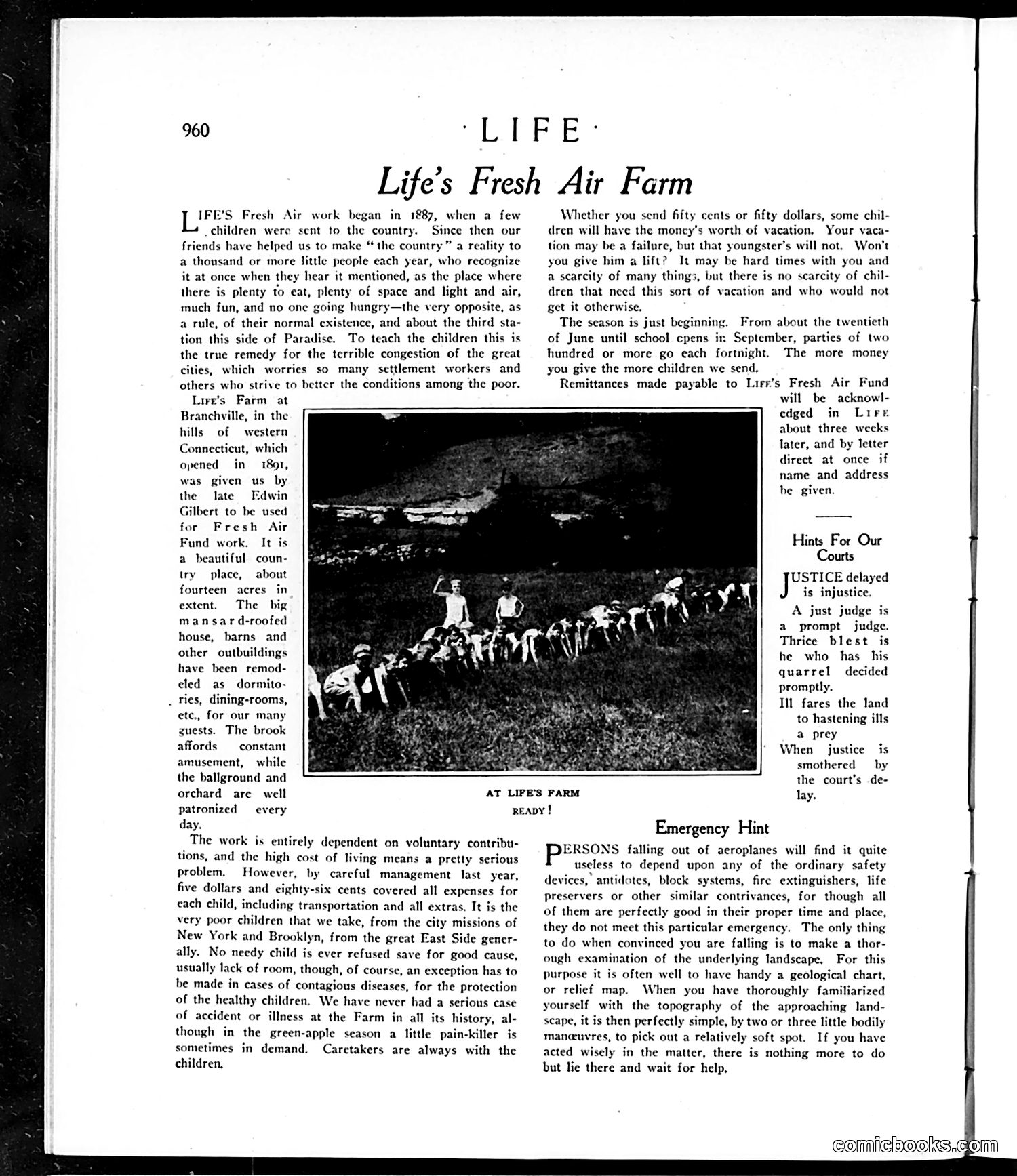
This is not a political cartoon but rather an advocacy article about Life Magazine's charitable program. The page describes Life's Fresh Air Farm in Branchville, Connecticut, established in 1891 to provide rural vacation experiences for poor urban children from New York and Brooklyn. The central photograph shows children at the farm, apparently having a meal or gathering outdoors. The article emphasizes the farm's mission: giving city children access to fresh air, space, and healthy food—addressing urban poverty and overcrowding. The accompanying sections include practical information about donations and an "Emergency Hint" about airplane safety, likely reflecting contemporary aviation concerns. This represents Life's dual role as both satirical publication and civic advocate for Progressive-era social welfare.
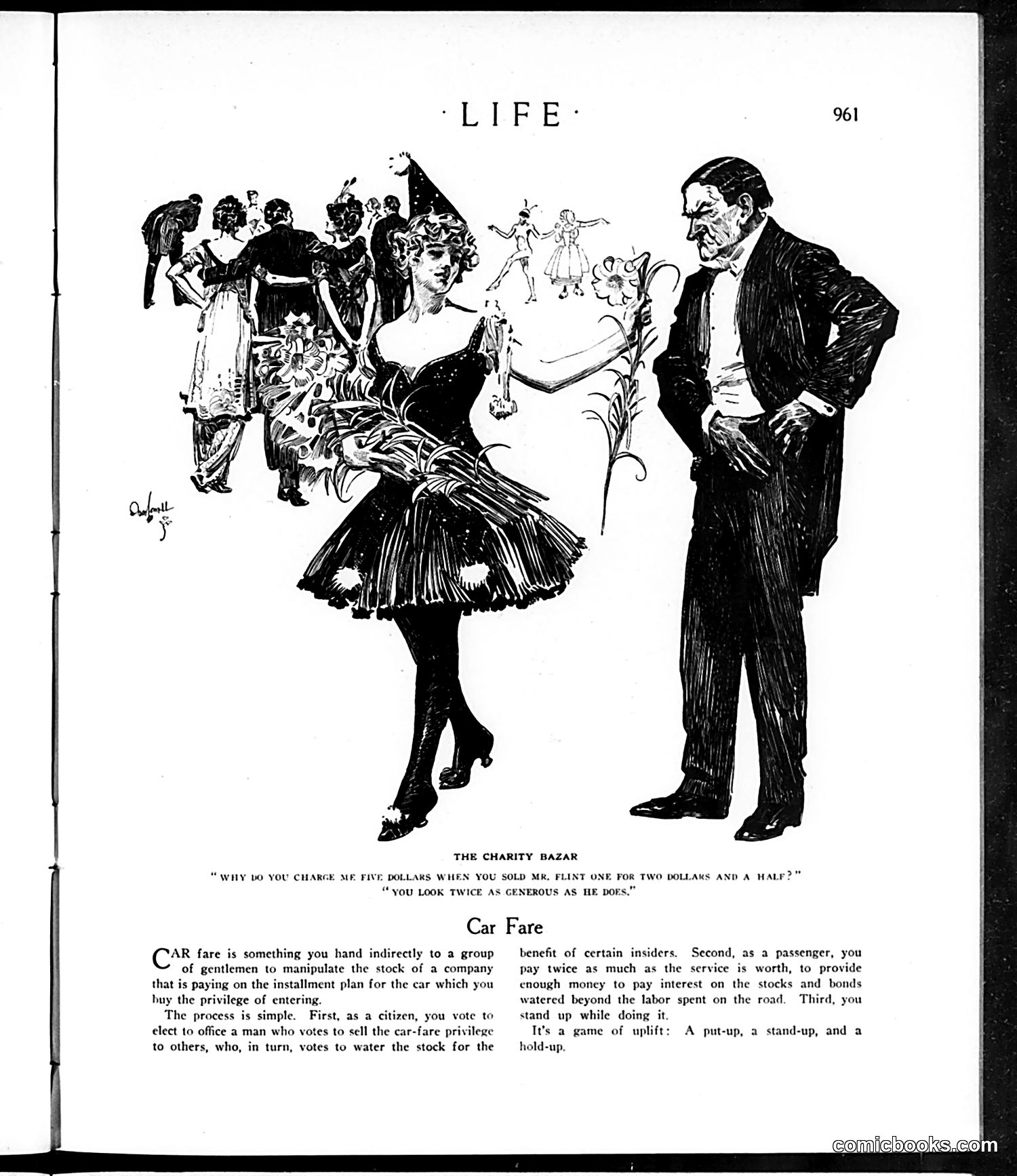
This Life magazine cartoon satirizes the "car-fare" scheme—a financial scam involving installment-plan automobile purchases. The illustration shows a well-dressed man confronting a woman at a charity bazaar, with the caption: "Why do you charge me five dollars when you sold Mr. Flint one for two dollars and a half?" / "You look twice as generous as he does." The accompanying text explains how car-fare operates: citizens vote to elect officials who sell car-fare privileges to insiders for profit. Passengers then pay inflated prices, with the excess funding stock manipulation. The scheme is characterized as "a game of uplift: A put-up, a stand-up, and a hold-up"—meaning it's rigged corruption disguised as public benefit.
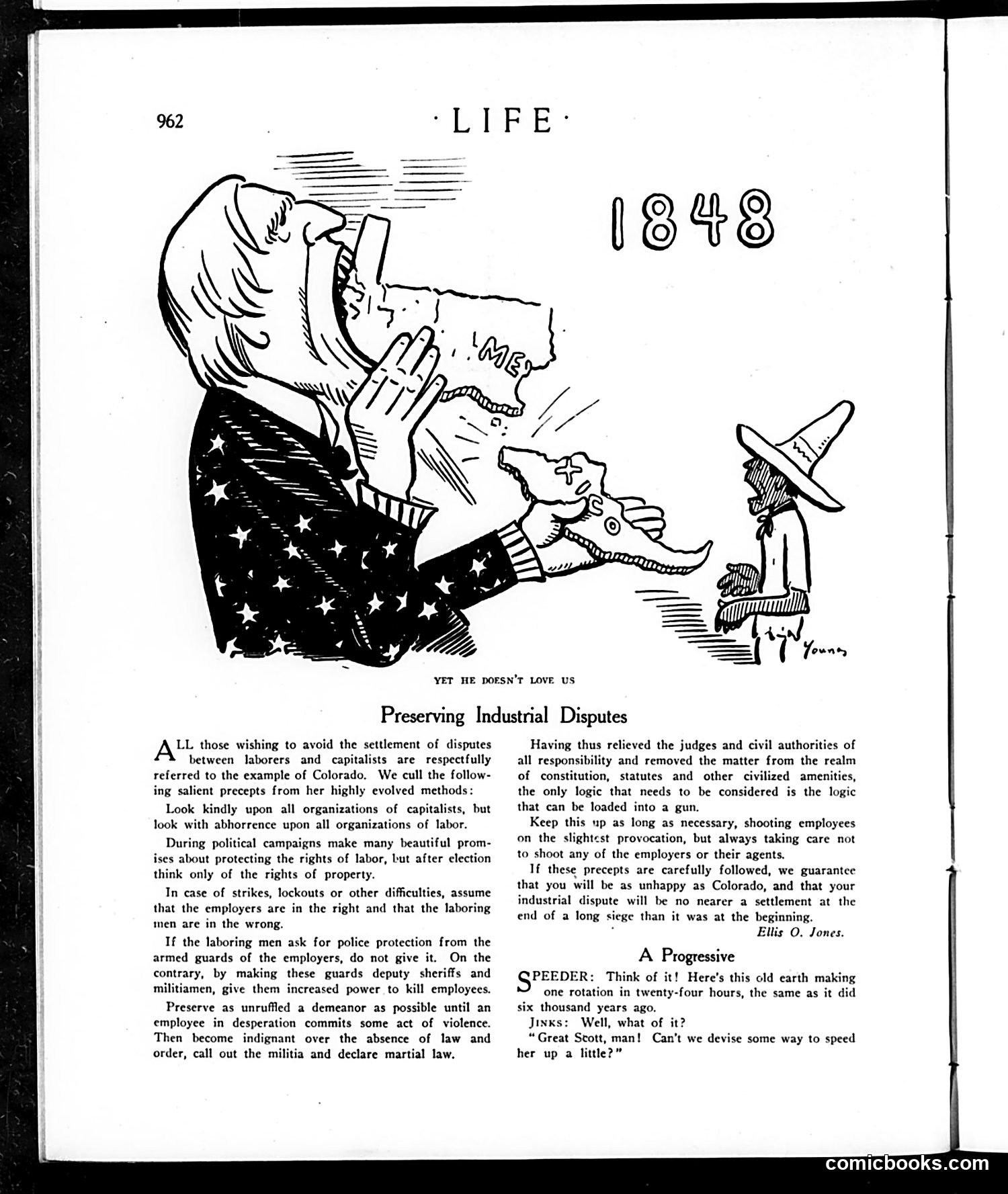
This cartoon satirizes labor disputes through a grotesque caricature of a large capitalist or employer figure (drawn with exaggerated features) towering over tiny workers wearing Mexican sombreros. The title "Yet He Doesn't Love Us" suggests bitter irony about the employer-worker relationship. The accompanying text "Preserving Industrial Disputes" by Ellis O. Jones presents cynical advice to avoid labor settlement, advocating suppression of worker organizing while maintaining employer control. It mocks this approach as Colorado's "highly evolved method." The cartoon critiques capitalist indifference to workers' welfare and the power imbalance in industrial relations. The Mexican imagery likely references contemporary westward expansion and labor conflicts in frontier regions. The overall message condemns callous employer attitudes toward their workforce.
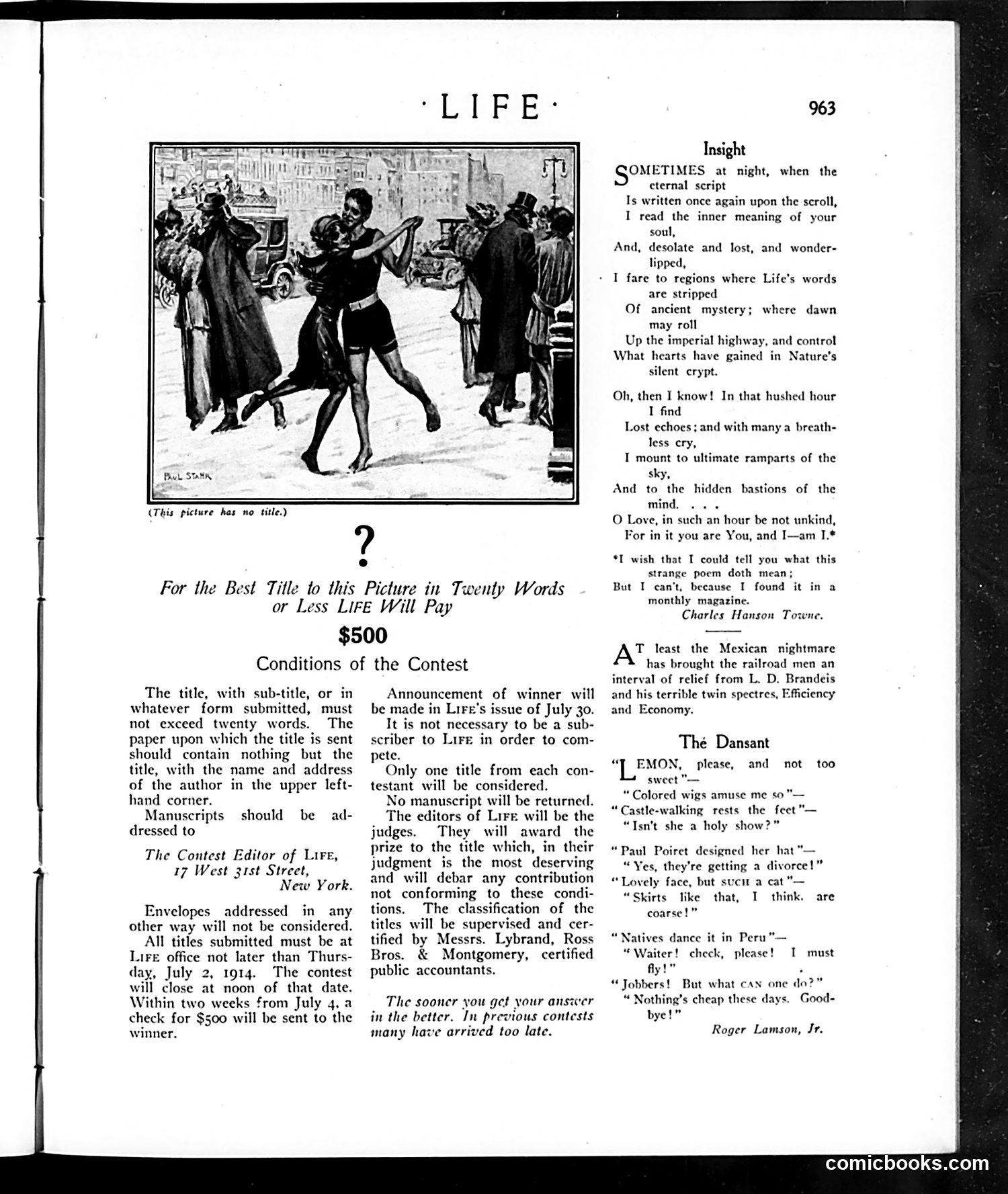
The main illustration (credited to Cesare Soban) depicts a street scene with a skeletal figure in the center—appearing to represent Death or a plague personification—surrounded by well-dressed pedestrians who seem oblivious or indifferent to this macabre presence. The caption notes the picture has no title, and below it Life announces a $500 contest for readers to propose one in twenty words or less. This appears to be satirizing public apathy toward a significant social danger—likely disease, mortality, or urban decay—that persists amid everyday life while citizens go about their business unconcerned. The contest invitation makes the satire participatory, inviting readers to name the unnamed threat. The page also includes unrelated poetry and humorous quotes sections ("Insight," "The Dansant").
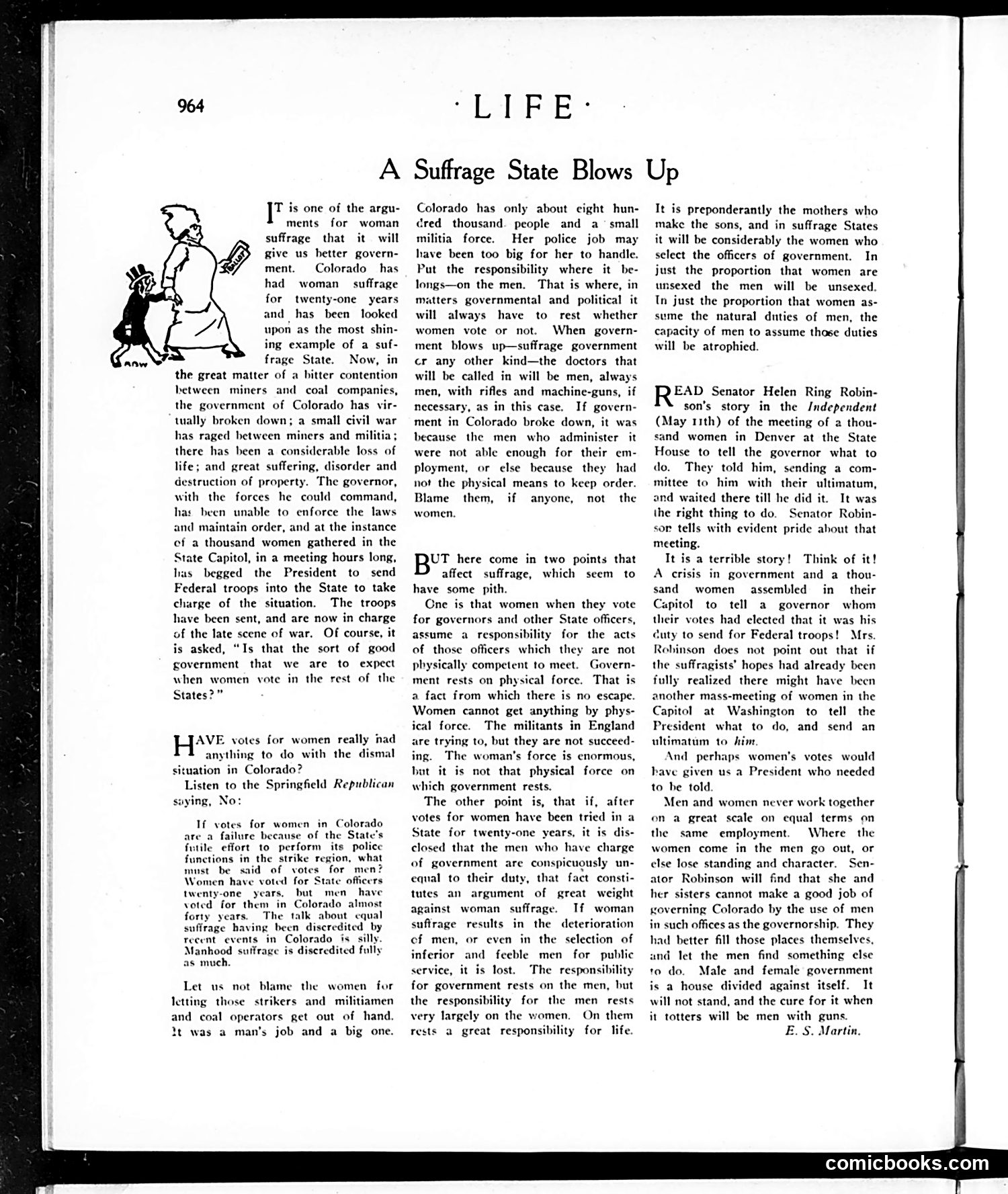
This page satirizes woman suffrage in Colorado through both cartoon and essay. The illustration (upper left) shows a woman striking a man, depicting the chaos the author claims results from women voting. The essay argues that Colorado's experience with woman suffrage for twenty-one years proves it harmful to government. The author contends that women lack the physical force necessary to enforce laws and maintain order—a responsibility he claims properly belongs to men. He suggests that when women vote, they select weak or incompetent male officials unable to govern effectively. The piece references Colorado's 1903 suffrage law and uses labor unrest (miners' strikes) as evidence that female voters create governmental instability. The satire attacks woman suffrage as inherently destabilizing to proper masculine authority and state function.
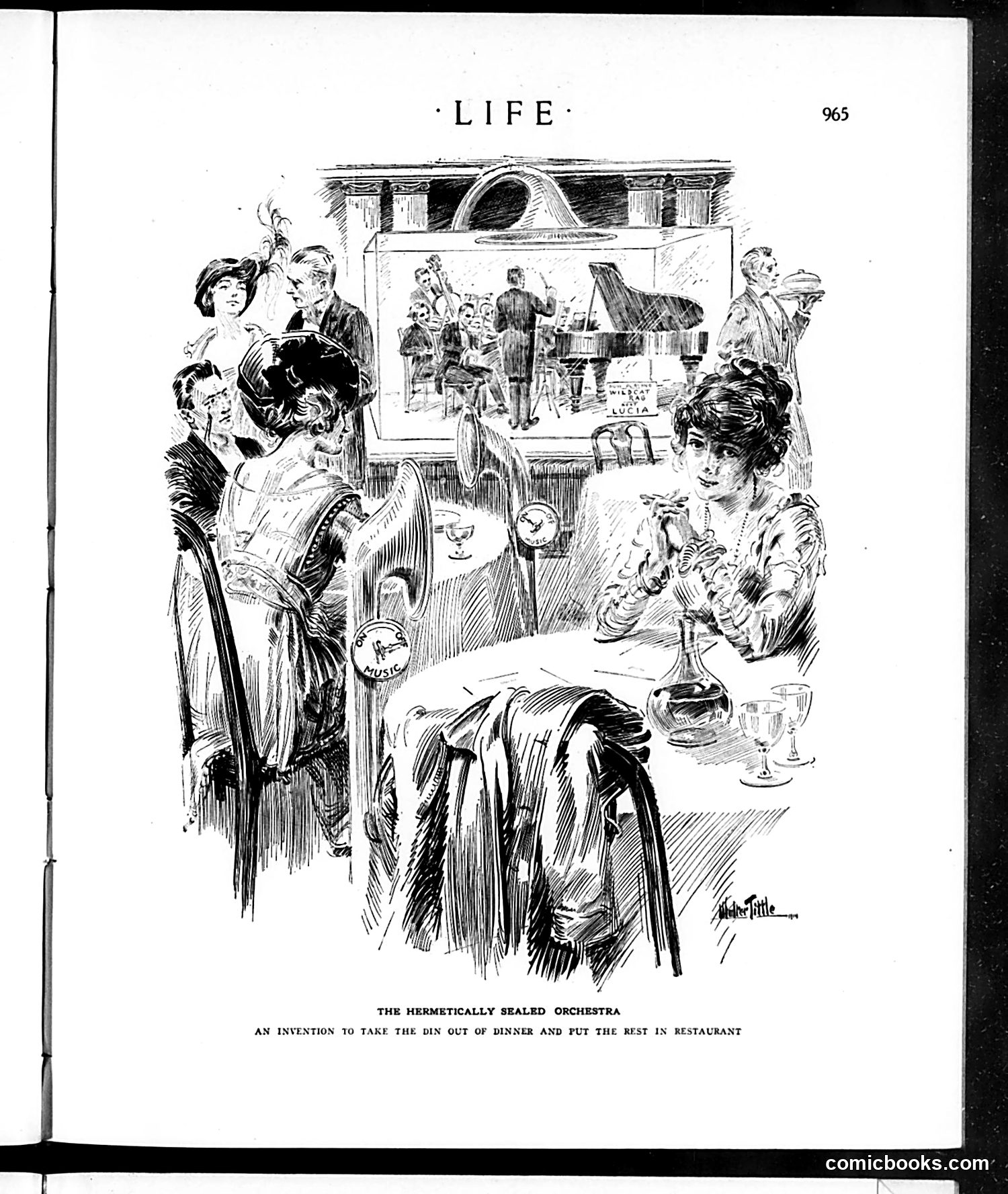
This satirical cartoon depicts a restaurant dinner scene where an orchestra performs inside a completely sealed glass enclosure. The subtitle explains the joke: it's "an invention to take the din out of dinner and put the best in restaurant." The satire targets a common complaint about dining establishments—that live orchestral music was often too loud, drowning out conversation. The cartoon mocks this problem with an absurd "solution": physically isolating the musicians behind glass so diners can see the performance while being spared the noise. The well-dressed patrons shown dining and conversing represent the restaurant's clientele. This reflects early 20th-century upper-class restaurant culture, where live entertainment was standard but frequently criticized as intrusive to the dining experience.
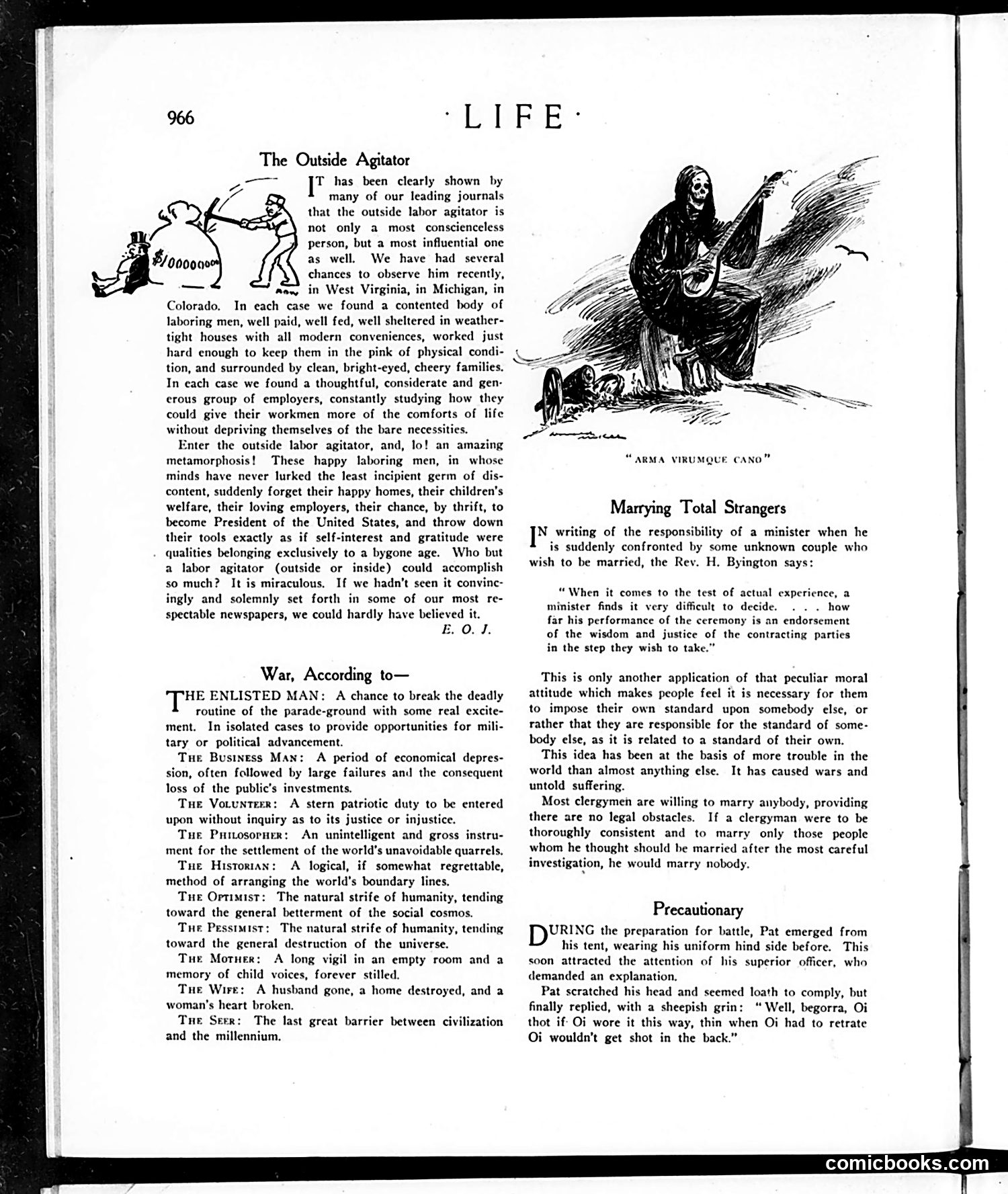
This cartoon depicts labor agitation during the early 20th century. The illustration shows a sinister figure labeled "ARMA VIRUMQUE CANO" (a classical Latin phrase) riding what appears to be a dynamite barrel or explosive device—a visual metaphor common in anti-labor propaganda of the era. The accompanying text criticizes "outside labor agitators" who allegedly infiltrated American communities (West Virginia, Michigan, Colorado) to stir discontent among otherwise content, well-paid workers with good families and homes. The satirical piece presents these agitators as manipulative outsiders who exploit workers' contentment for their own purposes. This reflects a common management and journalistic narrative blaming external radicals rather than addressing legitimate worker grievances during the industrial era's labor conflicts.
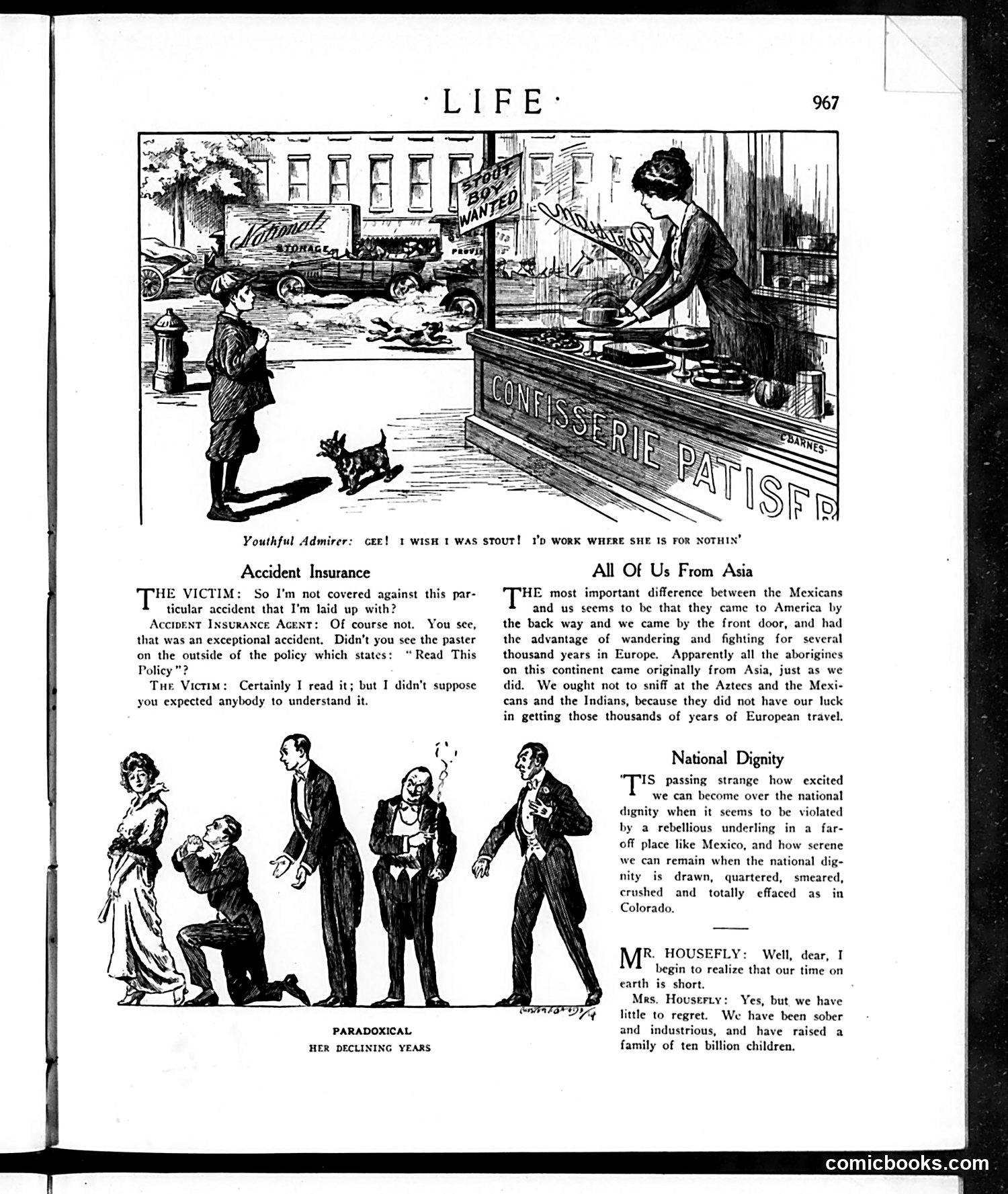
This page contains three distinct satirical pieces: **"Accident Insurance"** mocks insurance companies' deceptive practices. A policyholder denied coverage for an accident points out the absurdity: the fine print disclaimer "Read This Policy" is unreadable, yet the insurer claims he should have understood exclusions. The satire targets corporate dishonesty hidden behind deliberately obscure legal language. **"All Of Us From Asia"** critiques American prejudice against Mexicans and Native Americans. The piece argues that all Western Hemisphere inhabitants—including European Americans—descended from Asian migrants, so Americans have no basis for racial superiority. It suggests we benefited merely from arriving earlier and having extra centuries of European development. **"National Dignity"** employs bitter irony comparing American outrage over Mexican instability with American indifference to labor violence in Colorado (likely referencing mining conflicts). The hypocrisy: we defend "national dignity" abroad while ignoring it at home. **"Her Declining Years"** and the confectionery shop cartoon appear to be separate humorous vignettes about aging and workplace attractions.
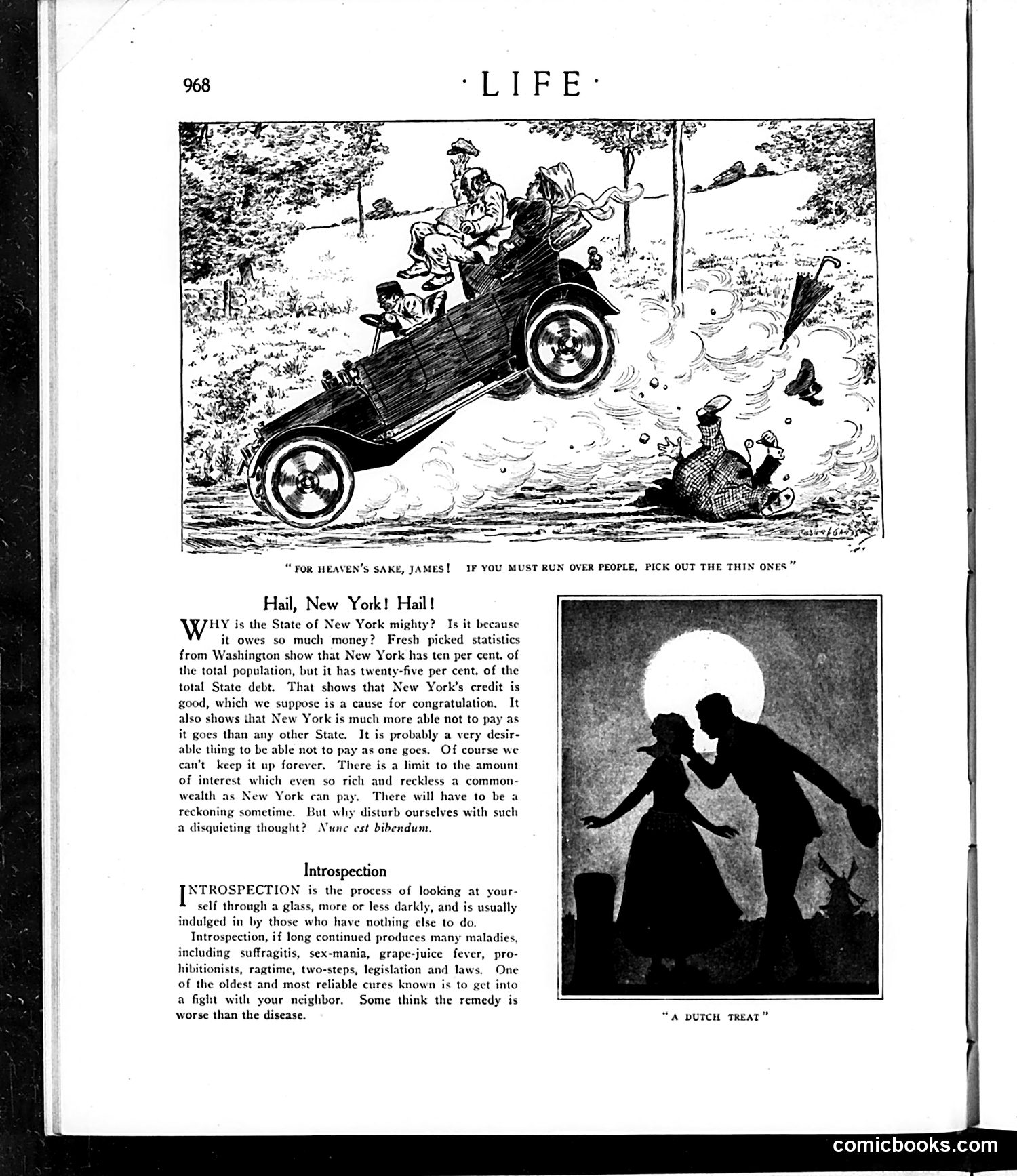
**The Top Cartoon:** Satirizes reckless automobile driving. A wealthy couple in an overturned car callously instructs their driver to hit "thin ones" instead of fat pedestrians—darkly joking that slim victims cause less damage. This mocks both the new automobile's danger to pedestrians and the careless indifference of wealthy drivers. **"Hail, New York! Hail!":** Sarcastically praises New York State for its massive debt (25% of total state debt despite only 10% of population). The piece mocks politicians and citizens for celebrating financial irresponsibility, using the Latin phrase "Nunc est bibendum" ("now is the time to drink")—suggesting they're ignoring a looming financial reckoning. **"Introspection":** Satirizes excessive self-reflection and modern social movements. It lumps together "suffragitis" (women's suffrage), prohibitionism, ragtime, and legislation as byproducts of idle introspection. The remedy suggested—fighting one's neighbor—is presented as possibly worse than the disease itself, mocking both introspection and its proposed cure.
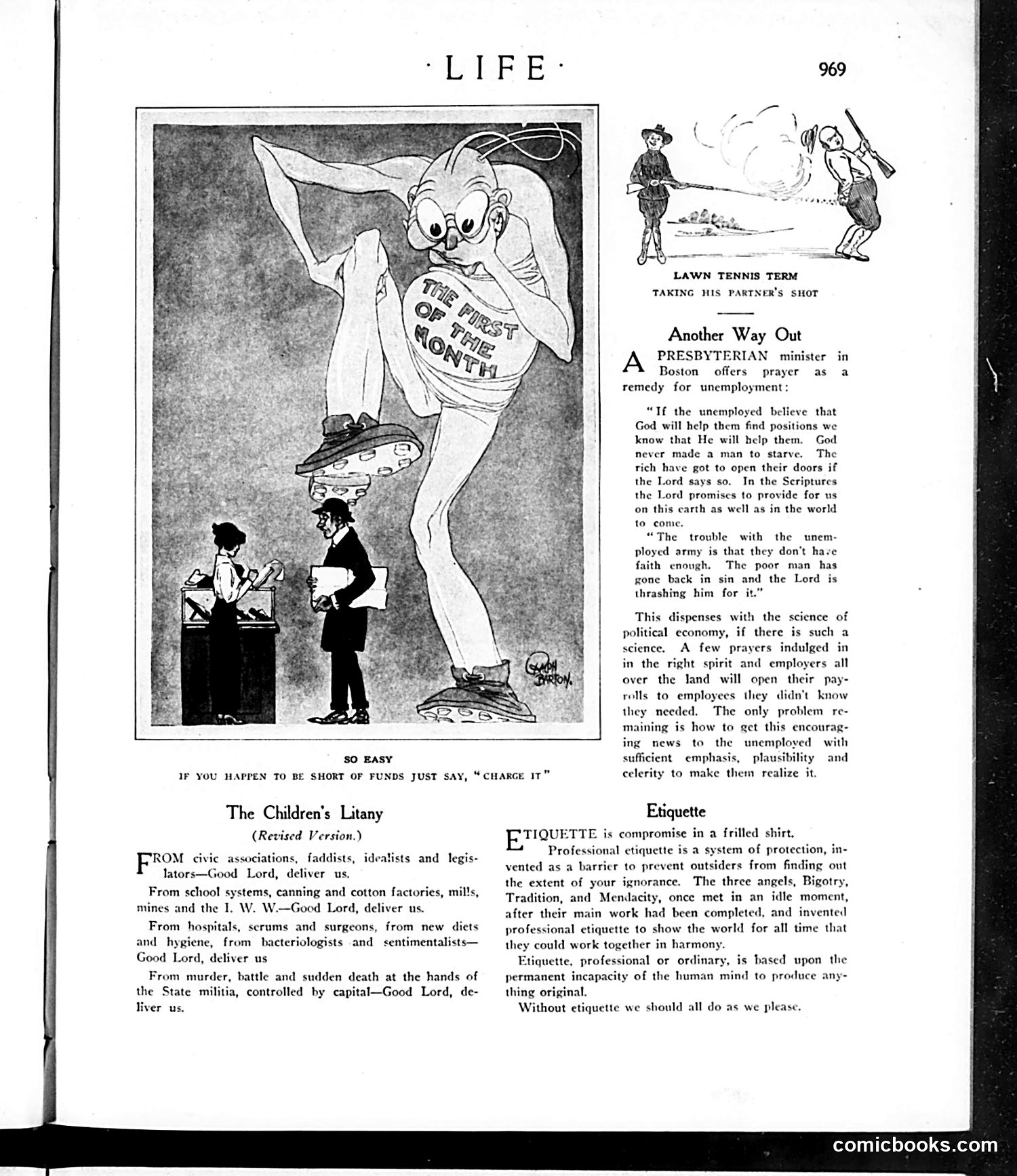
**Main Cartoon (left):** A grotesquely tall figure labeled "The Burden of the Month" towers over two small businessmen below. The satire mocks easy financial solutions—the caption reads "So Easy / If You Happen to Be Short of Funds Just Say, 'Charge It'"—criticizing frivolous spending and credit during what appears to be economic hardship. **"Another Way Out" (text):** This section sardonically reports a Boston Presbyterian minister's suggestion that prayer and faith—not economic policy—solve unemployment. The satire pointedly critiques this religious approach as dismissing actual economic science and blaming the poor themselves ("the poor man has gone back in sin"). **"The Children's Litany":** A mock prayer parodying religious litanies, listing societal problems (factories, hospitals, state militia violence) from which deliverance is sought. It critiques industrial conditions and government suppression. **"Etiquette":** A brief satirical essay defining etiquette as protective pretense masking ignorance, invented by "Bigotry, Tradition, and Mendacity." The page overall reflects early 20th-century progressive critique of economic inequality and institutional hypocrisy.
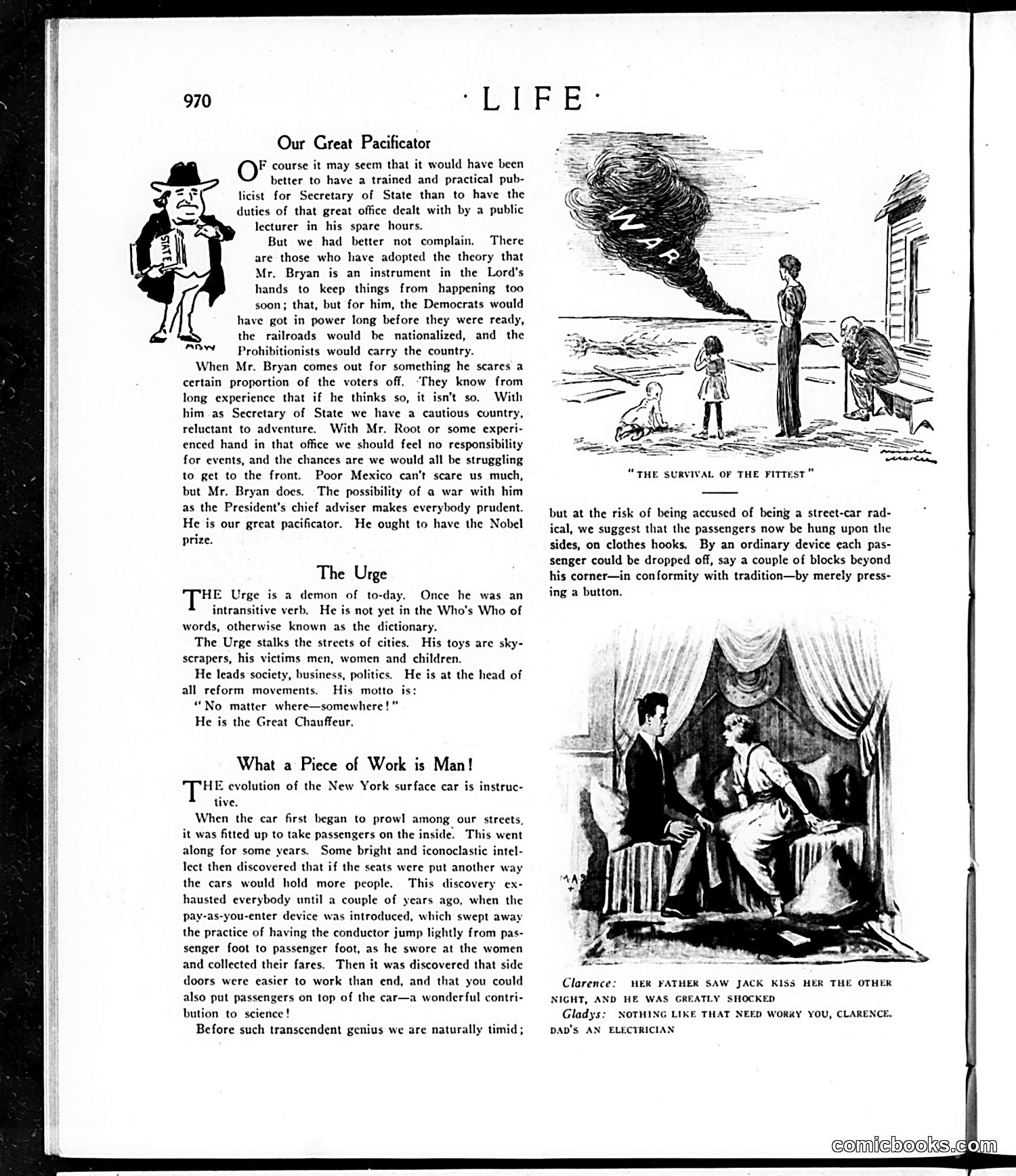
## "Our Great Pacificator" The caricatured figure is **William Jennings Bryan**, Secretary of State under President Wilson. The satire mocks Bryan as an ineffective "pacificator" — the joke being that his unpopularity actually *prevents* American adventurism. The text sardonically suggests that because Bryan's opinions are so consistently wrong, his pacifist stance makes the country cautious. He's portrayed as a public lecturer dabbling in diplomacy, unfit for the role compared to experienced statesmen like Elihu Root. ## "The Urge" This personifies modern American momentum — the relentless drive for progress and change ("No matter where—somewhere!"). It's presented as a chaotic force driving society, business, and reform movements, depicted as the "Great Chauffeur" wildly steering civilization forward. ## "What a Piece of Work is Man!" Satirizes the incremental "improvements" to New York streetcars, culminating in absurd suggestions like hanging passengers from clothes hooks like coats — mocking how minor engineering changes are celebrated as revolutionary breakthroughs. ## Bottom Cartoon A light social joke about an electrician father approving his daughter's kissing (electrical pun intended).
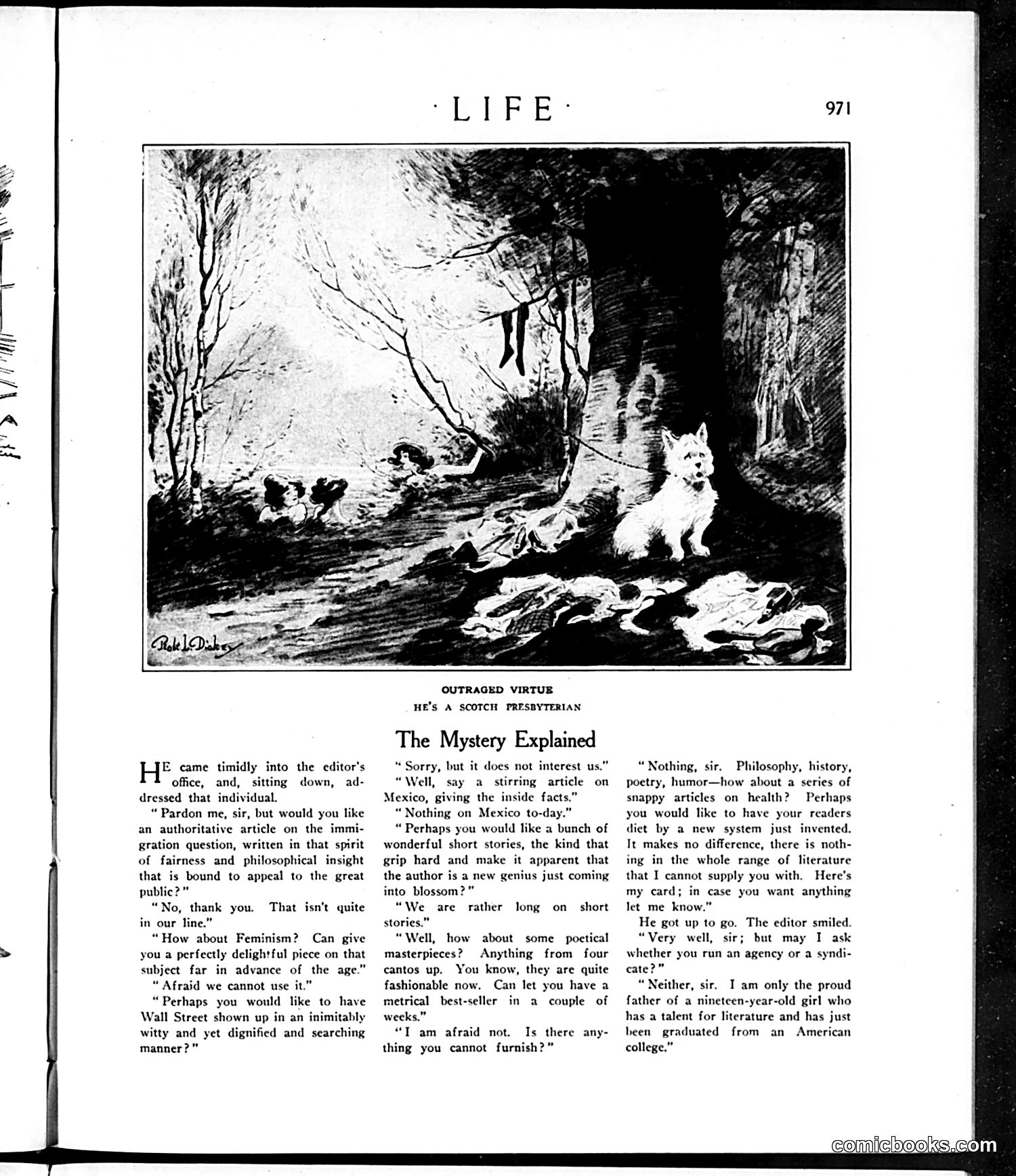
This satirical piece mocks a self-deluded father pitching his daughter's writing to a magazine editor. The man confidently offers articles on immigration, feminism, Wall Street exposés, Mexican politics, short stories, and poetry—all supposedly within his supply. The editor repeatedly declines each pitch. The joke's revelation: he's a "Scotch Presbyterian"—the caption suggests his stubborn, self-righteous confidence despite obvious rejections. When asked what he *cannot* furnish, he claims nothing, yet the editor's final question exposes the truth: this man is merely a proud father of a recent college graduate, not a professional writer or agent. The cartoon satirizes parental blindness to their children's actual talent (or lack thereof) and the inflated expectations of newly educated young people entering the job market. The "outraged virtue" of the title refers to his indignation at being declined while remaining oblivious to why editors aren't interested.
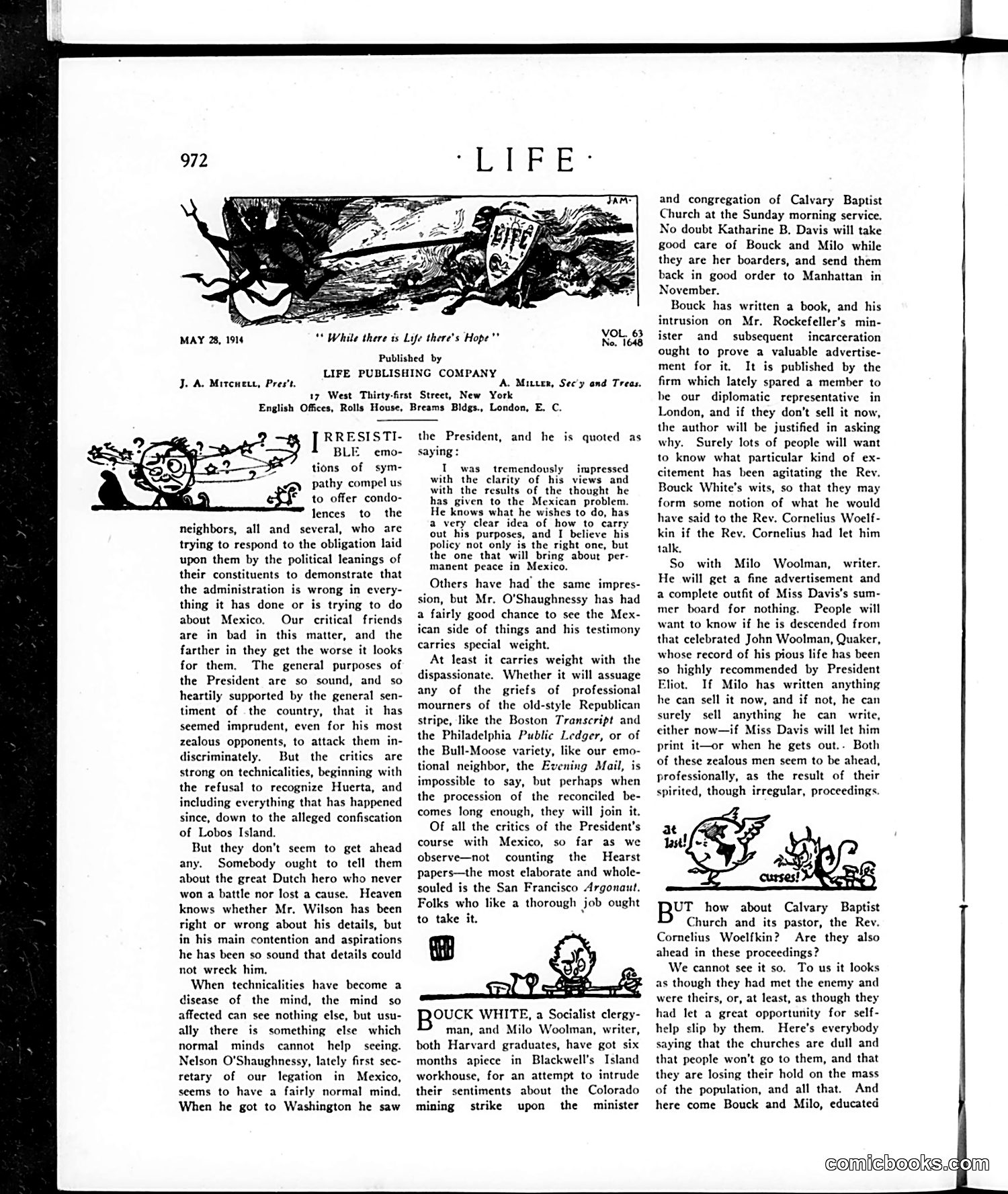
This page defends President Wilson's Mexico policy against critics who focus on technicalities (like refusing to recognize the Huerta regime) rather than supporting his sound overall goals. The article argues Wilson's general purpose is so correct that procedural objections shouldn't undermine it, citing diplomat Nelson O'Shaughnessy's praise of Wilson's clarity on Mexican affairs. The second section mocks two Harvard-educated Socialist activists—Bouck White (a clergyman) and Milo Woolman (a writer)—sentenced to six months in Blackwell's Island workhouse for disrupting a Calvary Baptist Church service to protest the Colorado mining strike. Life sardonically suggests their imprisonment will help advertise Bouck's book and that Katharine B. Davis (the workhouse superintendent) will treat them well before releasing them in November.
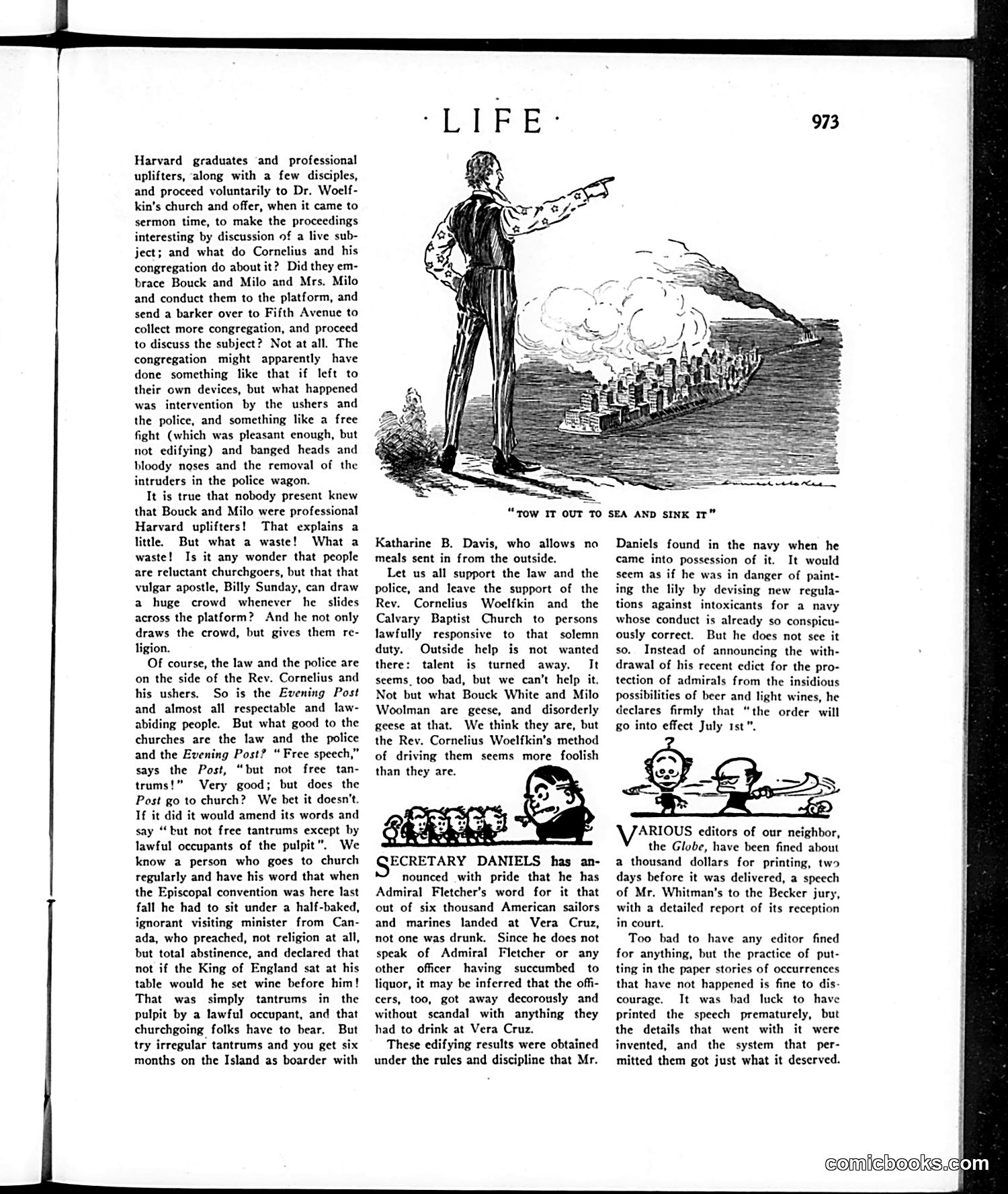
This page satirizes two distinct incidents: **The Church Disruption**: Harvard intellectuals ("professional uplifters") Bouck White and Milo Woolman attempted to inject discussion of "live subjects" into Rev. Cornelius Woelfkin's Calvary Baptist Church sermon. Church ushers and police forcibly removed them. Life mocks the establishment's self-righteousness—defending free speech in principle while violently suppressing actual dissent. The magazine argues the church's authoritarian response was more foolish than the protesters' disruption, yet respectable society (law, police, *Evening Post*) sides with the reverend. **Secretary Daniels and the Navy**: The accompanying illustration ("Tow It Out to Sea and Sink It") depicts Secretary of the Navy Josephus Daniels proudly announcing zero drunk sailors at Vera Cruz. Life sarcastically suggests Daniels risks "painting the lily"—unnecessarily imposing new temperance regulations on a navy already demonstrably well-disciplined. The satire questions why bureaucratic interference is needed when existing discipline works. Both pieces critique institutional overreach and self-satisfied moralizing by authority figures.
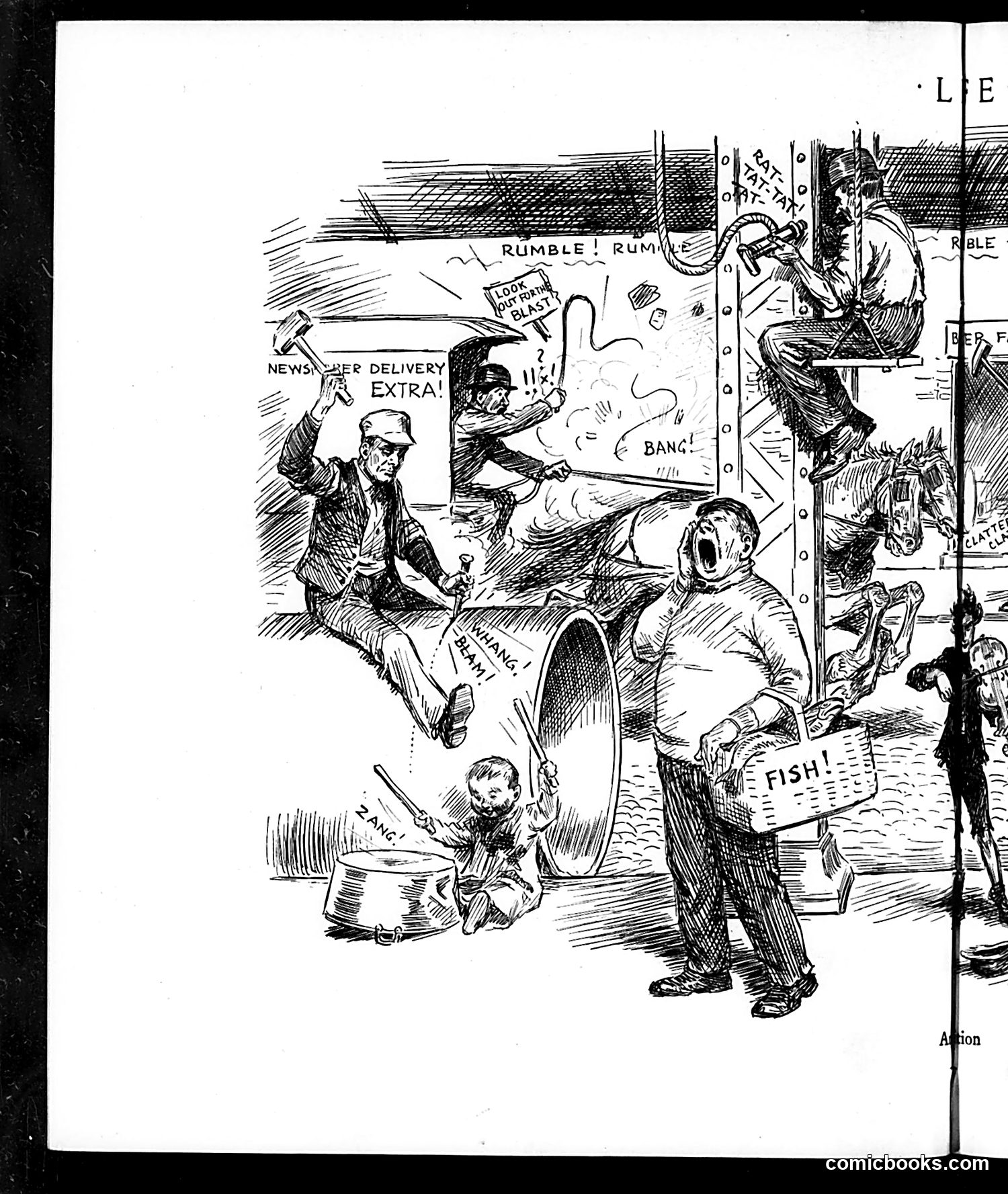
This appears to be an early 20th-century satirical cartoon depicting urban chaos and social disorder. The scene shows multiple figures engaged in violent or chaotic activity around what seems to be a street or alley setting—with sound effects like "RUMBLE," "BANG," and "FISH!" suggesting physical confrontation or destruction. The visible text references include "NEWSPAPER DELIVERY" and "EXTRA," suggesting this satirizes news distribution or media sensationalism during a period of social unrest. The figures appear to represent working-class individuals or street vendors in conflict. Without clearer identification of specific caricatured individuals, the cartoon likely comments on urban violence, labor disputes, or street-level social conflict common in early American cities. The chaotic composition and multiple simultaneous actions emphasize disorder and breakdown of public civility.
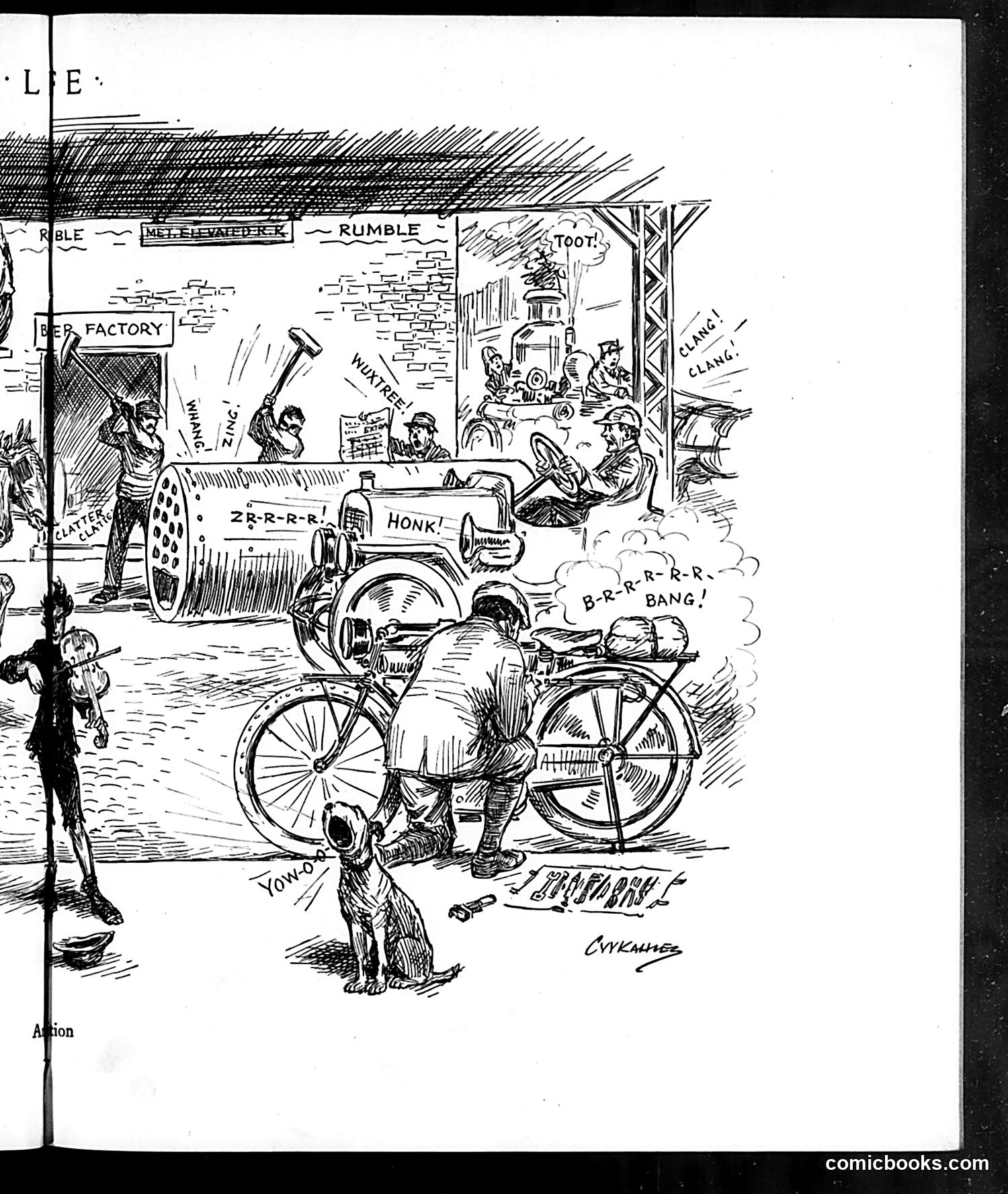
This is a satirical illustration depicting early automobile chaos in an urban industrial setting. A motorist in an early automobile honks and makes noise ("HONK!", "Z-R-R-R-R!", "B-R-R-R BANG!") while pedestrians, cyclists, and factory workers scatter in alarm. The cartoon mocks the dangerous, loud intrusion of automobiles into city streets populated by traditional transportation (bicycles) and workers. The rubber factory sign and "Met. Elevated R.R." reference suggest a working-class urban environment. The dog's frightened reaction ("YOW-O!") emphasizes the vehicle's terrifying effect on street life. The satire critiques how automobiles disrupted established city traffic patterns and endangered pedestrians—a common concern during the automobile's early adoption period. The cartoon is signed by what appears to be "Cesare" or similar.
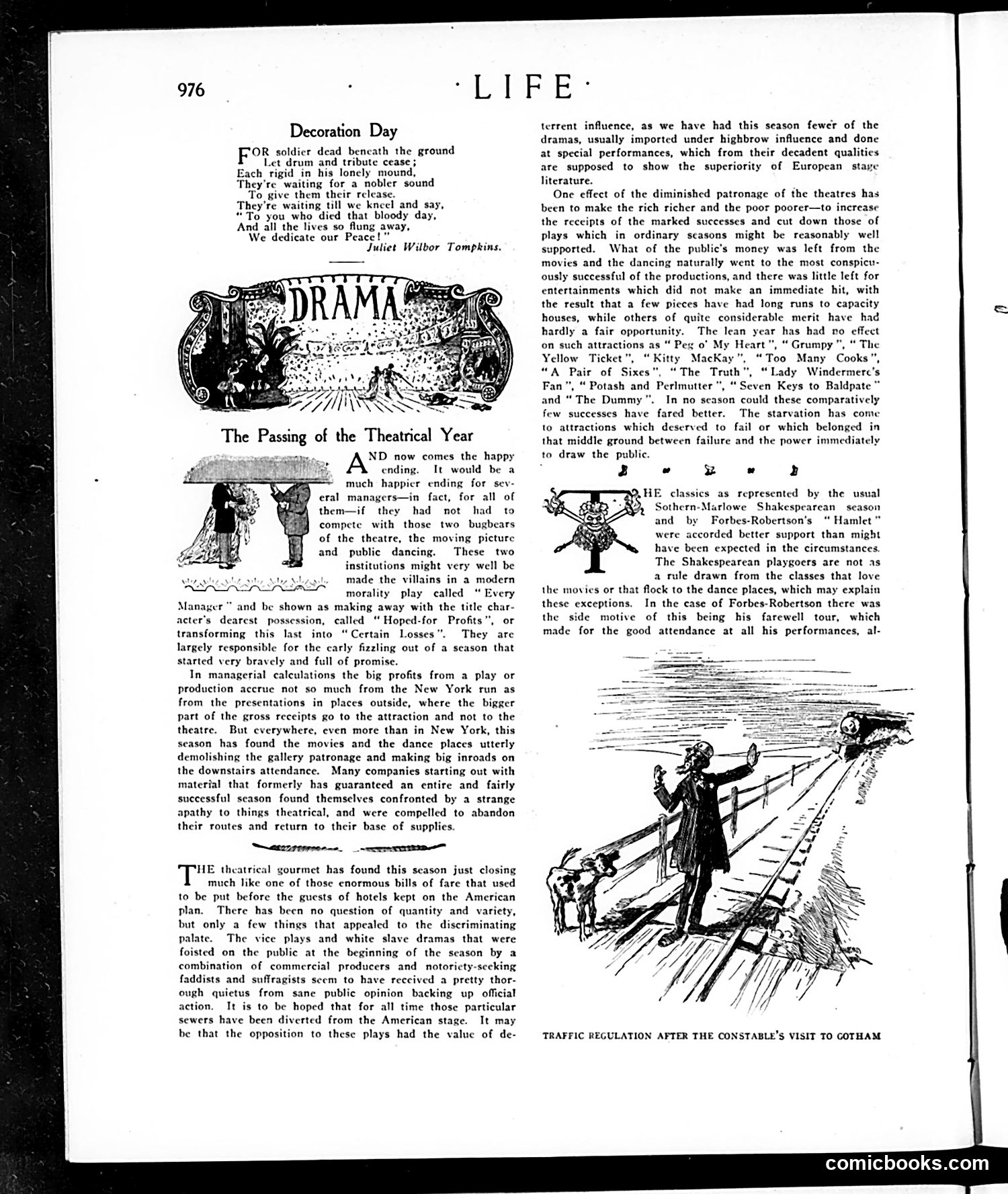
This page from Life magazine discusses the theatrical season's decline, blaming two modern rivals: **moving pictures (cinema) and public dancing venues**. The text presents these as villains in a "morality play" destroying theater managers' profits—particularly in touring circuits outside New York, where theaters relied on box office revenue. The article notes that successful shows like "Peg o' My Heart" and "Grumpy" thrived while others struggled, as audiences abandoned live theater for cheaper movie houses and dance halls. The writer laments that "vice plays" and European avant-garde dramas received less patronage, viewing this as a silver lining. The bottom illustration, "Traffic Regulation After the Constable's Visit to Gotham," appears to be a separate satirical drawing about urban management, though its specific reference is unclear. The **Decoration Day poem** at top honors war dead—likely referencing recent WWI veterans—calling for peace as their true memorial.
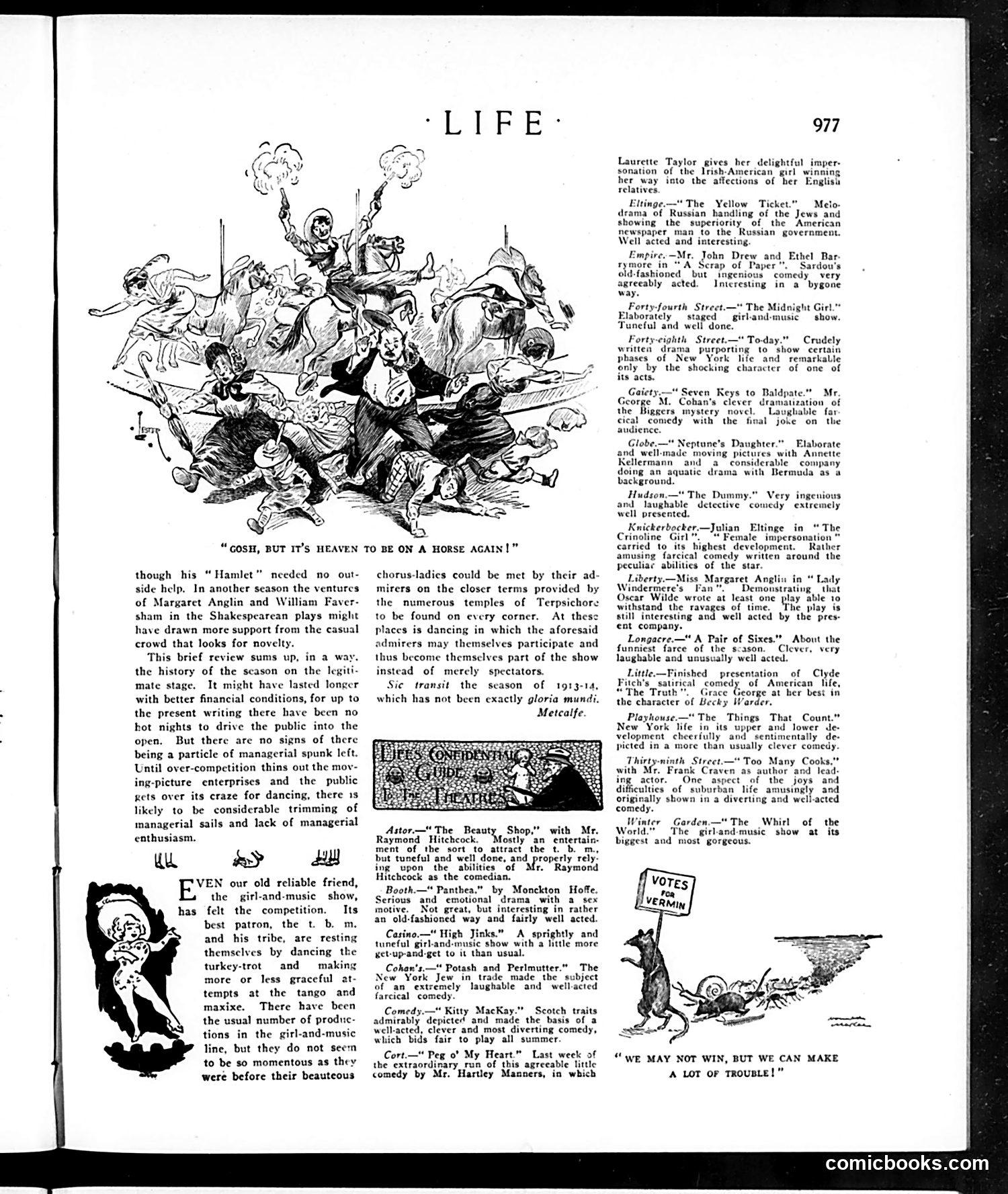
This page reviews Broadway's 1913-14 theater season. The main cartoon shows a skeletal Death figure astride a horse, captioned "GOSH, BUT IT'S HEAVEN TO BE ON A HORSE AGAIN!"—a darkly humorous commentary on the season's poor health. The text explains theater attendance collapsed due to two competing entertainments: **motion pictures** and **dance halls** (temples of "Terpsichore"). The "t.b.m." (tuberculosis man—a stock character of the era seeking fresh air) now goes dancing instead of attending stage shows, even leaving girl-and-music shows underattended. The author (Metcalfe) laments that without "managerial spunk," theatrical enterprises face "considerable trimming" until movies' novelty fades and dancing crazes pass. Individual show reviews follow, with brief judgments on various Broadway productions ranging from serious drama to farce.
This page is primarily a **book review column** titled "The Latest Books," not a political cartoon. The opening section uses an extended metaphor comparing how people sharpen pencils to their reading preferences—a clever conceit typical of Life's satirical approach to literary criticism. The reviewer argues that pencil-sharpening habits reveal personality types: beaver-bitten points indicate readers of sociological reform fiction; patent sharpeners suggest businessmen who prefer standardized plots; and careful craftsmen using pocket knives are "Conrad enthusiasts" seeking literary sophistication. The main review critiques Joseph Conrad's novel *Chance*, praising its crystalline technique and prismatic narrative structure (told through multiple layers of hearsay) while warning impatient readers seeking straightforward action that Conrad's approach requires refined palates—a satirical dig at both the author's complexity and pretentious readers alike. The page then briefly catalogs other contemporary books, including works by Samuel Merwin and G.K. Chesterton, typical of literary magazines of this era (appears to be early 1910s based on publication style).
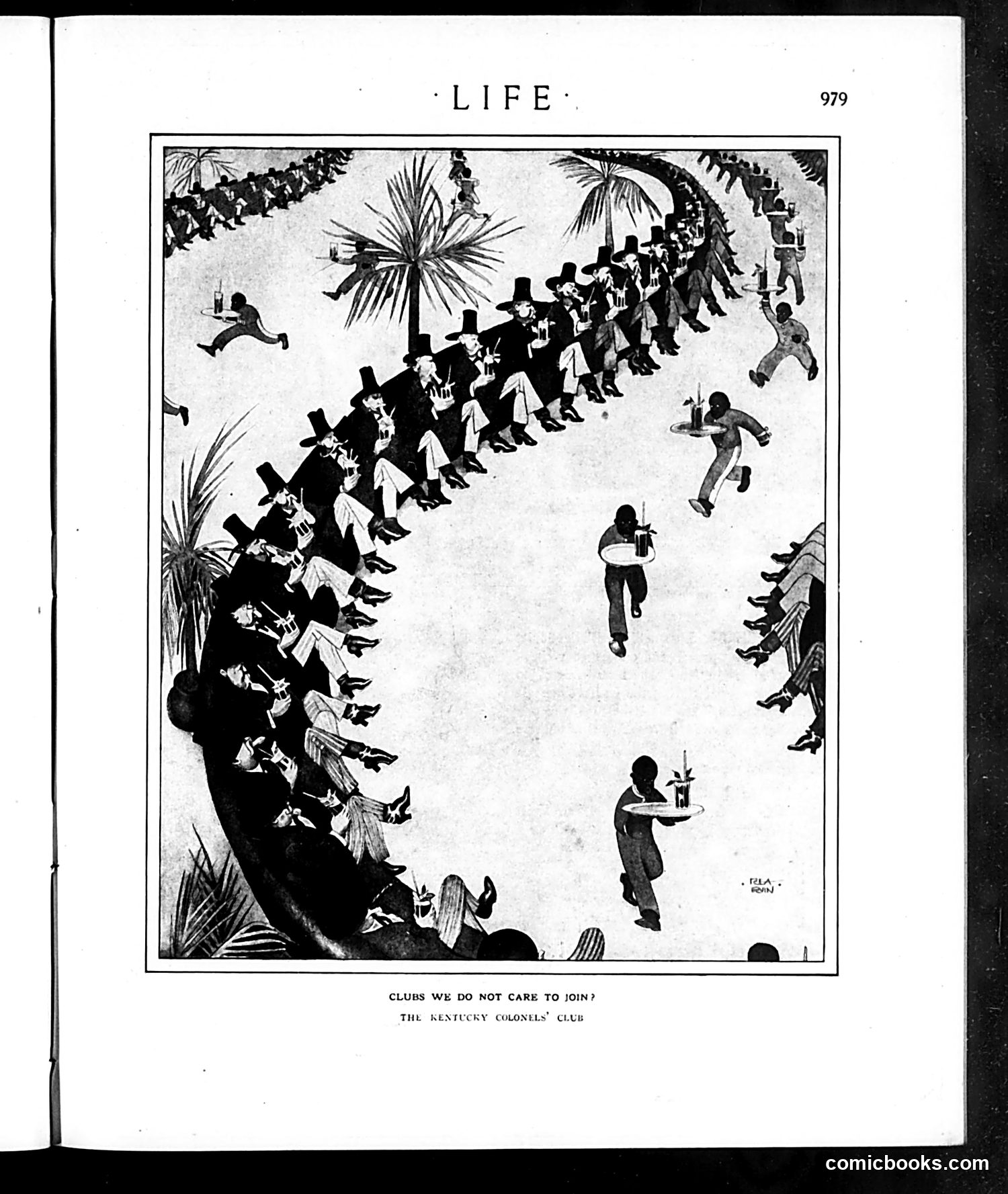
This satirical cartoon critiques the **Kentucky Colonels' Club**, an exclusive social organization. The image depicts a long line of formally-dressed figures in top hats (representing club members) standing alongside what appears to be a tropical or Southern landscape, while several Black figures are shown running or being excluded from the group. The satire targets the club's exclusionary membership practices, likely its racial discrimination. The title's rhetorical question—"Clubs We Do Not Care to Join?"—is ironic; it suggests that excluded individuals wouldn't want membership anyway, when the real message is that such clubs actively barred non-white members. This reflects early-20th-century Life magazine's progressive stance against racial segregation in exclusive institutions.
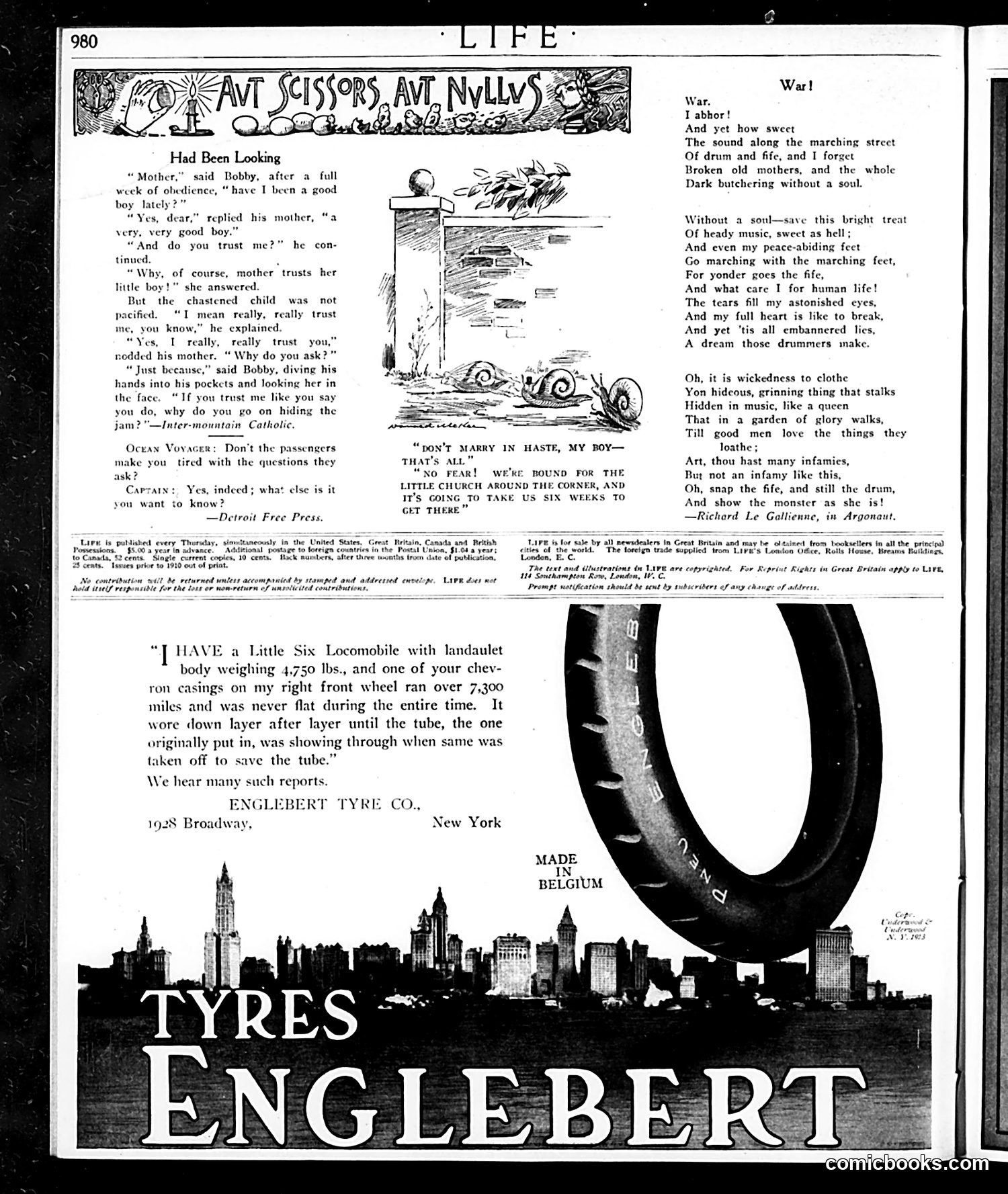
This page combines three distinct elements: humor comics, poetry, and advertising. The comics present mild domestic and workplace humor. "Had Been Looking" depicts a child's logic trap—after earning his mother's trust through obedience, Bobby catches her in hypocrisy by asking why she still hides the jam jar if she truly trusts him. The "Ocean Voyager" joke plays on a ship captain's weary acceptance of passengers' endless questions. The centerpiece is Richard Le Gallienne's anti-war poem "War!" It critiques how martial music and pageantry seduce even pacifists into romanticizing warfare, masking its brutal reality behind "embannered lies." This reflects post-WWI disillusionment common in 1920s literature. The page is dominated by an Englebert Tire advertisement featuring a giant tire looming over a New York City skyline, and testimonials about tire durability. The "Made in Belgium" notation suggests international manufacturing. Overall, the page juxtaposes trivial domestic humor and serious anti-war sentiment alongside commercial promotion—typical of Life's mixed editorial-advertising format.
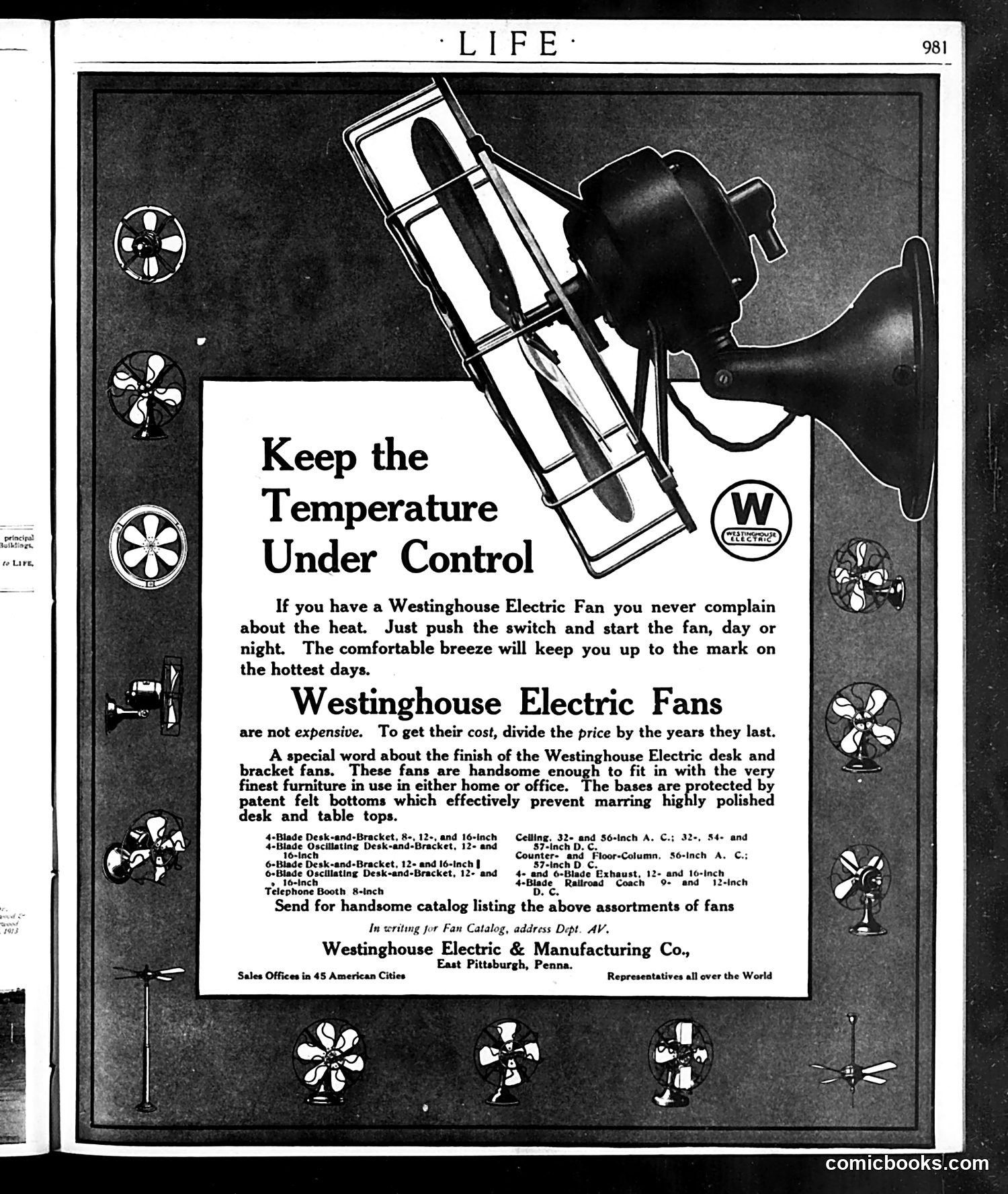
This is primarily a **product advertisement** for Westinghouse Electric Fans, not political satire or editorial cartooning. The page features a large illustration of a woman operating an electric fan mounted on a stand, positioned to cool her down. The surrounding border displays various fan models available for purchase. The advertisement's messaging emphasizes: - **Convenience**: Simply push a switch to control uncomfortable heat - **Affordability**: Fans are "not expensive" when cost is divided by years of use - **Aesthetics**: Desk and bracket fans are "handsome enough to fit in with the very finest furniture" - **Protection**: Patent felt bottoms prevent damage to furniture The text and imagery appeal to middle-class comfort and modern convenience—selling not just functionality but respectability and refinement. This reflects early 20th-century consumer culture where owning electric appliances signaled status and progressiveness. No political commentary or satire is apparent. This is straightforward commercial advertising in what was likely a mainstream publication.
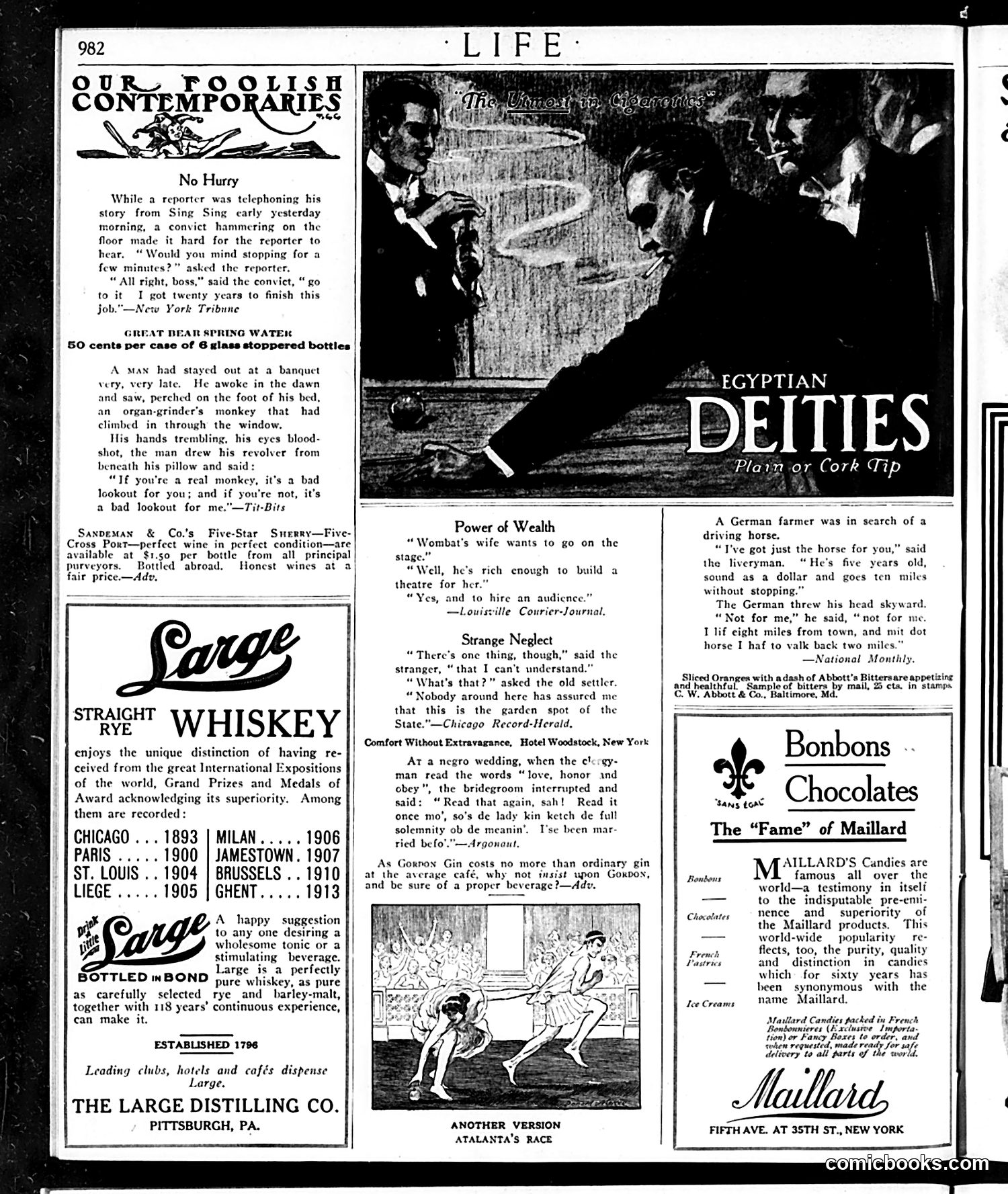
This page from *Life* magazine contains several brief humorous anecdotes under "Our Foolish Contemporaries," a satirical column mocking contemporary behavior and attitudes. The main jokes include: 1. **"No Hurry"**: A convict at Sing Sing prison, asked to stop hammering while a reporter makes a phone call, responds that he has "twenty years to finish this job"—satirizing the convict's indifference to time, given his long sentence. 2. **"Strange Neglect"**: A stranger criticizes a rural area for failing to advertise itself as "the garden spot of the State"—mocking small-town boosterism and commercialism. 3. **The German farmer anecdotes**: Poking fun at German immigrants' thrift and practicality through dialect humor. 4. **The wedding scene**: A dialect-heavy joke about African American speech patterns (representing period stereotyping). The page is primarily **advertising-driven**, featuring whiskey, spring water, chocolates, and other products. The satirical content is secondary to commercial promotion.
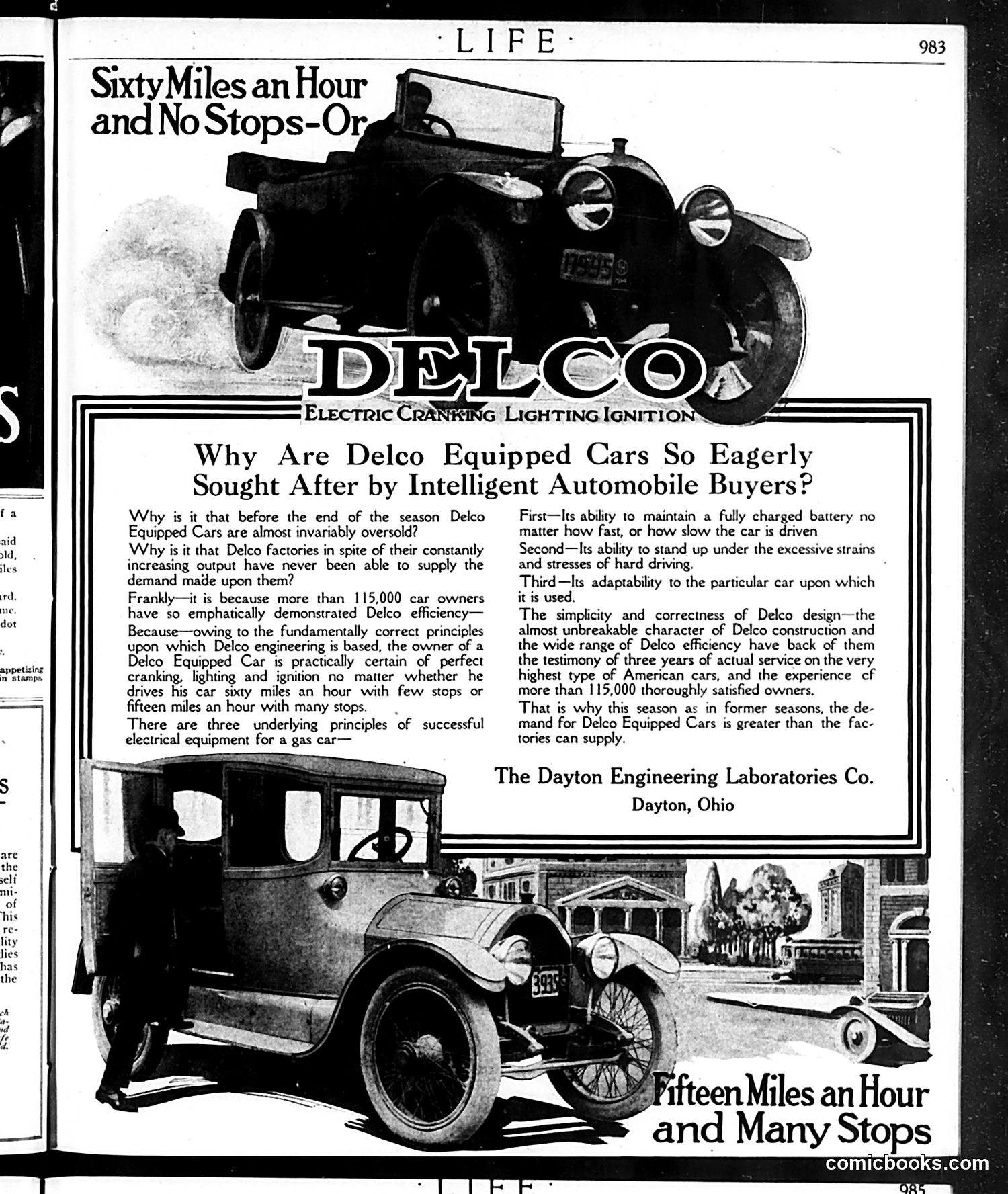
This is **not a cartoon or satire**—it's a straightforward automobile advertisement from Life magazine's early automotive era. The page compares two cars through contrasting images: a speedy roadster (top) labeled "Sixty Miles an Hour and No Stops" versus a slower family sedan (bottom) labeled "Fifteen Miles an Hour and Many Stops." The ad promotes **Delco electrical systems** (cranking, lighting, ignition), manufactured by Dayton Engineering Laboratories. It argues that Delco-equipped cars are superior because they maintain battery charge and reliability regardless of driving speed or frequency of stops—a significant technical advantage when automobiles were still relatively new and unreliable. The "satire" is implied humor: wealthy buyers want fast cars without stopping; ordinary drivers need reliable cars for frequent stops. Yet Delco works equally well for both, making it the intelligent choice. This reflects early 1920s American automotive culture when car ownership was still a marker of status.
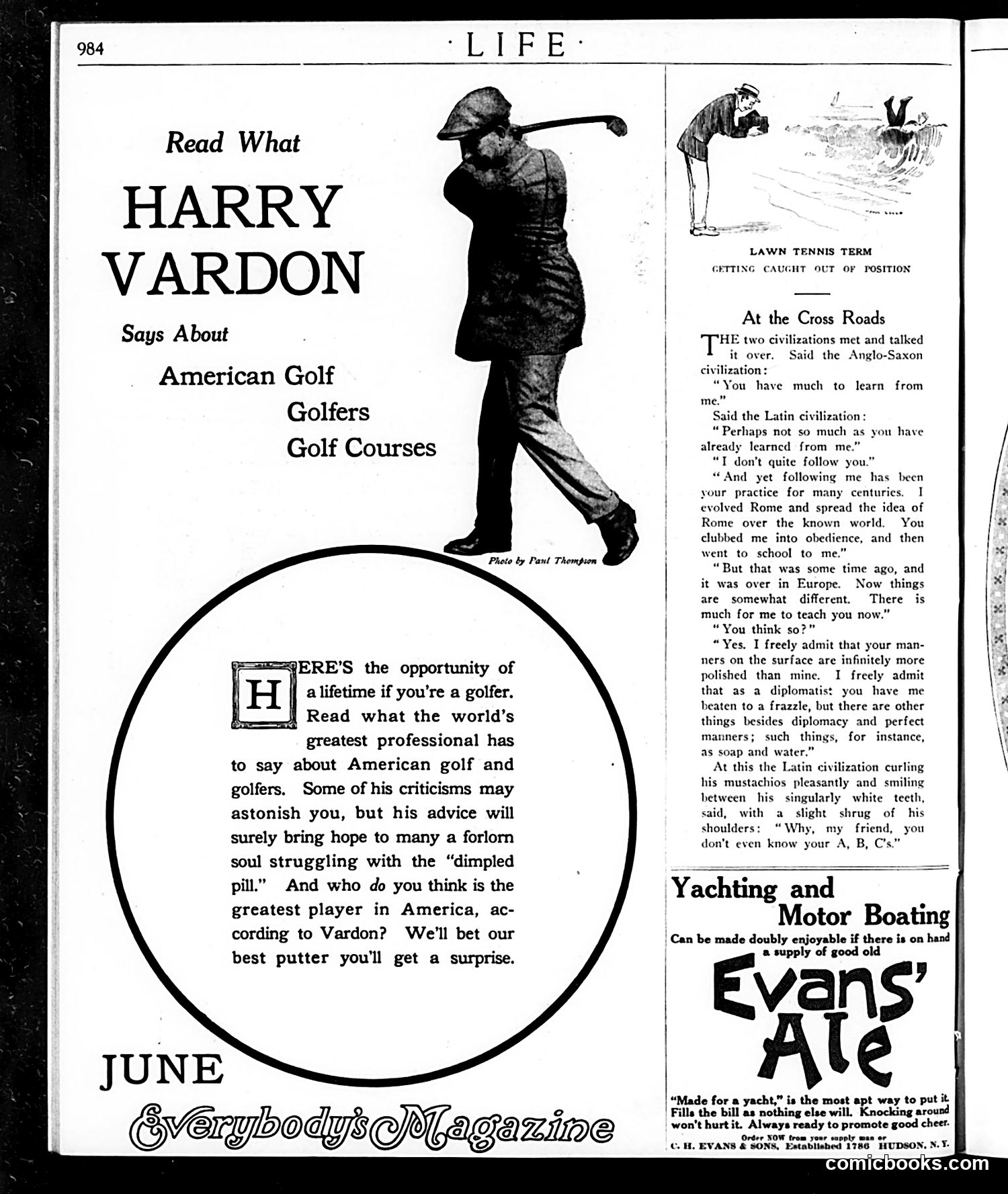
This page combines advertising with satirical commentary. The left side promotes Harry Vardon's golf insights—Vardon was a legendary British professional golfer whose opinions on American golf and golfers are presented as authoritative. The ad teases readers with the promise of surprising answers about America's greatest player. The main satirical piece, "At the Cross Roads," depicts an encounter between Anglo-Saxon and Latin civilizations as equals debating cultural superiority. The Anglo-Saxon claims modernity and manners; the Latin civilization counters that it invented Rome and civilization itself, and sarcastically questions whether Americans even know their "A, B, C's"—suggesting intellectual inferiority despite surface polish. The satire mocks American cultural pretension and competitive anxiety toward European heritage. The remaining content is advertising for Evans' Ale and lawn tennis terminology, typical of the magazine's mixed commercial-editorial format.
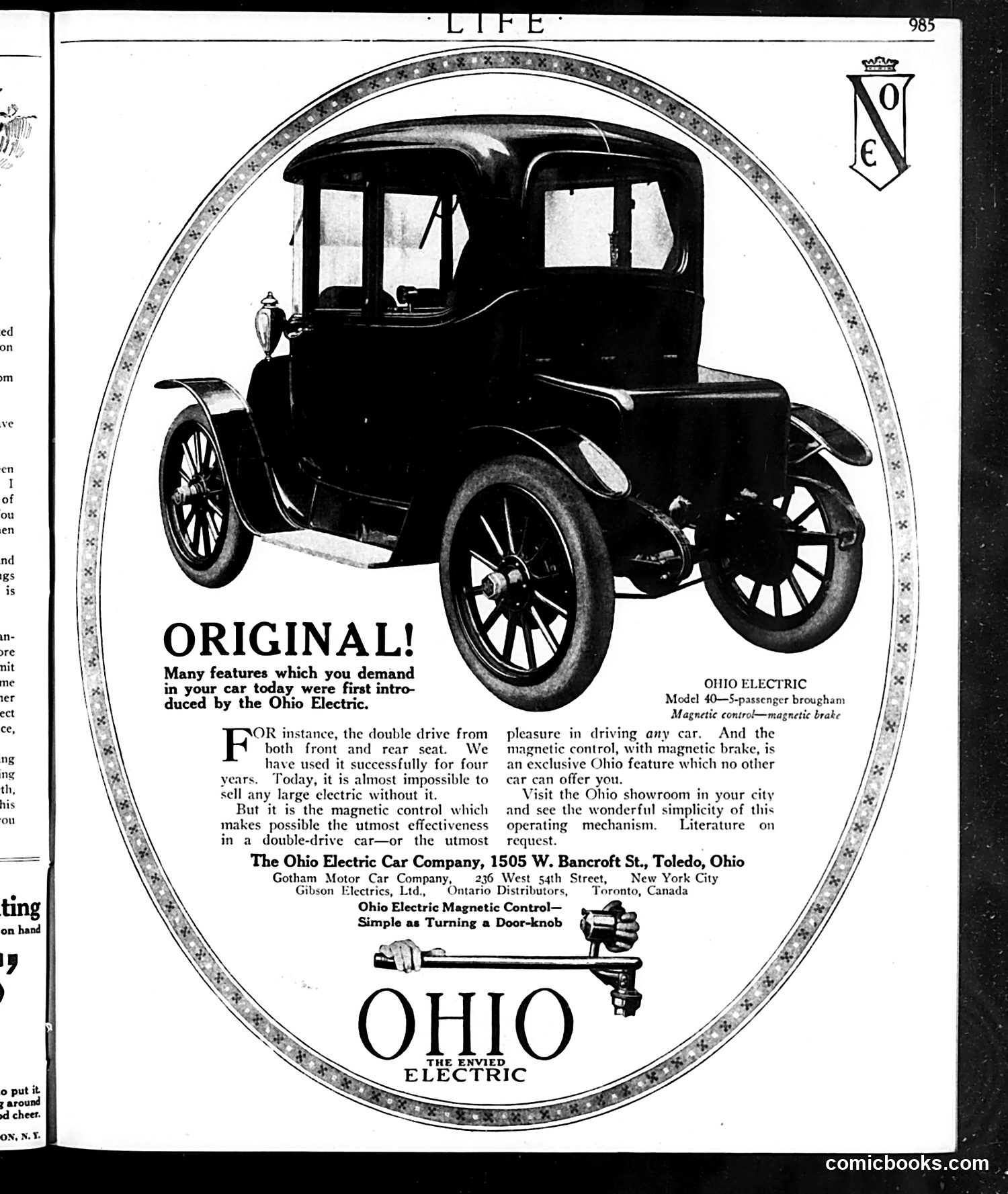
This is **not a cartoon or satire**—it's a straightforward advertisement for the Ohio Electric automobile, appearing in Life magazine (page 985). The ad promotes the Ohio Electric Model 40, a 5-passenger electric brougham (a closed carriage-style car). The text emphasizes the vehicle's innovative "magnetic control" braking system as its key selling point, claiming it's exclusive to Ohio Electric and makes the car easier to operate—"simple as turning a door-knob." The ad highlights that Ohio Electric pioneered the double drive (controllable from both front and rear seats) four years prior, and claims this feature is now standard on all large electric cars. The image shows a side view of the boxy, early automobile with prominent spoked wheels. Contact information is provided for the manufacturer in Toledo, Ohio, and distributors in New York and Canada. This reflects the early 20th-century automotive market when electric cars were serious competitors to gasoline vehicles.
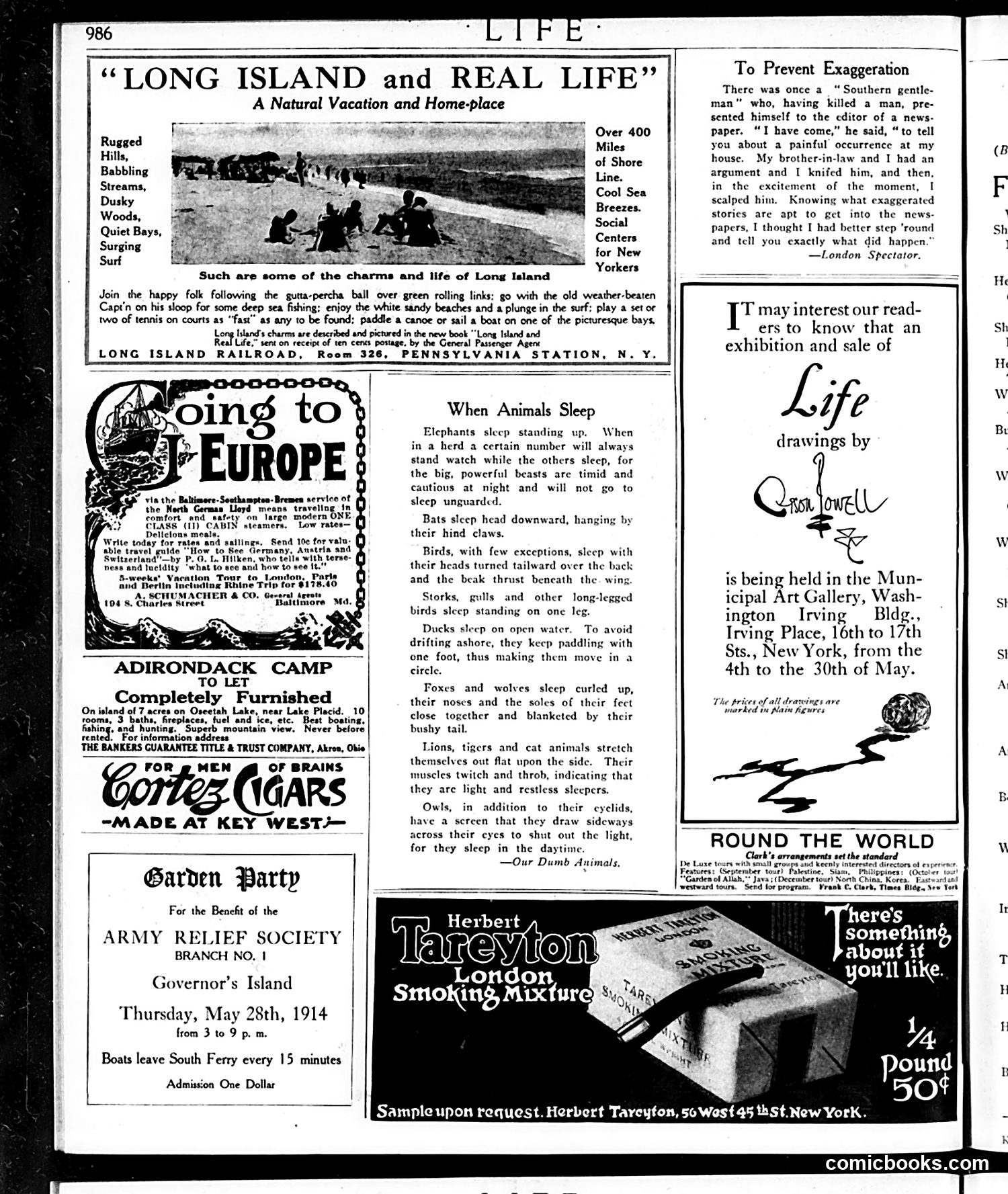
This page is primarily **advertising and promotional content** rather than political satire. The main sections include: 1. **Long Island Railroad Advertisement**: Promotes Long Island as a vacation destination with recreational activities (golf, fishing, boating, tennis). 2. **"When Animals Sleep" Educational Article**: A straightforward natural history piece describing sleeping habits of various animals—elephants, bats, birds, ducks, lions, and owls. This appears informational rather than satirical. 3. **Various Travel & Product Advertisements**: Including German steamship lines, Adirondack camp rentals, cigars, and Herbert Tareyton smoking mixture. 4. **Quentin Dowell Art Exhibition Notice**: Announces an exhibition at a New York gallery (May 4-30). 5. **"To Prevent Exaggeration" Anecdote**: A brief humorous story about a Southern gentleman attempting to keep a newspaper from exaggerating his crime—satirizing newspaper sensationalism. The page contains no significant political cartoons. It's a typical early 20th-century magazine mix of advertisements, light humor, and informational content.
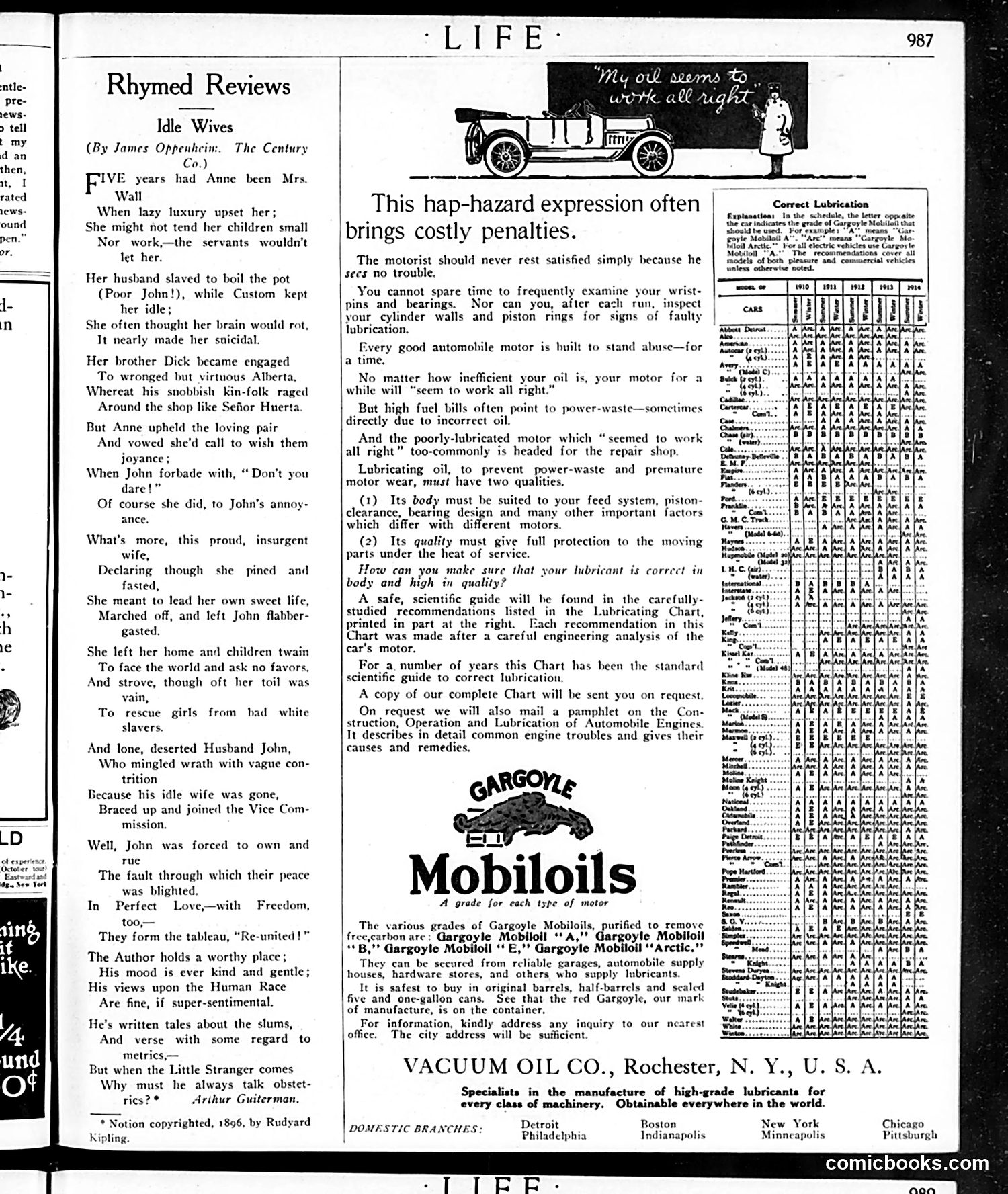
This page combines literary and advertising content. The "Rhymed Reviews" section presents James Oppenheim's serialized story "Idle Wives," a social commentary about a frustrated housewife (Anne) whose enforced idleness drives her to abandon her family and husband John to pursue social reform work. The narrative critiques the restrictive constraints placed on women while celebrating Anne's independent spirit—she leaves her domestic role to rescue "girls from bad white slavers," ultimately reconciling with John after he recognizes his fault in restricting her autonomy. The page's dominant feature is an advertisement for Gargoyle Mobiloils motor oil, accompanied by technical guidance about proper automobile lubrication. The small cartoon at the page's top depicts a motorist whose negligent maintenance ("My oil seems to work all night") causes problems. This juxtaposes women's social liberation themes with consumerist appeals to male automobile owners—a striking editorial pairing reflecting 1920s American concerns with both gender roles and automobile ownership.
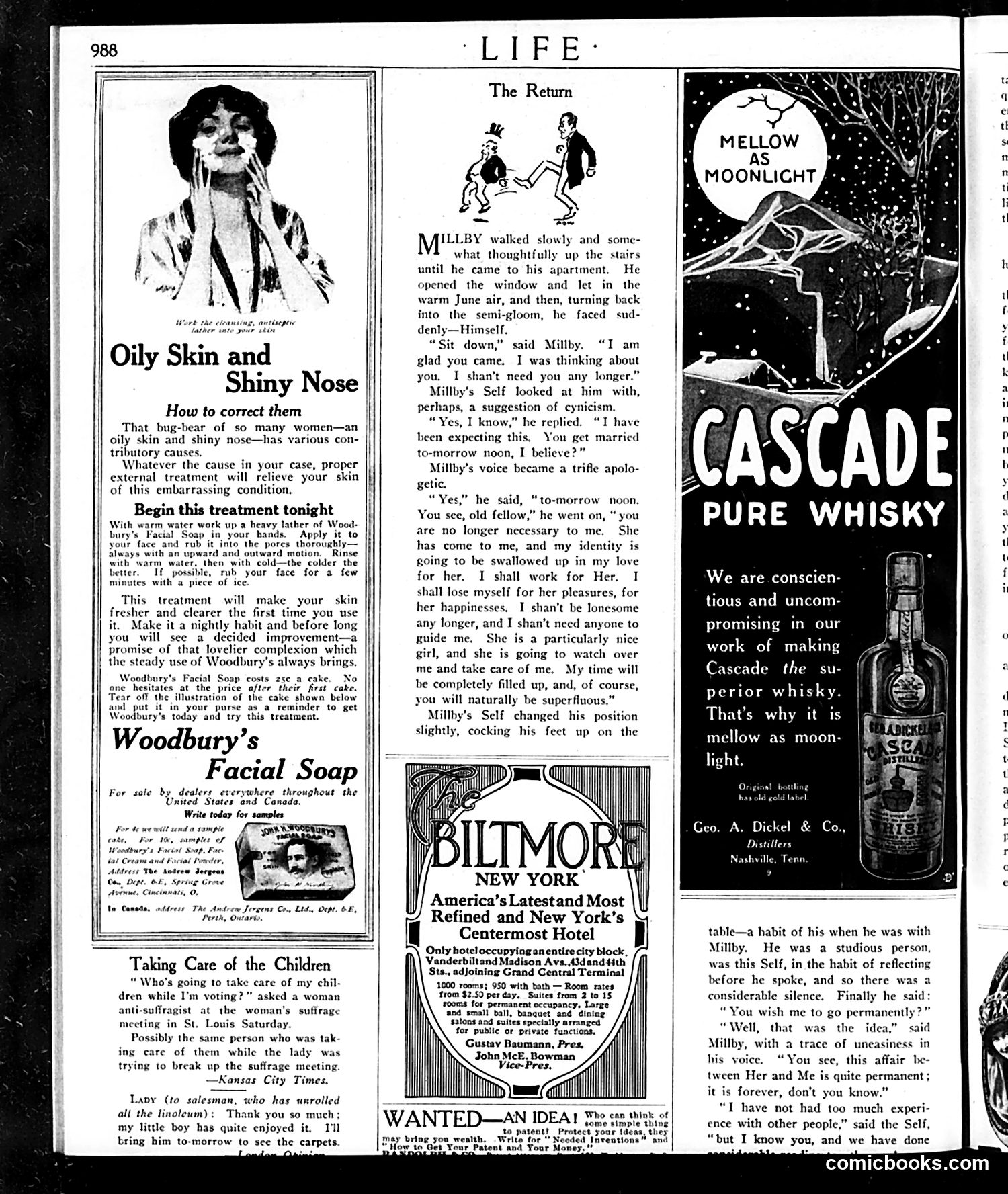
This page contains three distinct elements: **Left column:** Beauty advertisements for Woodbury's Facial Soap addressing women's skin concerns—typical early 20th-century cosmetic marketing emphasizing a "lovelier complexion." **Center:** A satirical short story titled "The Return" depicting a man dismissing his own conscience/inner self on the eve of marriage. Millby tells his personified "Self" he's no longer needed because marriage will subsume his identity into his wife's care. The "Self" responds with cynicism to this romantic delusion. This is social satire about male anxiety regarding matrimony and loss of independence—a common theme in early Life magazine's humor. **Right side:** Whiskey and hotel advertisements typical of period publications. **Bottom text:** A suffrage-related joke mocking anti-suffragist women who claim they can't vote because childcare duties prevent it, while ignoring they somehow manage to attend anti-suffrage meetings. The page reflects early 1900s gender politics and consumer culture.
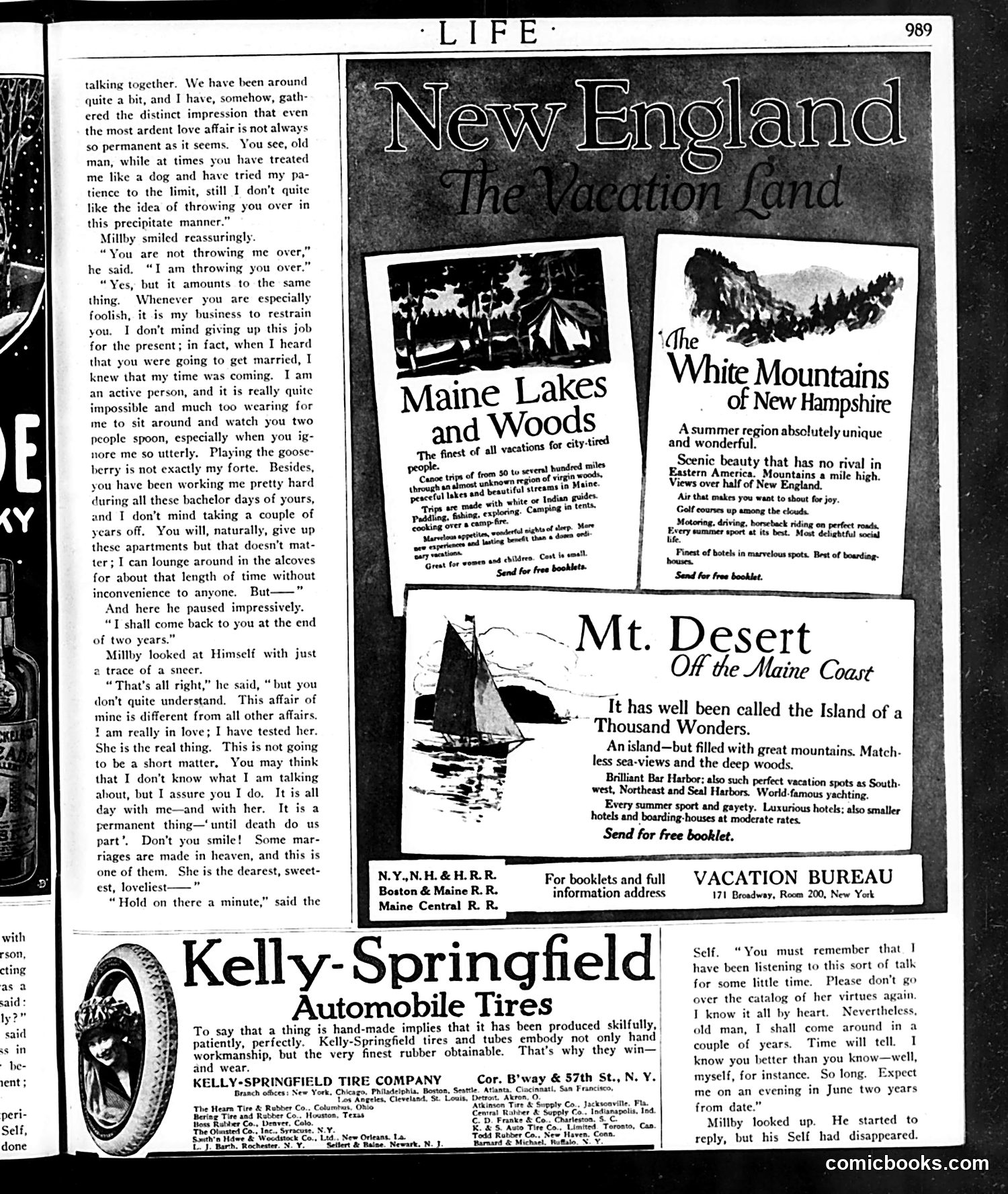
This page consists primarily of **advertisements** for New England vacation destinations and Kelly-Springfield automobile tires, with a fictional dialogue excerpt on the left side. The dialogue appears to be a romantic or comedic exchange between two men—one named Millby and another referred to as "Self"—discussing a love affair and potential marriage. The speaker (Self) is apparently a valet or personal attendant to Millby, joking about being replaced once his employer marries. The humor relies on the attendant's mock-wounded dignity and self-deprecating remarks about becoming a "gooseberry" (third wheel). The advertisements emphasize leisure tourism: Maine Lakes, New Hampshire's White Mountains, and Mt. Desert Island are promoted as vacation destinations. The Kelly-Springfield ad emphasizes quality craftsmanship in tire manufacturing. **Context for modern readers:** This reflects early 20th-century class dynamics where wealthy employers had live-in personal staff, and the humor derives from servant-master relationship complications during major life changes.
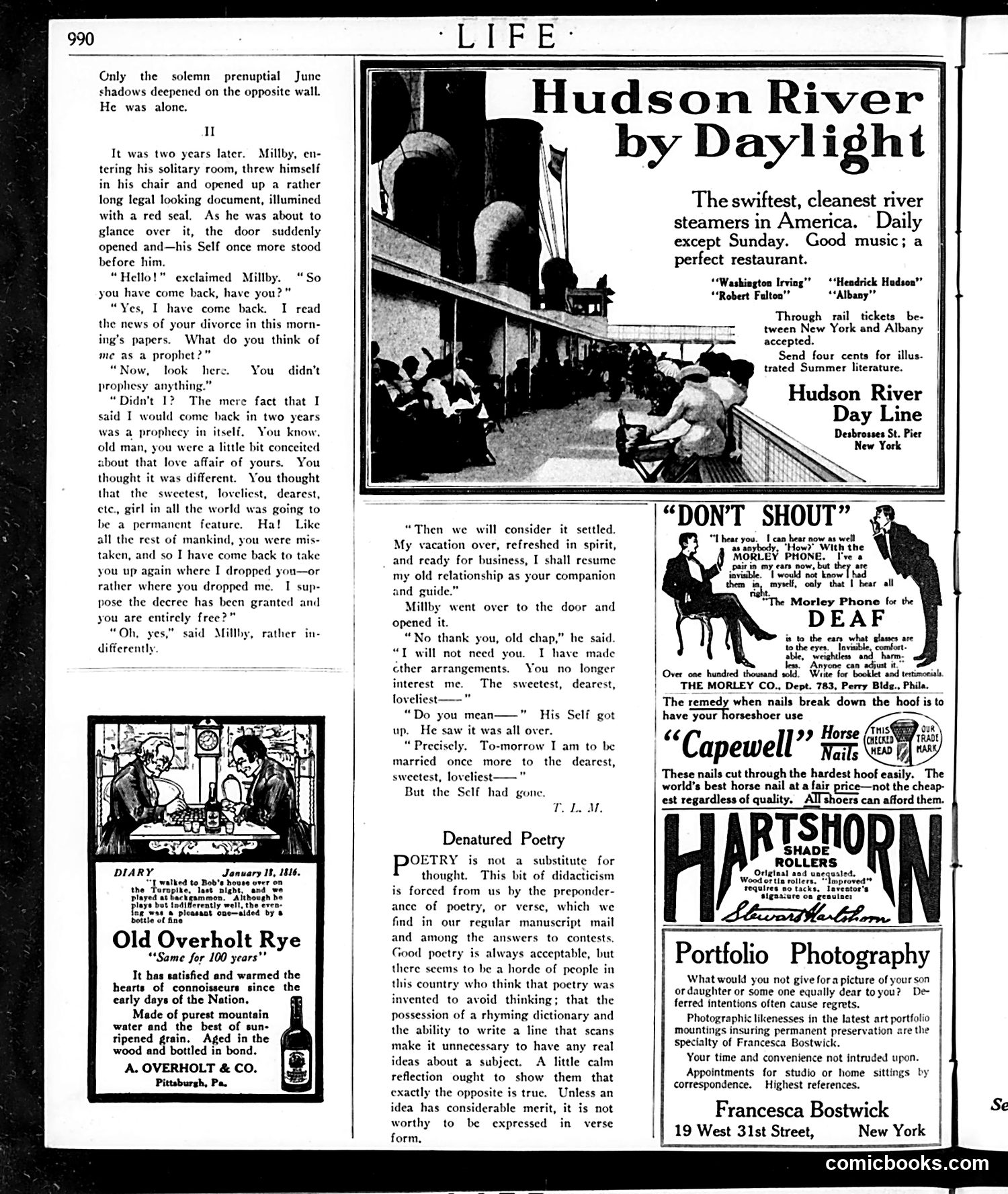
## Main Story: "His Self" The featured narrative depicts a man named Millby encountering his own conscience or "Self" personified. Two years after a failed marriage, his Self returns to claim their "old relationship" as companion and guide. Millby rejects this, announcing he'll remarry—to another "sweetest, dearest" woman. The Self vanishes, defeated. **The satire**: This appears to critique male hypocrisy and self-deception in romance. Millby dismisses his conscience after divorce, planning to repeat the same romantic mistakes. His Self's departure suggests willful abandonment of moral self-awareness. ## Editorial: "Denatured Poetry" Life's editors criticize contemporary verse submissions, arguing poets substitute rhyming for actual thought. They claim many writers believe owning a rhyming dictionary eliminates the need for genuine ideas. **The point**: A complaint about lowered literary standards—poetry reduced to technical mechanics rather than meaningful expression. The page also contains period advertisements (Old Overholt Rye, Hudson River Day Line, devices for the deaf, horse nails).
This page is a **Schlitz beer advertisement**, not a cartoon or satire. It promotes Schlitz beer in brown bottles, claiming they preserve purity and freshness better than other packaging during nationwide distribution. The ad emphasizes the brown bottle's protective properties—a legitimate selling point in an era before modern refrigeration and reliable shipping methods made product degradation a genuine concern. The tagline "The Beer That Made Milwaukee Famous" references Milwaukee's historic prominence in American beer brewing. The call to action urges consumers to "Order a Case Today" and verify the crown cap is branded "Schlitz" to ensure authenticity. This appears to be a straightforward commercial message rather than satirical content.
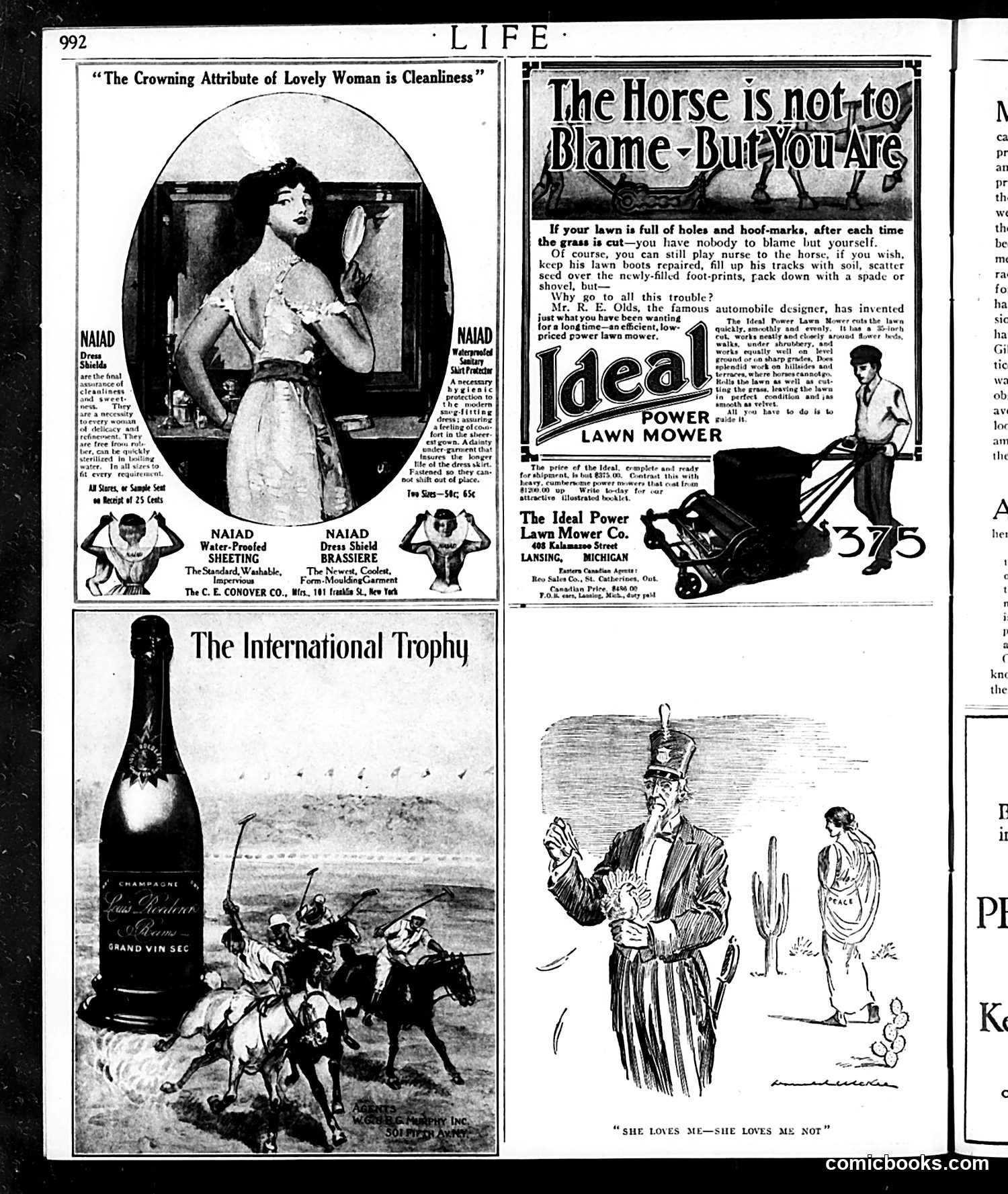
This page contains three separate advertisements and satirical content typical of early 20th-century Life magazine. **Top Left:** A advertisement for Naiad dress shields (underarm sweat protection), using the slogan "The Crowning Attribute of Lovely Woman is Cleanliness"—satirizing Victorian-era obsession with female purity and hygiene standards. **Top Right:** An ad for the Ideal Power Lawn Mower that humorously absolves the horse of blame for lawn damage, suggesting mechanical solutions are preferable to animal labor. This reflects early automotive-era humor mocking traditional farming methods. **Bottom:** An illustration captioned "She Loves Me—She Loves Me Not" depicting a man in military dress (appears to be a Turkish or exotic uniform based the ornate headpiece) plucking petals from a flower while a woman watches. This appears to be satirical commentary on romantic uncertainty or fickleness, though the specific context is unclear without additional page context. The page reflects early 1900s concerns with modernity, cleanliness standards, and romantic conventions.
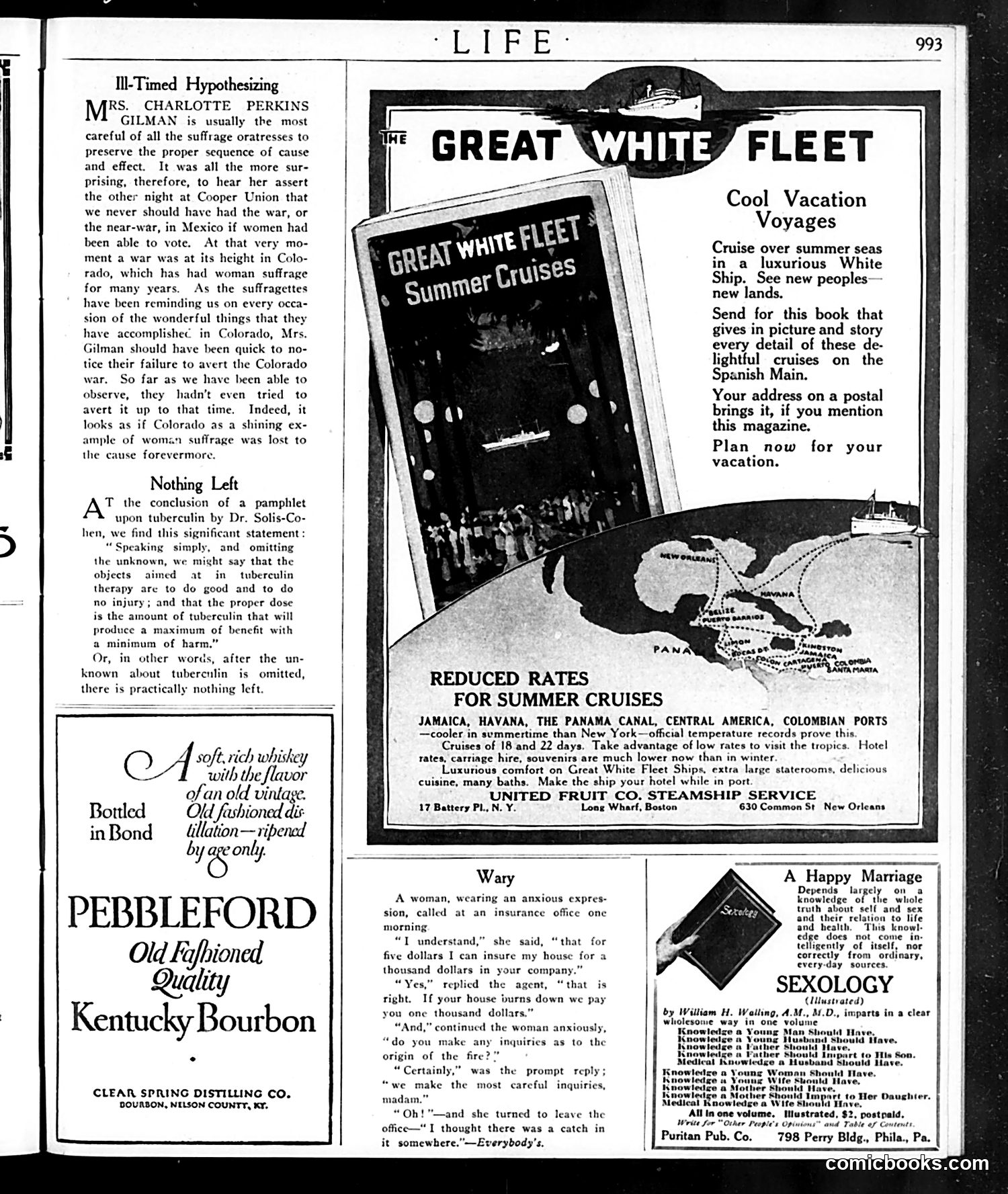
This page contains three distinct pieces of satirical content: **"Ill-Timed Hypothesizing"** mocks Charlotte Perkins Gilman, a prominent suffragist, for arguing that women's voting rights would have prevented wars. The satire points out Colorado already had woman suffrage yet experienced violent labor conflict (the "Colorado war"), undermining her thesis. The joke: Gilman's logic fails by her own example. **"Nothing Left"** ridicules a tuberculosis medical pamphlet that claims to explain proper dosing while admitting the fundamental unknowns remain omitted—making the conclusion meaningless. It's absurdist satire about pseudo-scientific rhetoric. **"Wary"** is a brief humorous anecdote about a woman asking an insurance agent detailed questions, implying she's considering arson—a joke about suspicious insurance inquiries. The page also contains period advertisements (Great White Fleet cruises, Pebbleford bourbon, and a "Sexology" book), typical of Life's format.
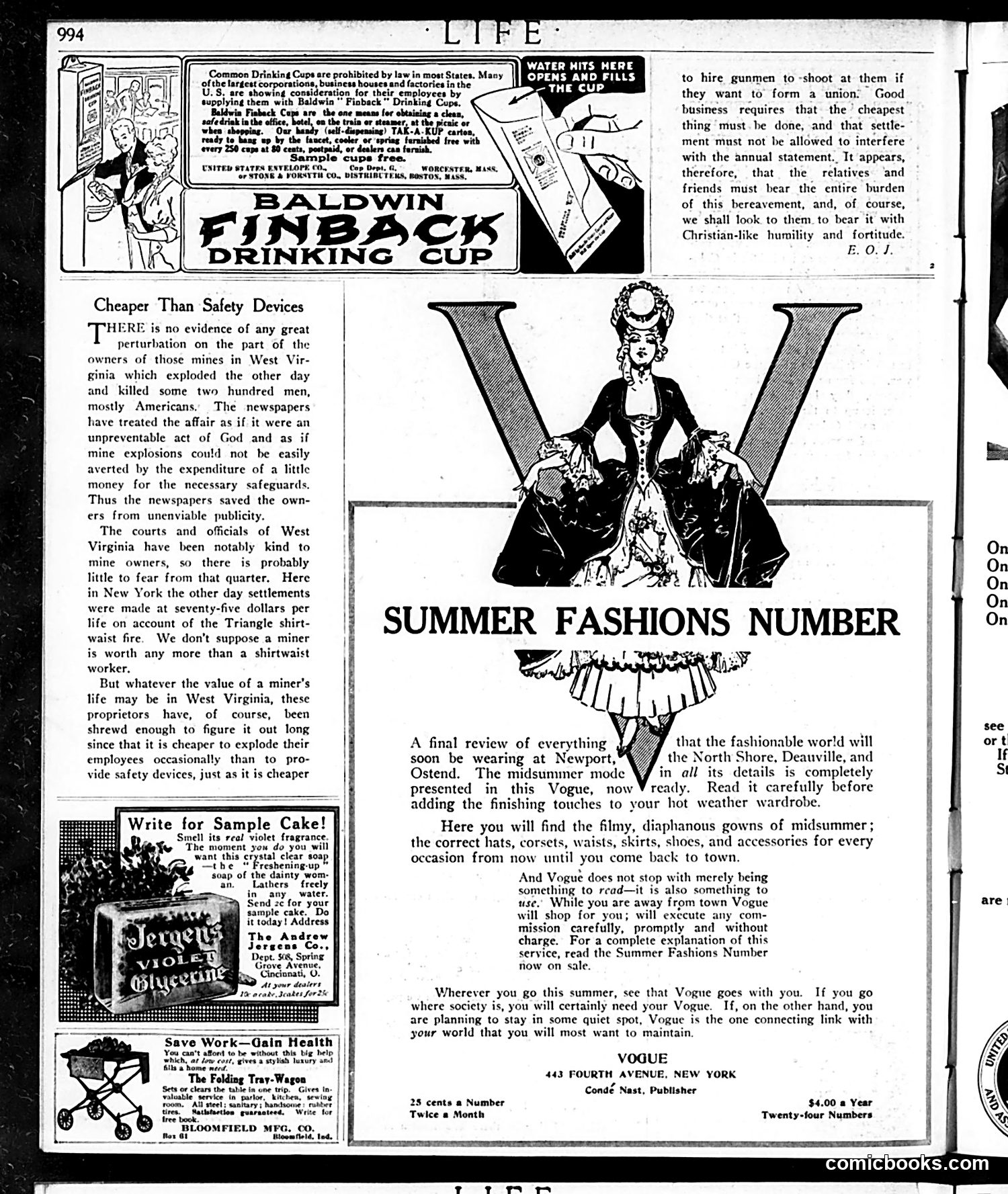
This page combines social satire with advertising typical of early 20th-century Life magazine. **The Main Satire ("Cheaper Than Safety Devices"):** Life criticizes mine owners in West Virginia following a recent mining explosion that killed approximately 200 workers. The editorial argues that owners deliberately choose NOT to invest in safety equipment because it's financially cheaper to occasionally lose workers than to implement safeguards. Life sarcastically notes that newspapers treated the disaster as an "act of God" rather than preventable negligence, and that West Virginia courts are "notably kind to mine owners." The piece references the Triangle Shirtwaist Factory fire, where settlements were made at only $75 per life, suggesting workers' lives are valued at rock-bottom rates by industrial owners. **The Baldwin Drinking Cup Advertisement:** The top ad promotes a individual drinking cup invention, noting that "common drinking cups" are now legally prohibited in most states—an early public health measure. **Advertisements:** The page also includes typical period ads for cakes, soap, and household items, alongside Vogue's "Summer Fashions Number" promotion.
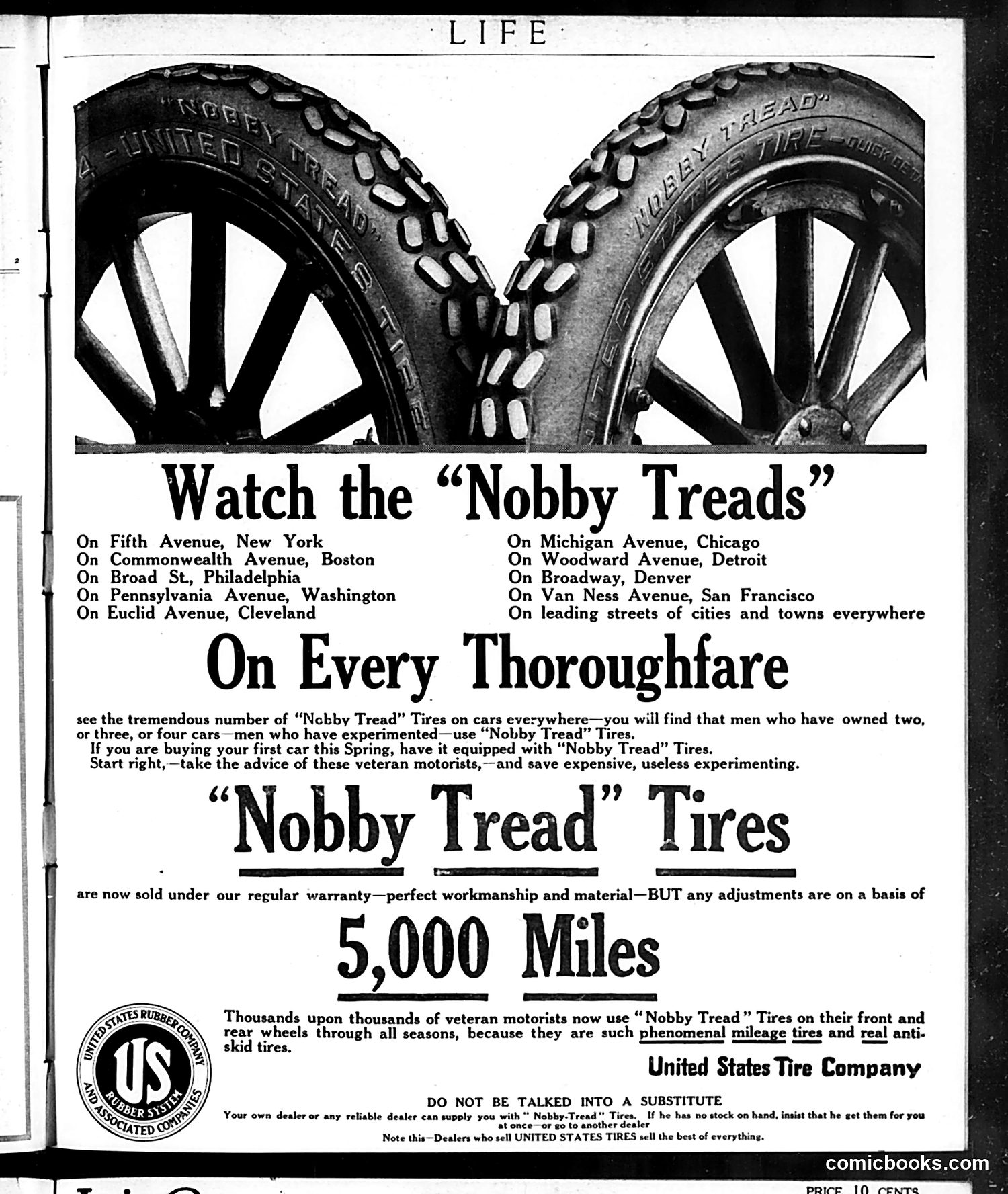
This is **not a political cartoon or satire**—it's a straightforward **automobile tire advertisement** from United States Tire Company. The page shows two tire images demonstrating the "Nobby Tread" pattern (the raised bumps visible on the rubber). The advertisement targets early-automobile owners, listing major American cities where these tires can be observed "on every thoroughfare," using social proof: experienced motorists who own multiple cars allegedly prefer this brand. Key selling points emphasized: - **5,000-mile warranty** (notable for the era, when tire durability was a significant concern) - Anti-skid properties - Reliability through repeated customer purchases The warning at bottom—"DO NOT BE TALKED INTO A SUBSTITUTE"—suggests competitive tire market pressures. This reflects the early automotive era (likely 1910s-1920s) when tire quality directly affected vehicle safety and performance, making brand choice genuinely consequential for drivers.
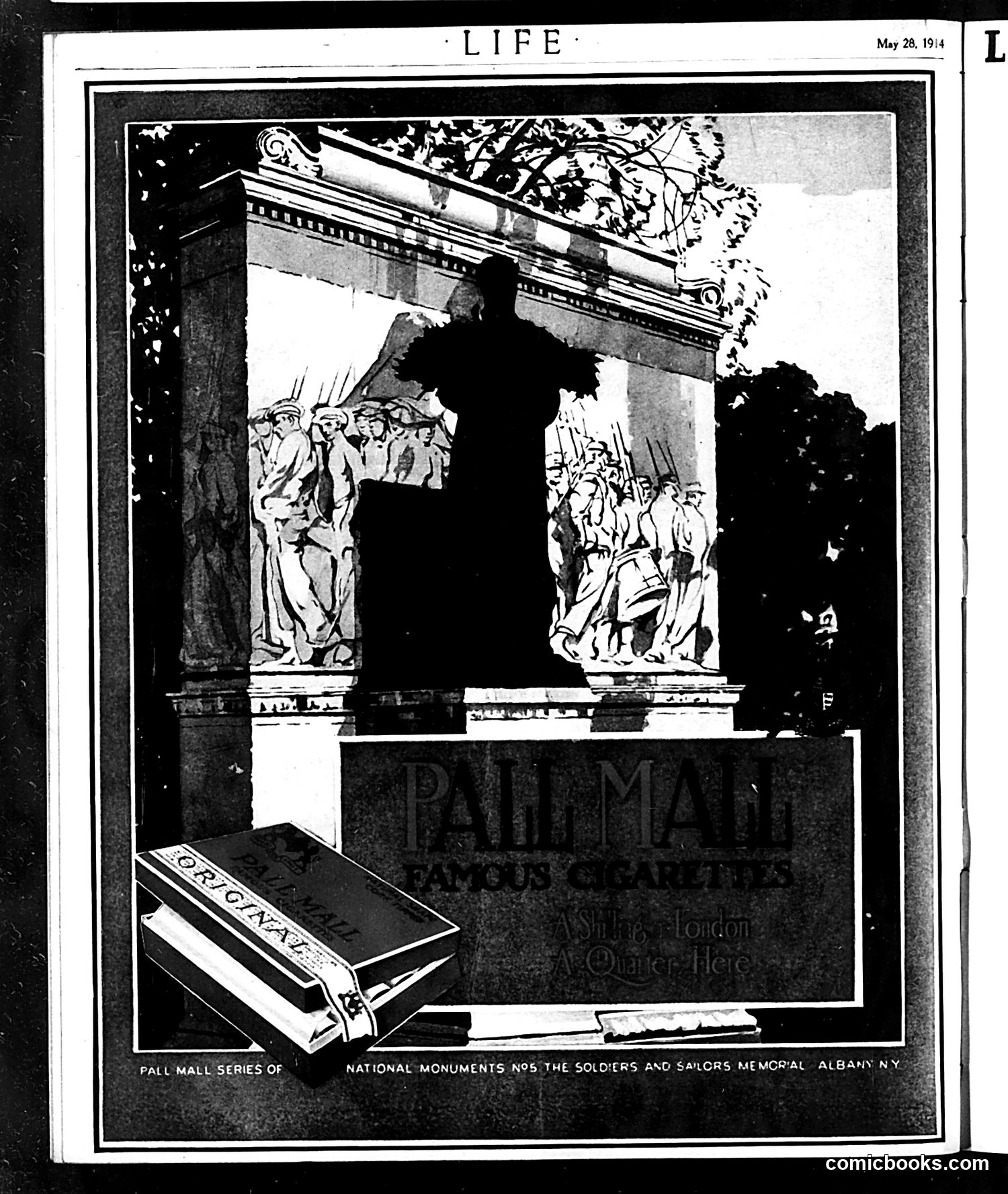
This page features an advertisement for Pall Mall cigarettes disguised as patriotic content. It depicts a monument to soldiers and sailors in Albany, New York, with a silhouetted statue and relief panels showing uniformed military figures. A Pall Mall cigarette package is prominently displayed in the foreground. The satire appears to mock commercialism masquerading as patriotism—the cigarette company associates its product with national monuments and military service to enhance brand prestige. By placing the cigarette package at the memorial's base, Life suggests how corporations exploit patriotic sentiment for profit. This was typical of early 20th-century advertising that borrowed national imagery to sell consumer goods, a practice satirical magazines like Life frequently criticized.