
Life, 1914-05-28 · page 14 of 44
Life — May 28, 1914 — page 14: what you’re looking at
What you’re looking at
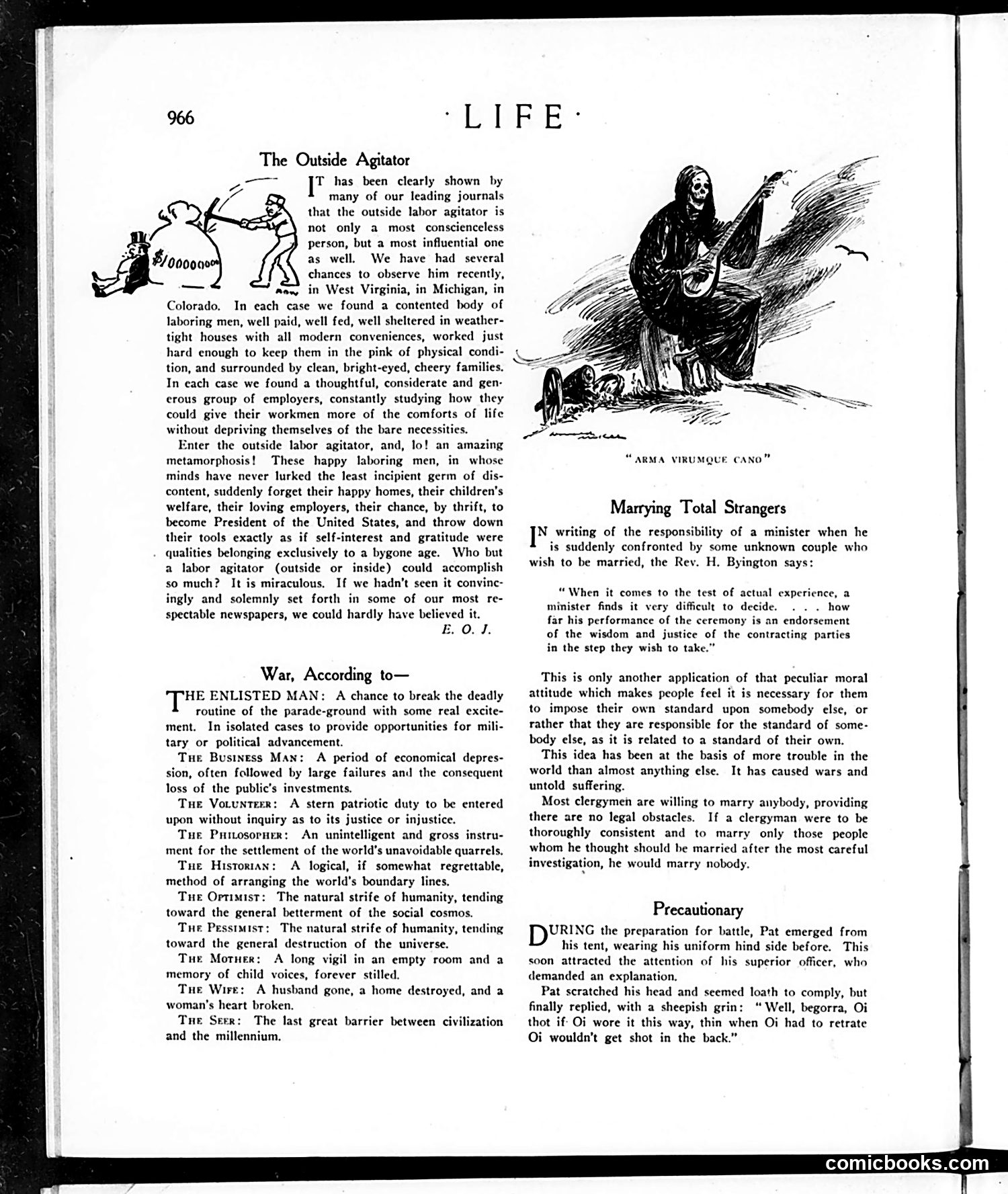
This cartoon depicts labor agitation during the early 20th century. The illustration shows a sinister figure labeled "ARMA VIRUMQUE CANO" (a classical Latin phrase) riding what appears to be a dynamite barrel or explosive device—a visual metaphor common in anti-labor propaganda of the era. The accompanying text criticizes "outside labor agitators" who allegedly infiltrated American communities (West Virginia, Michigan, Colorado) to stir discontent among otherwise content, well-paid workers with good families and homes. The satirical piece presents these agitators as manipulative outsiders who exploit workers' contentment for their own purposes. This reflects a common management and journalistic narrative blaming external radicals rather than addressing legitimate worker grievances during the industrial era's labor conflicts.
📄 Transcribed text from this page (OCR, searchable)
Machine-transcribed from the original scan — historical spelling and the odd misread are preserved.
“1 DRE The Outside Agitator ae r has been clearly shown by “ many of our leading journals G that the outside labor agitator is P not only a most conscienceless person, but a most influential one ¥/o000 as well. We have had several chances to observe him recently, = aew in West Virginia, in Michigan, in Colorado. In each case we found a contented body of laboring men, well paid, well fed, well sheltered in weather- tight houses with all modern conveniences, worked just hard enough to keep them in the pink of physical condi- tion, and surrounded by clean, bright-eyed, cheery families. In cach case we found a thoughtful, considerate and gen- erous group of employers, constantly studying how they could give their workmen more of the comforts of life without depriving themselves of the bare necessities. Enter the outside labor agitator, and, lo! an amazing metamorphosis! These happy laboring men, in whose minds have never lurked the least incipient germ of dis- content, suddenly forget their happy homes, their children’s welfare, their loving employers, their chance, by thrift, to become President of the United States, and throw down their tools exactly as if self-interest and gratitude were - qualities belonging exclusively to a bygone age. Who but a labor agitator (outside or le) could accomplish so much? It is miraculous. If we hadn't seen it convinc- ingly and solemnly set forth in some of our most re- spectable newspapers, we could hardly have believed it. E. 0. J. War, According to— HE ENLISTED MAN: A chance to break the deadly routine of the parade-ground with some real excite- ment. In isolated cases to provide opportunities for mili- tary or political advancement. Tue Business Man: A period of economical depres- sion, often followed by large failures and the consequent loss of the public’s investments, Tue Votunterr: A stern patriotic duty to be entered upon without inquiry as to its justice or injustice. Tue Puitosorner: An unintelligent and gross instru- ment for the settlement of the world’s unavoidable quarrels. Tue Historian: A logical, if somewhat regrettable, method of arranging the world's boundary lines, Tue Optimist: The natural strife of humanity, tending toward the general betterment of the social cosmos. Tue Pesstmist: The natural strife of humanity, tending toward the general destruction of the universe. Tue Motier: A long vigil in an empty room and a memory of child voices, forever stilled. Tue Wire: A husband gone, a home destroyed, and a woman's heart broken. Tne Seer: The last great barrier between civilization and the millennium. “ARMA VIRUMQUE CANO” Marrying Total Strangers N writing of the responsibility of a minister when he is suddenly confronted by some unknown couple who wish to be married, the Rev. H. Byington says: “When it comes to the test of actual experience, a minister finds it very difficult to decide. . . . haw far his performance of the ceremony is an endorsement of the wisdom and justice of the contracting parties in the step they wish to take.” This is only another application of that peculiar moral attitude which makes people feel it is necessary for them to impose their own standard upon somebody else, or rather that they are responsible for the standard of some- body else, as it is related to a standard of their own. This idea has been at the basis of more trouble in the world than almost anything else. It has caused wars and untold suffering. Most clergymen are willing to marry anybody, providing there are no legal obstacles. If a clergyman were to be thoroughly consistent and to marry only those people whom he thought should be married after the most careful investigation, he would marry nobody. Precautionary URING the preparation for battle, Pat emerged from his tent, wearing his uniform hind side before. This soon attracted the attention of his superior officer, who demanded an explanation. Pat scratched his head and seemed loath to comply, but finally replied, with a sheepish grin: “ Well, begorra, Oi thot if: Oi wore it this way, thin when Oi had to retrate Oi wouldn't get shot in the back.” comicbooks.com