
Life, 1914-05-28 · page 26 of 44
Life — May 28, 1914 — page 26: what you’re looking at
What you’re looking at
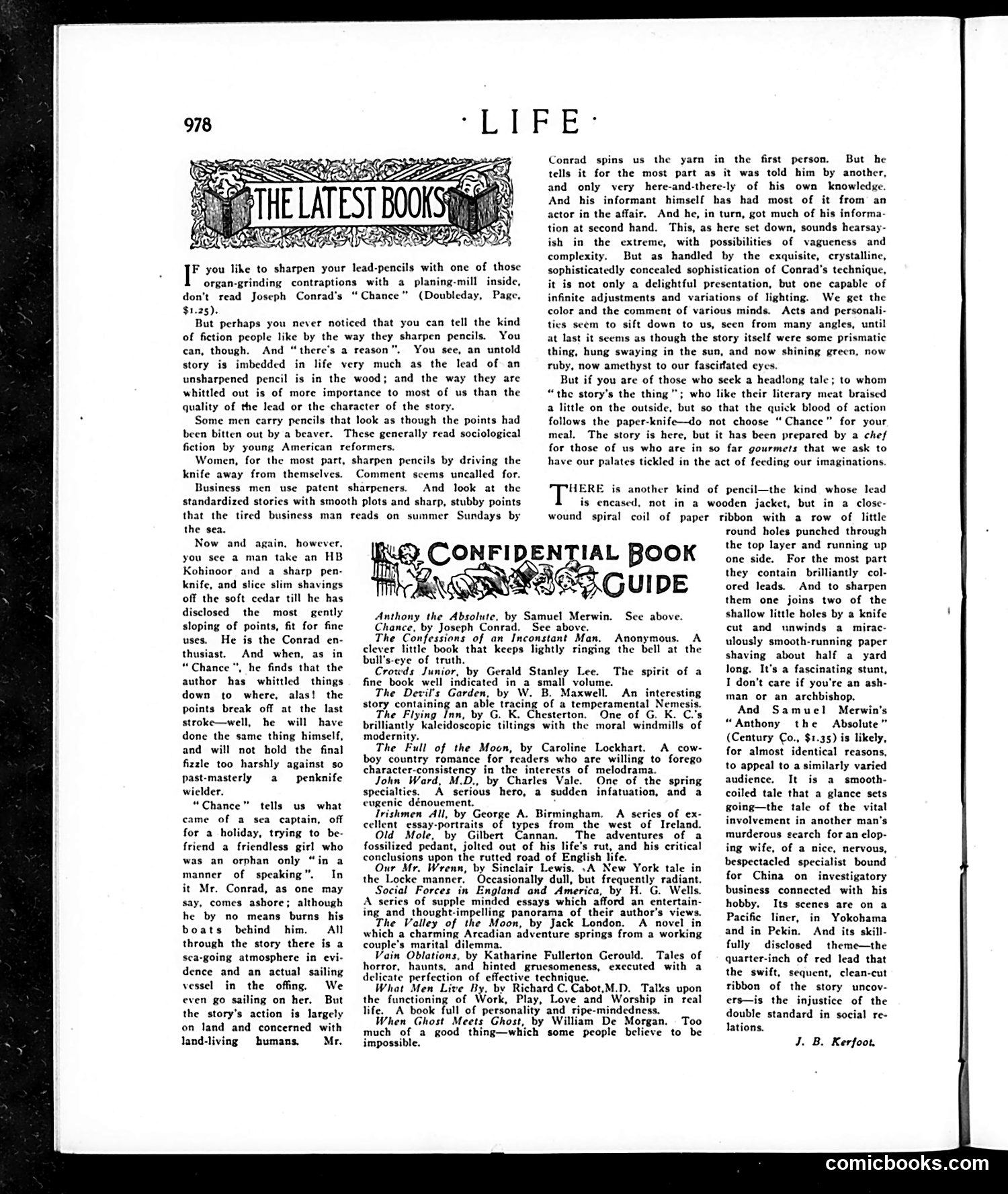
This page is primarily a **book review column** titled "The Latest Books," not a political cartoon. The opening section uses an extended metaphor comparing how people sharpen pencils to their reading preferences—a clever conceit typical of Life's satirical approach to literary criticism. The reviewer argues that pencil-sharpening habits reveal personality types: beaver-bitten points indicate readers of sociological reform fiction; patent sharpeners suggest businessmen who prefer standardized plots; and careful craftsmen using pocket knives are "Conrad enthusiasts" seeking literary sophistication. The main review critiques Joseph Conrad's novel *Chance*, praising its crystalline technique and prismatic narrative structure (told through multiple layers of hearsay) while warning impatient readers seeking straightforward action that Conrad's approach requires refined palates—a satirical dig at both the author's complexity and pretentious readers alike. The page then briefly catalogs other contemporary books, including works by Samuel Merwin and G.K. Chesterton, typical of literary magazines of this era (appears to be early 1910s based on publication style).
📄 Transcribed text from this page (OCR, searchable)
Machine-transcribed from the original scan — historical spelling and the odd misread are preserved.
L PEE I you like to sharpen your lead-pencils with one of those organ-grinding contraptions with a planing-mill inside, don't read Joseph Conrad’s “Chance” (Doubleday, Page, $1.25). But perhaps you never noticed that you can tell the kind of fiction people like by the way they sharpen pencils. You can, though. And “there's a reason”. You see, an untold story is imbedded in life very much as the lead of an unsharpened pencil is in the wood; and the way they are whittled out is of more importance to most of us than the quality of the lead or the character of the story. Some men carry pencils that look as though the points had been bitten out by a beaver. These generally read sociological fiction by young American reformers. Women, for the most part, sharpen pencils by driving the knife away from themselves. Comment scems uncalled for. Business men use patent sharpeners. And look at the standardized stories with smooth plots and sharp, stubby points that the tired business man reads on summer Sundays by the sea. Now and again, however, you sce a man take an HB Kohinoor and a sharp pen- knife, and slice slim shavings off the soft cedar till he has disclosed the most gently sloping of points, fit for fine uses. He is the Conrad en- thusiast. And when, as in “Chance ", he finds that the author has whittled things down to where, alas! the The Devi points break off at the last stroke—well, he will have Chance, by Joseph Conrad. bull’s-eye of truth. The Flying Inn, by G. ‘6 CONFIDEN Anthony the Absolute, by Samuel Merwin. See above. cut and unwinds a mirac- The Confessions of an Inconstant Man. clever little book that keeps lightly ringing the bell at the Crowds Junior, by Gerald Stanley Lee. fine book well indicated in a small volume. . Garden, by W. B. Maxwell. story conta ing an ste tracing of a femperarmental Neme: in K. Chesterton, Conrad spins us the yarn the first person. But he tells it for the most part as it was told him by another, and only very here-and-there-ly of his own knowledge. And his informant himself has had most of it from an actor in the affair. And he, in turn, got much of his informa- tion at second hand. This, as here set down, sounds hearsay- ish in the extreme, with possibilities of vagueness and complexity. But as handled by the exquisite, crystalline, sophisticatedly concealed sophistication of Conrad’s technique, it is not only a delightful presentation, but one capable of infinite adjustments and variations of lighting. We get the color and the comment of various minds. Acts and personali- seem to sift down to us, seen from many angles, until at last it seems as though the story itself were some prismatic thing, hung swaying in the sun, and now shining green, now ruby, now amethyst to our fascirfated eyes. But if you are of those who seek a headlong tale; to whom “the story’s the thing”; who like their literary meat braised a little on the outside, but so that the quick blood of action follows the paper-knife—do not choose “Chance” for your meal. The story is here, but it has been prepared by a chef for those of us who are in so far gourmets that we ask to have our palates tickled in the act of fecding our imaginations HERE is another kind of pencil—the kind whose lead is encased, not in a wooden jacket, but in a close- wound spiral coil of paper ribbon with a row of little round holes punched through IAL Book the top layer and running up one side. For the most part they contain brilliantly col- ored leads. And to sharpen them one joins two of the See above. shallow little holes by a knife Anonymous. A wlously smooth-running paper shaving about half a yard Jong. It’s a fascinating stunt, I don't care if you're an ash- man or an archbishop. And Samuel Merwin's “Anthony the Absolute” The spirit of a An interesting One of done the same thing himself, and will not hold the final fizzle too harshly against so past-masterly a penknife wielder. “Chance” tells us what came of a sea captain, off for a holiday, trying to be- friend a friendless girl who was an orphan only “in a manner of speaking”. In it Mr. Conrad, as one may say, comes ashore; although he by no means burns his boats behind him. All through the story there is a sca-going atmosphere in evi- dence and an actual sailing vessel in the offing. We even go sailing on her. But the story's action is largely on land and concerned with land-living humans, Mr. » K. C's brilliantly kaleidoscopic tiltings with the moral windmills of modernity. The Full of the Moon, by Caroline Lockhart. A cow- boy country romance for readers who are willing to forego character-consistency in the interests of melodrama. John Ward, M.D., by Charles Vale. One of the spring specialties. A serious hero, a sudden infatuation, and a cugenic dénouement. Irishmen All, by George A. Birmingham. A scrics of ex- cellent essay-portraits of types from the west of Ireland. Old Mole, by Gilbert Cannan. The adventures of a fossilized pedant, jolted out of his life's rut, and his critical conclusions upon the rutted road of English life. Our Mr. Wrenn, by Sinclair Lewis. .A New York tale in the Locke manner. Occasionally dull, but frequently radiant. Social Forces in England and America, by H. G. Wells. A series of supple minded essays which afford an entertain- ing and thought-impelling panorama of their author's views. The Valley of ihe Moon, by Jack London, A novel in which a charming Arcadian adventure springs from a working couple's marital dilemma. Vain Oblations, by Katharine Fullerton Gerould. Tales of horror, haunts, and hinted gruesomeness, executed with a delicate perfection of effective technique. What Men Live By, by Richard C. Cabot,M.D. Talks upon the functioning of Work, Play, Love and Worship in real life. A book full of personality and ripe-mindedness. When Ghost Meets Ghost, by William De Morgan. Too much of a good thing—which some people believe to be impossible. (Century Co., $1.35) is likely, for almost identical reasons, to appeal to a similarly varied audience, It is a smooth- coiled tale that a glance sets going—the tale of the vital involvement in another man's murderous search for an elop- ing wife, of a nice, nervous, bespectacled specialist bound for China on investigatory business connected with his hobby. Its scenes are on a Pacific liner, in Yokohama and in Pekin. And its skill- fully disclosed theme—the quarter-inch of red lead that the swift, sequent, clean-cut ribbon of the story uncov- ers—is the injustice of the double standard in social re- lations. J. B. Kerfoot comicbooks.com