
Life, 1914-05-28 · page 18 of 44
Life — May 28, 1914 — page 18: what you’re looking at
What you’re looking at
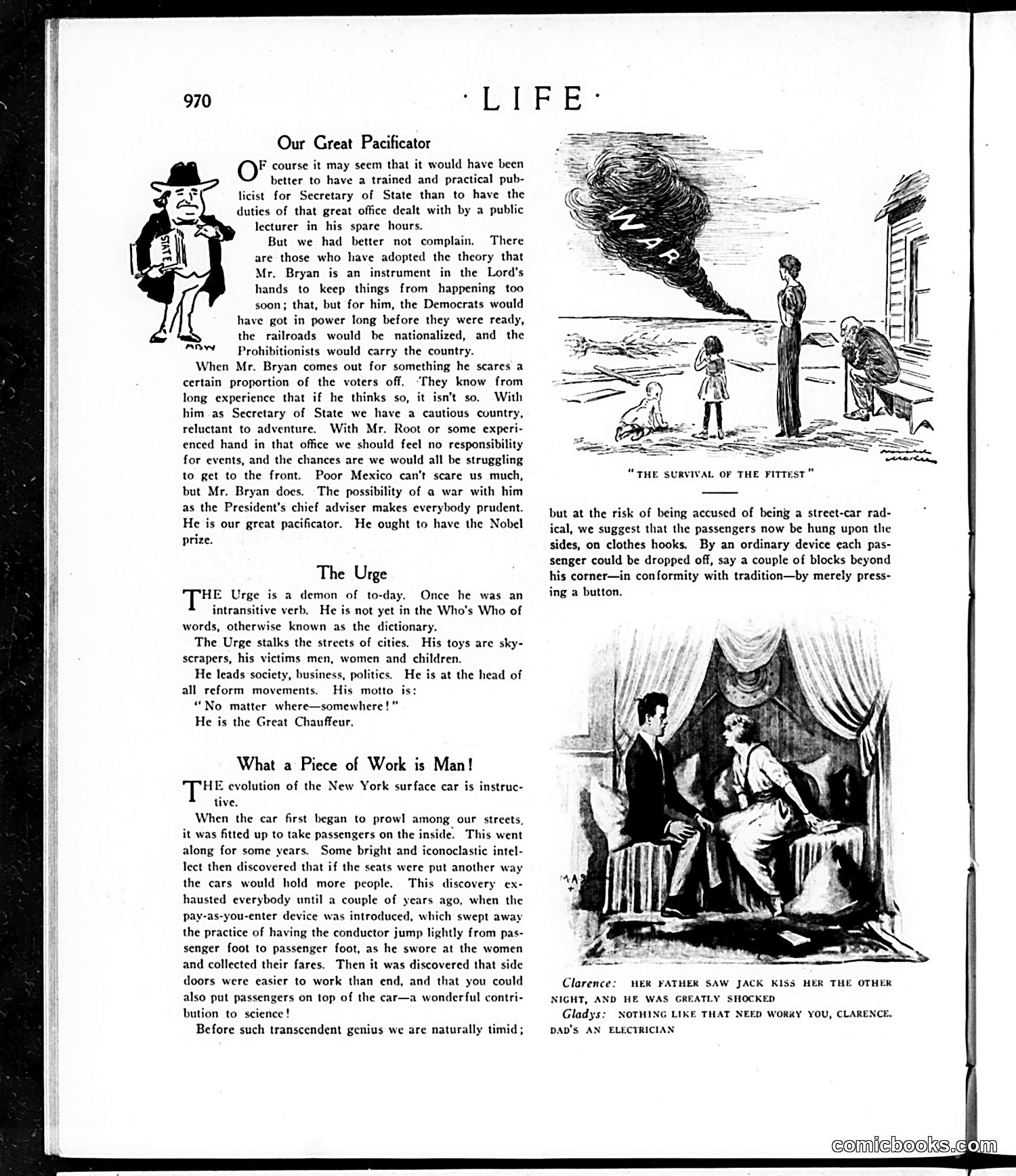
## "Our Great Pacificator" The caricatured figure is **William Jennings Bryan**, Secretary of State under President Wilson. The satire mocks Bryan as an ineffective "pacificator" — the joke being that his unpopularity actually *prevents* American adventurism. The text sardonically suggests that because Bryan's opinions are so consistently wrong, his pacifist stance makes the country cautious. He's portrayed as a public lecturer dabbling in diplomacy, unfit for the role compared to experienced statesmen like Elihu Root. ## "The Urge" This personifies modern American momentum — the relentless drive for progress and change ("No matter where—somewhere!"). It's presented as a chaotic force driving society, business, and reform movements, depicted as the "Great Chauffeur" wildly steering civilization forward. ## "What a Piece of Work is Man!" Satirizes the incremental "improvements" to New York streetcars, culminating in absurd suggestions like hanging passengers from clothes hooks like coats — mocking how minor engineering changes are celebrated as revolutionary breakthroughs. ## Bottom Cartoon A light social joke about an electrician father approving his daughter's kissing (electrical pun intended).
📄 Transcribed text from this page (OCR, searchable)
Machine-transcribed from the original scan — historical spelling and the odd misread are preserved.
Our Great Pacificator O F course it may seem that it would have been better to have a trained and practical pub- st for Secretary of State than to have the duties of that great office dealt with by a public lecturer in his spare hours. But we had better not complain. There are those who have adopted the theory that Mr. Bryan is an instrument in the Lord's hands to keep things from happening too soon; that, but for him, the Democrats would have got in power long before they were ready, the railroads would be nationalized, and the Prohibitionists would carry the country. When Mr. Bryan comes out for something he scares a certain proportion of the voters off. ‘They know from long experience that if he thinks so, it isn’t so. With him as Secretary of State we have a cautious country, reluctant to adventure. With Mr. Root or some experi- enced hand in that office we should feel no responsibility for events, and the chances are we would all be struggling to get to the front. Poor Mexico can’t scare us much, but Mr. Bryan does. The possibility of a war with him as the President's chief adviser makes everybody prudent. He is our great pacificator. He ought to have the Nobel prize. AoW The Urge HE Urge is a demon of to-day. Once he was an intransitive verb. He is not yet in the Who's Who of words, otherwise known as the dictionary. The Urge stalks the streets of cities. His toys are sky- scrapers, his victims men, women and children. He leads society, business, polit He is at the head of all reform movements. His motto is: “No matter where—somewhere!” He is the Great Chauffeur. What a Piece of Work is Man! HE evolution of the New York surface car is instruc- tive. When the car first began to prowl among our streets, it was fitted up to take passengers on the inside. This went along for some years. Some bright and iconoclastic intel- lect then discovered that if the seats were put another way the cars would hold more people. This discovery ex- hausted everybody until a couple of years ago, when the pay-as-you-enter device was introduced, which swept away the practice of having the conductor jump lightly from pas- senger foot to passenger foot, as he swore at the women and collected their fares. Then it was discovered that side doors were easier to work than end, and that you could also put passengers on top of the car—a wonderful contri- bution to science! Before such transcendent genius we are naturally timid; “THE SURVIVAL OF THE FITTEST” but at the risk of being accused of being a street-car rad- ical, we suggest that the passengers now be hung upon the sides, on clothes hooks. By an ordinary device each pas- senger could be dropped off, say a couple of blocks beyond his corner—in conformity with tradition—by merely press- ing a button. o> Clarence: MER FATHER SAW JACK KISS HER THE OTHER NIGHT, AND HE WAS GREATLY SHOCKED Gladys: NOTING LIKE THAT NEED WORRY YOU, CLARENCE. DAD'S AN ELECTRICIAN comichooks.