
Life, 1914-05-28 · page 25 of 44
Life — May 28, 1914 — page 25: what you’re looking at
What you’re looking at
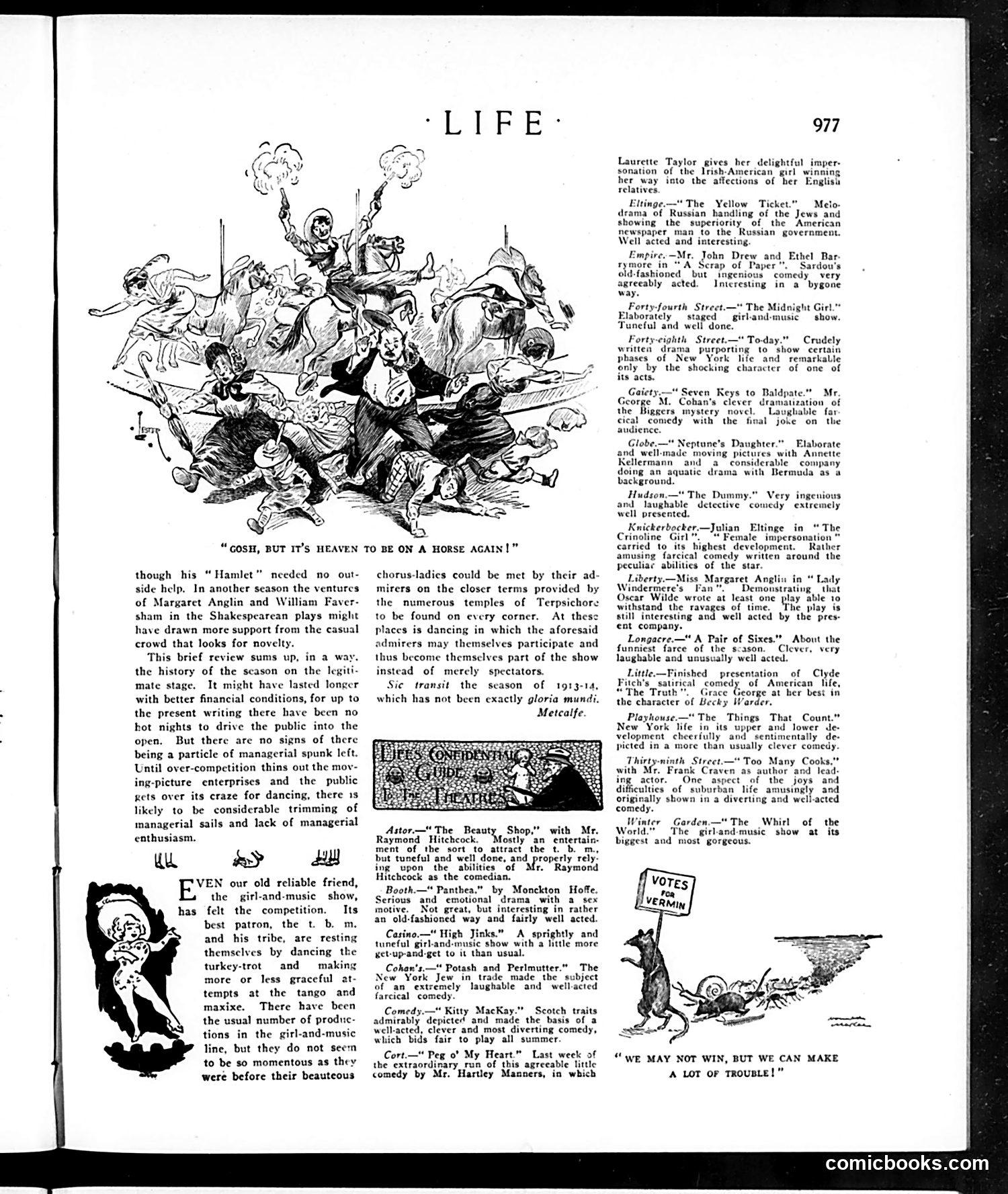
This page reviews Broadway's 1913-14 theater season. The main cartoon shows a skeletal Death figure astride a horse, captioned "GOSH, BUT IT'S HEAVEN TO BE ON A HORSE AGAIN!"—a darkly humorous commentary on the season's poor health. The text explains theater attendance collapsed due to two competing entertainments: **motion pictures** and **dance halls** (temples of "Terpsichore"). The "t.b.m." (tuberculosis man—a stock character of the era seeking fresh air) now goes dancing instead of attending stage shows, even leaving girl-and-music shows underattended. The author (Metcalfe) laments that without "managerial spunk," theatrical enterprises face "considerable trimming" until movies' novelty fades and dancing crazes pass. Individual show reviews follow, with brief judgments on various Broadway productions ranging from serious drama to farce.
📄 Transcribed text from this page (OCR, searchable)
Machine-transcribed from the original scan — historical spelling and the odd misread are preserved.
“GOSH, BUT I1’S HEAVEN TO BE ON A HORSE AGAIN!” though his “Hamlet” needed no out- side help, In another season the venturcs of Margaret Anglin and William Faver- sham in the Shakespearean plays might have drawn more support from the casual crowd that looks for novelty. This brief review sums up, in a way. the history of the scason on the legiti- mate stage. It might have lasted longer with better financial conditions, for up to the present writing there have been no hot nights to drive the public into the open. But there are no signs of there being a particle of managerial spunk left. Until over-competition thins out the mov- ing-picture enterprises and the public gets over its craze for dancing, there 1s likely to be considerable trimming of managerial sails and lack of managerial enthusiasm, cS cs VEN our old reliable friend, the girl-and-music show, has felt the competition. Its best patron, the t. b. m. and his tribe, are resting themselves by dancing the turkey-trot and = making more or less graceful at- tempts at the tango and maxixe. There have been the usual number of produc- tions in the girl-and-music line, but they do not seem to be so momentous as they were before their beauteous chorus-ladies could be met by their ad- mirers on the closer terms provided by the numerous temples of Terpsichore to be found on every corner. At these places is dancing in which the aforesaid admirers may themselves participate and thus become themselves part of the show instead of merely spectators. Sic transit the season of 1913-14 which has not been exactly gloria mund Metcalfe. —" The Raymond Hitchcock. Mostly ‘an entertain: ment of the sort to attract the t. b. m., but tuneful and well done, and properly rely: ing upon the abilities ‘of Mr. Raymond Hitehcock as the comedian, Booth.— Panthea.” by Monckton Hoffe. Serious and emotional drama with a sex . Not great, but interesting in rather an old-fashioned way and fairly well acted. Casin High Jinks.” A sprightly and tuneful girl-and-music show with a little more xetup-and-get to it than usual. Cohan's.— Potash and Perlmutter.” The New York Jew in trade made the subject ‘an extremely laughable and well-acted farcical comedy. Comedy.— Kitty MacKay.” Scotch traits admirably depicted and made the basis of a wellacted, clever and most diverting comedy, which bids fair to play all summer. Cort.— Peg o! My Heart” Last week of the extraordinary run of this agreeable little comedy by Mr. Hartley Manners, in which Beauty| Shop.” with Mr. 977 Laurette Taylor gives her delightful imper- sonation of the Irish-American girl winning her way into the affections of her Engli relatives, Eltinge.—" The Yellow Ticket.” Meto- drama of Russian handling of the Jews and showing the superiority of the American newspaper man to the Russian government. Well acted and interesting. Empire.—Mr. John Drew and, Ethel Bar rymore in “A Scrap of Paper”. Sardou's old-fashioned’ but ingenious comedy very agreeably acted. Interesting in a bygone way. _Forty-fourth Stre The Midnight Girl.” Elaboratcly staged | girl-and-music show. Tuneful and well done. Forty-eighth Street.—" Today." Crudely written drama purporting to. show certain phases of New York life and remarkalle only by the shocking character of one of its acts. Gaiety.— Seven Keys to Baldpate.” Mr, George M. Cohan's clever dramatization of the Biggers mystery novel. Laughable far cical comedy with the final joke on the audience. Globe.—" Neptune's Daughter.” Elaborate and well-made moving pictures with Annette Kellermann and a considerable company doing an aquatic drama with Bermuda as a background. Hudson.—" The Dummy." Very ingenious and laughable detective comedy extremely well presented. Knickerbock Eltinge in Crinoline Girl Female impersonati carried to its highest development. Rather amusing farcical comedy written around the peculiar abilities of the star. Liberty.—Miss Margaret Anglin in “ Lady Windermere’s ns Demonstrating that Oscar Wilde wrote at least one play able 10 withstand the ravages of time. The play is still interesting and well acted by the pres- ent company. Longacre.—" A Pair of Sixes.” About the funniest farce of the scason. Clever, very laughable and unusually well acted. Little-—Finisbed presentation of Clyde Fitch's satirical comedy of American life, “The Truth". Grace George at her best in the character of Becky Warder. Playhouse.— The Things That Count.” New York life in its upper and lower de- velopment cheerfully and sentimentally de- picted in a more than usually clever comedy. Thirty-ninth Street.—* Too Many Cooks with Mr. Frank Craven as author and lead- ing actor. One aspect af the joys and difficulties. of suburban life amusingly and originally shown in a diverting and well-acted comedy. Winter Garden.—" The Whirl of the World.” The girland-music show at its biggest and most gorgeous. “WE MAY NOT WIN, BUT WE CAN MAKE A LOT OF TROUBLE!” comicbooks.com