
A complete issue · 40 pages · 1914
Life — February 19, 1914
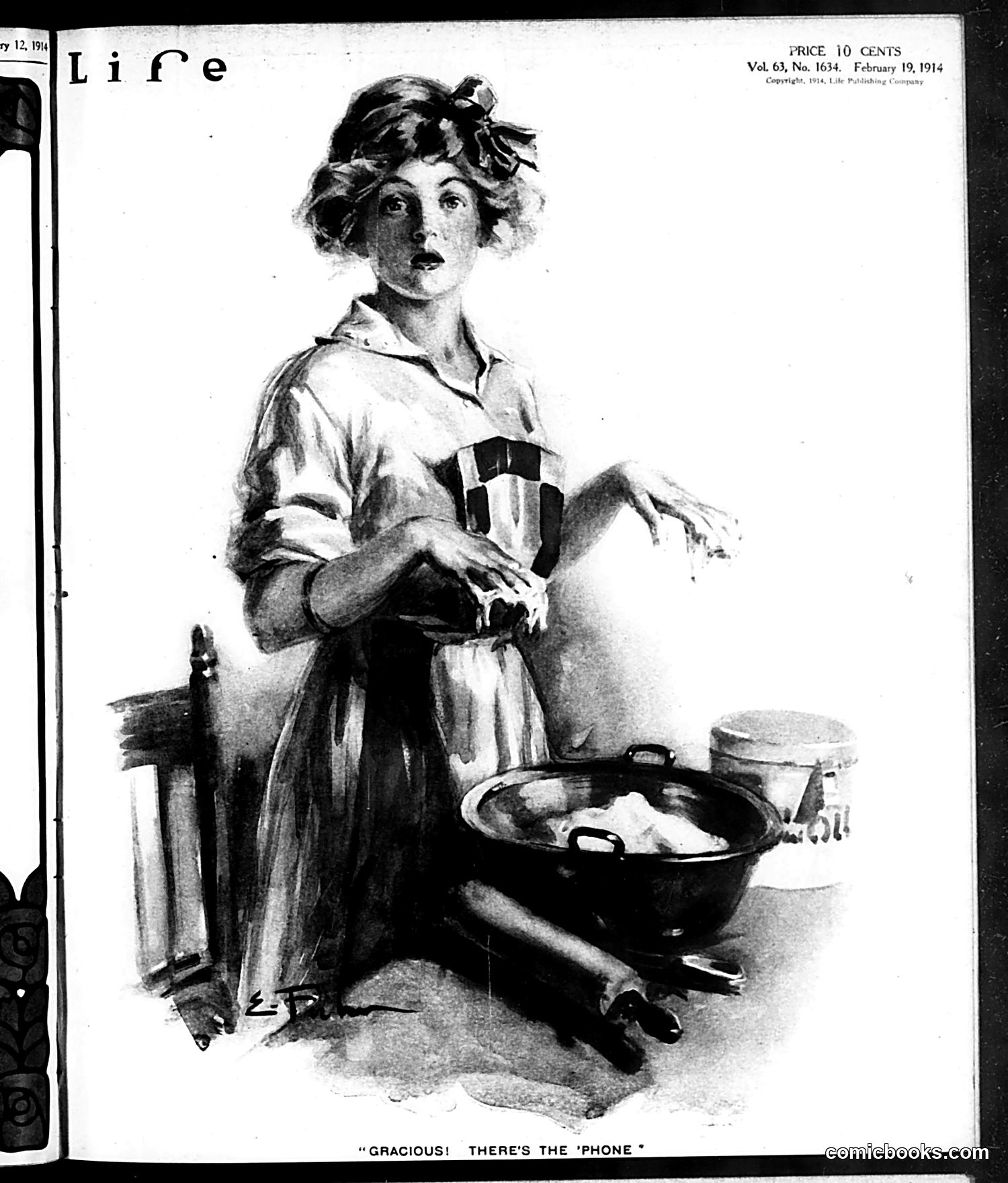
This satirical illustration depicts a woman in early 1900s housewife attire standing beside a cooking pot, holding what appears to be a telephone receiver. The caption reads "Gracious! There's the 'Phone." The joke plays on the emerging technology of telephones in American homes. The humor lies in the domestic interruption—a housewife mid-cooking is startled by an unexpected telephone call, a still-novel occurrence in 1914. The satire gently mocks how this new technology disrupted domestic routines and the household's traditional rhythm. This reflects early-20th-century anxieties about technological change invading private domestic spaces, presenting the telephone as an intrusive modern convenience that interrupted women's established household duties.
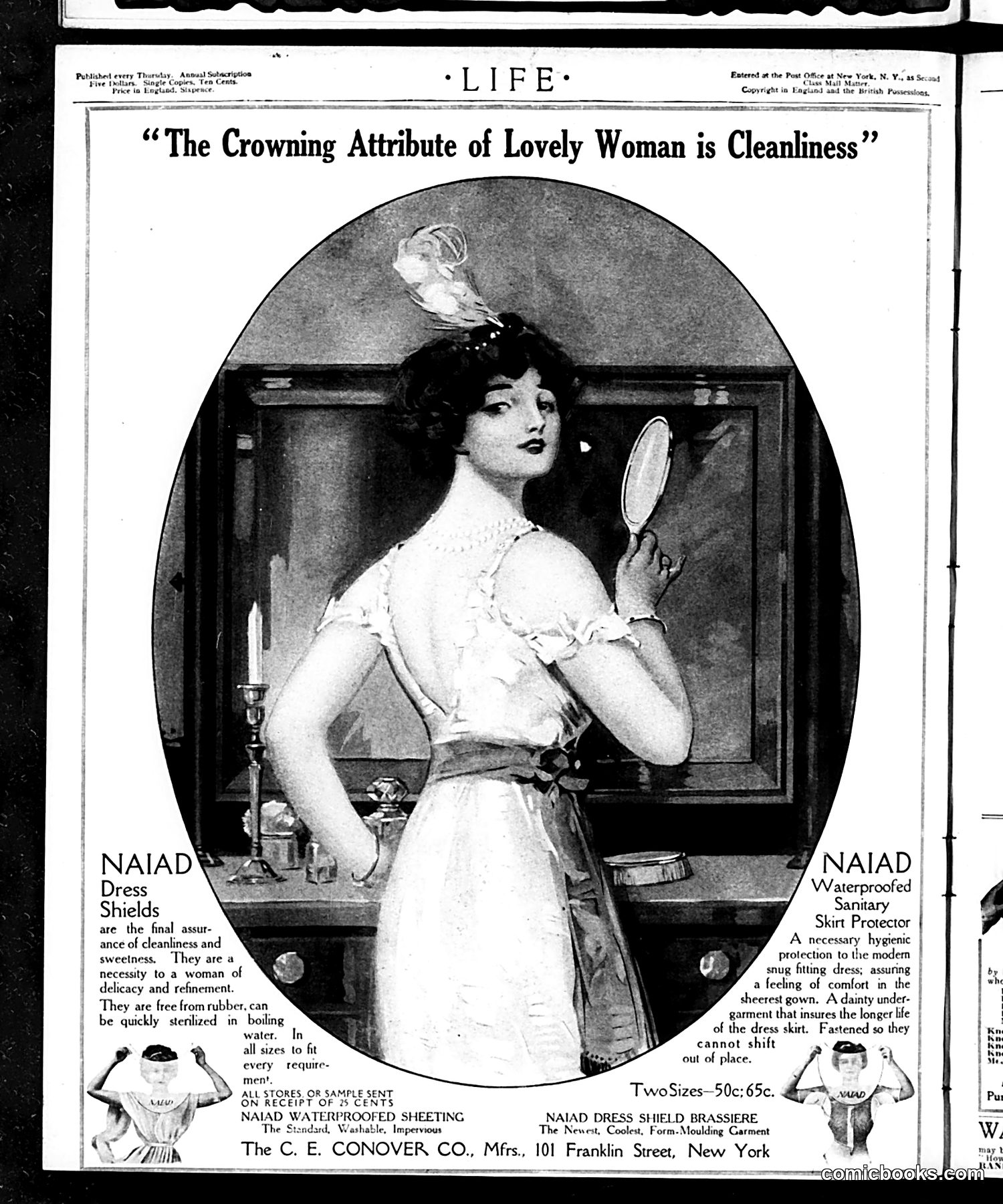
This page is primarily **advertising, not satire or political commentary**. It features a full-page advertisement for NAIAD brand feminine hygiene products, specifically dress shields and sanitary skirt protectors. The headline "'The Crowning Attribute of Lovely Woman is Cleanliness'" reflects early 20th-century marketing rhetoric about women and personal hygiene. The illustration shows a woman in a bathroom examining herself in a mirror, depicting the products' intended use. The advertisement emphasizes practicality—waterproof materials, easy sterilization, and comfort—targeting women concerned with discretion and hygiene standards of the era. This represents how Life magazine's pages mixed satirical content with period advertising, and reveals historical attitudes toward women's bodies and consumer marketing strategies.
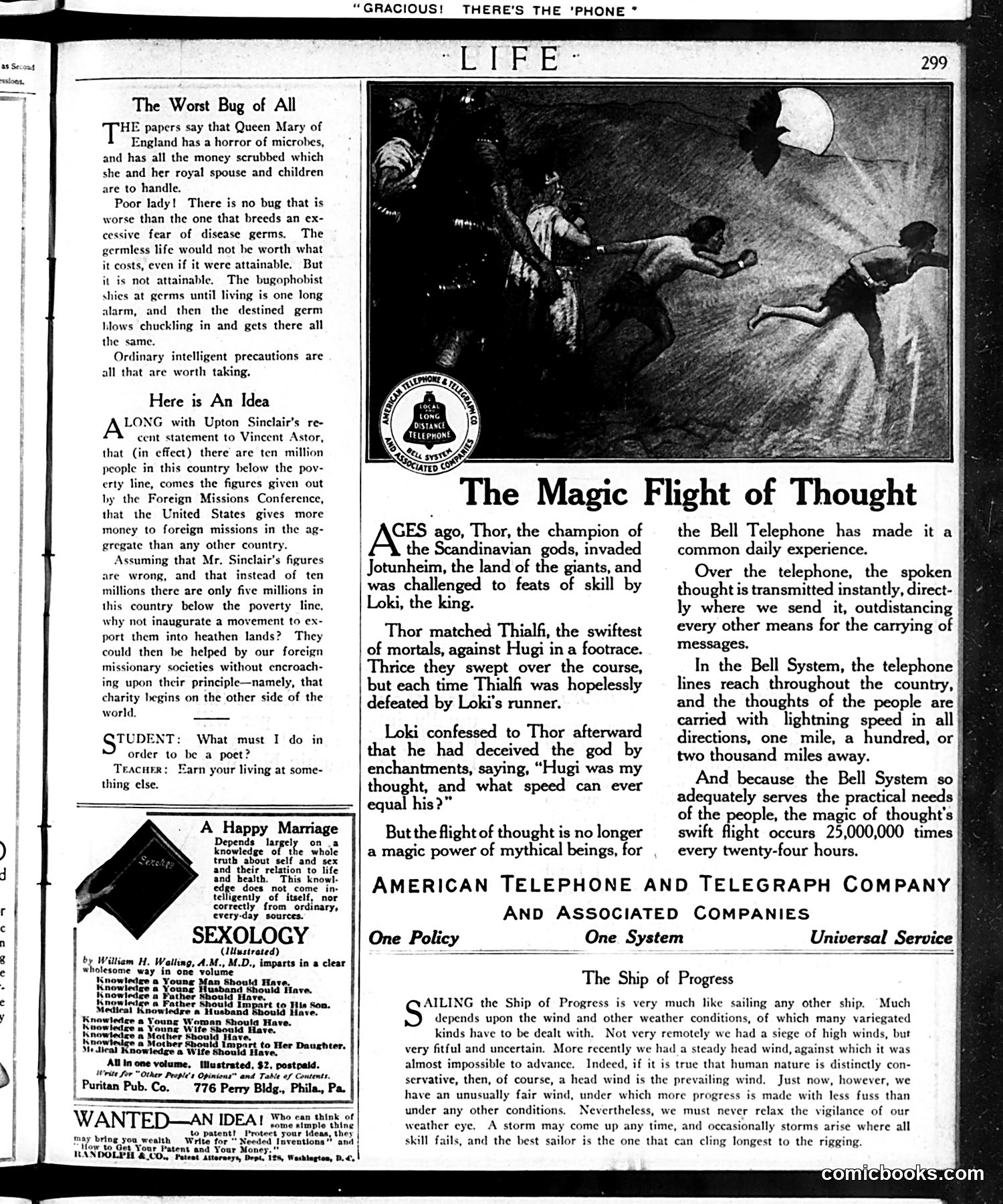
This page contains an advertisement for the American Telephone and Telegraph Company disguised as editorial content. The illustration depicts a figure fleeing from what appears to be a mythological creature under moonlight. The accompanying text references Norse mythology—Thor, Loki, and other gods—as an extended metaphor. It argues that while ancient myths celebrated magical thought transmission by gods, the Bell Telephone System now accomplishes this "magic" for ordinary people through modern technology. The piece celebrates how telephone lines enable instantaneous communication across vast distances—up to 25,000,000 times daily. This is corporate propaganda promoting telephone service adoption by framing telecommunications as democratizing ancient magical powers into practical daily experience for all Americans.
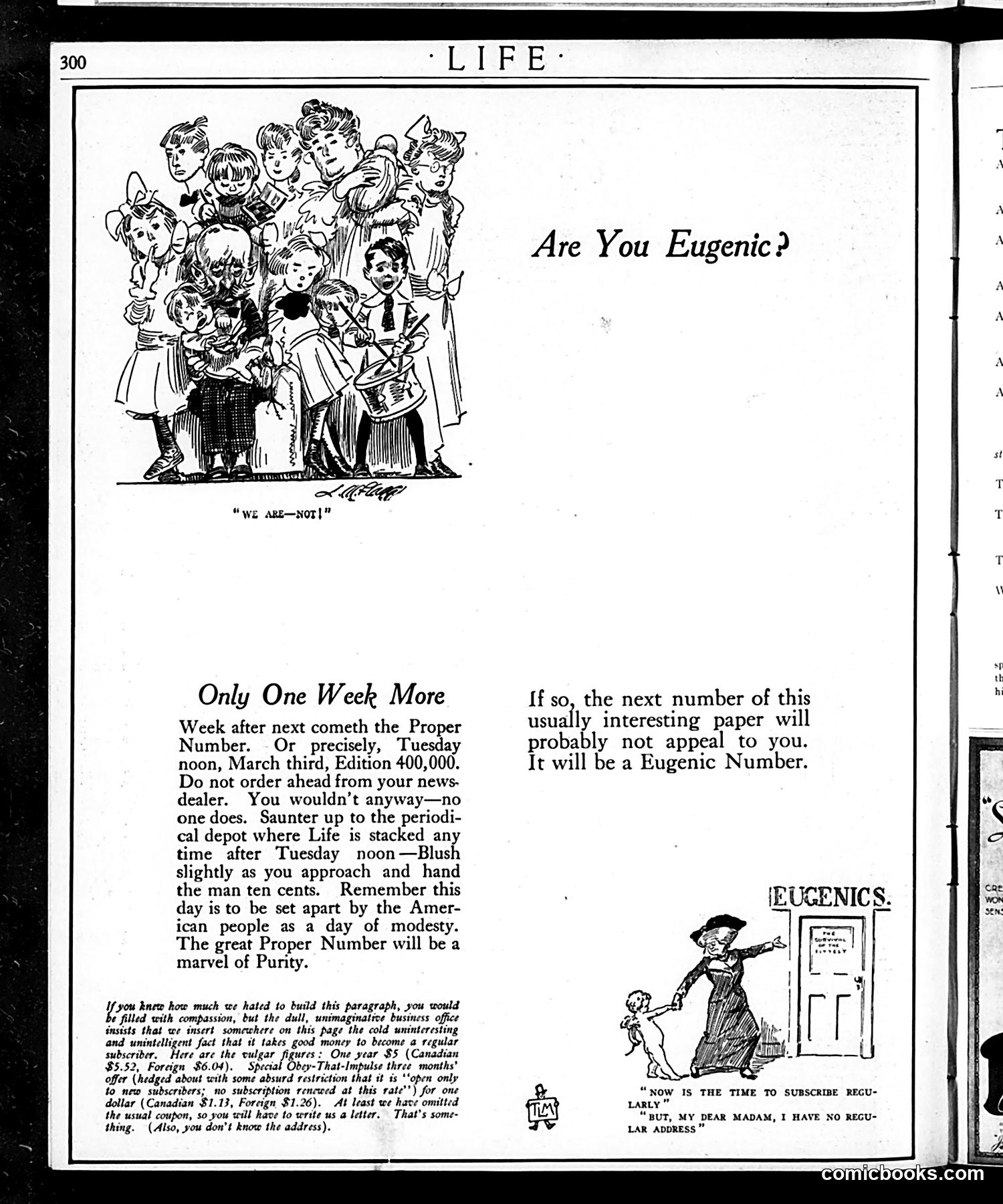
This page satirizes the eugenics movement, a pseudoscientific theory popular in early 20th-century America claiming some people were genetically "superior." The cartoon's heading "Are You Eugenic?" mocks this ideology. The illustration shows a diverse group of children with the caption "WE ARE—NOT!" The satire suggests that by eugenics standards, most ordinary people—represented by these varied children—would be deemed "unfit," which is absurd. The accompanying text announces an upcoming "Eugenic Number" of Life magazine, sarcastically suggesting it "will probably not appeal to you," implying the eugenics ideology is ridiculous and unappealing to reasonable readers. This represents Life's editorial stance against eugenics pseudoscience during a period when such discredited ideas unfortunately held mainstream appeal.
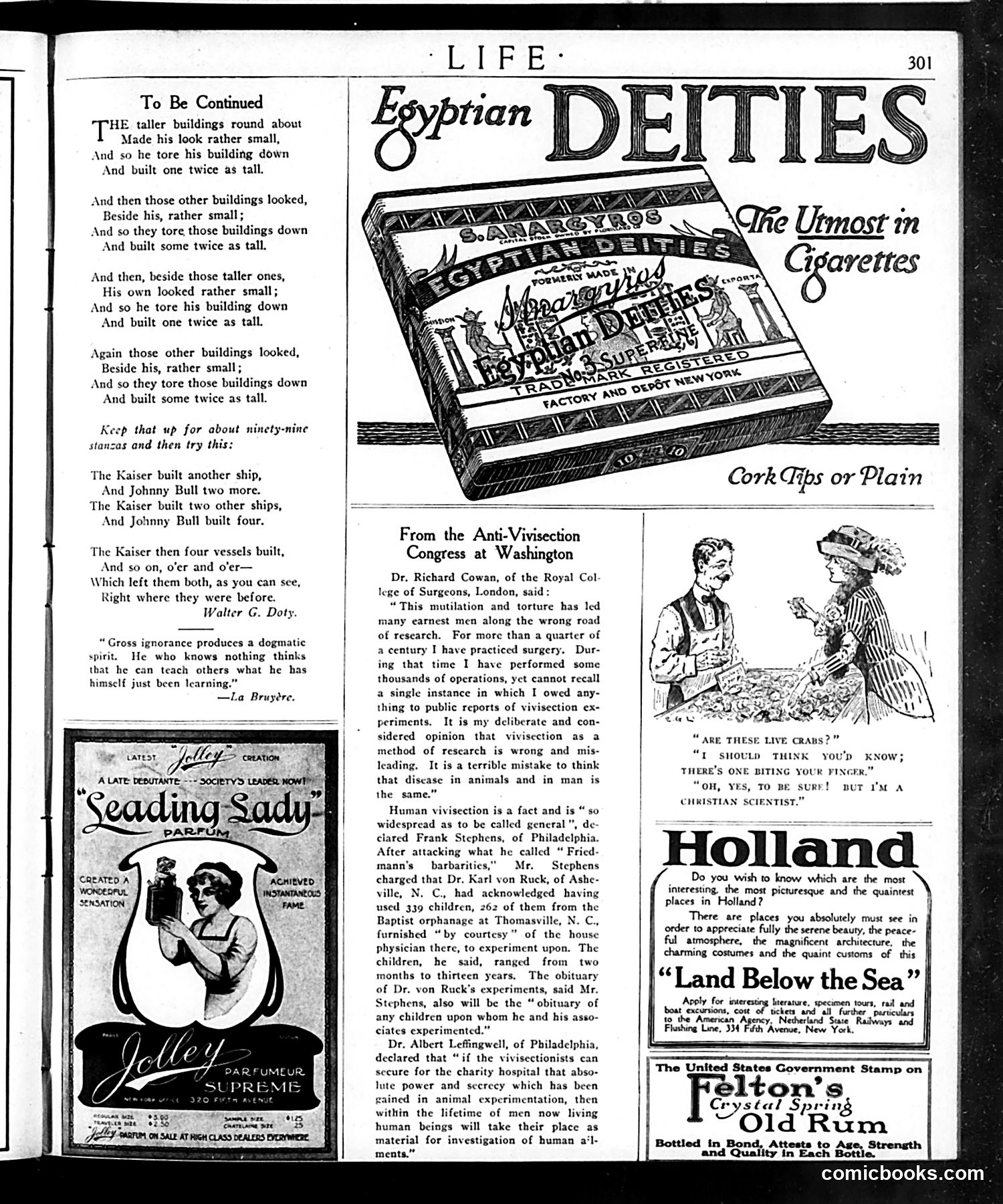
This page is primarily **advertising and miscellaneous content** rather than political satire. The main elements are: 1. **Egyptian Deities cigarettes ad** - a commercial advertisement claiming superiority ("The Utmost in Cigarettes") 2. **"Leading Lady" perfume ad** - vintage cosmetics marketing 3. **Anti-Vivisection Congress article** - reporting on a Washington conference where doctors debated animal experimentation ethics, with quotes from physicians arguing vivisection was scientifically questionable and morally wrong 4. **Holland tourism advertisement** - promoting travel to Netherlands with the tagline "Land Below the Sea" 5. **Crystal Spring Old Rum ad** - alcohol advertisement The page reflects early 20th-century concerns about animal welfare in medical research, alongside typical magazine advertising. There is no obvious political cartoon or satire present.

This page is **primarily an advertisement**, not satire or political commentary. It promotes Weed Anti-Skid Chains, tire traction devices for winter driving. The ad uses fear-based marketing: the dramatic illustration ("A Vision") shows a silhouetted motorist witnessing a car skidding dangerously on icy pavement ahead. The text warns drivers they're "taking chances on your own life" without chains, appealing to both personal safety anxiety and social responsibility ("serious menace to every road user"). The product claim—"Absolutely Prevent Skidding"—is presented as essential winter equipment. The ad emphasizes ease of installation and promises chains won't damage tires, concluding with a "safety campaign" appeal to equip cars immediately. This reflects early-20th-century automotive winter safety concerns before modern tire technology.
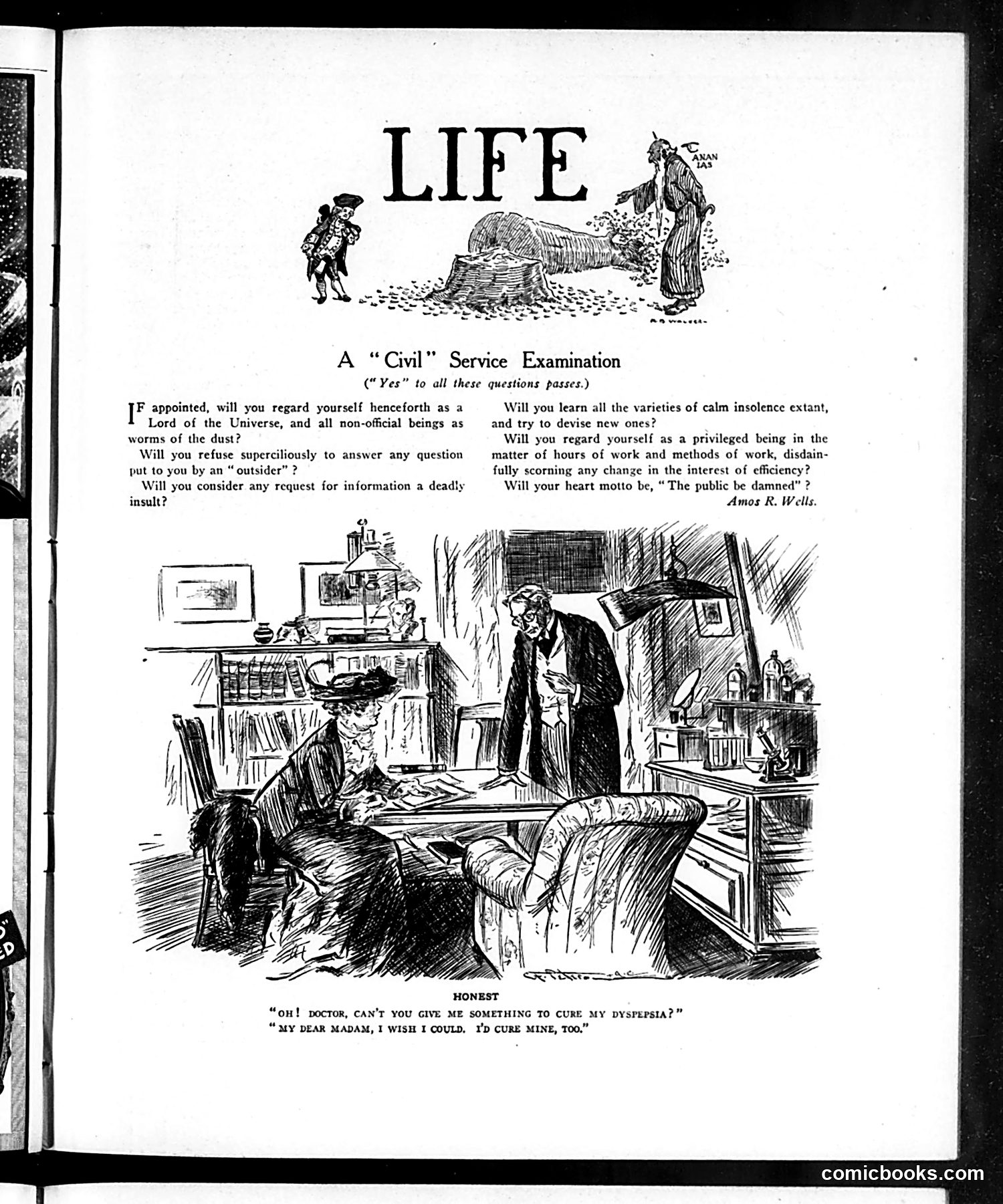
This satirical piece, attributed to James R. Wells, mocks the pretensions of civil service bureaucrats. The top section presents an ironic "examination" asking whether an appointed official will regard themselves as a lord of the universe, refuse to answer outsiders' questions, and scorn efficiency—all rhetorical jabs at bureaucratic arrogance and unaccountability. The illustration below depicts a doctor's office scene labeled "Honest," showing a patient complaining of dyspepsia while the doctor offers mutual sympathy rather than a cure. This cartoon satirizes incompetence and deflection—the doctor cannot help but sympathizes with the patient's complaint, mirroring how civil servants might acknowledge problems while doing nothing to solve them. The overall message critiques government inefficiency and self-serving bureaucracy.
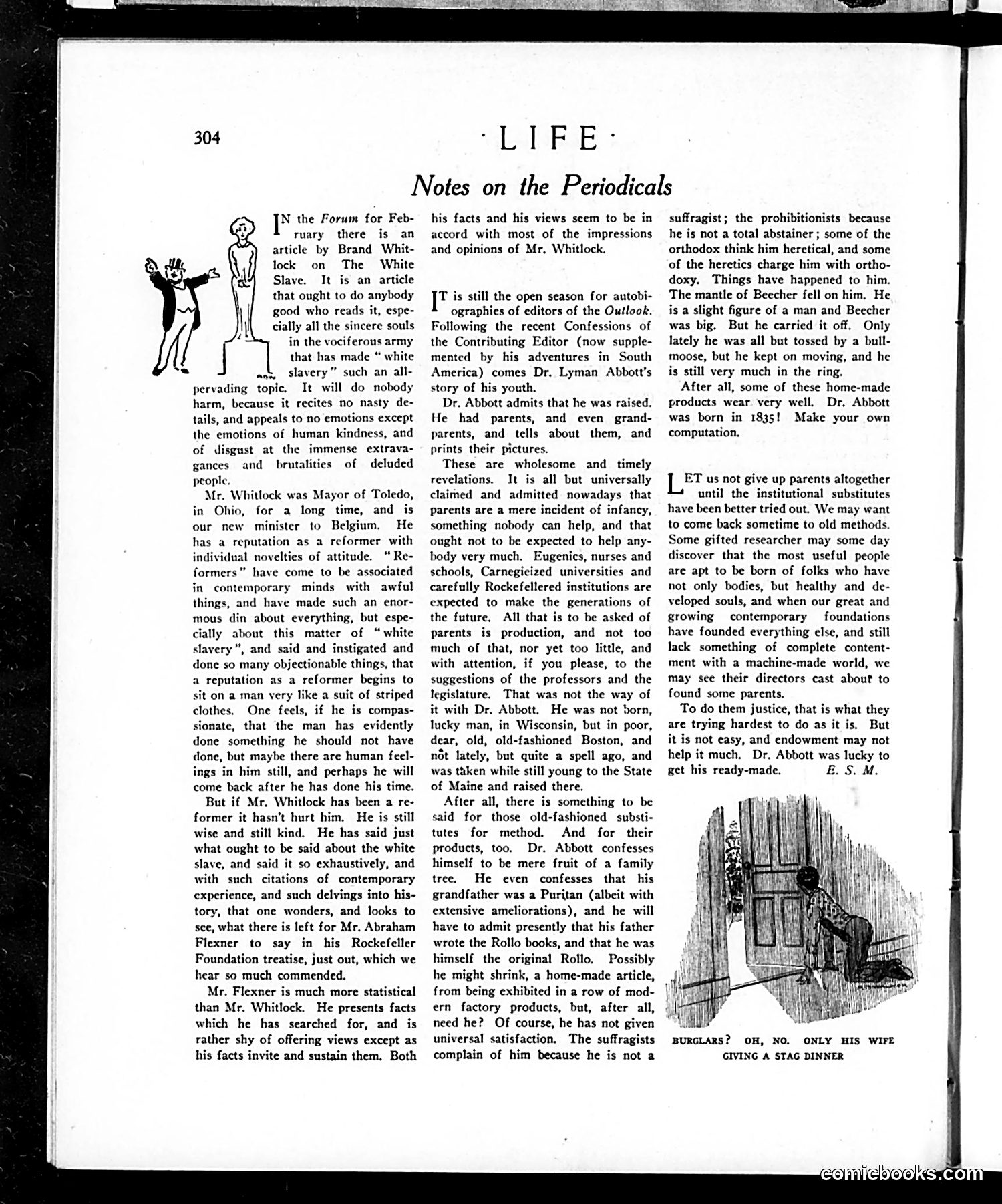
This page contains "Notes on the Periodicals," a commentary section rather than a political cartoon. The article discusses Brand Whitlock's essay "The White Slave" in the *Forum*, praising it as unemotional and effective reform writing that avoids sensationalism. The page critiques Dr. Lyman Abbott's autobiographical *Outlook* contributions, noting he was born into privilege (unlike Whitlock, who came from modest Boston origins). The text compares Abbott's "home-made" success unfavorably to statistical reformer Abraham Flexner's approach. The small illustration at bottom—captioned "BURGLARS? OH, NO. ONLY HIS WIFE GIVING A STAG DINNER"—appears to be a society joke about wealthy husbands being alarmed by their wives' entertaining habits.
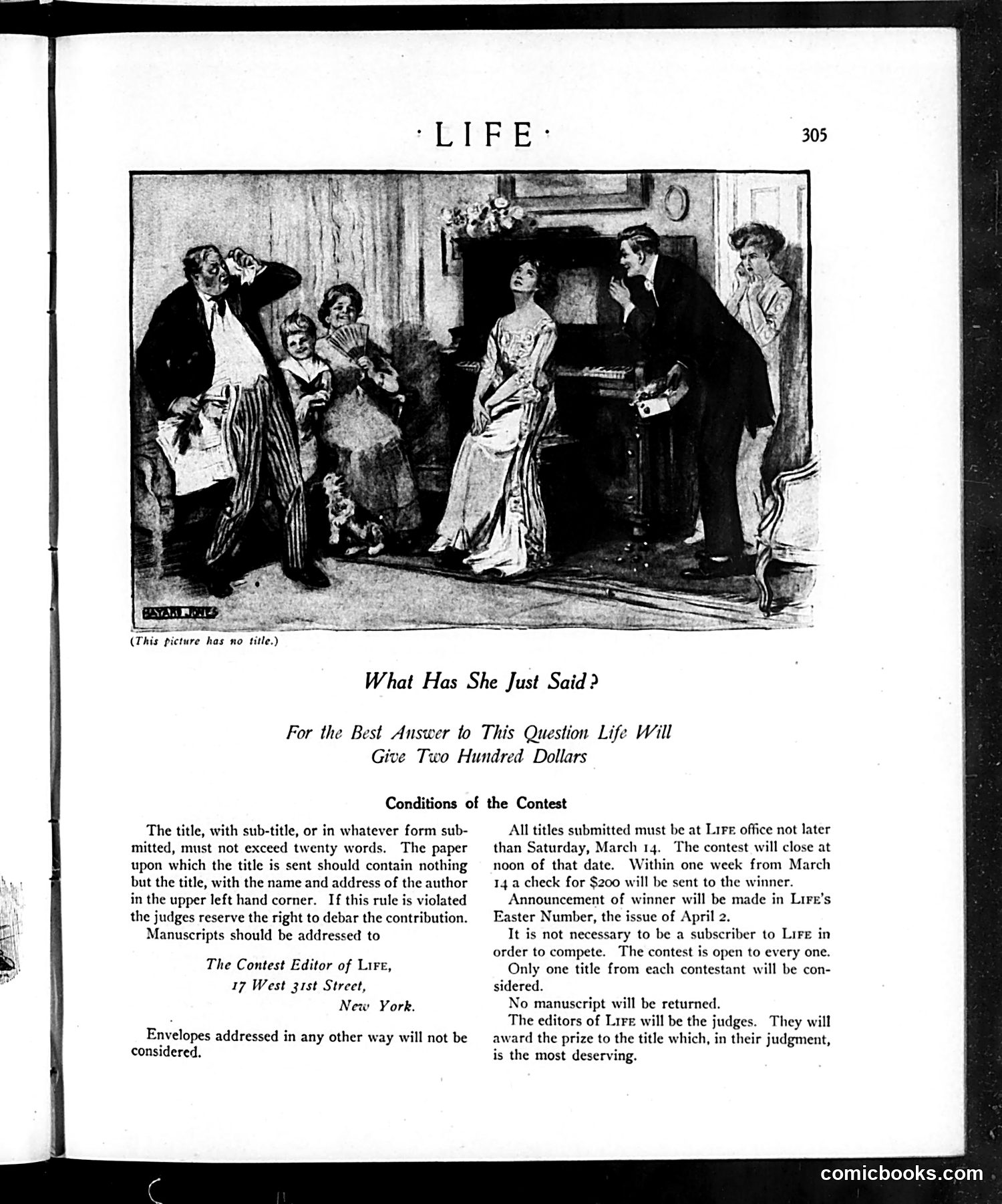
This page from *Life* magazine features a **contest for readers**, not a political cartoon. The central image shows an interior scene with several people in formal dress gathered around a seated woman who appears to be speaking. The contest asks readers to caption the image: "What Has She Just Said?" The winner will receive $200, with entries due by March 14. Contest rules specify submissions must be titled, under twenty words, and addressed to the Contest Editor at Life's New York offices. This was a popular early 20th-century magazine feature—essentially a captioning contest where readers created humorous dialogue or statements for the unnamed woman in the scene. It's an interactive puzzle rather than editorial commentary.
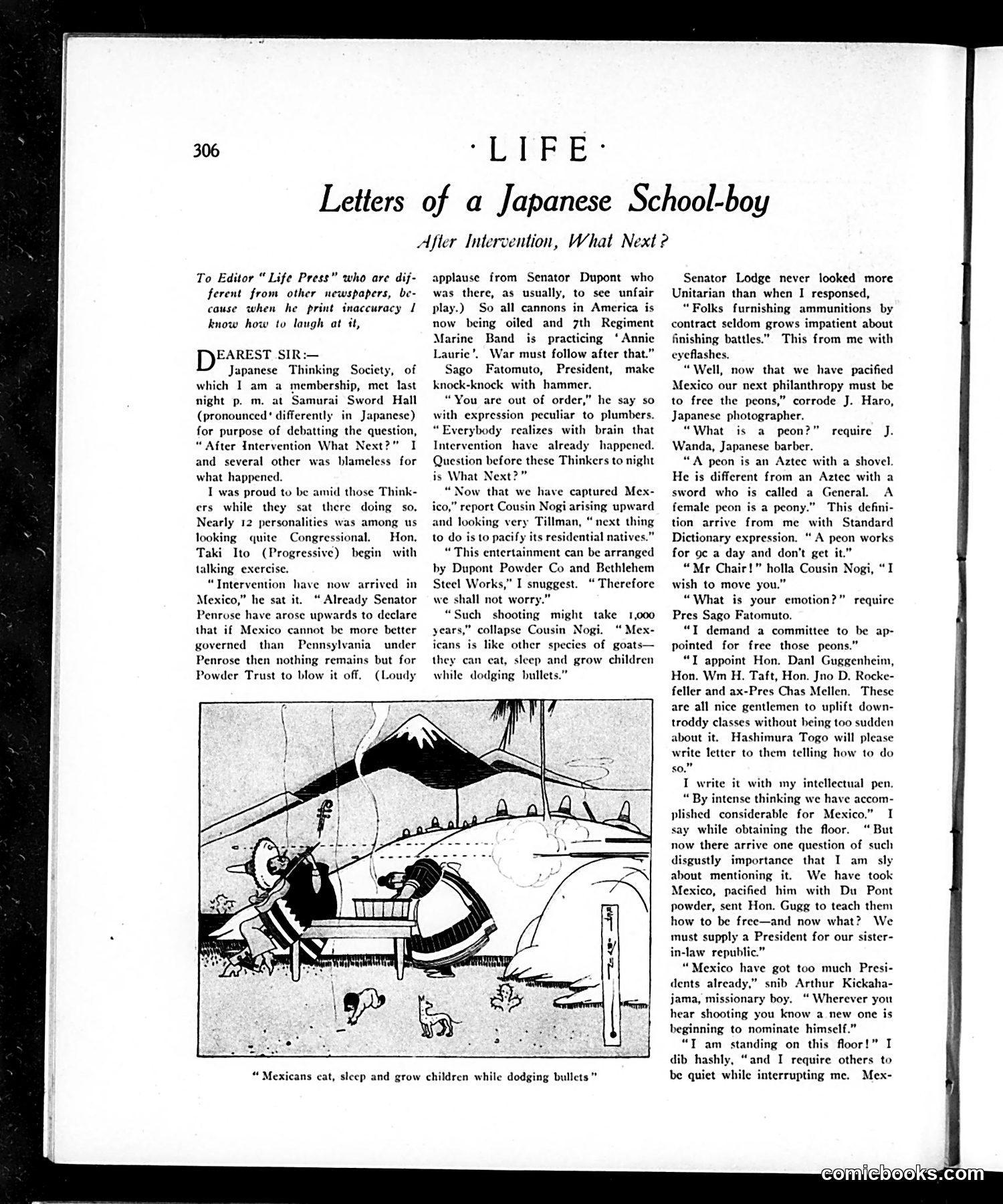
This page satirizes American interventionism in Mexico following recent military action. The cartoon depicts Mexicans "sleeping and growing children while dodging bullets"—a dark joke about civilian casualties amid conflict. The text mocks the absurdity of the situation: American officials (named: Senator Penrose, Senator Lodge, Dupont Powder Co., Bethlehem Steel Works) have "pacified Mexico" but now face the problem of installing a new government. Characters debate whether to appoint a president for Mexico's "in-law republic." The satire targets weapons manufacturers profiting from intervention and politicians' naive belief that military intervention solves political problems. The Japanese school-boy narrator uses this American fiasco to critique American pretensions to superiority, suggesting America's actual conduct contradicts its claimed values. The overall point: American military intervention creates chaos while enriching defense contractors.
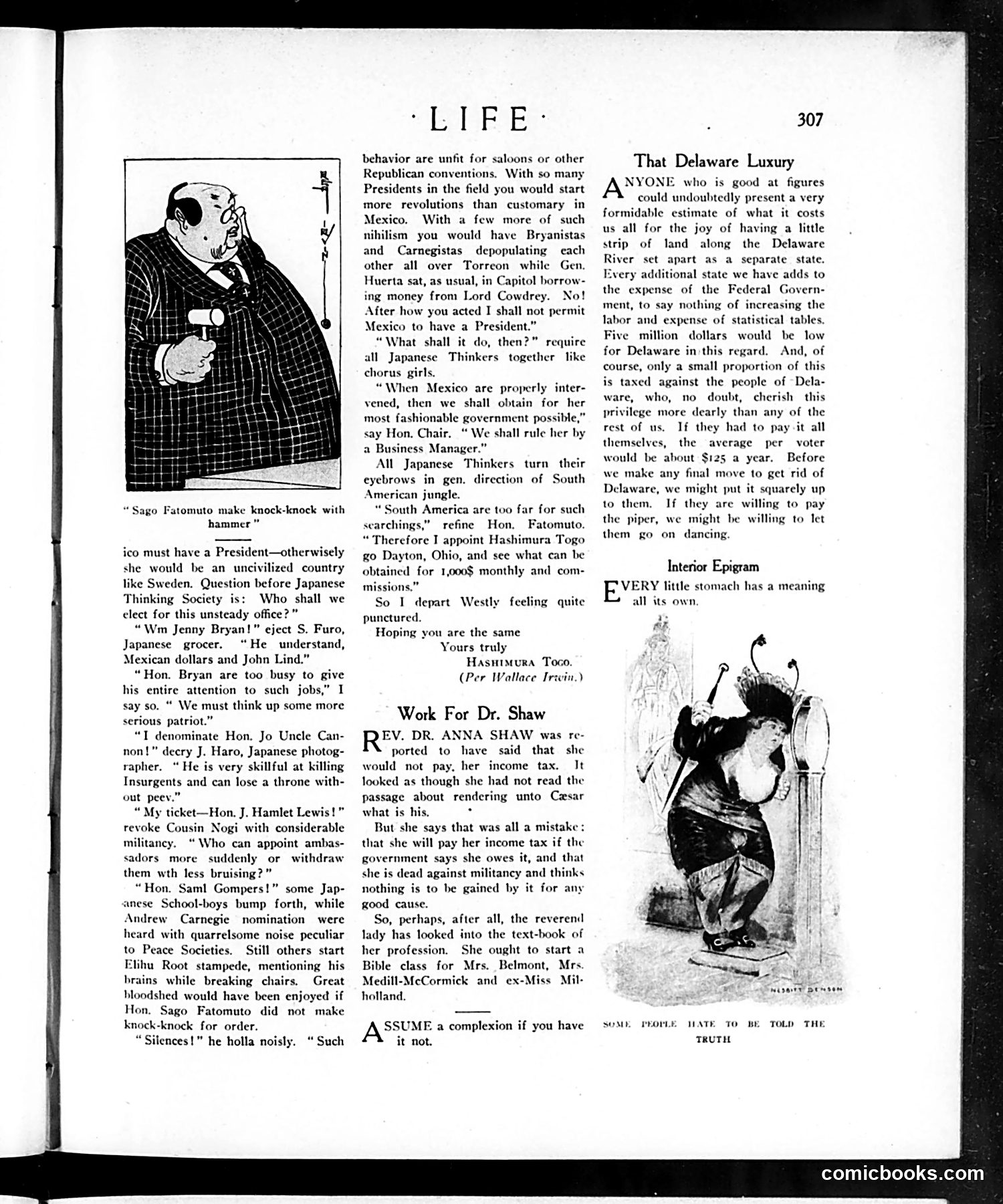
The main cartoon depicts a caricatured Asian figure (labeled "Sago Fotomuto") presenting a gavel or hammer to what appears to be a Mexican official, likely referencing early 20th-century U.S.-Mexico-Japan diplomatic tensions. The surrounding text mocks a Japanese "Thinking Society" debate about electing a Mexican president. The satire ridicules absurd political proposals—including appointing Japanese candidates to oversee Mexico's governance—while making crude ethnic caricatures. The cartoon's humor relies on contemporary anxieties about foreign intervention and racial "othering." Modern readers should recognize this as reflecting period jingoism and xenophobia rather than legitimate political commentary.
This page is **not a political cartoon**. It's a **program or plot summary** for "Lay Boheem," an opera in four reels with French text by Henri Malinger and music by Poorsheeni. The page documents the opera's four scenes across different locations (an attic, a quarter street, a kibosch exterior, and an attic again). It lists the characters—Rudolph, Marcel, Schaunard, Colline, Mimi, and Musette—and provides scene-by-scene descriptions of the plot involving these bohemian characters. At the bottom, it's credited to Quincy Kilby. This appears to be **Life magazine's** humorous take on or parody of Puccini's "La Bohème," using satirical stage directions and commentary rather than straightforward synopsis.
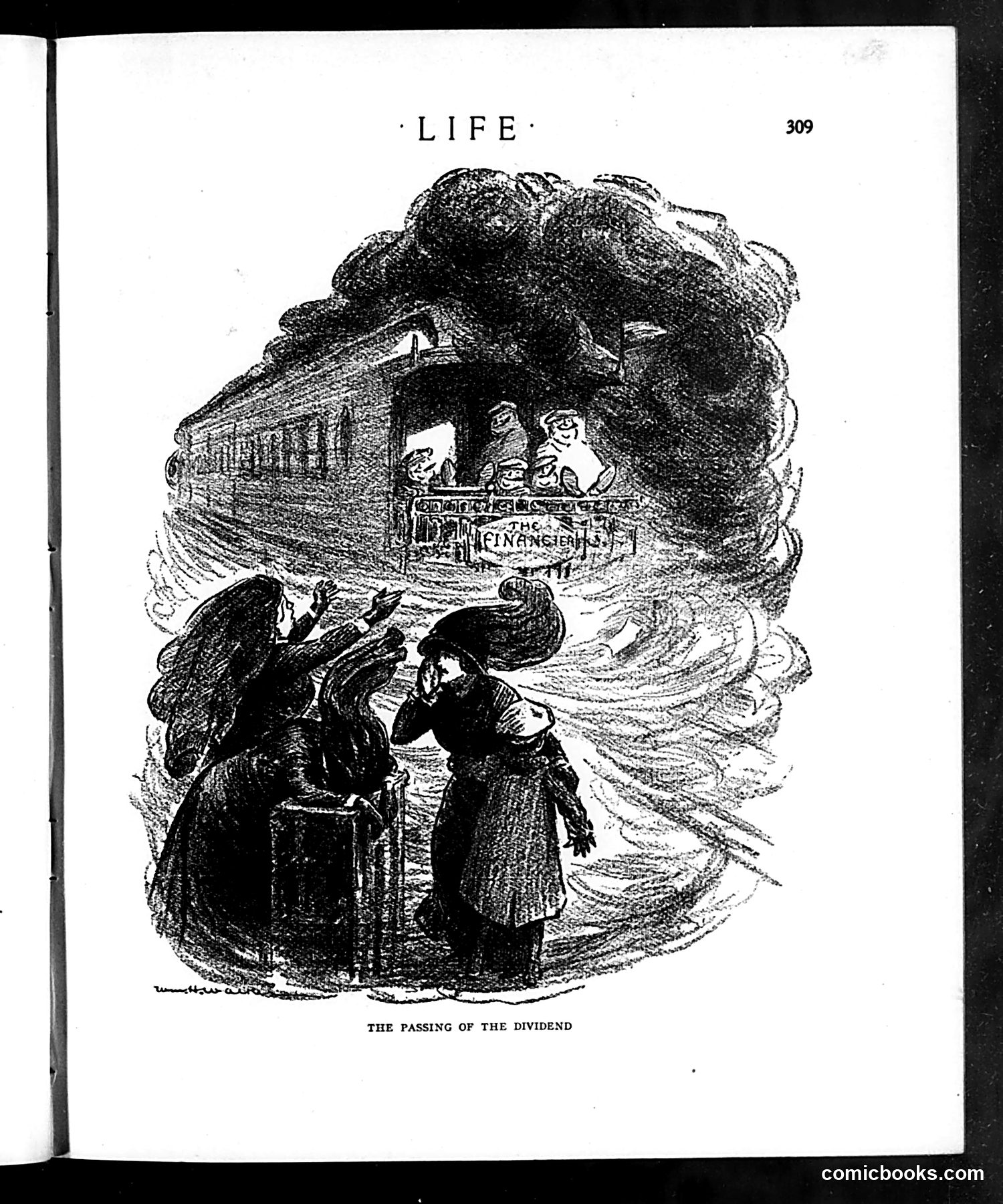
This satirical illustration depicts two figures in the foreground gesturing toward a building labeled "THE FINANCIERS" in the background, where three faces peer from windows. The title suggests commentary on financial matters, specifically the cessation or reduction of dividend payments. The cartoon likely critiques wealthy financiers or corporate leaders during a period of economic difficulty. The two figures in front appear to represent ordinary citizens or workers, while those in the building represent the financial establishment. The dramatic, swirling composition and their gestures suggest dismay or accusation directed at the financiers above. Without a specific date visible, the exact historical event remains unclear, though this reflects satirical coverage of financial instability common in *Life* magazine's commentary on American economic conditions.
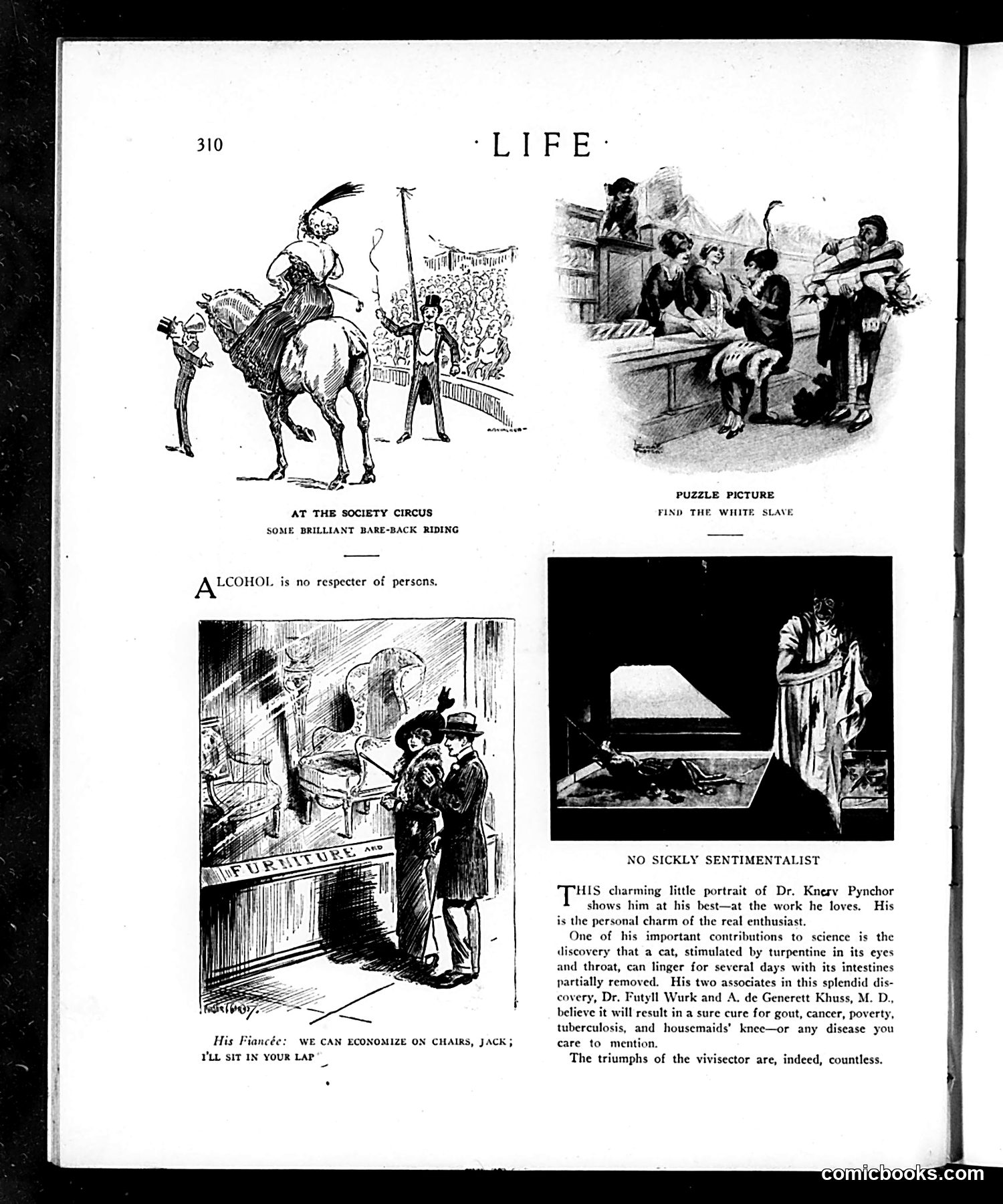
This page contains four satirical pieces mocking various social topics: 1. **"At the Society Circus"** (top left): Satirizes wealthy elite who attend fashionable circus events, depicting bare-back riding as entertainment for the upper class. 2. **"Puzzle Picture: Find the White Slave"** (top right): References the early 1900s moral panic over "white slavery"—forced prostitution of white women, a major social reform issue of the era. 3. **"His Fiancée"** (bottom left): A joke about economizing on furniture by sitting in a woman's lap instead of buying chairs—mocking both frugality and courtship customs. 4. **"No Sickly Sentimentalist"** (bottom right): Profiles Dr. Kingey Pynchor, a scientist whose research involves vivisecting cats to study disease cures. The text celebrates his pragmatism despite the animal cruelty involved—reflecting early 1900s attitudes toward medical experimentation.
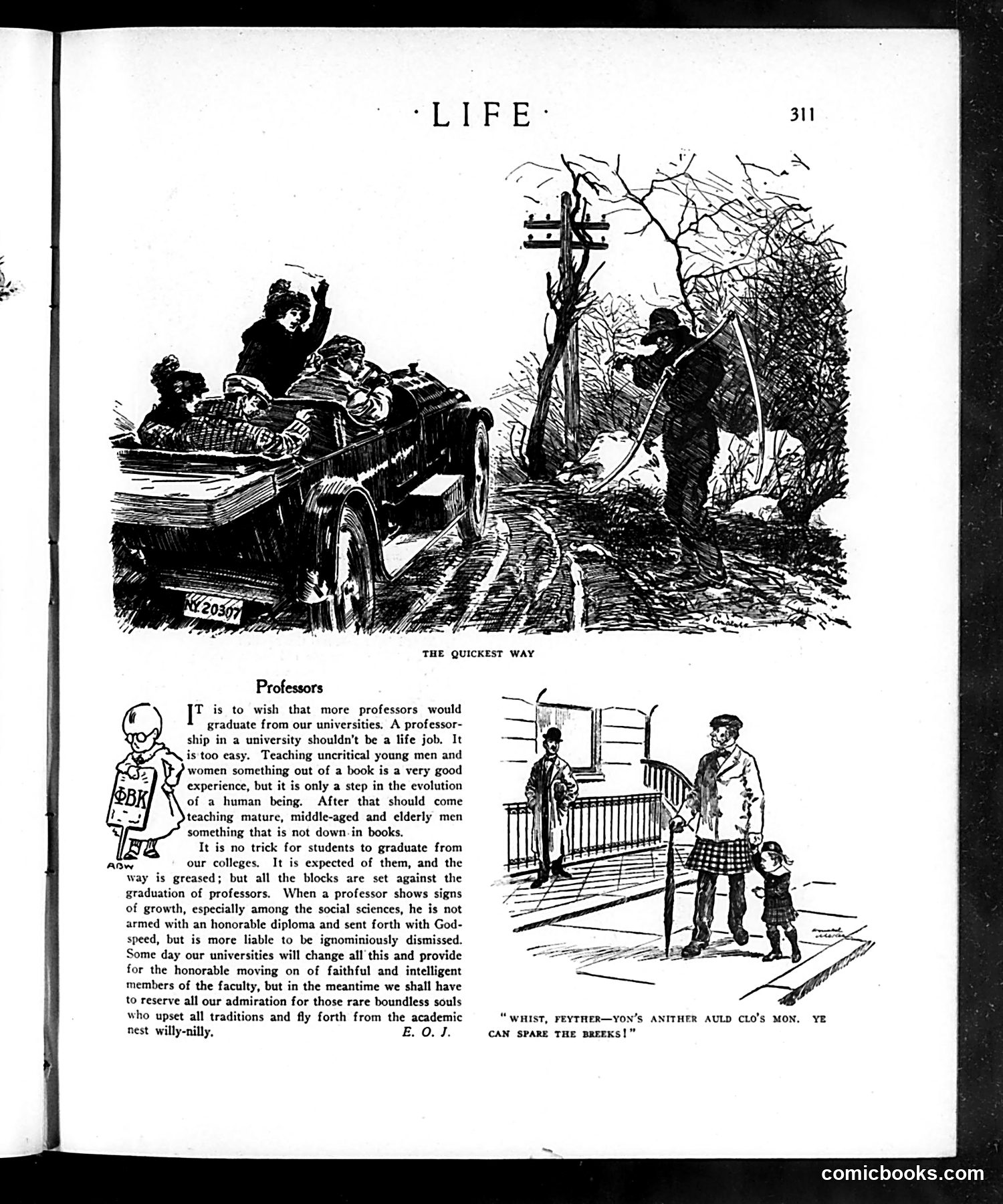
**Top Cartoon ("The Quickest Way"):** Shows a motorist stopping to ask directions from a man with a scythe near a roadside cross. The joke appears to involve taking a shortcut via death—dark humor about avoiding life's complications. **Article "Professors":** Critiques the academic system. The author argues professorships shouldn't be lifetime positions, claiming universities easily graduate students but systematically block professors' advancement—especially those showing intellectual growth in social sciences. The piece suggests professors showing "signs of growth" risk dismissal rather than promotion. It advocates for academics to leave universities to evolve as human beings, praising the "rare boundless souls" who rebel against academic tradition. **Bottom Cartoon:** Scottish dialect dialogue between a child and adult about an old clothes man ("Auld Clo's Mon"), referencing spare trousers ("breeks"). This appears unrelated to the professor article—likely a separate humor piece. The article reflects early-20th-century anxieties about institutional rigidity stifling intellectual freedom, particularly regarding unconventional or progressive thought in academia.
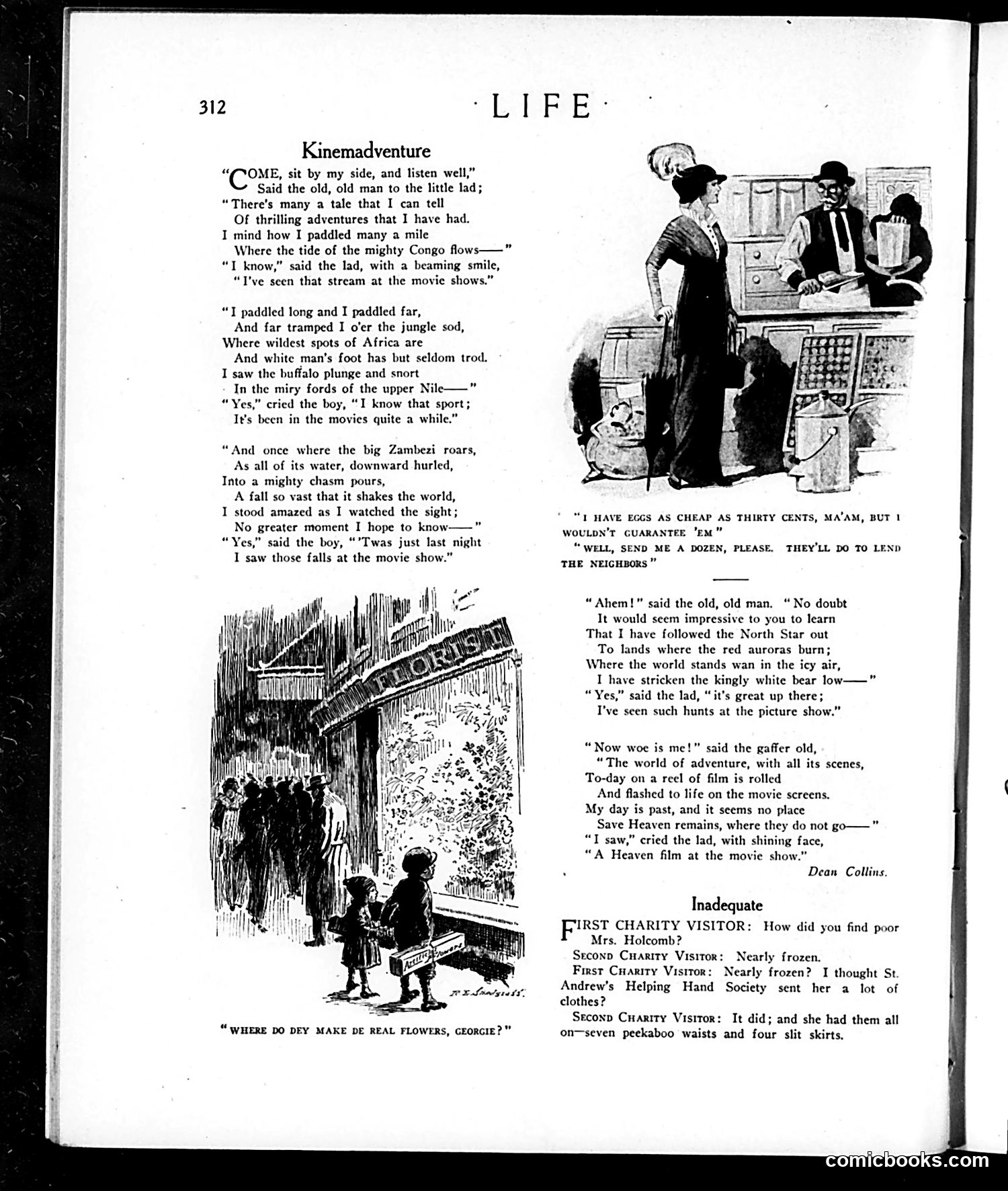
This 1920s-era piece satirizes how cinema has made traditional adventure narratives obsolete. An elderly man tries to impress a boy with tales of African exploration—paddling the Congo, witnessing Victoria Falls, Arctic polar bear hunts—but the boy interrupts each time: "I've seen that at the movie show." The joke critiques both cinema's dominance over lived experience and the boy's passivity. Where an old adventurer once held cultural authority through firsthand stories, movies now deliver the same exotic spectacles instantly, making his adventures seem quaint and secondhand. The bottom cartoons continue this theme: one mocks artificial movie sets ("where do they make de real flowers?"), another shows a poor woman receiving fashionable but impractical charity clothes with slits and sheer panels—useless for actual warmth, but matching trendy movie fashions. Together, the page satirizes how 1920s mass media (film) was reshaping culture, replacing traditional storytelling and practical values with visual spectacle.
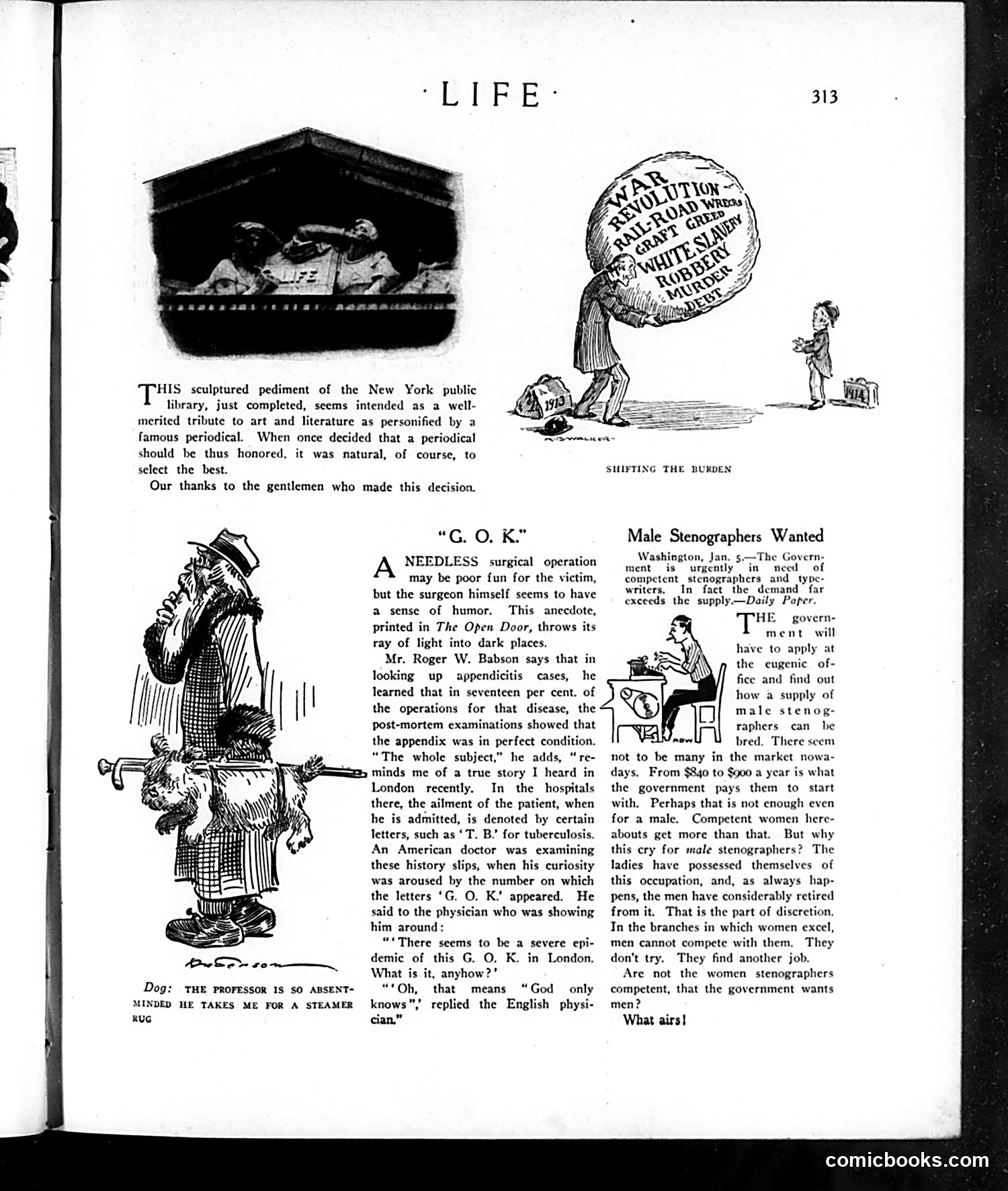
This page contains three distinct satirical pieces: **1. Library Pediment (top):** Life magazine mockingly congratulates itself for being selected for a sculpture on the New York Public Library's newly completed pediment—a prestigious honor. The joke is self-congratulatory vanity: Life claims it was "natural, of course, to select the best," sarcastically suggesting Life's own importance. **2. "G.O.K." Anecdote (center):** A humorous story about medical incompetence. An American doctor discovers British hospitals use "G.O.K." to denote patient ailments—which stands for "God Only Knows," implying doctors don't actually know what's wrong. The piece highlights unnecessary surgeries, particularly appendectomies performed on healthy appendixes. **3. Male Stenographers (right):** Satirizes a government employment notice seeking male stenographers. The commentary sarcastically questions why men are needed when women have proven more competent and willing to work for lower wages ($84-$900/year). The final "What airs!" mocks men's entitlement to positions they've abandoned.
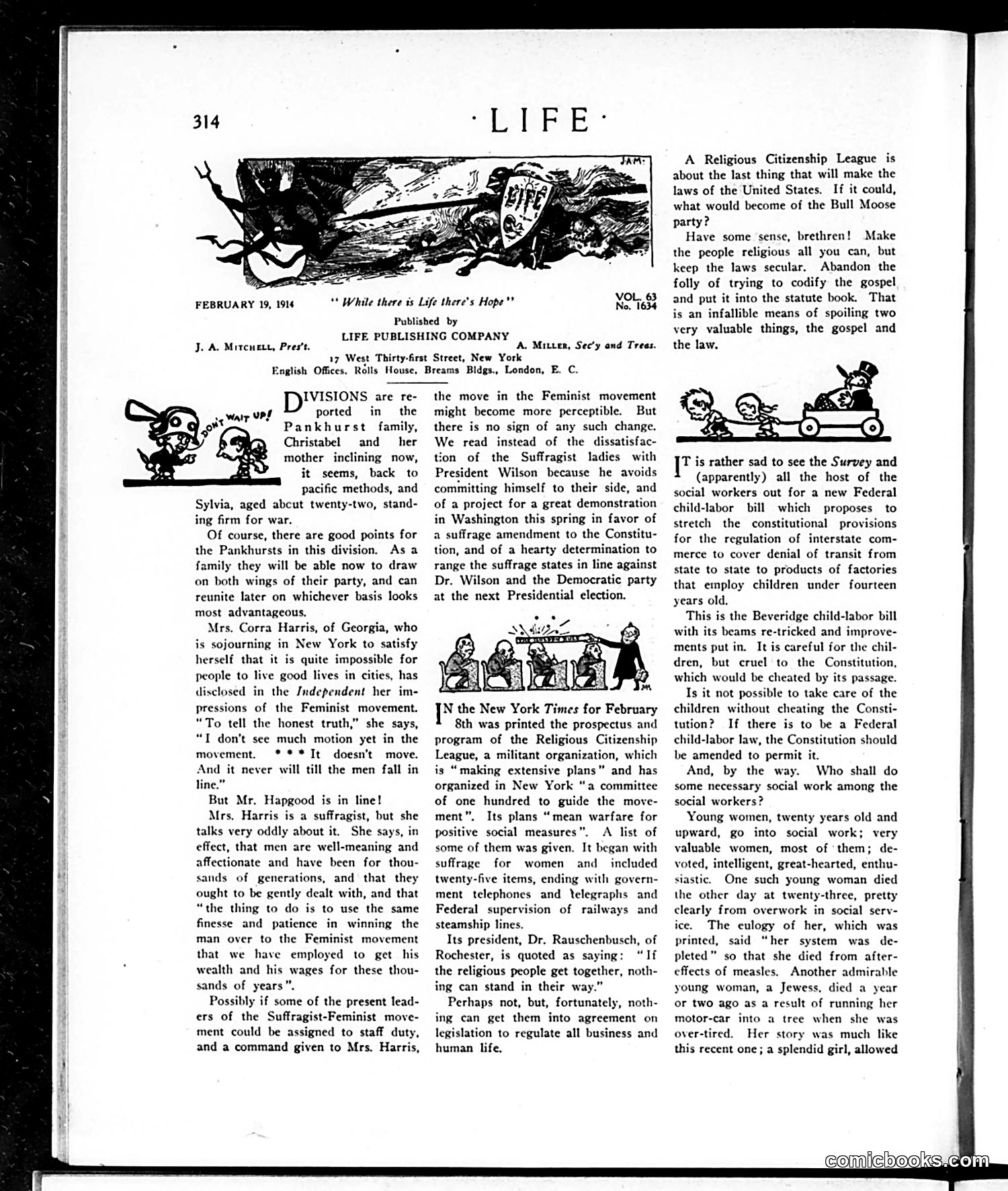
This page contains satirical commentary on early 20th-century progressive movements, particularly feminism and religious activism. **Main Cartoon (top):** A skeletal figure labeled "LIFE" sits with a shield, illustrating the magazine's title motto "While there is Life there's Hope." **Key Satire Targets:** 1. **The Pankhurst Family Division:** The text mocks splits within the famous British suffragist family—Christabel and mother favoring "pacific methods" while younger Sylvia advocates "war" (militant tactics). 2. **The Religious Citizenship League:** Life ridicules this militant organization's ambitious agenda (25 planks from women's suffrage to government control of railways and telegraphs), sardonically warning: "If it could [make laws], what would become of the Bull Moose party?" The editor argues for secular laws, not gospel-based legislation. 3. **Feminist Movement Criticism:** Via Mrs. Corra Harris's quoted views, the magazine suggests feminists should use gentler "finesse" rather than confrontation. The overall tone dismisses these reform movements as either ineffectual or dangerously overreaching.
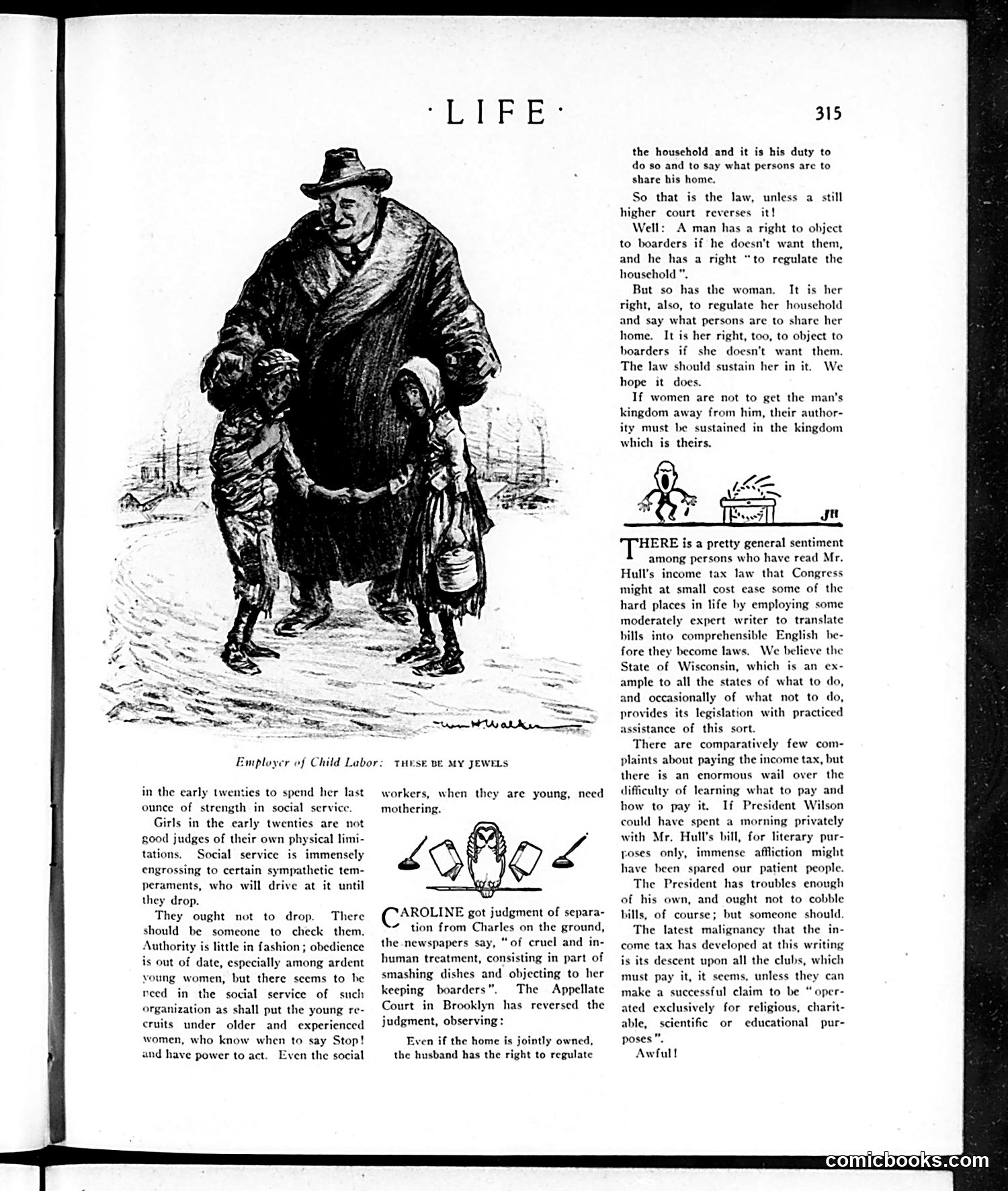
This page contains two distinct satirical pieces: **"Employer of Child Labor: These Be My Jewels"** (left illustration and accompanying text): The cartoon depicts an older man with children, sarcastically captioned "these be my jewels." The text criticizes the exploitation of young women in social service work. It argues that girls in their early twenties, though energetic and idealistic, lack judgment about their physical limits and need oversight from experienced older women to prevent burnout. The satire targets both the system that overworks young female social workers and society's lack of protective authority structures. **"Caroline" (right section):** This discusses a Brooklyn court case where a wife (Caroline) obtained a separation from her husband Charles for "cruel and inhuman treatment" that included his objecting to her keeping boarders. The appellate court reversed the decision, ruling the husband has authority to regulate the household. Life's editors sarcastically counter that if women deserve equal authority in their "kingdom" (the home), the law should sustain their right to object to boarders too. Both pieces critique gender inequality in early 20th-century law and social practice.
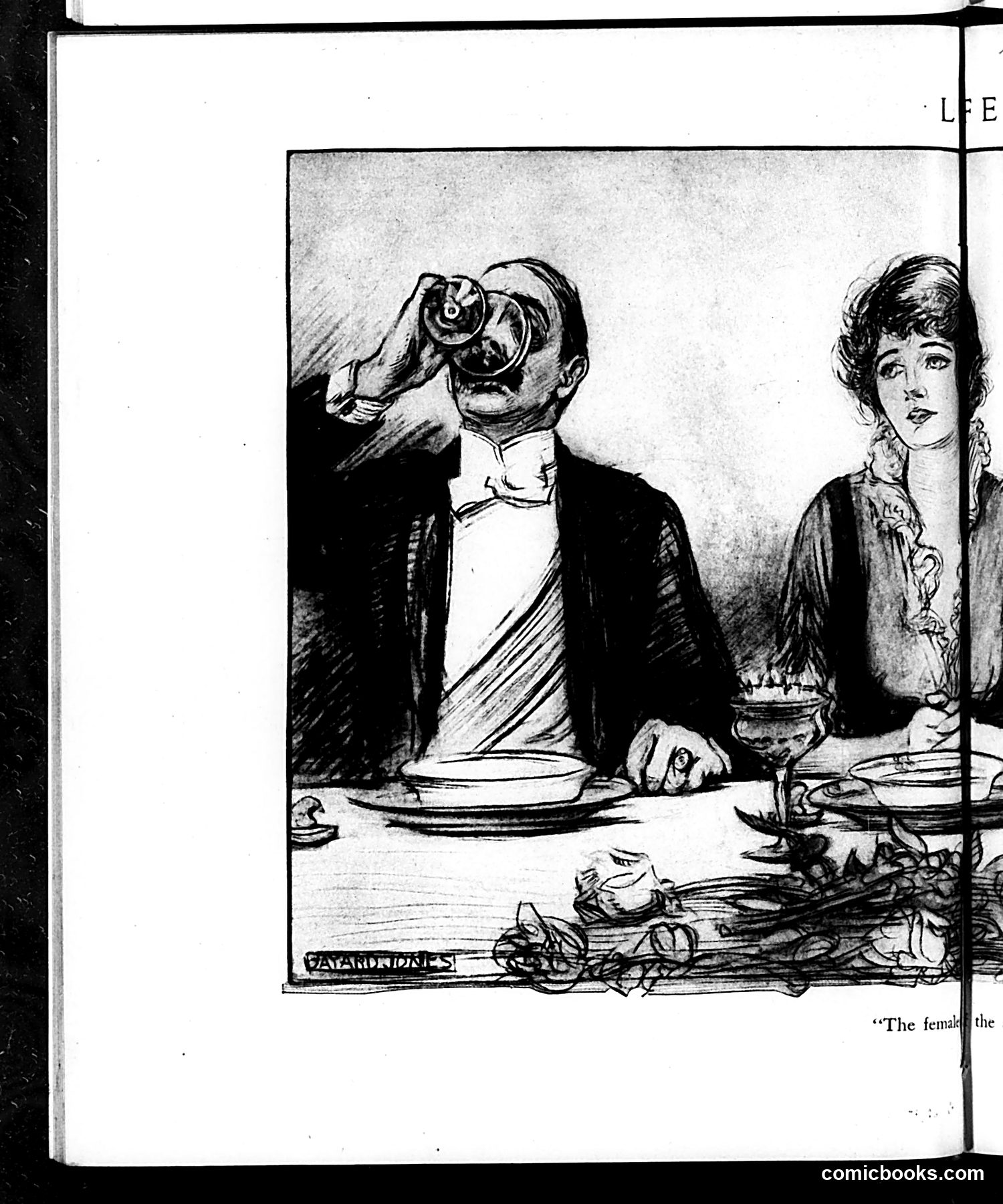
This appears to be a satirical illustration from *Life* magazine featuring a formal dinner scene. A man in evening dress holds opera glasses or binoculars to his face, seemingly distracted or pretending to observe something, while an elegantly dressed woman sits beside him at the dining table. The humorous point likely satirizes social pretense at high-society dinners—the man's absurd use of optical instruments at the table suggests he's either genuinely oblivious to proper etiquette, or deliberately performing indifference to his companion. The illustration's style and the partial caption beginning "The female the" suggest commentary on gender dynamics or courtship behavior among the wealthy. Without the complete caption text, the exact satirical target remains somewhat unclear, though it appears to mock either male boorishness or the theatrical nature of upper-class socializing.
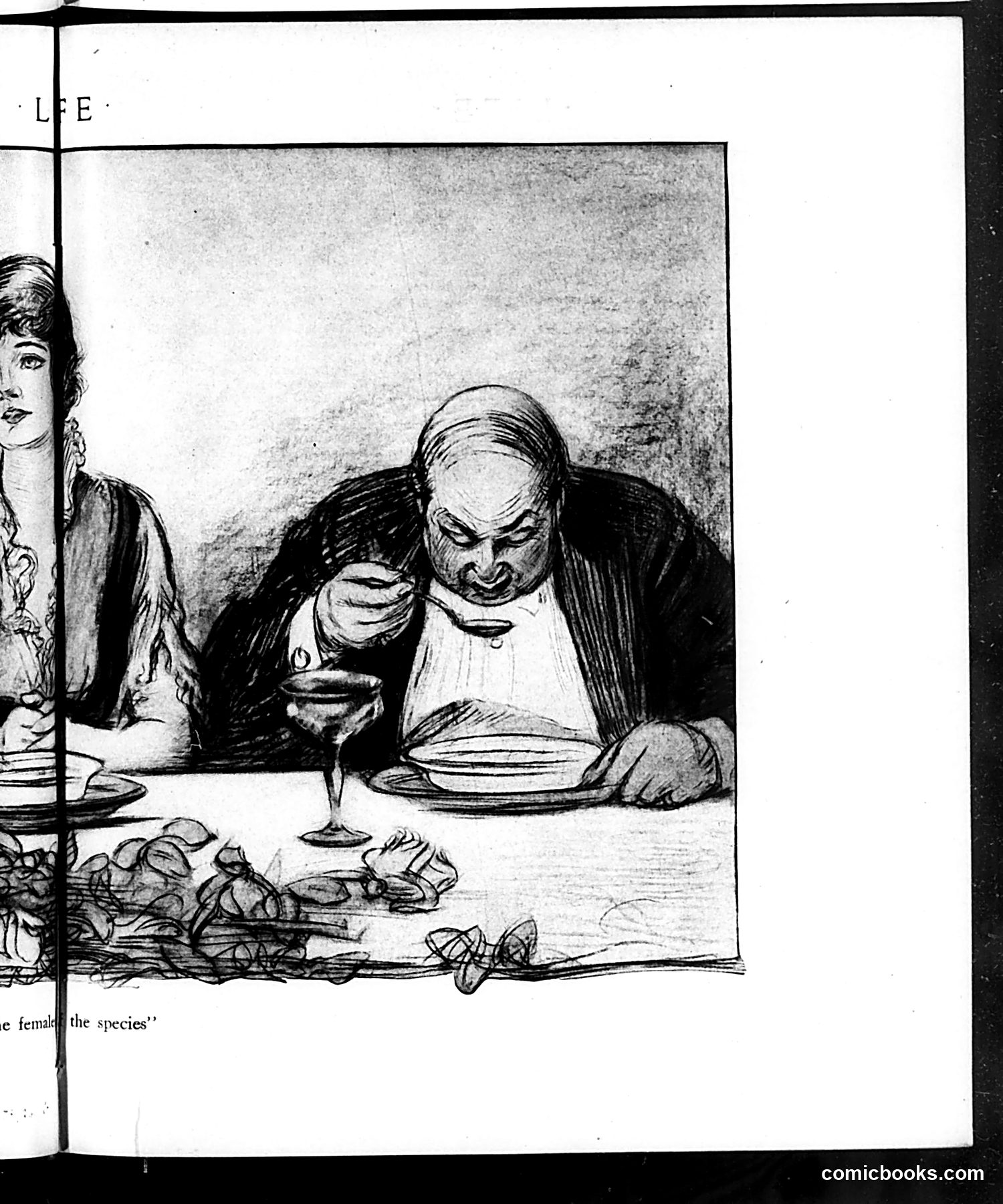
This appears to be a satirical illustration from *Life* magazine depicting a dining scene. A woman watches as a rotund, balding man leans over his plate with utensils, examining food closely with an exaggerated expression of scrutiny or distaste. The scattered food debris on the table suggests messy eating habits. The partial text visible ("the female the species") likely references Rudyard Kipling's 1888 poem "The Female of the Species," which argues women are more dangerous than men. The cartoon appears to satirize male behavior or dining etiquette—possibly mocking masculine pretension, poor table manners, or hypocrisy regarding female conduct. Without fuller context or caption, the specific social critique remains unclear, though the gender commentary seems central to the satire.
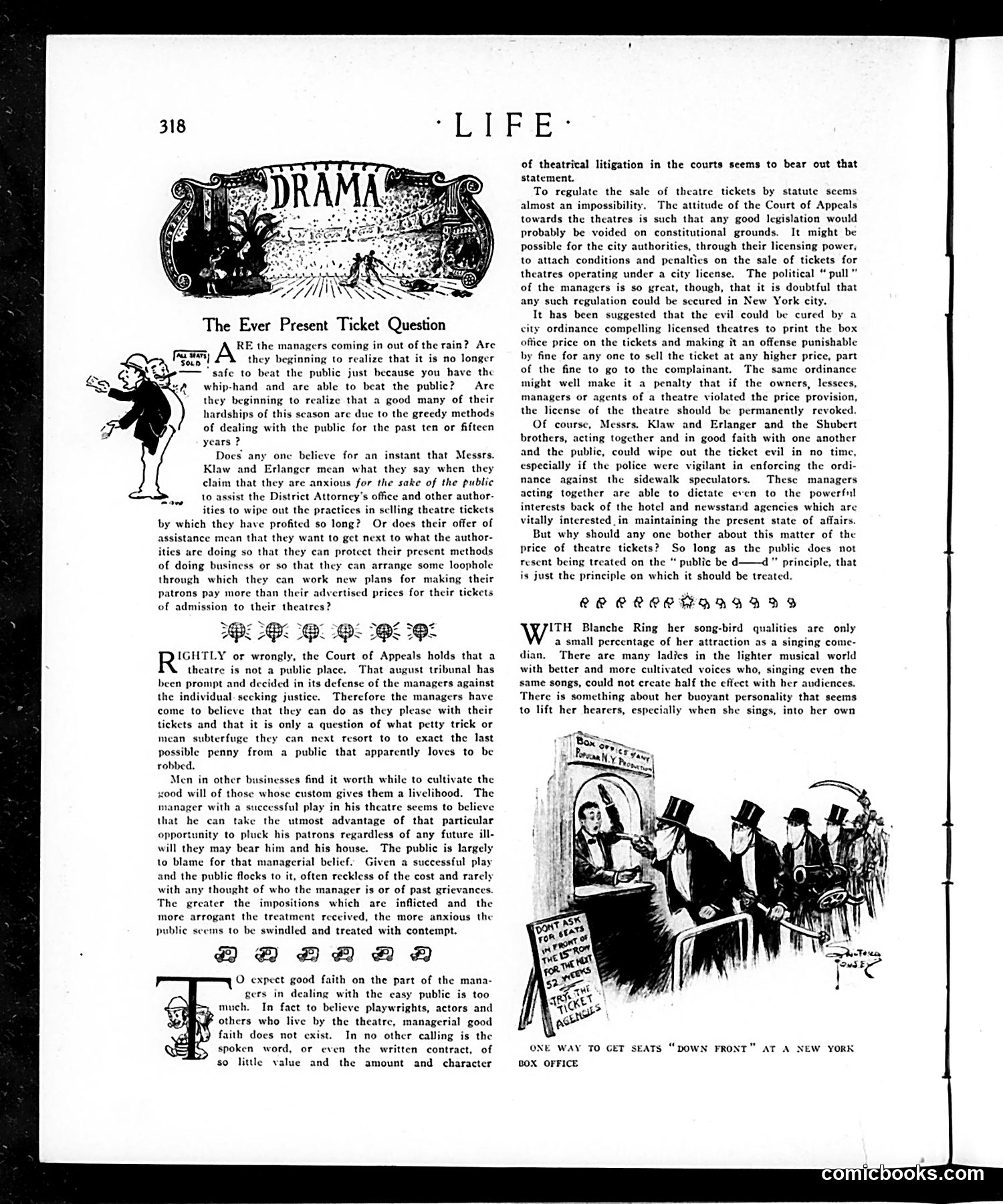
This article satirizes **theater managers Klaw and Erlanger**, who controlled Broadway ticket distribution in the early 1900s. The piece accuses them of price-gouging and scalping schemes—charging patrons far more than advertised prices for "front row" seats. The accompanying cartoon shows the actual mechanism: scalpers operating outside box offices with signs advertising inflated prices, while well-dressed theatergoers queue inside. The satire's point: Klaw and Erlanger claim to help authorities stop these practices "for the public good," but the author sardonically doubts their sincerity—suggesting they merely want to protect their own profitable ticket-manipulation schemes. The article argues theaters treat customers with contempt because successful plays guarantee attendance regardless of price-gouging. It proposes (pessimistically) that city ordinances requiring printed box-office prices could help, but doubts the managers' political influence would allow it. The underlying complaint: **theatrical monopolists exploiting captive audiences**.
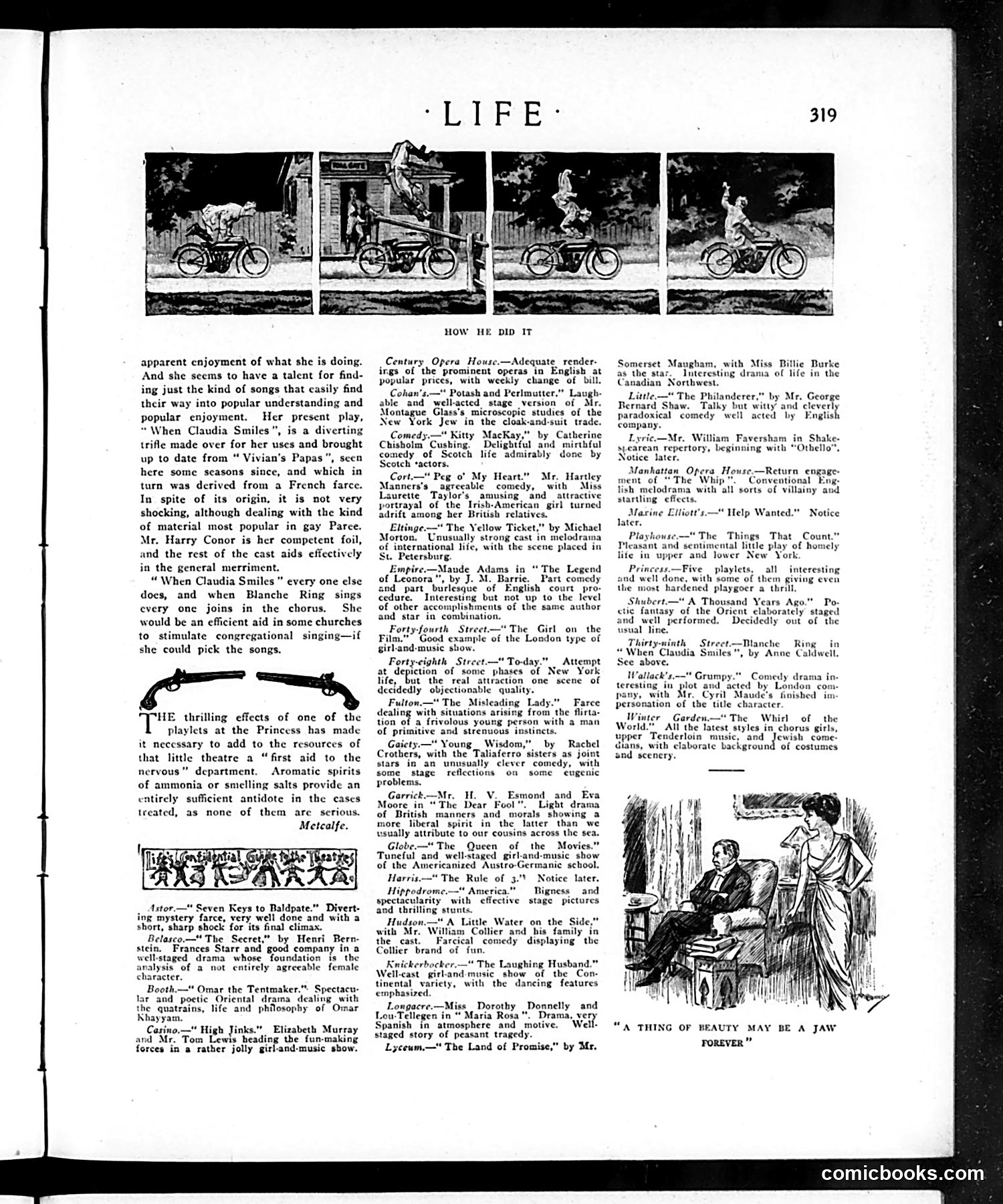
This page consists primarily of theater reviews for Broadway productions, with four small photographs at the top showing "HOW HE DID IT"—apparently a sequence of a man performing a stunt on a motorcycle (standing on the seat while riding). The main content is a critical review of actress **Blanche Ring** and her current play "When Claudia Smiles." The reviewer praises her talent for selecting popular songs and her engaging stage presence, noting she effectively draws audiences into the chorus numbers. The text humorously suggests she could improve church congregational singing if given the chance to select hymns. Below are brief reviews of other Broadway shows including "Seven Keys to Baldpate," "Omar the Tentmaker," and "High Jinks," along with extended listings of current productions at various theaters with plot summaries and cast information. The bottom right contains an illustration with the caption **"A THING OF BEAUTY MAY BE A JAW FOREVER"**—likely a humorous visual gag, though details are unclear from the reproduction.
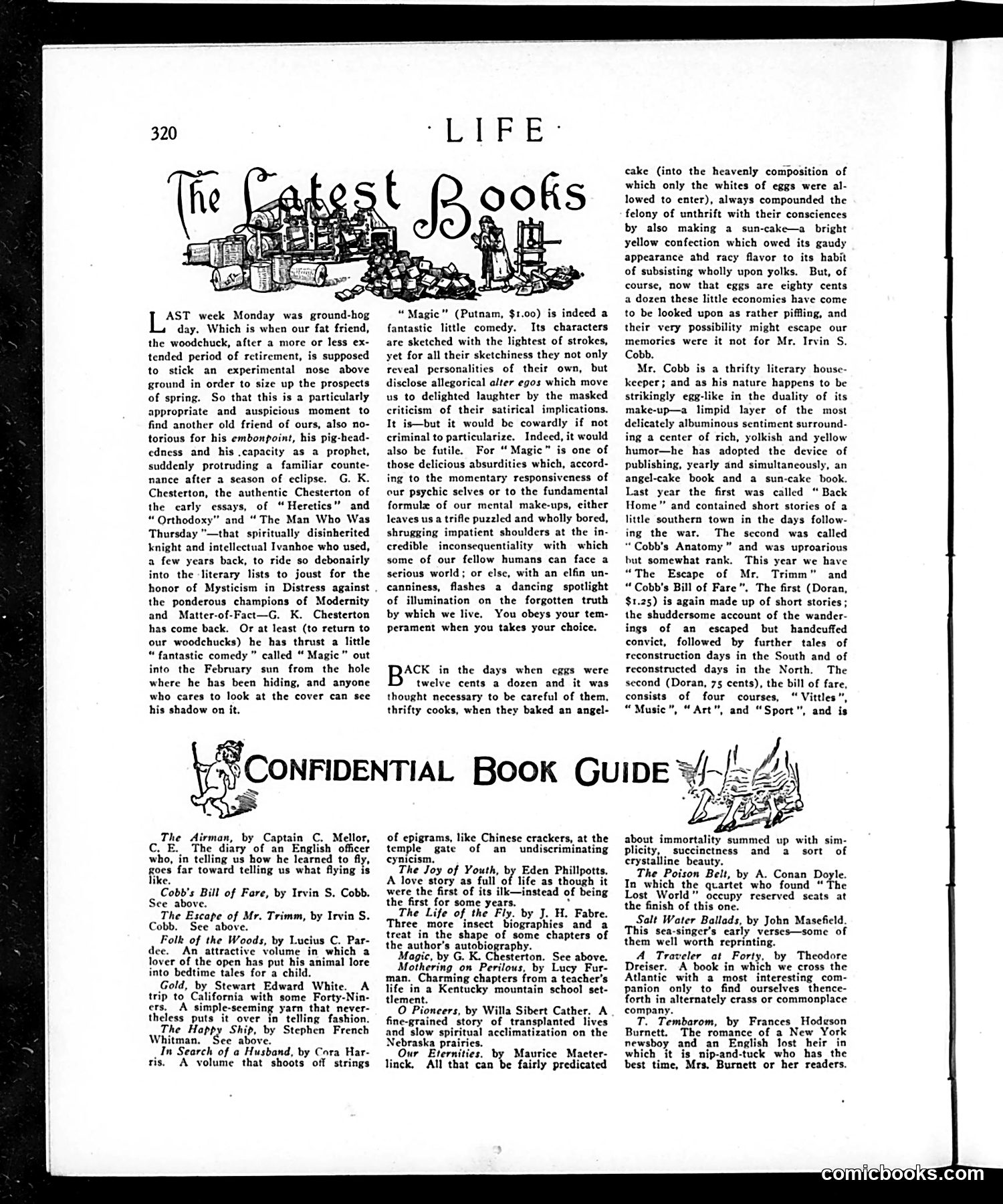
This page features **book reviews** rather than political cartoons. The main content discusses G.K. Chesterton's return to publishing with a play called *Magic* after a period of absence—humorously compared to a groundhog emerging on Groundhog Day. The review praises Chesterton's allegorical comedy for its wit and satirical implications, though the critic deliberately avoids spoiling details. The tone is playful, describing how the work's meaning depends entirely on the reader's temperament and "psychic responsiveness." Below is a "Confidential Book Guide" listing twelve other recent publications with brief descriptions—mostly adventure novels, memoirs, and nature writing typical of the era. There are **no political cartoons visible** on this page. It's a standard literary review section aimed at Life's educated readership, showcasing Chesterton's intellectual reputation among American intellectuals of the period.
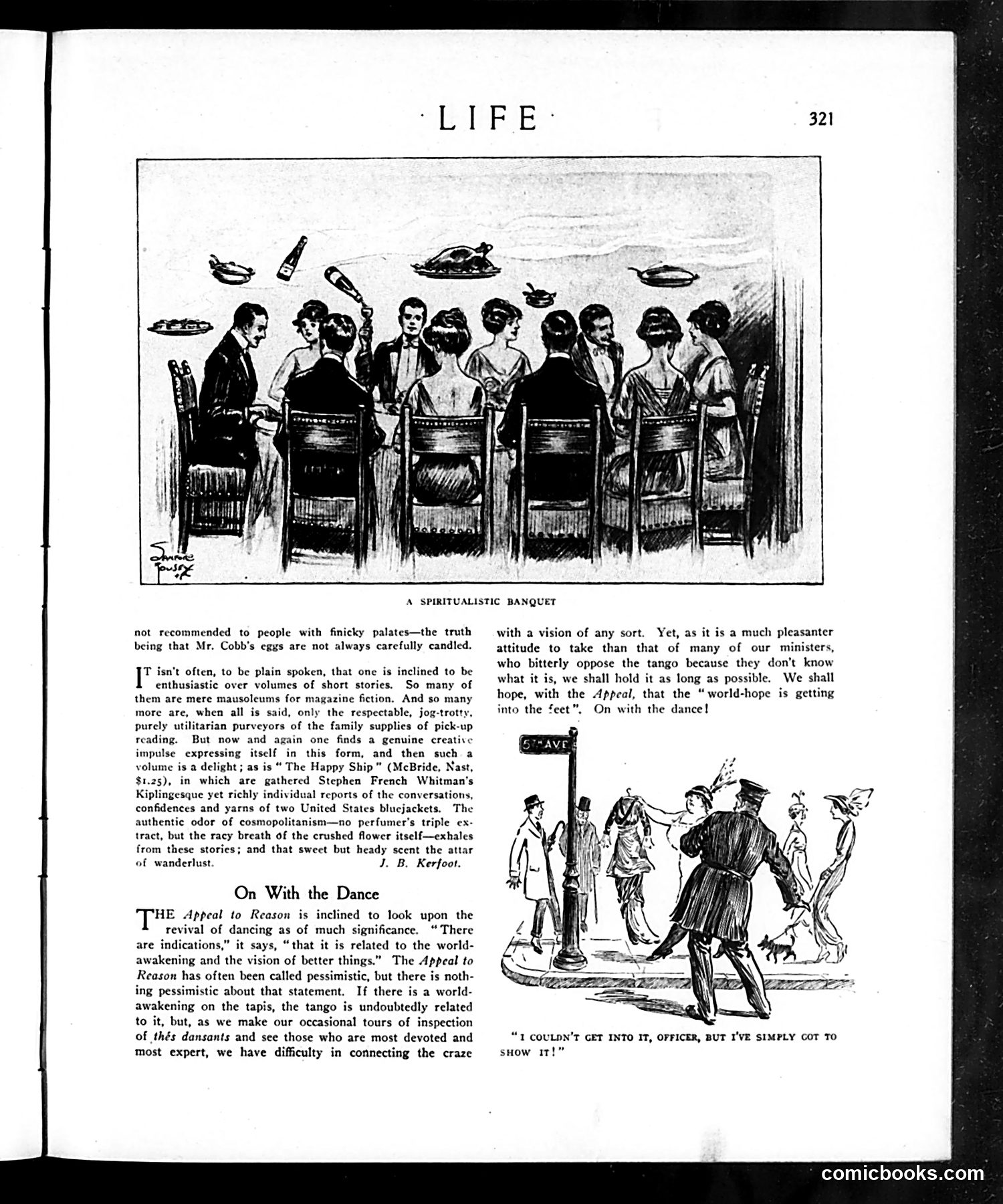
The top cartoon, "A Spiritualistic Banquet," depicts a séance—people seated around a table attempting to contact the dead. The joke references Mr. Cobb's eggs being "not always carefully candled" (inspected for quality), suggesting the "spirits" summoned at such gatherings are as dubious and poorly vetted as suspect food. The page's second section discusses the tango craze. The text humorously notes that *Appeal to Reason* (a socialist publication) sees the dance revival as connected to social "world-awakening," but Life's editors doubt this connection—they see it as frivolous entertainment rather than meaningful social progress. They prefer this optimistic view to ministers' moral opposition to the tango (which was considered scandalously sensual at the time). The bottom cartoon shows a woman telling a police officer she "simply got to show it"—likely referencing the irresistible urge to display the latest dance moves, satirizing the era's dance obsession.
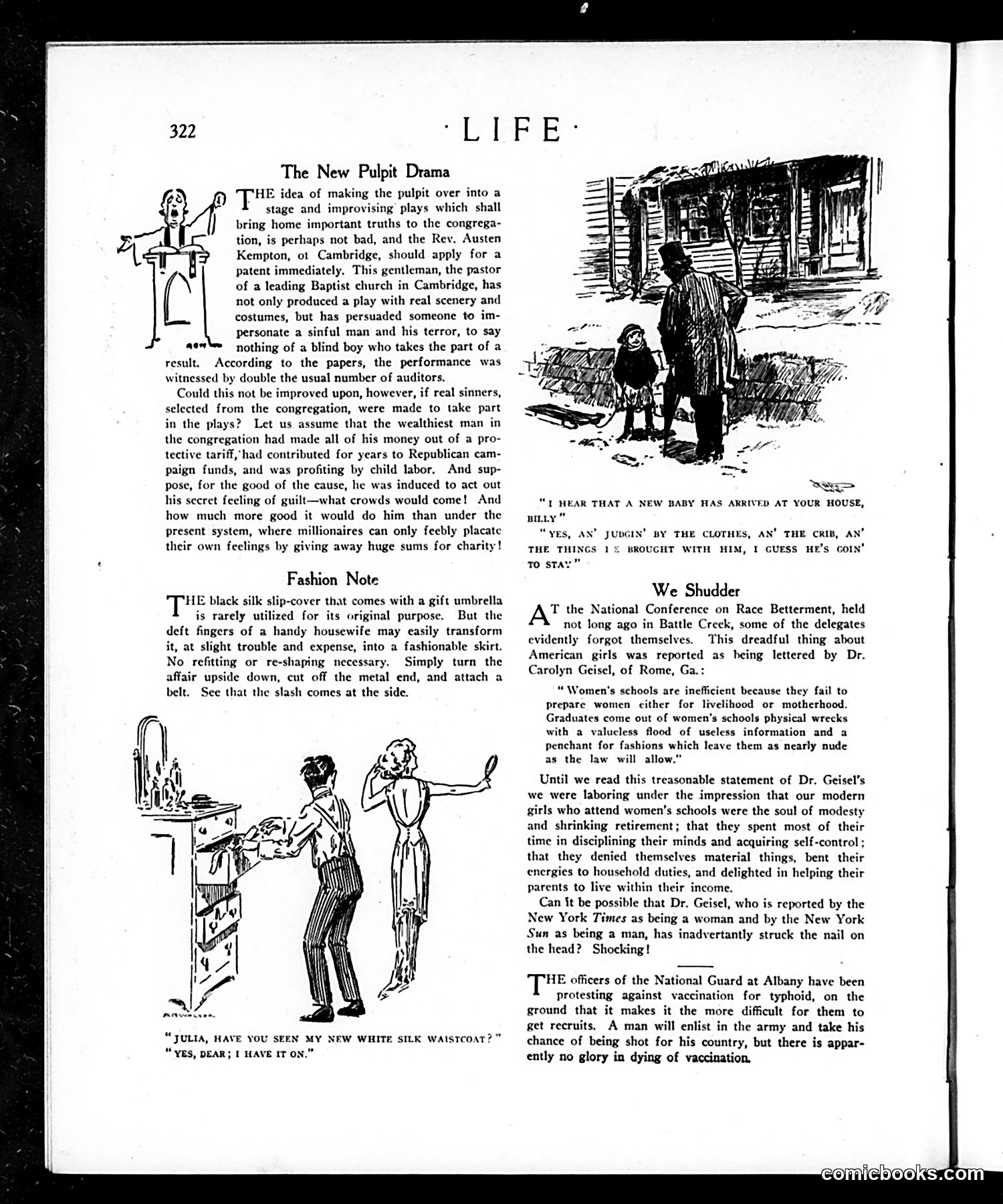
**The New Pulpit Drama** mocks a Cambridge Baptist minister's theatrical church productions. Life's satire suggests the real moral impact would come from forcing *wealthy congregation members*—specifically a tariff-profiteering millionaire who funds Republican campaigns and exploits child labor—to publicly dramatize their own guilt. The implicit critique targets: wealthy philanthropists who assuage guilt through charitable donations rather than ethical business practices, and the hypocrisy of churches entertaining rather than genuinely confronting congregants' sins. **Fashion Note** is a practical household tip disguised as satire about wartime resourcefulness, showing how to repurpose an umbrella slip-cover into a skirt. **We Shudder** responds to Dr. Carolyn Geisel's statement at a "Race Betterment" conference criticizing women's education. Life sarcastically attacks the absurdity of Geisel's claim that educated women become "nearly nude"—exposing how anti-women's education arguments rely on nonsensical moral panic rather than logic. **The Guard recruitment item** satirizes military recruitment logic: soldiers accept death in combat but resist typhoid vaccination.
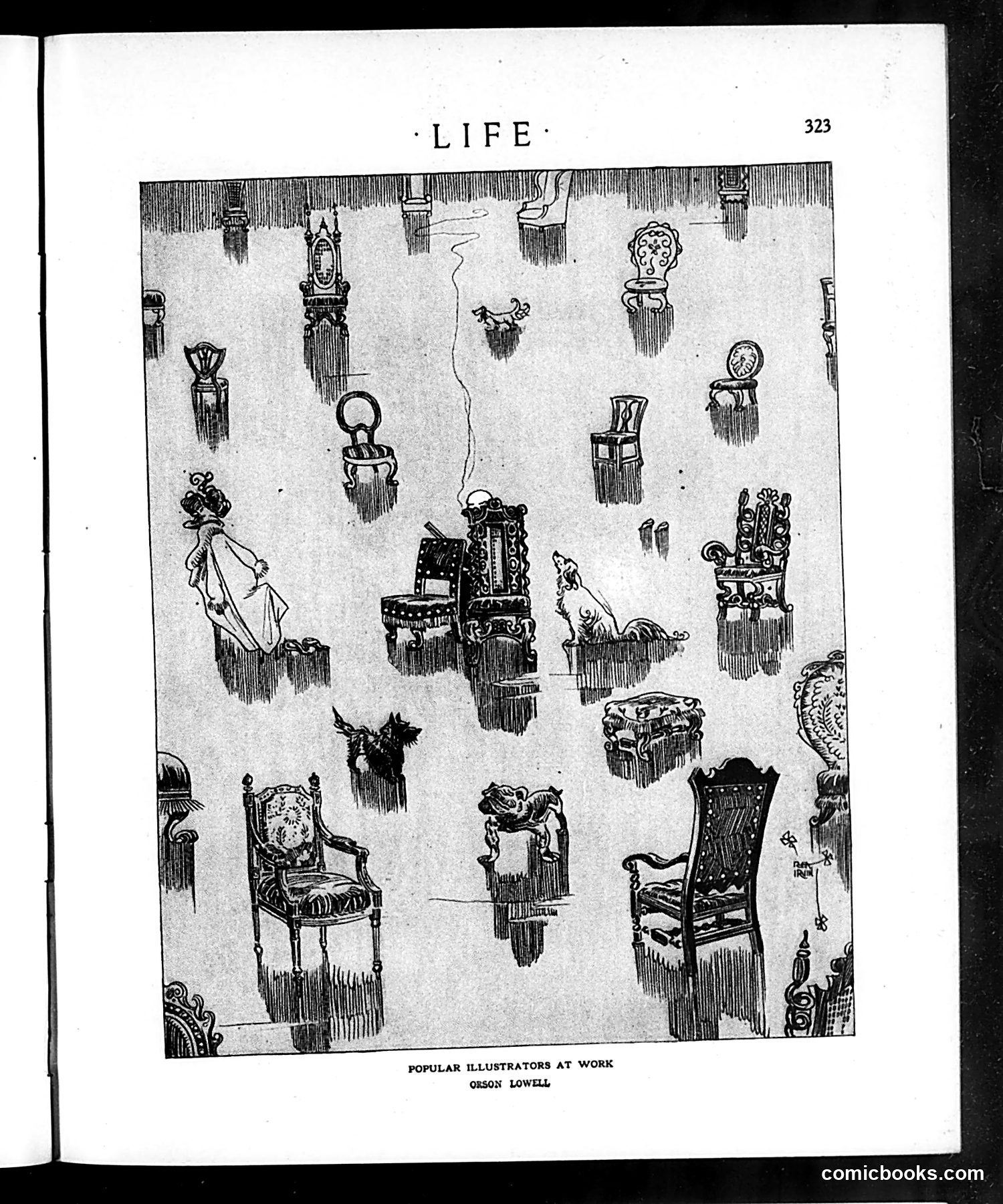
This page from *Life* magazine showcases "Popular Illustrators at Work" and credits artist **Orson Lowell**. The illustration is a satirical composition depicting various ornate furniture pieces, decorative objects, and sculptural elements scattered across a space—chairs with elaborate upholstery, busts, urns, and hanging ornaments. The satire likely targets **excessive decorative excess** or overwrought interior design aesthetics popular in the era. By crowding the composition with ostentatious objects, Lowell appears to mock the cluttered, ornamental style favored by wealthy or status-conscious consumers. The arrangement creates visual chaos, suggesting commentary on materialism, poor taste, or the absurdity of accumulating expensive but aesthetically questionable décor items. Without additional context or captions identifying specific figures, the critique remains focused on design pretension rather than specific individuals.
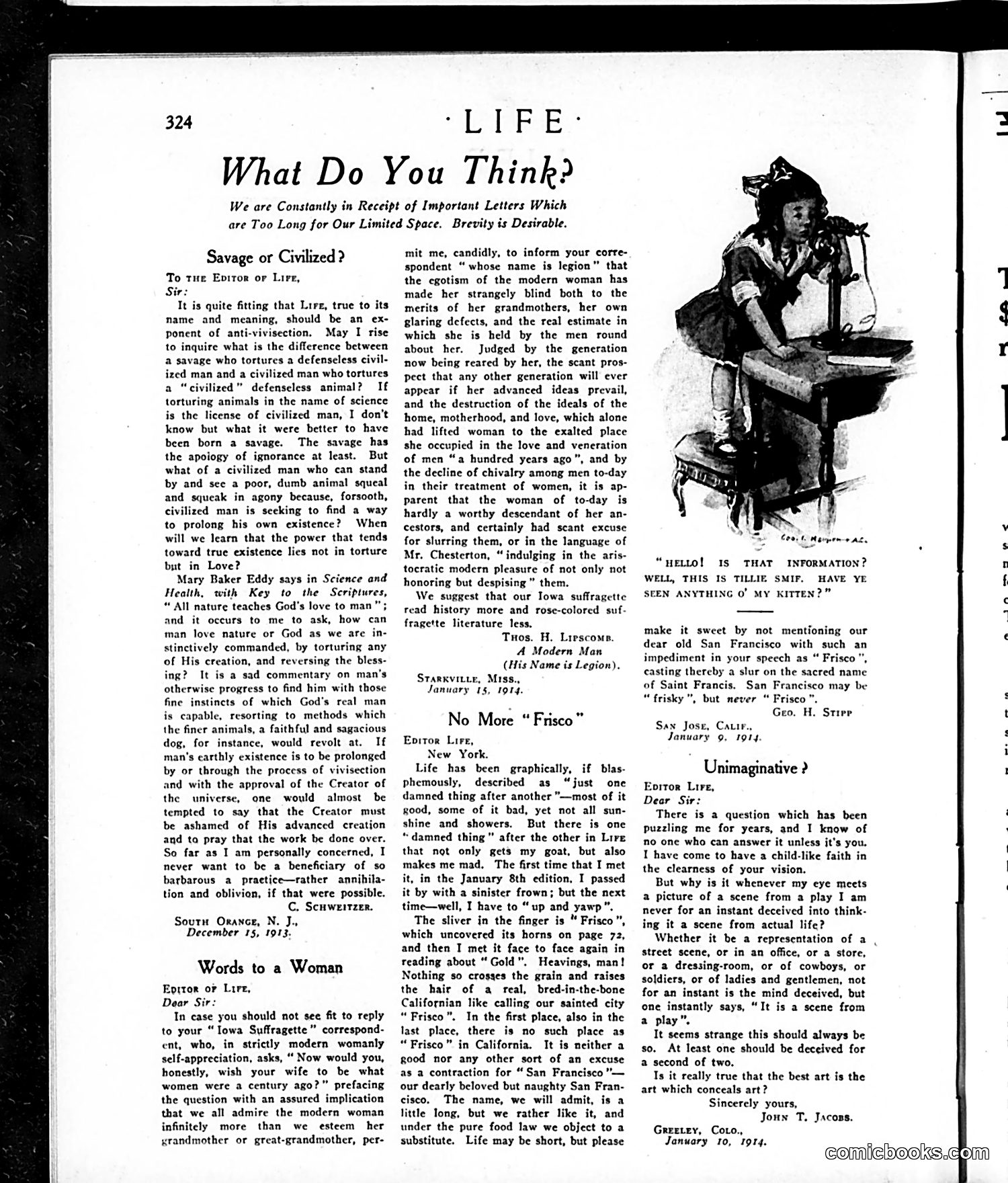
This page features the magazine's "What Do You Think?" letters column. The accompanying cartoon depicts a fashionably dressed woman (labeled "HELLO! IS THAT INFORMATION? WELL, THIS IS THEIR SNIP. HAVE YOU SEEN ANYTHING O' MY KITTEN?") engaging a young man in conversation. The satire targets debates over **women's changing roles in the Progressive Era**. Letters criticize both animal vivisection and modern women's "advancement." One correspondent argues the modern woman has become arrogant and ungrateful to her predecessors, claiming she's abandoning traditional domesticity (home, motherhood, love) and causing the decline of male chivalry. The cartoon's flirtatious woman represents the "New Woman"—educated, independent, socially forward—whom traditionalists viewed with suspicion. The satire mocks those resisting women's suffrage and modernization, portraying their nostalgia for the past as misguided while illustrating the generational conflict over women's evolving social position.
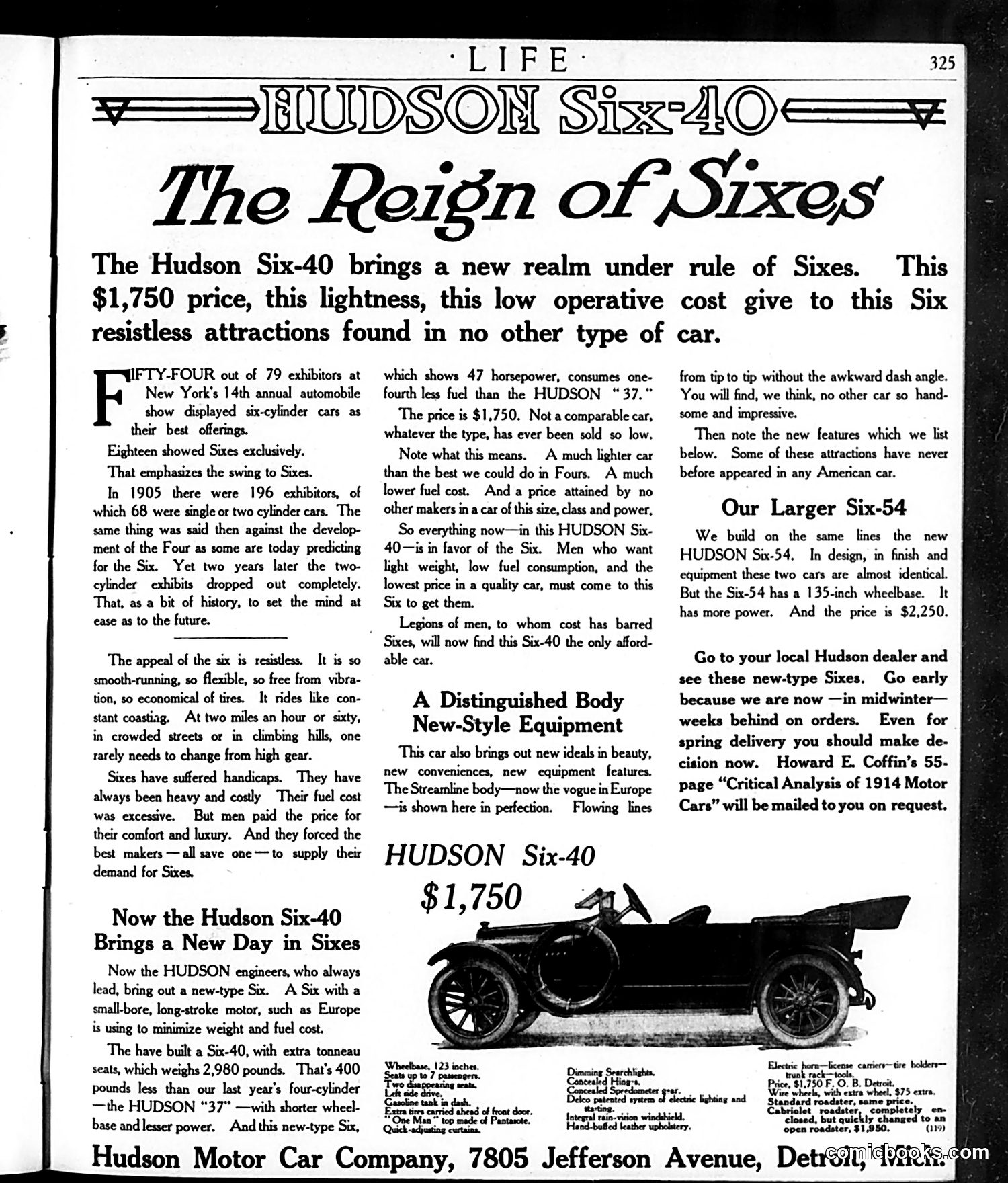
This is a **car advertisement**, not a cartoon or satire. It appeared in *Life* magazine's early automotive era (1914, based on internal references). The page promotes Hudson's new Six-40 automobile, emphasizing its revolutionary affordability and efficiency. The text argues that six-cylinder cars were once luxury items, but Hudson has democratized them through engineering innovation—a lighter engine design borrowed from European models reduces fuel consumption and weight while maintaining power. The "satire" is implicit: the ad mocks historical skepticism toward automotive innovation. It notes that in 1905, critics dismissed the four-cylinder engine the same way some now dismiss the six. The message: Hudson's engineers (led by Howard E. Coffin) have solved what competitors couldn't—delivering six-cylinder luxury at a four-cylinder price ($1,750). For modern readers, this reflects early 20th-century automotive competition and marketing claims that innovations make premium features accessible to ordinary consumers.
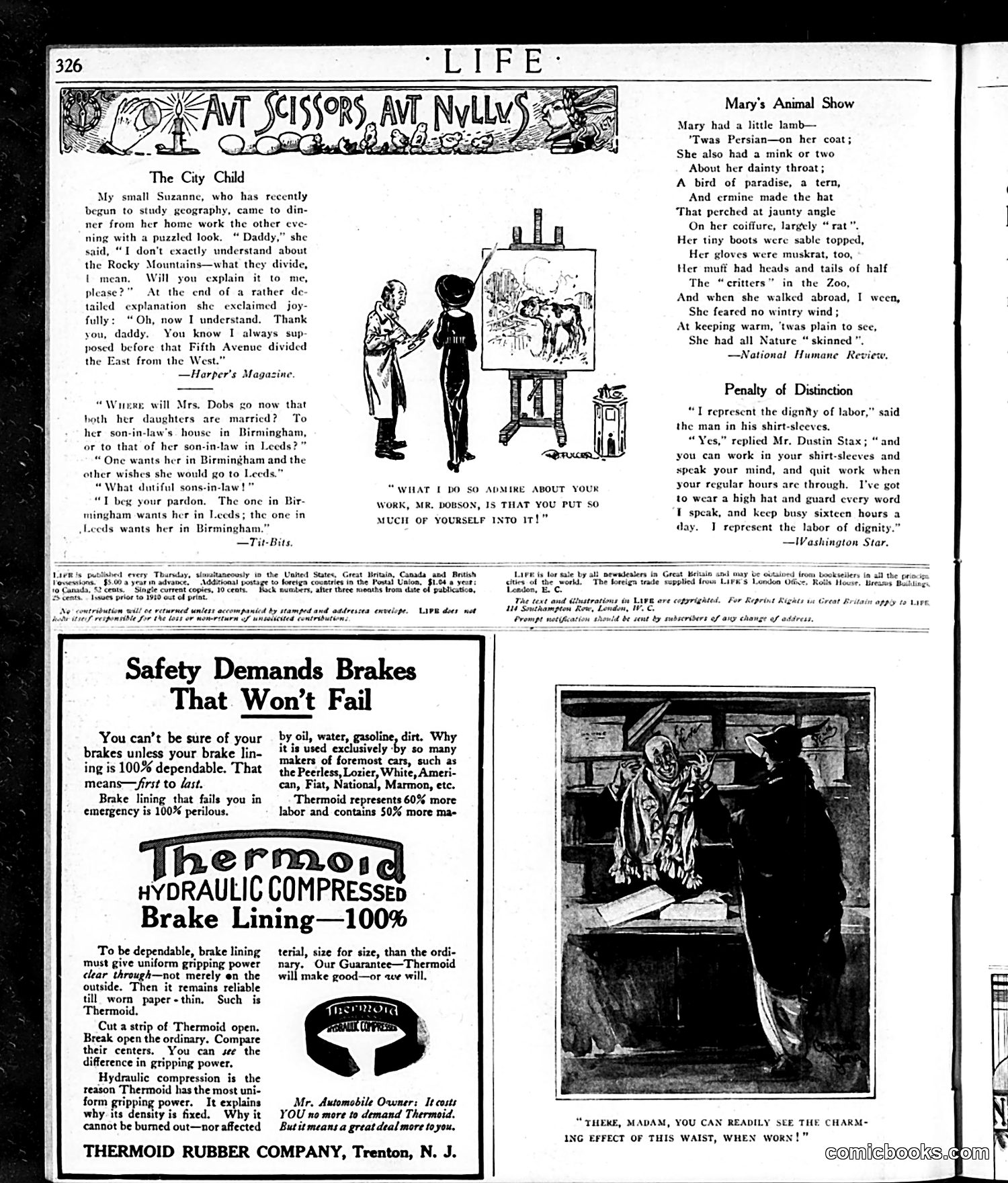
This page contains **light satirical humor** typical of early 20th-century Life magazine—social observation rather than hard political commentary. **"The City Child"** jokes about urban children's detachment from geography: a girl understands the Rocky Mountains only when her father compares them to Fifth Avenue, suggesting privileged city kids know only their own neighborhoods. **"Mary's Animal Show"** satirizes the Edwardian fashion for elaborate fur garments. The poem catalogs a fashionable woman covered in exotic furs (Persian lamb, mink, ermine, sable) and jokes that she's so thoroughly adorned with animal skins that Nature itself is "skinned"—a subtle jab at both wasteful consumption and animal welfare (note the attribution to the *National Humane Review*). **"Penalty of Distinction"** inverts class expectations: a dignified laborer in shirtsleeves enjoys freedom of speech and movement, while a wealthy businessman (wearing a top hat) is imprisoned by social obligation and must work sixteen-hour days. The **Thermoid brake advertisement** is unrelated commercial content. Overall: gentle mockery of city manners, fashion excess, and class pretense.
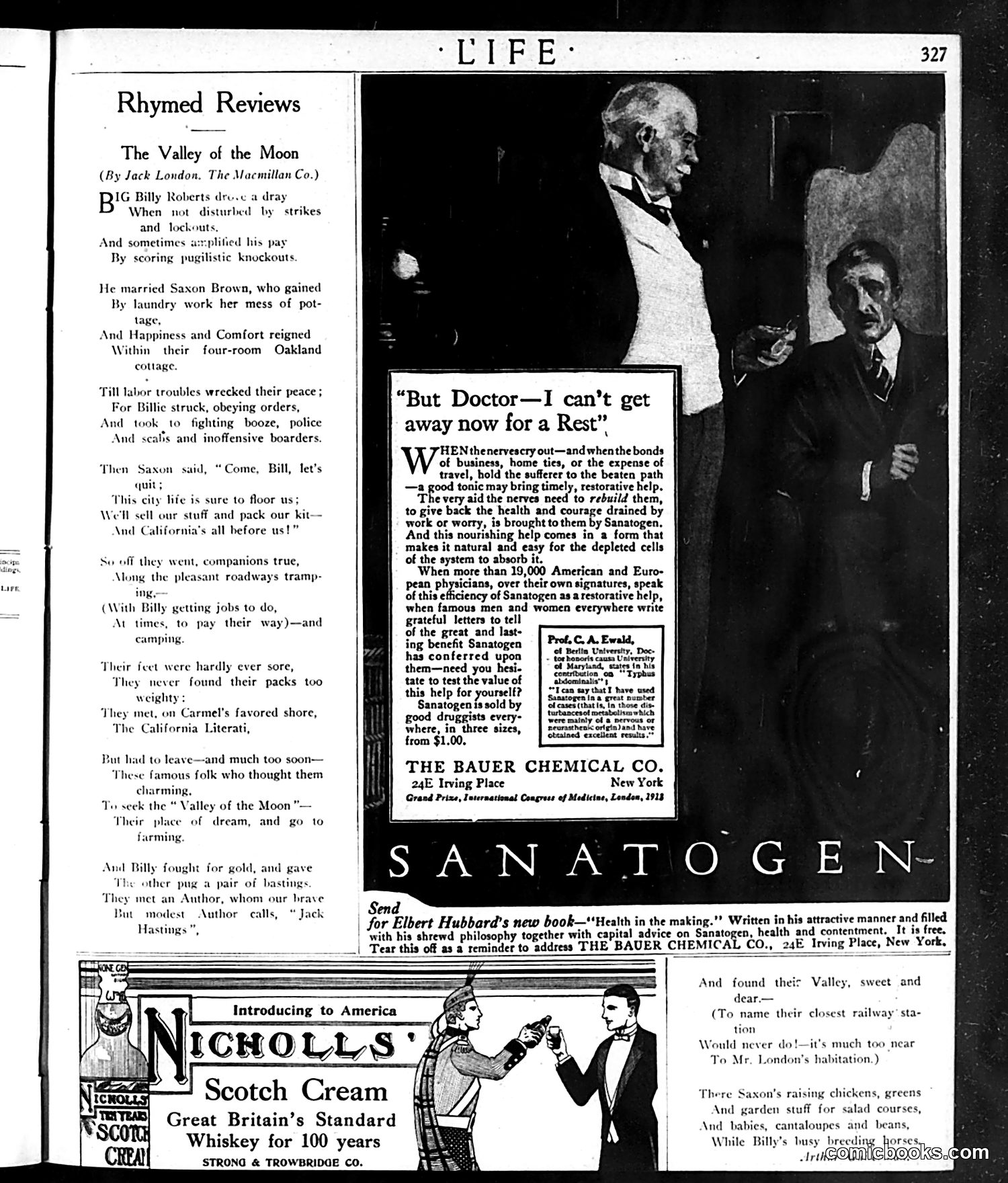
This page reviews Jack London's novel "The Valley of the Moon" (1913) in verse form. The review summarizes the plot: Billy Roberts, a laborer plagued by strikes and lockouts, and his wife Saxon decide to abandon urban life in Oakland and seek farming in California's Valley of the Moon region, eventually finding contentment. The satire is gentle, mocking the romantic fantasy of escaping industrial troubles through pastoral retreat. The verse humorously chronicles their journey from city struggle to rural simplicity—Billy's boxing work, Saxon's laundry labor, and their ultimate success farming and raising livestock. The page is dominated by **advertisements**, particularly for Sanatogen (a tonic/restorative marketed to depleted nerves), Nicholls Scotch Cream whiskey, and other products. These ads are unrelated to the book review. The cartoon image shows two figures (appears to be a doctor and patient), supporting the Sanatogen advertisement's "I can't get away now for a Rest" tagline—illustrating the marketed problem the tonic supposedly solves.
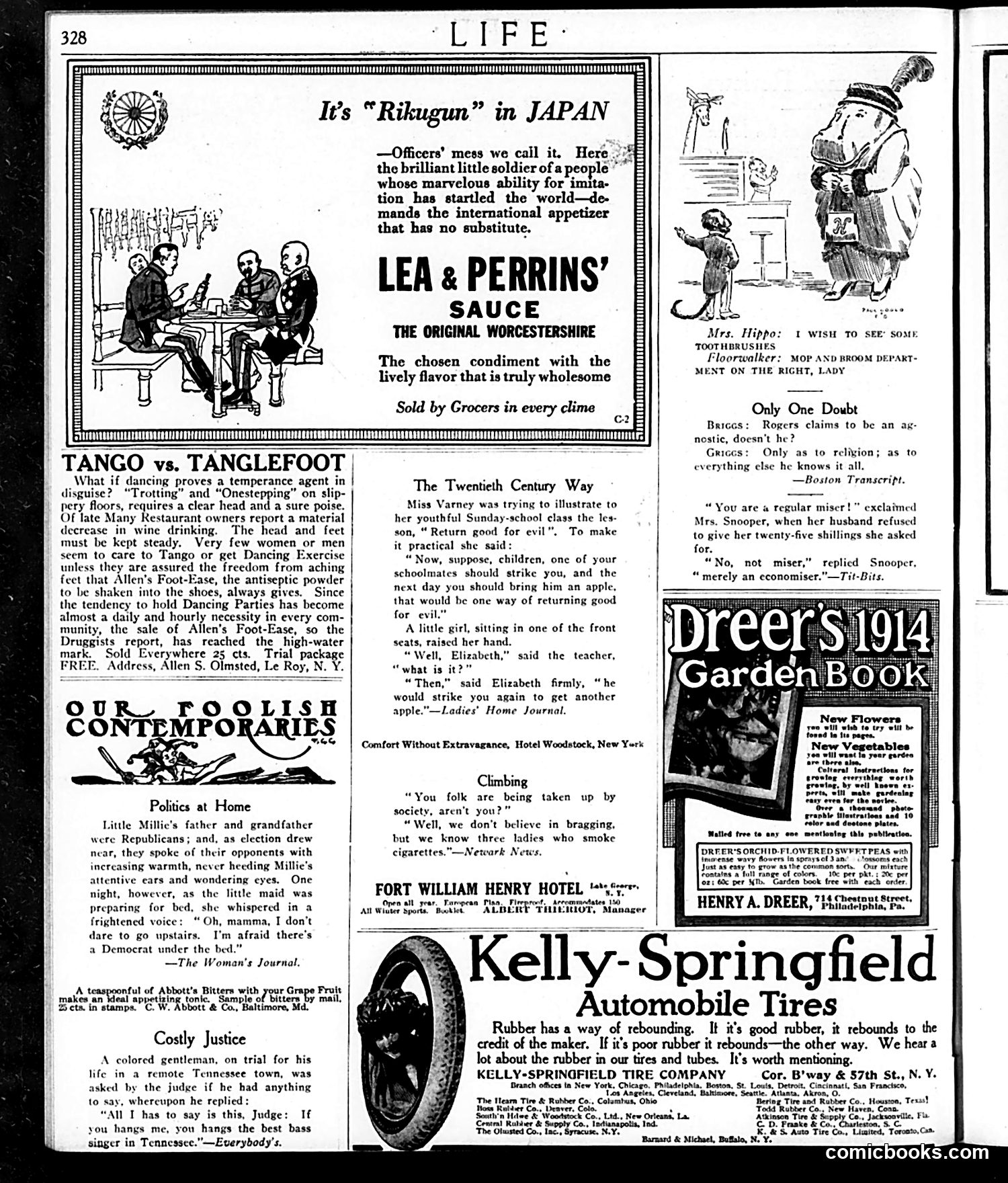
This page is primarily **advertising mixed with brief humor pieces**, typical of Life's format. Key content: **"Tango vs. Tanglefoot"**: A joke-advertisement suggesting the tango dance craze (popular in the 1910s) reduces alcohol consumption because dancing requires sobriety and steady feet. It promotes Allen's Foot-Ease powder, claiming restaurants report decreased wine sales as patrons prefer dancing to drinking. **"Politics at Home"**: A brief anecdote mocking partisan political fervor—a Republican child, overhearing heated election-year attacks on Democrats, becomes afraid a Democrat is hiding under her bed. The satire targets adults' excessive political rhetoric alarming children. **"The Twentieth Century Way"**: A Sunday school lesson backfires when teaching "return good for evil"—a student points out that if you return kindness after being struck, the striker will simply hit you again for another reward. It's satirical commentary on naive morality. **"Costly Justice"**: A dark racial humor piece about a Black defendant arguing his execution would be wasteful because he's a good singer. The page also contains period advertisements (Lea & Perrins sauce, Kelly-Springfield tires, Dreer's Garden Book).
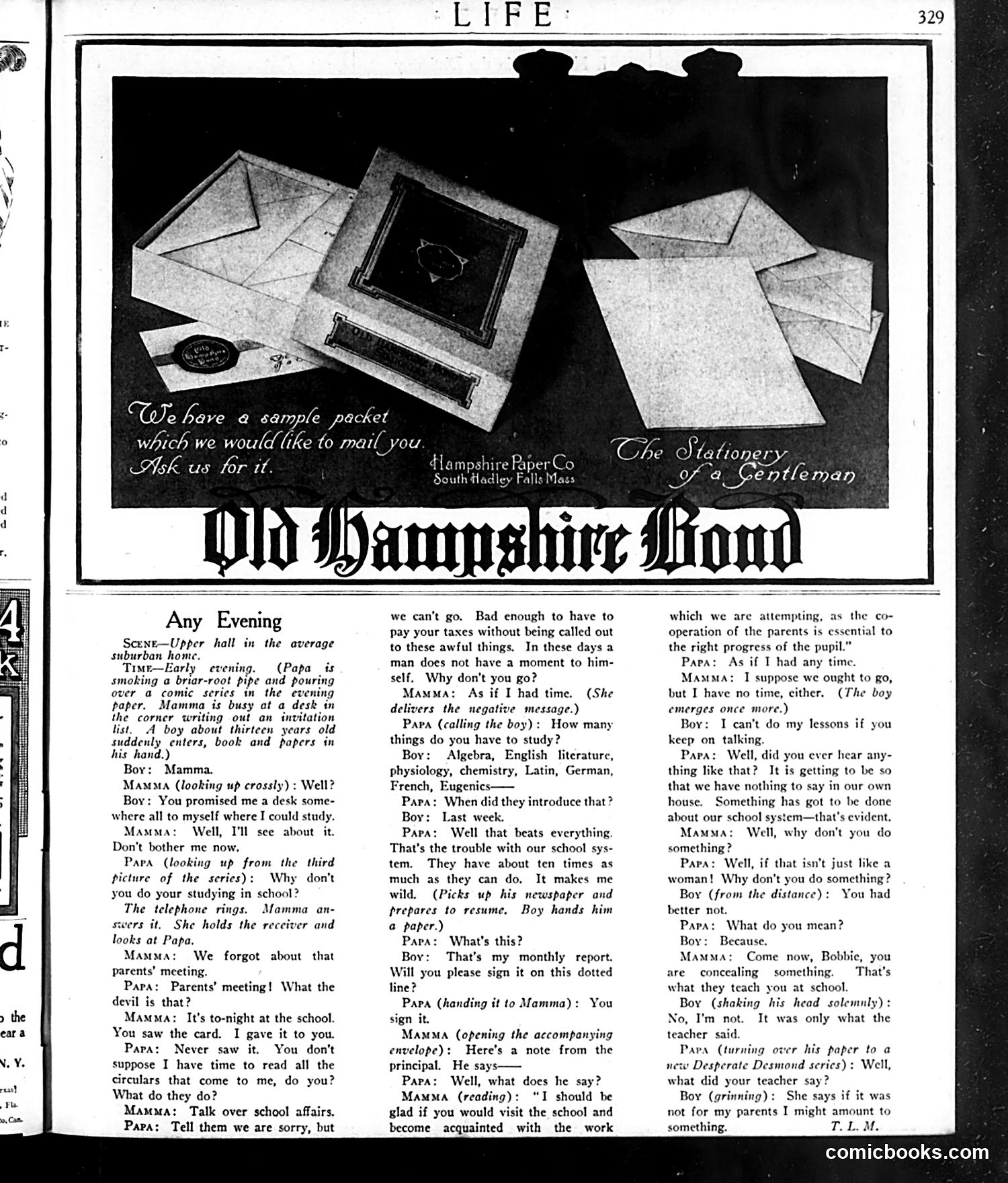
This is a domestic comedy sketch satirizing middle-class parents who neglect their son's education while blaming the school system. **The Setup:** A teenage boy seeks a quiet study space; his parents are too busy (father reading comics, mother organizing social events) to help. When summoned to a parents' meeting at school, both refuse to attend—the father claims no time, the mother agrees. **The Satire's Point:** The parents criticize the school for overloading students, yet take no responsibility themselves. When the boy mentions his teacher said he'd amount to something "if it was not for my parents," they're shocked—but the irony is obvious to readers: the parents' indifference is exactly the problem they complained about. **Social Context:** This reflects early 20th-century anxieties about education, parental involvement, and the new subject "Eugenics" (mentioned as recently added to curriculum—a sign of the era's pseudoscience). The advertisement above promotes quality stationery as "the stationery of a gentleman"—contrasting refined, literate values with the parents' dismissive attitude toward learning.
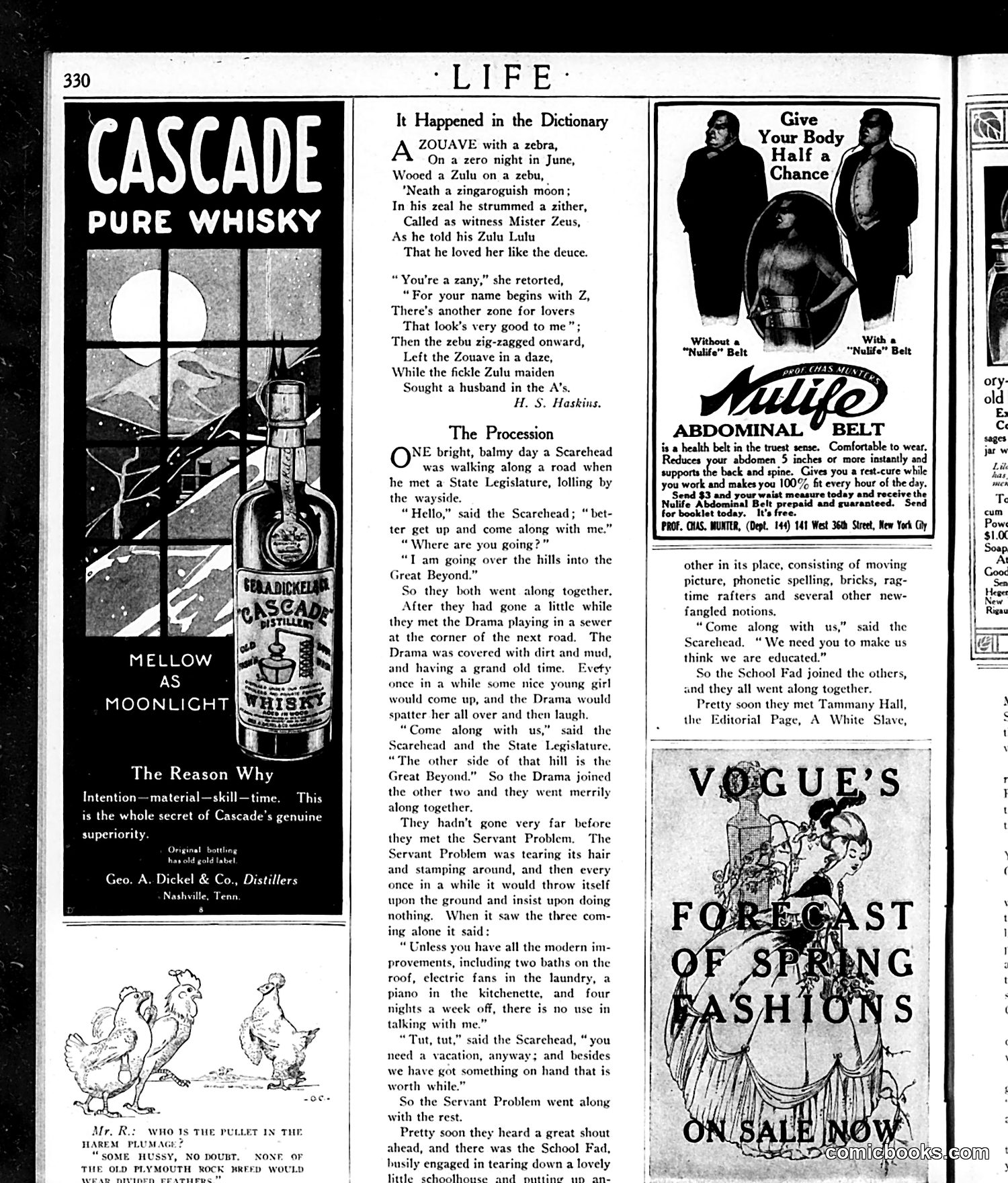
This piece is a personified allegory where abstract social issues are depicted as characters journeying toward "the Great Beyond." The Scarehead (sensationalist journalism) recruits: the Drama (theatrical entertainment, shown degraded in a sewer); the Servant Problem (labor shortage and domestic worker unrest, demanding modern amenities); and the School Fad (educational trends destroying traditional schoolhouses in favor of trendy innovations like "phonetic spelling" and "ragtime"). The satire mocks early 20th-century American anxieties: yellow journalism's role in social decay, theatrical frivolity, servants' rising demands for modern conveniences and time off, and progressive educational reforms viewed as faddish destruction of established institutions. The procession symbolizes how these forces collectively lead society toward doom. The final mention of "Tammany Hall" and "The Editorial Page" suggests political corruption and press complicity round out the critique.
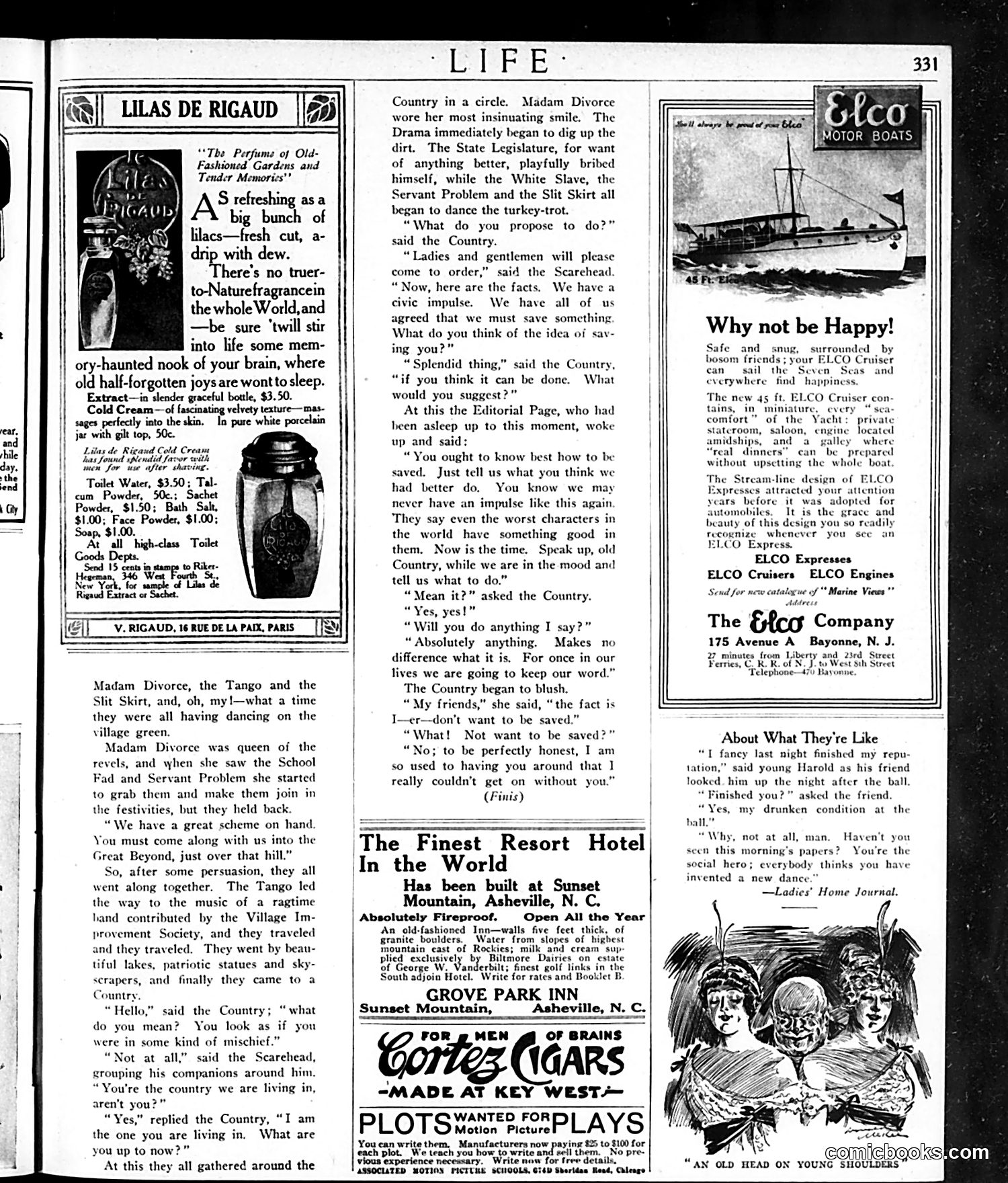
This satirical story—the main text content—is an allegorical critique of American civic reform movements around the early 1900s. **The figures:** Personified concepts including "Madam Divorce" (social dissolution), "The Tango" and "Slit Skirt" (modern moral threats), "School Fad," "Servant Problem," "White Slave" (social issues), "Scarehead" (sensationalist journalism), and "Editorial Page" (editorial moralizing) all approach "the Country" (America itself) with salvation schemes. **The satire:** Reform-minded citizens enthusiastically propose saving the nation from its problems, but when asked what specifically needs doing, they have no real plan—only vague impulses. The Country's reply is the punchline: she doesn't want saving because she's grown *dependent* on these problems. **The point:** Life magazine mocks the era's self-righteous reform movements as performative and ineffective, driven by sensationalism and editorializing rather than genuine solutions. The satire suggests Americans had become comfortably resigned to social ills rather than willing to genuinely address them. The page is otherwise filled with period advertisements.
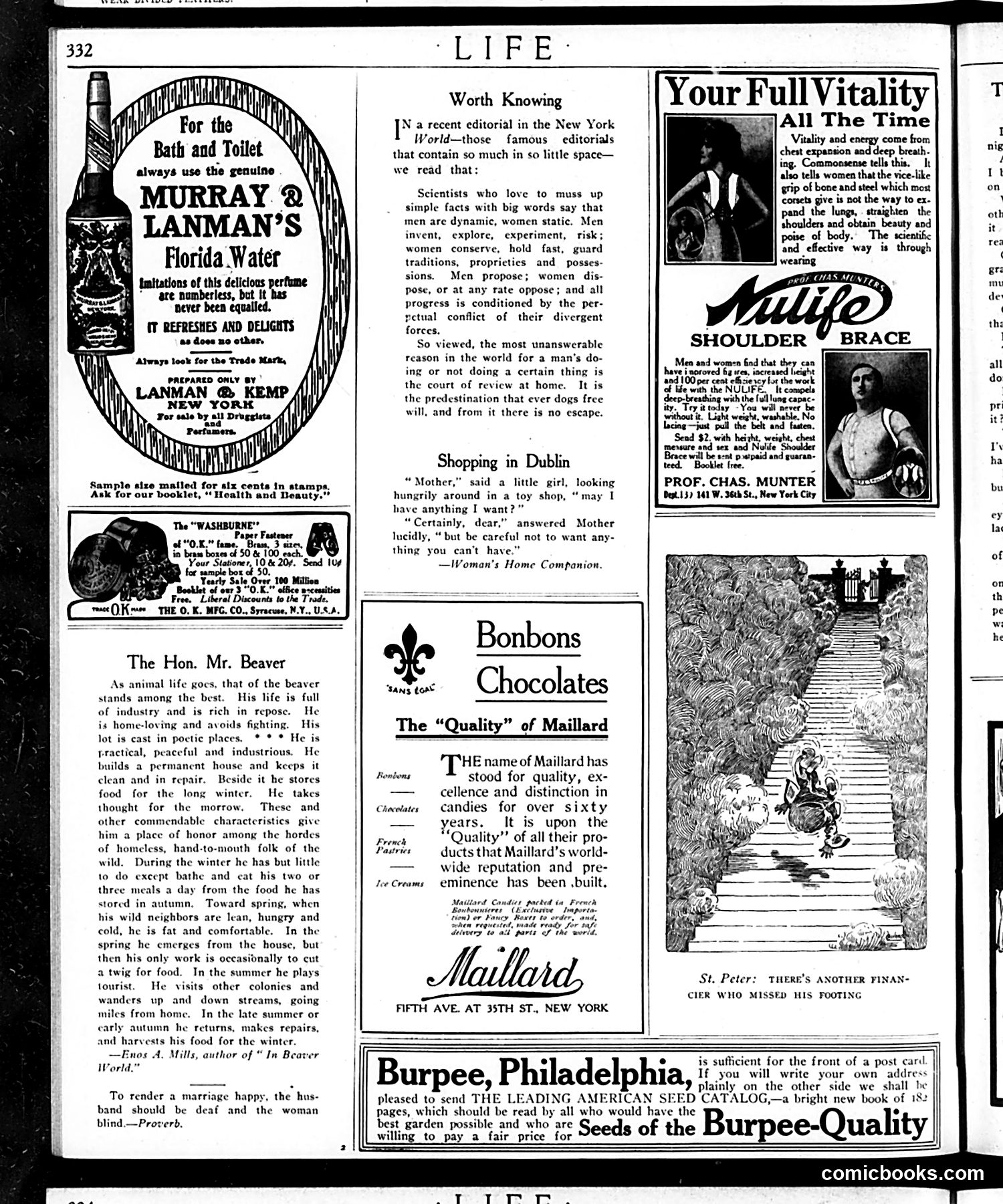
This page consists primarily of advertisements and miscellaneous content with minimal satirical content. The main items are: **Advertisements**: Murray & Lanman's Florida Water perfume, a "Washburne" office product, Maillard chocolates, Burpee seeds, and Prof. Chas. Munter's shoulder brace (with a photograph of a woman demonstrating improved posture). **Editorial content**: A brief essay on gender differences (men as "dynamic," women as "static" conservers), and a short anecdote about a mother teaching her daughter not to want things she cannot have. **Animal profile**: A piece praising the beaver for its industriousness, home-building, and foresight—seemingly a morality tale about virtue. **Cartoon**: A small illustration labeled "St. Peter" showing a financier who "missed his footing"—a reference to death/judgment, though incomplete context makes the specific satirical target unclear. The page reflects early 20th-century gender norms and consumer culture, with advertising dominating over actual satire.
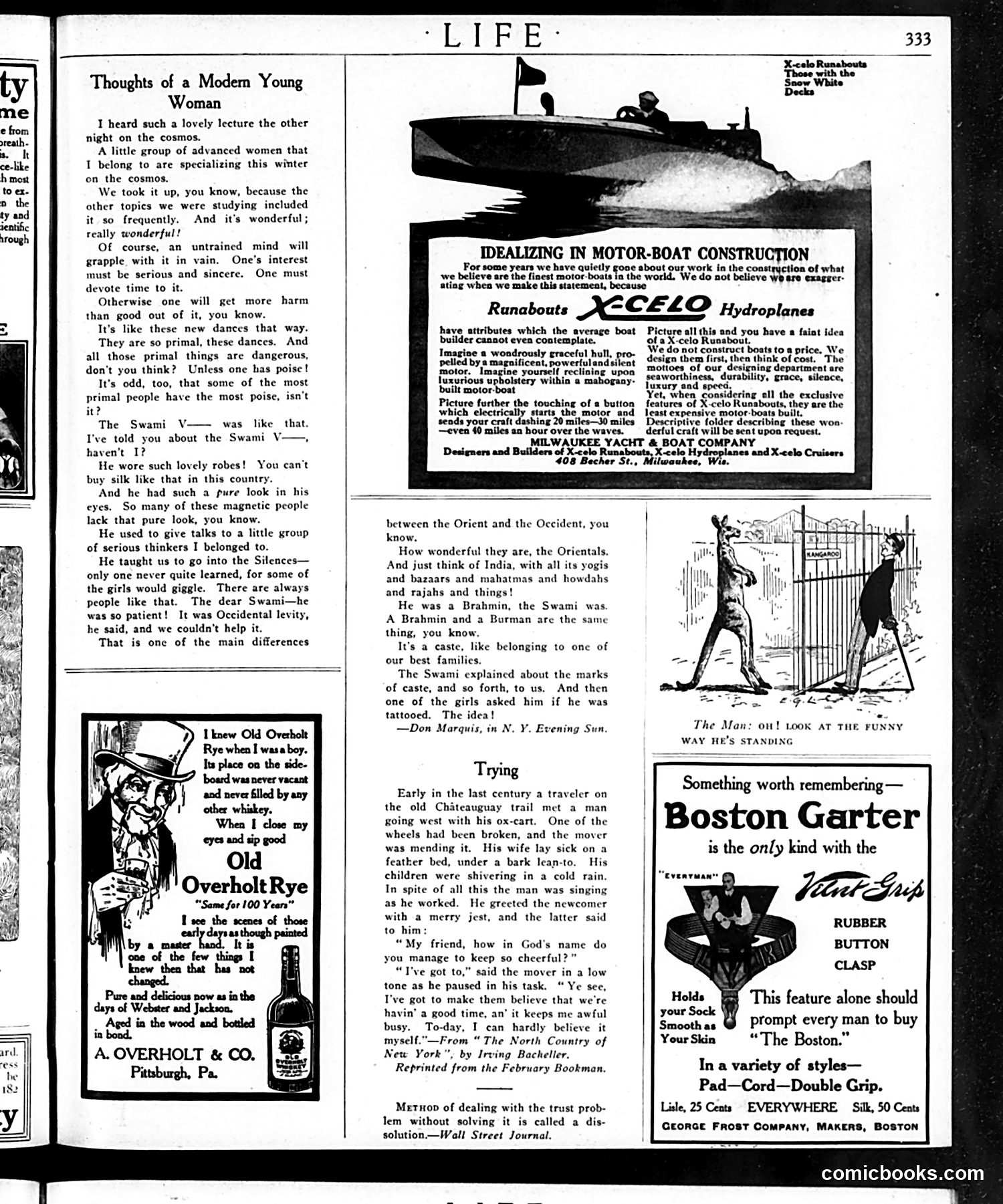
This page satirizes the pretensions of a certain type of early 20th-century American woman through the column "Thoughts of a Modern Young Woman," written by Don Marquis. The unnamed narrator represents an earnest but superficial intellectual who dabbles in fashionable pursuits—attending lectures on "the cosmos" and studying with a charismatic Indian spiritual teacher ("the Swami"). The satire targets her breathless admiration for exoticism and pseudo-intellectual sophistication. She romanticizes Indian culture, conflates Brahmins with Burmans, and is impressed by the Swami's "pure look" and elegant robes while remaining oblivious to her own naïveté. Her repeated qualifications ("really wonderful," "you know") and scattered focus expose her lack of genuine understanding. The page also contains period advertisements (motor-boats, whiskey, garters) typical of Life magazine's revenue model, unrelated to the editorial content.
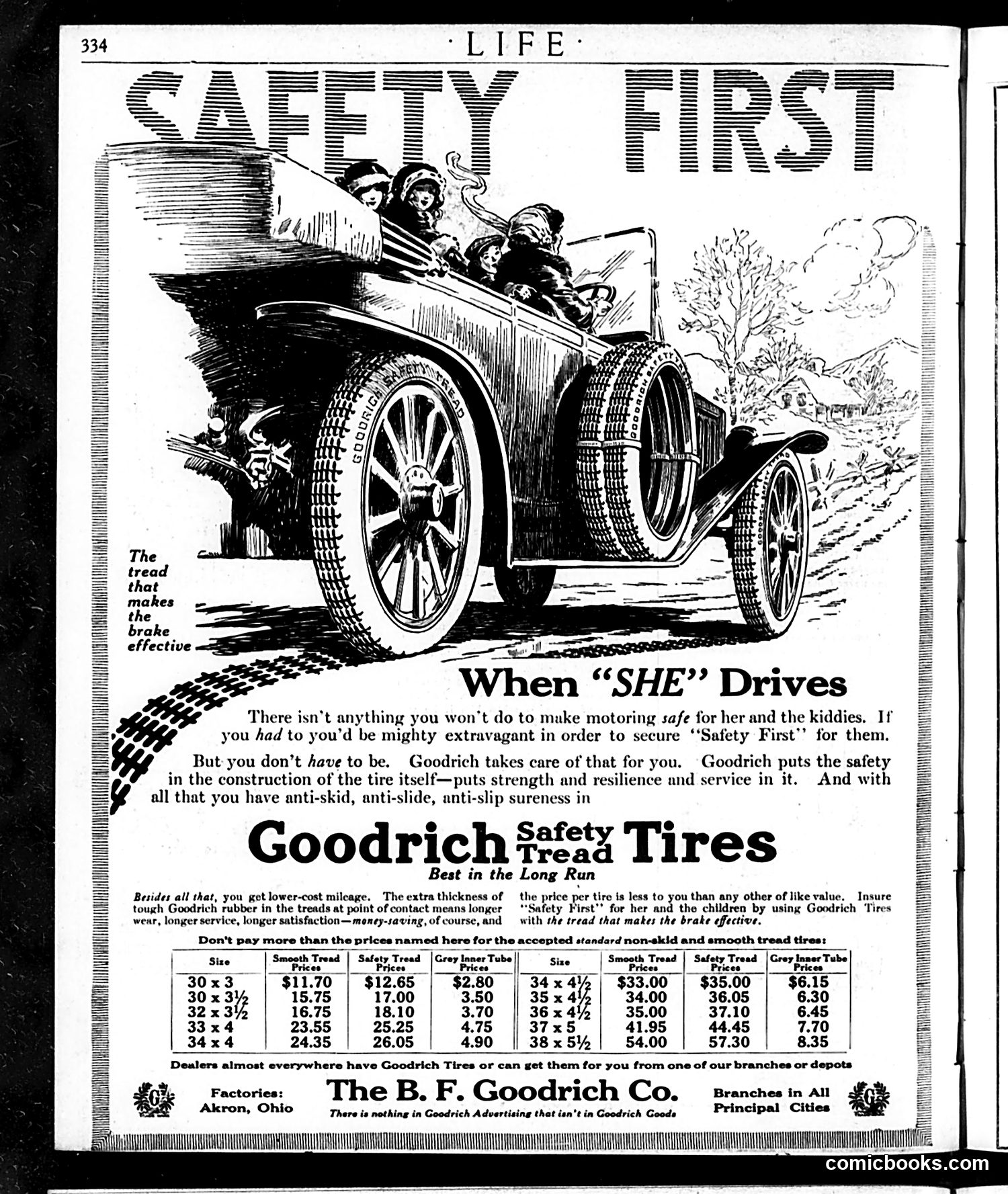
This is primarily a **tire advertisement**, not satire or political commentary. The "Safety First" campaign reflects early 20th-century automotive safety concerns—a genuine social movement emphasizing vehicle reliability. The illustration depicts a woman driving a car with passengers (described as "her and the kiddies"), appealing to buyers' anxieties about family safety. The advertisement's pitch: quality tires provide braking effectiveness and skid-resistance without requiring drivers to make expensive choices. The phrase "Safety First" references the broader Progressive Era workplace safety movement, repurposed here for consumer marketing. The pricing table and factory information ground this as genuine commercial messaging rather than satire. **Context for modern readers**: This assumes cars were still novel enough that tire quality significantly affected safety—and that marketing to women drivers (increasingly common in the 1910s-20s) required emphasizing protection of children.
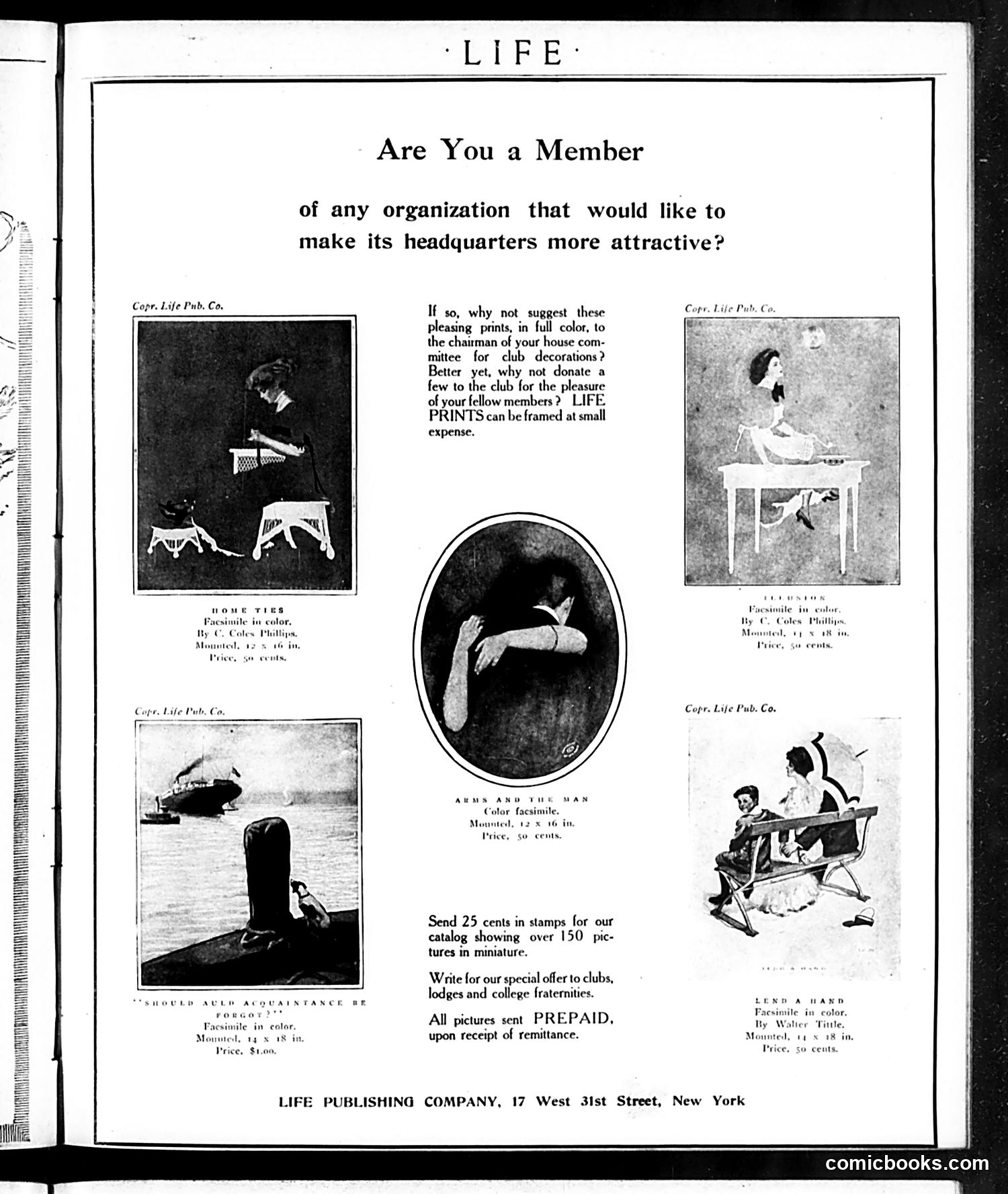
This is primarily **advertising copy**, not political satire. Life Publishing Company is marketing framed art prints to organizations seeking affordable decoration for clubhouses and meeting spaces. The page showcases five sample prints available for purchase—titles include "Home Ties," "Should Acquaintance Be Forgot," "Arms and the War," "Illusions," and "Lend a Hand." Each costs 50 cents; the central oval portrait appears to be the featured item. The pitch targets members of clubs, lodges, and college fraternities, offering bulk discounts and suggesting they either purchase prints for their organizations or donate them as gifts. A full catalog of "over 150 pictures in miniature" was available for 25 cents in stamps. This reflects early 20th-century consumer culture—Life magazine supplemented journalism revenue by selling decorative merchandise to middle-class social organizations seeking to furnish their headquarters affordably.

This is a **commercial advertisement**, not a political cartoon. The J.B. Williams Company (Glastonbury, Connecticut) promotes their shaving soap products in the February 19, 1914 *Life* magazine. The ad uses five illustrated benefits, each with a small circular icon showing a clock, flexed arm, satisfied man, happy face, and money symbol. The copywriting employs hyperbolic claims typical of early 20th-century advertising: the soap "saves" time, energy, worry, temper, and money by producing superior lather that softens beards and prepares skin for shaving. The right side shows product bottles and promotes a "Special Offer"—discounted sample "Suit Case Sets" (five trial-size reproductions) available for 24 cents in stamps, targeting customers unfamiliar with the brand. This reflects pre-regulation advertising practices when health and performance claims faced minimal scrutiny.