
Life, 1914-02-19 · page 24 of 40
Life — February 19, 1914 — page 24: what you’re looking at
What you’re looking at
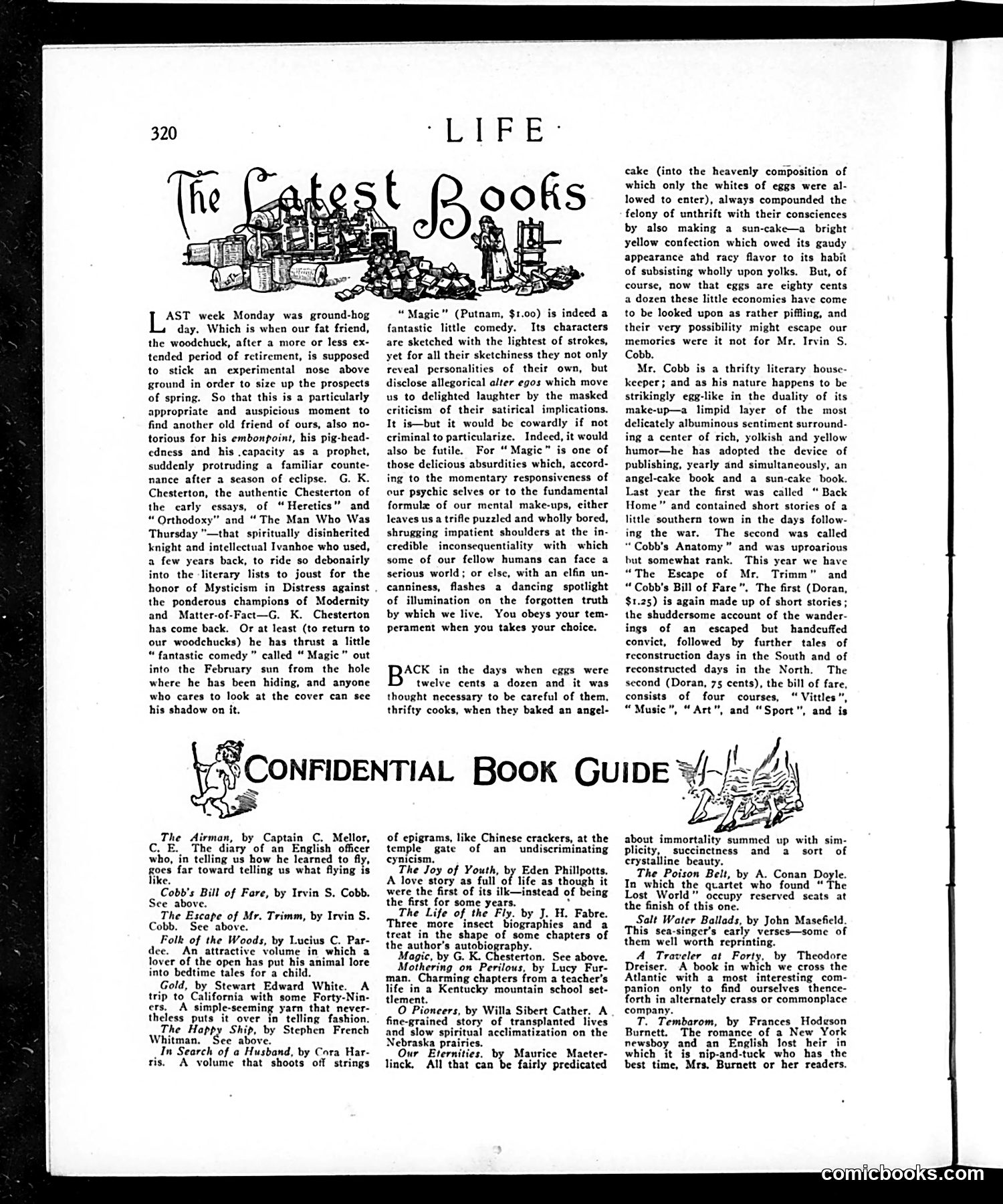
This page features **book reviews** rather than political cartoons. The main content discusses G.K. Chesterton's return to publishing with a play called *Magic* after a period of absence—humorously compared to a groundhog emerging on Groundhog Day. The review praises Chesterton's allegorical comedy for its wit and satirical implications, though the critic deliberately avoids spoiling details. The tone is playful, describing how the work's meaning depends entirely on the reader's temperament and "psychic responsiveness." Below is a "Confidential Book Guide" listing twelve other recent publications with brief descriptions—mostly adventure novels, memoirs, and nature writing typical of the era. There are **no political cartoons visible** on this page. It's a standard literary review section aimed at Life's educated readership, showcasing Chesterton's intellectual reputation among American intellectuals of the period.
📄 Transcribed text from this page (OCR, searchable)
Machine-transcribed from the original scan — historical spelling and the odd misread are preserved.
AST week Monday was ground-hog day. Which is when our fat friend, the woodchuck, after a more or less ex- tended period of rctirement, is supposed to stick an experimental nose above ground in order to size up the prospects of spring. So that this is a particularly appropriate and auspicious moment to find another old friend of ours, also no- torious for his embonpoint, his pig-head- edness and his .capacity as a prophet, suddenly protruding a familiar counte- nance after a season of eclipse. G. K. Chesterton, the authentic Chesterton of the carly essays, of “Heretics” and “ Orthodoxy” and “The Man Who Was Thursday ‘hat spiritually disinherited knight and intellectual Ivanhoe who used, a few years back, to ride so debonairly into the literary lists to joust for the honor of Mysticism in Distress against the ponderous champions of Modernity and Matter-of-Fact—G. K. Chesterton has come back. Or at least (to return to our woodchucks) he has thrust a little “ fantastic comedy ” called “ Magic” out into the February sun from the hole where he has been hiding, and anyone who cares to look at the cover can sce his shadow on it. The Airman, by Captain C. Mellor, C. E. The diary of an English officer who, in telling us how he learned to fiy, fcc? far toward telling us what flying is ike. Cobb's Bill of Fare, by Irvin S. Cobb. See above. The Escape of Mr. Trimm, by Irvin S. Cobb. See above. Folk of the Woods, by Lucius C. Par- dee. An attractive volume in which a lover of the open has put his animal lore into bedtime tales for a child. Gold, by Stewart Edward White. A trip to ifornia with some Forty-Nin- crs, A simple-seeming yarn that never- theless puts it over in telling fashion. The Happy Ship, by Stephen French Whitman. See above. In Search of a Husband, by Cora Har- ris. A volume that shoots off strings “Magic” (Putnam, $1.00) is indeed a fantastic little comedy. Its characters are sketched with the lightest of strokes, yet for all their sketchiness they not only reveal personalities of their own, but disclose allegorical alter egos which move us to delighted laughter by the masked criticism of their satirical implications. It is—but it would be cowardly if not criminal to particularize. Indeed, it would also be futile. For “ Magic” is one of those delicious absurdities which, accord- ing to the momentary responsiveness of our psychic selves or to the fundamental formule of our mental make-ups, either leaves us a trifle puzzled and wholly bored, shrugging impatient shoulders at the in- credible inconsequentiality with which some of our fellow humans can face a serious world; or else, with an elfin un- canniness, flashes a dancing spotlight of illumination on the forgotten truth by which we live. You obeys your tem- perament when you takes your choice. ACK in the days when eggs were twelve cents a dozen and it was thought necessary to be careful of them, thrifty cooks, when they baked an angel- of epigrams, like Chinese crackers, at the temple gate of an undiscriminating cynicism, The Joy of Youth, by Eden Phillpott A love story as full of life as though were the first of its ilk—instead of being the first for some years. . The Life of the Fly. by J. H. Fabre. Three more insect biographies and a treat in the shape of some chapters of the author’s autobiography. Magic, by G. K. Chesterton. See above. Mothering on Perilous, by Lucy Fur- man. Charming chapters from a teacher's life in a Kentucky mountain school set- tlement. O Pioneers, by Willa Sibert Cather. A fine-grained story of transplanted lives and slow spiritual acclimatization on the Nebraska prairies. Our Eternities. by Maurice Maeter- linck, All that can be fairly predicated cake (into the heavenly composition of which only the whites of eggs were al- lowed to enter), always compounded the felony of unthrift with their consciences by also making a sun-cake—a bright yellow confection which owed its gaudy appearance ahd racy flavor to its habit of subsisting wholly upon yolks. But, of course, now that eggs are eighty cents a dozen these little economics have come to be looked upon as rather piffling, and their very possibility might escape our memories were it not for Mr. Irvin S. Cobb. Mr. Cobb is a thrifty literary house- keeper; and as his nature happens to be strikingly egg-like in the duality of its make-up—a limpid layer of the most delicately albuminous sentiment surround- ing a center of rich, yolkish and yellow humor—he has adopted the device of publishing, yearly and simultancously, an angel-cake book and a sun-cake book. Last year the first was called “ Back Home” and contained short stories of a little southern town in the days follow- ing the war. The second was called “Cobb's Anatomy” and was uproarious but somewhat rank. This year we have “The Escape of Mr. Trimm” and “Cobb's Bill of Fare”. The first (Doran, $1.25) is again made up of short stories; the shuddersome account of the wander- ings of an escaped but handcuffed convict, followed by further tales of reconstruction days in the South and of reconstructed days in the North. The second (Doran, 75 cents), the bill of fare, consists of four courses, “ Vittles”, “Music”, “Art”, and “Sport”, and is about immortality summed up with Plicity, succinctness sort of crystalline beauty. The Poison Belt, by A. Conan Doyle. In which the quartet who found “ The Lost. World” occupy reserved seats at the finish of this one. Salt Water Ballads, by John Masefield. This sea-singer’s early verses—some of them well worth reprinting. A Traveler at Forty, by Theodore Dreiser. A book in which we cross the Atlantic with a most interesting com- panion only to find ourselves thence- forth in alternately crass or commonplace company. T. Tembarom, by Frances Hodgson Burnett. The romance of a New York newsboy and an English lost heir in which it is nip-and-tuck who has the best time, Mrs, Burnett or her readers. and a