
Life, 1914-02-19 · page 8 of 40
Life — February 19, 1914 — page 8: what you’re looking at
What you’re looking at
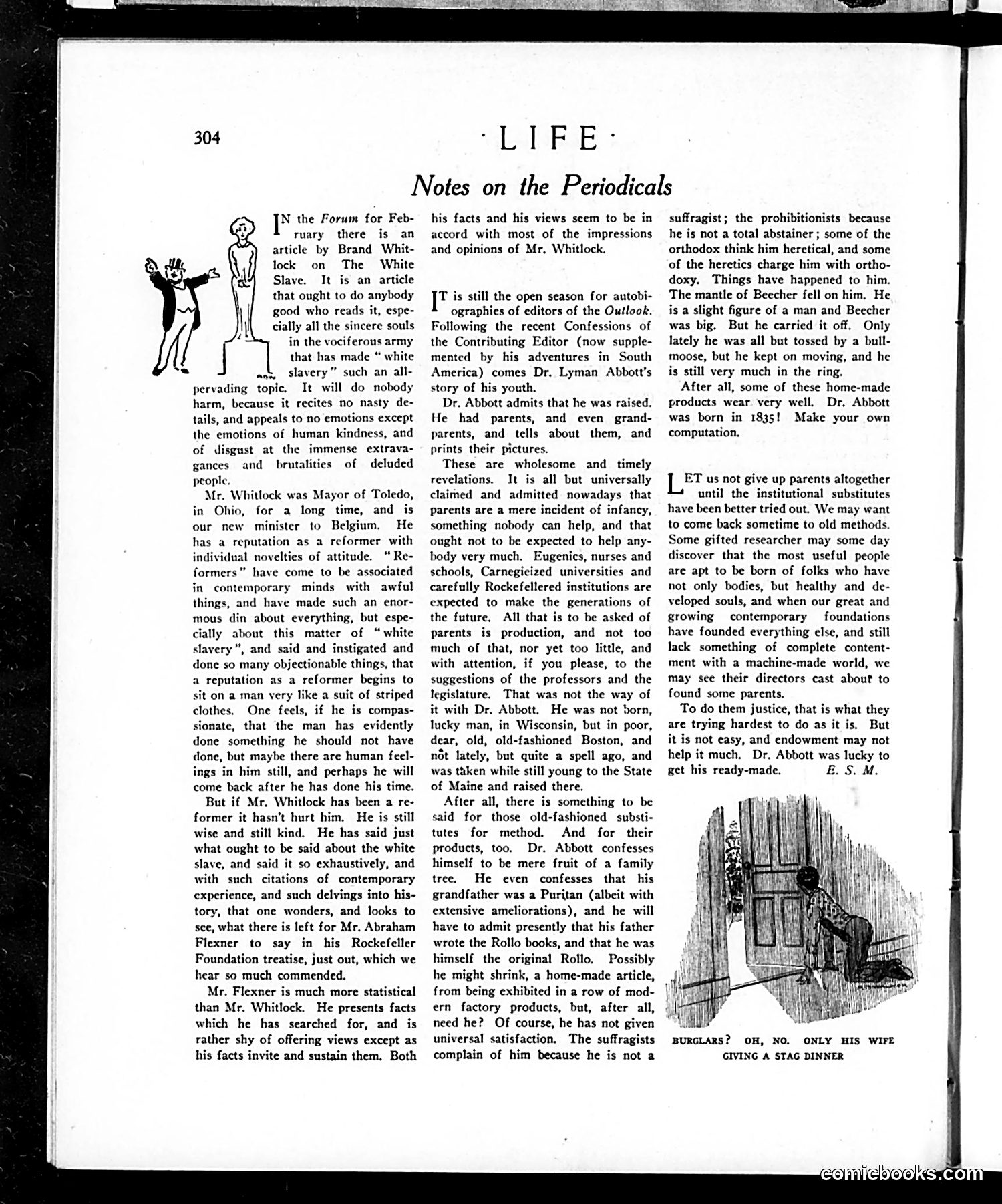
This page contains "Notes on the Periodicals," a commentary section rather than a political cartoon. The article discusses Brand Whitlock's essay "The White Slave" in the *Forum*, praising it as unemotional and effective reform writing that avoids sensationalism. The page critiques Dr. Lyman Abbott's autobiographical *Outlook* contributions, noting he was born into privilege (unlike Whitlock, who came from modest Boston origins). The text compares Abbott's "home-made" success unfavorably to statistical reformer Abraham Flexner's approach. The small illustration at bottom—captioned "BURGLARS? OH, NO. ONLY HIS WIFE GIVING A STAG DINNER"—appears to be a society joke about wealthy husbands being alarmed by their wives' entertaining habits.
📄 Transcribed text from this page (OCR, searchable)
Machine-transcribed from the original scan — historical spelling and the odd misread are preserved.
Notes on the Periodicals N the Forum for Feb- ruary there is an article by Brand Whit- lock on The White Slave. It is an article that ought to do anybody good who reads it, espe- cially all the sincere souls in the vociferous army that has made “ white ans Slavery” such an all- pervading topic. It will do nobody harm, because it recites no nasty de- tails, and appeals to no emotions except the emotions of human kindness, and of disgust at the immense extrava- gances and brutalities of deluded people. Mr. Whitlock was Mayor of Toledo, in Ohio, for a long time, and is our new minister to Belgium. He has a reputation as a reformer with individual novelties of attitude. “ Re- formers” have come to be associated in contemporary minds with awful things, and have made such an enor- mous din about everything, but espe- cially about this matter of “white slavery”, and said and instigated and done so many objectionable things, that a reputation as a reformer begins to sit on a man very like a suit of striped clothes. One feels, if he is compas- sionate, that the man has evidently done something he should not have done, but maybe there are human feel- ings in him still, and perhaps he will come back after he has done his time. But if Mr. Whitlock has been a re- former it hasn't hurt him. He is still wise and still kind. He has said just what ought to be said about the white slave, and said it so exhaustively, and with such citations of contemporary experience, and such delvings into his- tory, that one wonders, and looks to see, what there is left for Mr. Abraham Flexner to say in his Rockefeller Foundation treatise, just out, which we hear so much commended. Mr. Flexner is much more statistical than Mr. Whitlock. He presents facts which he has searched for, and is rather shy of offering views except as his facts invite and sustain them. Both his facts and his views seem to be in accord with most of the impressions and opinions of Mr. Whitlock. " is still the open season for autobi- ographies of editors of the Outlook. Following the recent Confessions of the Contributing Editor (now supple- mented by his adventures in South America) comes Dr. Lyman Abbott's story of his youth. Dr. Abbott admits that he was raised. He had parents, and even grand- parents, and tells about them, and prints their pictures. These are wholesome and timely revelations. It is all but universally claimed and admitted nowadays that parents are a mere incident of infancy, something nobody can help, and that ought not to be expected to help any- body very much. Eugenics, nurses and schools, Carnegicized universities and carefully Rockefellered institutions are expected to make the generations of the future, All that is to be asked of parents is production, and not too much of that, nor yet too little, and with attention, if you please, to the suggestions of the professors and the legislature. That was not the way of it with Dr. Abbott. He was not born, lucky man, in Wisconsin, but in poor, dear, old, old-fashioned Boston, and not lately, but quite a spell ago, and was taken while still young to the State of Maine and raised there. After all, there is something to be said for those old-fashioned substi- tutes for method. And for their products, too. Dr. Abbott confesses himself to be mere fruit of a family tree. He even confesses that his grandfather was a Puritan (albeit with extensive ameliorations), and he will have to admit presently that his father wrote the Rollo books, and that he was himself the original Rollo, Possibly he might shrink, a home-made article, from being exhibited in a row of mod- ern factory products, but, after all, need he? Of course, he has not given universal satisfaction. The suffragists complain of him because he is not a suffragist; the prohibitionists because he is not a total abstainer ; some of the orthodox think him heretical, and some of the heretics charge him with ortho- doxy. Things have happened to him. The mantle of Beecher fell on him. He is a slight figure of a man and Beecher was big. But he carried it off. Only lately he was all but tossed by a bull- moose, but he kept on moving, and he is still very much in the ring. After all, some of these home-made products wear very well. Dr. Abbott was born in 1835! Make your own computation, ET us not give up parents altogether until the institutional substitutes have been better tried out. We may want to come back sometime to old methods. Some gifted researcher may some day discover that the most useful people are apt to be born of folks who have not only bodies, but healthy and de- veloped souls, and when our great and growing contemporary foundations have founded everything else, and still lack something of complete content- ment with a machine-made world, we may see their directors cast about to found some parents. To do them justice, that is what they are trying hardest to do as it is. But it is not easy, and endowment may not help it much. Dr. Abbott was lucky to get his ready-made. E.S. M. BURGLARS? OH, NO. ONLY HIS WIFE GIVING A STAG DINNER