
Life, 1914-02-19 · page 28 of 40
Life — February 19, 1914 — page 28: what you’re looking at
What you’re looking at
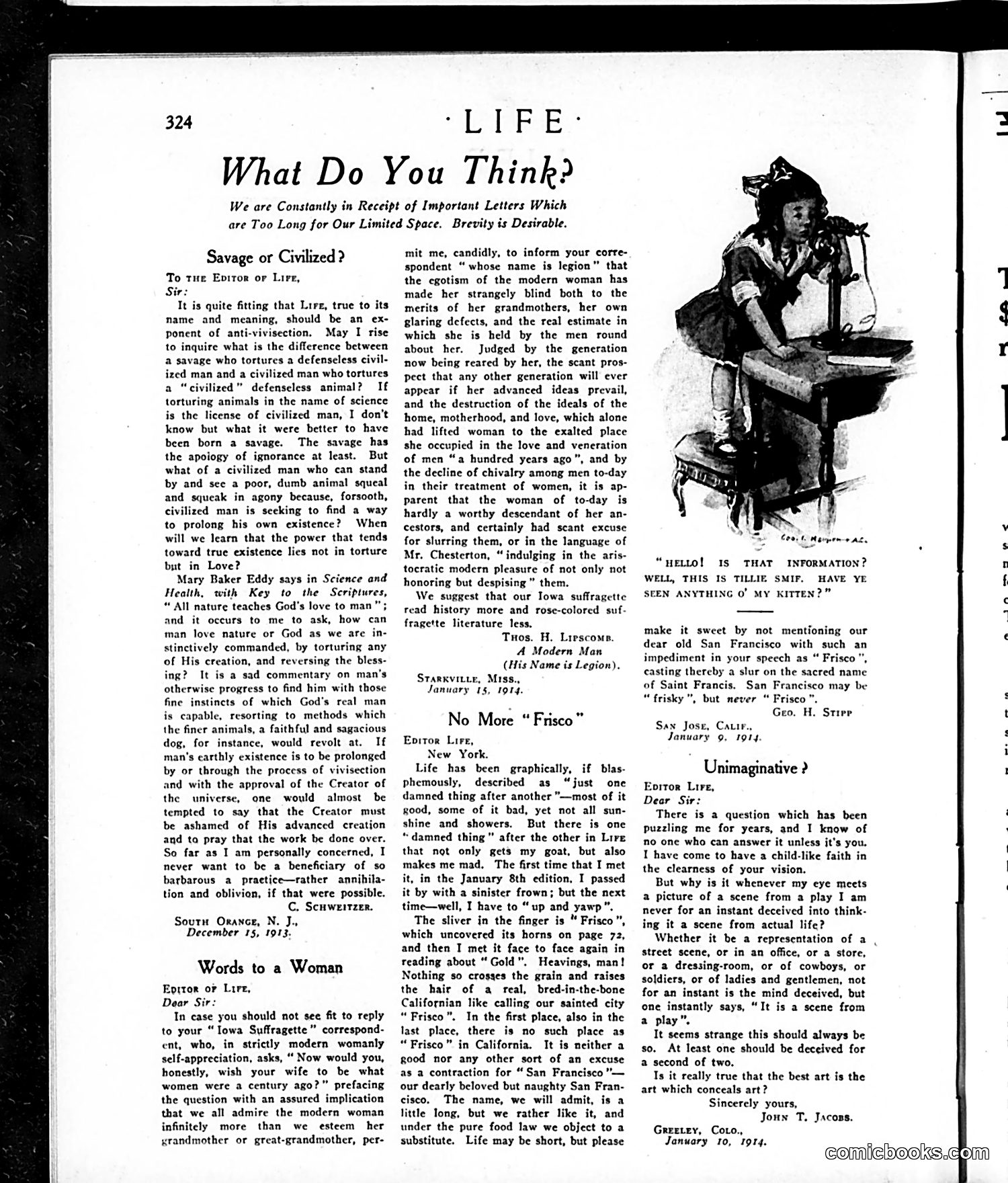
This page features the magazine's "What Do You Think?" letters column. The accompanying cartoon depicts a fashionably dressed woman (labeled "HELLO! IS THAT INFORMATION? WELL, THIS IS THEIR SNIP. HAVE YOU SEEN ANYTHING O' MY KITTEN?") engaging a young man in conversation. The satire targets debates over **women's changing roles in the Progressive Era**. Letters criticize both animal vivisection and modern women's "advancement." One correspondent argues the modern woman has become arrogant and ungrateful to her predecessors, claiming she's abandoning traditional domesticity (home, motherhood, love) and causing the decline of male chivalry. The cartoon's flirtatious woman represents the "New Woman"—educated, independent, socially forward—whom traditionalists viewed with suspicion. The satire mocks those resisting women's suffrage and modernization, portraying their nostalgia for the past as misguided while illustrating the generational conflict over women's evolving social position.
📄 Transcribed text from this page (OCR, searchable)
Machine-transcribed from the original scan — historical spelling and the odd misread are preserved.
LA RE: What Do You Think? We are Constantly in Receipt of Important Letters Which are Too Long for Our Limited Space. Brevity is Desirable. Savage or Civilized ? To tHe Evitor or Lire, Sir: It is quite fitting that Lire, true to its name and meaning, should be an ex- ponent of anti-vivisection. May I rise to inquire what is the difference between a savage who tortures a defenseless civil- ized man and a civilized man who tortures a “civilized” defenseless animal? If torturing animals in the name of science is the license of civilized man, I don’t know but what it were better to have been born a savage. The savage has the apology of ignorance at least. But what of a civilized man who can stand by and see a poor, dumb animal squeal and squeak in agony because, forsooth, civilized man is seeking to find a way to prolong his own existence? When will we learn that the power that tends toward true existence lies not in torture but in Love? Mary Baker Eddy says in Science and Health, with Key to the Scriptures, “ All nature teaches God's love to man"; and it occurs to me to ask, how can man love nature or God as we are in- stinctively commanded, by torturing any of His creation, and reversing the bless- ing? It is a sad commentary on man’s otherwise progress to find him with those fine instincts of which God's real man is capable, resorting to methods which the finer animals, a faithful and sagacious dog, for instance, would revolt at. If man’s carthly existence is to be prolonged by or through the process of vivisection and with the approval of the Creator of the universe, one would almost be tempted to say that the Creator must be ashamed of His advanced creation and to pray that the work be done over. So far as I am personally concerned, I never want to be a beneficiary of so barbarous a praetice—rather annihila- tion and oblivion, if that were possible. C. Scuwenrzer. Sourn Orancz, N. J., December 15, 1913. Words to a Woman Eprror oF Lire, Dear Sir: In case you should not see fit to reply to your “Iowa Suffragette ” correspond- ent, who, in strictly modern womanly self-appreciation, asks, “ Now would you, honestly, wish your wife to be what ‘women were a century ago?” prefacing the question with an assured implication that we all admire the modern woman infinitely more than we esteem her grandmother or great-grandmother, per- mit me, candidly, to inform your corte- spondent “whose name is legion” that the egotism of the modern woman has made her strangely blind both to the merits of her grandmothers, her own glaring defects, and the real estimate in which she is held by the men round about her. Judged by the generation now being reared by her, the scant pros- pect that any other generation will ever appear if her advanced ideas prevail, and the destruction of the ideals of the home, motherhood, and love, which alone had lifted woman to the exalted place she occupied in the love and veneration of men “a hundred years ago”, and by the decline of chivalry among men to-day in their treatment of women, it is ap- parent that the woman of to-day is hardly a worthy descendant of her an- cestors, and certainly had scant excuse for slurring them, or in the language of Mr. Chesterton, “indulging in the aris- tocratic modern pleasure of not only not honoring but despising ” them. We suggest that our Iowa suffragette read history more and rose-colored suf- fragette literature less. Tos. H. Lirscoms. A Modern Man (His Name is Legion). Starkvitte, Mrss., January 15, 1914. No More “ Frisco” Eoitor Lire, New York. Life has been graphically, if blas- phemously, described as “just one damned thing after another "—most of it good, some of it bad, yet not all sun- shine and showers. But there is one “damned thing" after the other in Lire that not only gets my goat, but also makes me mad, The first time that I met it, in the January 8th edition, I passed it by with a sinister frown; but the next time—well, I have to “up and yawp”. The sliver in the finger is “ Frisco”, which uncovered its horns on page 72, and then I met it face to face again in reading about “Gold”. Heavings, man! Nothing so crosses the grain and raises the hair of a real, bred-in-the-bone Californian like calling our sainted city “Frisco”. In the first place, also in the last place, there is no such place as “Frisco” in California. It is neither a good nor any other sort of an excuse as a contraction for “San Francisco "— our dearly beloved but naughty San Fran- cisco, The name, we will admit, is a little long, but we rather like it, and under the pure food law we object to a substitute. Life may be short, but please “HELLO! IS THAT INFORMATION? WELL, THIS IS TILLIE SMIF, HAVE YE SEEN ANYTHING 0’ MY KITTEN?” make it sweet by not mentioning our dear old San Francisco with such an impediment in your speech as “ Frisco”, casting thereby a slur on the sacred name of Saint Francis, San Francisco may be “frisky”, but never “ Frisco”. Geo. H. Stier Sax Jose, Cauir., January 9. 1914 Unimaginative ? Eortor Lire, Dear Sir: There is a question which has been puzzling me for years, and I know of no one who can answer it unless it's you. I have come to have a child-like faith in the clearness of your vision. But why is it whenever my eye meets a picture of a scene from a play I am never for an instant deceived into think- ing it a scene from actual life? Whether it be a representation of a . street scene, or in an office, or a store, or a dressing-room, or of cowboys, or soldiers, or of ladies and gentlemen, not for an instant is the mind deceived, but one instantly says, “It is a scene from a play”, It seems strange this should always be so. At least one should be deceived for a second of two. Is it really true that the best art is the art which conceals art? Sincerely yours, Joux T. Jacons. Greetey, Coto., January 10, 1914. comichooks.com