
Life, 1914-02-19 · page 37 of 40
Life — February 19, 1914 — page 37: what you’re looking at
What you’re looking at
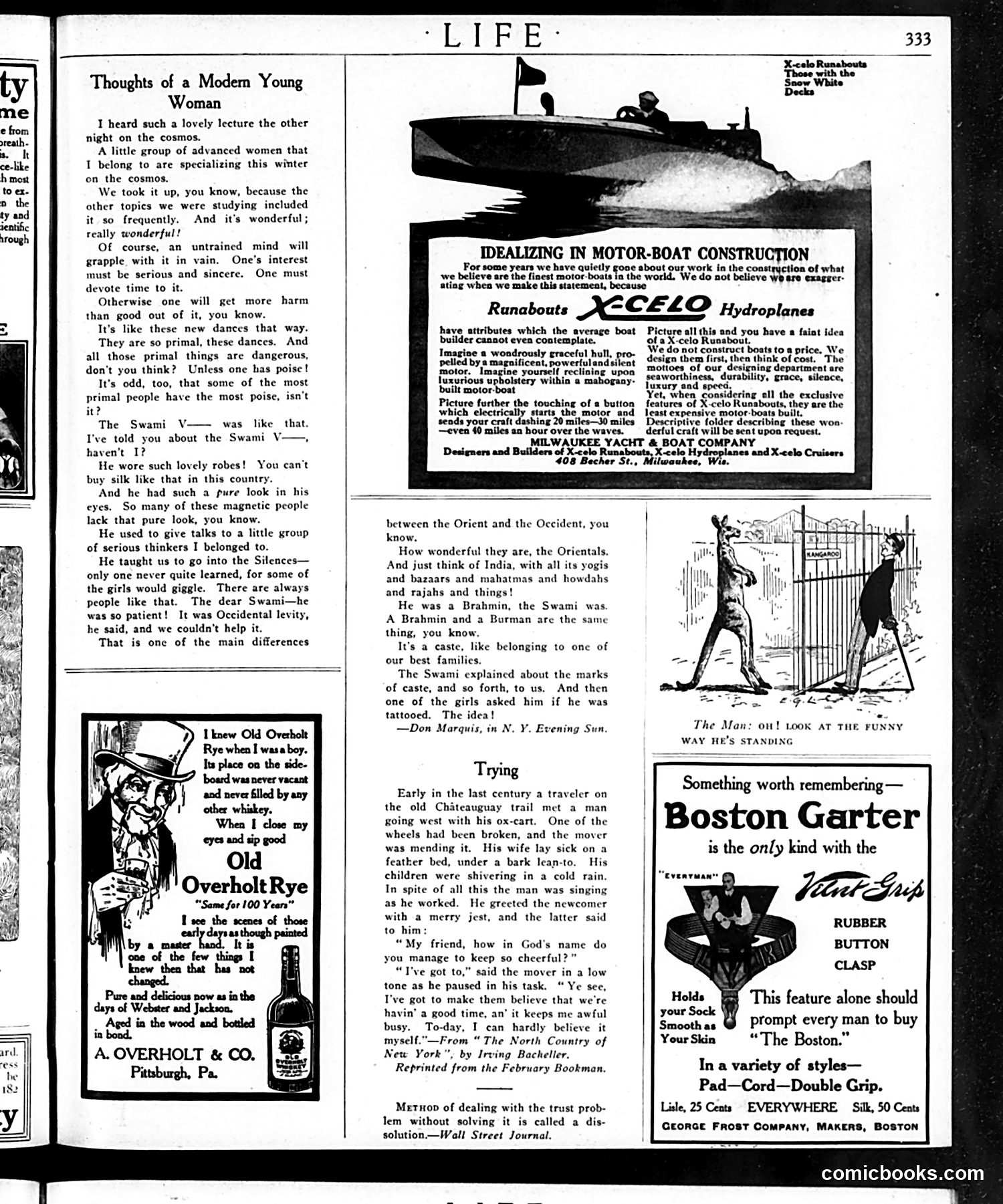
This page satirizes the pretensions of a certain type of early 20th-century American woman through the column "Thoughts of a Modern Young Woman," written by Don Marquis. The unnamed narrator represents an earnest but superficial intellectual who dabbles in fashionable pursuits—attending lectures on "the cosmos" and studying with a charismatic Indian spiritual teacher ("the Swami"). The satire targets her breathless admiration for exoticism and pseudo-intellectual sophistication. She romanticizes Indian culture, conflates Brahmins with Burmans, and is impressed by the Swami's "pure look" and elegant robes while remaining oblivious to her own naïveté. Her repeated qualifications ("really wonderful," "you know") and scattered focus expose her lack of genuine understanding. The page also contains period advertisements (motor-boats, whiskey, garters) typical of Life magazine's revenue model, unrelated to the editorial content.
📄 Transcribed text from this page (OCR, searchable)
Machine-transcribed from the original scan — historical spelling and the odd misread are preserved.
Thoughts of a Modem Young ‘Woman T heard such a lovely lecture the other night on the cosmos. A little group of advanced women that I belong to are specializing this winter on the cosmos. We took it up, you know, because the other topics we were studying included it so frequently. And it's wonderful; really wonderful! Of course, an untrained mind will grapple. with it in vain. One's interest must be serious and sincere. One must devote time to it. Otherwise one will get more harm than good out of it, you know. It’s like these new dances that way. They are so primal, these dances. And all those primal things are dangerous, don't you think? Unless one has poise! It's odd, too, that some of the most primal people have the most poise, isn’t it? The Swami V. was like that. I've told you about the Swami V—, haven't 1? He wore such lovely robes! You can’t buy silk like that in this country. And he had such a pure look in his eyes. So many of these magnetic people lack that pure look, you know. He used to give talks to a little group of serious thinkers I belonged to. He taught us to go into the Silences— only one never quite learned, for some of the girls would giggle. There are always people like that. The dear Swami—he was so patient! It was Occidental levity, he said, and we couldn't help it. That is one of the main differences IDEALIZING IN MOTOR-BOAT CONSTRUCTION For some years we have quietly e about our work in the const He rh we belleve are the fincet motor boats In the work: We do aot bellove ttre canteen ating when we make this statement, because Ranabouts KXCELO Hydroplanes have attributes which the average boat Picture all this and you have a faint idea builder cannot even contemplate. ofa X-celo Runabout, a Imagine a wondrously graceful hull, pro. qV§20 not construct boats to @ pri : pelled by a magnificent, powerfulandsilent design them first, then think of cost. The motor. Imagine yourself reclining upon otters, of our cesiening department are luxurious upholstery within a mahogany. feaworthiness, durability, grace, [xury and epced. built motor-boat Yet, when considering ell the exclusive Picture further the touching of a button features of X-celo Runabouts, they are the which electricall rts the motor and least expensive motor-boats built. seads your craft dashing 20 miles—30 miles Descriptive folder describing these won- “even 40 miles an hour over the waves. _derlul craft will be sent upon request. sod BuifLWAUKEE YACHT & BOAT COMPANY : 408 Becher St, Mitocukes, Wie. —s Iknew Old Overholt Rye when I wasa boy. Its place on the side- board was never vacant and never filled by any other whiskey. ‘When I close my eyes and sip good Old Overholt Rye “Same for 100 Year” A. OVERHOLT & CO. Pittsburgh, Pa. between the Orient and the Occident, you know, How wonderful they are, the Orientals. And just think of India, with all its yogis and bazaars and mahatmas and howdahs and rajahs and thing: He was a Brahmin, the Swami was. A Brahmin and a Burman are the same thing, you know. It's a caste, like belonging to one of our best families. The Swami explained about the marks of caste, and so forth, to us. And then one of the girls asked him if he was tattooed. The idea! —Don Marquis, in N. Y. Evening Sun. Trying ; ; . Something worth remembering — Early in the last century a traveler on the old Chateauguay trail met a man in Weraih teen oot || BOSton Garter wheels had been broken, and the mover . tian was mending it. His wife lay sick on a is the only kind with the featker bed, under a bark lean-to. His children were shivering in a cold rain. In spite of all this the man was singing as he worked. He greeted the newcomer with a merry jest, and the latter said to him: “My friend, how in God's name do you manage to keep so cheerful?” “T've got to,” said the mover in a low tone as he paused in his task. “Ye see, T've got to make them believe that we're ie This feature alone should havin’ a good time, an’ it keeps me awful your busy. ‘To-day, Tecan hardly believe. it Smocthas @ Prompt every man to buy myself."—From “The North Country of Your Skin “The Boston.” New York”, by Irving Bacheller. ; Reprinted from the February Bookman. In a variety of styles— Pad—Cord—Double Grip. Metnop of dealing the trust prob- | | Lisle, 25 Cents EVERYWHERE Silk, 50 Cents lem without solving it is called a dis- GEORGE FROST COMPANY, MAKERS, BOSTON solution—Wall Street Journal. comicbooks.com