
Life, 1914-02-19 · page 25 of 40
Life — February 19, 1914 — page 25: what you’re looking at
What you’re looking at
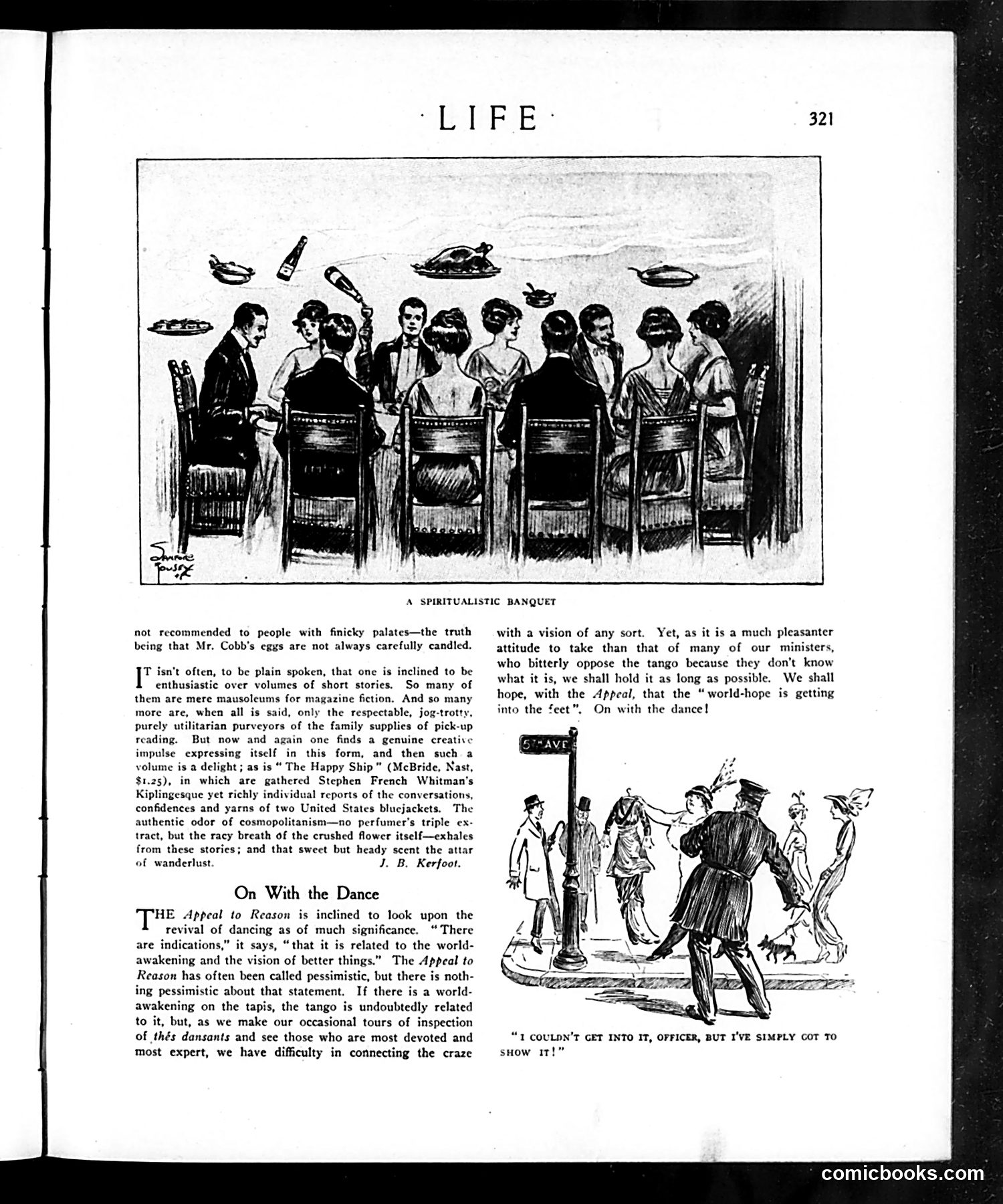
The top cartoon, "A Spiritualistic Banquet," depicts a séance—people seated around a table attempting to contact the dead. The joke references Mr. Cobb's eggs being "not always carefully candled" (inspected for quality), suggesting the "spirits" summoned at such gatherings are as dubious and poorly vetted as suspect food. The page's second section discusses the tango craze. The text humorously notes that *Appeal to Reason* (a socialist publication) sees the dance revival as connected to social "world-awakening," but Life's editors doubt this connection—they see it as frivolous entertainment rather than meaningful social progress. They prefer this optimistic view to ministers' moral opposition to the tango (which was considered scandalously sensual at the time). The bottom cartoon shows a woman telling a police officer she "simply got to show it"—likely referencing the irresistible urge to display the latest dance moves, satirizing the era's dance obsession.
📄 Transcribed text from this page (OCR, searchable)
Machine-transcribed from the original scan — historical spelling and the odd misread are preserved.
A SPIRITUALISTIC BANQUET not recommended to people with finicky palates—the truth being that Mr. Cobb’s eggs are not always carefully candled. T isn't often, to be plain spoken, that one is inclined to be enthusiastic over volumes of short stories. So many of them are mere mausoleums for magazine fiction. And so many more are, when all is said, only the respectable, jog-trotty, purely utilitarian purveyors of the family supplies of pick-up reading. But now and again one finds a genuine creative impulse expressing itself in this form, and then such a volume is a delight; as is “ The Happy Ship” (McBride, Nast, $1.25), in which are gathered Stephen French Whitman's Kiplingesque yet richly individual reports of the conversations, confidences and yarns of two United States blucjackets. The authentic odor of cosmopolitanism—no perfumer's triple ex- tract, but the racy breath of the crushed flower itself—exhales from these stories; and that sweet but heady scent the attar of wanderlust. J. B. Kerfoot. On With the Dance 'HE Appeal to Reason is inclined to look upon the revival of dancing as of much significance. “There are indications,” it says, “that it is related to the world- awakening and the vision of better things.” The Appeal to Reason has often been called pessimistic, but there is noth- ing pessimistic about that statement. If there is a world- awakening on the tapis, the tango is undoubtedly related to it, but, as we make our occasional tours of inspection of thés dansants and see those who are most devoted and most expert, we have difficulty in connecting the craze with a vision of any sort. Yet, as it is a much pleasanter attitude to take than that of many of our ministers, who bitterly oppose the tango because they don’t know what it is, we shall hold it as long as possible. We shall hope, with the Appeal, that the “world-hope is getting into the feet”. On with the dance! “1 COULDN'T GET INTO IT, OFFICER, BUT I'VE SIMPLY GOT TO sHow it!” comicbooks.com