
Life, 1914-02-19 · page 22 of 40
Life — February 19, 1914 — page 22: what you’re looking at
What you’re looking at
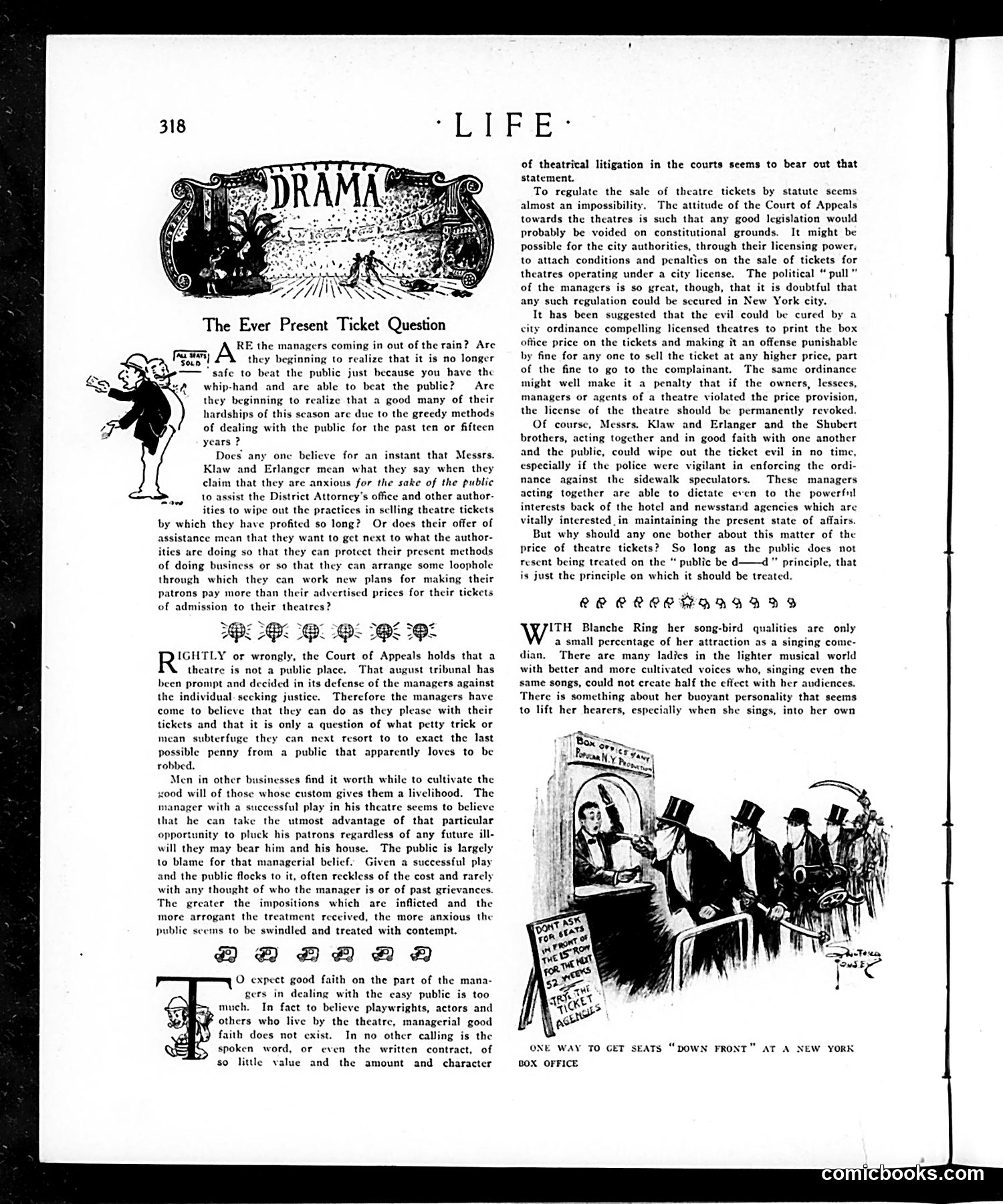
This article satirizes **theater managers Klaw and Erlanger**, who controlled Broadway ticket distribution in the early 1900s. The piece accuses them of price-gouging and scalping schemes—charging patrons far more than advertised prices for "front row" seats. The accompanying cartoon shows the actual mechanism: scalpers operating outside box offices with signs advertising inflated prices, while well-dressed theatergoers queue inside. The satire's point: Klaw and Erlanger claim to help authorities stop these practices "for the public good," but the author sardonically doubts their sincerity—suggesting they merely want to protect their own profitable ticket-manipulation schemes. The article argues theaters treat customers with contempt because successful plays guarantee attendance regardless of price-gouging. It proposes (pessimistically) that city ordinances requiring printed box-office prices could help, but doubts the managers' political influence would allow it. The underlying complaint: **theatrical monopolists exploiting captive audiences**.
📄 Transcribed text from this page (OCR, searchable)
Machine-transcribed from the original scan — historical spelling and the odd misread are preserved.
TREE: The Ever Present Ticket Question RE the managers coming in out of the rain? Are they beginning to realize that it is no longer safe to beat the public just because you have the whip-hand and are able to beat the public? Are they beginning to realize that a good many of their hardships of this season are duc to the greedy methods of dealing with the public for the past ten or fifteen years ? Docs any one believe for an instant that Messrs. Klaw and Erlanger mean what they say when they claim that they are anxious for the sake of the public to assist the District Attorney's office and other author- ities to wipe out the practices in selling theatre tickets by which they have profited so long? Or does their offer of ore >» "Soro! assistance mean that they want to get next to what the author- ities are doing so that they can protect their present methods of doing business or so that they can arrange some loophole through which they can work new plans for making their patrons pay more than their advertised prices for their tickets of admission to their theatres? RK seat BE LEG. IGHTLY or wrongly, the Court of Appeals holds that a theatre is not a public place. That august tribunal has been prompt and decided in its defense of the managers against the individual. secking justice. Therefore the managers have come to believe that they can do as they please with their tickets and that is only a question of what petty trick or mean subterfuge they can next resort to to exact the last possible penny from a public that apparently loves to be robbed. Men in other businesses find it worth while to cultivate the od will of those whose custom gives them a livelihood. The manager with a cessful play in his theatre seems to believe that he can take the utmost advantage of that particular opportunity to pluck his patrons regardless of any future ill- will they may bear him and his house. The public is largely to blame for that managerial belief. Given a successful play and the public flocks to it, often reckless of the cost and rarely with any thought of who the manager is or of past grievances. The greater the impositions which are inflicted and the more arrogant the treatment received, the more anxious the public scems to be swindled and treated with contempt. AA AANA A O expect good faith on the part of the mana- gers in dealing with the easy public is too much. In fact to believe playwrights, actors and others who live by the theatre, managerial good faith does not exist. In no other calling is the spoken word, or even the written contract, of so little value and the amount and character of theatrical litigation in the courts seems to bear out that statement. To regulate the sale of theatre tickets by statute scems almost an impossibility, The attitude of the Court of Appeals towards the theatres is such that any good legislation would probably be voided on constitutional grounds. It might be possible for the city authorities, through their licensing power, to attach conditions and penaltics on the sale of tickets for theatres operating under a city license. The political “ pull” of the managers is so great, though, that it is doubtful that any such regulation could be secured in New York city. It has been suggested that the evil could be cured by a city ordinance compelling licensed theatres to print the box office price on the tickets and making it an offense punishable by fine for any one to sell the ticket at any higher price, part of the fine to go to the complainant. The same ordinance might well make it a penalty that if the owners, lessees, managers or agents of a theatre violated the price provision, the license of the theatre should be permanently revoked. Of cour: Messrs. Klaw and Erlanger and the Shubert brothers, acting together and in good faith with one another and the public, could wipe out the ticket evil in no time, especially if the police were vigilant in enforcing the ordi- mance against the sidewalk speculators. These managers acting together are able to dictate even to the powerful interests back of the hotel and newsstand agencies which are vitally interested in maintaining the present state of affairs. But why should any one bother about this matter of the price of theatre tickets? So long as the public does not resent being treated on the “ public be d—d " principle, that is just the principle on which it should be treated. RR CRPOHIAAAADD ITH Blanche Ring her song-bird qualities are only a small percentage of her attraction as a singing come- dian, There are many ladies in the lighter musical world with better and more cultivated voices who, singing even the same songs, could not create half the effect with her audiences. There is something about her buoyant personality that seems to lift her hearers, especially when she sings, into her own WAY TO GET SEATS “DOWN FRONT” AT A NEW YORK 8OX OFFICE Comicbooks.com