
A complete issue · 40 pages · 1914
Life — January 15, 1914
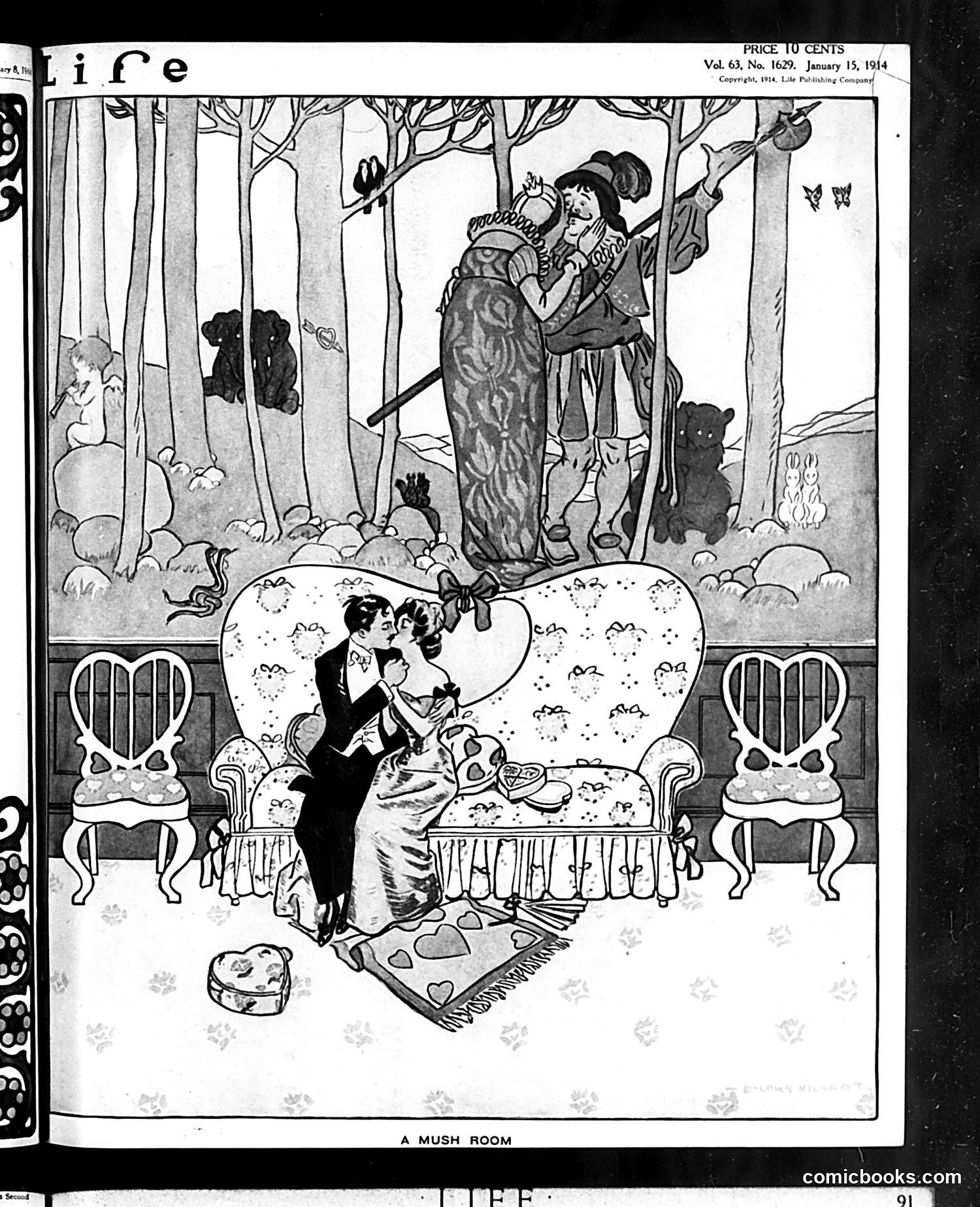
This cartoon uses a double visual pun on "mushroom." The title caption refers to a romantic rendezvous on a mushroom-shaped seat in an idealized forest setting (upper panel). The lower panel depicts a couple on an ornate couch in what appears to be a parlor, with heart-shaped chair backs and romantic decorations. The satire contrasts two versions of romance: the storybook fantasy (top, featuring fairy-tale figures and nature) versus reality (bottom, showing actual people in domestic settings). The humor targets the gap between romantic idealization and mundane reality—people imagine themselves in enchanted forests, but actually court in ordinary living rooms. This reflects period anxieties about modern urbanization versus nostalgic pastoral ideals.
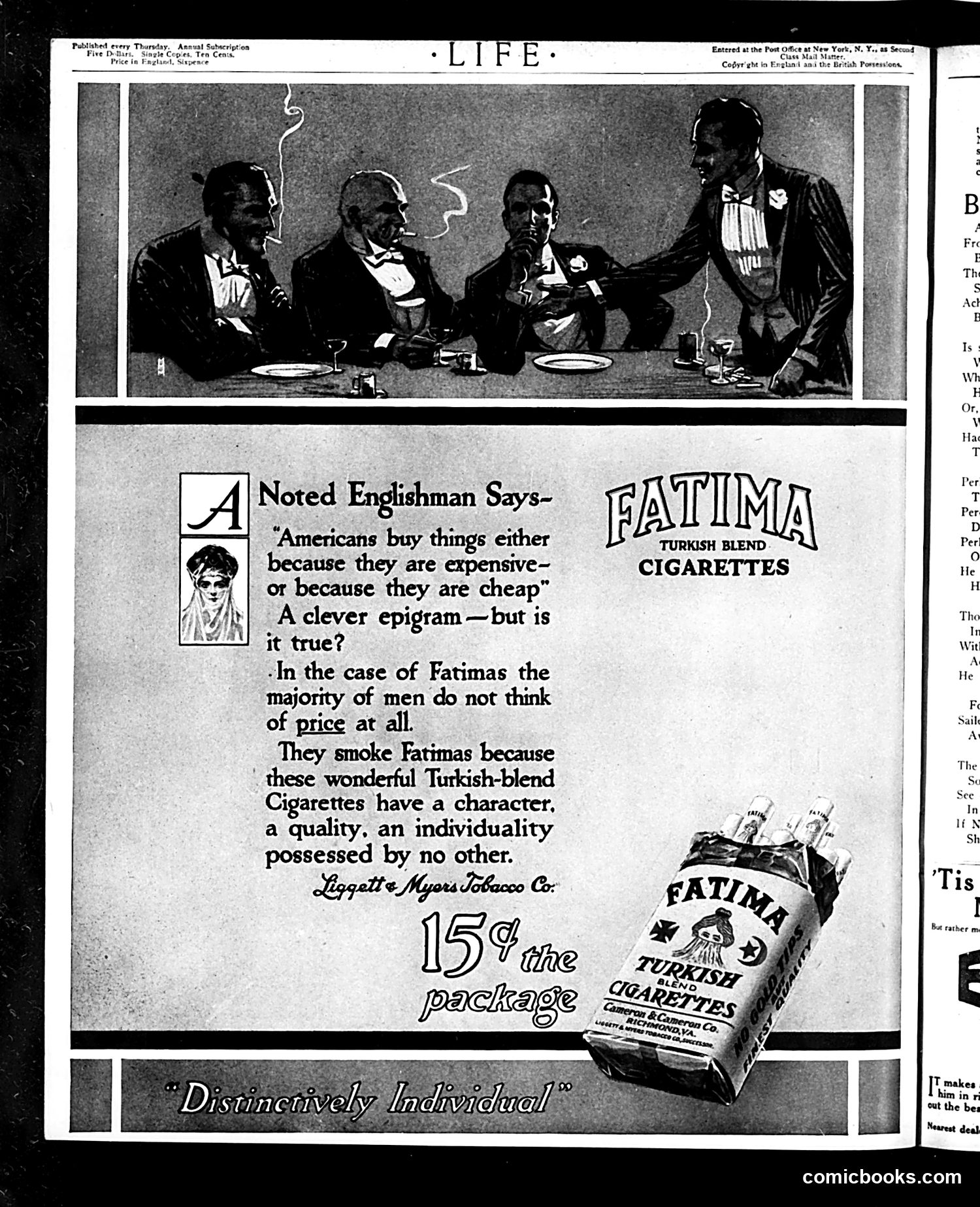
This page is primarily **advertising**, not political commentary. The top photograph shows four formally dressed men at a dinner table—their specific identities are unclear from the image alone. The main content is a **Fatima Turkish Blend Cigarettes advertisement** (15¢ per package). It quotes "a noted Englishman" making an epigram about American consumer behavior: people buy things either because they're expensive or cheap. The ad then argues Fatima cigarettes are purchased for neither reason, but rather for their unique "character" and "individuality." The tagline "Distinctively Individual" emphasizes brand differentiation. This represents early 20th-century marketing strategy—selling products on quality and personality rather than price. The photograph likely serves as aspirational imagery of sophistication, though the specific figures remain unidentified.
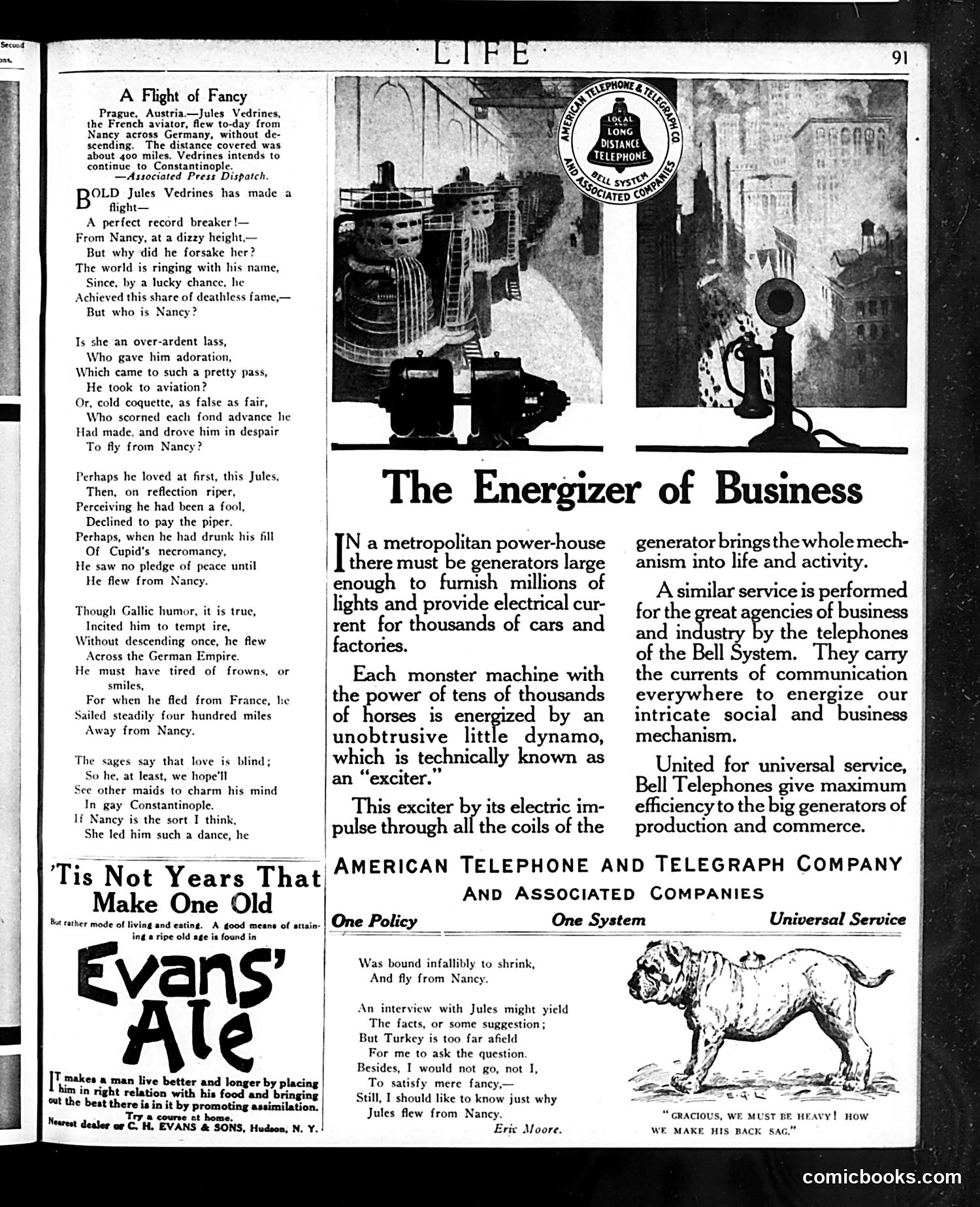
This page is primarily **advertising**, not political satire. The dominant content is a Bell Telephone System advertisement ("The Energizer of Business"), comparing telephone infrastructure to electrical generators—both providing essential power to metropolitan life and commerce. The ad emphasizes unified service across the Bell network. A secondary ad promotes **Evans' Ale**, claiming it promotes health and longevity through proper nutrition. The upper left contains a poem titled "A Flight of Fancy" about Jules Vedrines (a real French aviator) and a romantic figure named Nancy, satirizing the public's fascination with early aviation achievements. The poem questions why Vedrines abandoned Nancy for aviation fame—light social commentary rather than political satire. The page represents early 20th-century magazine content mixing advertising with lifestyle commentary.
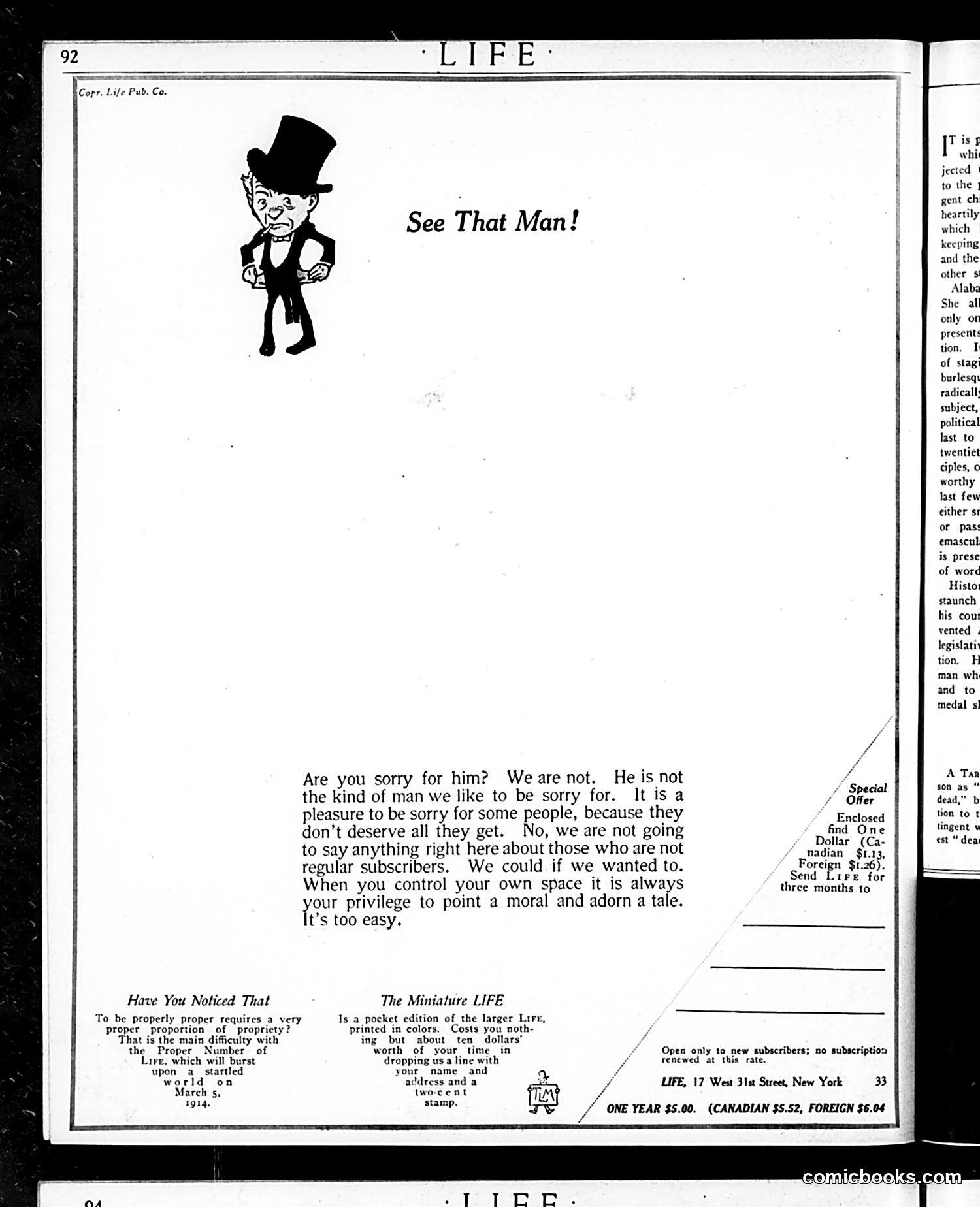
This page features a satirical cartoon attacking an unnamed figure depicted as a scrawny, angry man in formal dress (top hat and tails). The accompanying text, titled "See That Man!" explicitly refuses to sympathize with him, stating "He is not the kind of man we like to be sorry for." The satire targets someone Life considers morally objectionable, though the specific identity remains unclear from this page alone. The text suggests he's a public figure worthy of criticism—possibly a politician or businessman—whom the magazine considers hypocritical or undeserving of sympathy. The remainder of the page contains Life magazine advertisements and subscription information, indicating this was standard editorial content mixed with commercial material in early 20th-century American satirical publications.
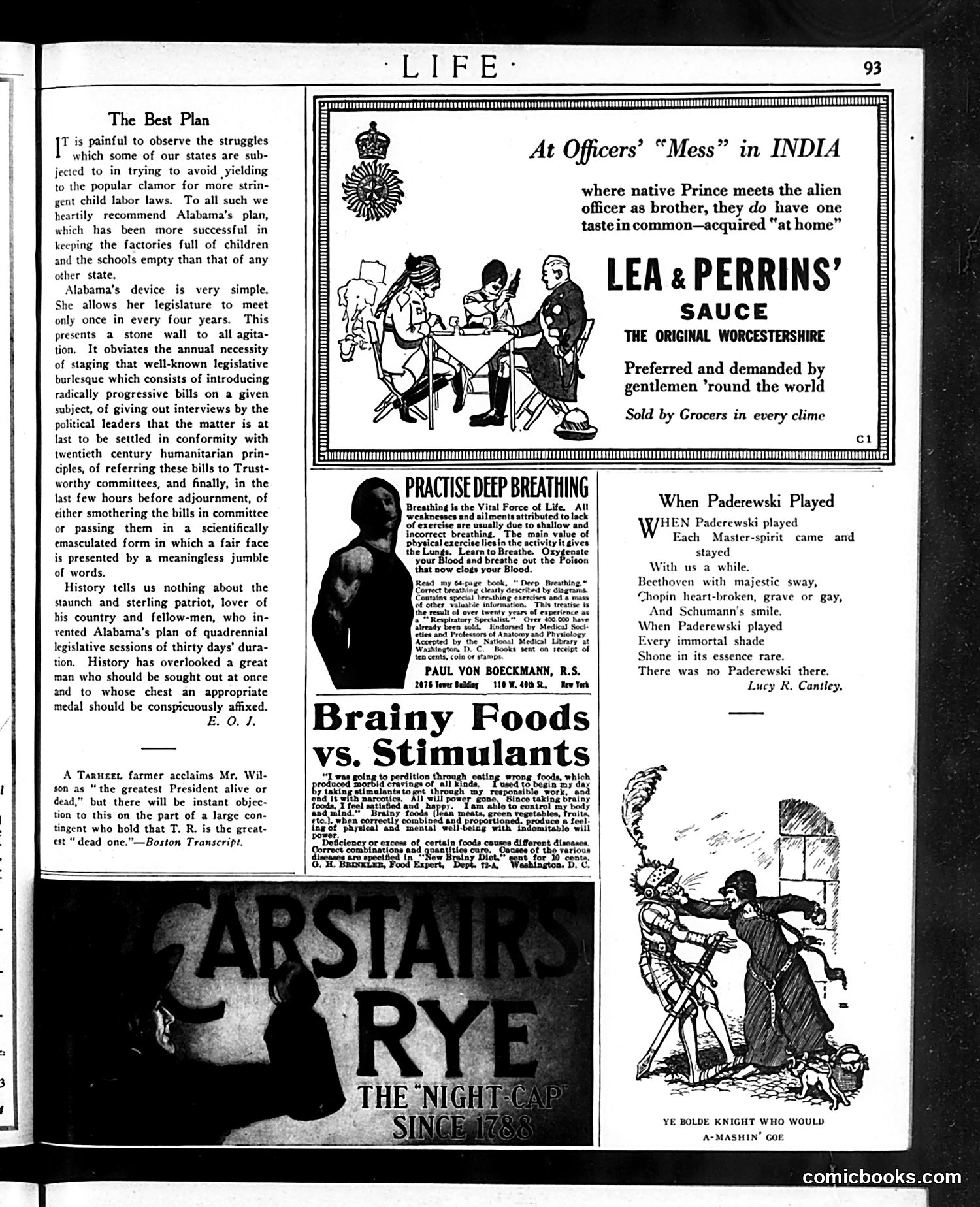
This page is primarily **advertising and filler content** rather than political satire. The main elements include: - **"The Best Plan"** article criticizing Alabama's child labor laws, advocating for legislative reform - **Lea & Perrins' Sauce advertisement** depicting British officers and an Indian prince dining together, emphasizing their "common taste" - **Deep breathing/health advice** from Paul von Boeckmann - **"Brainy Foods vs. Stimulants"** nutritional article - **A poem about Paderewski** (the famous pianist) - **Period advertisements** for Zarstairs Rye whiskey and a knight-themed illustration The page reflects early 20th-century concerns: child welfare reform, imperial British culture, health fads, and celebrity culture. The Indian prince/British officer ad subtly normalizes colonial hierarchy through shared "refined" tastes.
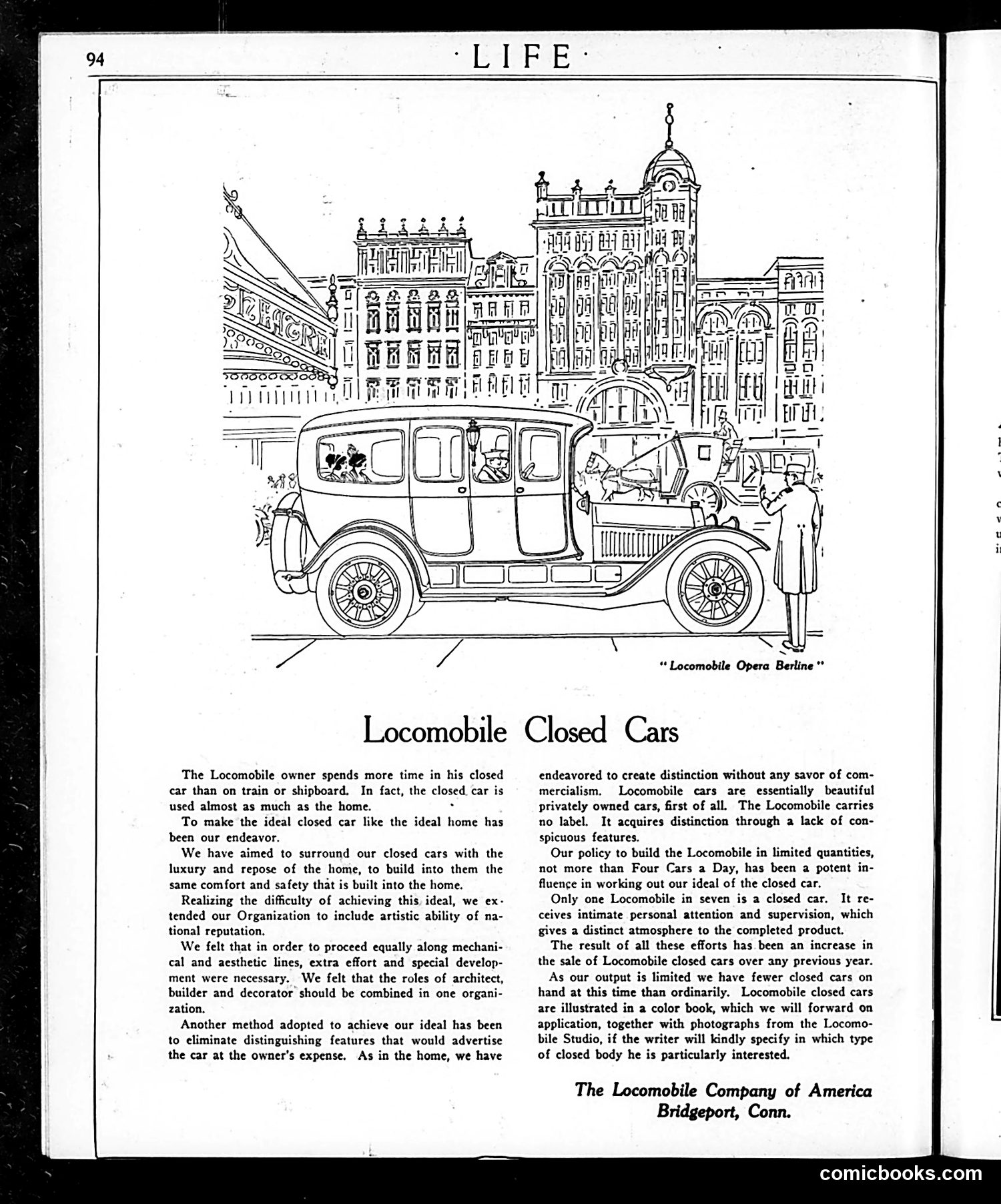
This page is **not satirical or political**—it's an advertisement for Locomotile automobiles. The illustration shows a "Locomotile Opera Berlina," a luxury closed automobile parked before an elegant urban building, with well-dressed passengers and pedestrians. The accompanying text emphasizes that Locomotile closed cars offer home-like comfort and luxury. The company argues their vehicles receive "intimate personal attention and supervision," limiting production to "not more than Four Cars a Day" to maintain quality. They stress aesthetic refinement without "conspicuous features" that would advertise the car's expense. This is early automotive marketing targeting wealthy consumers seeking discretion and elegance. There is no satire or political content—simply a straightforward luxury goods advertisement from Life magazine's advertising pages.
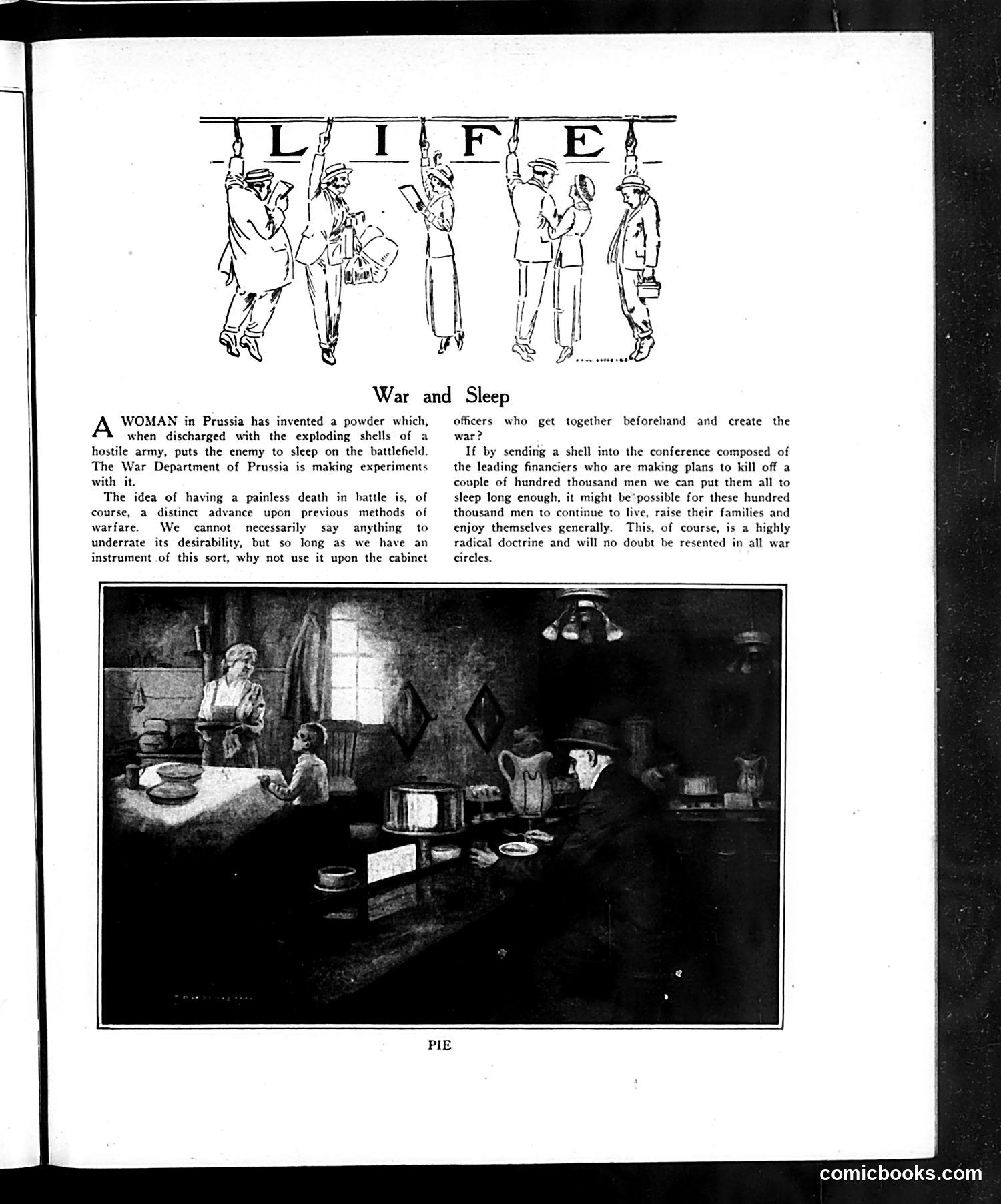
This page satirizes a Prussian woman's invention: a sleep-inducing powder that, when mixed with exploding shells, would put enemy soldiers to sleep on the battlefield instead of killing them. The satire mocks both the invention's impracticality and its naive humanitarian premise. The text sardonically notes that while a "painless death" would be an advance, such a powder could theoretically end warfare by putting enemy leadership to sleep during peace conferences—allowing soldiers to live and families to remain intact. The illustration titled "PIE" depicts what appears to be a domestic kitchen scene, likely contrasting the homely reality of cooking with the absurdity of the military scheme described above. The satire critiques Prussian militarism while questioning whether such a "radical doctrine" would ever be accepted in wartime.
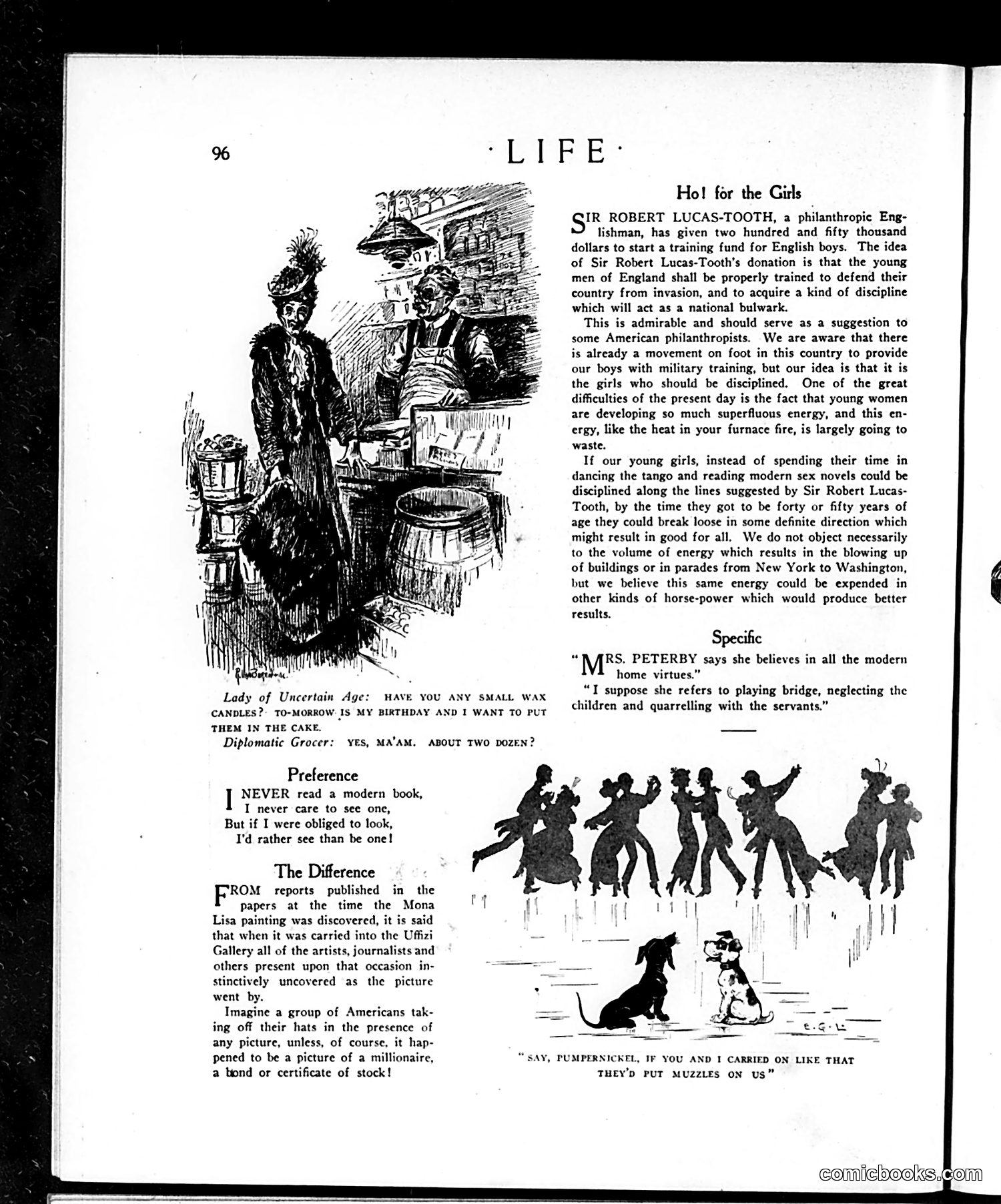
This page critiques proposals to militarily train English girls, inspired by Sir Robert Lucas-Tooth's £250,000 donation for boys' military training. The article sarcastically argues that girls—not boys—should receive discipline, claiming young women waste energy on frivolous activities like "dancing the tango and reading modern sex novels." The author suggests redirecting this "horse-power" toward useful training. The cartoon below ("Preference") mocks American attitudes toward modern art: it contrasts refined European appreciation of the Mona Lisa with crude American pragmatism—Americans allegedly only admire art if it belonged to a millionaire or has a certificate of authenticity, missing the point entirely. Both sections satirize class pretension and gender assumptions of the Edwardian era.
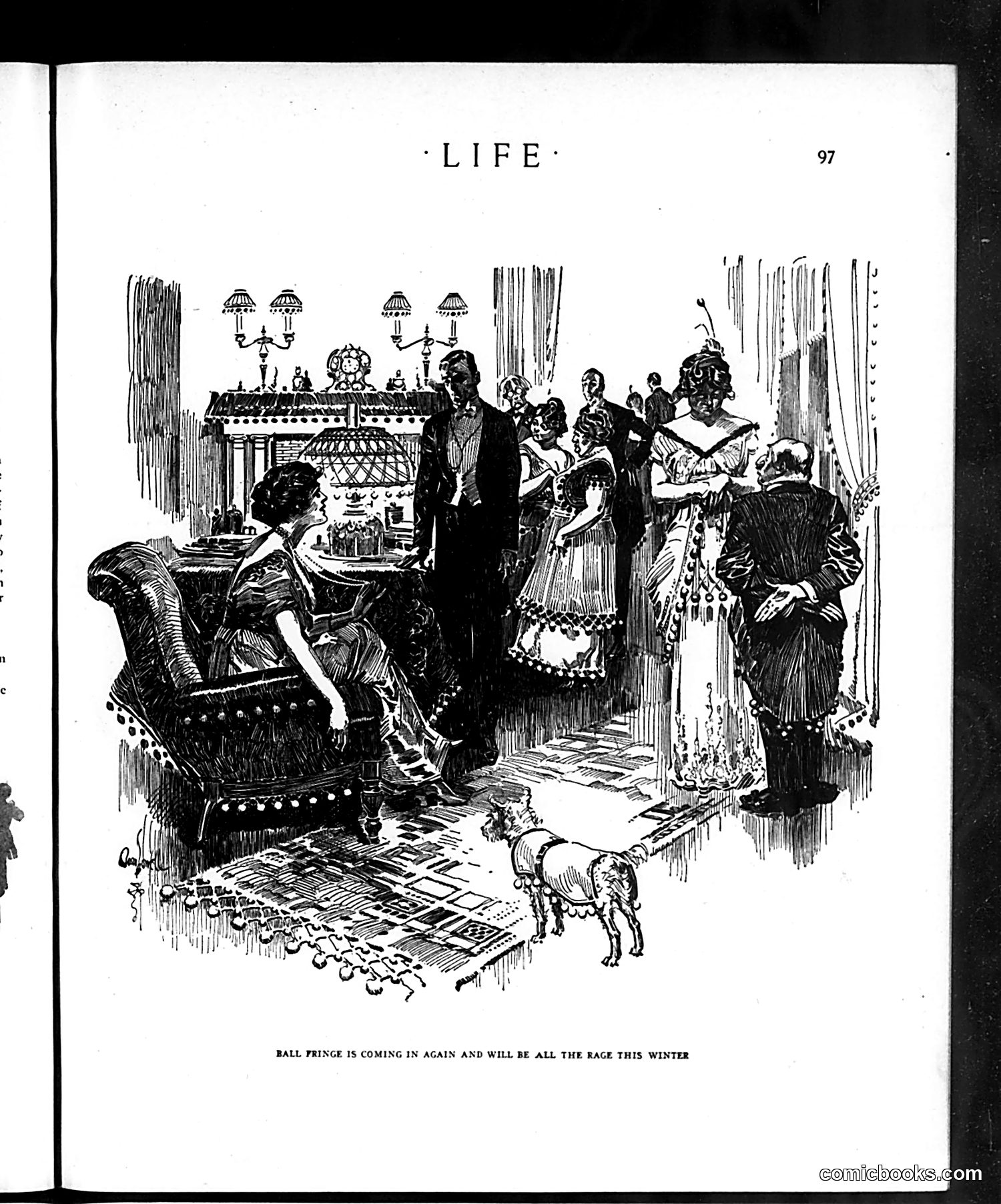
This is a single satirical illustration depicting an elegant society gathering—likely a ball or formal reception. The caption reads: "BALL FRINGE IS COMING IN AGAIN AND WILL BE ALL THE RAGE THIS WINTER." The humor is a **fashion satire**. The illustration shows fashionable society women and men in formal dress at what appears to be a high-society event. A small dog wearing decorative fringe is prominently featured in the foreground, which is the joke's visual punchline: the satirist is suggesting that "ball fringe"—decorative trim—will become so fashionable that even dogs will be outfitted in it. This mocks the tendency of the wealthy elite to adopt frivolous trends uncritically. The contrast between the serious formal gathering and the absurdity of dressing a dog in fashionable fringe creates the satirical commentary on vanity and status-conscious behavior.
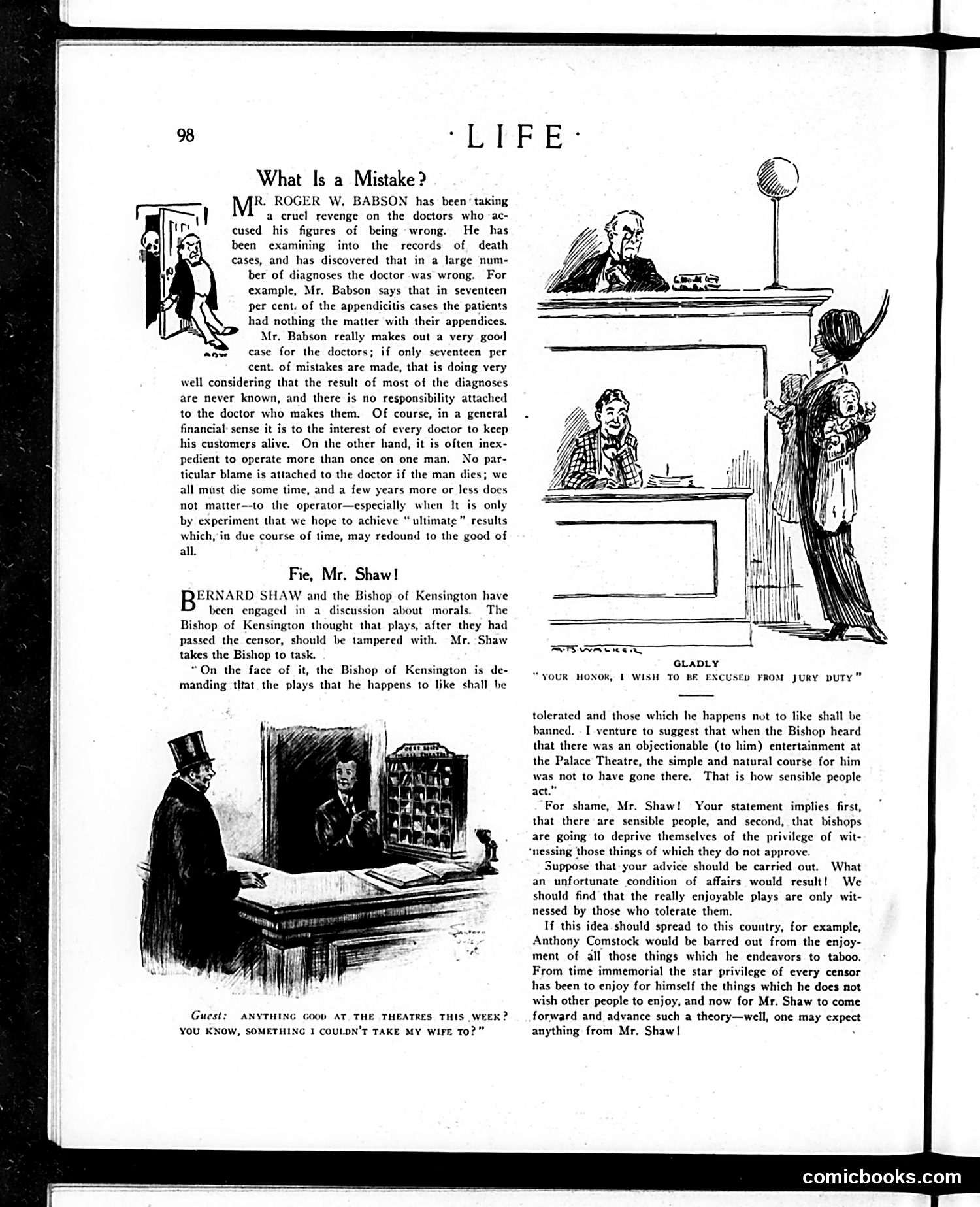
This page contains two satirical pieces targeting prominent figures of the era. **"What Is a Mistake?"** discusses Mr. Roger W. Babson's critique of doctors' diagnostic errors, arguing that failed diagnoses shouldn't be blamed since experimental treatment sometimes yields unforeseen benefits. **"Fie, Mr. Shaw!"** attacks Bernard Shaw and the Bishop of Kensington regarding theater censorship. Shaw apparently advised that plays should be "tampered with" by censors, while the Bishop demanded pre-approval of performances. The author sarcastically mocks Shaw's position, suggesting censorship would eliminate all entertainment and personal freedom of choice. The accompanying cartoons—a domestic scene and a theater scene—visually reinforce these arguments through satirical illustration typical of early 20th-century American humor magazines.
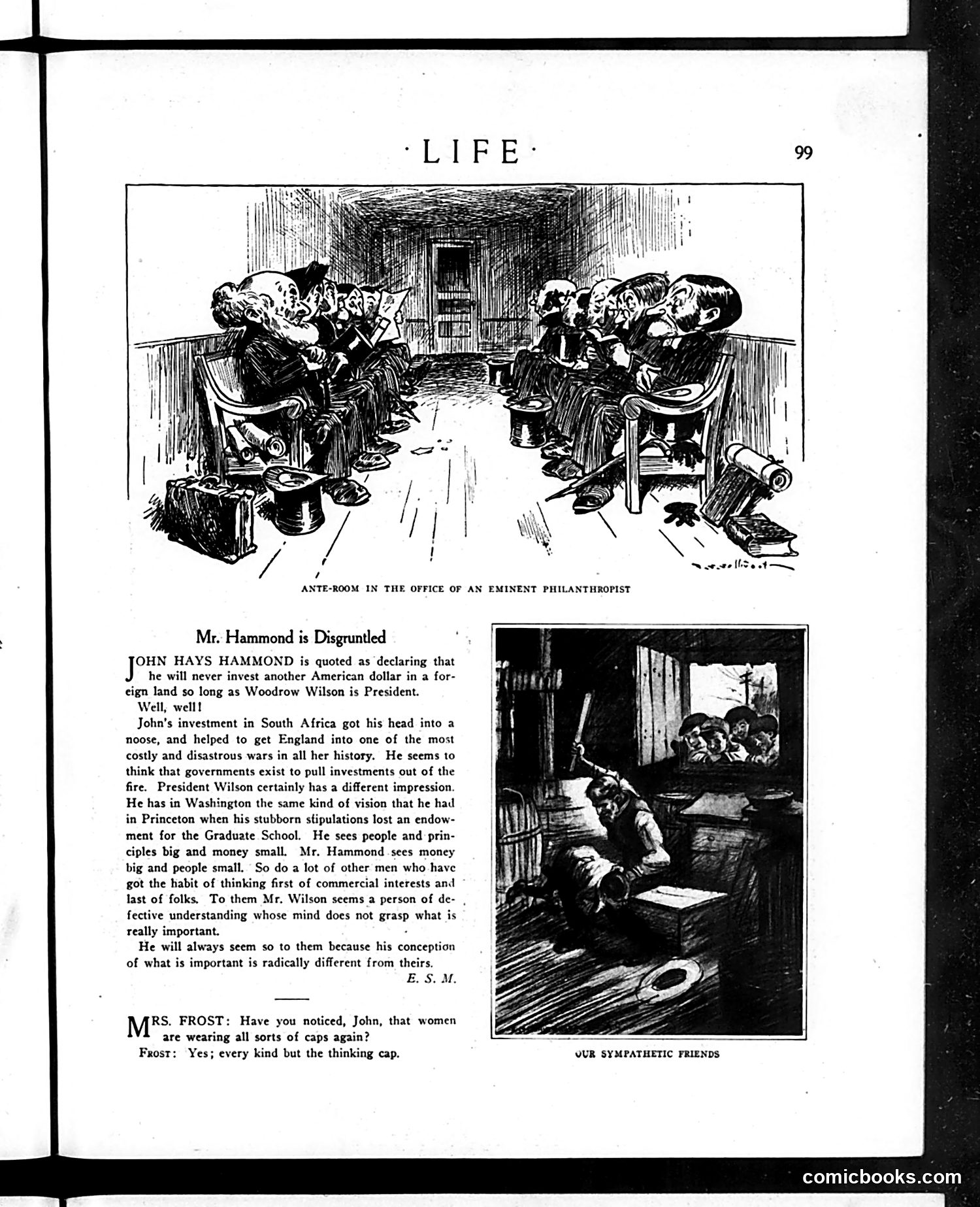
**Top Cartoon**: "Ante-room in the Office of an Eminent Philanthropist" depicts wealthy figures seated facing each other in a sparse room. The satire mocks wealthy donors' self-importance during charitable meetings—suggesting philanthropists spend time congratulating themselves rather than actually helping people. **Article "Mr. Hammond is Disgruntled"**: Criticizes businessman John Hays Hammond for declaring he won't invest in America while Woodrow Wilson is President. The author (E.S.M.) defends Wilson, arguing Hammond prioritizes money over principles. Hammond apparently views Wilson as impractical for thinking "big" about governance rather than commercial interests—a contrast the author uses to critique Hammond's narrow worldview. **Bottom Joke**: A brief exchange about women wearing various hats, with the punchline that women wear every hat type "but the thinking cap."
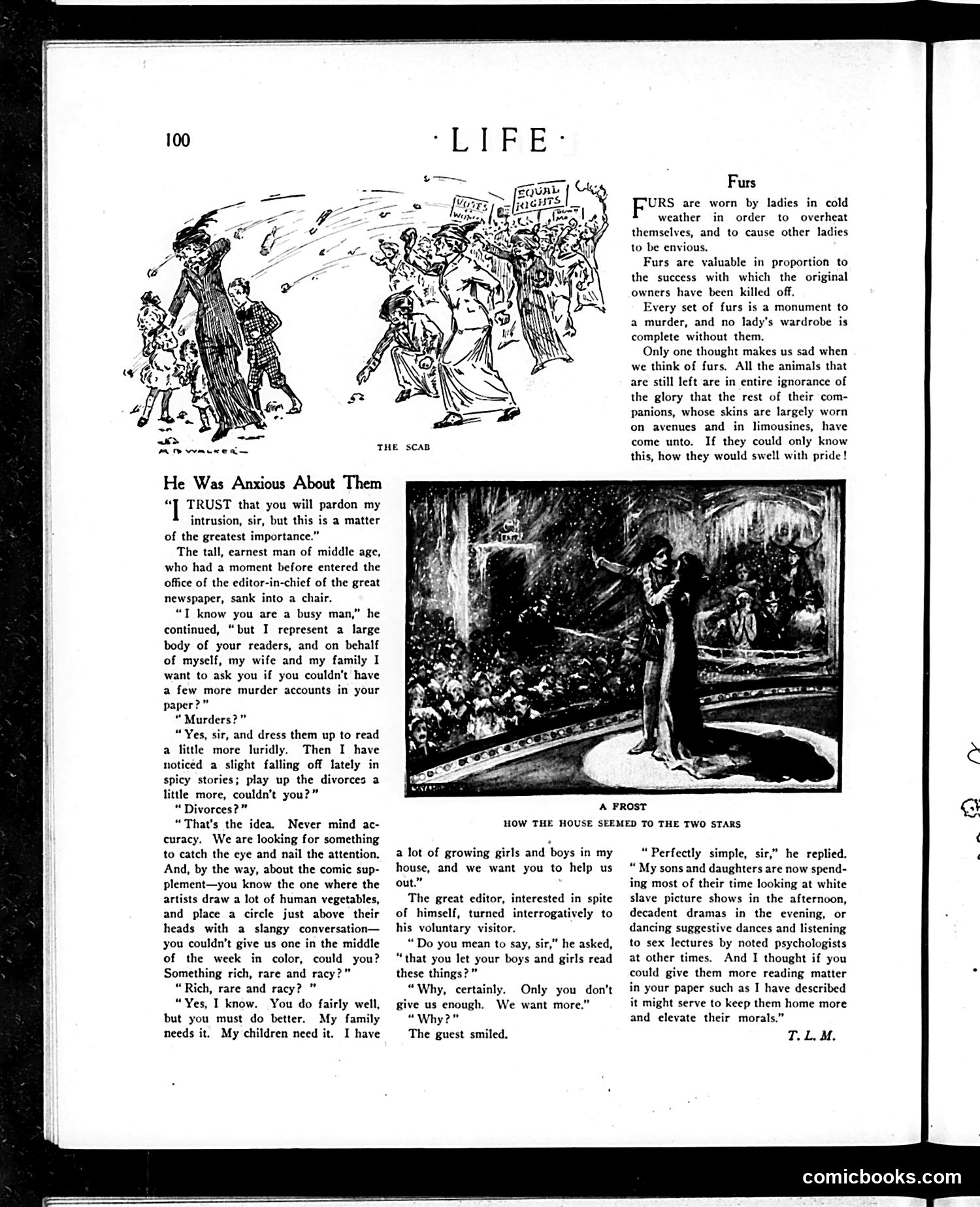
This page contains a satirical article titled "He Was Anxious About Them" featuring two cartoons. The main cartoon "THE SCAB" depicts striking workers confronting what appears to be a strikebreaker (scab), a common labor dispute image from the early 20th century. The accompanying article mocks a newspaper editor's visitor—a wealthy man requesting "murder accounts" for entertainment reading. The satire critiques both upper-class sensationalism and the disconnect between society's elite and working-class struggles. The secondary cartoon "A FROST: HOW THE HOUSE SEEMED TO THE TWO STARS" appears unrelated, depicting theatrical figures. The page concludes with a humorous piece on fur coats, sardonically noting animals' hypothetical pride at their skins adorning city streets and limousines.
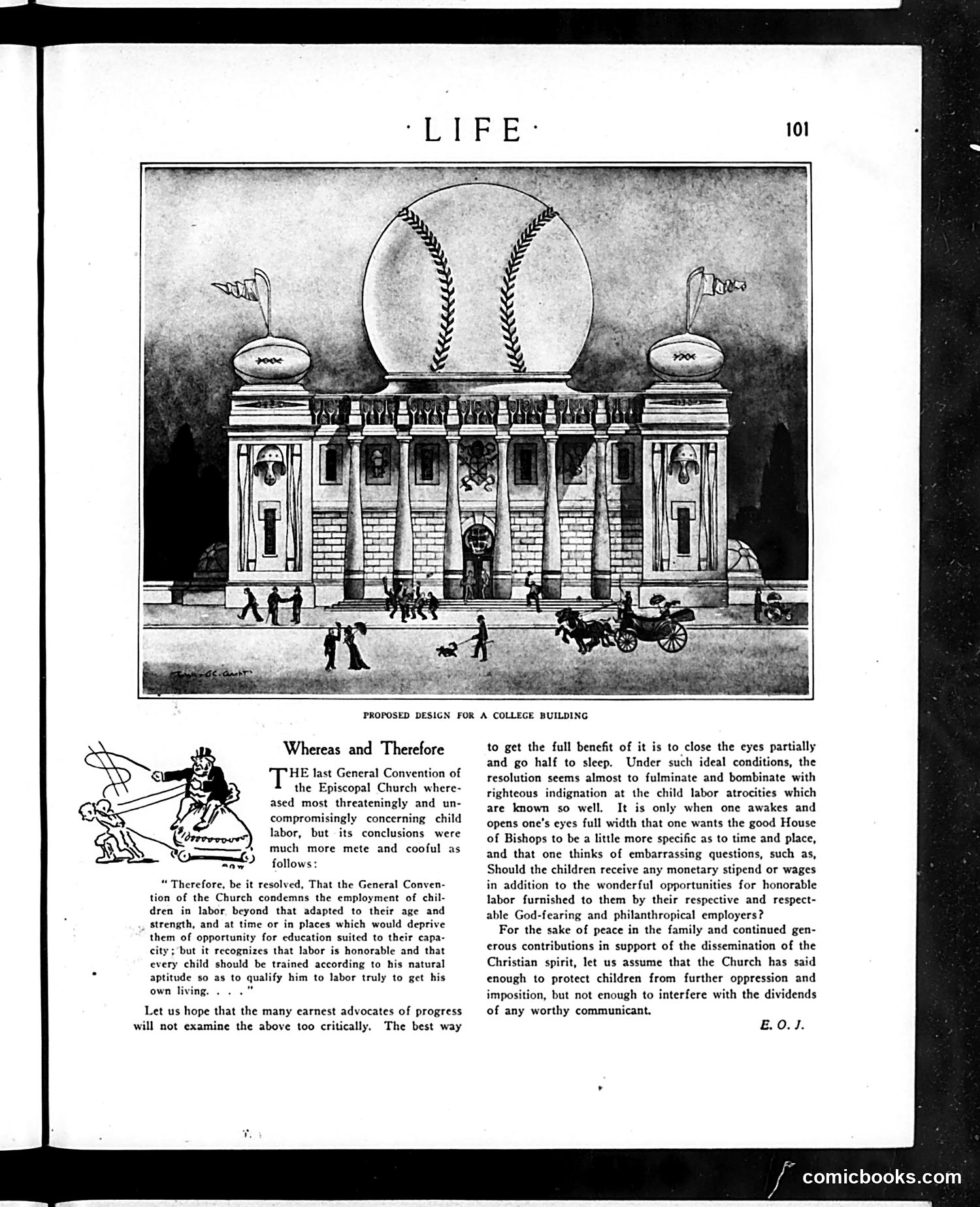
This page contains an architectural illustration labeled "Proposed Design for a College Building" topped with a baseball, alongside satirical editorial commentary on child labor. The main text, titled "Whereas and Therefore," sarcastically critiques the Episcopal Church's recent General Convention resolutions on child labor. The church condemned child labor "uncompromisingly" but used vague language about "time or place" that wouldn't actually prevent it. The editorial mocks this as hypocritical—the church provides fine-sounding principles without enforcing specifics. The small cartoon (left) depicts a figure with a whip, likely representing exploitative employers or authority figures continuing to abuse children despite the Church's toothless condemnation. The satire argues that unless the Church explicitly prevents dividends to shareholders profiting from child labor, its resolution is meaningless rhetoric protecting economic interests over children's welfare.
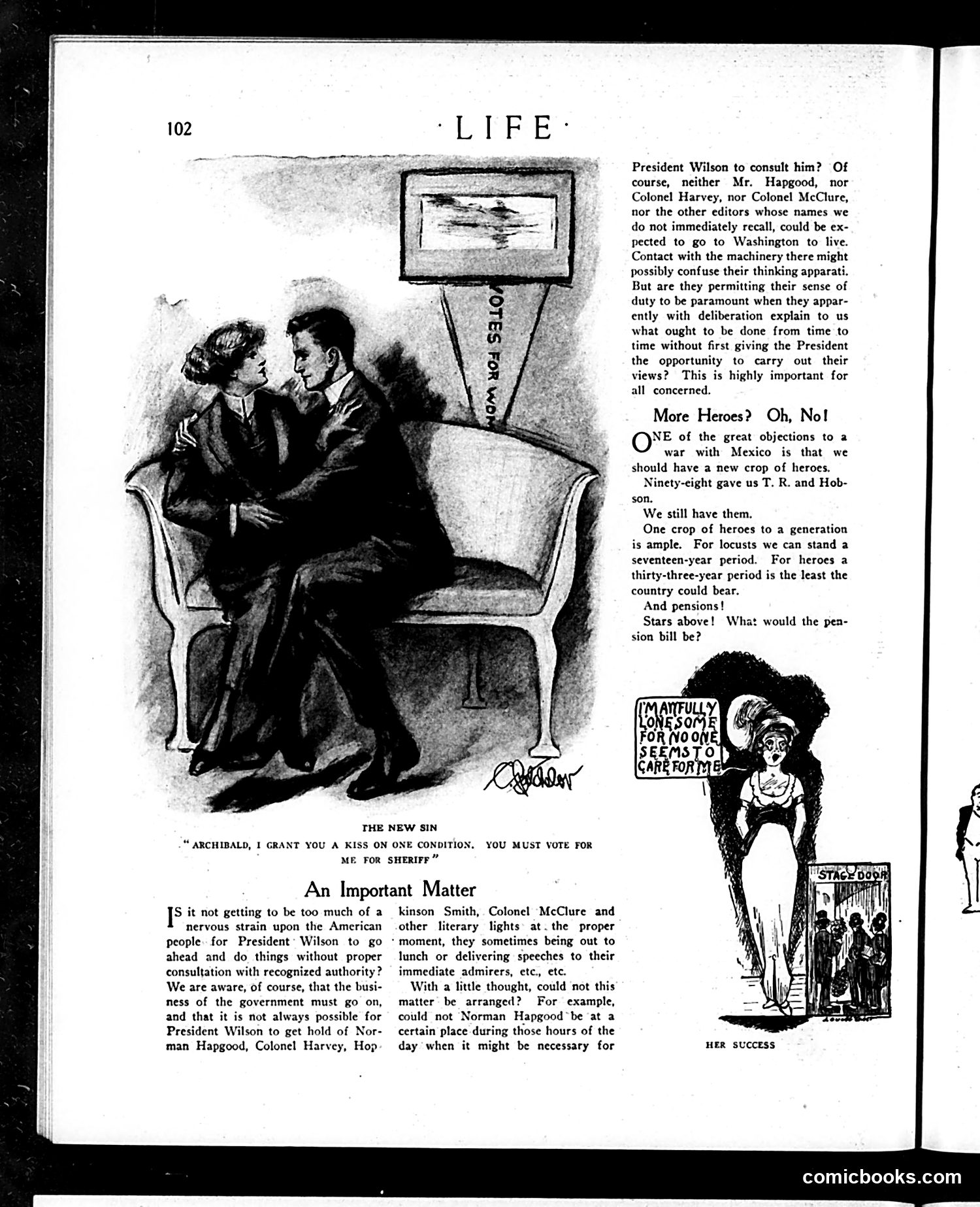
The main cartoon "The New Sin" depicts two figures in conversation, with one saying "Archibald, I grant you a kiss on one condition. You must vote for me for sheriff." This satirizes **political corruption and voter manipulation**, suggesting that even intimate relationships are being exploited for political gain. The caption criticizes how politicians use personal favors or leverage to secure votes. The accompanying text "An Important Matter" discusses whether President Wilson should consult with various government figures (Hapgood, Harvey, McClure) before making decisions, raising concerns about **proper governmental consultation and executive authority**. The smaller cartoon "Her Success" (lower right) appears to address women's political participation or influence, though the exact reference is unclear from the visible text.
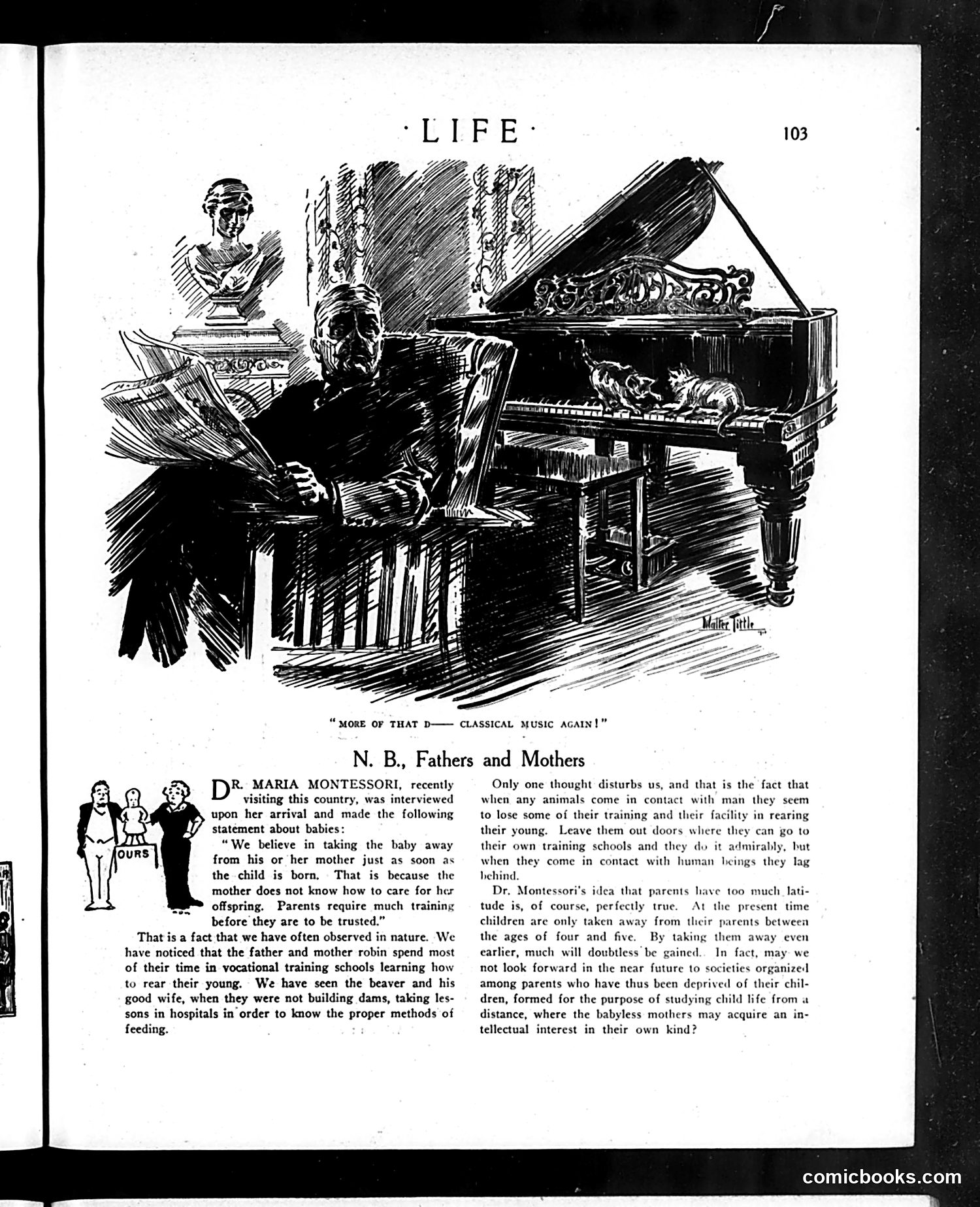
This page satirizes **Dr. Maria Montessori**, an Italian educator who recently visited America. The cartoon mocks her statement that babies should be separated from mothers at birth because parents lack training in childcare. **The satire's logic:** Life uses reductio ad absurdum, pointing out that animals (robins, beavers) naturally rear their young without formal training—yet Montessori insists human parents need institutional instruction. The piece sarcastically suggests that if we follow her logic, we should create organizations where childless mothers study their own children "from a distance" like laboratory subjects. **The top cartoon** shows a man at a piano with the caption "More of that d—— classical music again!"—likely suggesting that Montessori's educational theories represent unwanted, imported European refinement imposed on practical American life. The article ridicules progressive early-education ideas as disconnected from natural parenting instincts, reflecting early 20th-century skepticism toward both European pedagogical innovation and the removal of children from parental care.
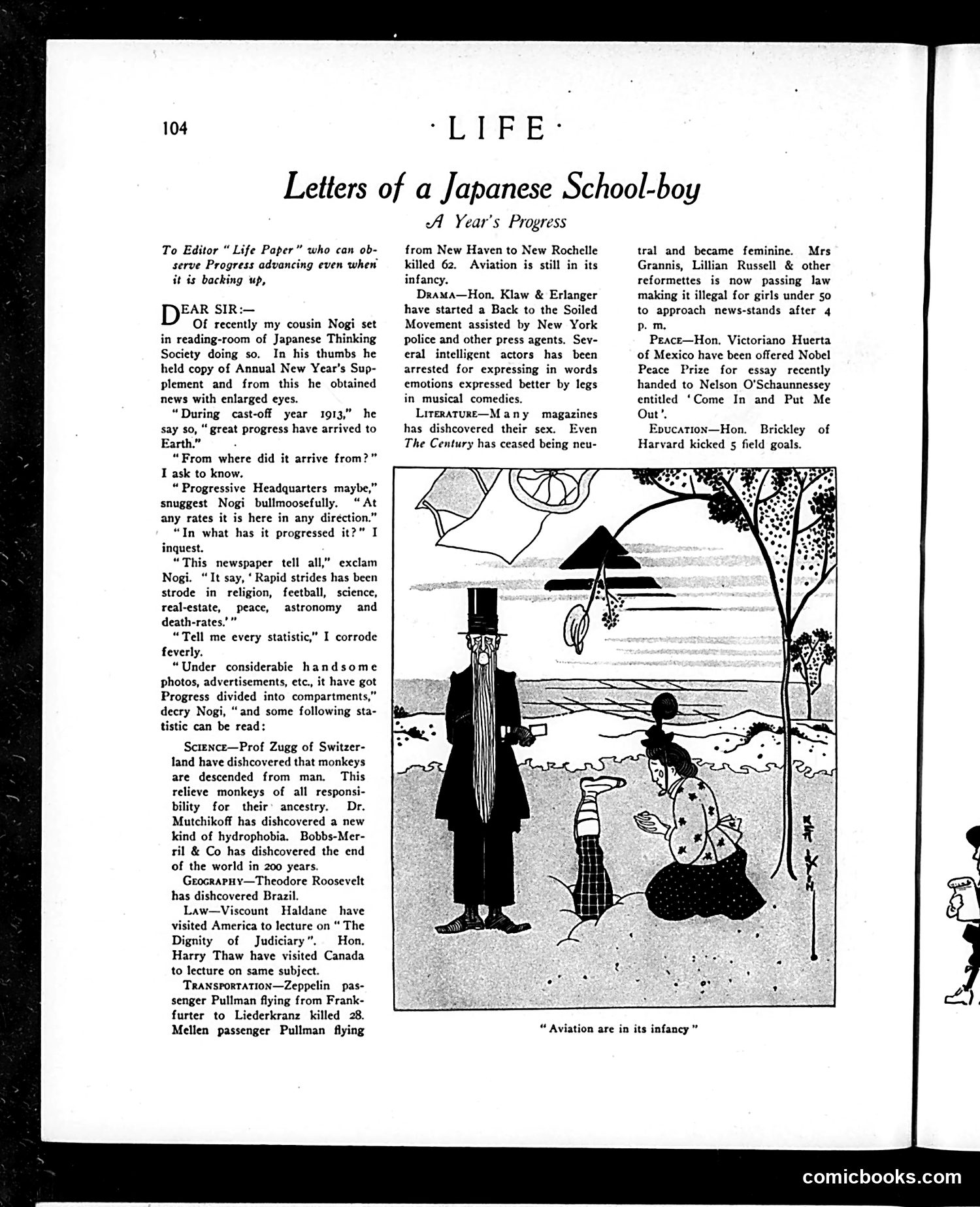
This 1913 *Life* magazine satire mocks the era's obsession with "progress" through a Japanese schoolboy's letter. The humor relies on broken English (a period stereotype) to undercut American self-congratulation. The cartoon illustrates "Aviation are in its infancy"—showing an early, primitive aircraft alongside conventional transportation, emphasizing aviation's dangerous infancy (the text notes multiple Zeppelin and airplane crashes killing dozens). The satirized "progress" items are absurd or backwards: evolution supposedly *relieves* monkeys of responsibility; Theodore Roosevelt "discovering" Brazil (mocking his famous 1913 expedition); Harry Thaw lecturing on judicial dignity (he was notorious for murdering architect Stanford White); and the "Back to the Soiled Movement" in theater (appearing to mock Broadway's commercial degradation). The overall joke: America claims progress while actually retreating morally and socially—aviation crashes, theatrical corruption, and arbitrary laws restricting women reveal progress is illusory or "backing up," as the editor's note suggests.
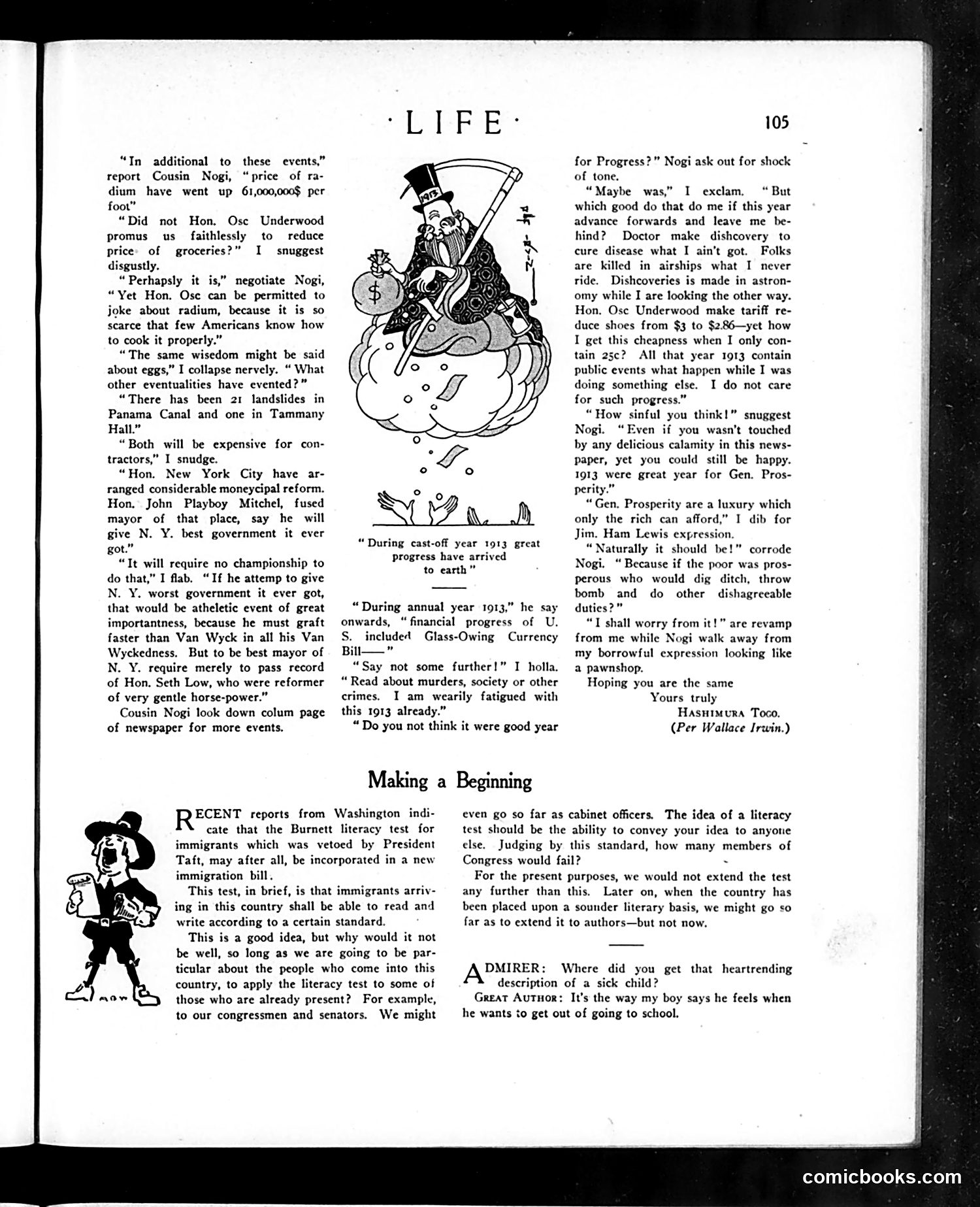
This page combines two satirical pieces. The upper section features "Cousin Nogi," a character speaking in deliberately fractured English, discussing 1913's "progress"—radium price inflation, Panama Canal scandals, New York City reform under Mayor John Purroy Mitchel, and tariff reductions. The satire mocks that such progress benefits only the wealthy while ordinary people remain unaffected; the poor narrator sardonically notes that scientific discoveries and political reforms mean nothing to him when he has only 25 cents. The lower section, "Making a Beginning," critiques the proposed Burnett literacy test for immigrants (vetoed by President Taft, but being reconsidered). Life argues the test is sensible but questions why it shouldn't apply to existing congressmen and senators—implying many elected officials would fail such a standard. Both pieces deploy dark humor to challenge Progressive Era optimism about "progress" and immigrant restrictions by exposing their hypocrisy and limited practical benefit.
This page contains two editorial pieces reflecting Progressive Era concerns: **J.P. Morgan's Retirement**: The main article celebrates the partial withdrawal of Morgan banking partners from railroad and corporate directorates. The author offers qualified praise for Morgan's past reorganizations (notably the 1893 railroad crisis and the Steel Trust formation), while sarcastically suggesting the new Federal Reserve currency law will now handle fiscal management better and "not charge so much for doing it." The tone is ambivalent—acknowledging Morgan's historical necessity while welcoming reduced banker influence over American industry. **Dr. Charles Eliot's Progressive Theology**: The second piece discusses Harvard president Eliot's published views on Christianity's "re-christianization," particularly the doctrine of human brotherhood. The author notes that democracy has finally enabled this Christian principle's practical implementation, and cites Eliot's claim that the past fifty years achieved more human progress toward brotherhood than all preceding Christian centuries. The piece treats this as mainstream Progressive ideology, mentioning William Jennings Bryan as another prominent advocate. Both pieces reflect 1914 Progressive concerns: banker regulation, Christian social ethics, and democratic reform.
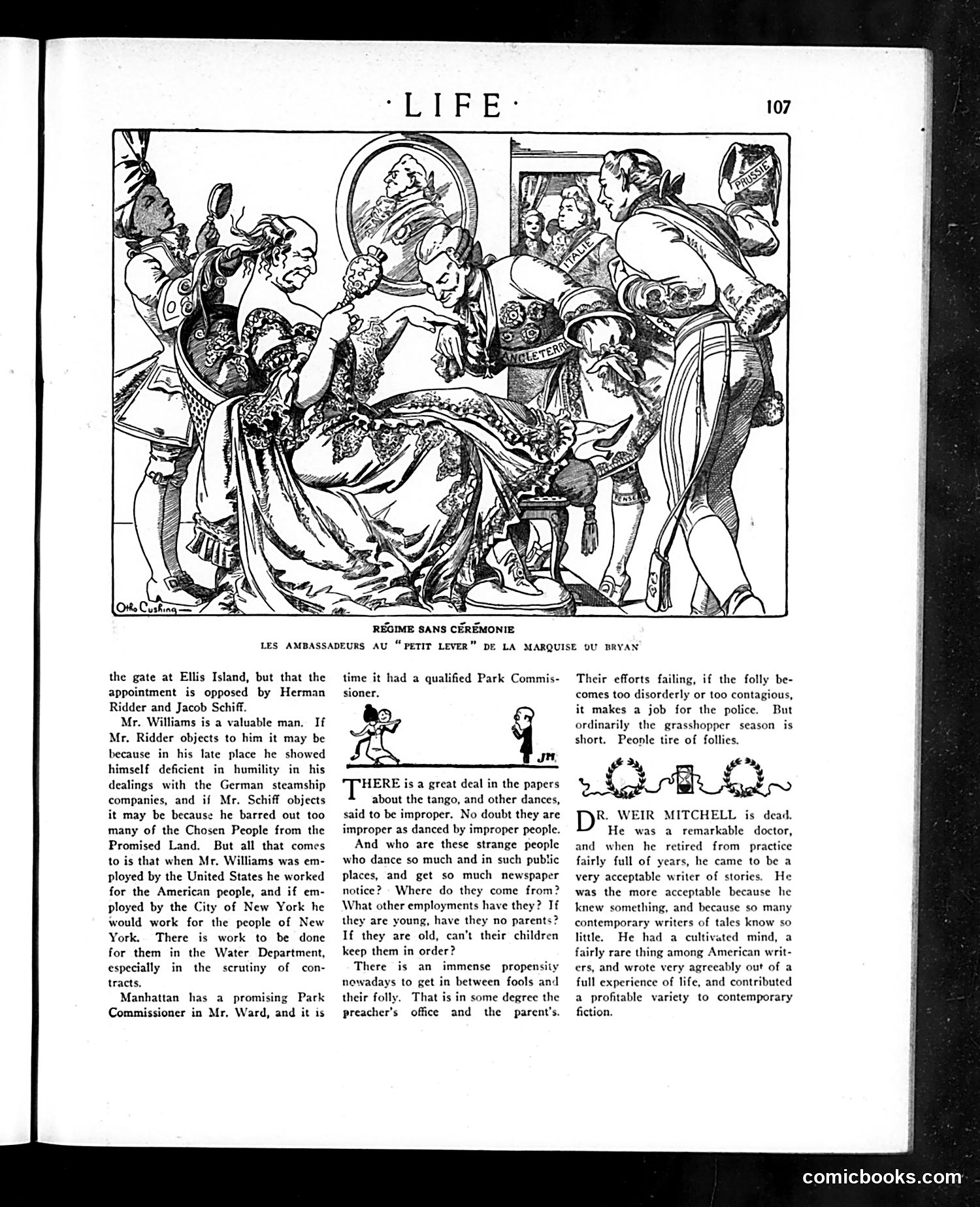
The top illustration satirizes high society's informal behavior. Titled "RÉGIME SANS CÉRÉMONIE" (Regime Without Ceremony), it depicts ambassadors at the "petit lever" (informal reception) of a Marquise or "Bryan"—likely referencing William Jennings Bryan, a three-time presidential candidate. The sketch mocks the pretense of formal diplomatic protocol being abandoned in actual practice, showing elaborately dressed diplomats in undignified poses. The text discusses New York City appointments and the tango dance craze. It defends a park appointee against opposition from Herman Ridder and Jacob Schiff, and dismisses moral panic about the tango as harmless folly that will fade. The page concludes with an obituary of Dr. S. Weir Mitchell, praising his medical credentials and subsequent literary contributions. The overall tone is irreverent mockery of social pretension and manufactured outrage.
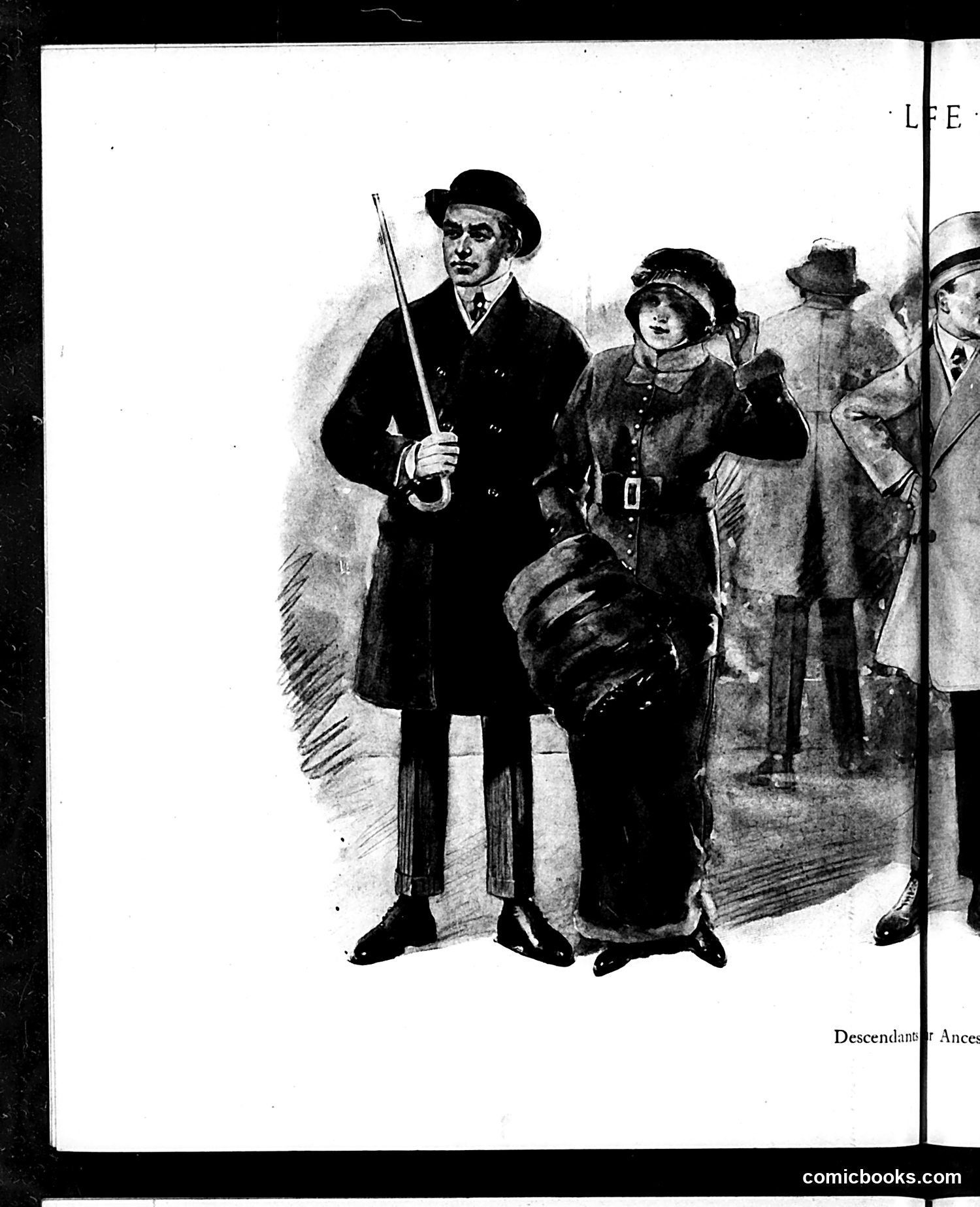
This appears to be a satirical illustration from *Life* magazine depicting a social hierarchy or class commentary. The central figure—a tall man in formal attire holding a cane—stands prominently, suggesting wealth or authority. He's positioned above a smaller, crouching figure, with other formally-dressed observers in the background. The caption "Descendants of Ancestors" suggests satire about genealogy, ancestry claims, or social pretension. The stark size difference and posturing likely mock either class distinctions, social climbing, or the absurdity of lineage-based status claims. Without identifying specific historical figures, the overall composition appears to criticize social hierarchy or the hollow nature of aristocratic pretensions—a common *Life* magazine theme. The exact political context remains unclear without additional publication date information.
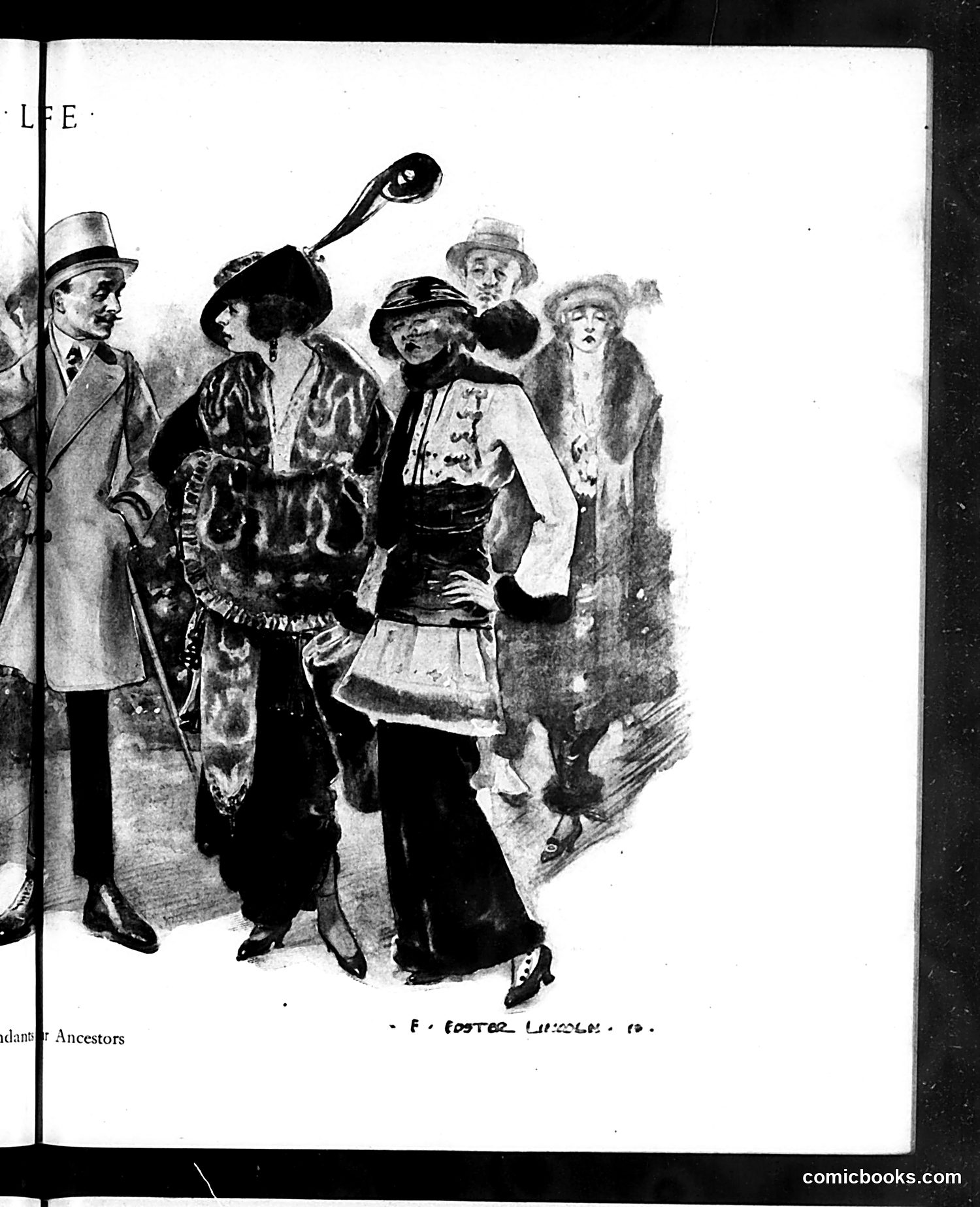
This appears to be a satirical illustration from *Life* magazine, credited to "E. Foster Lincoln" (visible at bottom). The cartoon depicts five figures in early 20th-century dress—men in suits and fedoras, women in fashionable coats and cloche hats typical of the 1920s era. The caption references "Ancestors," suggesting this is satirizing people's claimed or invented family lineages. The well-dressed, prosperous-looking group likely represents nouveaux riche or social climbers fabricating aristocratic pedigrees—a common *Life* magazine target. The humor derives from mocking Americans' pretensions to distinguished ancestry, particularly those lacking authentic credentials. The fashionable styling emphasizes their contemporary wealth rather than genuine historical legitimacy.
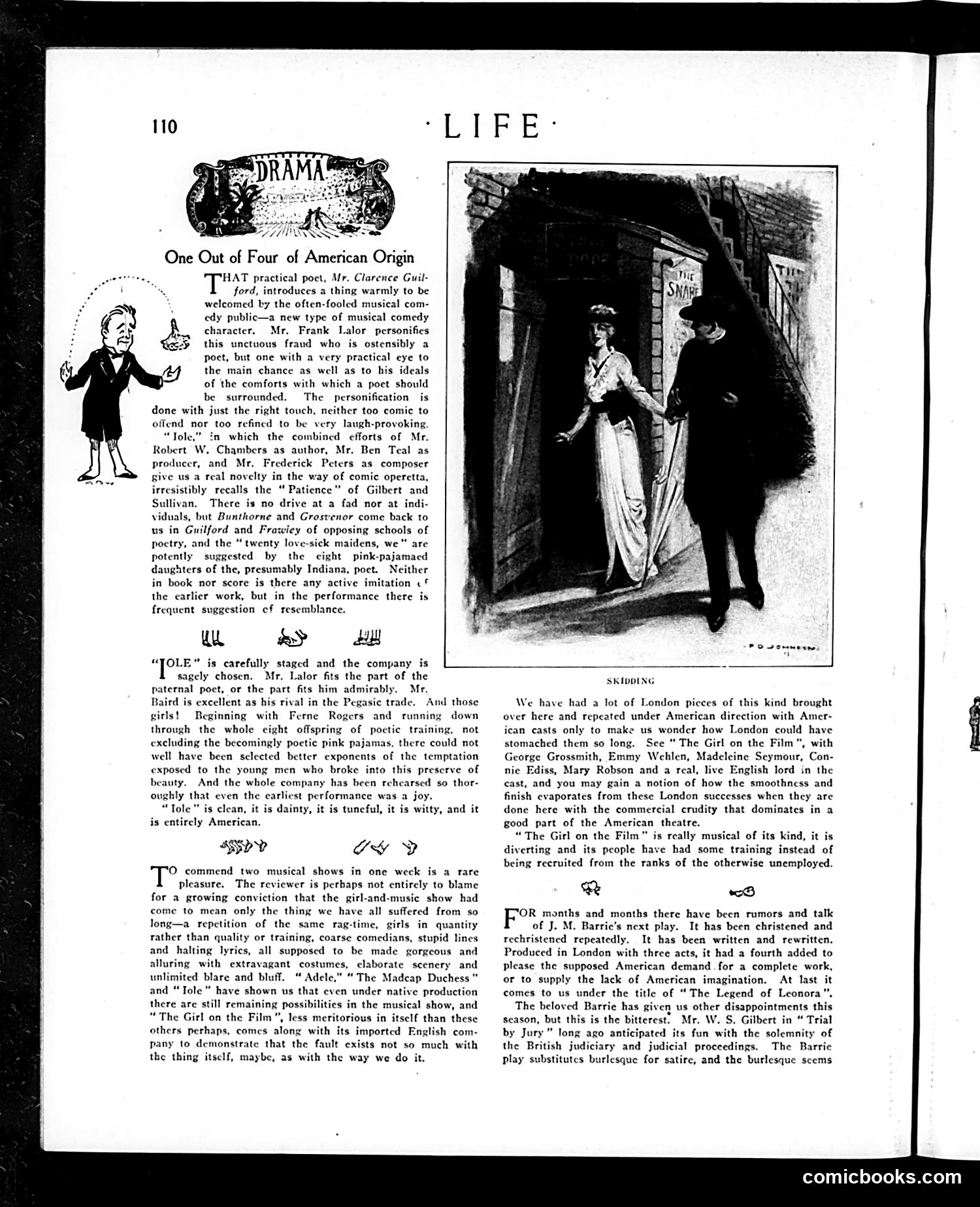
This page reviews three musical comedies, focusing on American theatrical production versus imported British work. **"Jole"** is praised as a novel American musical comedy featuring Frank Lalor as a fraudulent poet—a practical schemer masquerading as an artistic visionary. The review compares it favorably to Gilbert and Sullivan's "Patience," noting similar satire on poetry and aesthetics without direct imitation. **The Central Critique**: The reviewer argues that American musical shows have become formulaic—relying on "rag-time, girls in quantity rather than quality...coarse comedians, stupid lines and halting lyrics" hidden behind expensive costumes and scenery. **"The Girl on the Film"** (British import) is used to demonstrate this problem: London productions lose their "smoothness and finish" when produced in America with "commercial crudity." **The Satire's Point**: American theater prioritizes spectacle over substance, while even mediocre British imports reveal how poorly American producers execute musicals. The cartoonish figure on the left appears to represent the "unctuous fraud" character type—all flash and pretense.
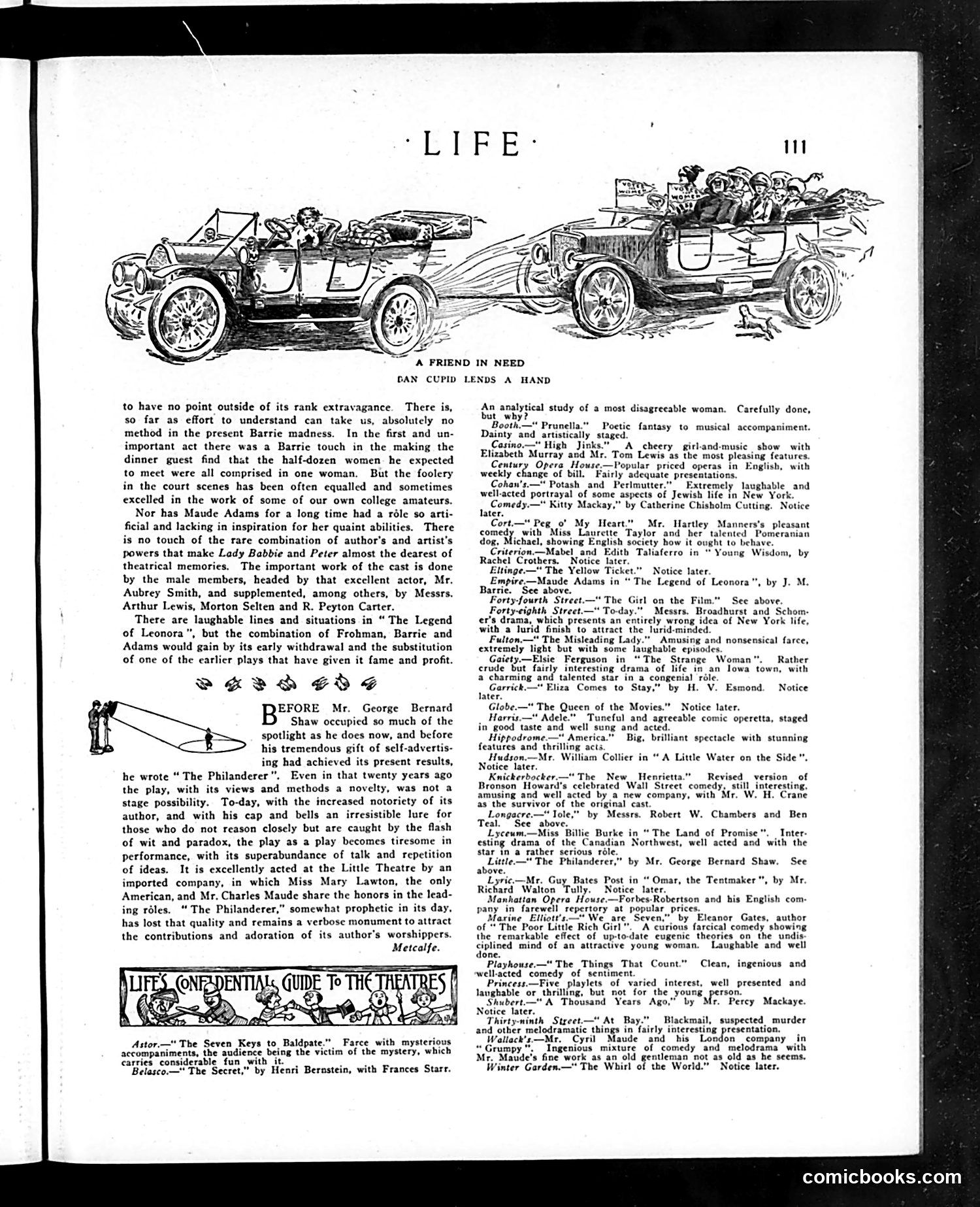
The illustration depicts two early automobiles in a comedic scenario: the first car has broken down or stalled, and the second vehicle—filled with passengers—arrives to assist. The caption suggests a romantic angle: "Cupid" (symbolizing romantic opportunity) helps when someone is "in need." The satire likely plays on the novelty of automobiles in this era—their unreliability and the social dynamics of early motoring. The crowded second car and the situation suggest humor around chance encounters, perhaps implying that breakdowns created opportunities for meeting potential romantic interests, or that helping stranded motorists was becoming a social practice worth noting. This reflects early 20th-century attitudes toward automobiles as both mechanical curiosities and social facilitators, before they became commonplace. The page is primarily theater reviews; this cartoon appears as light filler commentary on contemporary life.
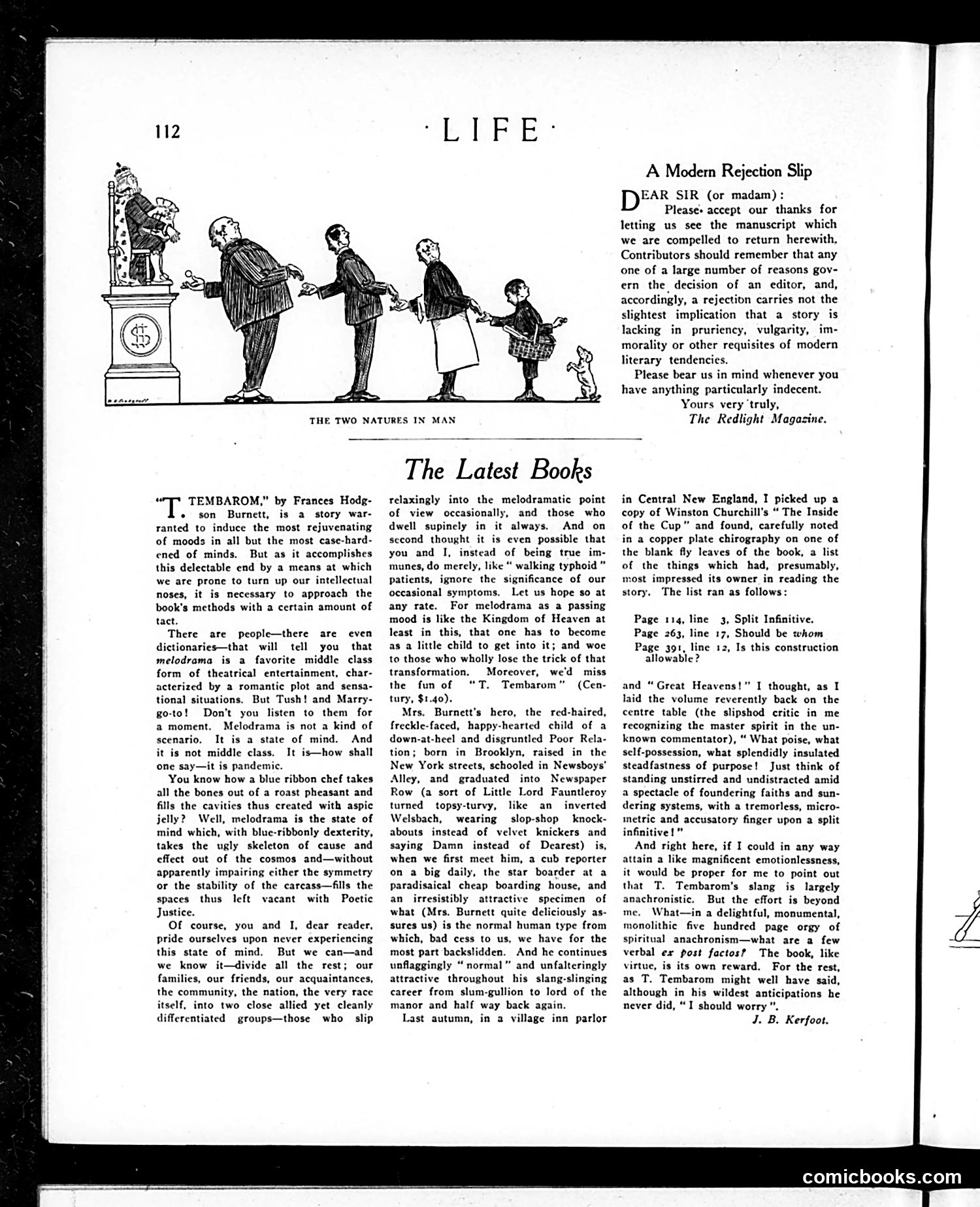
**The Cartoon "The Two Natures in Man":** The image depicts a clear class hierarchy: a statue of wealth (marked with a dollar sign) stands elevated while progressively smaller figures bow before it—from well-dressed gentlemen to a child to a small dog. This satirizes how greed and materialism reduce human dignity across all social classes, suggesting that financial self-interest is humanity's base nature. **"A Modern Rejection Slip":** The right panel parodies editorial hypocrisy. It's a mock rejection letter from "The Redlight Magazine" that purports to reject a manuscript while claiming rejection doesn't imply lack of "pruriency, vulgarity, immorality"—then ironically invites submissions of "anything particularly indecent." This mocks publications that claim moral standards while exploiting sensationalism. **Book Review:** The page includes a genuine review of Frances Hodgson Burnett's *T. Tembarom*, analyzing melodrama not as theatrical genre but as a psychological state affecting entire society—everyone from families to nations indulges in it, whether they admit it or not.
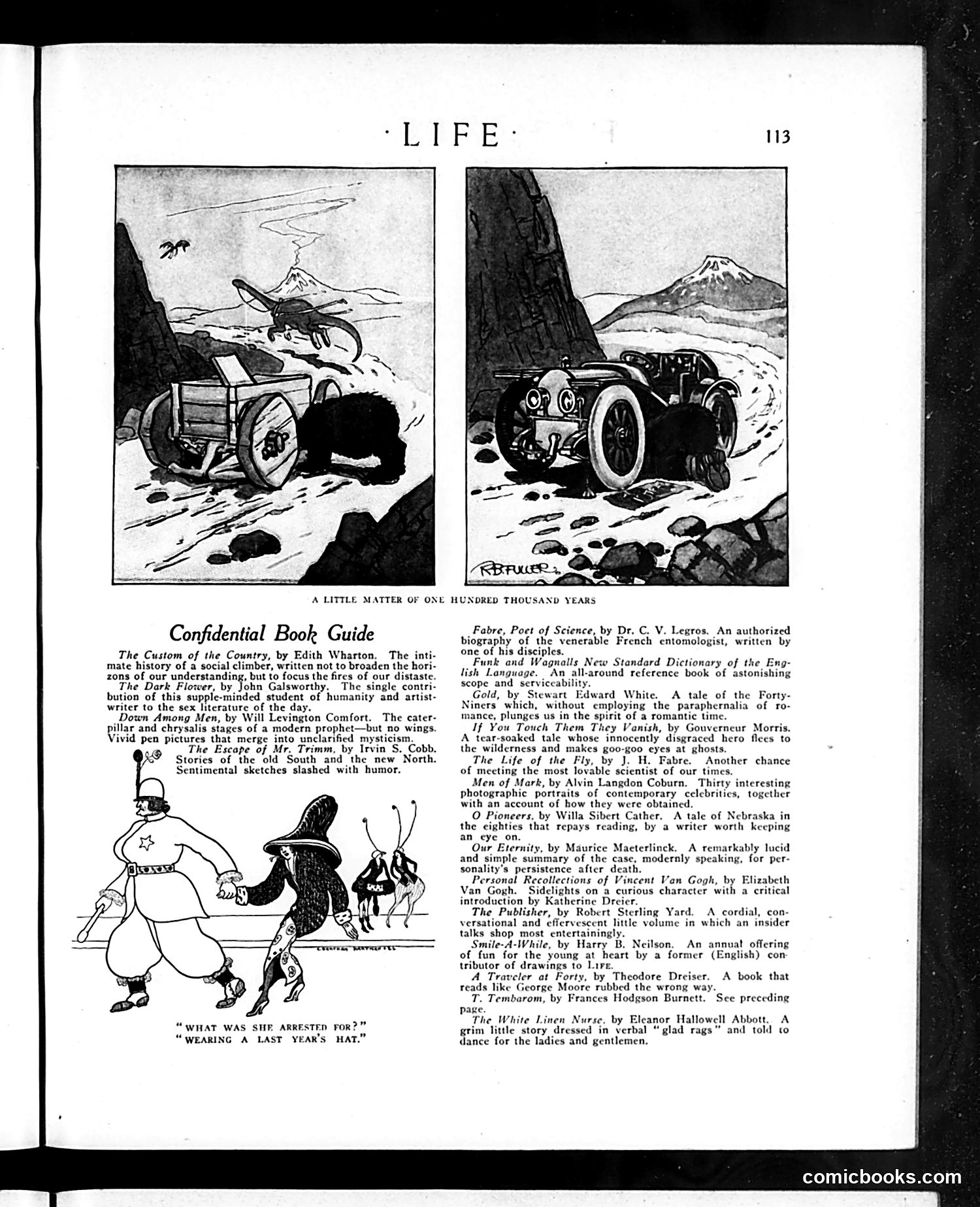
The top illustration titled "A Little Matter of One Hundred Thousand Years" depicts futuristic vehicles—a primitive cart and an early automobile—parked in a barren landscape with a mountain in the distance. The satire suggests technological progress across vast timescales: humanity's transportation has evolved from basic carts to motorcars, yet the achievement seems modest when measured against geological time. The cartoon below shows a woman arrested for "wearing a last year's hat"—satirizing rigid fashion conventions and society's absurd policing of women's appearance. The joke mocks how seriously the upper classes treated fashion obsolescence as a social transgression. The "Confidential Book Guide" section reviews contemporary literature (1914 era), offering acidic assessments of popular novels by Wharton, Galsworthy, and others. These brief, cutting critiques exemplify Life magazine's role as cultural arbiter, using wit to judge literary merit and social pretension.
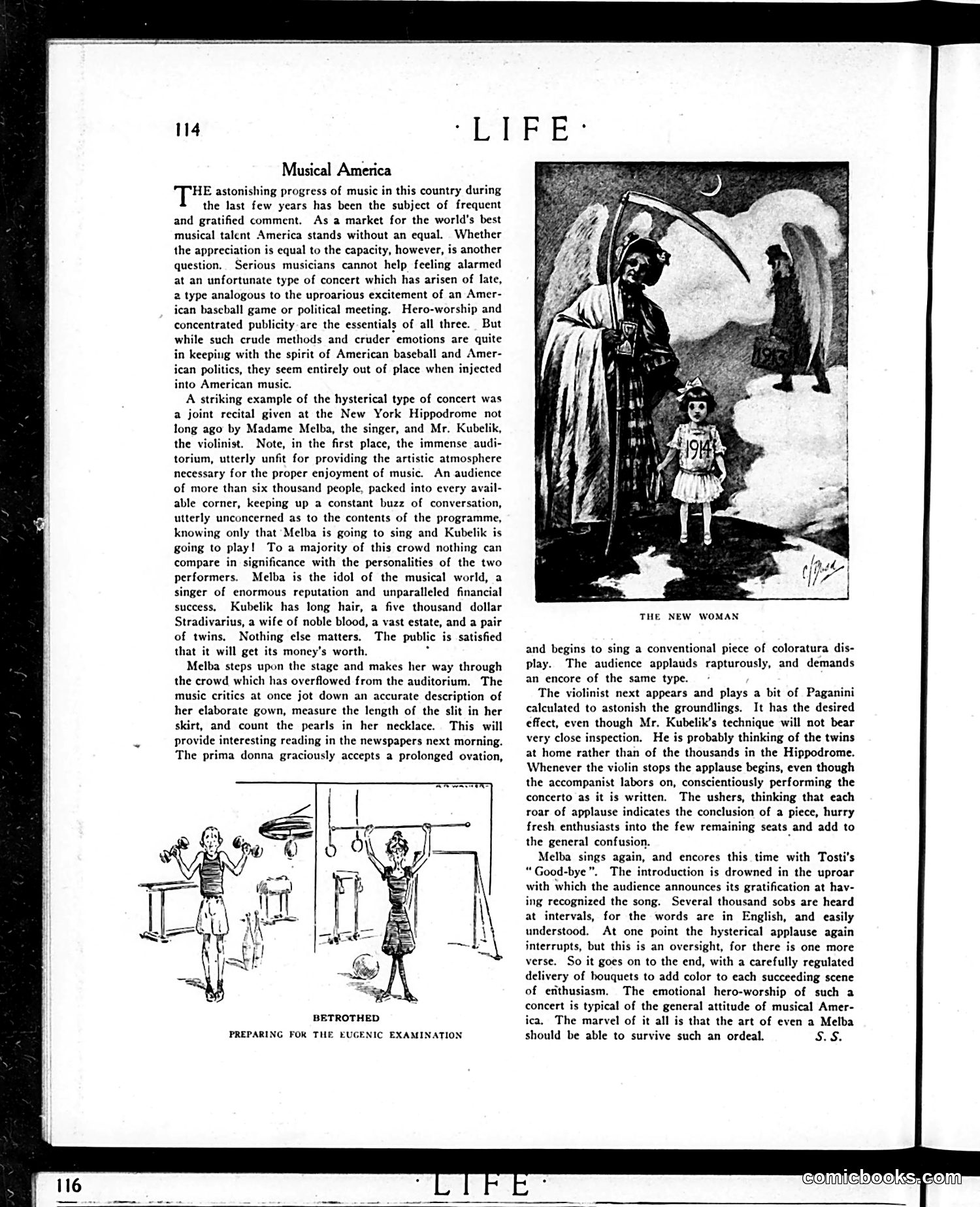
This article satirizes the commercialization and sensationalism of concert performances in early 20th-century America. The author criticizes a joint recital by famous soprano Madame Melba and violinist Jan Kubelik at New York's Hippodrome, attacking what he sees as "hero-worship" replacing genuine musical appreciation. The satire targets: - **The venue**: An enormous auditorium unsuitable for intimate musical experience - **The audience**: More interested in celebrities' personalities, clothing, and gossip than the actual music - **The performers**: Valued for reputation and romantic details (Kubelik's long hair, expensive Stradivarius, aristocratic wife and twins) rather than artistry - **The coverage**: Music critics describing gowns instead of performances The cartoon below (captioned "Betrothed: Preparing for the Eugenic Examination") appears unrelated, likely satirizing contemporary eugenics fads. The author concludes that American musical culture's survival despite such "ordeals" is remarkable.
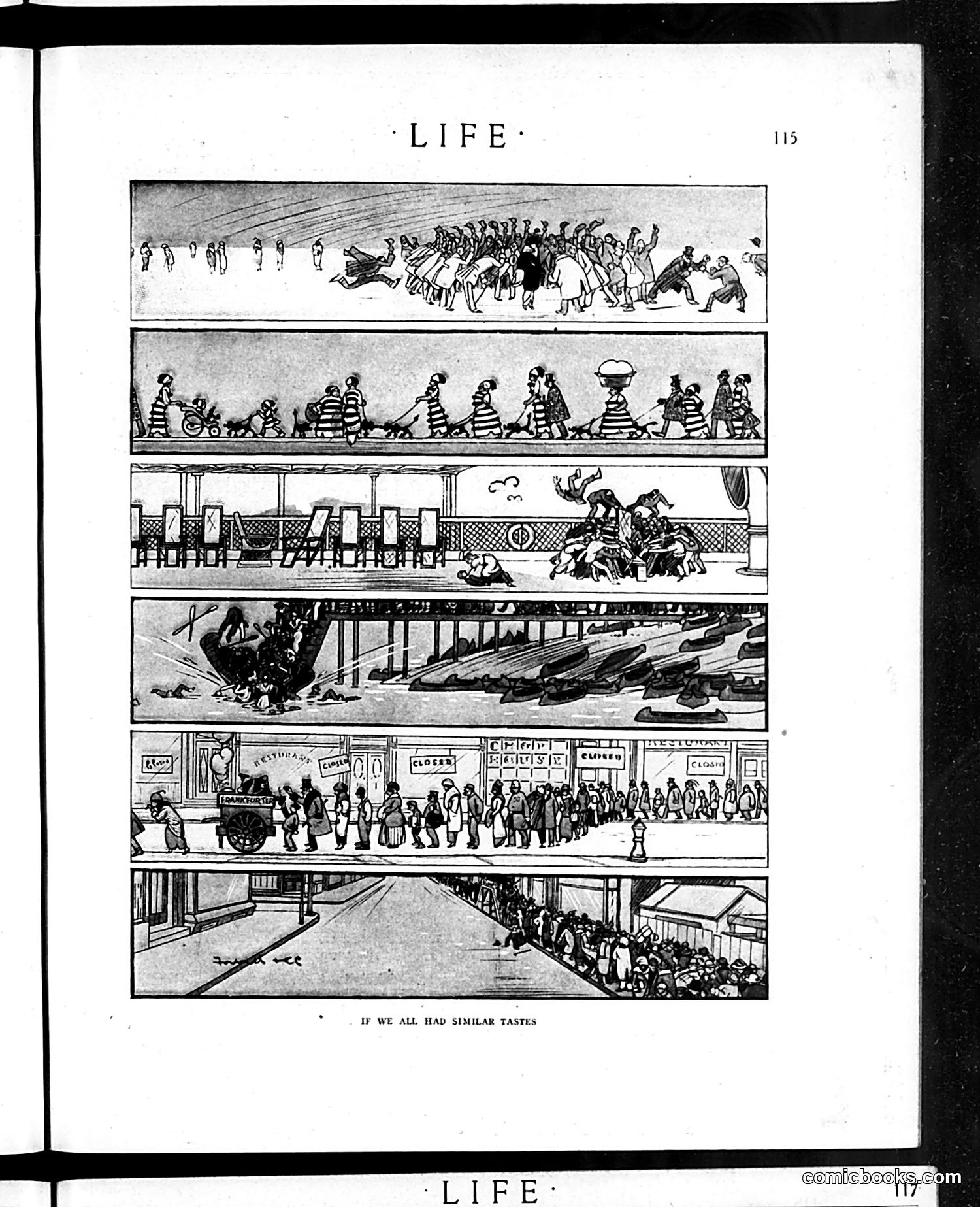
This Life magazine cartoon is a satirical visual essay showing six different leisure scenarios—from beach activities to seaside promenades to shopping districts to indoor crowds. The title's ironic premise is that if everyone shared identical tastes and preferences, public spaces would become uniformly monotonous and overcrowded. The satire targets conformity and mass culture. Each panel depicts the same activities repeated identically by crowds of people, suggesting that uniform taste leads to undifferentiated, boring, and congested social life. The cartoon critiques both the homogenizing effects of consumer culture and the loss of individual distinction when society pursues identical entertainments and shopping habits. The work exemplifies early-to-mid 20th century satirical commentary on American mass leisure and consumer conformity.
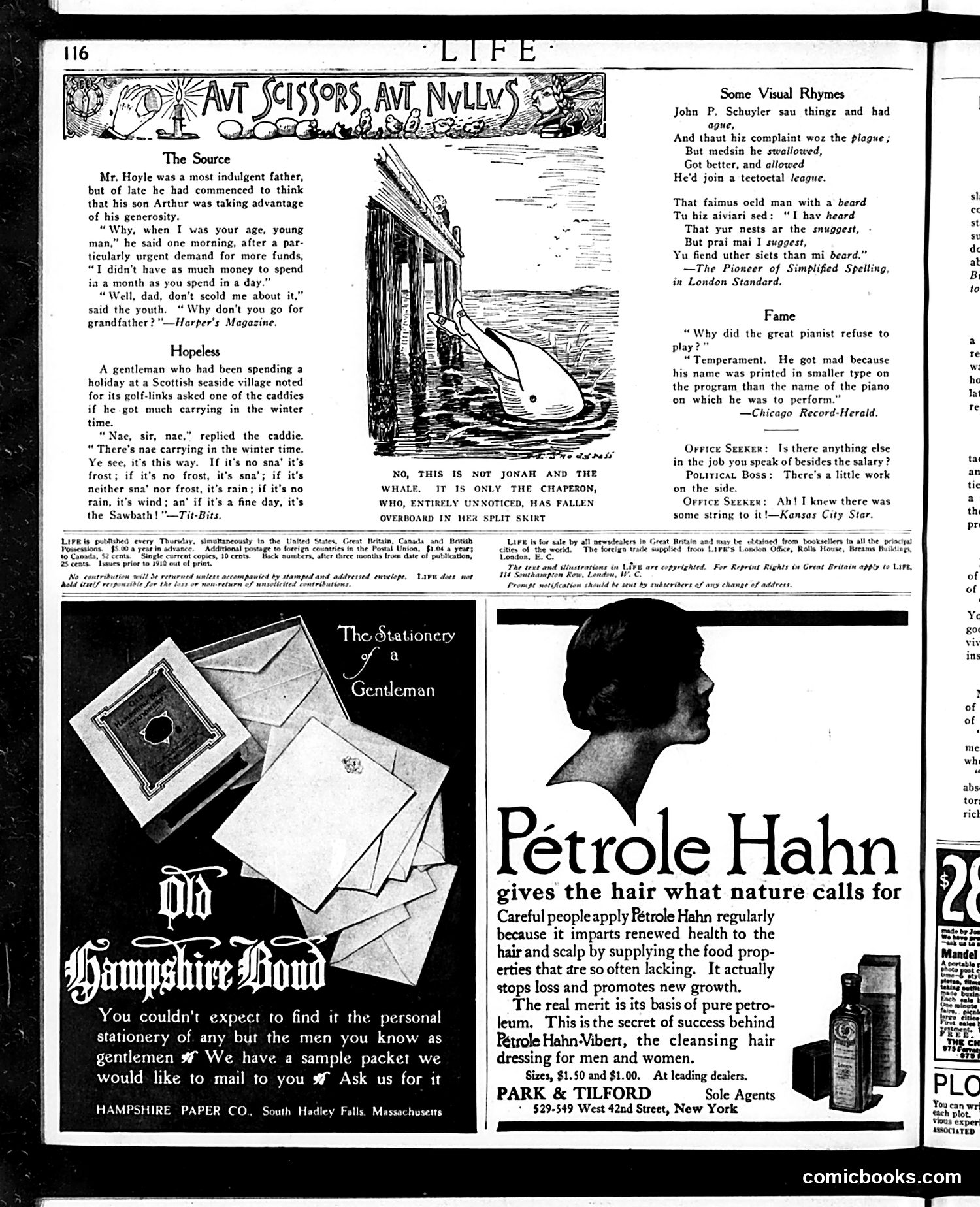
This page contains three separate comic anecdotes and advertisements typical of Life magazine's satirical humor. **"The Source"**: A father complains his son Arthur spends money extravagantly. Arthur's cheeky response—"Why don't you go for grandfather?"—satirizes generational entitlement, suggesting if the father thinks *he's* bad with money, he should ask his own father about wasteful spending. **"Hopeless"**: A Scottish caddie describes winter golf conditions with dark humor: whether it's snow, frost, rain, or—most absurdly—a fine day, something prevents golfing. Only the Sabbath offers respite. The joke mocks Scottish weather and religious observance. **"Some Visual Rhymes"**: Light verse using phonetic spelling to represent accents and speech patterns, covering minor life observations (illness, bird nests, musical temperament, office corruption). The page is primarily **advertising-driven**, featuring stationery and hair product promotions alongside humor. This reflects Life's dual purpose as satirical magazine and advertising vehicle for gentlemen's products.
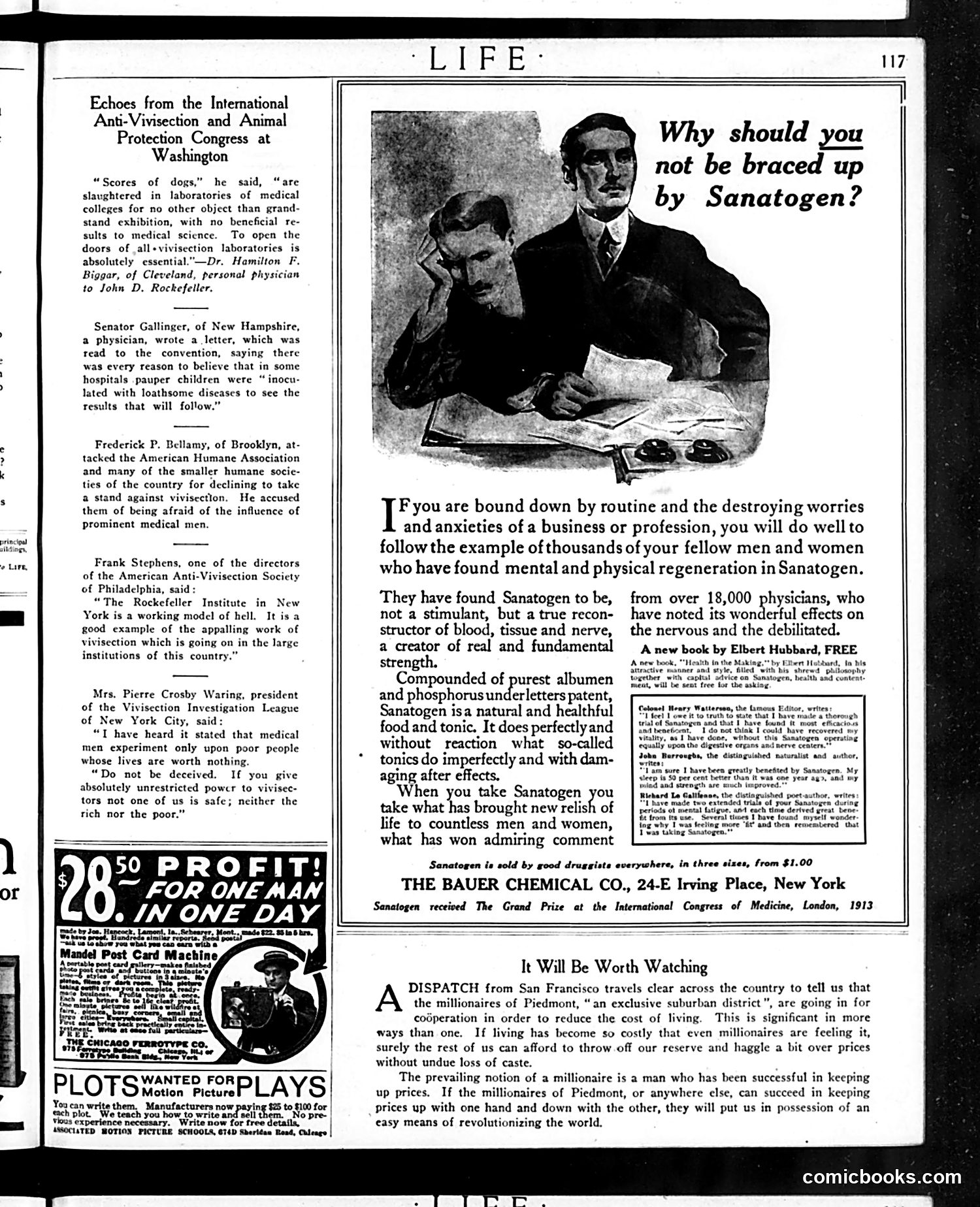
This page presents **anti-vivisection activism** from an early 1900s Congress in Washington. The left column quotes prominent figures—including a physician to John D. Rockefeller—attacking medical experimentation on animals and poor humans. Senator Gallinger alleges hospitals inoculated pauper children with disease. Frank Stephens calls the Rockefeller Institute "a working model of hell." The satire appears **implicit**: Life publishes these sensational accusations without overt mockery, allowing readers to judge the claims' credibility. The rhetoric is heated—comparing medical research to hellish cruelty—reflecting genuine early-20th-century moral panic about unregulated human and animal experimentation. The right side features a **Sanatogen advertisement** (a patent tonic), which provides unintended irony: while activists decry unproven medical practices, the magazine simultaneously advertises dubious health products as cure-alls. This juxtaposition may constitute subtle commentary on medical hucksterism versus legitimate research concerns.
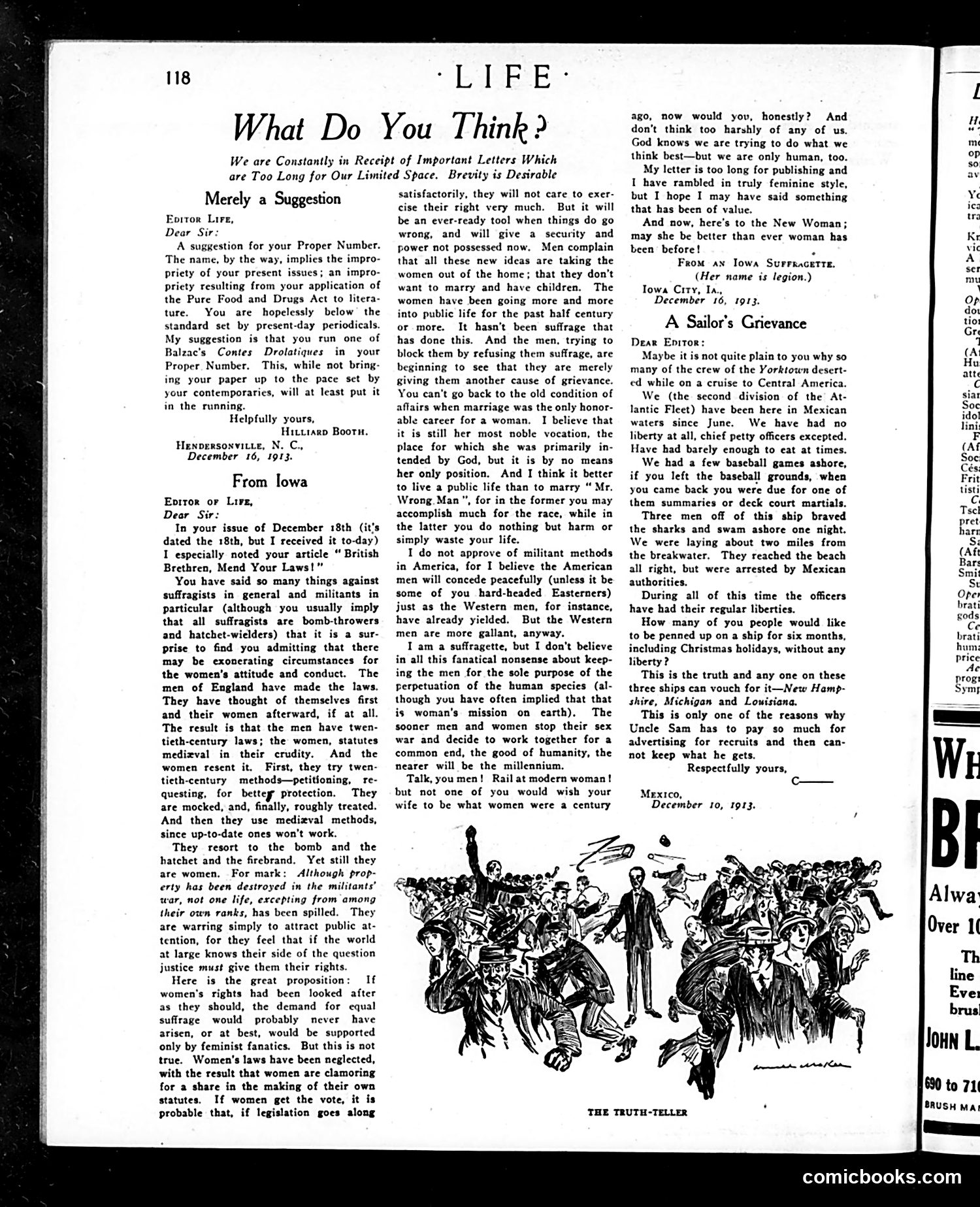
This page from *Life* magazine (December 1913) features reader letters debating women's suffrage and a political cartoon titled "The Truth-Teller." The cartoon depicts a chaotic crowd of figures appearing to flee or scatter in disarray. Based on the caption and the suffrage debate context, this likely satirizes the British suffragette movement—specifically militant suffragists who used property destruction (bombings, arson) to demand voting rights. The scattered, panicked figures probably represent either fleeing suffragettes or the disruption they caused. The irony: the accompanying letters defend suffragists' "militant methods" as justified response to male lawmakers' neglect of women's rights. The cartoon's title "The Truth-Teller" suggests *Life* is mocking the public panic over suffragette violence, positioning the magazine as revealing uncomfortable truths about the movement's actual impact and tactics. The overall page juxtaposes serious reader arguments for suffrage against satirical visual commentary skeptical of militant methods.
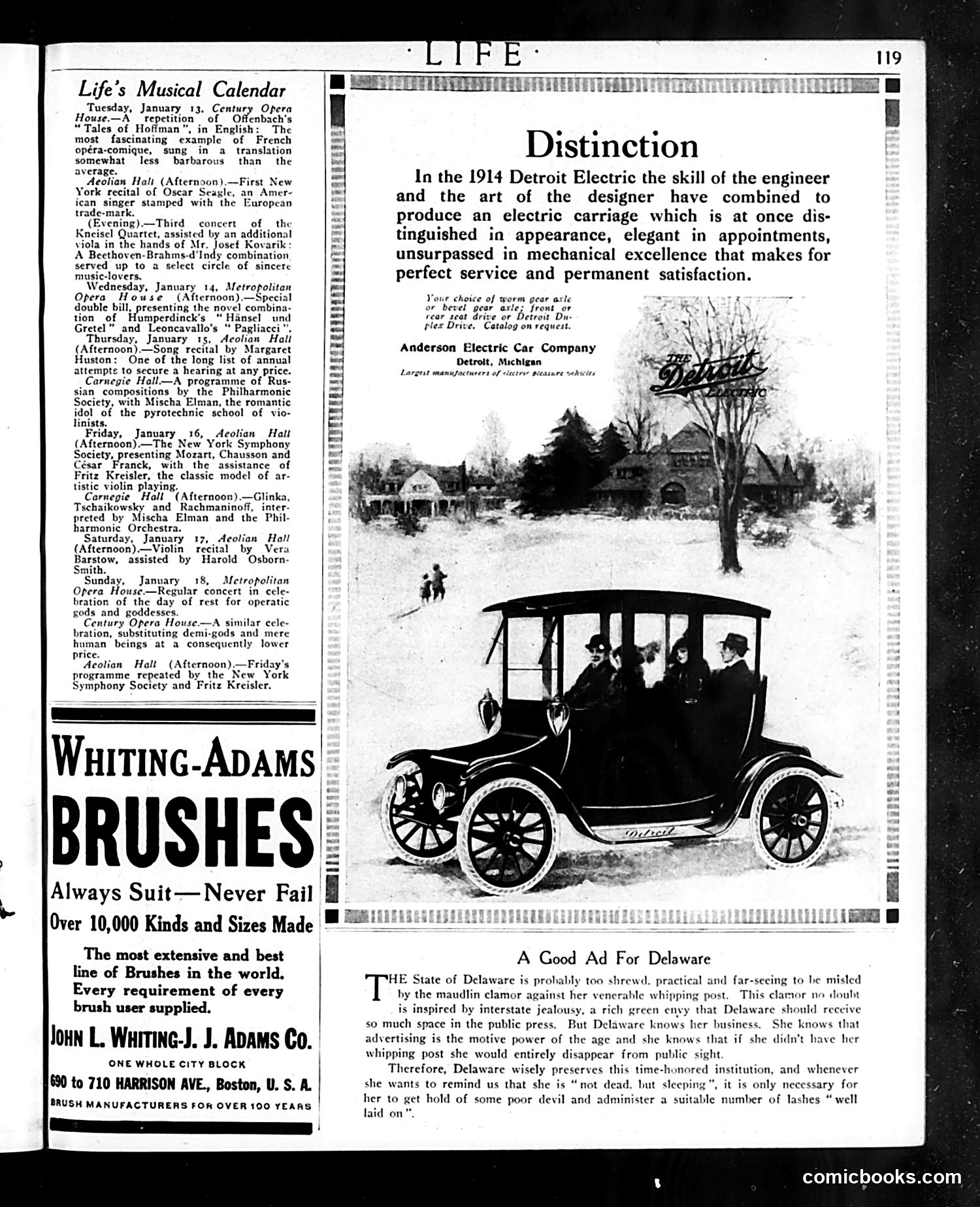
This page is primarily **advertising and cultural listings**, not political satire. The left column presents **Life's Musical Calendar**—concert listings for New York venues (Metropolitan Opera, Carnegie Hall, Aeolian Hall) featuring classical music performances by renowned musicians like Mischa Elman and Fritz Kreisler. The tone is mildly satirical, mocking some performers as undistinguished ("One of the long list of annual attempts to secure a hearing at any price"). The main content features **two advertisements**: Whiting-Adams brushes (industrial/commercial product) and the **1914 Anderson Electric Car** (a luxury vehicle marketed as refined and mechanically superior). Below is a short satirical piece titled **"A Good Ad For Delaware,"** defending Delaware's whipping post as effective publicity—a tongue-in-cheek argument that the state preserves this brutal punishment method primarily for marketing purposes. The satire mocks both Delaware's outdated practices and modern advertising obsession. The page reflects early-1900s American culture: refined classical music consumption, emerging automotive luxury, and institutional brutality treated as a curiosity rather than a moral issue.
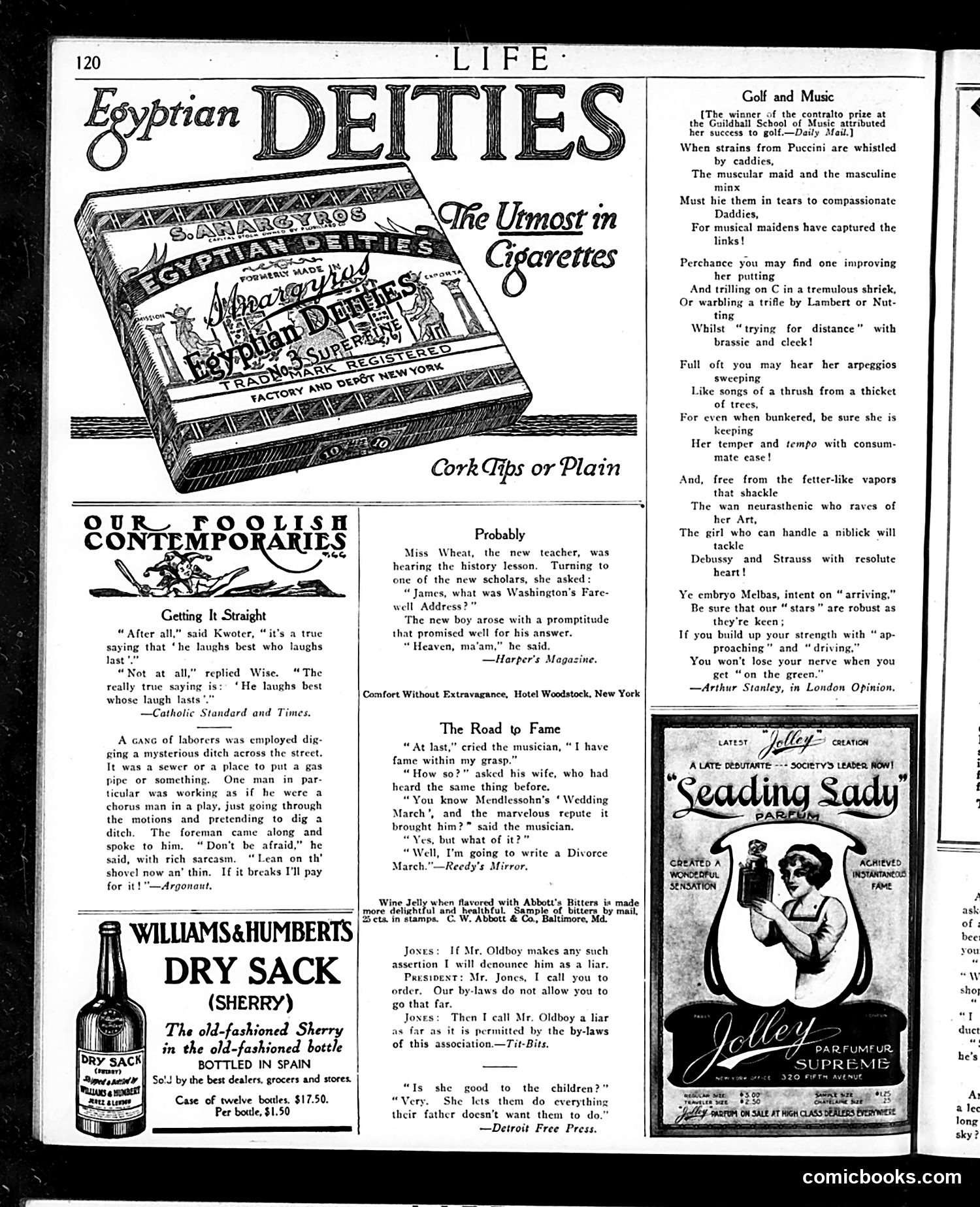
This page contains several humor pieces typical of early 20th-century American satire: **Main Cartoons/Jokes:** - "Getting It Straight": A philosophical joke about who laughs best, contrasting two sayings - "Probably": A teacher asks a student about Washington's Farewell Address; the boy answers "Heaven, ma'am"—a joke playing on "Farewell" as death - "The Road to Fame": A musician plans to compose a "Divorce March," mimicking Mendelssohn's famous "Wedding March"—satirizing how composers build reputations on existing templates - "Golf and Music": A poem mocking women golfers who sing/whistle opera while playing, treating serious music as frivolous background entertainment **Context for Modern Readers:** The humor reflects class anxieties about women entering sports (golf was becoming accessible to women), and assumes educated readers recognize Puccini, Debussy, and Strauss. The tone is gently mocking toward both pretentious musicians and athletic women. The page also features period advertisements for Egyptian cigarettes, sherry, and perfume—typical of this era's *Life* magazine format.
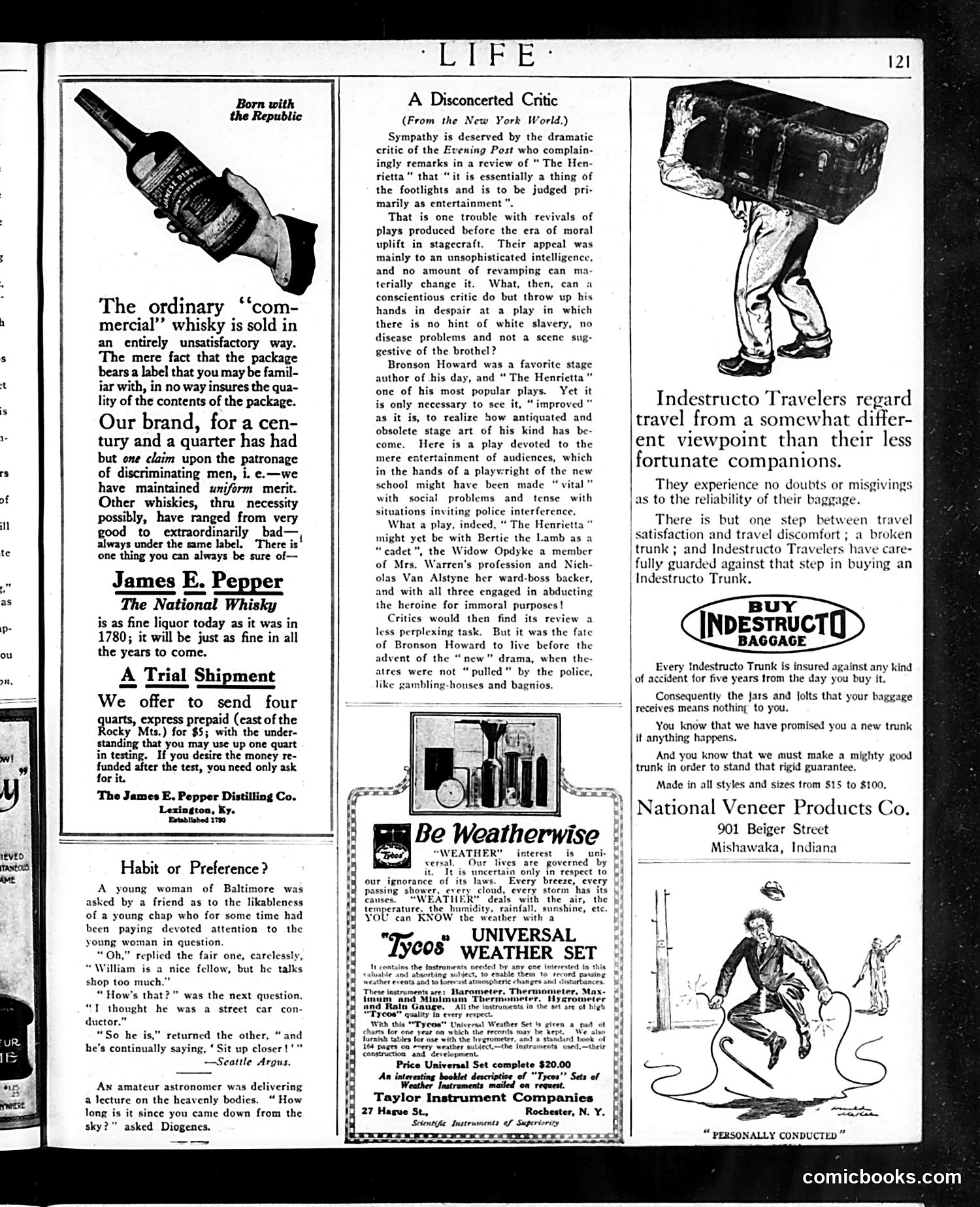
This is primarily an **advertising page** from Life magazine, mixing commercial pitches with light satirical humor pieces. The **main advertisements** promote: - **James E. Pepper whisky** — emphasizing consistent quality for "discriminating men" (contrast to competitors' variable standards) - **Indestructo Trunks** — luggage guaranteed against accidents - **Tycos Universal Weather Set** — instruments for amateur meteorologists The **satirical content** includes short humor pieces: - A joke about a Baltimore woman complaining her suitor "talks shop" as a streetcar conductor, constantly saying "Sit up closer!" - A brief piece mocking a theater critic who laments that a revival of Bronson Howard's old play "The Henrietta" lacks modern social problems (white slavery, disease, brothels) — satirizing critics who demand moralistic content over entertainment value The page reflects **early 20th-century concerns**: prohibition-era whisky marketing, the "social problem play" movement in theater, and emerging consumer product guarantees. The humor is genteel, aimed at educated readers familiar with theater and classical authors.
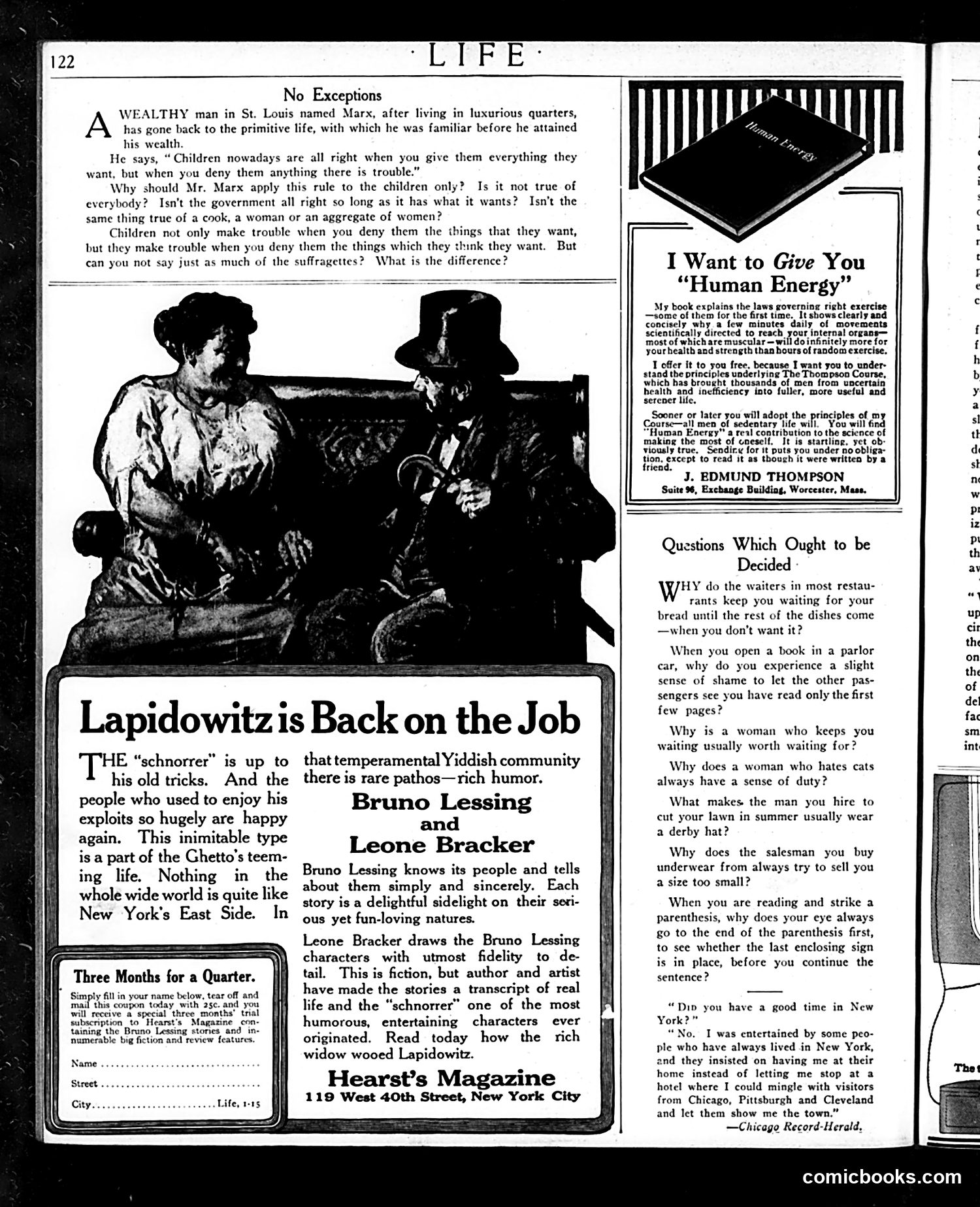
This Life magazine page contains social satire typical of early 20th-century American humor: **"No Exceptions"** (top): A pointed editorial comparing a wealthy St. Louis man named Marx to children and suffragettes. The piece argues that denying anyone—government, women, or the public—what they want causes "trouble," just as it does with children. This is **pro-suffrage satire**, mocking those who opposed women's voting rights by exposing the logical hypocrisy of the argument. **"Lapidowitz is Back on the Job"** (center): Advertises a Hearst's Magazine story featuring a "schnorrer" (Yiddish slang for a beggar/social climber) from New York's Lower East Side immigrant community. The piece celebrates the humor and pathos of Jewish immigrant life, presented as colorfully entertaining. **"Questions Which Ought to be Decided"** (right): Whimsical rhetorical questions about everyday social embarrassments and oddities—early 20th-century observational humor. The page mixes political advocacy (suffrage) with ethnic entertainment and light philosophy—characteristic of Life's satirical approach to American society.
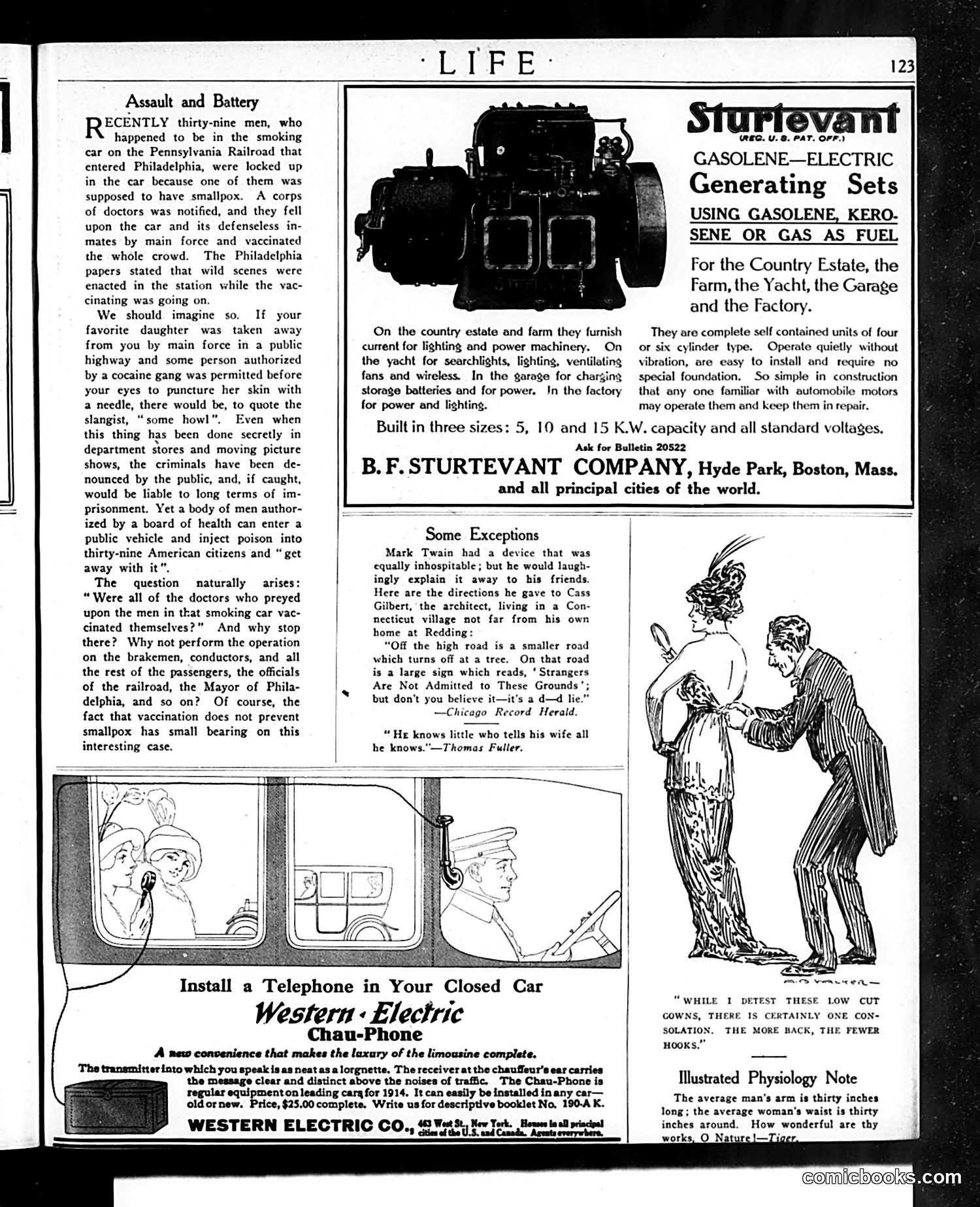
This page primarily contains **advertisements** (Sturtevant generators, Western Electric phone) interspersed with opinion content. The main editorial piece, "Assault and Battery," critiques what appears to be a real 1913 Philadelphia incident: health officials forcibly vaccinated 39 men in a railroad car suspected of smallpox exposure. The author satirizes the **violation of bodily autonomy**—arguing that while private citizens would face imprisonment for such "assault," government boards of health face no consequences despite performing identical actions. The piece argues sarcastically that if forced vaccination is justified, authorities should vaccinate *everyone* (officials, railroad staff, mayors)—especially since the author claims vaccination doesn't prevent smallpox. The second section includes **Mark Twain anecdotes** about anti-visitor signage and philosophical quotes, apparently topical examples unrelated to the main critique. The page reflects early 20th-century debates over **public health authority** versus **individual liberty**—tensions that remain relevant today, particularly post-pandemic.
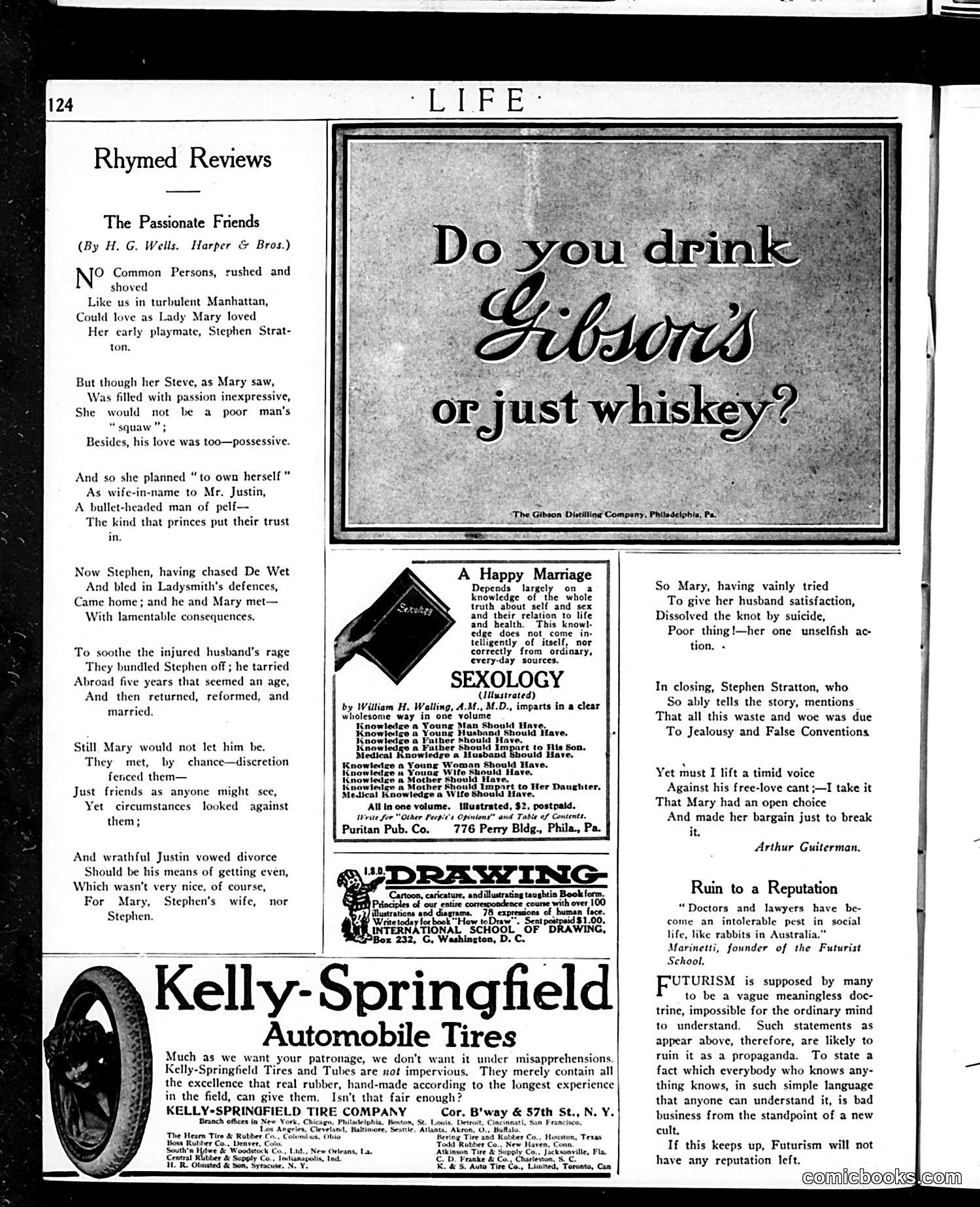
This page contains **book and product reviews** rather than political cartoons. The main content is a rhymed book review by Arthur Guiterman of H.G. Wells' *The Passionate Friends*, a novel about a woman (Mary) torn between two men—her true love Stephen Stratton and a wealthy husband (Justin)—ultimately ending in her suicide. Guiterman satirizes the story's implicit endorsement of "free-love" philosophy, arguing Mary had agency and made a poor choice. Below are advertisements for *Sexology* (a guide to marital relations), an International School of Drawing, and Kelly-Springfield Automobile Tires. The page concludes with a brief satire on **Futurism**—the avant-garde artistic movement—mocking founder Marinetti's pretentious claim that doctors and lawyers are "pests." The critic notes that stating obvious facts in plain language undermines Futurism's reputation for obscure intellectualism. The satire targets **intellectual pretension**: both sexual progressivism and modernist art movements are gently mocked for claiming depth they don't possess.
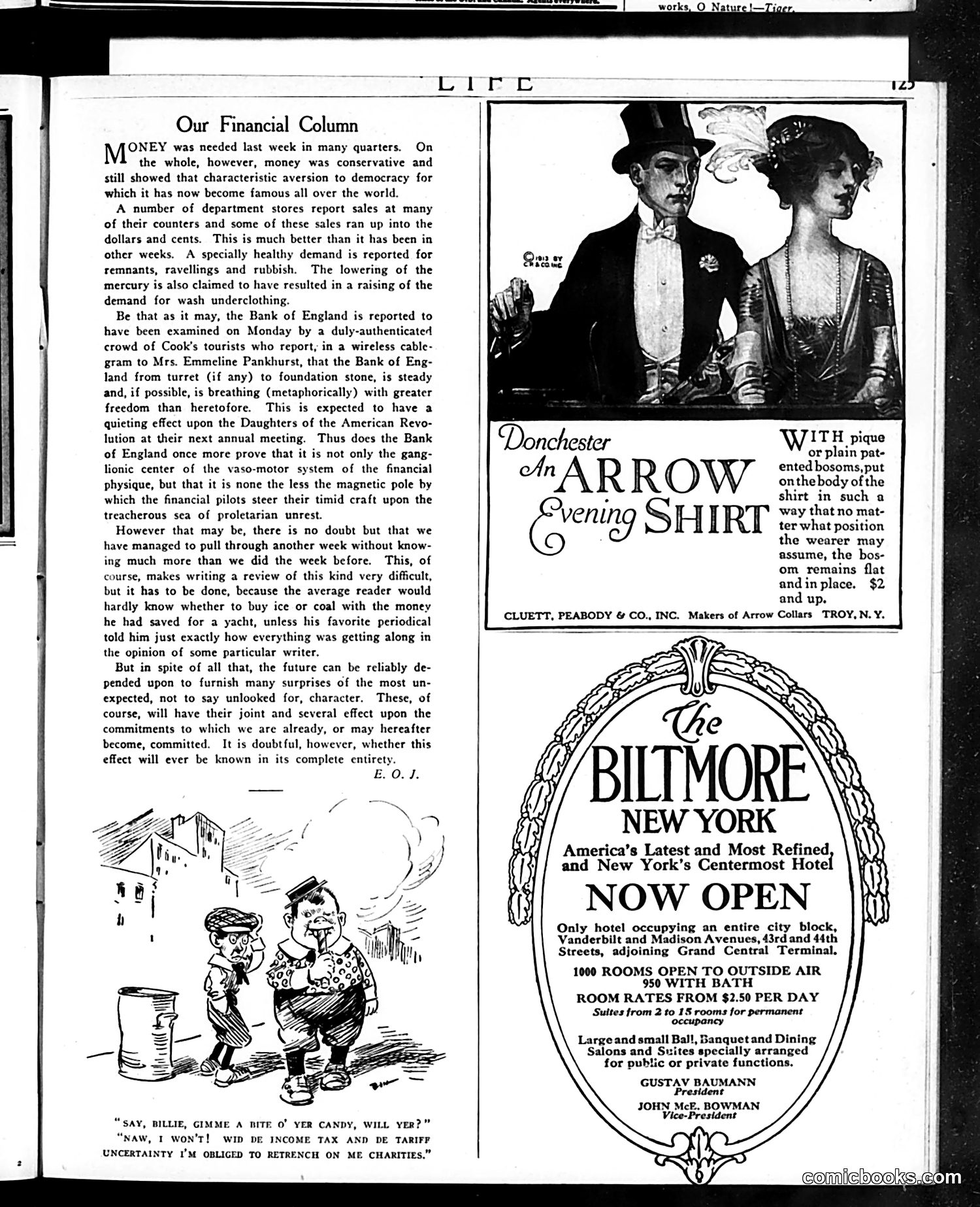
**The Financial Column:** This piece mockingly parodies economic reporting with absurdist language ("money...aversion to democracy"). It references the Bank of England's stability reassuring the "Daughters of the American Revolution" and mentions Emmeline Pankhurst (British suffragette leader), invoking women's rights activism. The overall effect satirizes financial journalism's opacity and pretentious language. **The Cartoon:** Two working-class boys are shown. One refuses to give candy to the other, claiming economic hardship from "income tax and tariff uncertainty"—appearing to mock how even children's charity is threatened by economic instability and changing tax/trade policies. The satire suggests that widespread financial anxiety has filtered down to affect basic human kindness. The page reflects early 20th-century concerns about financial markets, political reform movements (particularly women's suffrage), and economic unpredictability.
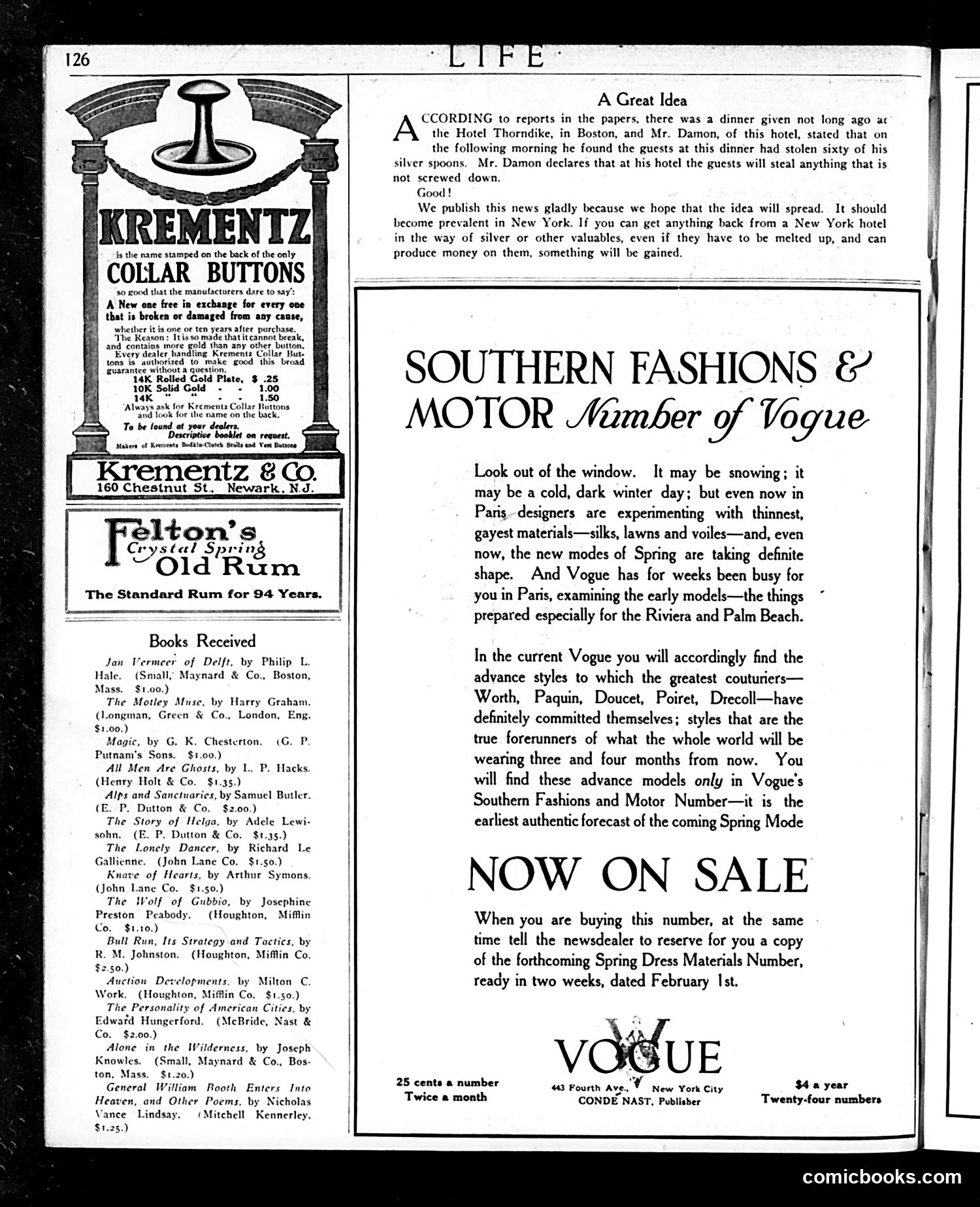
This short piece satirizes petty theft from hotels. It reports (approvingly, tongue-in-cheek) that a Boston hotel manager discovered guests had stolen sixty silver spoons, noting the hotel now screws down anything valuable to prevent theft. Life's editors *celebrate* this news, hoping the practice "spreads" to New York hotels. The satire is directed at hotel guests—wealthy enough to dine out, yet apparently compulsive petty thieves. By endorsing theft recovery (even melted-down silver has value), the magazine mocks both guest dishonesty and the absurdity of hotels needing to bolt down cutlery. This reflects early 20th-century anxieties about property crime among the supposedly respectable classes, presented here as darkly comic commentary on American greed and manners.
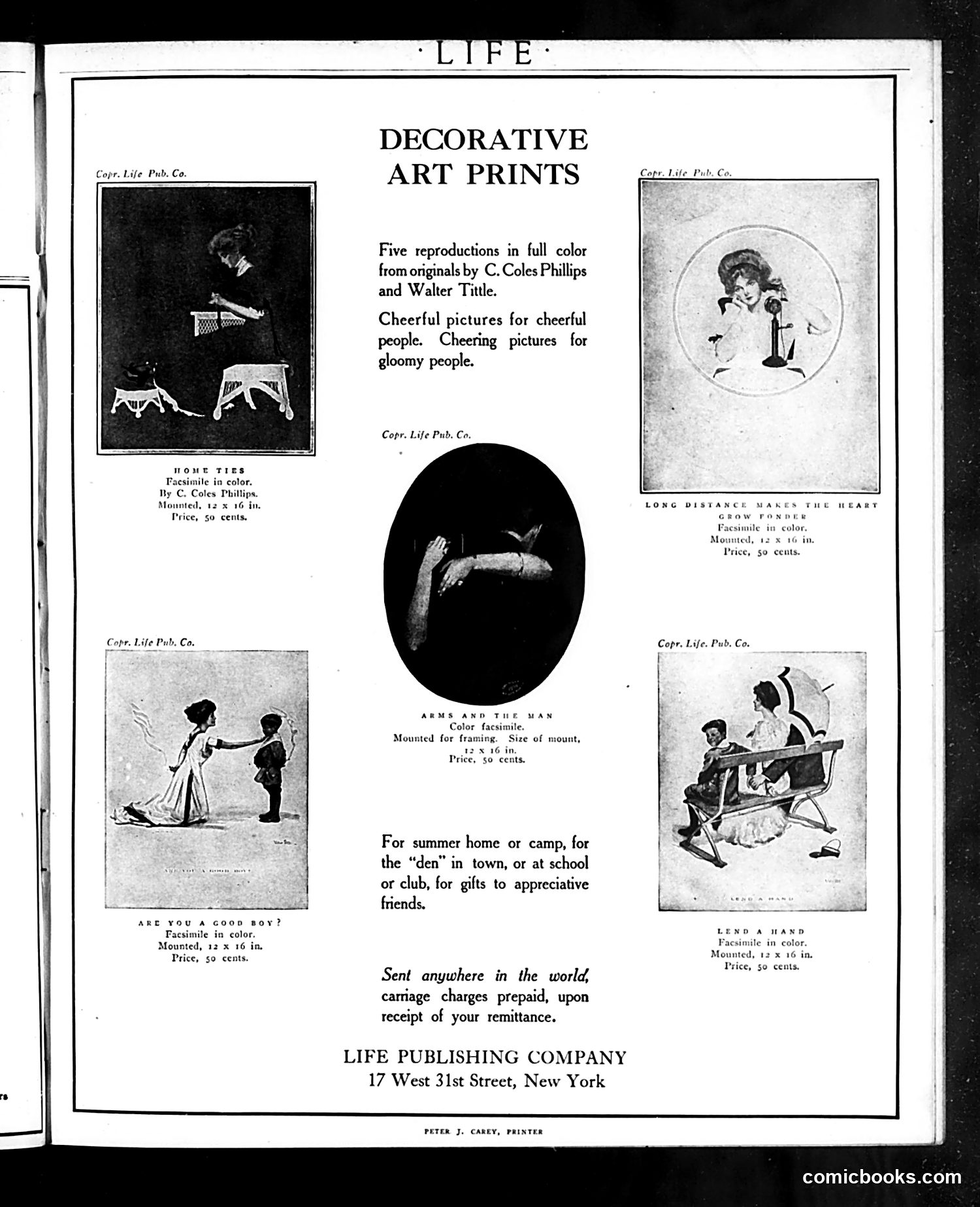
This is primarily **advertising copy**, not satire or political commentary. Life Publishing Company is selling decorative art prints—reproductions of works by illustrators C. Coles Phillips and Walter Tittle. The five prints shown feature romantic or sentimental subjects typical of early 20th-century popular art: home ties (domestic scene), long-distance romance (telephone conversation), "arms and the man" (intimate couple), "are you a good boy?" (woman with child), and "lend a hand" (domestic care scene). The marketing pitch emphasizes these are suitable for "cheerful people" and "gloomy people" alike—implying decorative art as mood-lifting decor for homes, camps, schools, and clubs. The prints cost 50 cents each, a modest price point for the era. This reflects the period's commercial distribution of affordable fine art reproductions for middle-class domestic decoration.
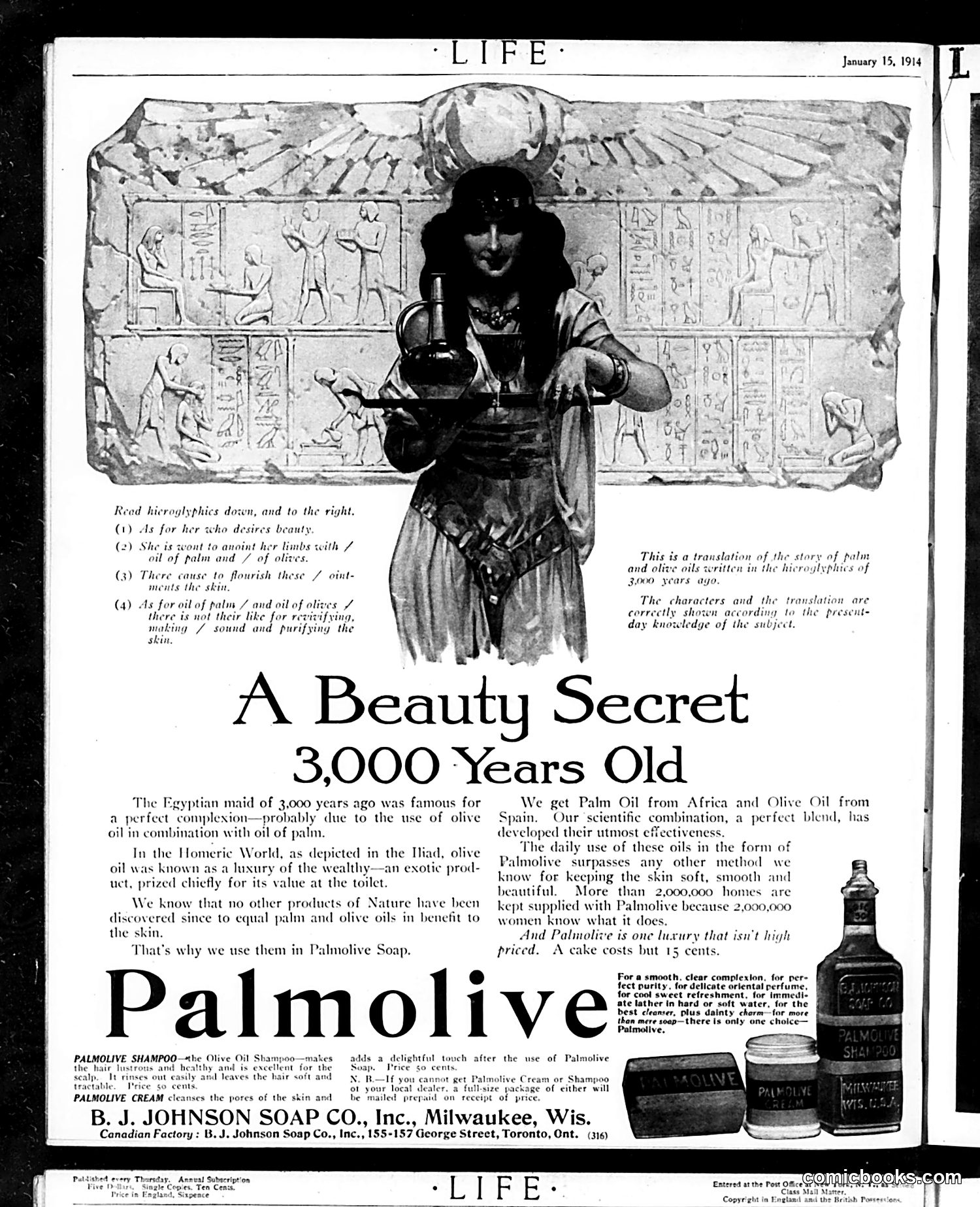
This is primarily a **Palmolive Soap advertisement**, not political satire. The page uses a pseudo-historical marketing hook: it claims ancient Egyptian hieroglyphics (shown in the background image) describe beauty secrets using palm and olive oils—positioning the product as derived from 3,000-year-old wisdom. The "figure" is a woman in Egyptian costume and headdress, posed as if translating ancient texts, lending historical authority to the sales pitch. This was a common early 20th-century advertising tactic: invoking exotic antiquity to sell mundane products to consumers. The humor, if any, lies in the anachronistic claim that ancient Egyptians endorsed a modern commercial soap—treating a modern product as timeless knowledge. The advertisement emphasizes affordability (15 cents per cake) while associating it with luxury and ancient prestige. This reflects 1914 consumer marketing, not editorial commentary.