
Life, 1914-01-15 · page 26 of 40
Life — January 15, 1914 — page 26: what you’re looking at
What you’re looking at
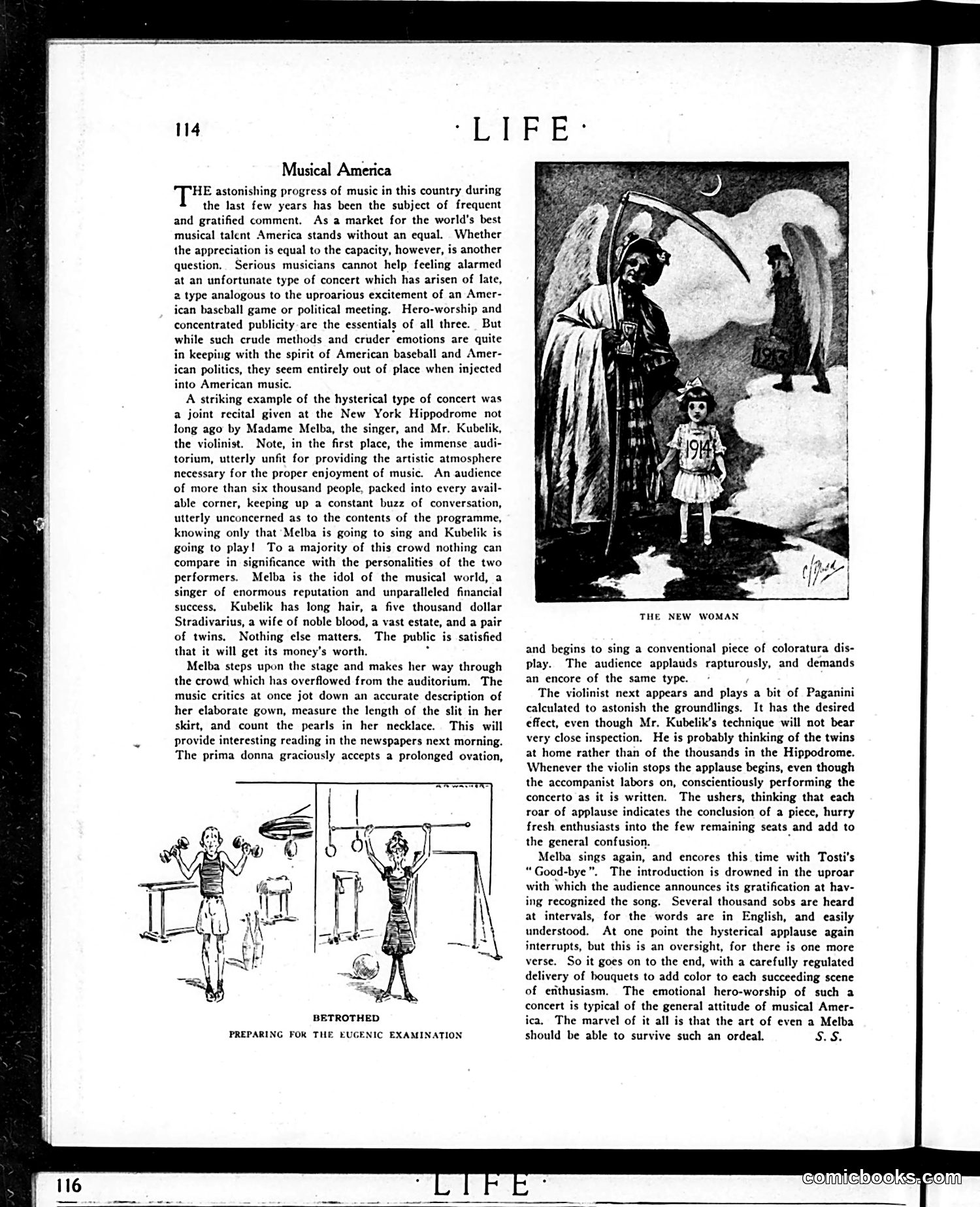
This article satirizes the commercialization and sensationalism of concert performances in early 20th-century America. The author criticizes a joint recital by famous soprano Madame Melba and violinist Jan Kubelik at New York's Hippodrome, attacking what he sees as "hero-worship" replacing genuine musical appreciation. The satire targets: - **The venue**: An enormous auditorium unsuitable for intimate musical experience - **The audience**: More interested in celebrities' personalities, clothing, and gossip than the actual music - **The performers**: Valued for reputation and romantic details (Kubelik's long hair, expensive Stradivarius, aristocratic wife and twins) rather than artistry - **The coverage**: Music critics describing gowns instead of performances The cartoon below (captioned "Betrothed: Preparing for the Eugenic Examination") appears unrelated, likely satirizing contemporary eugenics fads. The author concludes that American musical culture's survival despite such "ordeals" is remarkable.
📄 Transcribed text from this page (OCR, searchable)
Machine-transcribed from the original scan — historical spelling and the odd misread are preserved.
114 Musical America yee astonishing progress of music in this country during the last few years has been the subject of frequent and gratified comment. As a market for the world’s best musical talent America stands without an equal. Whether the appreciation is equal to the capacity, however, is another question. Serious musicians cannot help feeling alarmed at an unfortunate type of concert which has arisen of late, a type analogous to the uproarious excitement of an Amer- ican baseball game or political meeting. Hero-worship and concentrated publicity are the essentials of all three. But while such crude methods and cruder emotions are quite in keeping with the spirit of American baseball and Amer- ican politics, they seem entirely out of place when injected into American music. A striking example of the hysterical type of concert was a joint recital given at the New York Hippodrome not long ago by Madame Melba, the singer, and Mr. Kubelik, the violinist. Note, in the first place, the immense audi- torium, utterly unfit for providing the artistic atmosphere necessary for the proper enjoyment of music. An audience of more than six thousand people, packed into every avail- able corner, keeping up a constant buzz of conversation, utterly unconcerned as to the contents of the programme, knowing only that Melba is going to sing and Kubelik is going to play! To a majority of this crowd nothing can compare in significance with the personalities of the two performers. Melba is the idol of the musical world, a singer of enormous reputation and unparalleled financial success, Kubelik has long hair, a five thousand dollar Stradivarius, a wife of noble blood, a vast estate, and a pair of twins. Nothing else matters. The public is satisfied that it will get its money's worth, Melba steps upon the stage and makes her way through the crowd which has overflowed from the auditorium. The music critics at once jot down an accurate description of her elaborate gown, measure the length of the slit in her skirt, and count the pearls in her necklace. This will provide interesting reading in the newspapers next morning. The prima donna graciously accepts a prolonged ovation, BETROTHED PREPARING FOR THE EUGENIC EXAMINATION THE NEW WOMAN and begins to sing a conventional piece of coloratura dis- play. The audience applauds rapturously, and demands an encore of the same type. The violinist next appears and plays a bit of Paganini calculated to astonish the groundlings. It has the desired effect, even though Mr. Kubelik’s technique will not bear very close inspection. He is probably thinking of the twins at home rather than of the thousands in the Hippodrome. Whenever the violin stops the applause begins, even though the accompanist labors on, conscientiously performing the concerto as it is written. The ushers, thinking that each roar of applause indicates the conclusion of a piece, hurry fresh enthusiasts into the few remaining seats and add to the general confusion. ‘ Melba sings again, and encores this time with Tosti’s “Good-bye”. The introduction is drowned in the uproar with which the audience announces its gratification at hav- ing recognized the song. Several thousand sobs are heard at intervals, for the words are in English, and easily understood. At one point the hysterical applause again interrupts, but this is an oversight, for there is one more verse. So it goes on to the end, with a carefully regulated delivery of bouquets to add color to each succeeding scene of enthusiasm. The emotional hero-worship of such a concert is typical of the general attitude of musical Amer- ica, The marvel of it all is that the art of even a Melba should be able to survive such an ordeal. S.S.