
Life, 1914-01-15 · page 25 of 40
Life — January 15, 1914 — page 25: what you’re looking at
What you’re looking at
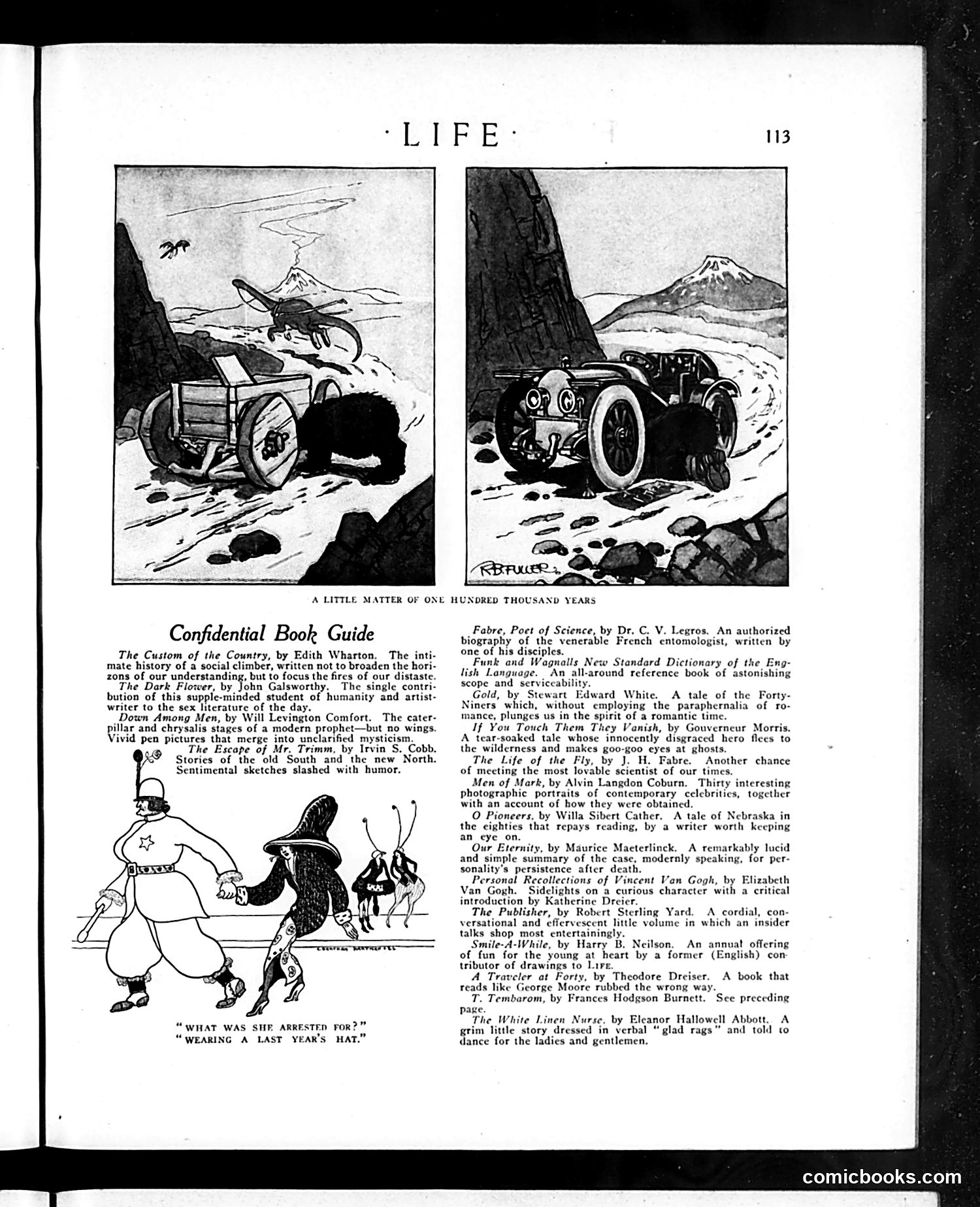
The top illustration titled "A Little Matter of One Hundred Thousand Years" depicts futuristic vehicles—a primitive cart and an early automobile—parked in a barren landscape with a mountain in the distance. The satire suggests technological progress across vast timescales: humanity's transportation has evolved from basic carts to motorcars, yet the achievement seems modest when measured against geological time. The cartoon below shows a woman arrested for "wearing a last year's hat"—satirizing rigid fashion conventions and society's absurd policing of women's appearance. The joke mocks how seriously the upper classes treated fashion obsolescence as a social transgression. The "Confidential Book Guide" section reviews contemporary literature (1914 era), offering acidic assessments of popular novels by Wharton, Galsworthy, and others. These brief, cutting critiques exemplify Life magazine's role as cultural arbiter, using wit to judge literary merit and social pretension.
📄 Transcribed text from this page (OCR, searchable)
Machine-transcribed from the original scan — historical spelling and the odd misread are preserved.
A LITTLE MATTER OF ONE HUNDRED THOUSAND YEARS Confidential Book Guide The Custom of the Country, by Edith Wharton. mate history of a social climber, written not to broaden the hori- zons of our understanding, but to focus the fires of our distaste. The inti- The Dark Flower, by John Galsworthy. The single contri- bution of this supple-minded student of humanity and artist- writer to the sex literature of the day. Down Among Men, by Will Levington Comfort. The cater- pillar and chrysalis stages of a modern prophet——but no wings. Vivid pen pictures that merge into unclarified mysticism, @ «Lhe Escape of Mr. Trimm, by Irvin S. Cobb. Stories of the old South and the new North. Sentimental sketches slashed with humor. HE ARRESTED FOR?” LAST YEAR'S HAT,” “WHAT WAS “WEARING A Fabre, Poet of Science, by Dr. C. V. Legros. An authorized biography of the venerable French entomologist, written by one of his disciples. Funk and Wagnalls New Standard Dictionary of the Eng- lish Language. An all-around reference book of astonishing scope and serviceability. Gold, by Stewart Edward White. A tale of the Forty- Niners’ which, without employing the paraphernalia of ro- mance, plunges us in the spirit of a romantic time. If You Touch Them They Vanish, by Gouverneur Morris. A tear-soaked tale whose innocently disgraced hero fices to the wilderness and makes goo-goo eyes at ghosts. The Life of the Fly, by J. H. Fabre. Another chance of meeting the most lovable scientist of our times. Men of Mark, by Alvin Langdon Coburn. Thirty interesting photographic portraits of contemporary celebrities, together with an account of how they were obtained. O Pioneers, by Willa Sibert Cather. A tale of Nebraska in the eighties that repays reading, by a writer worth keeping an cye on. Our Eternity, by Maurice Maeterlinck. A remar and simple summary of the case, modernly speak sonality’s persistence after death. Personal Recollections of Vincent Van Gogh, by Elizabeth Van Gogh. Sidelights on a curious character with a critical introduction by Katherine Dreier. The Publisher, by Robert Sterling Yard. A cordial, con- versational and effervescent little volume in which an insider talks shop most entertainingly. Smile-A-While, by Harry B. Neilson, An annuat offering of fun for the young at heart by a former (English) con tributor of drawings to Lire. A Traveler at Forty, by Theodore Dreiser. A book that reads like George Moore rubbed the wrong way T. Tembarom, by Frances Hodgson Burnett. Page. ‘he White Linen Nurse, by Eleanor Hallowell Abbott. A grim little story dressed in verbal “glad rags” and told to dance for the ladies and gentlemen. bly lucid for per- See preceding comicbooks.com