
Life, 1914-01-15 · page 30 of 40
Life — January 15, 1914 — page 30: what you’re looking at
What you’re looking at
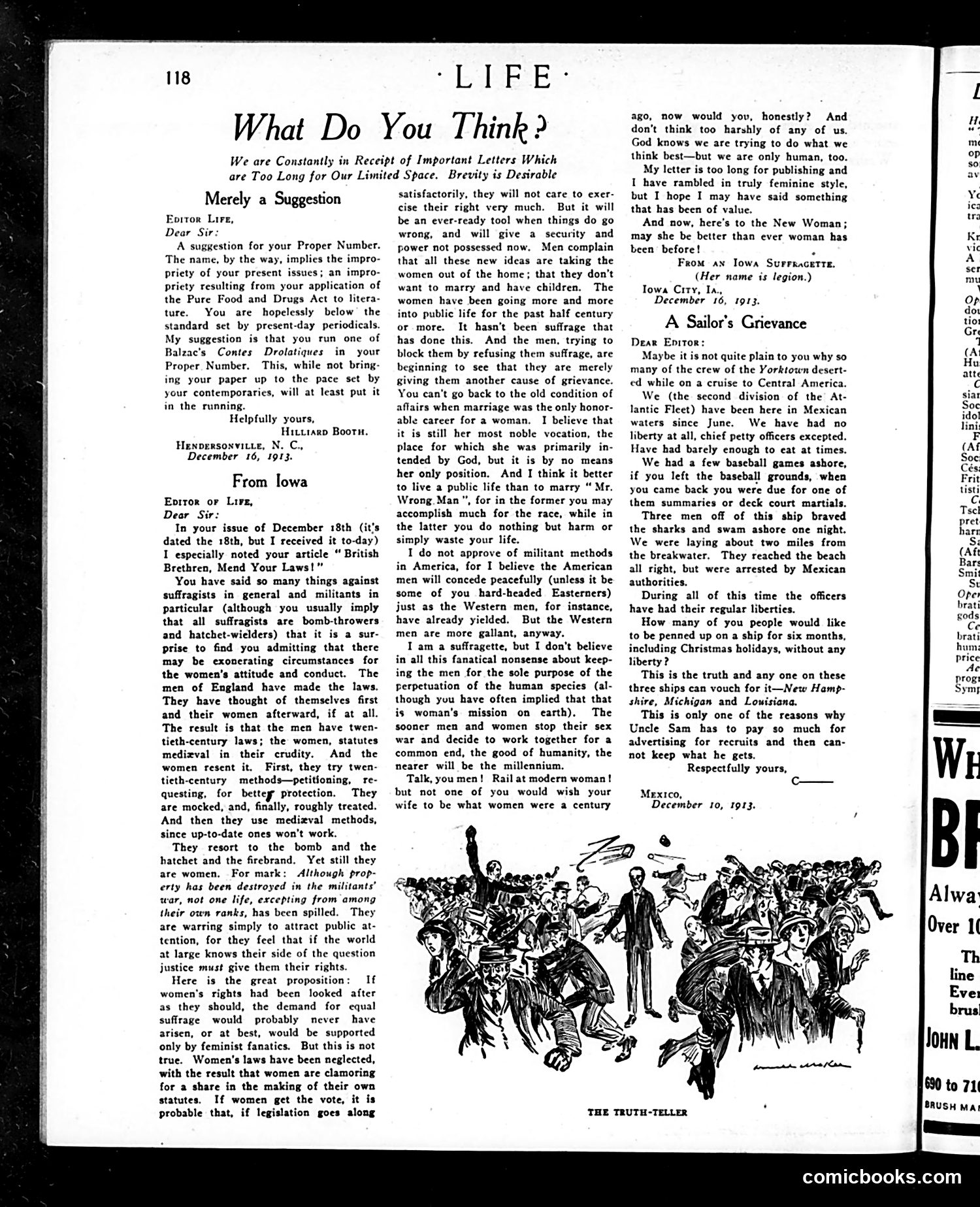
This page from *Life* magazine (December 1913) features reader letters debating women's suffrage and a political cartoon titled "The Truth-Teller." The cartoon depicts a chaotic crowd of figures appearing to flee or scatter in disarray. Based on the caption and the suffrage debate context, this likely satirizes the British suffragette movement—specifically militant suffragists who used property destruction (bombings, arson) to demand voting rights. The scattered, panicked figures probably represent either fleeing suffragettes or the disruption they caused. The irony: the accompanying letters defend suffragists' "militant methods" as justified response to male lawmakers' neglect of women's rights. The cartoon's title "The Truth-Teller" suggests *Life* is mocking the public panic over suffragette violence, positioning the magazine as revealing uncomfortable truths about the movement's actual impact and tactics. The overall page juxtaposes serious reader arguments for suffrage against satirical visual commentary skeptical of militant methods.
📄 Transcribed text from this page (OCR, searchable)
Machine-transcribed from the original scan — historical spelling and the odd misread are preserved.
~EREE=: What Do You Think? We are Constantly in Receipt of Important Letters Which are Too Long for Our Limited Space. Brevity is Desirable Merely a Suggestion Eortor Lire, Dear Sir: A suggestion for your Proper Number. The name, by the way, implies the impro- priety of your present issues; an impro- priety resulting from your application of the Pure Food and Drugs Act to litera- ture. You are hopelessly below the standard set by present-day periodicals. My suggestion is that you run one of Balzac’s Contes Drolatiques in your Proper Number, This, while not bring- ing your paper up to the pace set by your contemporaries, will at least put it in the running. Helpfully yours, Hitttarp Bootn, Henpersonvitte, N. C., December 16, 1913. From lowa Eprror or Lives, Dear Sir: In your issue of December 18th (it's dated the 18th, but I received it to-day) I especially noted your article “ British Brethren, Mend Your Laws!” You have said so many things against suffragists general and militants in particular (although you usually imply that all suffragists are bomb-throwers and hatchet-wielders) that it is a sur- prise to find you admitting that there may be exonerating circumstances for the women’s attitude and conduct. The men of England have made the laws. They have thought of themselves first and their women afterward, if at all. The result is that the men have twen- tieth-century laws; the women, statutes medixval in their crudity. And the women resent it. First, they try twen- tieth-century methods—petitioning, re- questing, for bettey protection. They are mocked, and, finally, roughly treated. And then they use medieval methods, since up-to-date ones won't work. They resort to the bomb and the hatchet and the firebrand. Yet still they are women. For mark: Although prop- erty has been destroyed in the militants’ war, not one life, excepting from among their own ranks, has been spilled. They are warring simply to attract public at- tention, for they feel that if the world at large knows their side of the question justice must give them their rights. Here is the great proposition: If women's rights had been looked after as they should, the demand for equal suffrage would probably never have arisen, or at best, would be supported only by feminist fanatics. But this is not true. Women's laws have been neglected, with the result that women are clamoring for a share in the making of their own statutes. If women get the vote, it is probable that, if legislation goes along satisfactorily, they will not care to exer- cise their right very much. But it will be an ever-ready tool when things do go wrong, and will give a security and power not possessed now. Men complain that all these new ideas are taking the women out of the home; that they don’t want to marry and have children. The women have been going more and more into public life for the past half century or more. It hasn't been suffrage that has done this. And the men, trying to block them by refusing them suffrage, are beginning to see that they are merely giving them another cause of grievance. You can't go back to the old condition of affairs when marriage was the only honor- able career for a woman. I believe that it is still her most noble vocation, the place for which she was primarily in- tended by God, but it is by no means her only position. And I think it better to live a public life than to marry “ Mr. Wrong. Man”, for in the former you may accomplish much for the race, while in the latter you do nothing but harm or simply waste your life. I do not approve of militant methods in America, for I believe the American men will concede peacefully (unless it be some of you hard-headed Easterners) just as the Western men, for instance, have already yielded. But the Western men are more gallant, anyway. I am a suffragette, but I don’t believe in all this fanatical nonsense about keep- ing the men for the sole purpose of the Perpetuation of the human species (al- though you have often implied that that is woman's mission on earth). The sooner men and women stop their sex war and decide to work together for a common end, the good of humanity, the nearer will be the millennium. Talk, you men! Rail at modern woman! but not one of you would wish your wife to be what women were a century ago, now would you, honestly? And don’t think too harshly of any of us. God knows we are trying to do what we think best—but we are only human, too. My letter is too long for publishing and I have rambled in truly feminine style, but I hope I may have said something that has been of value. And now, here’s to the New Woman; may she be better than ever woman has been before! . From ax Iowa Surrracetre. (Her name is legion.) Towa City, Ia., December 16, 1913. A Sailor’s Grievance Dear Enitor: Maybe it is not quite plain to you why so many of the crew of the Yorktown desert- ed while on a cruise to Central America. We (the second division of the At- lantic Fleet) have been here in Mexican waters since June. We have had no liberty at all, chief petty officers excepted. Have had barely enough to eat at times. We had a few baseball games ashore, if you left the baseball grounds, when you came back you were due for one of them summaries or deck court martials. Three men off of this ship braved the sharks and swam ashore one night. We were laying about two miles from the breakwater, They reached the beach all right, but were arrested by Mexican authorities. During all of this time the officers have had their regular liberties. How many of you people would like to be penned up on a ship for six months, including Christmas holidays, without any liberty? This is the truth and any one on these three ships can vouch for it—New Hamp- shire, Michigan and Louisiana. This is only one of the reasons why Uncle Sam has to pay so much for advertising for recruits and then can- not keep what he gets. Respectfully yours, ¢— Mextco, December 10, 1913. THE TRUTH-TELLER 8RUSH Mal comicbooks.com