
Life, 1914-01-15 · page 18 of 40
Life — January 15, 1914 — page 18: what you’re looking at
What you’re looking at
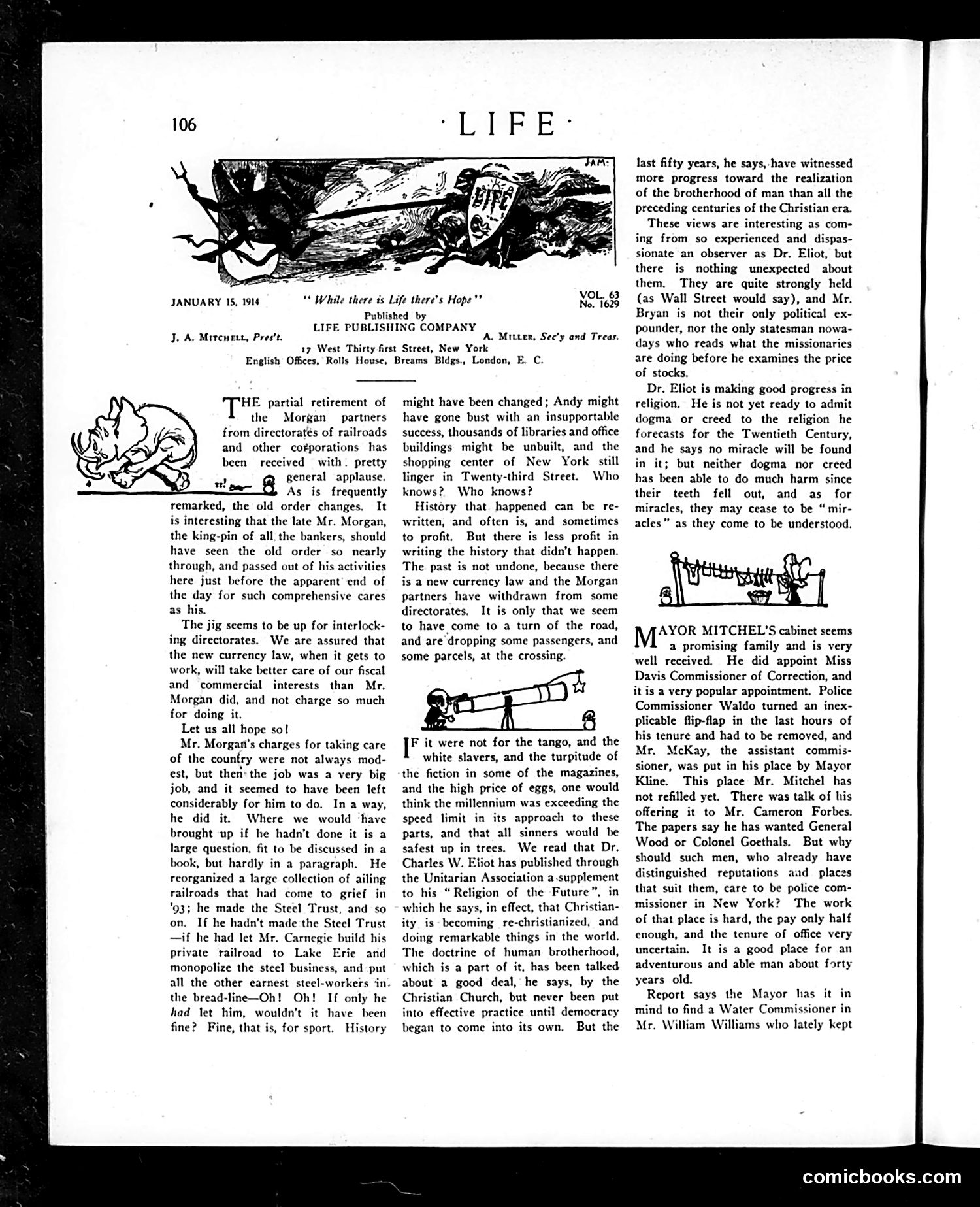
This page contains two editorial pieces reflecting Progressive Era concerns: **J.P. Morgan's Retirement**: The main article celebrates the partial withdrawal of Morgan banking partners from railroad and corporate directorates. The author offers qualified praise for Morgan's past reorganizations (notably the 1893 railroad crisis and the Steel Trust formation), while sarcastically suggesting the new Federal Reserve currency law will now handle fiscal management better and "not charge so much for doing it." The tone is ambivalent—acknowledging Morgan's historical necessity while welcoming reduced banker influence over American industry. **Dr. Charles Eliot's Progressive Theology**: The second piece discusses Harvard president Eliot's published views on Christianity's "re-christianization," particularly the doctrine of human brotherhood. The author notes that democracy has finally enabled this Christian principle's practical implementation, and cites Eliot's claim that the past fifty years achieved more human progress toward brotherhood than all preceding Christian centuries. The piece treats this as mainstream Progressive ideology, mentioning William Jennings Bryan as another prominent advocate. Both pieces reflect 1914 Progressive concerns: banker regulation, Christian social ethics, and democratic reform.
📄 Transcribed text from this page (OCR, searchable)
Machine-transcribed from the original scan — historical spelling and the odd misread are preserved.
JANUARY 15, 1914 “* While there ts Life there's Hope"’ Published by LIFE PUBLISHING COMPANY J. A. Mircnete, Pres’t. A. Mutter, Sec’y and Treas. 17 West Thirty first Street, New York English Offices, Rolls House, Breams Bldgs., London, E. C. HE partial retirement of the Morgan partners from directoratés of railroads and other cogporations has been received with. pretty general applause. As is frequently remarked, the old order changes. It is interesting that the late Mr. Morgan, the king-pin of all the bankers, should have seen the old order so nearly through, and passed out of his activities here just before the apparent’ end of the day for such comprehensive cares as his. The jig seems to be up for interlock- ing directorates. We are assured that the new currency law, when it gets to work, will take better care of our fiscal and commercial interests than Mr. Morgan did, and not charge so much for doing it. Let us all hope so! Mr. Morgan's charges for taking care of the counfry were not always mod- est, but then the job was a very big job, and it seemed to have been left considerably for him to do. In a way, he did it. Where we would ‘have brought up if he hadn't done it is a large question, fit to be discussed in a book, but hardly in a paragraph. He reorganized a large collection of ailing railroads that had come to grief in ‘93; he made the Steel Trust, and so on. If he hadn’t made the Steel Trust —if he had let Mr. Carnegie build his private railroad to Lake Erie and monopolize the steel business, and put all the other earnest steel-workers in: the bread-line—Oh! Oh! If only he had let him, wouldn't it have been fine? Fine, that is, for sport. History might have been changed; Andy might have gone bust with an insupportable success, thousands of libraries and office buildings might be unbuilt, and the shopping center of New York still linger in Twenty-third Street. Who knows? Who knows? History that happened can be re- written, and often is, and sometimes to profit. But there is less profit in writing the history that didn’t happen. The past is not undone, because there is a new currency law and the Morgan partners have withdrawn from some directorates. It is only that we seem to have come to a turn of the road, and are dropping some passengers, and some parcels, at the crossing. F it were not for the tango, and the white slavers, and the turpitude of the fiction in some of the magazines, and the high price of eggs, one would think the millennium was exceeding the speed limit in its approach to these parts, and that all sinners would be safest up in trees. We read that Dr. Charles W. Eliot has published through the Unitarian Association a.supplement to his “Religion of the Future”, in which he says, in effect, that Christian- ity is becoming re-christianized, and doing remarkable things in the world. The doctrine of human brotherhood, which is a part of it, has been talked about a good deal, he says, by the Christian Church, but never been put into effective practice until democracy began to come into its own. But the last fifty years, he says, have witnessed more progress toward the realization of the brotherhood of man than all the preceding centuries of the Christian era. These views are interesting as com- ing from so experienced and dispas- sionate an observer as Dr. Eliot, but there is nothing unexpected about them, They are quite strongly held (as Wall Street would say), and Mr. Bryan is not their only political ex- pounder, nor the only statesman nowa- days who reads what the missionaries are doing before he examines the price of stocks. Dr. Eliot is making good progress in religion. He is not yet ready to admit dogma or creed to the religion he forecasts for the Twentieth Century, and he says no miracle will be found in it; but neither dogma nor creed has been able to do much harm since their teeth fell out, and as for miracles, they may cease to be “mir- acles” as they come to be understood. AYOR MITCHEL'S cabinet seems a promising family and is very well received. He did appoint Miss Davis Commissioner of Correction, and it is a very popular appointment. Police Commissioner Waldo turned an inex- plicable flip-flap in the last hours of his tenure and had to be removed, and Mr. McKay, the assistant commis- sioner, was put in his place by Mayor Kline. This place Mr. Mitchel has not refilled yet. There was talk of his offering it to Mr. Cameron Forbes. The papers say he has wanted General Wood or Colonel Goethals. But why should such men, who already have distinguished reputations aud places that suit them, care to be police com- missioner in New York? The work of that place is hard, the pay only half enough, and the tenure of office very uncertain. It is a good place for an adventurous and able man about forty years old. Report says the Mayor has it in mind to find a Water Commissioner in Mr. William Williams who lately kept comicbooks.com