
Life, 1914-01-15 · page 24 of 40
Life — January 15, 1914 — page 24: what you’re looking at
What you’re looking at
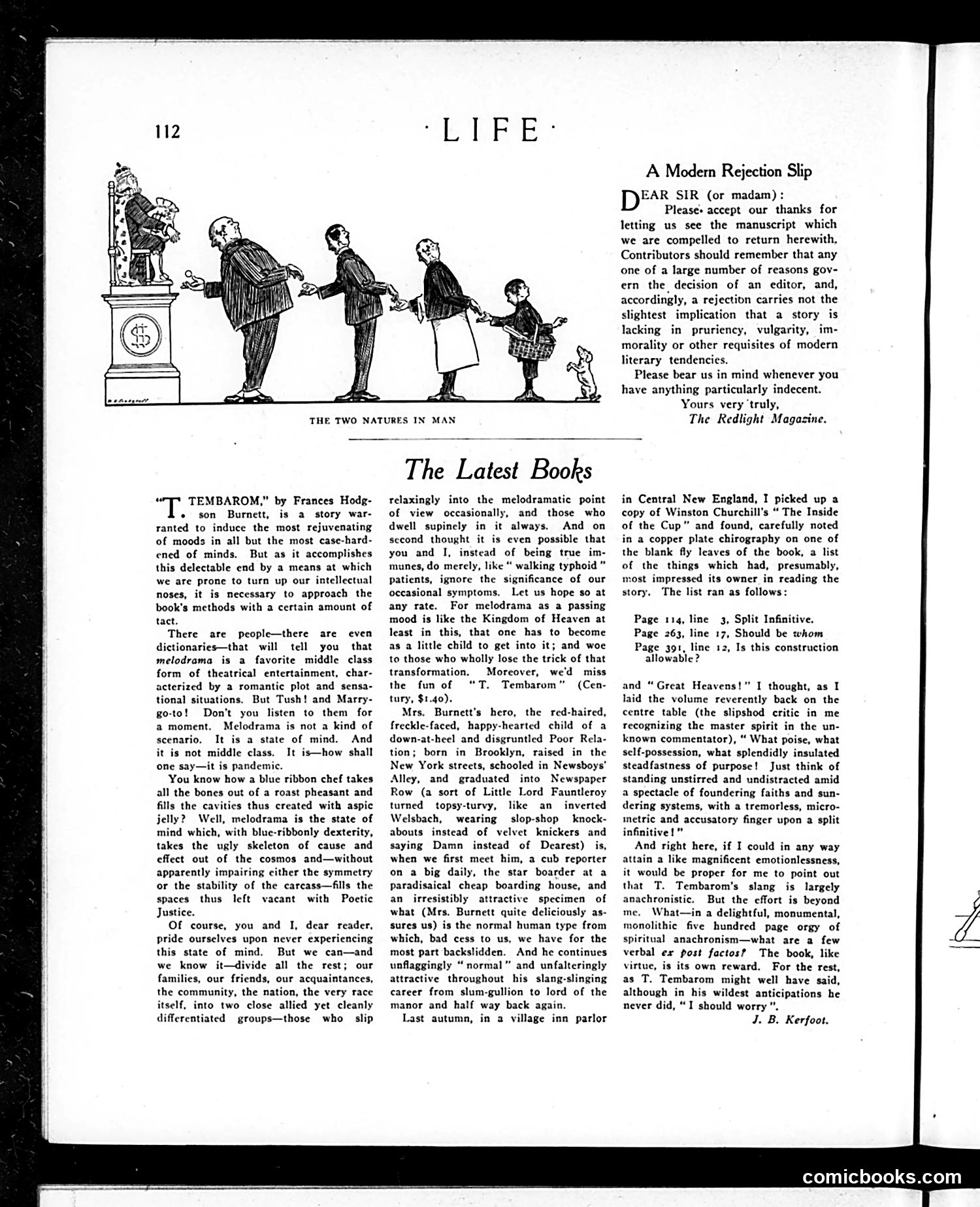
**The Cartoon "The Two Natures in Man":** The image depicts a clear class hierarchy: a statue of wealth (marked with a dollar sign) stands elevated while progressively smaller figures bow before it—from well-dressed gentlemen to a child to a small dog. This satirizes how greed and materialism reduce human dignity across all social classes, suggesting that financial self-interest is humanity's base nature. **"A Modern Rejection Slip":** The right panel parodies editorial hypocrisy. It's a mock rejection letter from "The Redlight Magazine" that purports to reject a manuscript while claiming rejection doesn't imply lack of "pruriency, vulgarity, immorality"—then ironically invites submissions of "anything particularly indecent." This mocks publications that claim moral standards while exploiting sensationalism. **Book Review:** The page includes a genuine review of Frances Hodgson Burnett's *T. Tembarom*, analyzing melodrama not as theatrical genre but as a psychological state affecting entire society—everyone from families to nations indulges in it, whether they admit it or not.
📄 Transcribed text from this page (OCR, searchable)
Machine-transcribed from the original scan — historical spelling and the odd misread are preserved.
THE TWO NATURE: IN MAN A Modem Rejection Slip EAR SIR (or madam) : Please+ accept our thanks for letting us see the manuscript which we are compelled to return herewith, Contributors should remember that any one of a large number of reasons gov- ern the, decision of an editor, and, accordingly, a rejection carries not the slightest implication that a story is lacking in pruriency, vulgarity, im- morality or other requisites of modern literary tendencies. Please bear us in mind whenever you have anything particularly indecent. Yours very ‘truly, The Redlight Magazine. Be TEMBAROM,” by Frances Hodg- « son Burnett, is a story war- ranted to induce the most rejuvenating of moods in all but the most case-hard- ened of minds. But as it accomplishes this delectable end by a means at which we are prone to turn up our intellectual noses, it is necessary to approach the book's methods with a certain amount of tact. There are people—there are even dictionaries—that will tell you that melodrama is a favorite middle class form of theatrical entertainment, char- acterized by a romantic plot and sensa- tional situations. But Tush! and Marry- go-to! Don't you listen to them for a moment. Melodrama is not a kind of scenario. It is a state of mind. And it is not middle class, It is—how shall one say—it is pandemic. You know how a blue ribbon chef takes all the bones out of a roast pheasant and fills the cavities thus created with aspic jelly? Well, melodrama is the state of mind which, with blue-ribbonly dexterity, takes the ugly skeleton of cause and effect out of the cosmos and—without apparently impairing cither the symmetry or the stability of the carcass—fills the spaces thus left vacant with Poetic Justice. Of course, you and I, dear reader, pride ourselves upon never experiencing this state of mind. But we can—and we know it—divide all the rest; our families, our friends, our acquaintances, the community, the nation, the very race itself, into two close allied yet cleanly differentiated groups—those who slip The Latest Books relaxingly into the melodramatic point of view occasionally, and those who dwell supinely in it always. And on sccond thought it is even possible that you and I, instead of being true im- munes, do merely, like “ walking typhoid” patients, ignore the significance of our occasional symptoms. Let us hope so at any rate. For melodrama as a passing mood is like the Kingdom of Heaven at least in this, that one has to become as a little child to get into it; and woe to those who wholly lose the trick of that transformation. Moreover, we'd miss the fun of “T. Tembarom” (Cen- tury, $1.40). Mrs. Burnett's hero, the red-haired, freckle-faced, happy-hearted child of a down-at-heel and disgruntled Poor Rela- tion; born in Brooklyn, raised in the New York streets, schooled in Newsboys’ Alley, and graduated into Newspaper Row (a sort of Little Lord Fauntleroy turned topsy-turvy, like an inverted Welsbach, wearing slop-shop knock- abouts instead of velvet knickers and saying Damn instead of Dearest) is, when we first meet him, a cub reporter on a big daily, the star boarder at a paradisaical cheap boarding house, and an irresistibly attractive specimen of what (Mrs. Burnett quite deliciously as- sures us) is the normal human type from which, bad cess to us, we have for the most part backslidden. And he continues unflaggingly “normal” and unfalteringly attractive throughout his slang-slinging career from slum-gullion to lord of the manor and half way back again. Last autumn, in a village inn parlor in Central New England, I picked up a copy of Winston Churchill's “ The Inside of the Cup” and found, carefully noted in a copper plate chirography on one of the blank fly leaves of the book, a list of the things which had, presumably, most impressed its owner in reading the story. The list ran as follows: Page 114, line 3, Split Infinitiv. Page 263, line 17, Should be whom Page 391, line 12, Is this construction allowable? and “Great Heavens!" I thought, as I laid the volume reverently back on the centre table (the slipshod critic in me recognizing the master spirit in the un- known commentator), “ What poise, what self-possession, what splendidly insulated steadfastness of purpose! Just think of standing unstirred and undistracted amid a spectacle of foundering faiths and sun- dering systems, with a tremorless, micro- metric and accusatory finger upon a split infinitive!" And right here, if I could in any way attain a like magnificent emotionlessness, it would be proper for me to point out that T. Tembarom’s slang is largely anachronistic. But the effort is beyond me, What—in a delightful, monumental, monolithic five hundred page orgy of spiritual anachronism—what are a few verbal ex post factos? The book, like virtue, is its own reward. For the rest, as T. Tembarom might well have said, although in his wildest anticipations he never did, “I should worry". J. B. Kerfoot. comicbooks.com