
Life, 1914-01-15 · page 22 of 40
Life — January 15, 1914 — page 22: what you’re looking at
What you’re looking at
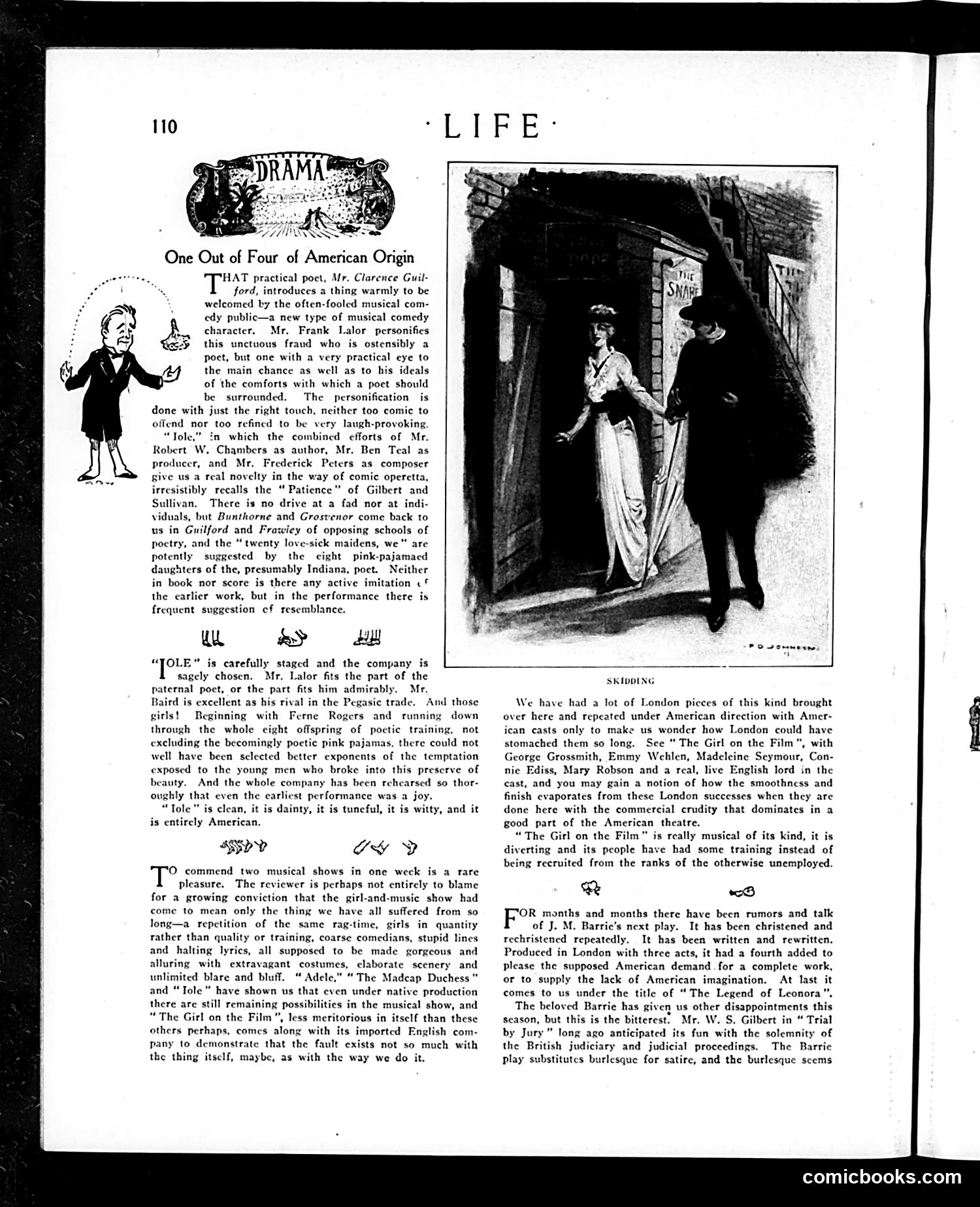
This page reviews three musical comedies, focusing on American theatrical production versus imported British work. **"Jole"** is praised as a novel American musical comedy featuring Frank Lalor as a fraudulent poet—a practical schemer masquerading as an artistic visionary. The review compares it favorably to Gilbert and Sullivan's "Patience," noting similar satire on poetry and aesthetics without direct imitation. **The Central Critique**: The reviewer argues that American musical shows have become formulaic—relying on "rag-time, girls in quantity rather than quality...coarse comedians, stupid lines and halting lyrics" hidden behind expensive costumes and scenery. **"The Girl on the Film"** (British import) is used to demonstrate this problem: London productions lose their "smoothness and finish" when produced in America with "commercial crudity." **The Satire's Point**: American theater prioritizes spectacle over substance, while even mediocre British imports reveal how poorly American producers execute musicals. The cartoonish figure on the left appears to represent the "unctuous fraud" character type—all flash and pretense.
📄 Transcribed text from this page (OCR, searchable)
Machine-transcribed from the original scan — historical spelling and the odd misread are preserved.
of American Origin HAT practical poet, Mr. Clarence Guil- ford, introduces a thing warmly to be welcomed by the often-fooled musical com- edy public—a new type of musical comedy character. Mr. Frank Lalor personifies t unctuous fraud who is ostensibly a poet, but one with a very practical eye to the main chance as well as to his ideals of the comforts with which a poet should be surrounded. The personification is done with just the right touch, neither too comic to offend nor too refined to be very laugh-provoking. “Tole,” in which the combined efforts of Mr. Robert W. Chambers as author, Mr. Ben Teal as producer, and Mr. Frederick Peters as composer give us a real novelty in the way of comic operetta, irresistibly recalls the “ Patience" of Gilbert and Sullivan. There is no drive at a fad nor at indi- viduals, but Bunthorne and Grosvenor come back to us in Guilford and Frawiey of opposing school poetry, and the “twenty love-sick maidens, we potently suggested by the cight pink-pajamaed daughters of the, presumably Indiana, poct. Neither in book nor score is there any active imitation «f the earlier work, but in the performance there is frequent suggestion cf resemblance. qu ay au Ph EI OS OG BA OS AN OP a “TOLE" is carefully staged and the company is sagely chosen. Mr. Lalor fits the part of the paternal poct, or the part fits him admirably, Mr. Baird is excellent as his rival in the Pegasic trade. And those girls! Beginning with Ferne Rogers and running down through the whole cight offspring of poctic training, not exeluding the becomingly poctic pink pajamas, there could not well have been selected better exponents of the temptation exposed to the young men who broke into this preserve of beauty. And the whole company has been rehearsed so thor- oughly that even the earliest performance was a joy. “Tole” is clean, dainty, it is tuncful, it is witty, and it is entirely American. SHV ‘O commend two musical shows in one weck is a rare pleasure, The reviewer is perbaps not entirely to blame for a growing conviction that the girl-and-music show had come to mean only the thing we have all suffered from so long—a repetition of the same rag-time, girls in quantity rather than quality or training, coarse comedians, stupid lines and halting lyrics, all supposed to be made gorgeous and alluring with extravagant costumes, elaborate scenery and unlimited blare and bluff. “Adele,” “The Madcap Duchess” and “Tole” have shown us that even under native production there are still remaining possibilities in the musical show, and “The Girl on the Film”, less meritorious in itself than these others perhaps, comes along with its imported English com- pany to demonstrate that the fault exists not so much with the thing itsclf, maybe, as with the way we do it. oy Y SKIDDING We have had a lot of London picces of this kind brought over here and repeated under American direction with Amer- ican casts only to make us wonder how London could have stomached them so long. See “ The Girl on the Film”, with George Grossmith, Emmy Wehlen, Madeleine Seymour, Con- nie Ediss, Mary Robson and a real, live English lord in the cast, and you may gain a notion of how the smoothness and finish evaporates from these London successes when they are done here with the commercial crudity that dominates in a good part of the American theatre. “The Girl on the Film” is really musical of its kind, it is erting and its people have had some training instead of being recruited from the ranks of the otherwise unemployed. Se <3 'OR months and months there have been rumors and talk of J. M. Barrie’s next play. It has been christened and rechristened repeatedly. It has been written and rewritten. Produced in London with three acts, it had a fourth added to please the supposed American demand. for a complete work, or to supply the lack of American imagination. At last it comes to us under the title of “The Legend of Leonora”. The beloved Barrie has given us other disappointments this season, but this is the bitterest. Mr. W. S. Gilbert in “ Trial long ago anticipated its fun with the solemnity of h judiciary and judi proceedings. The Barric play substitutcs burlesque for satire, and the burlesque scems comicbooks.com