
Life, 1914-01-15 · page 10 of 40
Life — January 15, 1914 — page 10: what you’re looking at
What you’re looking at
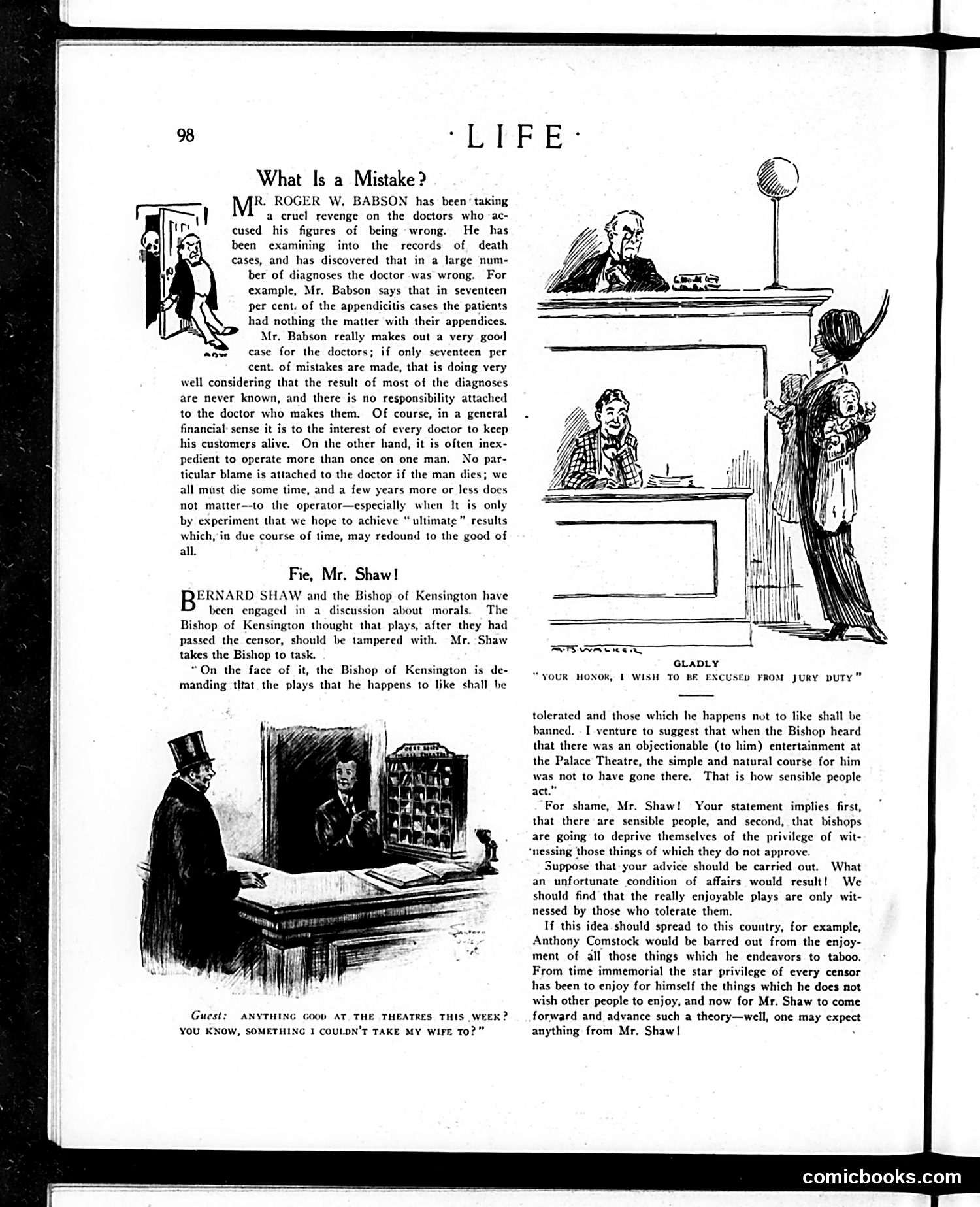
This page contains two satirical pieces targeting prominent figures of the era. **"What Is a Mistake?"** discusses Mr. Roger W. Babson's critique of doctors' diagnostic errors, arguing that failed diagnoses shouldn't be blamed since experimental treatment sometimes yields unforeseen benefits. **"Fie, Mr. Shaw!"** attacks Bernard Shaw and the Bishop of Kensington regarding theater censorship. Shaw apparently advised that plays should be "tampered with" by censors, while the Bishop demanded pre-approval of performances. The author sarcastically mocks Shaw's position, suggesting censorship would eliminate all entertainment and personal freedom of choice. The accompanying cartoons—a domestic scene and a theater scene—visually reinforce these arguments through satirical illustration typical of early 20th-century American humor magazines.
📄 Transcribed text from this page (OCR, searchable)
Machine-transcribed from the original scan — historical spelling and the odd misread are preserved.
a A) LS oa a What Is a Mistake > R. ROGER W. BABSON has been taking a cruel revenge on the doctors who ac- cused his figures of being wrong. He has been examining into the records of death cases, and has discovered that in a large num- ber of diagnoses the doctor was wrong. For example, Mr. Babson says that in seventeen per cent. of the appendicitis cases the patients had nothing the matter with their appendices. Mr. Babson really makes out a very good case for the doctors; if only seventeen per cent. of mistakes are made, that is doing very well considering that the result of most of the diagnoses are never known, and there is no responsibility attached to the doctor who makes them. Of course, in a general financial: sense it is to the interest of every doctor to keep his customers alive. On the other hand, it is often inex- pedient to operate more than once on one man. No par- ticular blame is attached to the doctor if the man dies; we all must die some time, and a few years more or less docs not matter—-to the operator—especially when It is only by experiment that we hope to achieve “ultimate” results which, in due course of time, may redound to the good of all. Fie, Mr. Shaw! ERNARD AW and the Bishop of Kensington have been engaged in a discussion about morals. The Bishop of Kensington thought that plays, after they had passed the censor, should be tampered with. Mr. Shaw takes the Bishop to task. “On the face of it, the Bishop of Kensington is de- manding tltat the plays that he happens to like shall be Guest: ANYTHING GOOD AT THE THEATRES THIS .W! YOU KNOW, SOMETHING I COULDN’T TAKE MY WIFE 10?" WIS WAT GLADLY “YOUR MONO, I WISH TO BE EXCUSED FROM JURY DUTY tolerated and those which he happens not to like shall be banned. I venture to suggest that when the Bishop heard that there was an objectionable (to him) entertainment at the Palace Theatre, the simple and natural course for him was not to have gone there. That is how sensible people act.” For shame, Mr. Shaw! Your statement implies first, that there are sensible people, and second, that bishops are going to deprive themselves of the privilege of wit- “nessing those things of which they do not approve. Suppose that your advice should be carried out. What an unfortunate condition of affairs would result! We should find that the really enjoyable plays are only wit- nessed by those who tolerate them. If this idea should spread to this country, for example, Anthony Comstock would be barred out from the enjoy- ment of all those things which he endeavors to taboo. From time immemorial the star privilege of every censor has been to enjoy for himself the things which he does not wish other people to enjoy, and now for Mr. Shaw to come forward and advance such a theory—well, one may expect anything from Mr. Shaw! . comicbooks.com