
Life, 1914-01-15 · page 23 of 40
Life — January 15, 1914 — page 23: what you’re looking at
What you’re looking at
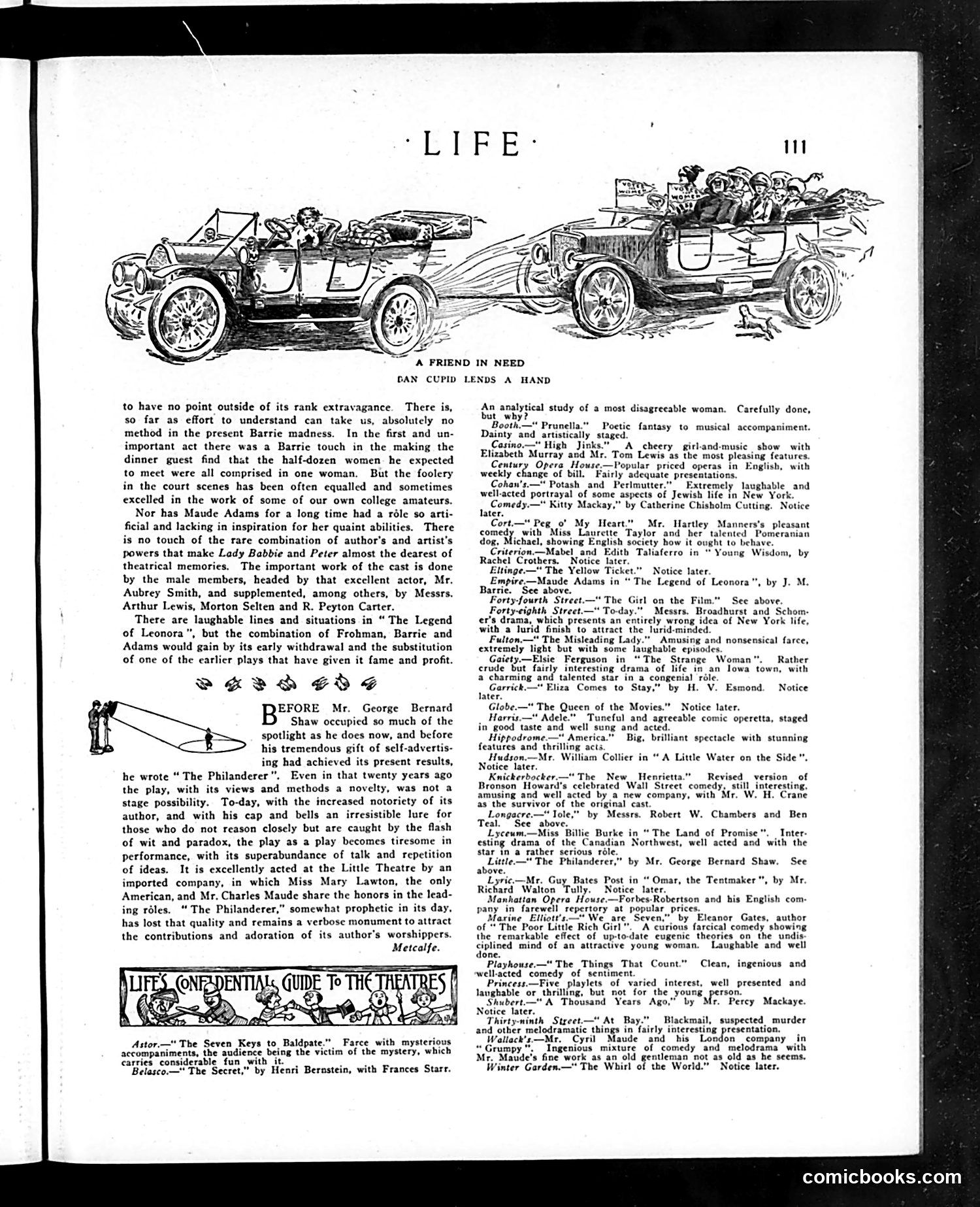
The illustration depicts two early automobiles in a comedic scenario: the first car has broken down or stalled, and the second vehicle—filled with passengers—arrives to assist. The caption suggests a romantic angle: "Cupid" (symbolizing romantic opportunity) helps when someone is "in need." The satire likely plays on the novelty of automobiles in this era—their unreliability and the social dynamics of early motoring. The crowded second car and the situation suggest humor around chance encounters, perhaps implying that breakdowns created opportunities for meeting potential romantic interests, or that helping stranded motorists was becoming a social practice worth noting. This reflects early 20th-century attitudes toward automobiles as both mechanical curiosities and social facilitators, before they became commonplace. The page is primarily theater reviews; this cartoon appears as light filler commentary on contemporary life.
📄 Transcribed text from this page (OCR, searchable)
Machine-transcribed from the original scan — historical spelling and the odd misread are preserved.
A FRIEND IN NEED GAN CUPID LENDS A HAND to have no point outside of its rank extravagance. There is, so far as effort to understand can take us, absolutely no method in the present Barrie madness. In the first and un- important act there was a Barrie touch in the making the dinner guest find that the half-dozen women he expected to meet were all comprised in one woman. But the foolery in the court scenes has been often equalled and sometimes excelled in the work of some of our own college amateurs. Nor has Maude Adams for a long time had a réle so arti- ficial and lacking in inspiration for her quaint abilities. There is no touch of the rare combination of author's and artist's powers that make Lady Babbie and Peter almost the dearest of theatrical memories. The important work of the cast is done by the male members, headed by that excellent actor, Mr. Aubrey Smith, and supplemented, among others, by Messrs. Arthur Lewis, Morton Selten and R. Peyton Carter. There are laughable lines and situations in “ The Legend of Leonora”, but the combination of Frohman, Barrie and Adams would gain by its early withdrawal and the substitution of one of the earlicr plays that have given it fame and profit. SEZBRAEdSEG EFORE Mr. George Bernard Shaw occupied so much of the spotlight as he does now, and before his tremendous gift of self-advertis- ing had achieved its present results, he wrote “ The Philanderer”. Even in that twenty years ago the play, with its views and methods a novelty, was not a stage possibility. To-day, with the increased notoriety of its author, and with his cap and bells an irresistible lure for those who do not reason closely but are caught by the flash of wit and paradox, the play as a play becomes tiresome in performance, with its superabundance of talk and repetition of ideas. It is excellently acted at the Little Theatre by an imported company, in which Miss Mary Lawton, the only American, and Mr. Charles Maude share the honors in the lead- ing réles. “The Philanderer,” somewhat prophetic in its day, has lost that quality and remains a verbose monument to attract the contributions and adoration of its author's worshippers. Metcalfe. Astor.—" The Seven Keys to Baldpate.” Farce with mysterious accompaniments, the audience being the victim of the mystery, which carries considerable fun with it. aie Belasco.—" The Secret,” by Henri Bernstein, with Frances Starr. An analytical study of a most disagreeable woman. Carefully done, but why? Booth.— Prunella.” Poetic fantasy to musical accompaniment. Dainty and artistically staged. Casino.—" High Jinks.” A cheery girl-and-music show with Elizabeth Murray and Mr. Tom Lewis as the most pleasing features. Century Opera House.—Popular priced operas in English, with weekly change of bill. Fairly adequate presentations. Cohan's.— Potash and Perlmutter.” Extremely laughable and well-acted portrayal of some aspects of Jewish life in New Yor! Comedy.—" Kitty Mackay,” by Catherine Chisholm Cutting. Notice "Peg o' My Heart." Mr. Hartley Manners's pleasant with Miss Laurette Taylor and her talented Pomeranian dog, Michael, showing English society how it ought to behave. Criterion—Mabel and Edith Taliaferro in “* Young Wisdom, by Rachel Crothers. Notice later. Elti “The Yellow Ticket.” Notice later “The Legend of Leonora”, by J. M. Forty-fourth Street.— The Girl on the Film." See above. Forty-eighth Street.—* To-day.” Messrs, Broadhurst and Schom- er’s drama, which presents an entirely wrong idea of New York life, with a lurid finish to attract the lurid-minded. Fulton. —“ The Misleading Lady." Amusing and nonsensical farce, extremely light but with some laughable episodes. Gaiety.—Elsie Ferguson in “The Strange Woman”. Rather crude but fairly interesting drama of life in an lowa town, with a charming and talented star in a congenial réle. Garrick." Eliza Comes to Stay,” by H. V. Esmond. Notice * The Queen of the Movies."” Notice later. | —" Adele.” Tuneful and agreeable comic operetta, staged in good taste and well sung and acted. Hippodrome.—" America.” Big, brilliant spectacle with stunning features and thrilling acts. Hudson.—Mr. William Collier in “A Little Water on the Side". Notice later. Knickerbocker.—" The New. Henrietta." Revised version _ of Bronson Howard's celebrated Wall Street comedy, still interesting, amusing and well acted by a new company, with Mr. W. H. Crane as the survivor of the original cast. Longacre.—" Tole," by Messrs. Robert W. Chambers and Ben . See above. Lyceum.—Miss Billie Burke in “The Land of Promise”. Inter- esting drama of the Canadian Northwest, well acted and with the star in a rather serious réle. Bittle" The Philanderer,” by Mr. George Bernard Shaw. See above. Lyric.—Mr. Guy Bates Post in “ Omar, the Tentmaker", by Mr, Richard Walton Tully.” Notice. later, Manhattan Opera House.—Forbes-Robertson and his English com- pany in farewell repertory at popular, prices. Maxine Elliott We are Seven,” by Eleanor Gates, author of “ The Poor Little Rich Girl". A curious farcical comedy showi the remarkable effect of up-to-date eugenic theories on the undis: ciplined mind of an attractive young woman. Laughable and well done. Playhouse—" The Things That Count.” well-acted comedy of sentiment Princess.—Five playlets of varied interest, well presented and laughable or thrilling, but not for the young person. Shubert.—" A Thousand Years Ago,” by Mr. Percy Mackaye. Notice later. Thirty-ninth Street—" At Bay.” Blackmail, suspected murder and other melodramatic things in fairly interesting presentation. —_ Wallack’s—Mr. Cyril Maude and his London company in “Grumpy, Ingenious mixture of comedy and melodrama with Mr. Maude's fine work as an old gentleman not as old as he seems. Winter Garden.—" The Whirl of the World.” Notice later. Clean, ingenious and comicbooks.com