
A complete issue · 40 pages · 1913
Life — November 13, 1913
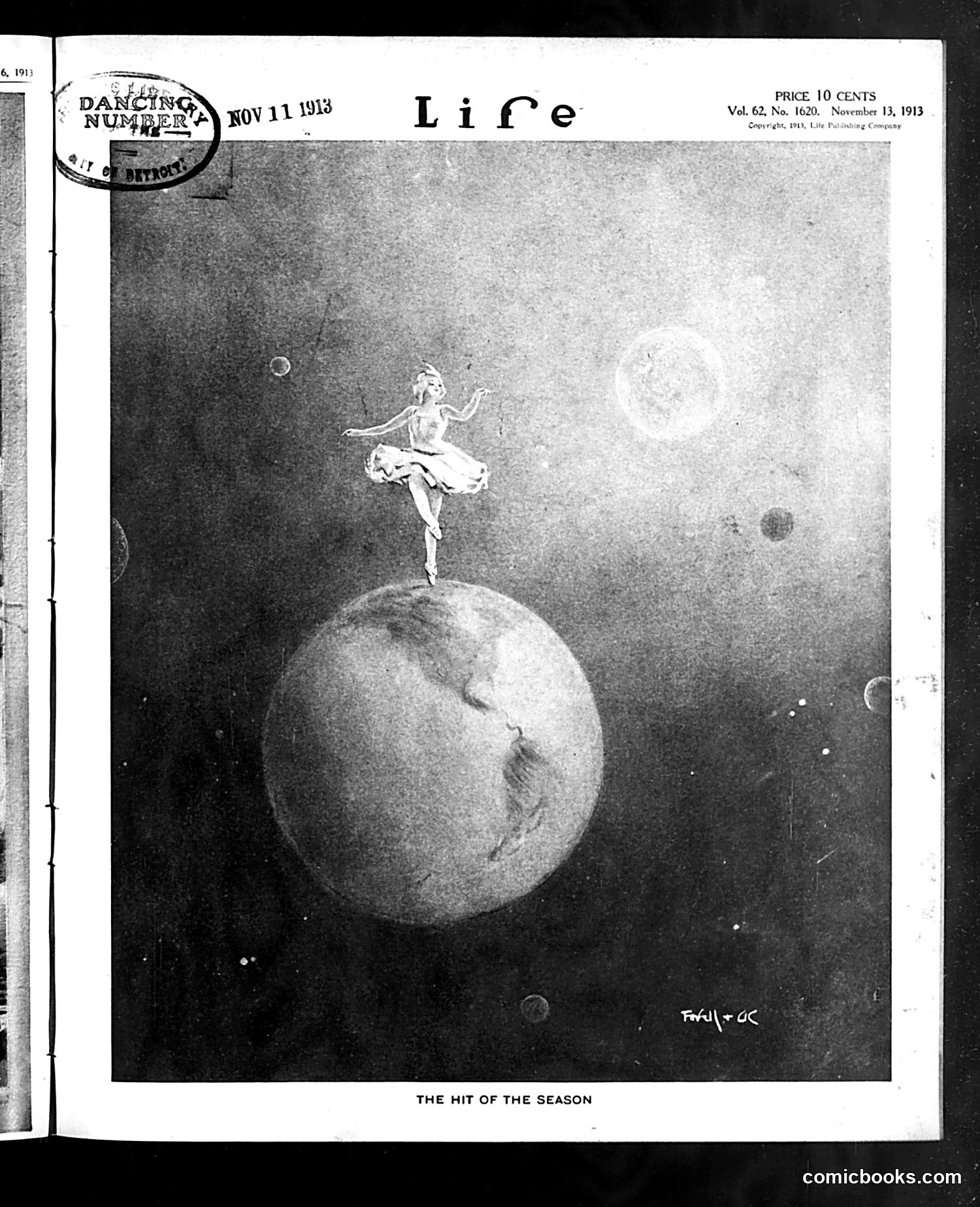
This is the November 13, 1913 cover of *Life* magazine, titled "The Hit of the Season." The image depicts a young female dancer in a classical ballet pose, balanced on one leg atop a large spherical planet or moon against a starry background. The satire likely references a popular theatrical production or dance performance that was the season's entertainment sensation—the phrase "hit of the season" suggests major cultural buzz. The whimsical, surreal composition (a ballerina poised impossibly on a celestial body) exaggerates the show's fantastical or otherworldly appeal. Without additional context, I cannot definitively identify the specific production or dancer referenced, though the Art Nouveau-influenced style and celestial theme suggest it may involve a avant-garde or imaginative theatrical work popular among 1913 audiences.
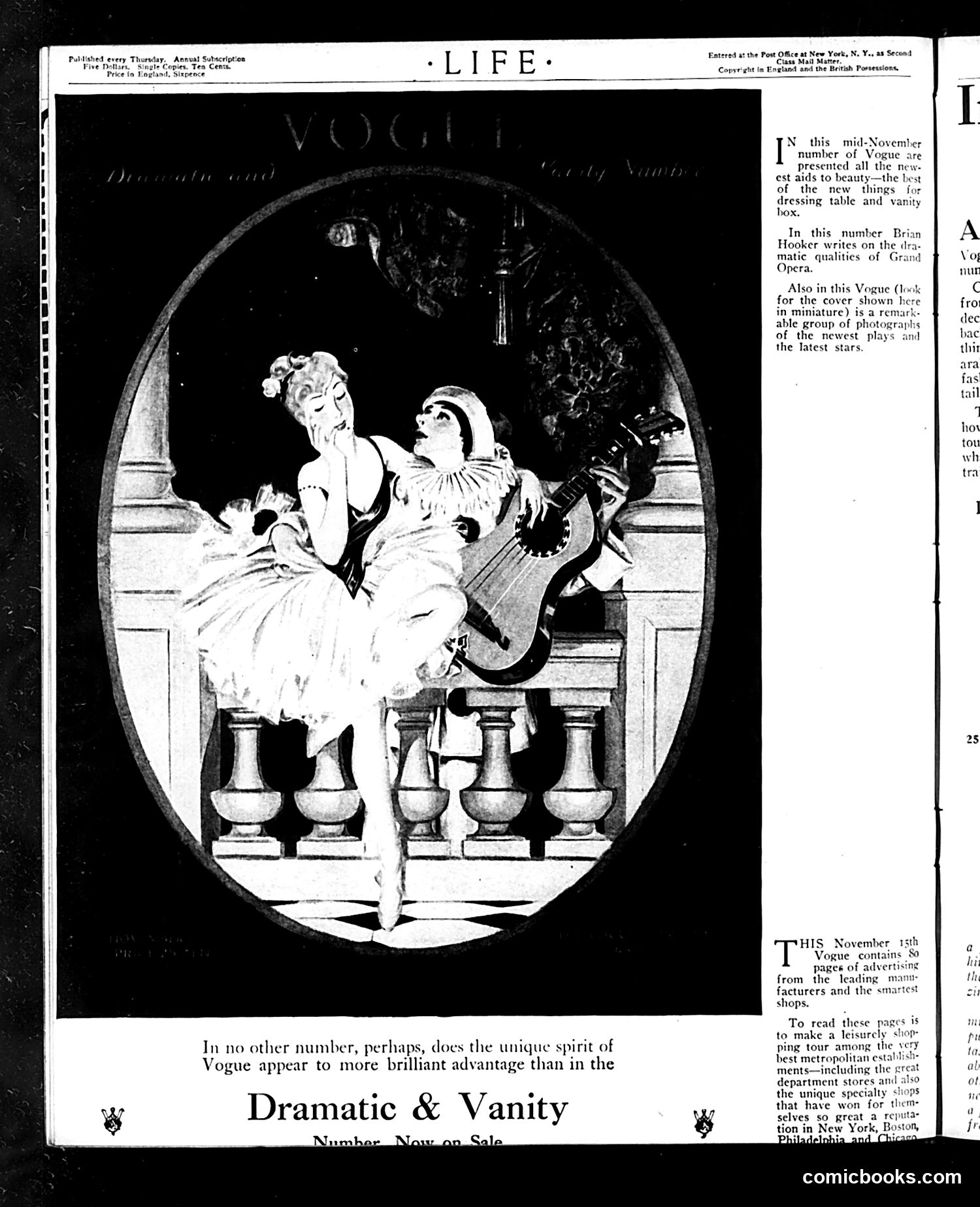
This is a **Life magazine advertisement/feature page**, not a political cartoon. The central oval illustration depicts two elegantly dressed women in 1920s attire on a classical balcony, one playing a stringed instrument (possibly a lute or guitar). The heading "Dramatic & Vanity" appears to reference Vogue magazine's mid-November issue, which the accompanying text indicates contains fashion and beauty content. The satire here is subtle: **Life is mocking Vogue's pretentious aesthetic** — the classical architectural setting, the affected poses, and theatrical costuming represent the exaggerated "high culture" aspirations of fashion journalism. The joke targets how Vogue presents ordinary consumer goods (dressing tables, beauty products) within artificially sophisticated, operatic framing to appeal to aspirational readers.
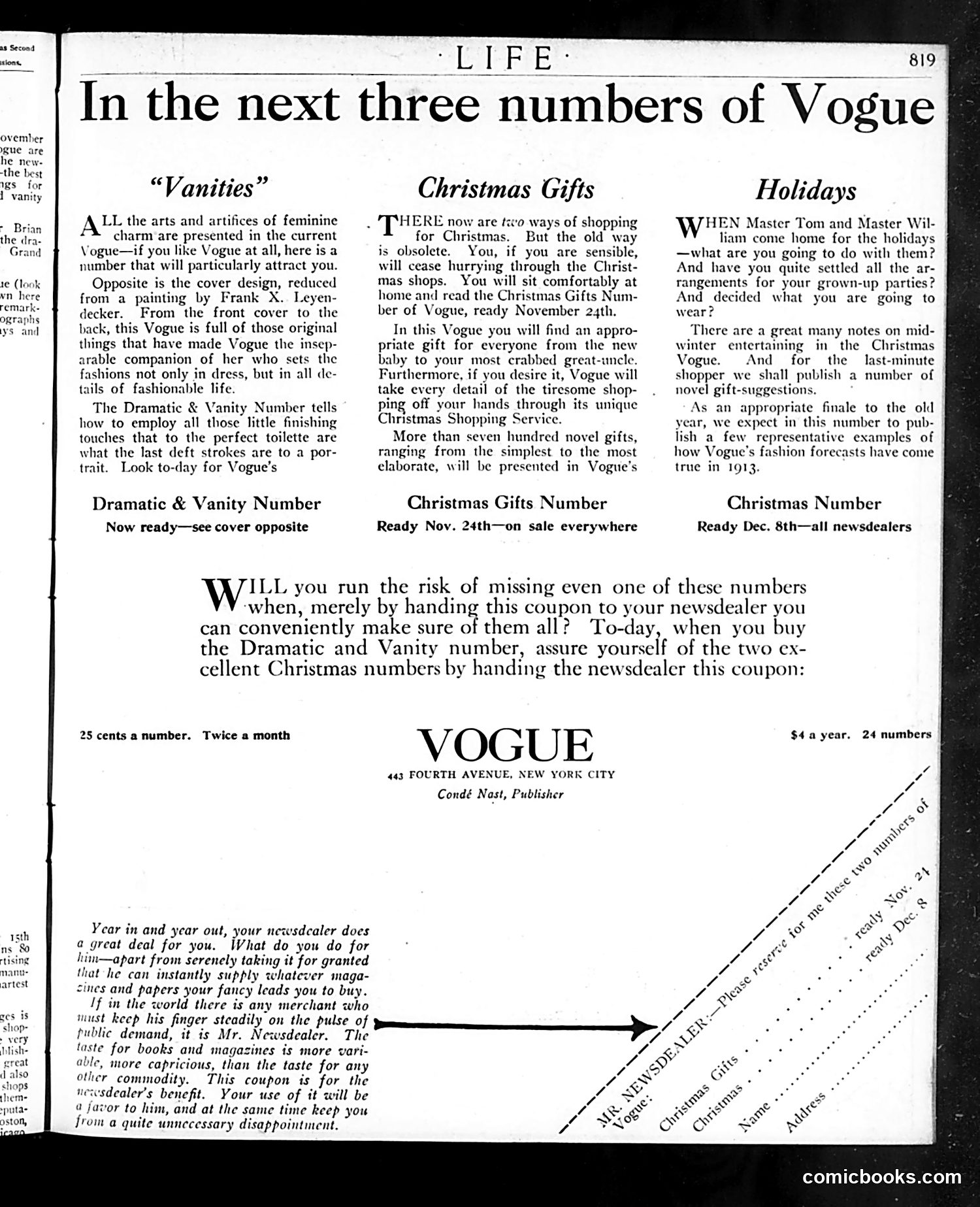
This page is **primarily advertising, not political satire**. It promotes three upcoming issues of *Vogue* magazine: 1. **"Vanities"** — a Dramatic & Vanity Number featuring feminine charm and finishing touches 2. **Christmas Gifts Number** — offering "seven hundred novel gifts" for holiday shopping 3. **Holidays Number** — addressing post-holiday entertainment and social arrangements The content targets affluent readers planning holiday parties and gift-giving. A coupon at bottom allows newsdealer pre-orders to ensure availability of all three issues. There is **no political cartoon or social satire present**. This is a straightforward commercial promotion from the early 20th century, emphasizing *Vogue*'s role as a lifestyle and shopping guide for wealthy consumers during the Christmas season.
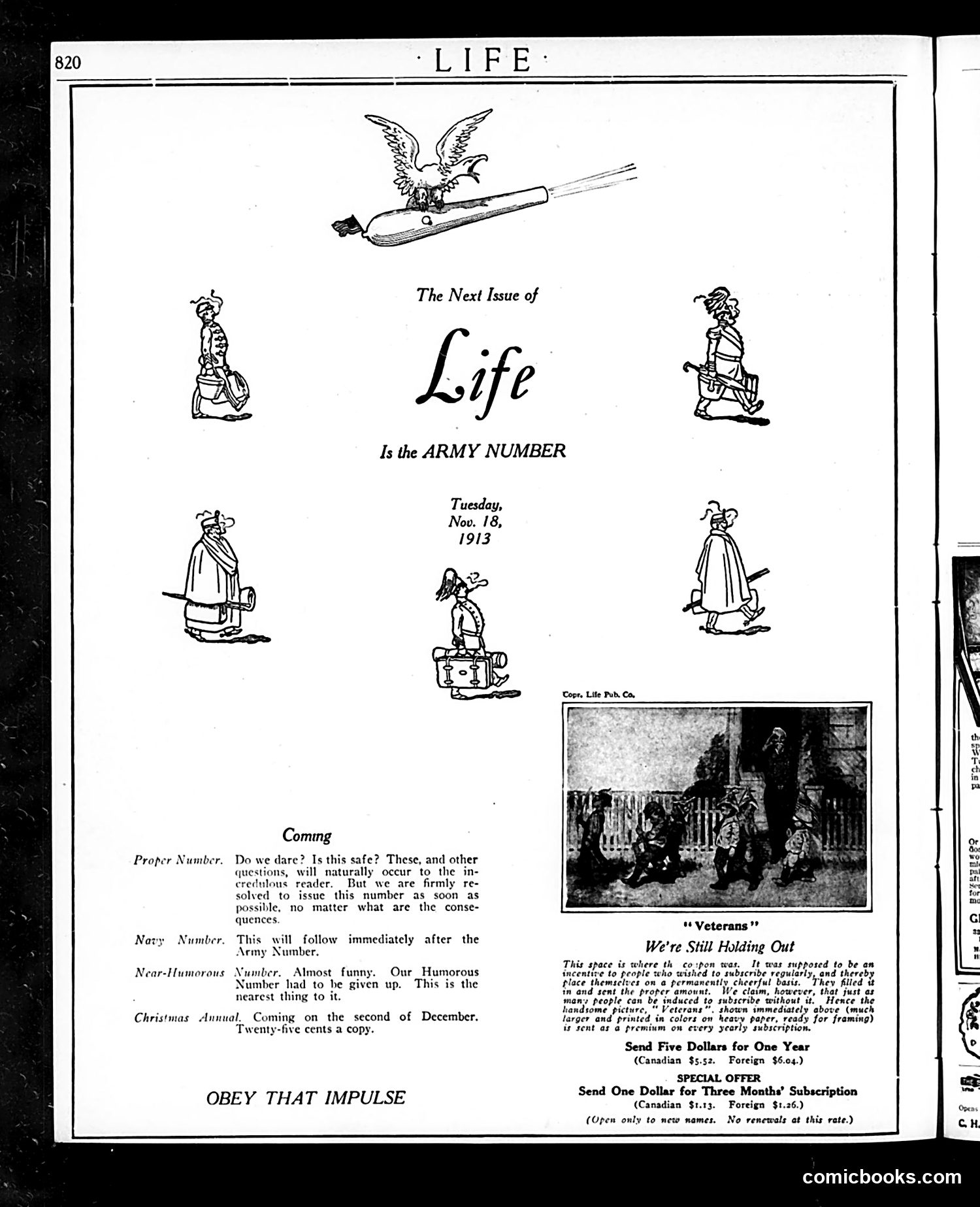
This page announces the next issue will be an "Army Number" (Tuesday, Nov. 18, 1913). The decorative illustrations show military and patriotic figures arranged around the announcement, including what appear to be soldiers and Liberty-style figures carrying military equipment. The bottom section titled "OBEY THAT IMPULSE" likely contains satirical commentary, though the specific text is too small to read clearly in this image. A photograph labeled "Veterans" shows what appears to be elderly military veterans, with accompanying text suggesting this was a nostalgic or commemorative feature about aging soldiers. The page reflects Life's typical mix of political satire, military-themed humor, and subscription promotion during the pre-World War I period when American military readiness was becoming an increasingly debated public issue.
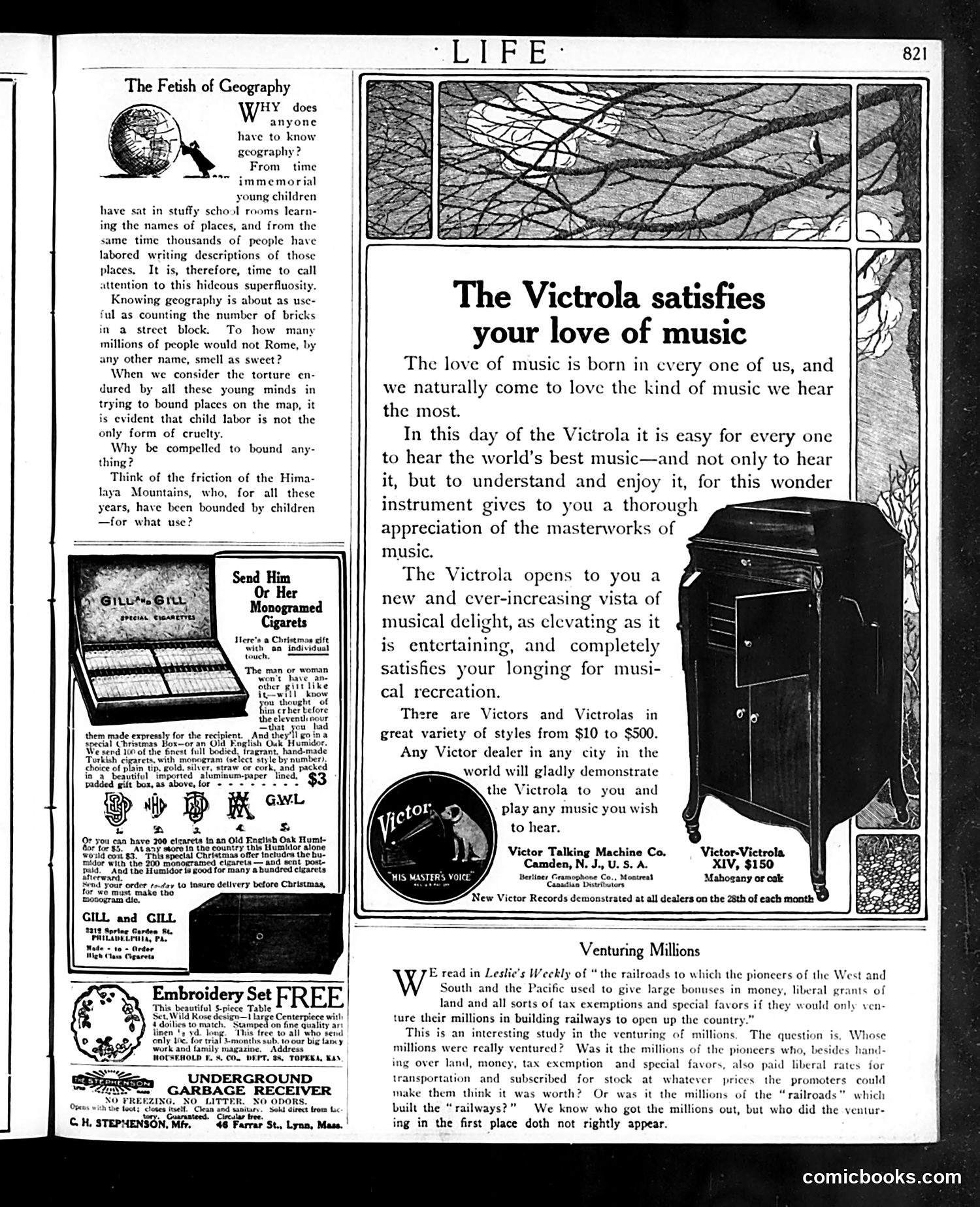
This page is primarily **advertising and editorial content** rather than political satire. The left column contains "The Fetish of Geography," a critical essay arguing that teaching geography through rote memorization of place names is educationally wasteful. The author contends this labor-intensive approach fails to develop genuine understanding. The page features advertisements for **Victrola phonographs** (the dominant gramophone brand), **Gill and Gill cigarettes**, and various other consumer products typical of the era. A brief editorial piece titled "Venturing Millions" discusses railroad pioneers and westward expansion financing, questioning who truly profited from these ventures. The page reflects early 20th-century concerns about educational methodology and consumer marketing rather than contemporary political commentary.
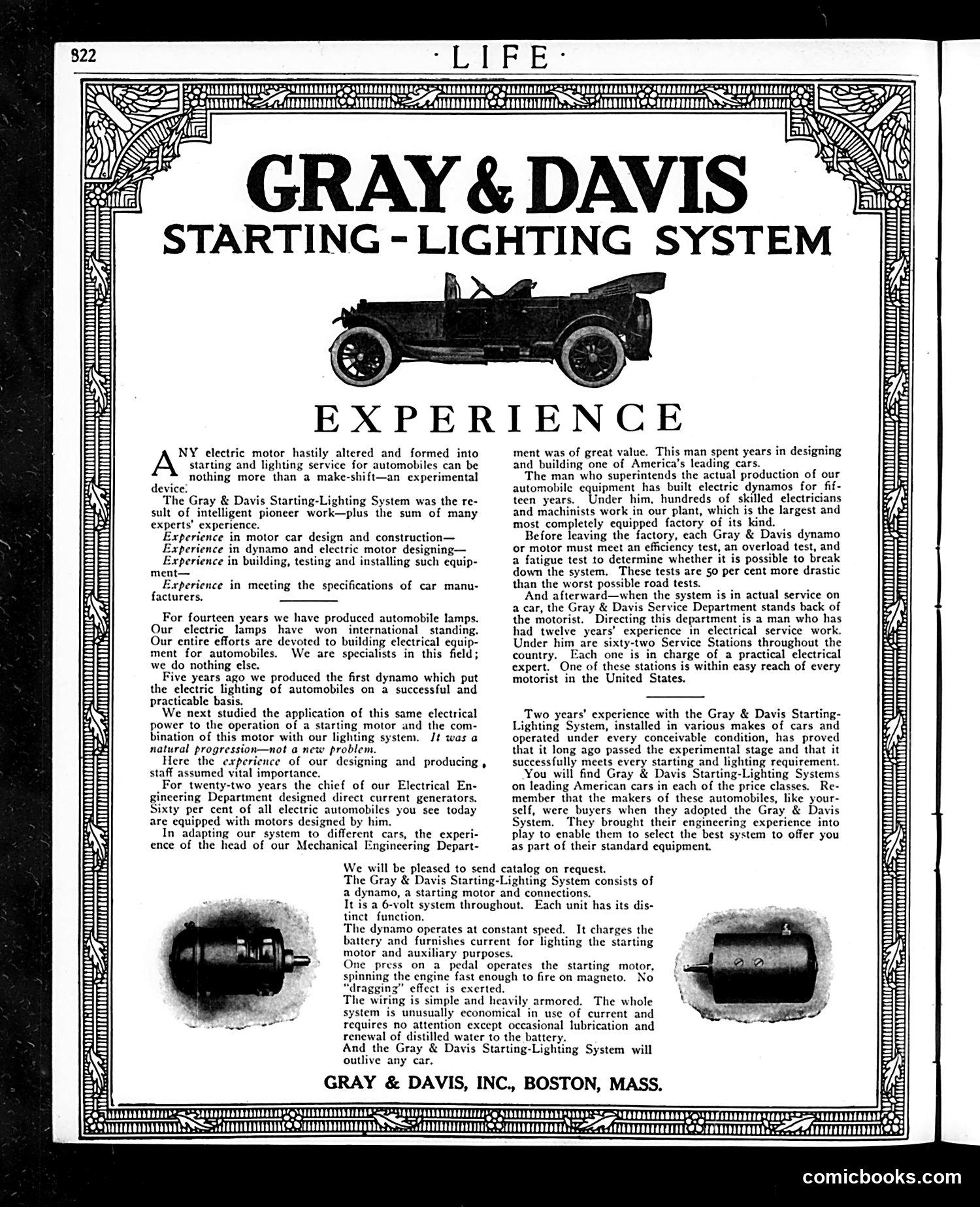
This page is **not a cartoon or satirical content**—it's a straightforward advertisement for the Gray & Davis Starting-Lighting System, an early automotive electrical component. The ad emphasizes the company's engineering expertise and reliability, highlighting that their system was already installed on "leading American cars." Key selling points include: a 6-volt system with distinct functions, constant-speed dynamo operation, simple heavy-duty construction, and economical current usage. The imagery shows the dynamo component itself (two mechanical photos) and a period automobile illustration. The text appeals to practical concerns: durability, proper testing, and availability of service stations nationwide. This represents standard early-1900s automotive advertising focused on technical specifications and brand credibility rather than satire or humor.
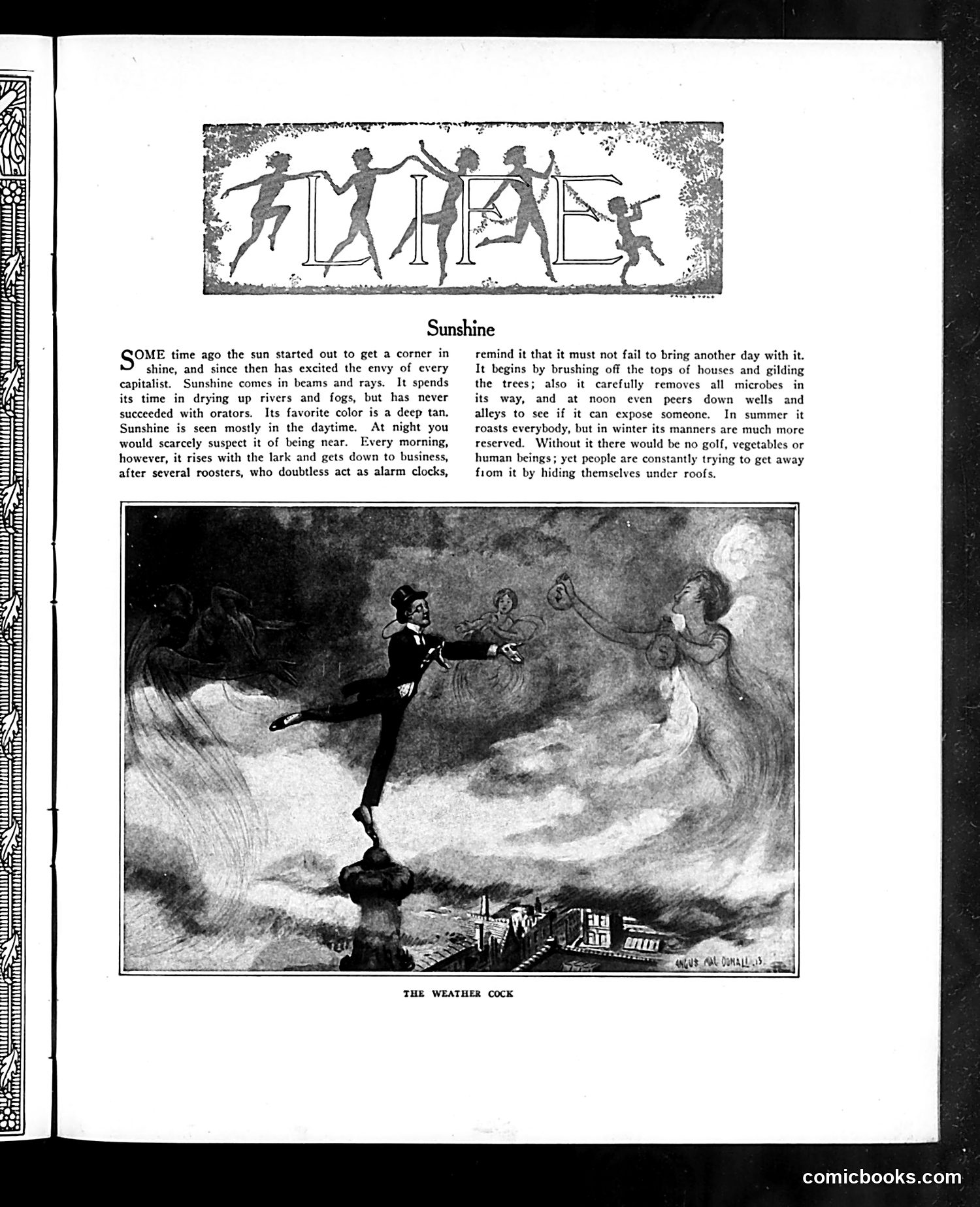
This page contains two distinct elements: **"Sunshine" Essay**: A whimsical personification of the sun as an energetic character that wakes people, dries laundry, and generally causes activity. It's anthropomorphic humor typical of early 20th-century Life magazine's lighter content. **"The Weather Cock" Illustration**: A surreal cartoon showing a well-dressed man balanced precariously atop a weather vane, gesturing toward celestial figures (possibly representing weather or fate) against a moonlit sky. The cityscape below suggests urban life controlled by meteorological forces. This appears to be satirizing human dependence on unpredictable weather or perhaps poking fun at those obsessed with weather forecasting—a commentary on humanity's vulnerability to natural forces beyond their control. Both pieces use personification and fantasy to explore humanity's relationship with atmospheric phenomena.
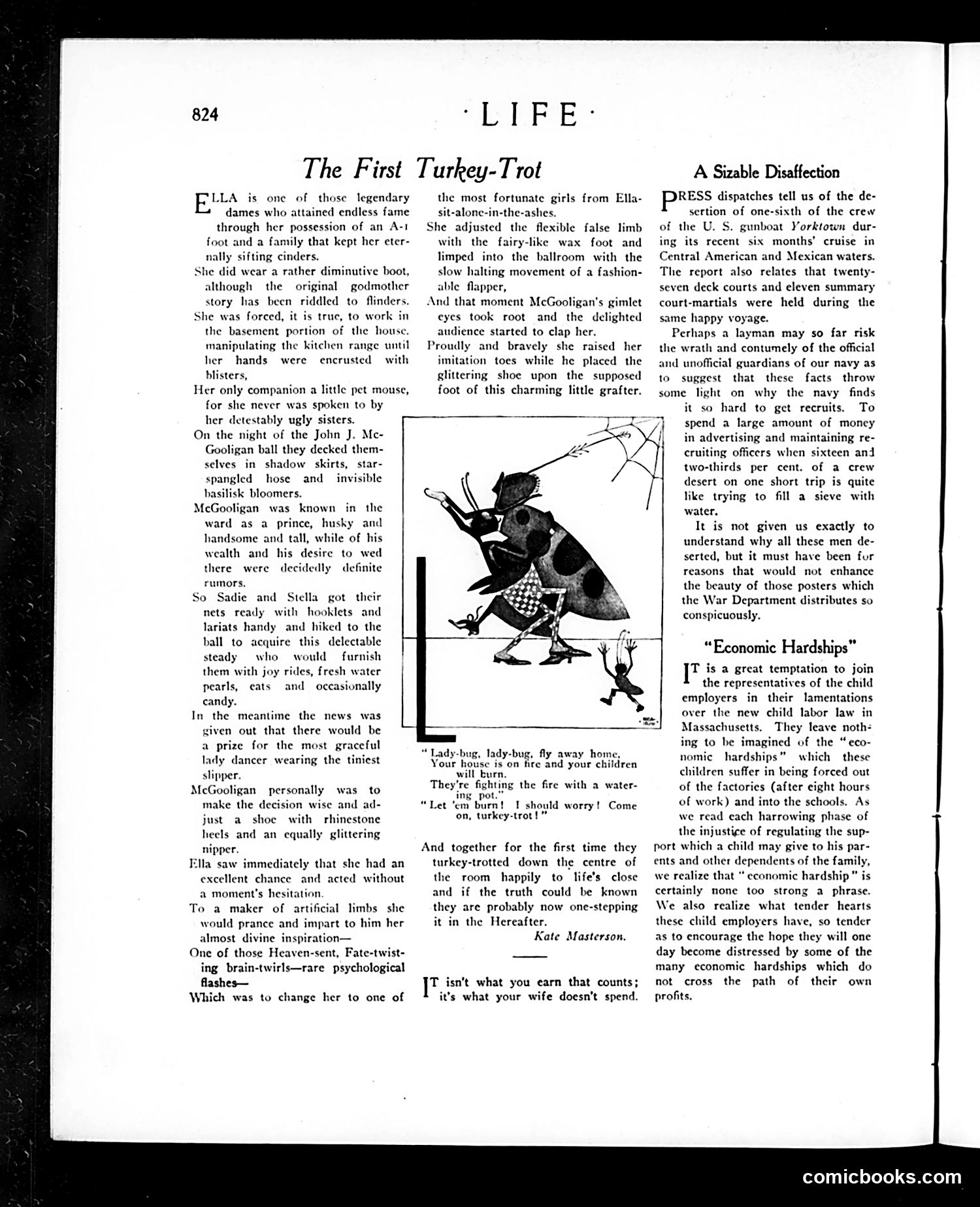
This page contains two distinct pieces: **Left side:** A humorous short story titled "The First Turkey-Trot" about a girl named Ella who obtains an A-1 foot and fancy slipper, allowing her to dance at a ball. The narrative satirizes fairy-tale conventions. **Center illustration:** A cartoon showing a woman in a dress doing the "turkey-trot," a popular but controversial early-1900s dance characterized by jerky, bird-like movements. The figure dances energetically while holding what appears to be a small animal. **Right side:** An unrelated article titled "A Sizable Disaffection" discussing U.S. Navy recruitment difficulties, and "Economic Hardships" about child labor law debates in Massachusetts. The humor depends on readers understanding the turkey-trot as a scandalous, modern dance that shocked conservative society—the story playfully literalizes the dance's animal movements.
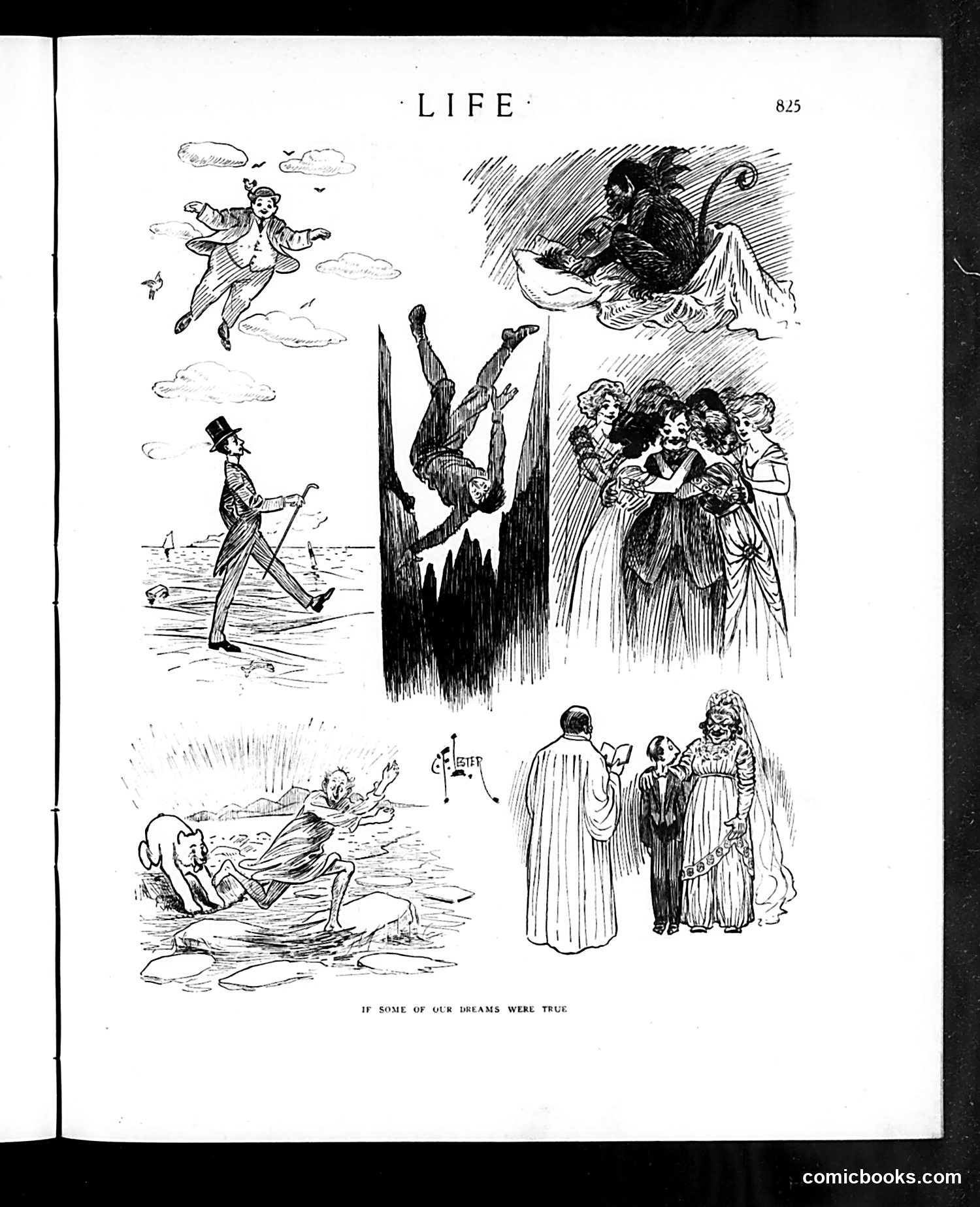
This page from *Life* magazine presents six satirical vignettes depicting fantastical scenarios. The caption "If Some of Our Dreams Were True" suggests these are wishful-thinking scenarios contrasting fantasy with reality. The sketches include: a man flying through clouds (escape/freedom fantasy); a gentleman fishing while standing impossibly on water; what appears to be a supernatural or demonic figure emerging from darkness; a group of women in classical dress (possibly representing idealized beauty or virtue); winged figures suggesting angels or heavenly beings; and a reclining figure with a flag marked "DEBT" (likely satirizing financial burdens). The overall message critiques gap between human aspirations and actual circumstances, particularly touching on economic hardship, escapism, and social anxieties of the era.
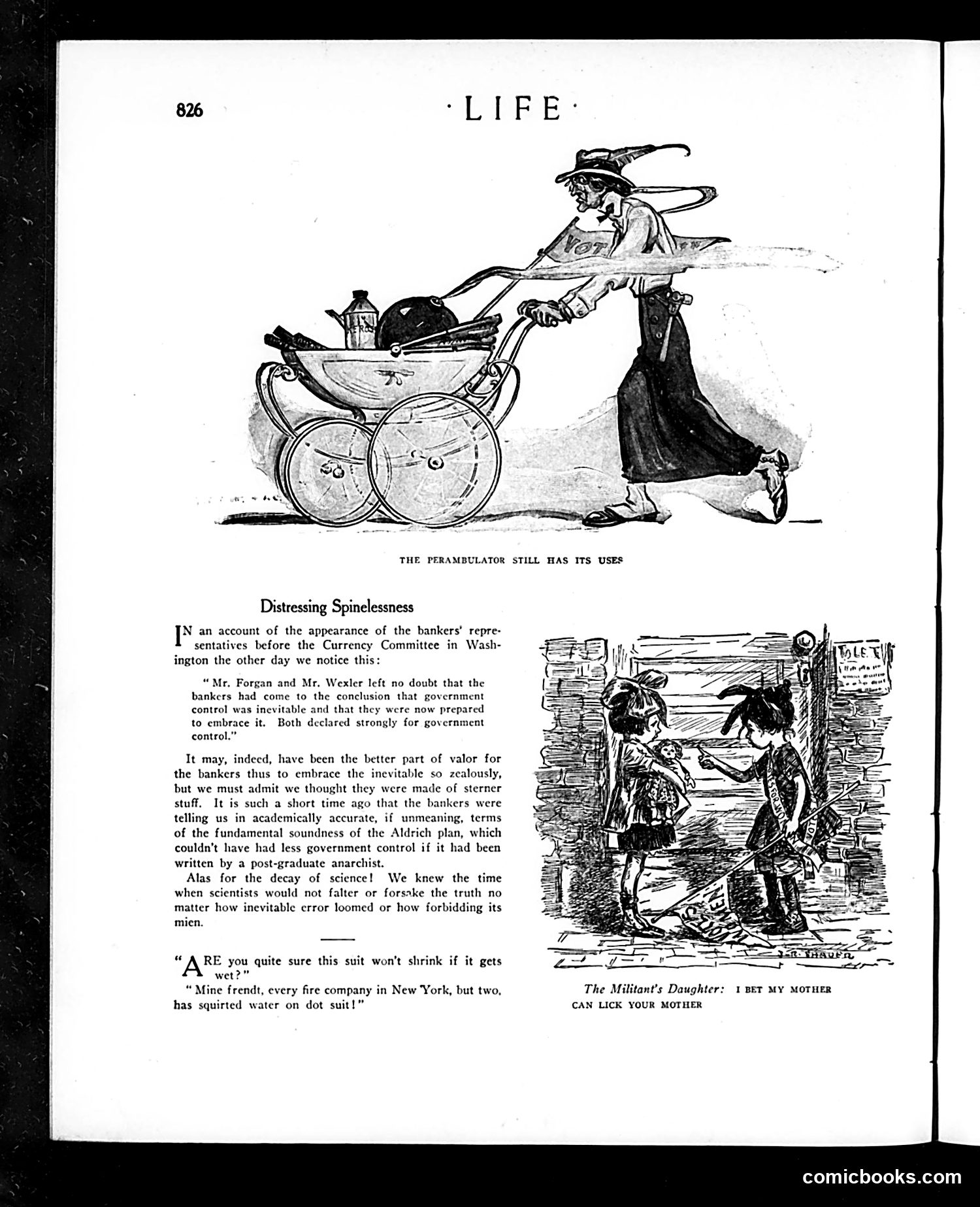
This page satirizes banking regulation and government control during what appears to be early 20th-century financial debates. The top cartoon, "The Perambulator Still Has Its Uses," depicts a woman pushing a baby carriage filled with banking materials—suggesting bankers are being treated like infants requiring oversight. The main article, "Distressing Spinelessness," mocks bankers' representatives who testified before Congress's Currency Committee, claiming they eagerly accepted government control. The text suggests the bankers lacked conviction, accepting regulation without the principled resistance one might expect. The bottom cartoon, "The Militant's Daughter," shows a child claiming "I bet my mother can lick your mother"—likely contrasting with serious political matters above, offering light comic relief typical of Life's format.
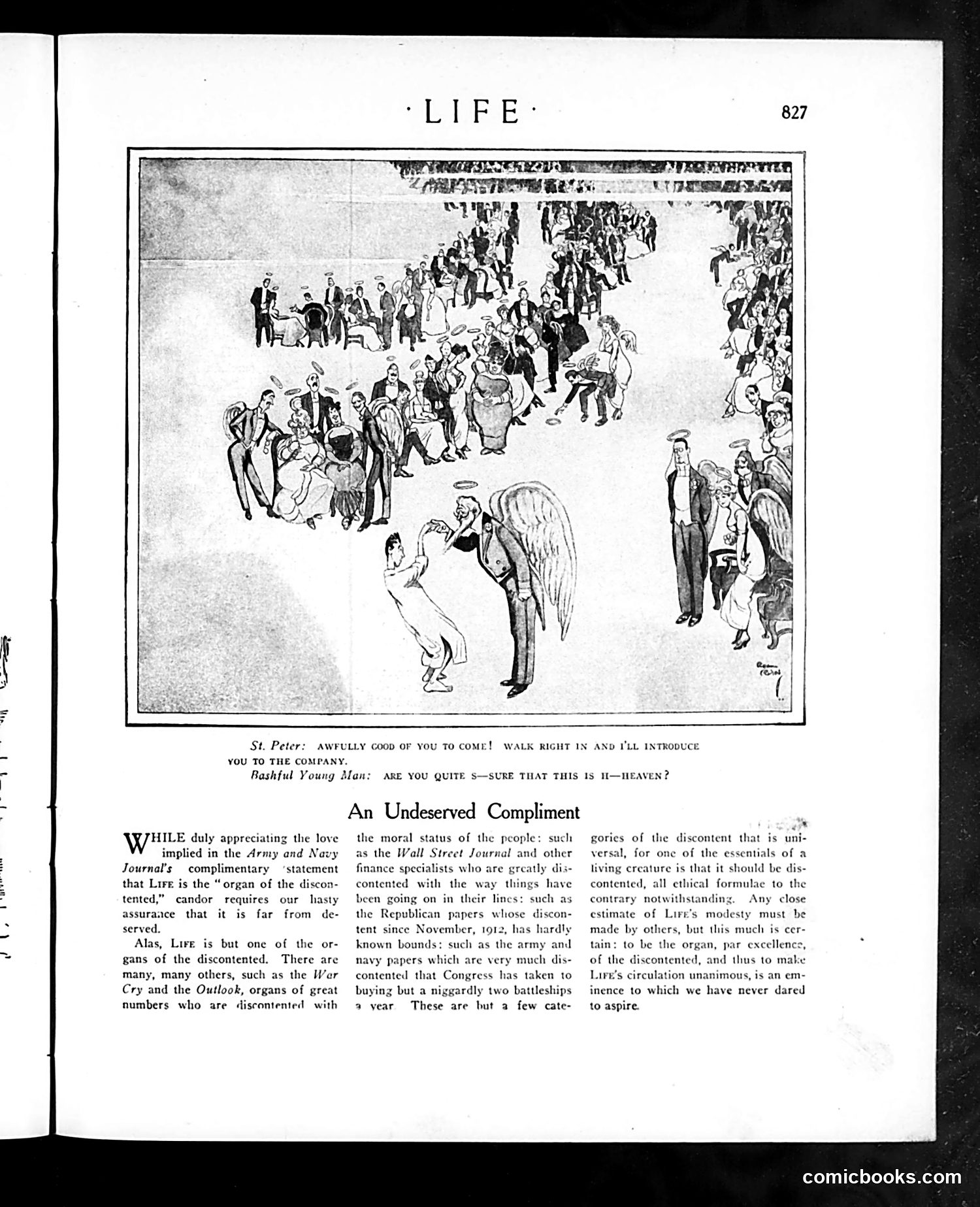
This satirical piece critiques *Life* magazine's own reputation. The text argues that while *Life* claims to be "the organ of the discontented," it's actually undeserving of this status compared to genuinely oppositional publications like the *War Cry* and *Outlook*. The cartoon depicts St. Peter at heaven's gates introducing a young man to an assembled crowd, with the young man asking if this is heaven. The satire suggests *Life* is being praised beyond its actual merit—receiving compliments it doesn't deserve. The piece references specific contemporary grievances: discontentment with Republican papers, Congress's military spending (two battleships in a year), and financial specialists' influence. *Life* ironically positions itself as less radical than truly oppositional organs of its era.
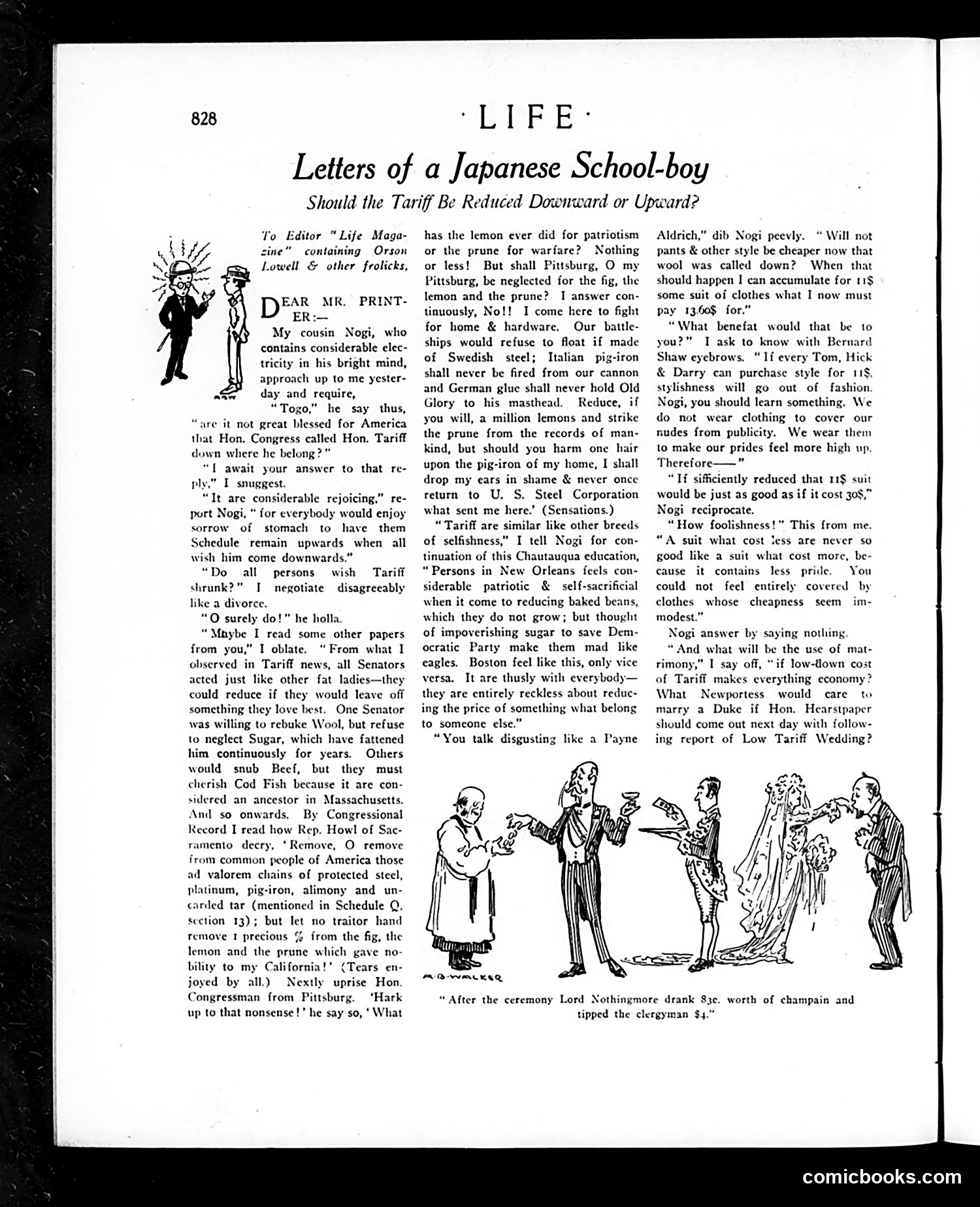
This is a satirical column presenting supposed letters from a Japanese schoolboy named Nogi offering commentary on American tariff policy and economics. The piece mocks protectionist trade arguments through exaggerated logic—comparing tariffs to absurd concepts like reducing lemon consumption for patriotism or refusing to use superior Swedish steel. The cartoon below depicts a formal ceremony where "Lord Nothingmore" ceremonially consumes cheap champagne and tips the clergyman, illustrating the economic inefficiency and waste that result from protectionist tariffs forcing Americans to buy inferior domestic goods at higher prices. The satire critiques American protectionist politicians who prioritize domestic industries over consumer welfare and economic logic. The Japanese schoolboy persona allows the author to present anti-tariff arguments from an outsider's perspective.
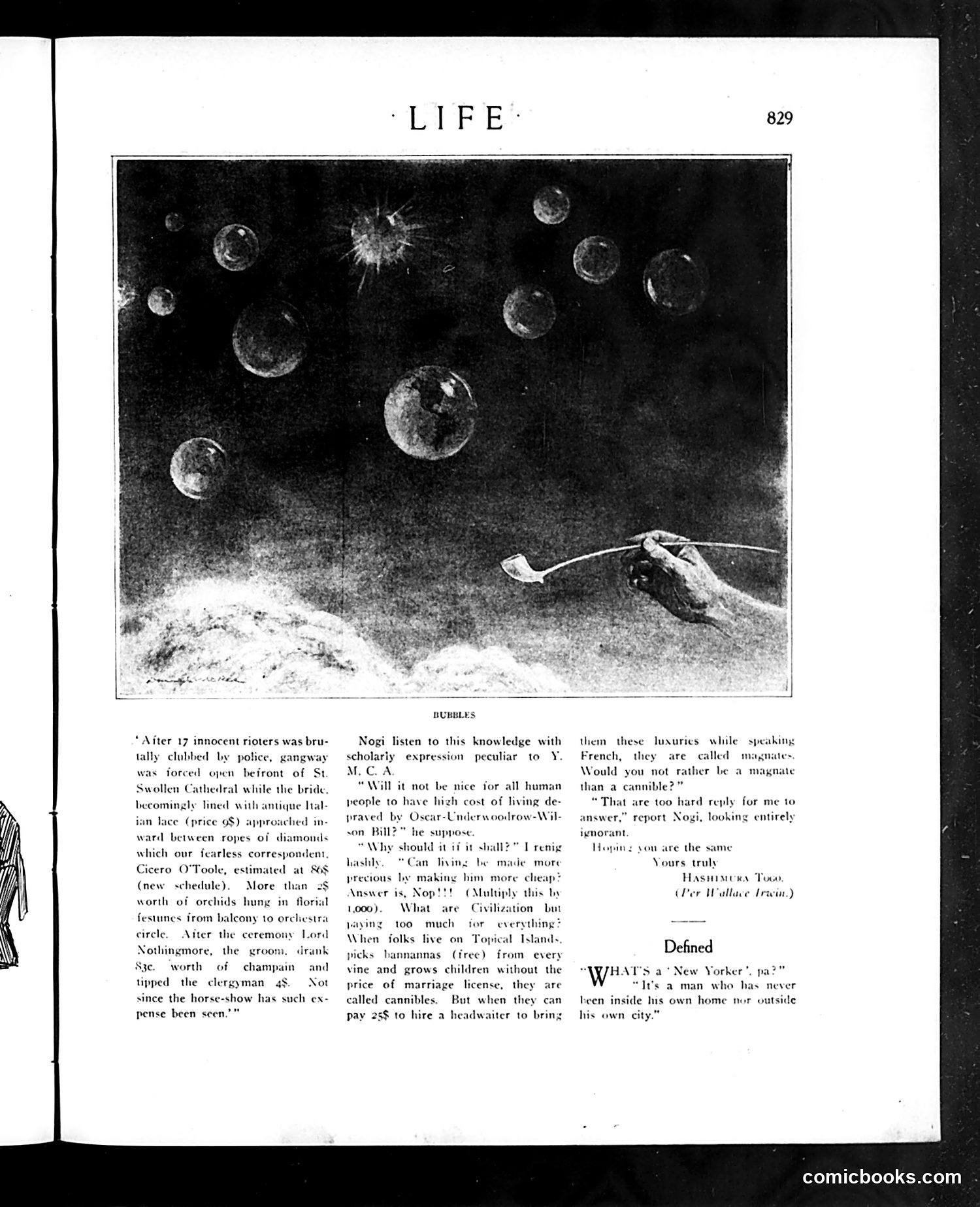
The main image depicts a hand blowing bubbles, with multiple spheres floating against a dark background—one prominent bubble in the center appears to contain a spiky object. The accompanying text is a satirical dialogue between characters named Nogi and Y.M.C.A. about wealth and luxury. Nogi mocks the high cost of living, sarcastically asking whether it would be "nice for all human people to have high cost of living." The conversation critiques conspicuous consumption: people buying expensive luxuries (called "magnates" in French) like candles made from orchids, while paying excessive fees for basic services like hiring headwaiters. The cartoon appears to satirize bubble economics or inflated wealth—the bubbles represent fragile, insubstantial luxuries that the wealthy indulge in while ordinary people struggle.
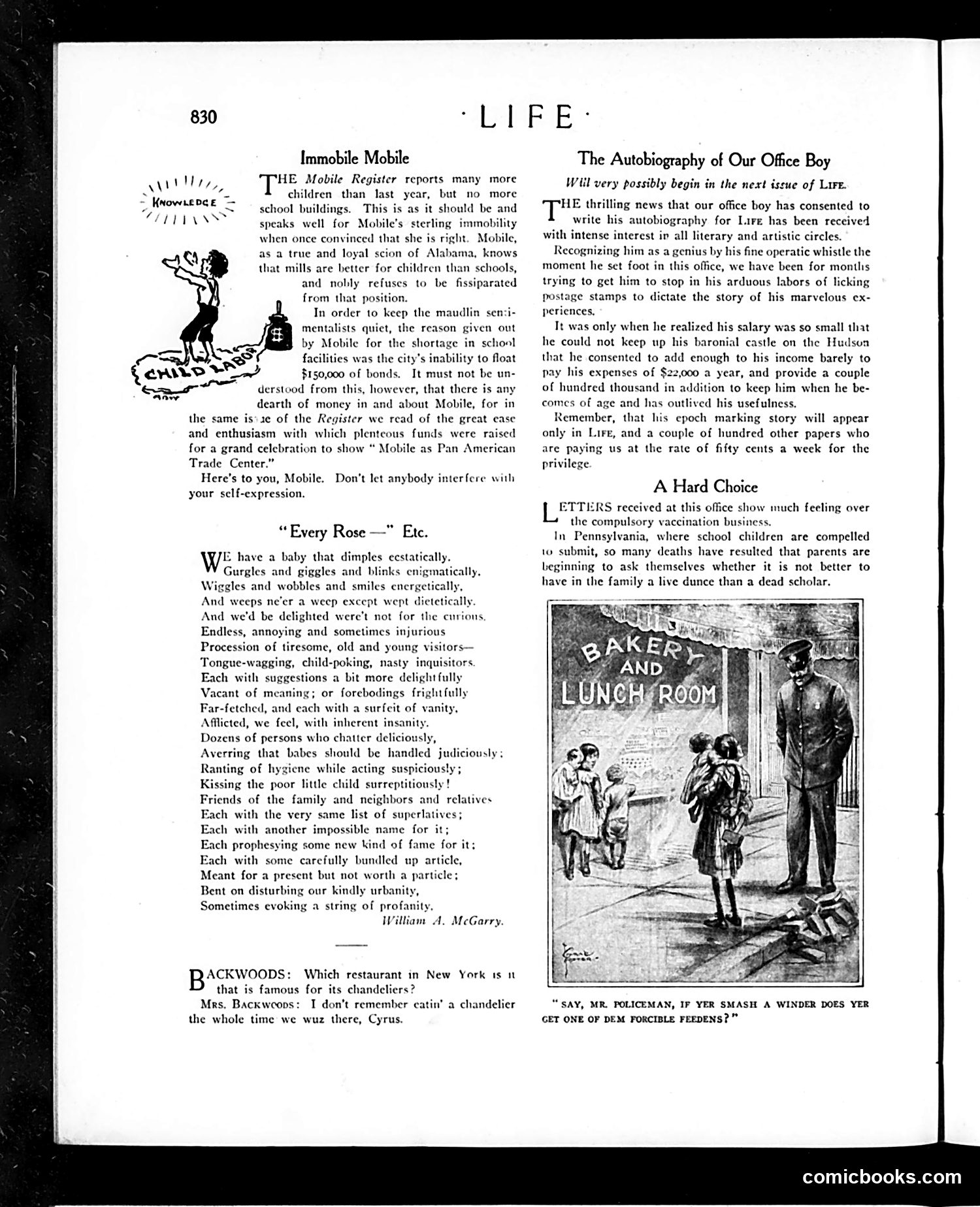
This page from *Life* magazine contains three distinct satirical pieces: 1. **"Immobile Mobile"**: Critiques Alabama's Mobile school system, which claimed to reject segregation but was actually immobile—refusing to integrate. The cartoon shows a stubborn child, satirizing the city's refusal to progress. 2. **"Every Rose — Etc."**: A poem by William A. McGarry mocking visitors to society events who make tiresome small talk and offer empty compliments while engaging in social posturing and gossip. 3. **"A Hard Choice"**: Discusses compulsory vaccination debates in Pennsylvania schools, presenting parental dilemmas between disease risk and vaccine concerns—an evergreen controversy. 4. **Bottom cartoon**: Features a Baker and Lunch Room scene with a policeman joke about broken windows and "popsicle feeders" (street children).
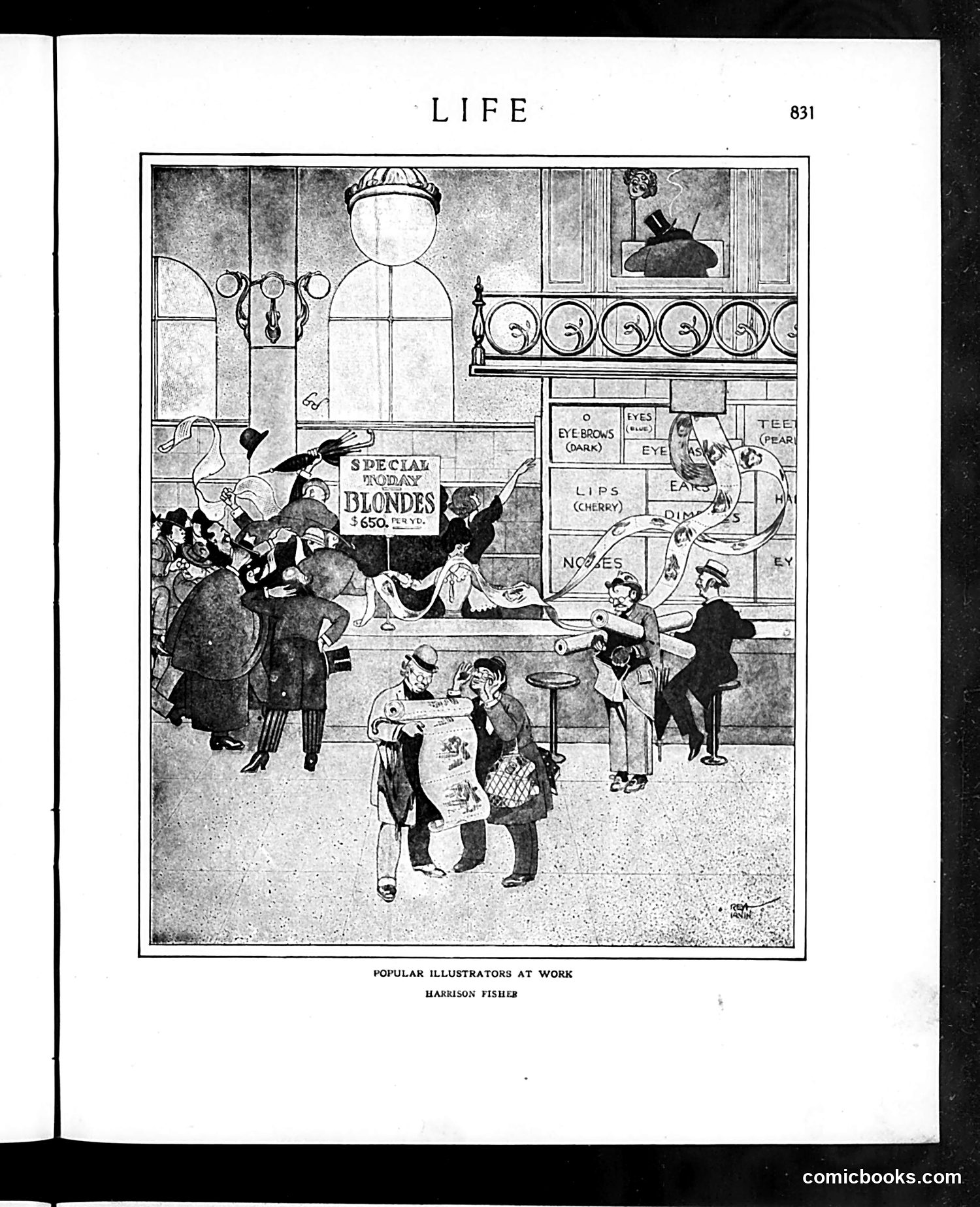
This page showcases work by illustrator Harrison Fisher, titled "Popular Illustrators at Work." The illustration depicts a fantastical retail or display environment where a giant female figure dominates the composition, wearing what appears to be a crown or headpiece. The scene includes labeled anatomical features (Eyes, Eyebrows, Lips, Nose, Ears, etc.) and a sign advertising "Special Today Blondes $3.50 [per?]," suggesting satirical commentary on the commercialization and objectification of women, particularly blonde women, as consumer commodities. Male figures in the scene appear to be shopping or examining the display, treating the woman as merchandise. This reflects early 20th-century satirical critique of beauty standards and the reduction of women to purchasable physical attributes—a commentary on both advertising culture and gender relations of that era.
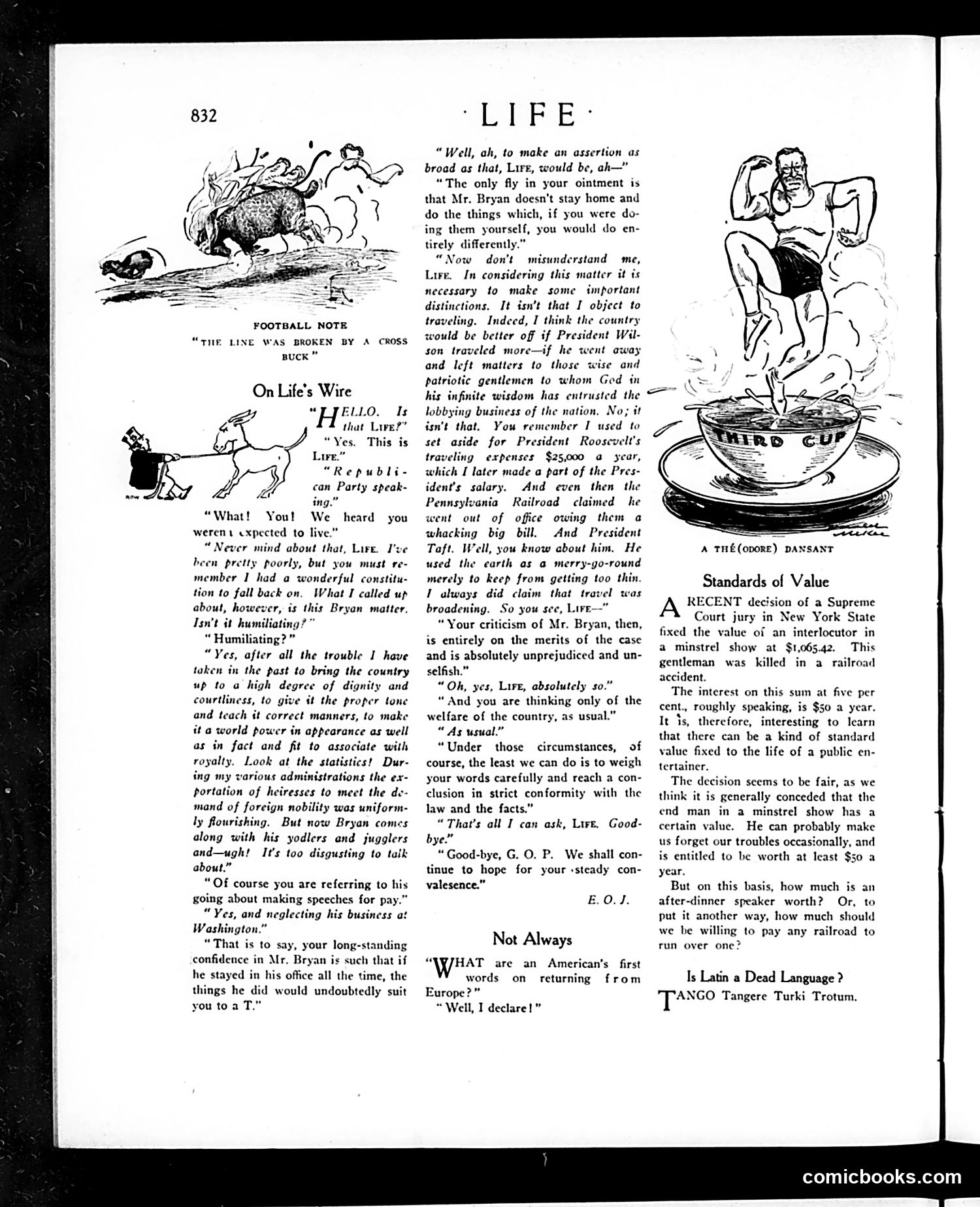
This satirical page mocks Republican Party hypocrisy regarding William Jennings Bryan's speaking tours. The main cartoon "On Life's Wire" depicts the Republican Party (personified as "Life") complaining to a figure representing the nation about Bryan traveling to give paid speeches instead of staying in Washington. The satire's point: Republicans criticize Bryan's travel as undignified and neglectful, yet the Republican speaker admits the party approved extensive travel for Presidents Roosevelt and Taft. The joke exposes the double standard—Republicans oppose Bryan's activities not on principle but purely because Bryan is a political opponent. The secondary items are lighter satire: one mocks the absurdity of valuing a minstrel show performer's life at $1,065.42 for insurance purposes, and another jokes about Americans' pretentiousness upon returning from Europe. The cartoons use anthropomorphized concepts and exaggerated dialogue typical of early-20th-century Life magazine's political commentary style.
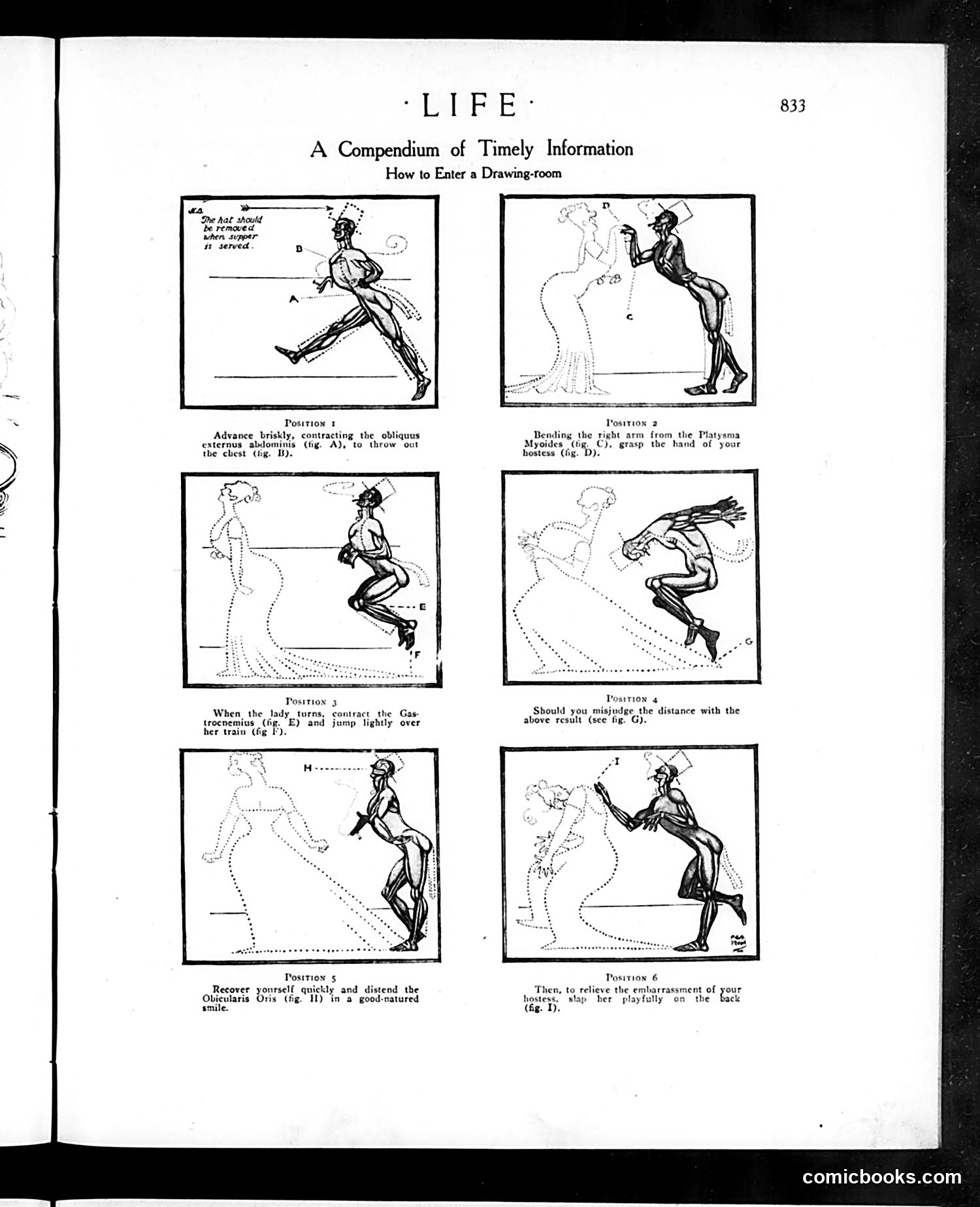
This is a humorous instructional guide satirizing both rigid Victorian etiquette and pseudo-scientific anatomical naming. The page presents six sequential positions for properly entering a formal drawing room, each labeled with exaggerated Latin anatomical terms (obliquus externus abdominis, gastrocnemius, etc.). The joke mocks the pretentious formality of upper-class social conventions by treating basic social interactions as if they were complex anatomical exercises requiring scientific precision. The illustrated mishaps—particularly Position 4, where the man trips over the woman's train—suggest that following these elaborate rules inevitably fails, revealing the absurdity of rigid social protocols. The final position, where he "playfully" slaps the hostess to recover from embarrassment, adds crude humor typical of satirical magazines, poking fun at both gentleman's etiquette and Victorian propriety.
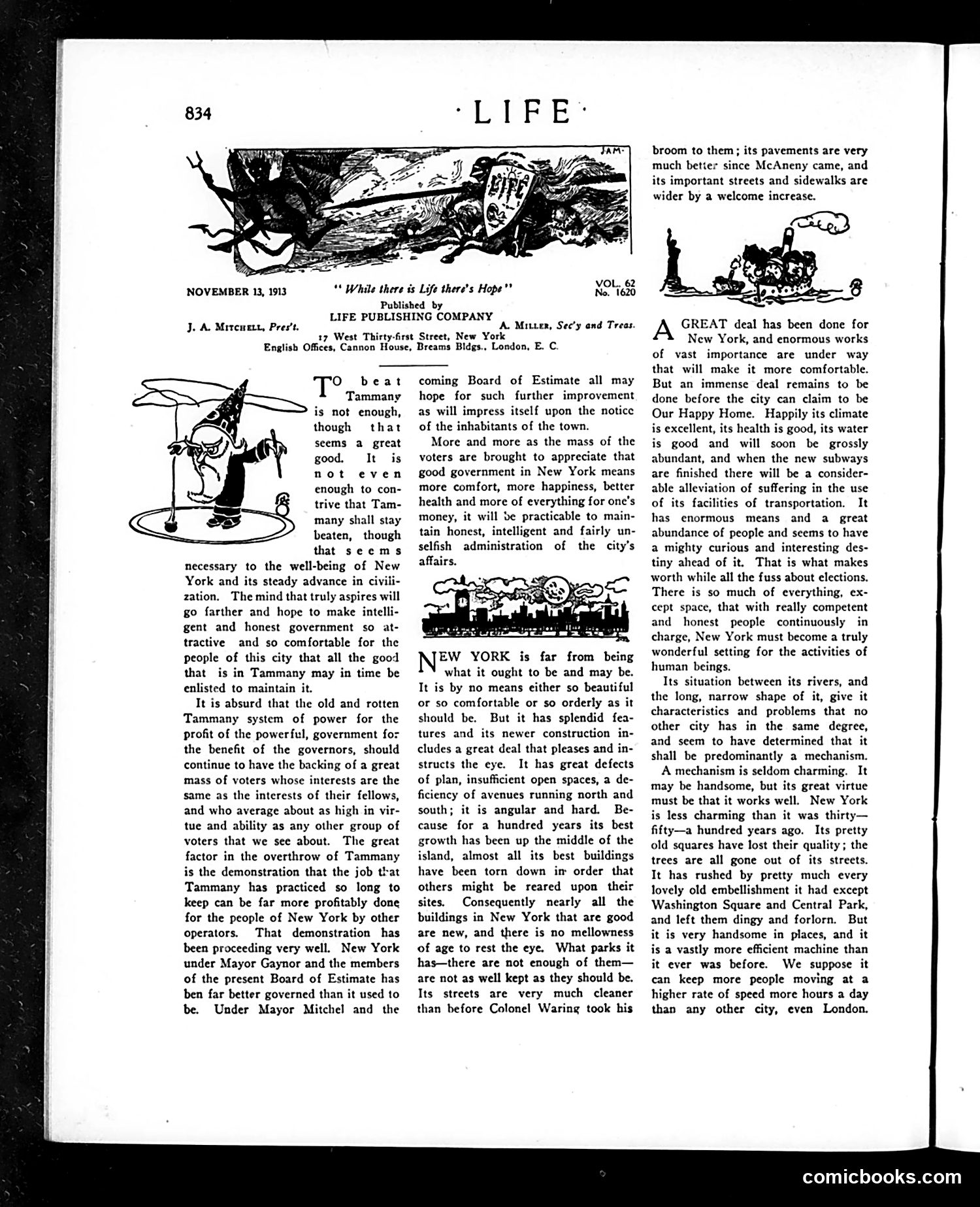
This editorial page critiques **Tammany Hall**, New York's corrupt Democratic political machine, and praises recent reform efforts. The small cartoon depicts someone being beaten or removed—likely representing Tammany's defeat. The text celebrates Mayor **Mitchel** and the Board of Estimate for improving city governance compared to the old Tammany system, which enriched politicians at public expense. The author argues that demonstrating competent, honest government—delivering comfort, health, and better services to ordinary voters—is the most effective way to permanently discredit Tammany's approach. The piece references recent improvements: Colonel **Waring's** street-cleaning reforms and **McAneny's** infrastructure upgrades (wider streets, better pavements). It acknowledges New York's remaining problems (inadequate parks, poor planning, aging buildings) while expressing optimism about ongoing subway construction. For modern readers: this reflects the Progressive Era's anti-corruption crusade, when reformers battled urban political machines through demonstrating better municipal management.
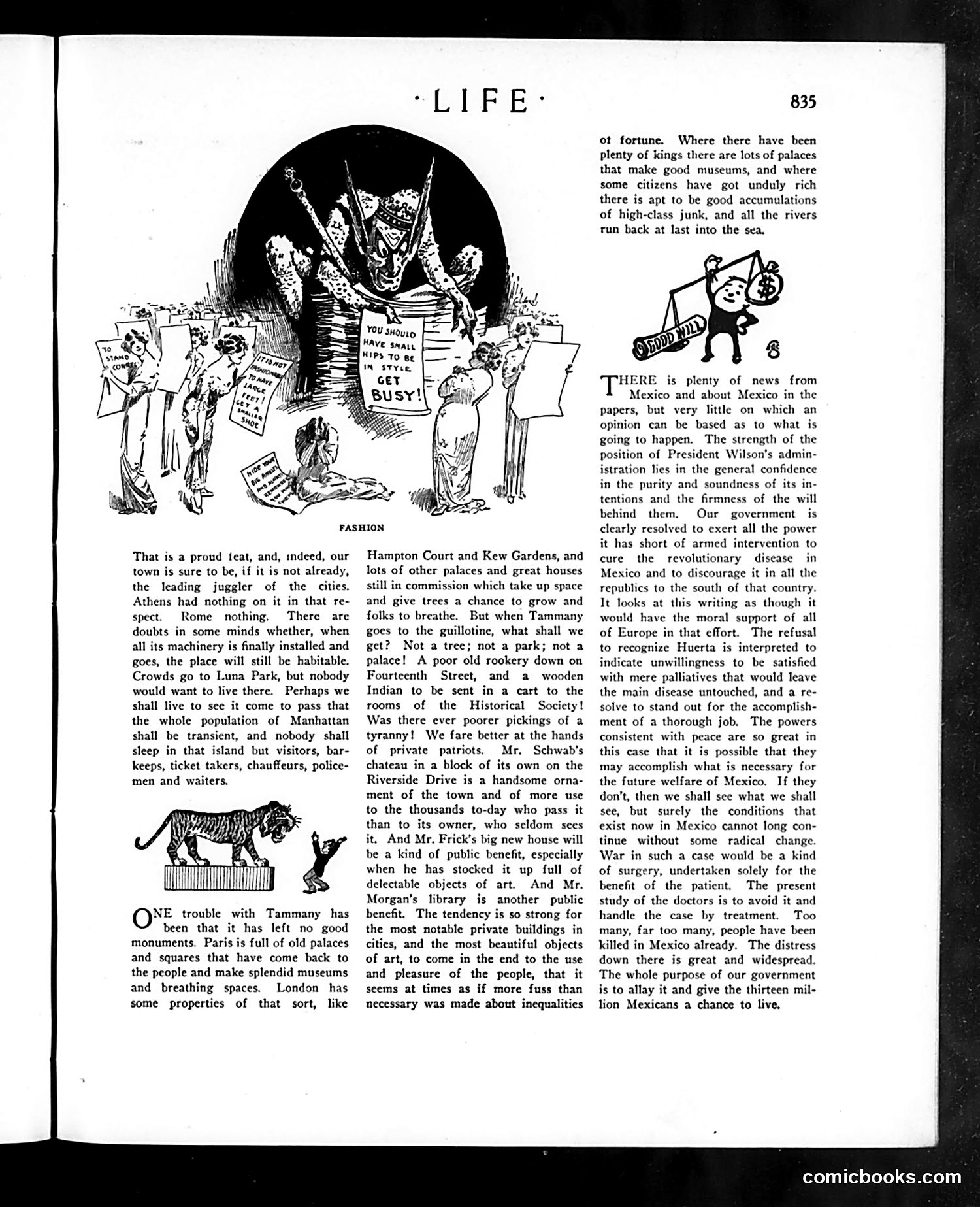
## The "Fashion" Cartoon The large illustration satirizes Manhattan's frenetic development and commercialism. A grotesque, mask-like face (representing the city itself) looms over tiny figures carrying signs reading "GET BUSY!" and similar exhortations. The satire criticizes New York's obsession with constant activity and consumption—suggesting the city prioritizes transient visitors (ticket-takers, chauffeurs) over permanent residents. ## The Tammany Hall Critique The accompanying text contrasts Tammany Hall (New York's corrupt Democratic political machine) unfavorably with European monarchies and American industrialists like Schwab, Frick, and Morgan. It argues that while European tyrants at least left behind palaces-turned-museums, Tammany will leave nothing but "a poor old rookery on Fourteenth Street." Ironically, the author suggests private wealth serves the public better than political patronage. ## Mexico Commentary The final section defends President Wilson's non-interventionist approach to Mexican revolution, praising his refusal to recognize Huerta and his moral firmness, while stopping short of armed intervention.
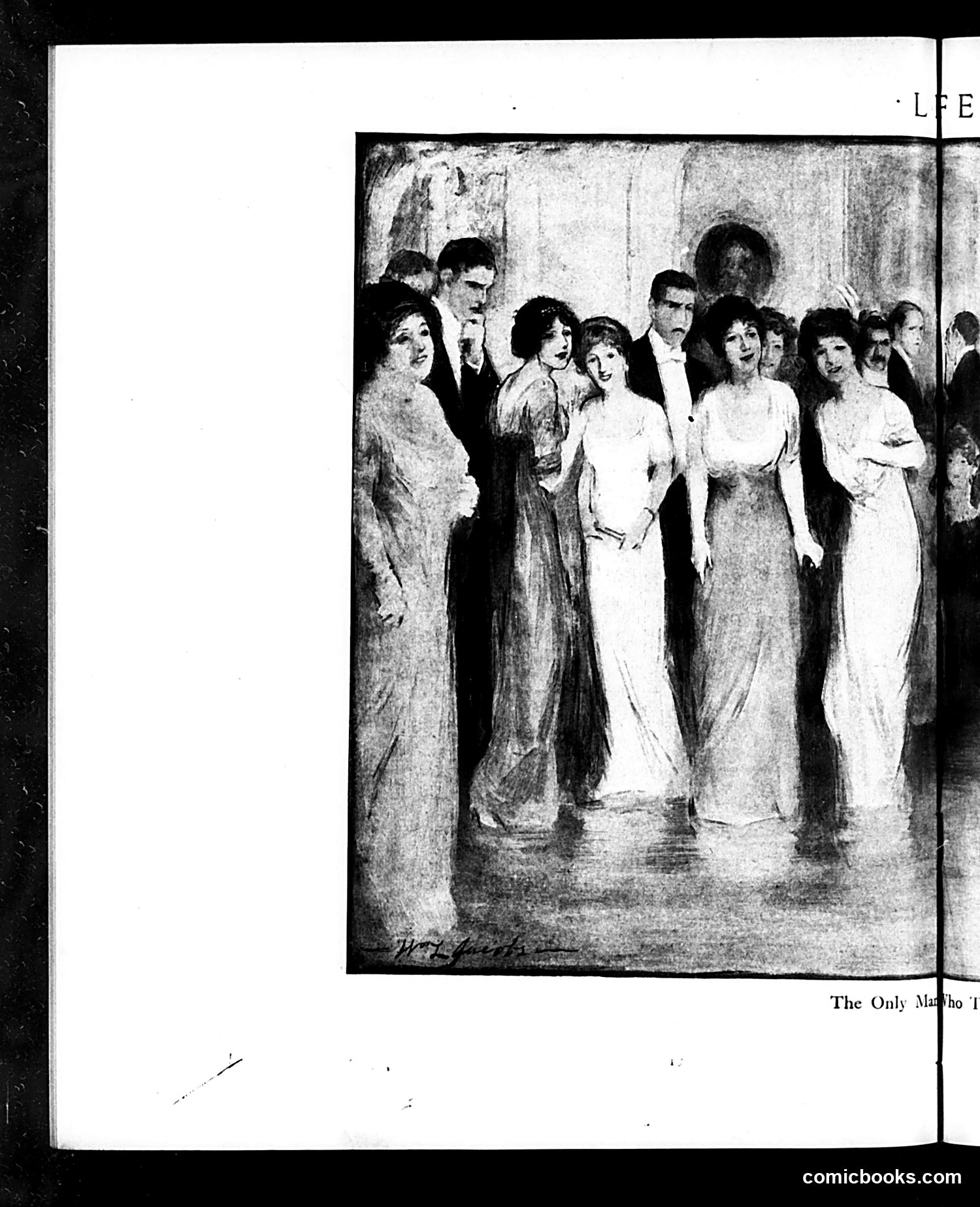
This appears to be a satirical illustration from *Life* magazine showing a formal social gathering of well-dressed women and men in early 20th-century attire. The caption reads "The Only Man who..." (text cut off). The satire likely comments on gender dynamics at high-society events. The composition suggests a commentary on women's social dominance or the scarcity of eligible men in certain circles—a recurring theme in *Life*'s social satire of the period. However, **the incomplete caption prevents definitive interpretation** of the specific joke or reference. Without the full text, I cannot identify which particular social trend, scandal, or cultural phenomenon this targets. The formal dress and indoor setting confirm it depicts upper-class society, but the precise satirical point remains unclear.
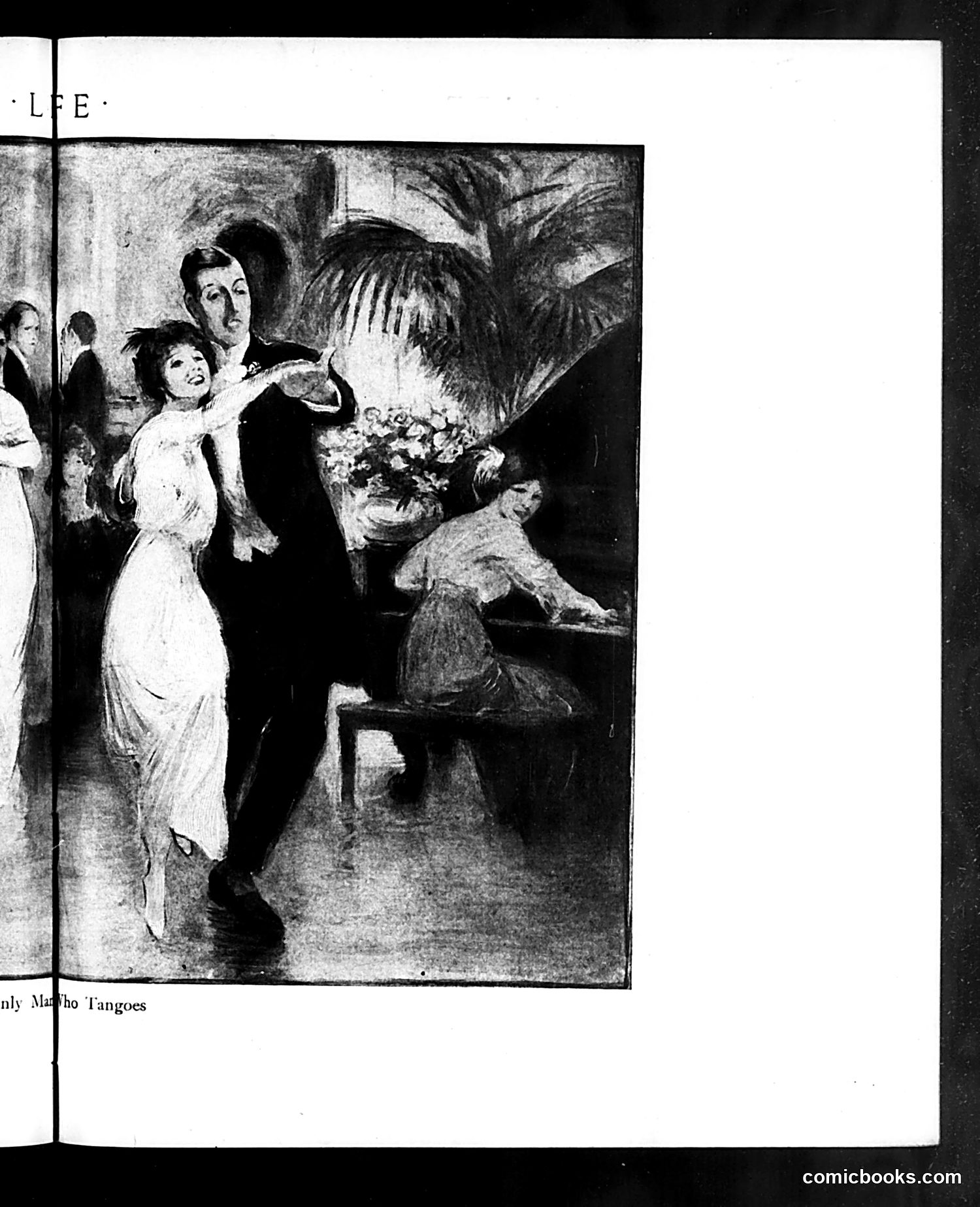
The OCR text is corrupted and unreadable. Based solely on the visible image and caption, this appears to be a scene depicting social life, likely from an early 20th-century Life magazine illustration. The image shows an elegant woman in a white gown being presented or introduced at what appears to be a formal gathering or party, with a man in dark formal wear beside her and other figures visible in the background. There's decorative foliage visible at top right. The partial visible caption mentions "only Man who Tangoes" (or similar), suggesting this may satirize tango dancing—a dance craze that scandalized American society in the 1910s for being considered sensual and morally questionable. Without clearer text or more context, I cannot definitively identify specific figures or the precise satirical intent beyond this likely reference to the tango controversy.
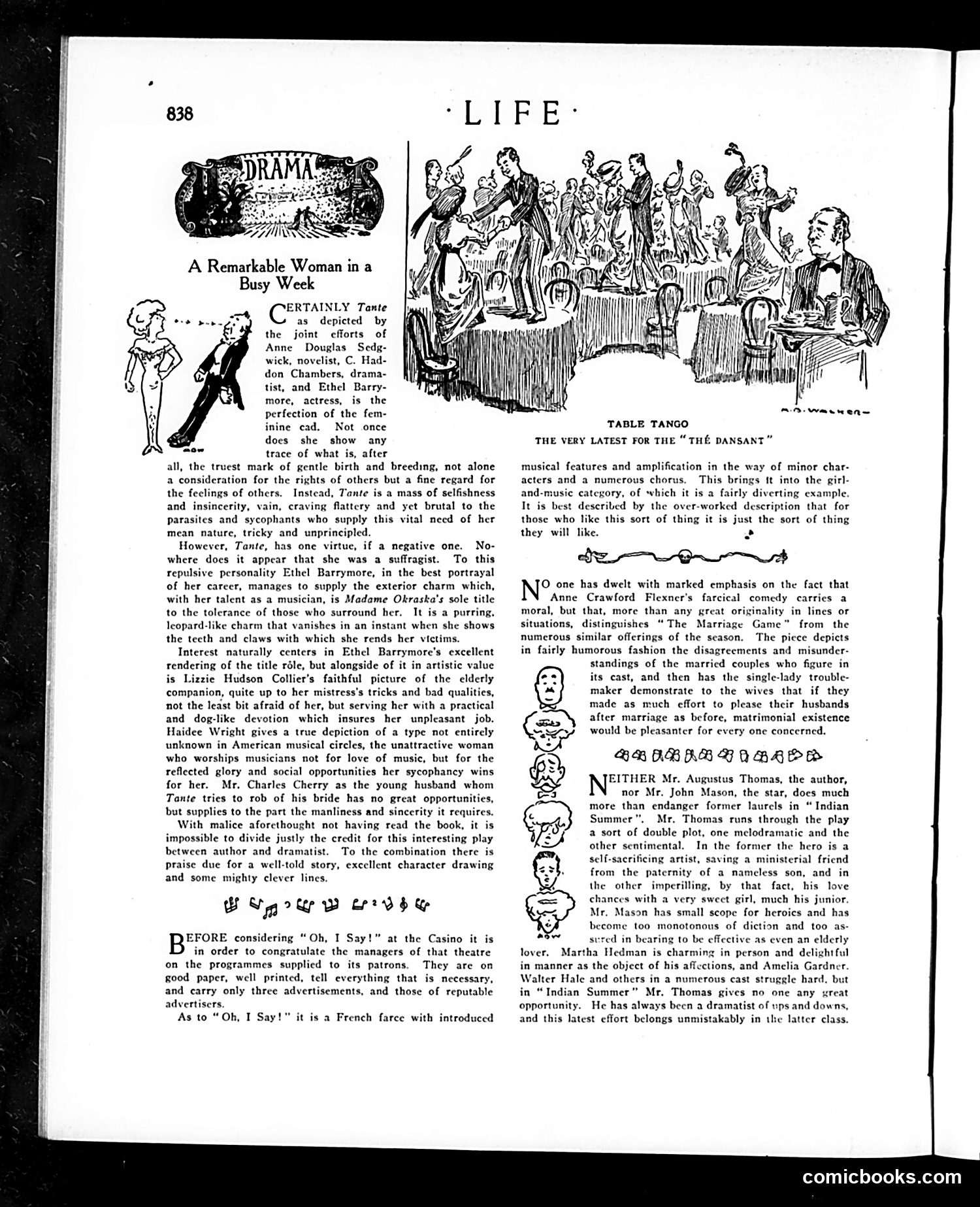
This page contains drama reviews from *Life* magazine's theater section. The main content critiques three Broadway productions: **"Tante"** features actress Ethel Barrymore in a play about a selfish, manipulative society woman—a "feminine cad" who charms others while exploiting them ruthlessly. The reviewer notes approvingly that the character is *not* a suffragist, suggesting contemporary anxiety about women's rights activism. Barrymore's performance is praised for conveying the character's predatory "leopard-like charm." **"Oh, I Say!"** is dismissed as a French farce with musical numbers—entertaining enough for those who enjoy such lightweight fare. **"The Marriage Game"** is a comedy about marital discord, where a single woman demonstrates to wives that maintaining pre-marriage effort keeps husbands happy—a conventional message about women's domestic duty. The illustration "Table Tango" shows a fashionable tea dance, reflecting the era's social scene. Overall, the page reflects early 20th-century theatrical culture and period attitudes toward women, marriage, and feminism.
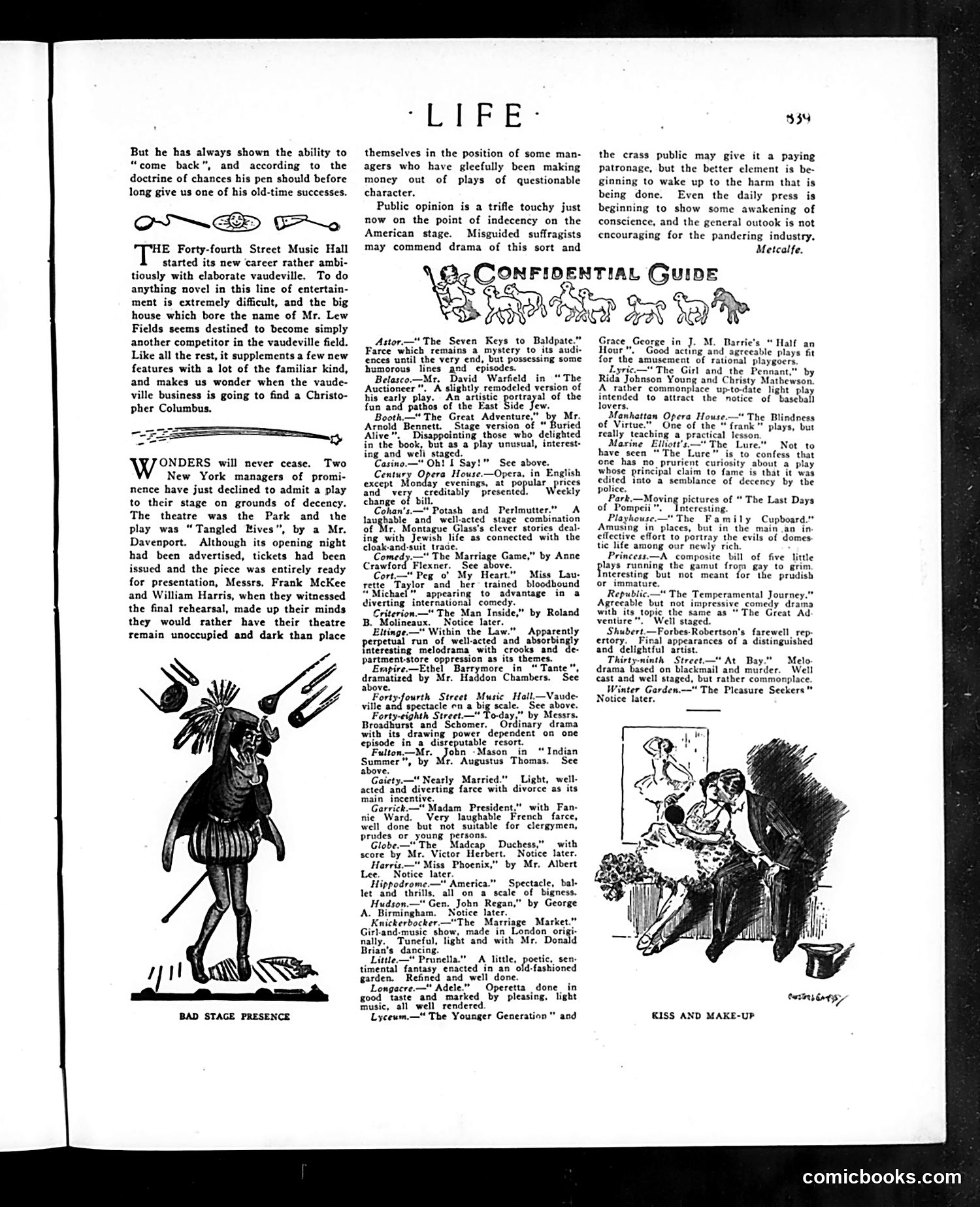
This page contains theatre criticism and listings, not political cartoons. The two illustrations—"Bad Stage Presence" (left) and "Kiss and Make-Up" (right)—are generic theatrical humor rather than specific satire. The main editorial content discusses theatre managers Frank McKee and William Harris rejecting a play called "Tangled Rivers" on moral grounds. The writer sarcastically notes this is unusual, as managers typically profit from indecent plays. The piece criticizes the "pandering industry" while praising the managers' decision, reflecting early 20th-century anxiety about stage morality and Progressive Era sensibilities around "decency." The bulk of the page comprises brief theatre reviews of current New York productions (Astor, Belasco, Booth, etc.), using coded abbreviations to indicate quality and content type. This was standard theatre journalism of the period.
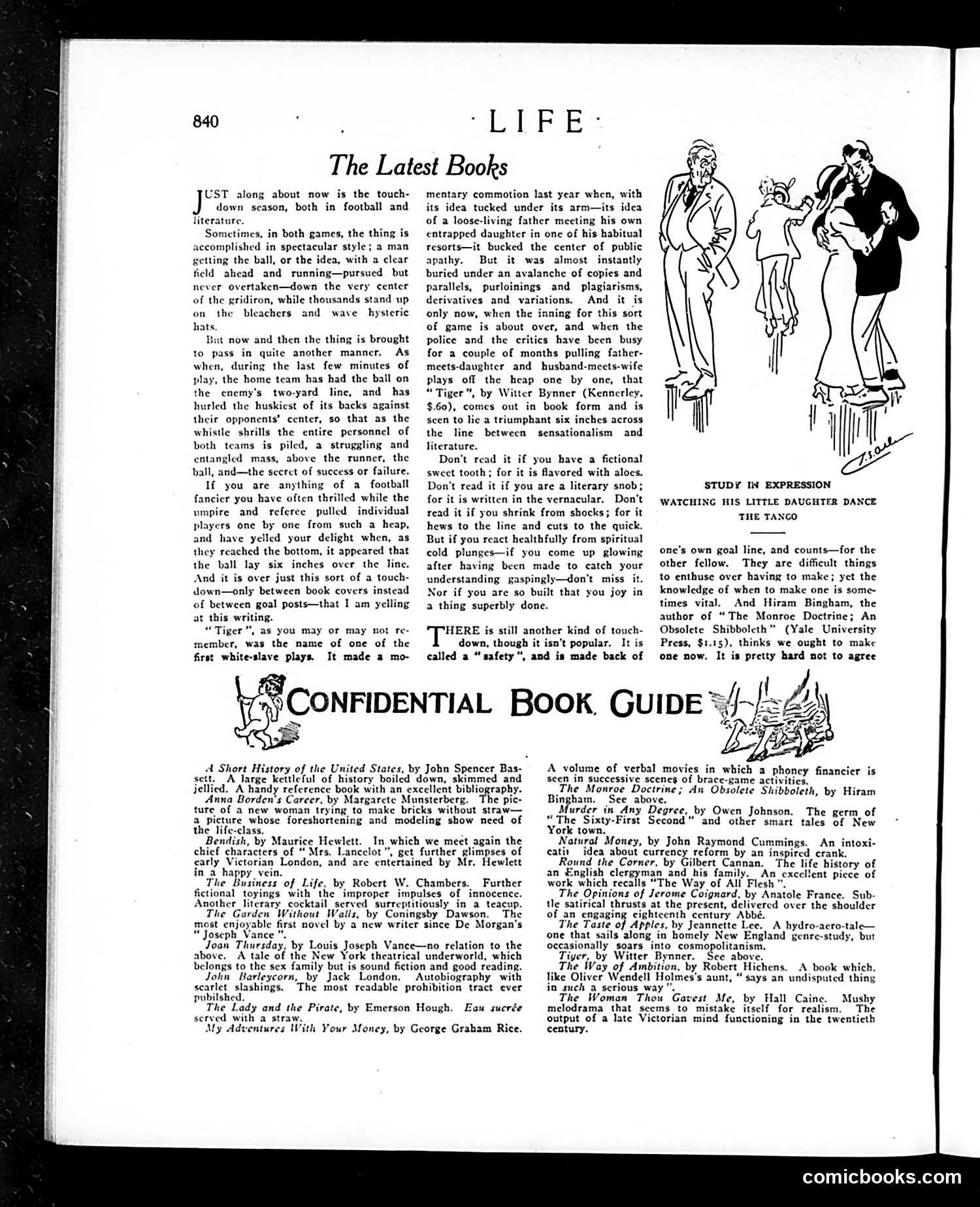
This page reviews literary "touchdowns"—using football metaphor to discuss books that successfully break through public indifference. The main illustration (captioned "Study in Expression: Watching His Little Daughter Dance the Tango") shows a father's disapproving reaction to his daughter dancing the tango with a partner. This satirizes contemporary anxieties about the tango, a scandalous new dance considered morally suspect by older generations. The cartoon captures the generational tension and parental shock at modern youth culture. The text praises Witter Bynner's play *Tiger* (about white slavery—a social reform topic) for achieving literary merit despite sensationalism. It criticizes the avalanche of derivative works that followed. A secondary reference discusses Hiram Bingham's *The Monroe Doctrine* as advocating American foreign policy restraint—a "safety" (in football terms, scoring for the other team) that Bingham argues America should embrace. The page reflects Progressive Era concerns: moral reform, literary standards, American international responsibility, and generational conflict over modern behavior.
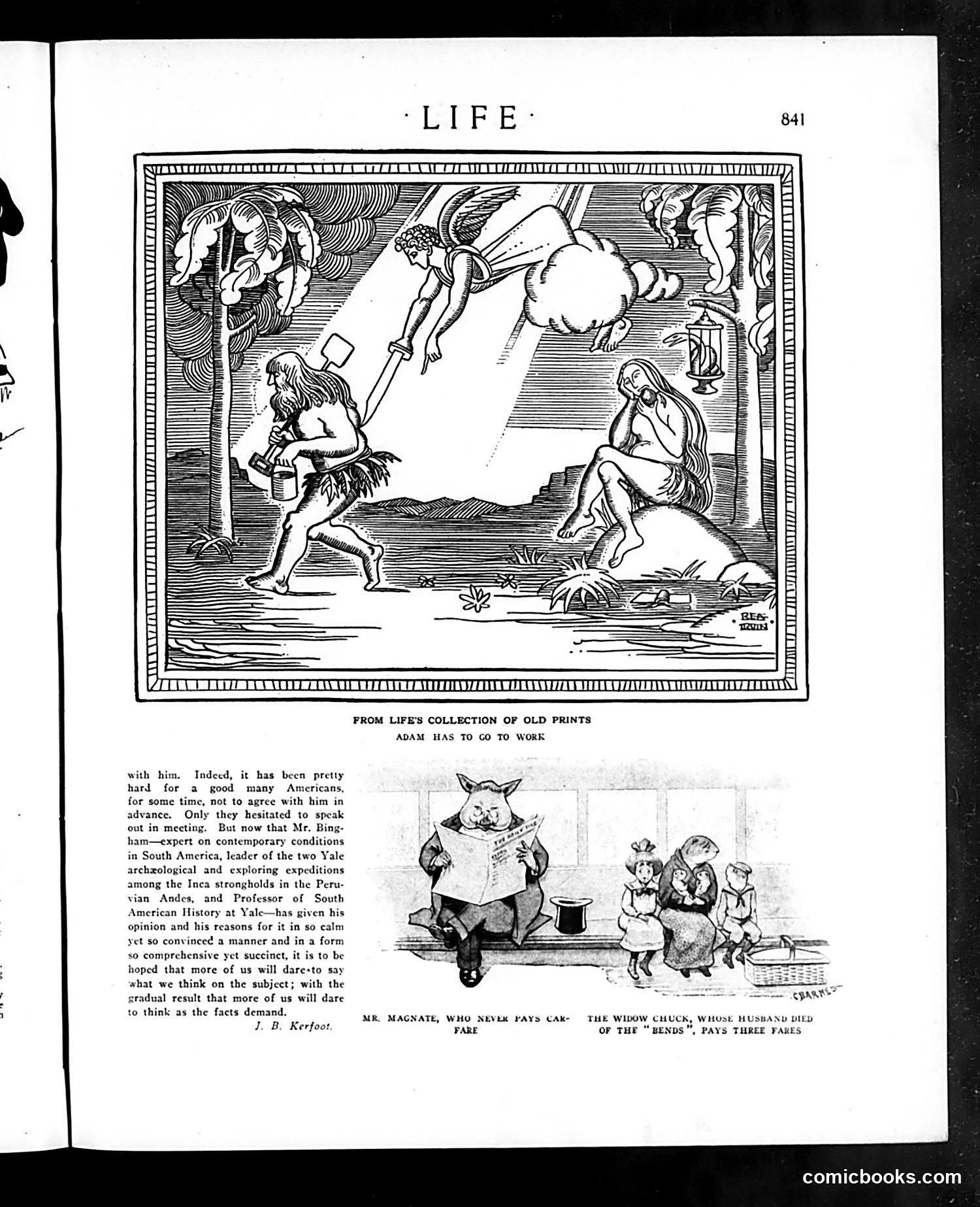
The page features two elements: a classical engraving titled "Adam Has to Go to Work" (showing Adam laboring after expulsion from Eden) and two contemporary cartoon captions below. The cartoons mock wealthy figures through economic satire: **"Mr. Magnate, Who Never Pays Carfare"** ridicules a rich man who avoids paying public transportation costs despite his wealth—satirizing miserliness among the ultra-rich. **"The Widow Chuck, Whose Husband Died of the 'Bends,' Pays Three Fares"** references decompression sickness ("the bends"), a danger to deep-sea divers and tunnel workers. The widow apparently pays three fares (possibly for herself and dependents), suggesting economic struggle following her husband's work-related death—contrasting her honest payment with the magnate's cheapness. The accompanying text discusses Professor Bingham's expertise on South American conditions, though its connection to these cartoons is unclear. The satire targets class hypocrisy: the wealthy shirk obligations while working-class widows bear financial burdens from industrial accidents.
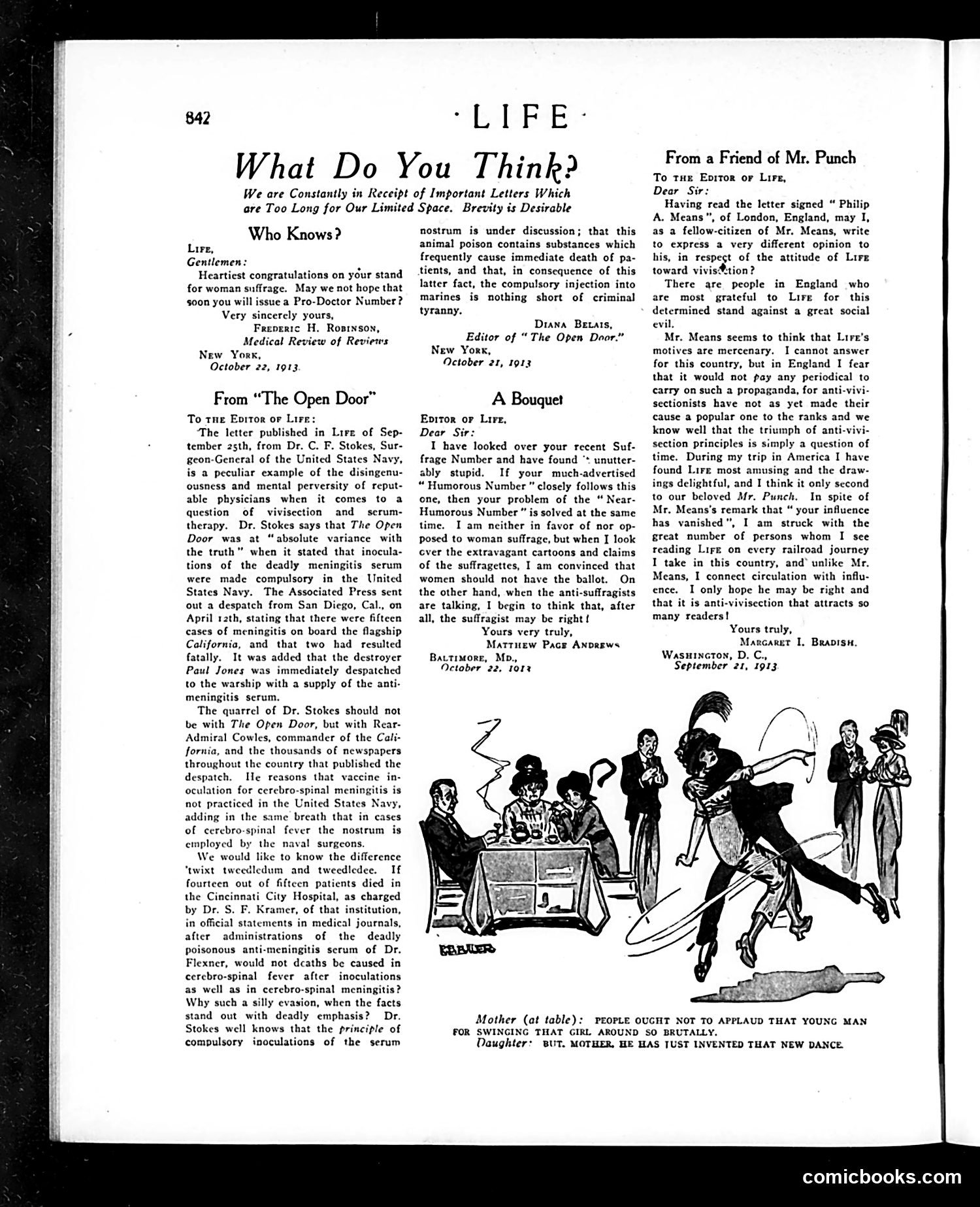
This page features reader letters debating two heated early-1910s issues: **medical autonomy vs. public safety**, and **women's suffrage**. The main letters dispute mandatory meningitis inoculations in the U.S. Navy. Diana Belais accuses Surgeon-General Stokes of evasion, claiming the serum causes deaths and that forced injection into marines constitutes "criminal tyranny." This reflects contemporary **anti-vivisection and anti-vaccination activism**—fears that medical experiments on animals and mandatory treatments violated bodily autonomy. A second letter from Matthew Andrews sarcastically describes Life's recent suffrage issue as "unutterably stupid," yet admits the opposing arguments also sway him—likely satirizing how both sides of the suffrage debate seemed equally unconvincing to skeptics. The cartoon (bottom) shows a mother objecting as a young man swings his dancing partner aggressively, captioned that he "invented that new dance"—gentle social satire about modern youth culture and generational conflict. The page captures **Progressive Era anxieties**: medical ethics, women's rights, and cultural change.
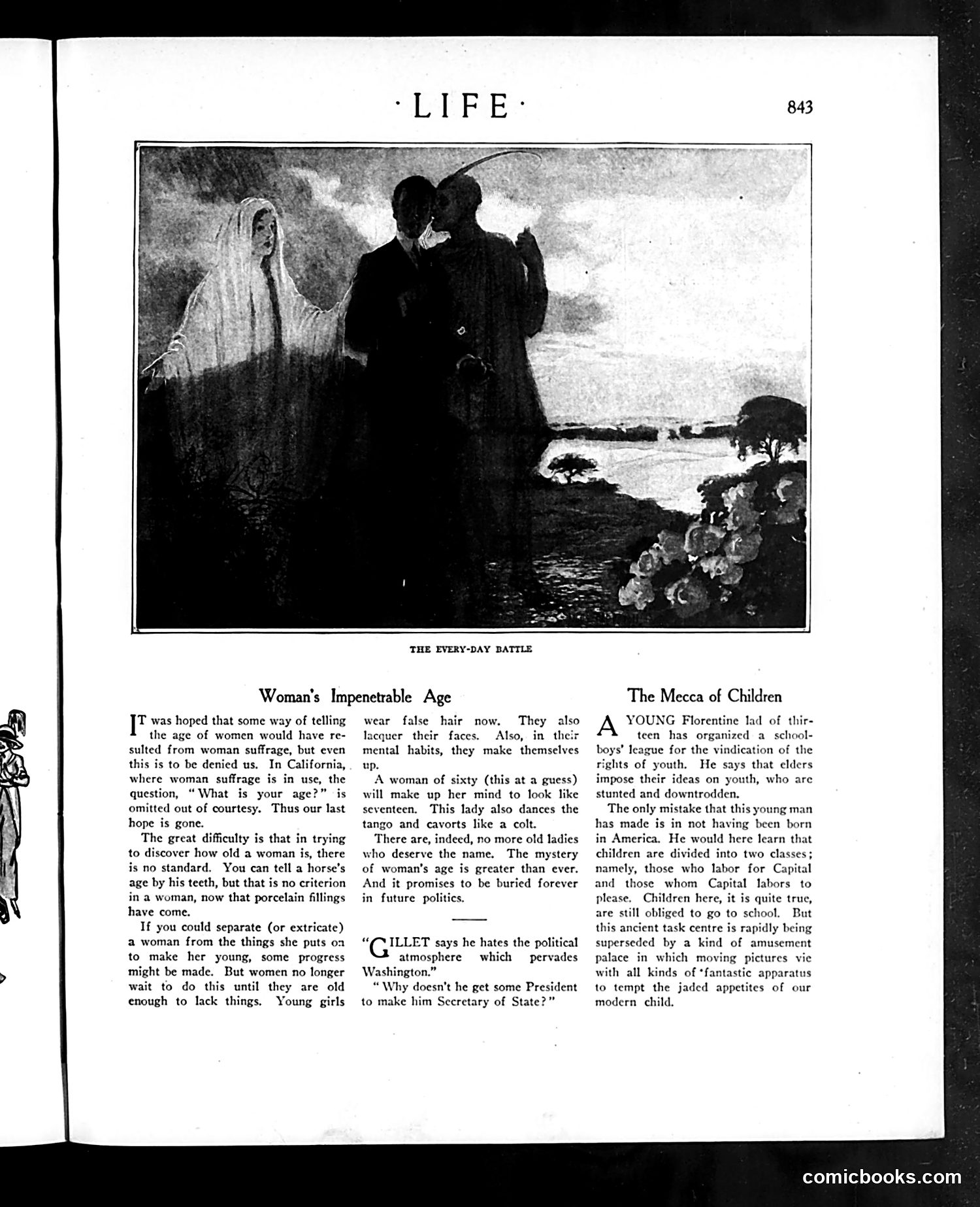
**"Woman's Impenetrable Age"** satirizes women's use of cosmetics and fashion to obscure their age. The article humorously argues that determining a woman's actual age has become impossible—women wear false hair, lacquer their faces, use porcelain tooth fillings, and mentally "make themselves up." A sixty-year-old will dress and behave like seventeen. The joke turns political: even woman suffrage in California hasn't solved this mystery, as the state omits age questions "out of courtesy." The satire mocks both women's deception and society's inability to handle the truth about aging. **"The Mecca of Children"** criticizes American child-rearing. It contrasts a thirteen-year-old Italian boy who organized a youth rights league with American children, who are divided into two classes: those exploited for labor and those indulged by capital. The real complaint: American children are being corrupted by amusement palaces featuring moving pictures and fantastic apparatus rather than traditional schooling—their appetites are being "jaded" by entertainment excess.
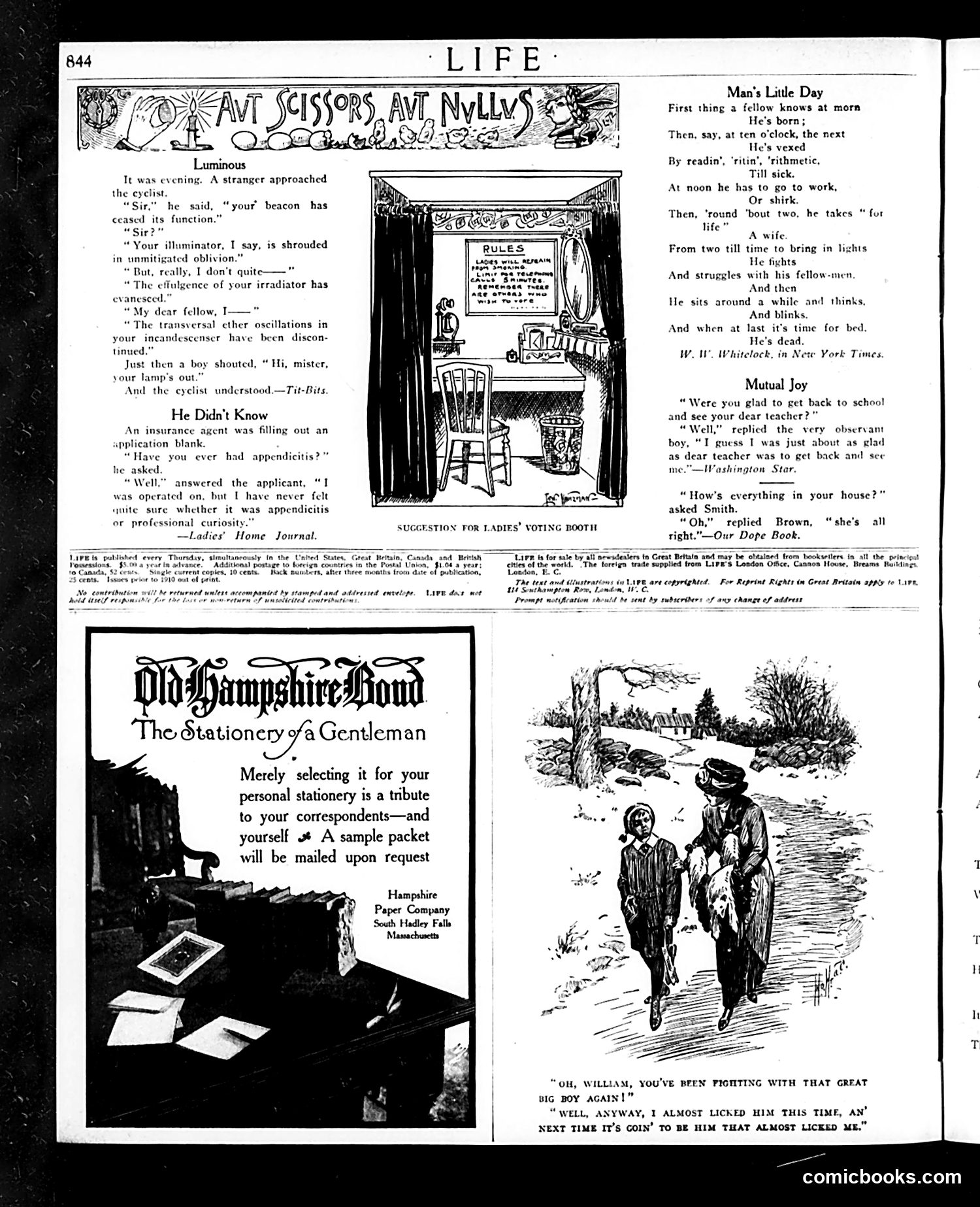
This page contains several short humor pieces typical of early 20th-century satirical magazines: **"He Didn't Know"** satirizes pretentious language. A stranger uses elaborate, pseudo-scientific jargon ("irradiator," "incandescenser") to describe a cyclist's broken lamp, but a boy states the problem plainly: "your lamp's out." The joke mocks those who obscure simple facts with unnecessarily complex vocabulary. **"Man's Little Day"** is a cynical poem about life's monotonous arc—birth, school drudgery, work, marriage/fighting, and death—reducing human existence to routine and struggle. **"Mutual Joy"** presents brief anecdotes about school and domestic life with dry punchlines about reluctant returns and marital indifference. **The cartoon** shows a man and boy by water; the boy has apparently fought a larger boy. His optimistic claim—that next time *he'll* almost beat his opponent—uses childish logic humorously. The page also contains advertisements for Hampshire Bond stationery, emphasizing social propriety and gentlemanly correspondence.
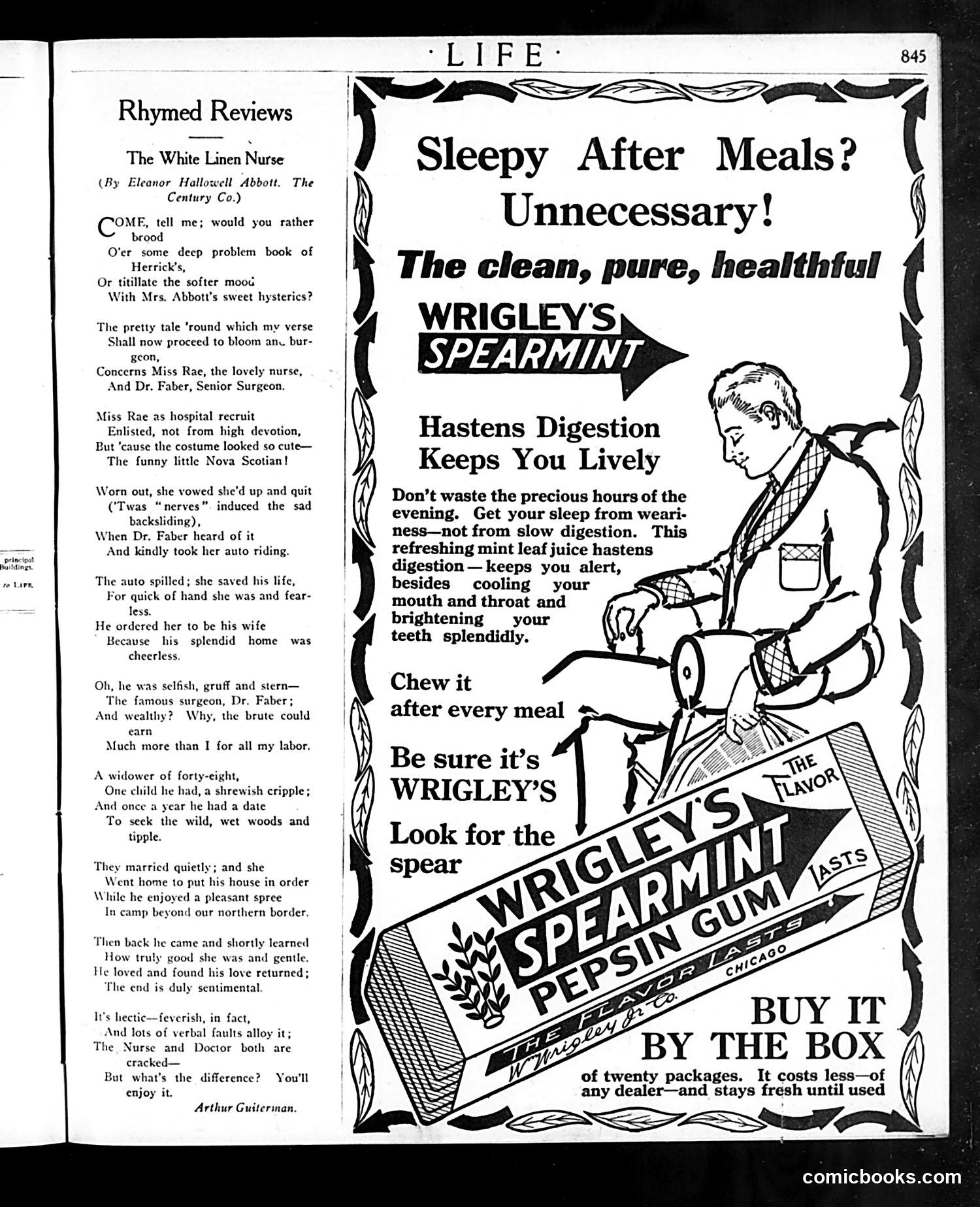
This page contains a book review and an advertisement, not political cartoons. **Left side:** Arthur Guiterman's verse review of *The White Linen Nurse* by Eleanor Hallowell Abbott. The poem summarizes a romantic plot: Miss Rae, a cute Nova Scotian nurse, enlists for the uniform; Dr. Faber, a wealthy, gruff surgeon, falls for her after she saves his life in a car accident; they marry and he discovers her goodness. Guiterman acknowledges the story is emotionally overwrought ("hectic," "feverish," characters are "cracked") but recommends it anyway as entertainment. **Right side:** A full-page advertisement for Wrigley's Spearmint gum claims chewing after meals prevents post-meal drowsiness by hastening digestion and keeping you "lively." The illustrated figure shows a man relaxing, suggesting the product prevents unwanted sleepiness. The ad encourages bulk purchase "by the box of twenty packages." This reflects early 20th-century patent-medicine style advertising with unsubstantiated health claims.
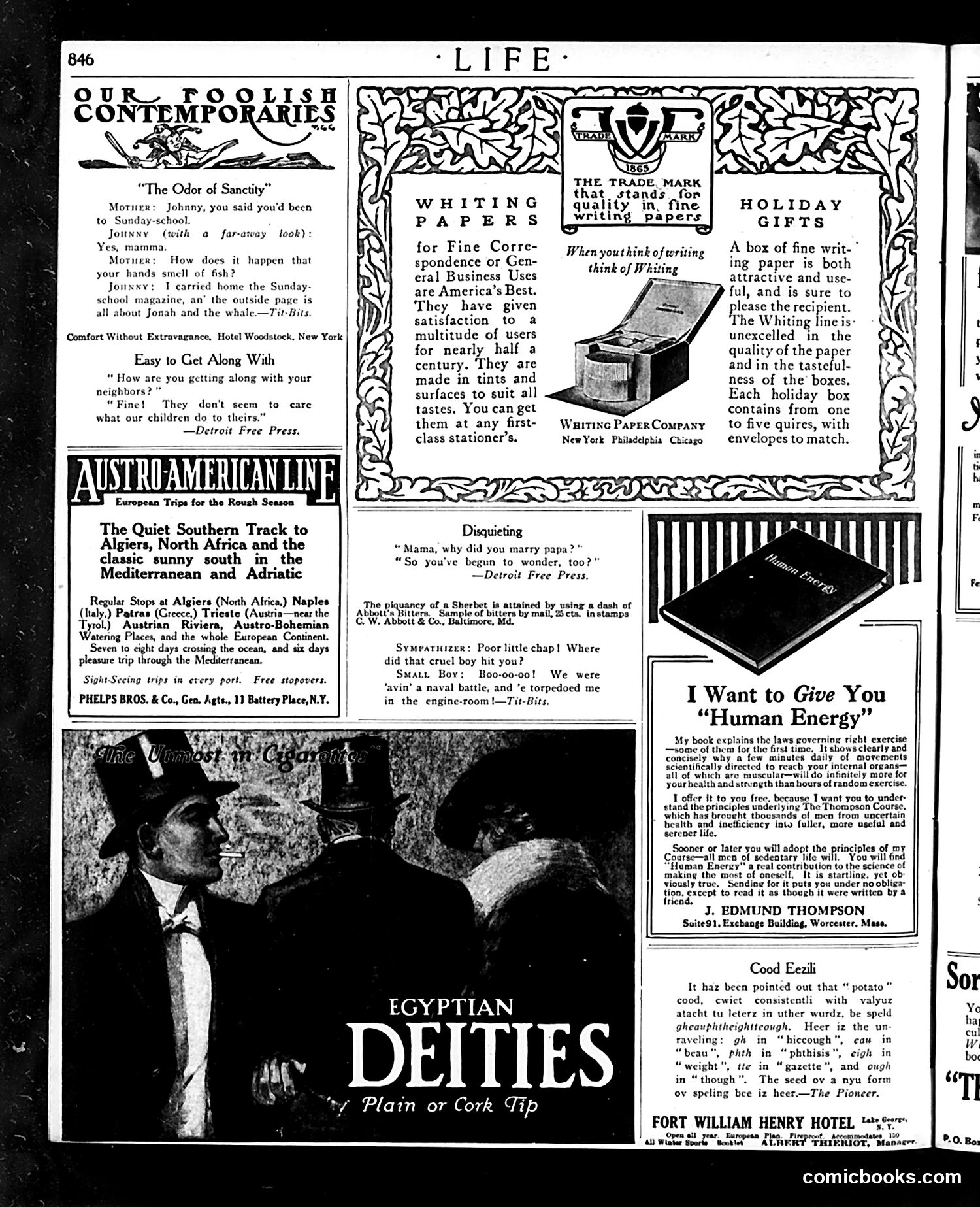
This page consists primarily of **advertisements and humor shorts** rather than political cartoons. Key content includes: **Humor Pieces:** - "The Odor of Sanctity": A joke about a boy claiming to have attended Sunday school but smelling of whale oil (likely from fish-based products), suggesting he lied about his activities. - "Easy to Get Along With" and "Disquieting": Brief satirical dialogues poking fun at social pretense and marriage expectations. - A naval humor piece about a boy torpedoing a ship's engine room during a "war game." **Advertisements:** The page features ads for Whiting Papers, Austro-American Line (Mediterranean travel), Egyptian Deities cork-tip cigarettes, "Human Energy" (an exercise/health book by J. Edmund Thompson), and the Fort William Henry Hotel. **Social Context:** The humor reflects early 20th-century middle-class anxieties about children's truthfulness, marriage, and leisure travel. The naval reference suggests post-WWI interest in naval warfare, though specifics are unclear.
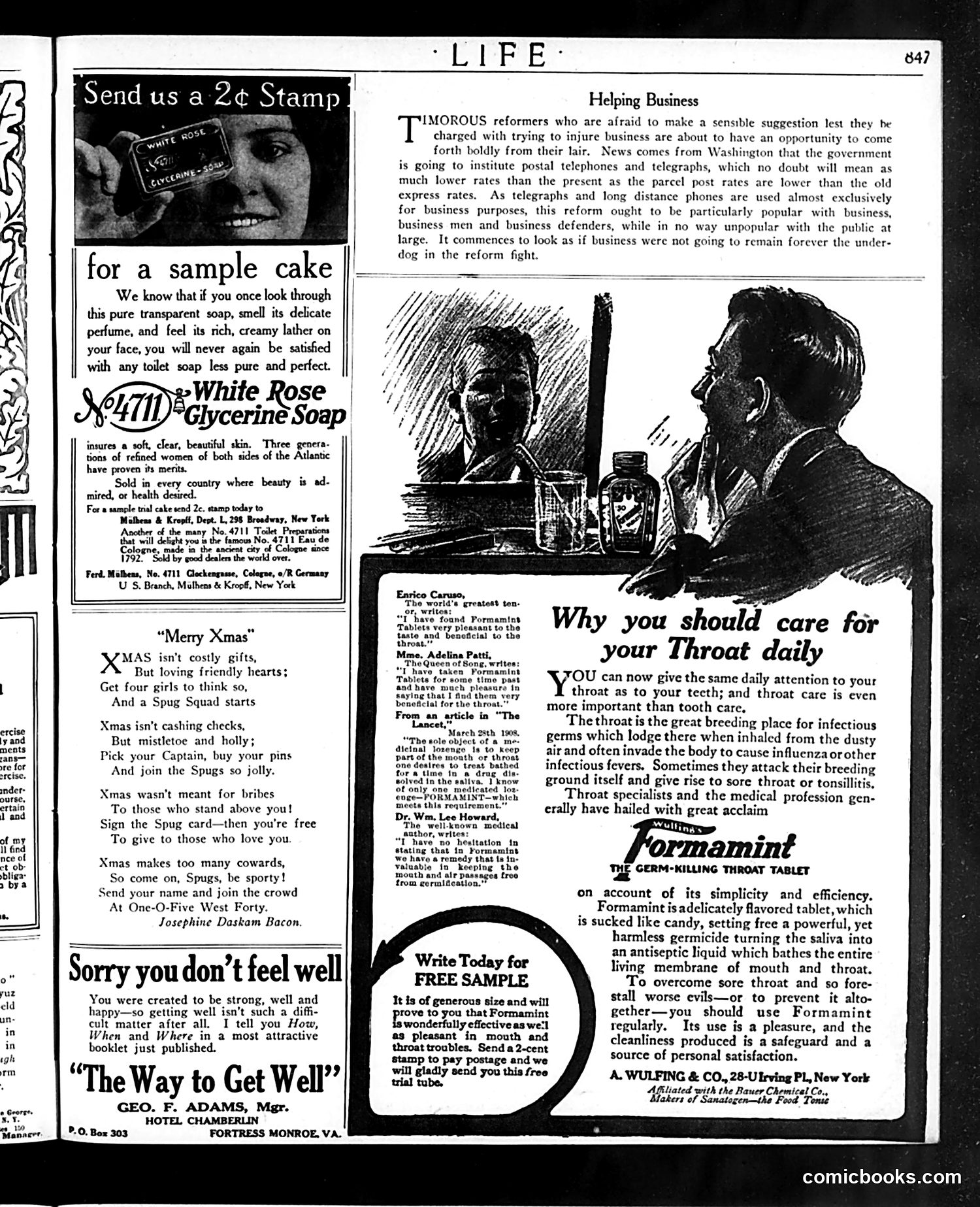
This page's main editorial cartoon (center-right) depicts a business conversation about postal reform. The text argues that the U.S. government plans to establish government-run postal telephones and telegraphs—a reform that would lower rates significantly (comparing the benefit to how parcel post undercut express rates). **The satirical point:** The writer challenges "timorous reformers" who hesitate to support business reforms for fear of seeming anti-business. The cartoon illustrates this discussion between businessmen. The humor lies in the ironic observation that *business itself* should enthusiastically support this reform, since telegraphs and long-distance phones are "used almost exclusively for business purposes." The satire suggests that business has unfairly positioned itself as victimized by reform efforts, when in fact this particular reform directly benefits them. The editorial concludes optimistically that "business were not going to remain forever the underdog in the reform fight." The surrounding advertisements (soap, throat lozenges, Christmas gift ideas) are typical period magazine filler unrelated to the editorial content.
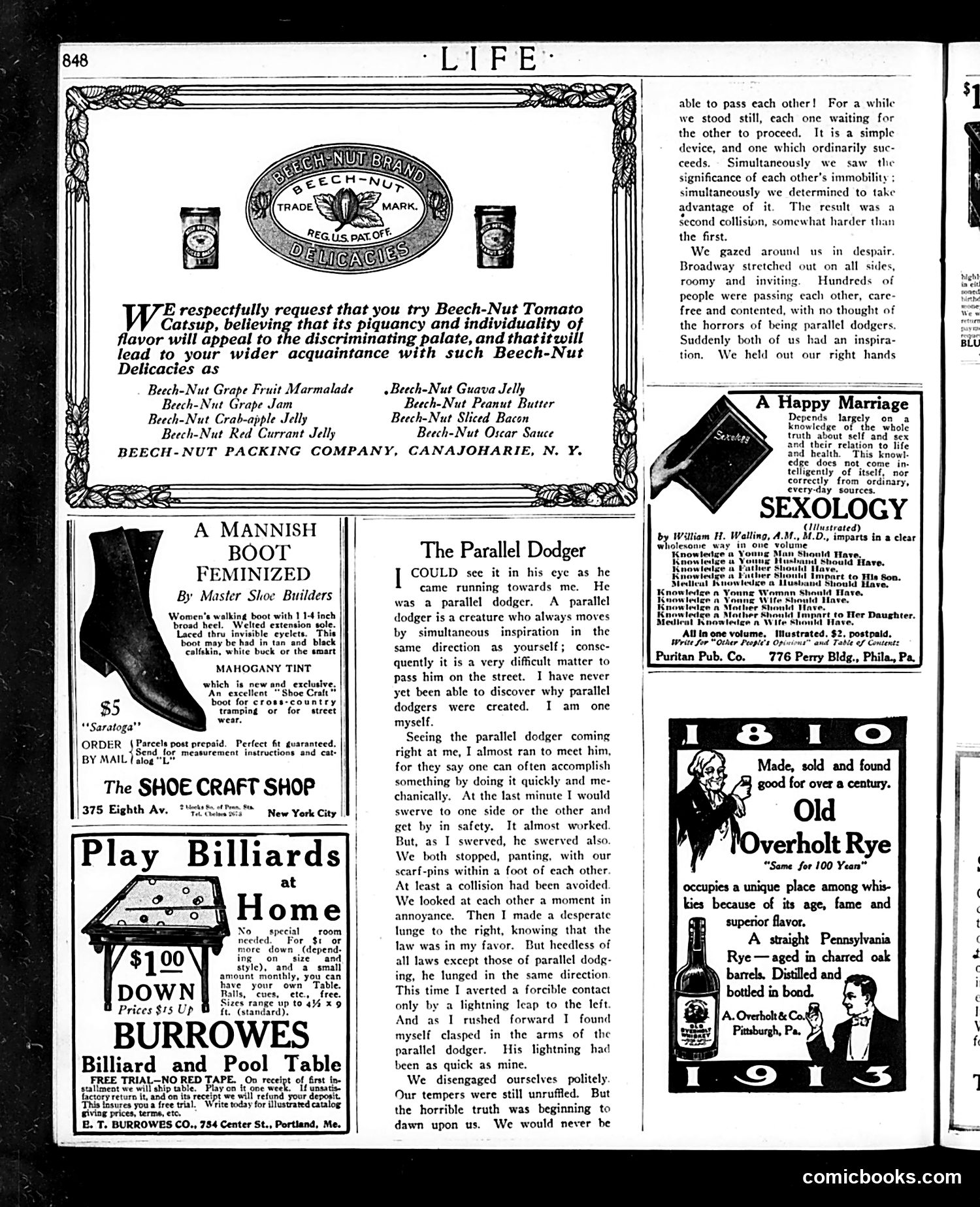
This is primarily an advertising page, but the central narrative piece—"The Parallel Dodger"—is a comedic essay about a common urban frustration. The author describes encountering another pedestrian on a crowded Broadway sidewalk, where both instinctively dodge in the same direction repeatedly, unable to pass each other. The "parallel dodger" is presented as a type of person who mysteriously moves simultaneously with you in the same direction—a universal experience of social awkwardness on busy streets. The humor lies in the relatability: the author admits being a parallel dodger themselves, and describes escalating failed attempts to pass (swerving left, then right, finally colliding). It's gentle satire of urban life and the absurd physics of human navigation—no political content, just observational humor about the small mortifications of city living circa the early 20th century.
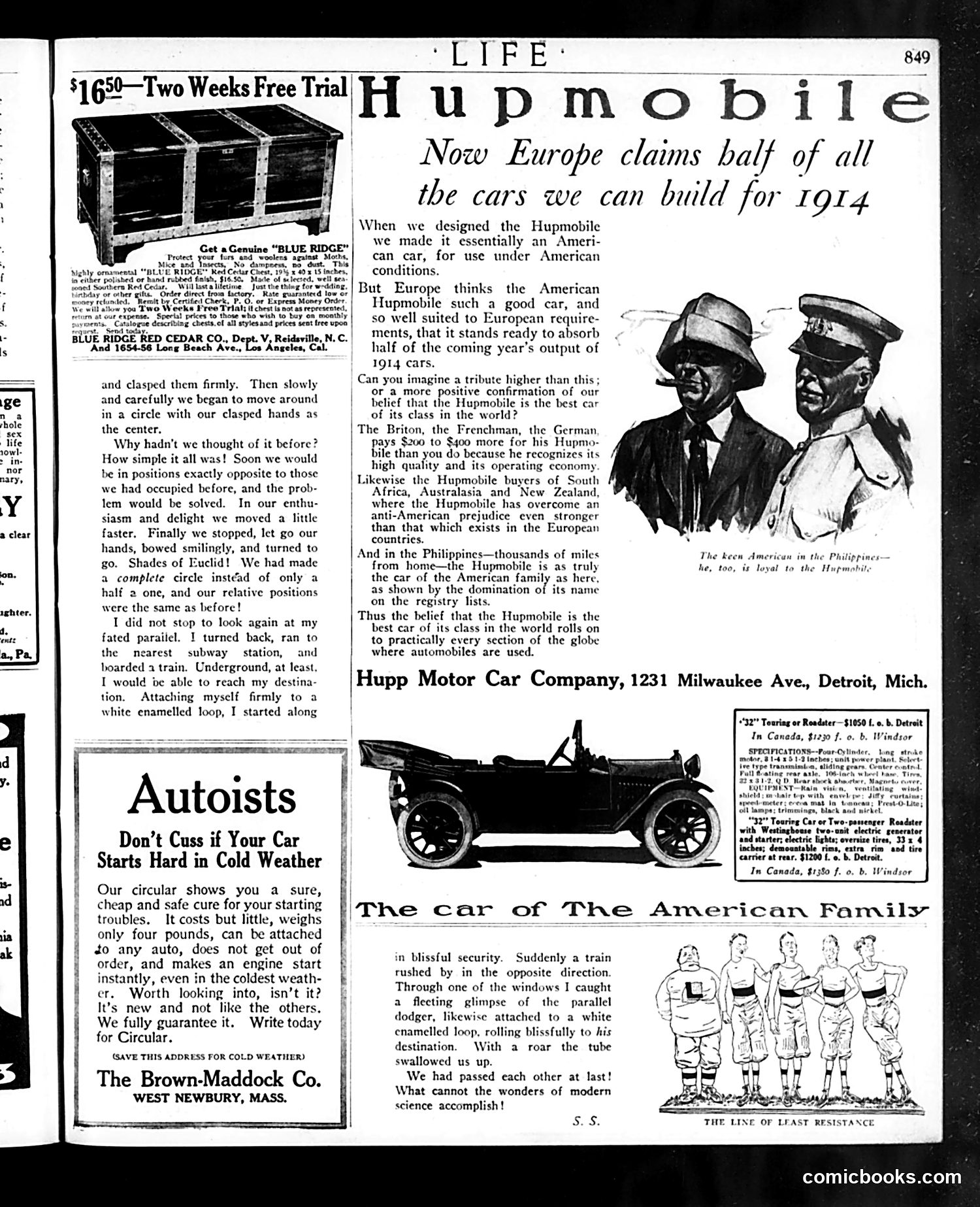
This page primarily consists of **automobile advertising**, not political satire. The dominant feature is a Hupmobile car advertisement claiming that Europe now demands half of all cars the company can manufacture for 1914—presenting this as evidence of the vehicle's superior quality and global appeal. The advertisement includes a photograph of two men (appearing to be a British and German buyer, based on the text's reference to "The Briton, the Frenchman, the German") examining the car, with caption text emphasizing international demand. The ad argues that buyers worldwide recognize the Hupmobile's quality, noting that even in regions with "anti-American prejudice," the car dominates. The page also contains minor advertisements (Hupmobile storage chest, cold-weather car starter device) and a brief story excerpt about navigating a parallel line—unrelated to the automobile content. The implicit claim: American manufacturing excellence transcends national prejudices, making American cars globally desirable even before U.S. industrial dominance became assured.
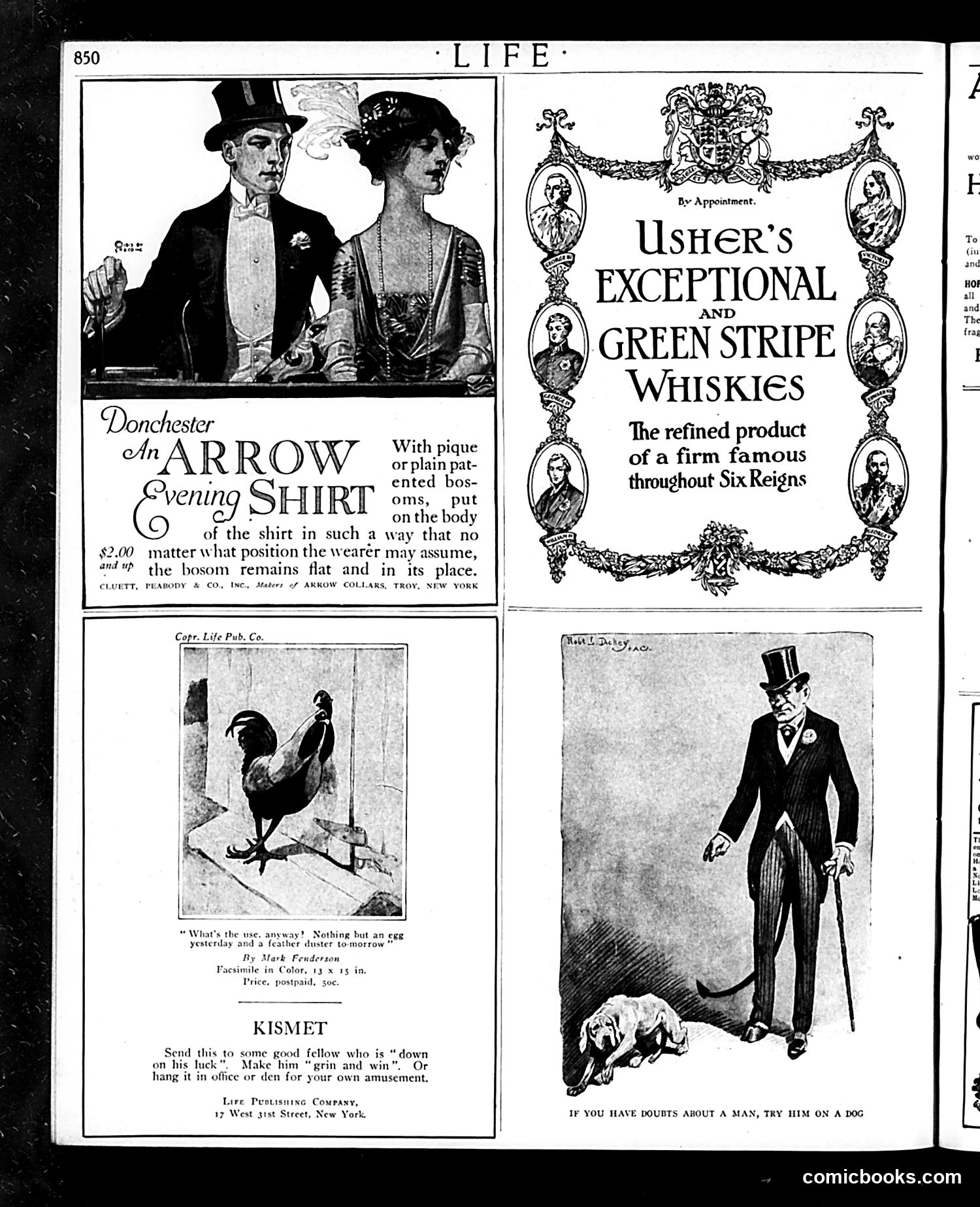
This page consists primarily of **advertisements and a single cartoon**, not political satire. **Advertisements:** - Arrow shirt collar (emphasizing a flat bosom design) - Usher's whisky (claiming refinement across "Six Reigns") - A "Kismet" postcard featuring a rooster with caption "What's use, anyway? Nothing but an egg yesterday and a feather duster to-morrow"—meant as an encouraging gift for someone facing bad luck **The Cartoon:** The bottom right shows a gentleman in top hat with a cane next to a dog, captioned "If you have doubts about a man, try him on a dog." This reflects the early 20th-century belief that character could be judged by how animals—particularly dogs—responded to someone. It's a satirical jab suggesting that a man's treatment of animals reveals his true nature. The page is primarily **commercial content** typical of Life magazine's advertising-heavy format rather than political commentary.
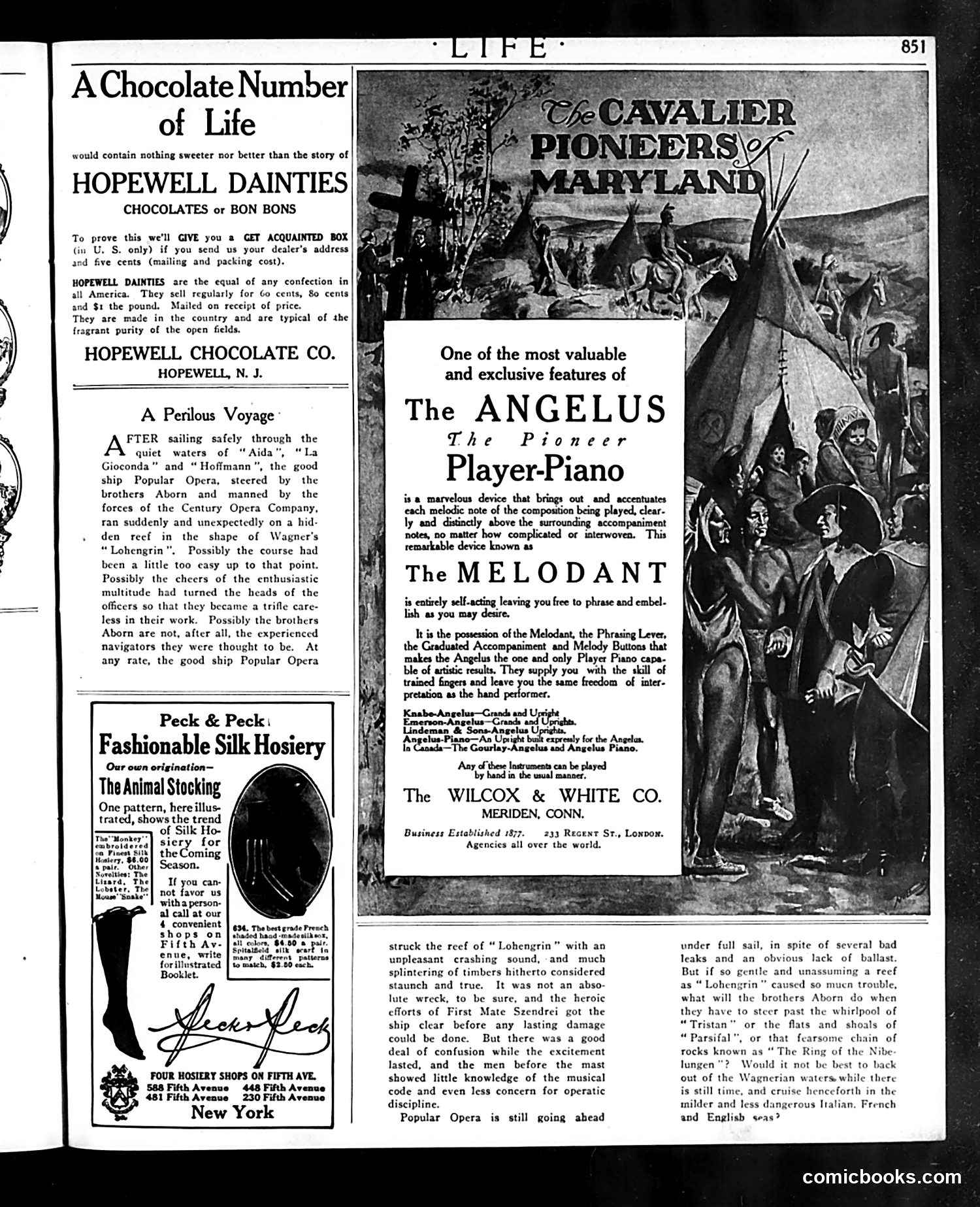
This page is primarily **advertisements** (chocolate, hosiery, player pianos), but contains a notable satirical piece titled "A Perilous Voyage." The satire uses maritime metaphor to mock the **Aborn brothers' Popular Opera Company**. Their ship has successfully navigated lighter operas ("Aida," "La Gioconda," "Hoffmann") but strikes a "hidden reef" when attempting Wagner's "Lohengrin"—suggesting the company lacks skill for ambitious, complex works. The piece humorously questions whether the Aborn brothers are truly experienced "navigators" of operatic repertoire or merely lucky. It warns of worse difficulties ahead with "Tristan" (another Wagner opera, presumably more challenging). The satire reflects early 1900s American opera culture: the Aborn brothers were actual opera impresarios attempting ambitious programming, and this playfully critiques whether their abilities matched their ambitions.
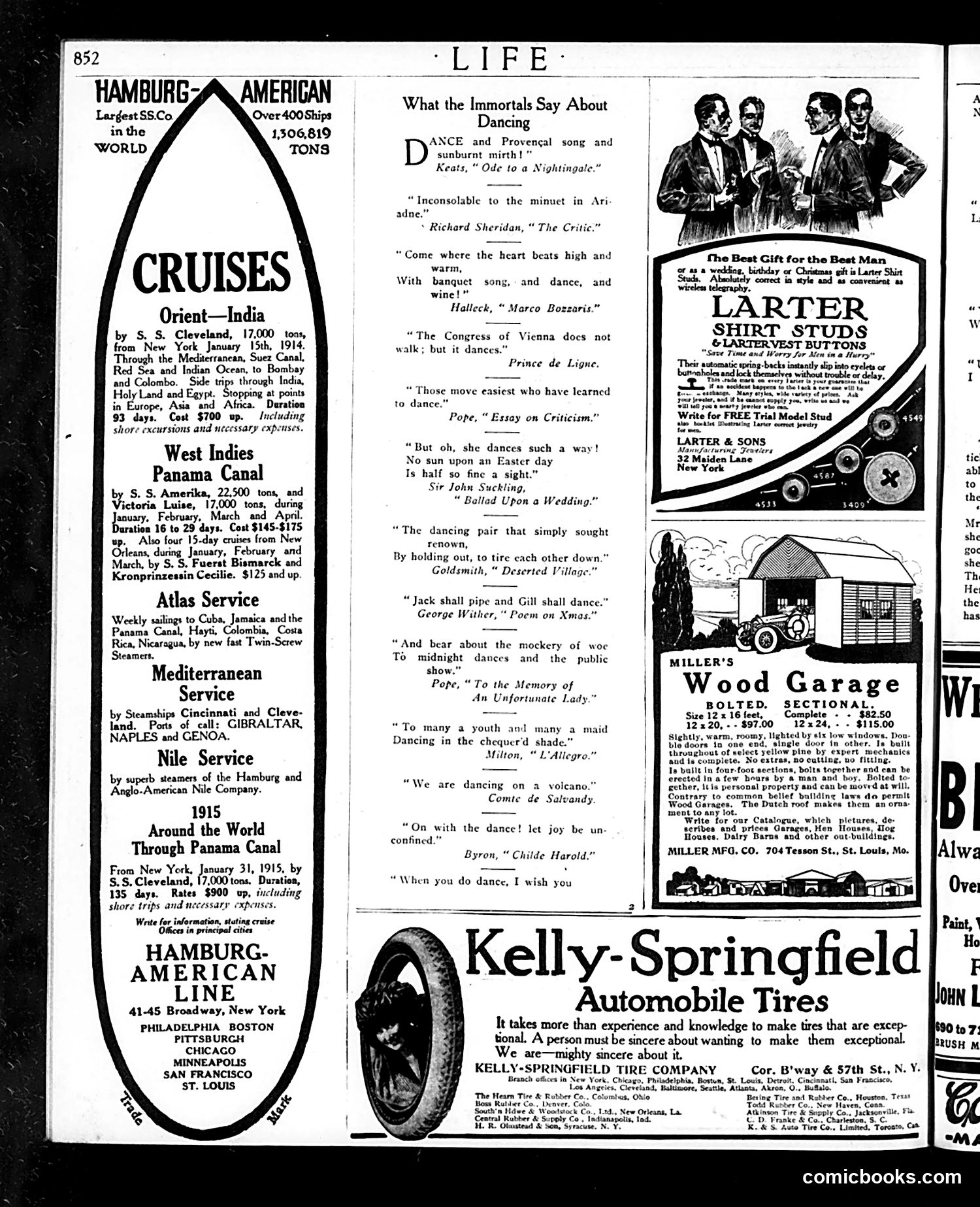
This page is primarily **advertising wrapped around a literary feature**, not political satire. The central content is a compilation of famous quotations about dancing, drawn from classical and Romantic poets and playwrights—Keats, Sheridan, Byron, Milton, Pope, and Goldsmith among them. The quotes range from celebratory ("Come where the heart beats high and warm, / With banquet song, and dance, and wine!") to philosophical reflections on dance's human significance. They're presented without commentary, simply as curated wisdom from literary "immortals." The surrounding advertisements—for Hamburg-American cruise lines, Larter shirt studs, Miller's wood garages, and Kelly-Springfield tires—occupy most of the page space. There's no visible cartoon or satirical illustration targeting specific figures or events. This appears to be a straightforward *Life* magazine editorial/advertising hybrid from 1914-1915, celebrating dance through canonical literary references rather than offering social or political critique.
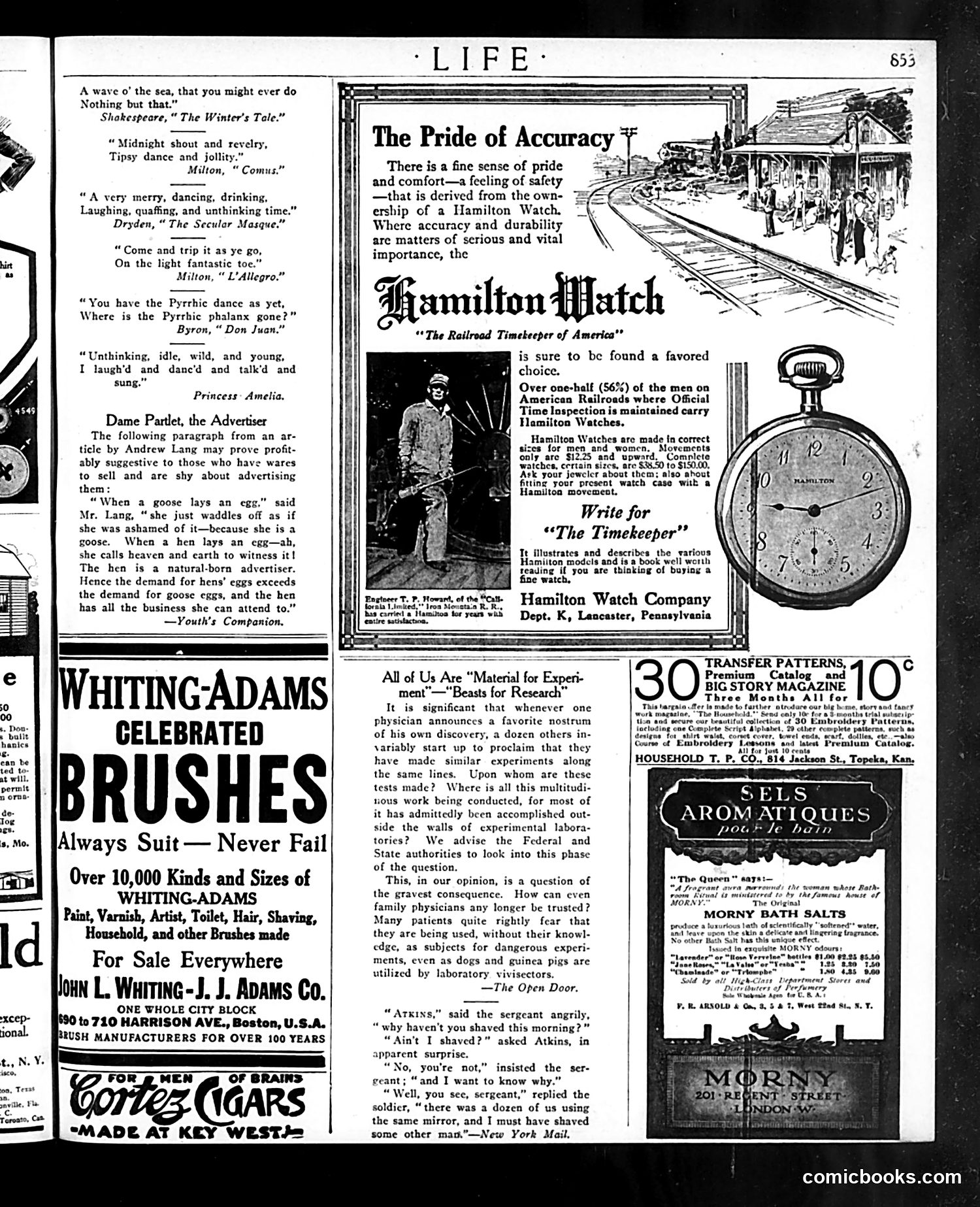
This page is primarily **advertisements and filler content**, not political satire. The main elements are: **"Dame Partlet, the Advertiser"** — A brief humorous piece referencing Andrew Lang's anecdote comparing geese and hens. A hen loudly advertises when laying eggs (natural self-promotion), while a goose hides the fact shamefully. The moral: successful business requires bold advertising, not modesty. This introduces the advertising section below. **The advertisements** include Hamilton Watches ("The Railroad Timekeeper of America"), Whiting-Adams Brushes, and other products—each using the "Pride of Accuracy" or quality-assurance angle to appeal to consumers. **A brief anecdote** at page bottom depicts a soldier named Atkins questioned about not shaving—minor military humor with no political significance. The page demonstrates **early 20th-century advertising strategy**: using clever editorial content and humor to frame product pitches as lifestyle advice rather than pure sales copy.
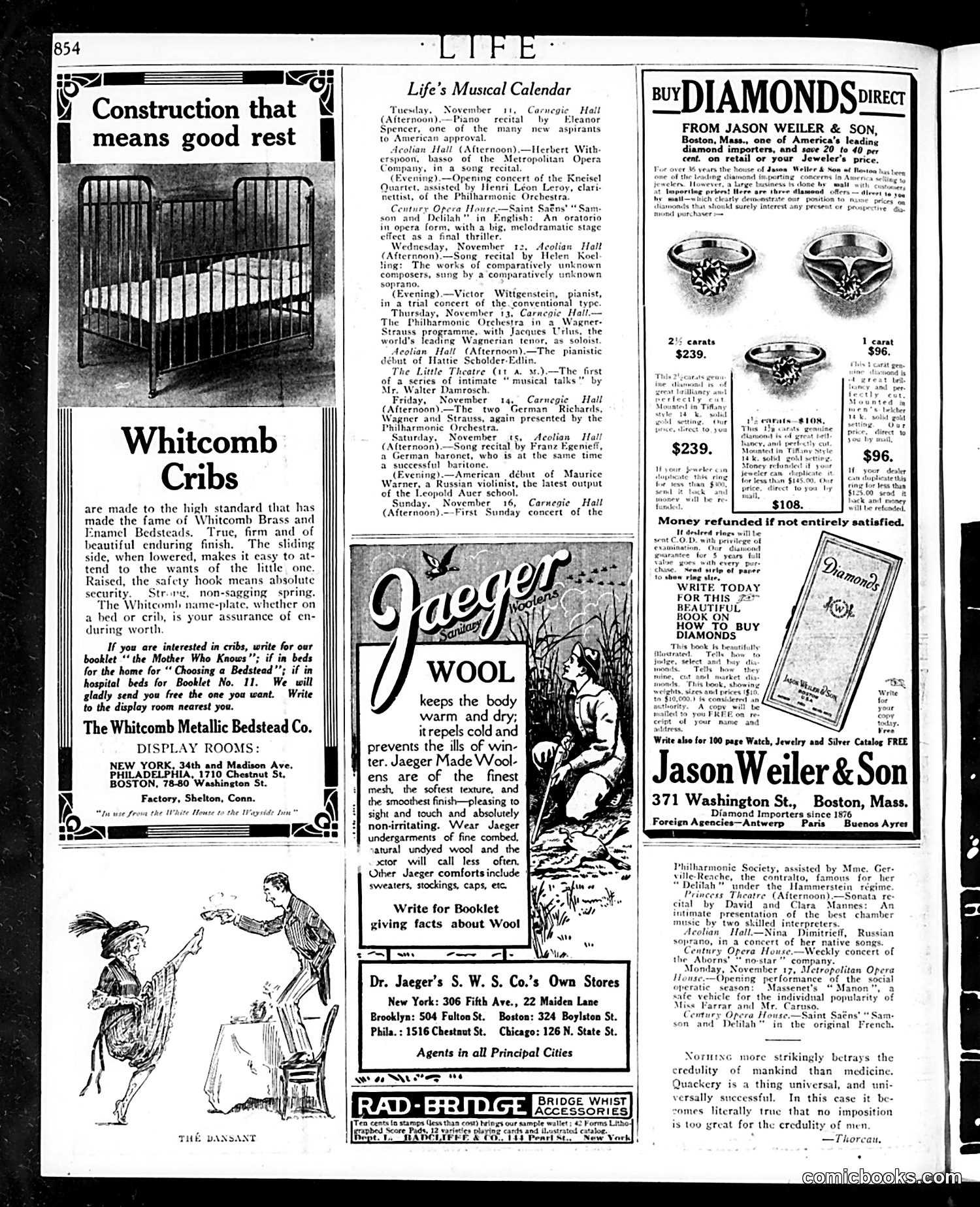
This page is primarily **advertising**, not political satire. It contains three major product advertisements with minimal cartoon content. The small illustration labeled "THE DANCANT" (bottom left) appears to be a generic decorative sketch of a dancing figure—not a political cartoon or recognizable caricature. The page's real content focuses on: 1. **Whitcomb Cribs** (metallic bedsteads) — emphasizing safety and durability for infants 2. **Jaeger Wool** — promoting thermal underwear and comfort clothing 3. **Jason Weiler & Son** — diamond importers offering direct sales The middle section includes **Life's Musical Calendar**, listing concert performances at venues like Carnegie Hall and Aeolian Hall featuring opera singers and orchestras. There is no discernible political message, satire, or social commentary on this page. It represents typical 1920s consumer advertising alongside cultural listings—the magazine's revenue model of combining editorial content with advertisements.
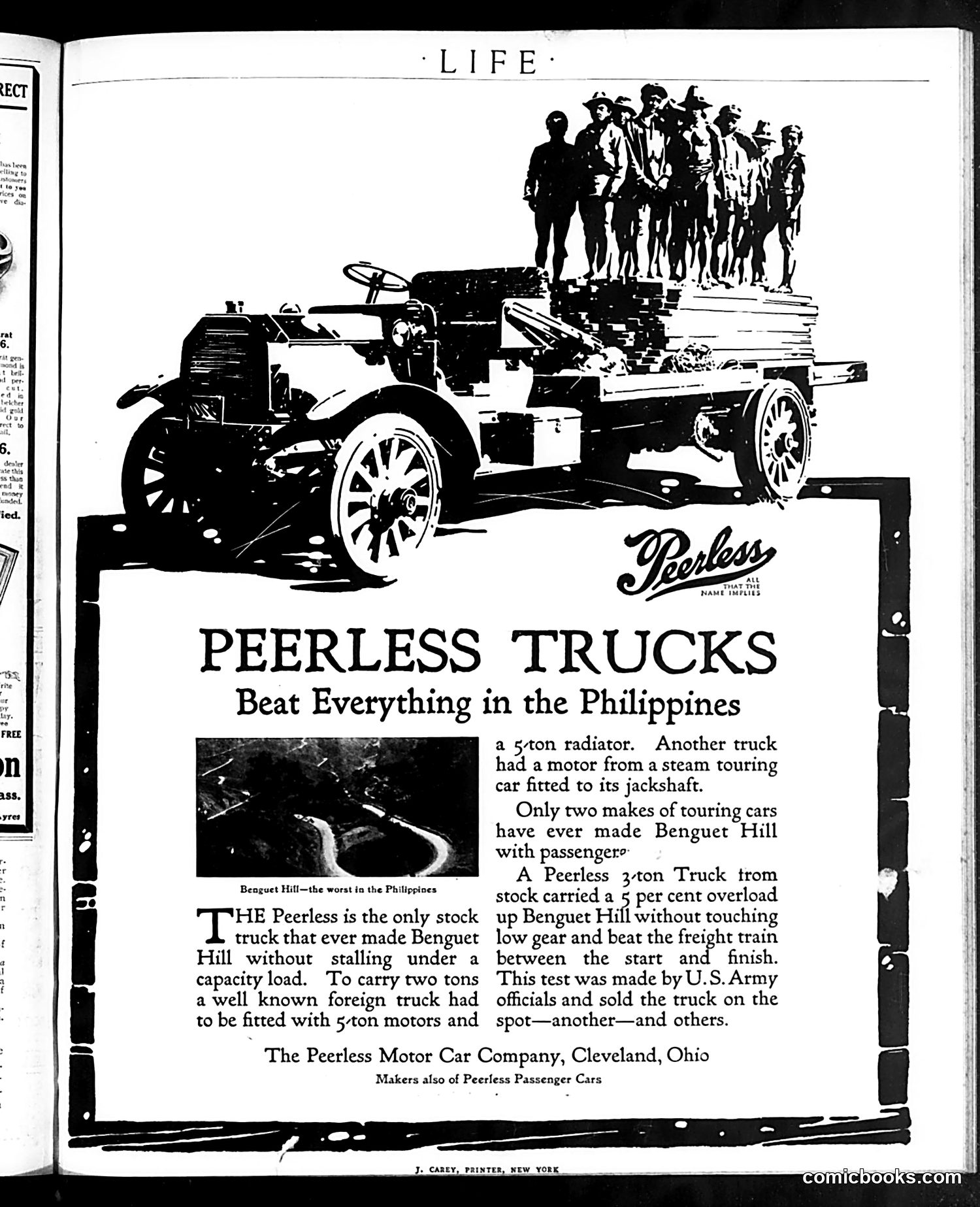
This is a **commercial advertisement**, not political satire. It promotes Peerless trucks, manufactured in Cleveland, Ohio. The page showcases an early automotive truck performing impressively on Benguet Hill in the Philippines—apparently a notoriously difficult mountain road. The advertisement claims the Peerless 3-ton truck successfully navigated this terrain while competitors (unnamed foreign trucks) required oversized 5-ton motors and modifications to manage the same load. The dramatic illustration depicts the truck laden with passengers ascending the hill, emphasizing its capability. The text highlights a test allegedly conducted by U.S. Army officials who "sold the truck on the spot," lending credibility through institutional endorsement. For modern readers: this reflects early 1900s industrial advertising emphasizing engineering superiority through dramatic testing claims—a precursor to modern performance marketing. The Philippines reference suggests American commercial/military presence in colonial territories.
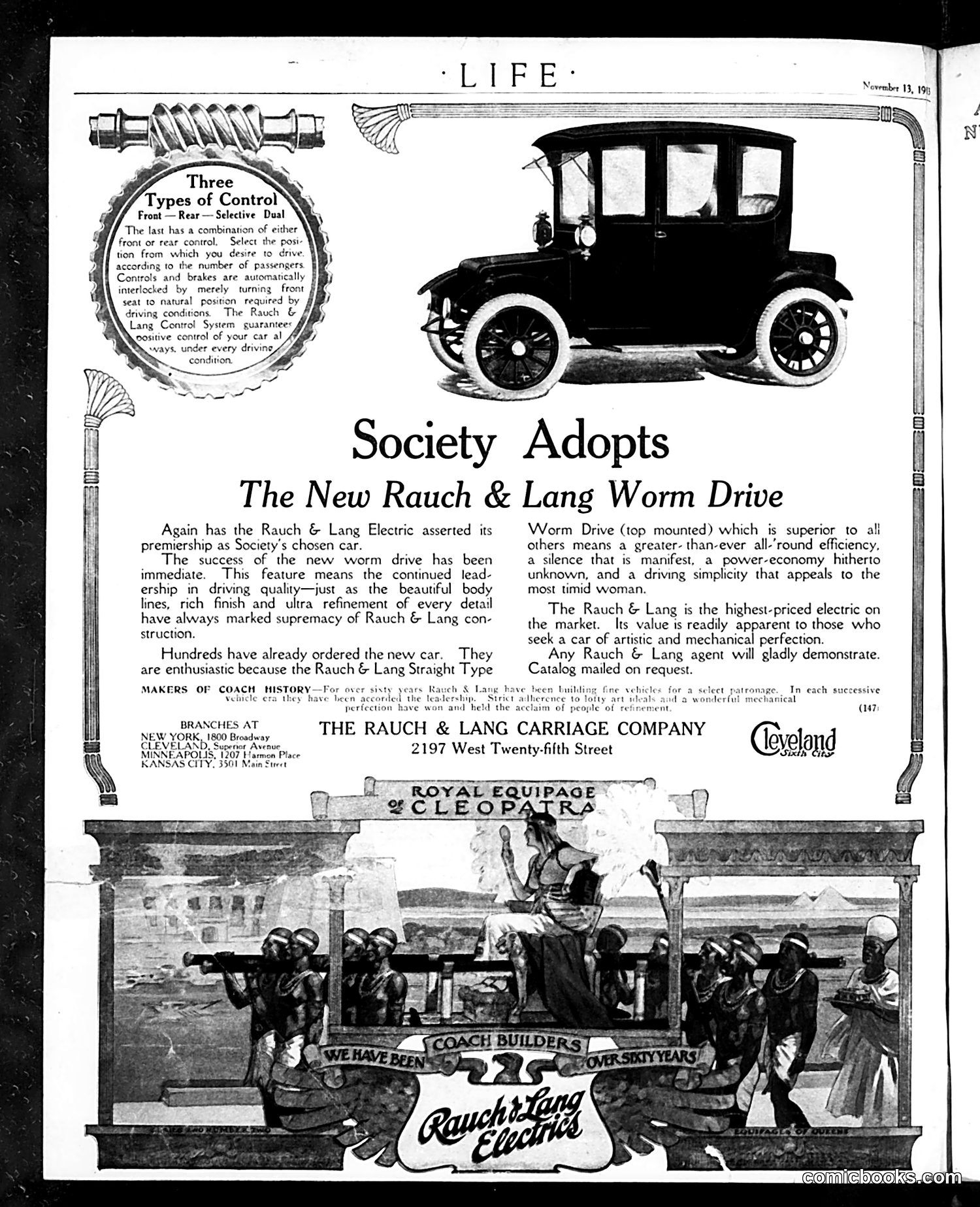
This page is **primarily advertising**, not satire. It promotes the Rauch & Lang electric automobile, marketed as society's choice vehicle. The ad emphasizes luxury features: multiple steering control positions, a "worm drive" transmission, silent operation, and fuel efficiency. Notably, it appeals to "the most timid woman," reflecting early-1900s assumptions that women drivers needed simpler, safer cars. The lower illustration references classical Rome (columns, "Royal Equipage of Cleopatra") to position the car as elite and timeless. The phrase "Coach Builders Over Sixty Years" establishes prestige through longevity. The tone is boastful—"highest-priced electric on the market"—assuming high cost signals superiority. This advertisement targets wealthy consumers seeking status symbols, reflecting the era when automobiles were luxury goods, not transportation basics. There is **no political cartoon or satire** present on this page.