
Life, 1913-11-13 · page 19 of 40
Life — November 13, 1913 — page 19: what you’re looking at
What you’re looking at
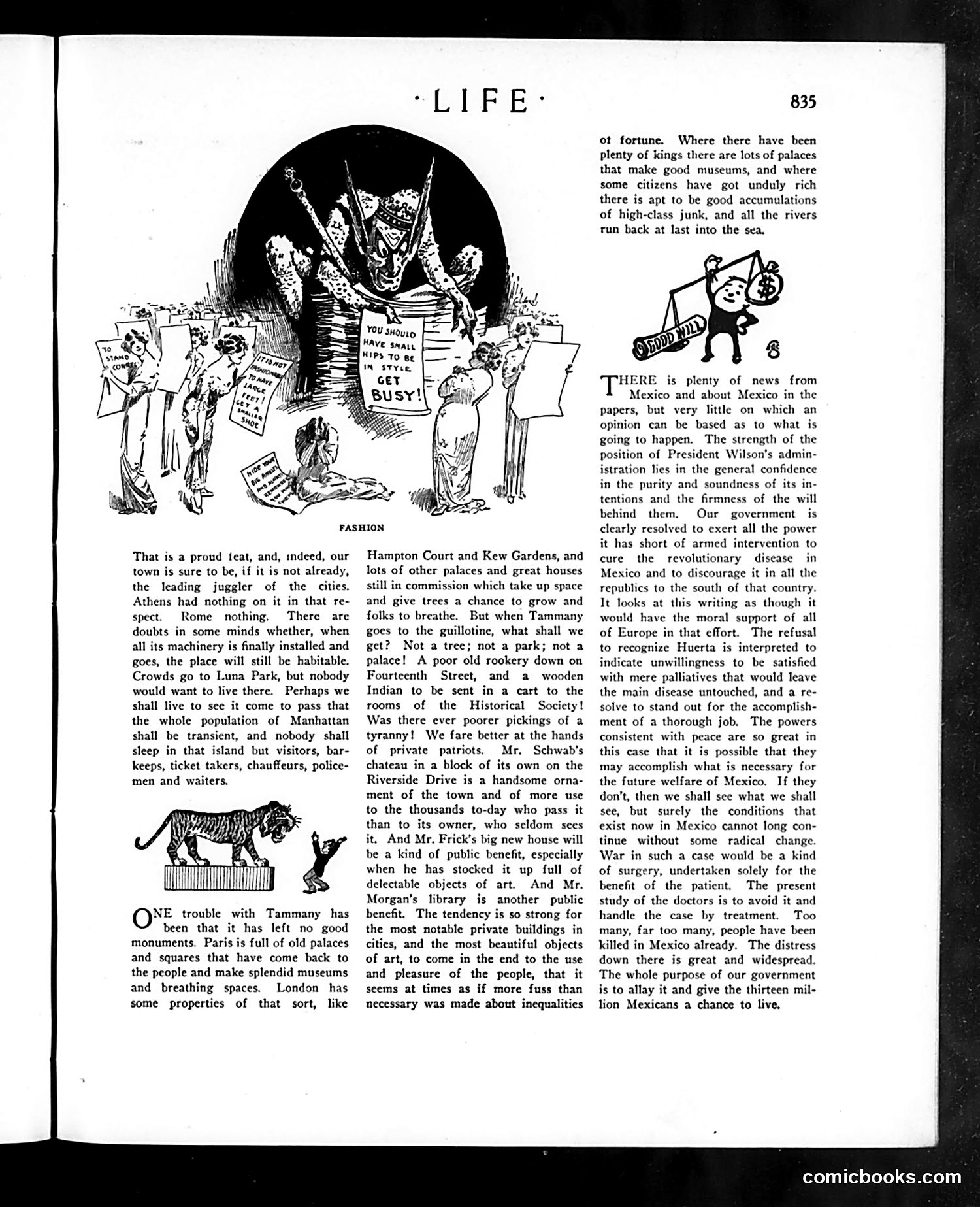
## The "Fashion" Cartoon The large illustration satirizes Manhattan's frenetic development and commercialism. A grotesque, mask-like face (representing the city itself) looms over tiny figures carrying signs reading "GET BUSY!" and similar exhortations. The satire criticizes New York's obsession with constant activity and consumption—suggesting the city prioritizes transient visitors (ticket-takers, chauffeurs) over permanent residents. ## The Tammany Hall Critique The accompanying text contrasts Tammany Hall (New York's corrupt Democratic political machine) unfavorably with European monarchies and American industrialists like Schwab, Frick, and Morgan. It argues that while European tyrants at least left behind palaces-turned-museums, Tammany will leave nothing but "a poor old rookery on Fourteenth Street." Ironically, the author suggests private wealth serves the public better than political patronage. ## Mexico Commentary The final section defends President Wilson's non-interventionist approach to Mexican revolution, praising his refusal to recognize Huerta and his moral firmness, while stopping short of armed intervention.
📄 Transcribed text from this page (OCR, searchable)
Machine-transcribed from the original scan — historical spelling and the odd misread are preserved.
FASHION That is a proud feat, and, indeed, our town is sure to be, if it is not already, the leading juggler of the cities. Athens had nothing on it in that re- spect. Rome nothing. There are doubts in some minds whether, when all its machinery is finally installed and goes, the place will still be habitable. Crowds go to Luna Park, but nobody would want to live there. Perhaps we shall live to see it come to pass that the whole population of Manhattan shall be transient, and nobody shall sleep in that island but visitors, bar- keeps, ticket takers, chauffeurs, police- men and waiters, Pyaar INS WH iR a sas OE trouble with Tammany has been that it has left no good monuments. Paris is full of old palaces and squares that have come back to the people and make splendid museums and breathing spaces. London has some properties of that sort, like Hampton Court and Kew Gardens, and lots of other palaces and great houses still in commission which take up space and give trees a chance to grow and folks to breathe. But when Tammany goes to the guillotine, what shall we get? Not a tree; not a park; not a palace! A poor old rookery down on Fourteenth Street, and a wooden Indian to be sent in a cart to the rooms of the Historical Society! Was there ever poorer pickings of a tyranny! We fare better at the hands of private patriots. Mr. Schwab's chateau in a block of its own on the Riverside Drive is a handsome orna- ment of the town and of more use to the thousands to-day who pass it than to its owner, who seldom sees it. And Mr, Frick’s big new house will be a kind of public benefit, especially when he has stocked it up full of delectable objects of art. And Mr. Morgan's library is another public benefit. The tendency is so strong for the most notable private buildings in cities, and the most beautiful objects of art, to come in the end to the use and pleasure of the people, that it seems at times as if more fuss than necessary was made about inequalities 835 ot fortune. Where there have been plenty of kings there are lots of palaces that make good museums, and where some citizens have got unduly rich there is apt to be good accumulations of high-class junk, and all the rivers tun back at last into the sea. HERE is plenty of news from Mexico and about Mexico in the papers, but very little on which an opinion can be based as to what is going to happen. The strength of the position of President Wilson's admin- istration lies in the general confidence in the purity and soundness of its in- tentions and the firmness of the will behind them. Our government is clearly resolved to exert all the power it has short of armed intervention to cure the revolutionary disease in Mexico and to discourage it in all the republics to the south of that country. It looks at this writing as though it would have the moral support of all of Europe in that effort. The refusal to recognize Huerta is interpreted to indicate unwillingness to be satisfied with mere palliatives that would leave the main disease untouched, and a re- solve to stand out for the accomplish- ment of a thorough job. The powers consistent with peace are so great in this case that it is possible that they may accomplish what is necessary for the future welfare of Mexico. If they don't, then we shall see what we shall see, but surely the conditions that exist now in Mexico cannot long con- tinue without some radical change. War in such a case would be a kind of surgery, undertaken solely for the benefit of the patient. The present study of the doctors is to avoid it and handle the case by treatment. Too many, far too many, people have been killed in Mexico already. The distress down there is great and widespread. The whole purpose of our government is to allay it and give the thirteen mil- lion Mexicans a chance to live. comicbooks.com