
Life, 1913-11-13 · page 24 of 40
Life — November 13, 1913 — page 24: what you’re looking at
What you’re looking at
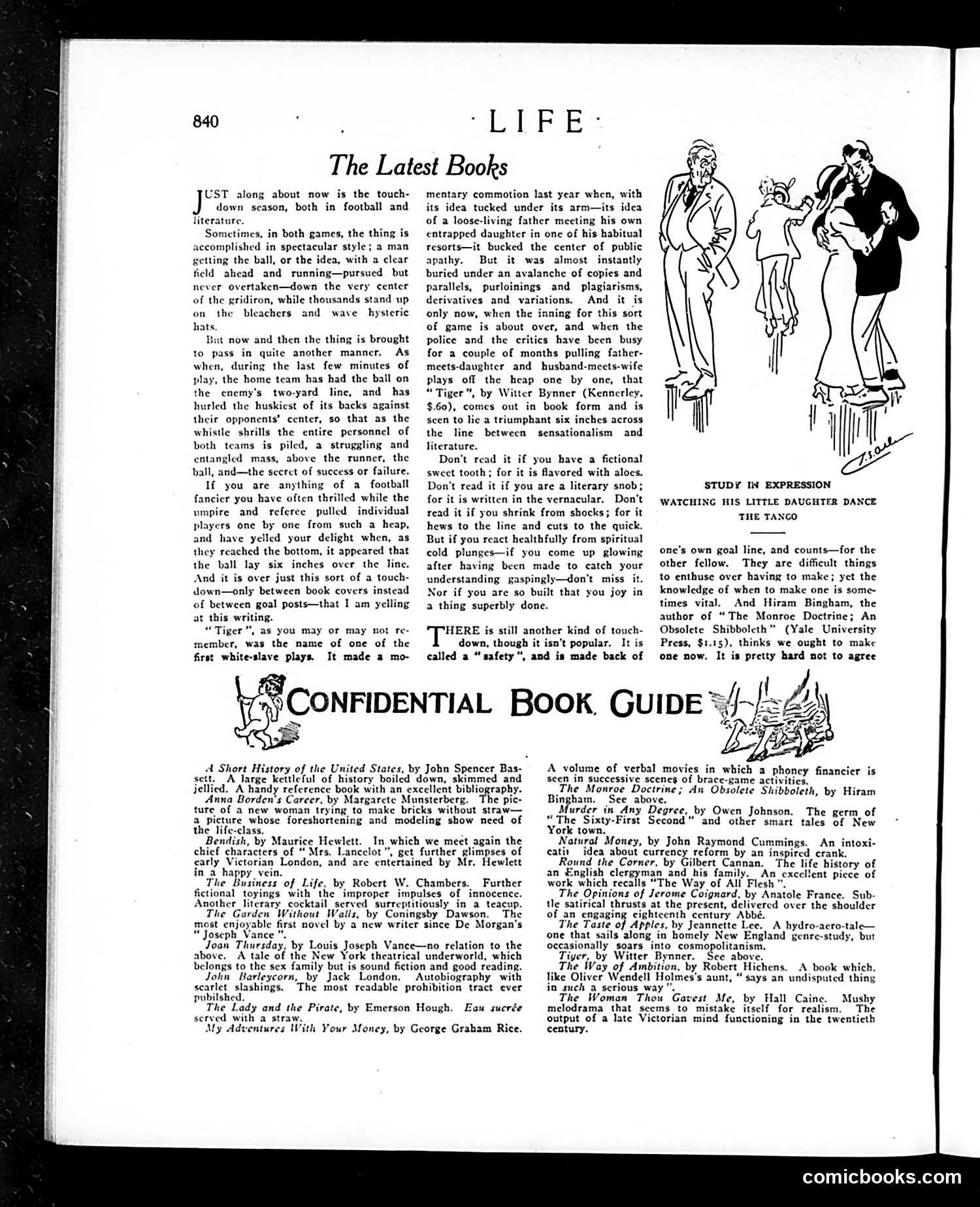
This page reviews literary "touchdowns"—using football metaphor to discuss books that successfully break through public indifference. The main illustration (captioned "Study in Expression: Watching His Little Daughter Dance the Tango") shows a father's disapproving reaction to his daughter dancing the tango with a partner. This satirizes contemporary anxieties about the tango, a scandalous new dance considered morally suspect by older generations. The cartoon captures the generational tension and parental shock at modern youth culture. The text praises Witter Bynner's play *Tiger* (about white slavery—a social reform topic) for achieving literary merit despite sensationalism. It criticizes the avalanche of derivative works that followed. A secondary reference discusses Hiram Bingham's *The Monroe Doctrine* as advocating American foreign policy restraint—a "safety" (in football terms, scoring for the other team) that Bingham argues America should embrace. The page reflects Progressive Era concerns: moral reform, literary standards, American international responsibility, and generational conflict over modern behavior.
📄 Transcribed text from this page (OCR, searchable)
Machine-transcribed from the original scan — historical spelling and the odd misread are preserved.
ge WE al i The Latest Books UST along about now is the touch- down season, both in football and literature. Sometimes, in both games, the thing is accomplished in spectacular style; a man getting the ball, or the idea, with a clear field ahead and running—pursued but never overtaken—down the very center of the gridiron, while thousands stand up on the bleachers and wave hysteric hats. But now and then the thing is brought to pass in quite another manner. As when, during the last few minutes of play, the home team has had the ball on the enemy's two-yard line, and has hurled the huskiest of its backs against their opponents’ center, so that as the whistle shrills the entire personnel of both teams is piled, a struggling and entangled mass, above the runner, the ball, and—the secret of success or failure. If you are anything of a football fancier you have often thrilled while the umpire and referee pulled individual players one by one from such a heap, and have yelled your delight when, as they reached the bottom, it appeared that the ball lay six inches over the line. And it is over just this sort of a touch- down—only between book covers instead ‘of between goal posts—that I am yelling at this writing. “Tiger, as you may or may not re- member, was the name of one of the first white-slave plays. It made a mo- mentary commotion last year when, with its idea tucked under its arm—its idea of a loose-living father meeting his own entrapped daughter in one of his habitual resorts—it bucked the center of public apathy. But it was almost instantly buried under an avalanche of copies and parallels, purloinings and plagiarisms, derivatives and variations. And it is only now, when the inning for this sort of game is about over, and when the police and the critics have been busy for a couple of months pulling father- meets-daughter and husband-meets-wife plays off the heap one by one, that “Tiger”, by Witter Bynner (Kennerley. $.60), comes out in book form and is seen to lic a triumphant six inches across the line between sensationalism and literature. Don’t read it if you have a fictional sweet tooth; for it is flavored with alocs. Don't read it if you are a literary snob; for it is written in the vernacular. Don't read it if you shrink from shocks; for it hews to the line and cuts to the quick. But if you react healthfully from spiritual cold plunges—if you come up glowing after having been made to catch your understanding gaspingly—don’t miss it. Nor if you are so built that you joy in a thing superbly done. HERE is still another kind of touch- down, though it isn't popular. It is called a “safety”, and is made back of STUDY IN EXPRESSION WATCHING HIS LITTLE DAUGHTER DANCE THE TANGO ‘one’s own goal line, and counts—for the other fellow. They are difficult things to enthuse over having to make; yet the knowledge of when to make one is some- times vital. And Hiram Bingham, the author of “The Monroe Doctrine; An Obsolete Shibboleth” (Yale University Press, $1.15), thinks we ought to make one now. It is pretty hard not to agree A Short History of the United States, by John Spencer Bas- sett. A large kettleful of history boiled down, skimmed and jellied. A handy reference book with an excellent bibliography. Anna Borden's Carcer, by Margarete Munsterberg. The pic- ture of a new woman trying to make bricks without straw— a picture whose foreshortening and modeling show need of the life-class. Bendish, by Maurice Hewlett. In which we meet again the chief characters of “Mrs. Lancelot”, get further glimpses of carly Victorian London, and are entertained by Mr. Hewlett in a happy. vein. The Business of Life, by, Robert W. Chambers. Further fictional toyings with the improper impulses of innocence. Another literary cocktail served surreptitiously in a teacup. The Garden Without Walls, by Coningsby Dawson. The most enjoyable first novel by a new writer since De Morgan's “Joseph Vance ". Joan Thursday, by Louis Joseph Vance—no relation to the above. A tale of the New York theatrical underworld, which belongs to the sex family but is sound fiction and good reading. Join Barleycorn, by Jack London. Autobiography. with scarlet slashings. The most readable prohibition tract ever pubilshed. The Lady and the Pirate, by Emerson Hough. Eau sucrée served with a straw, tures With Your Money, by George Graham Rice. A volume of verbal movies in which a phoney financier is seen in successive scenes of brace-game activiti The Monroe Doctrine; An Obsolete Sh Bingham. See above. 3. boleth, by Hiram Murder in Any Degree, by Owen Johnson. “The Sixty-First Second” and other smart tales of New York town. Natural Money, by John Raymond Cummings. catis Round the Corner, by Gilbert Cannan. The germ of + An intoxi- idea about currency reform by an inspired crank. ound , The life history of an English clergyman and his family. An excellent piece of work which recalls “The Way of All Flesh”. The Opinions of Jerome Coignard, by Anatole France. Sub- tle satirical thrusts at the present, delivered over the shoulder of an engaging eighteenth century Abbé. The Taste a Apples, by Jeannette Lee. A hydro-acro-tale— one that sails along in homely New England genre-study, but occasionally soars into cosmopolitanism. Tiger, by Witter Bynner. Sce above. The Way of Ambition, by Robert Hichens. A book which. like Oliver Wendell Holmes’s aunt, “ says an undisputed thing in such a serious way". The Woman Thou Gavest Me, by Hall Caine. Mushy melodrama that seems to mistake itself for realism. The output of a late Victorian mind functioning in the twentieth century. comicbooks.com