
Life, 1913-11-13 · page 22 of 40
Life — November 13, 1913 — page 22: what you’re looking at
What you’re looking at
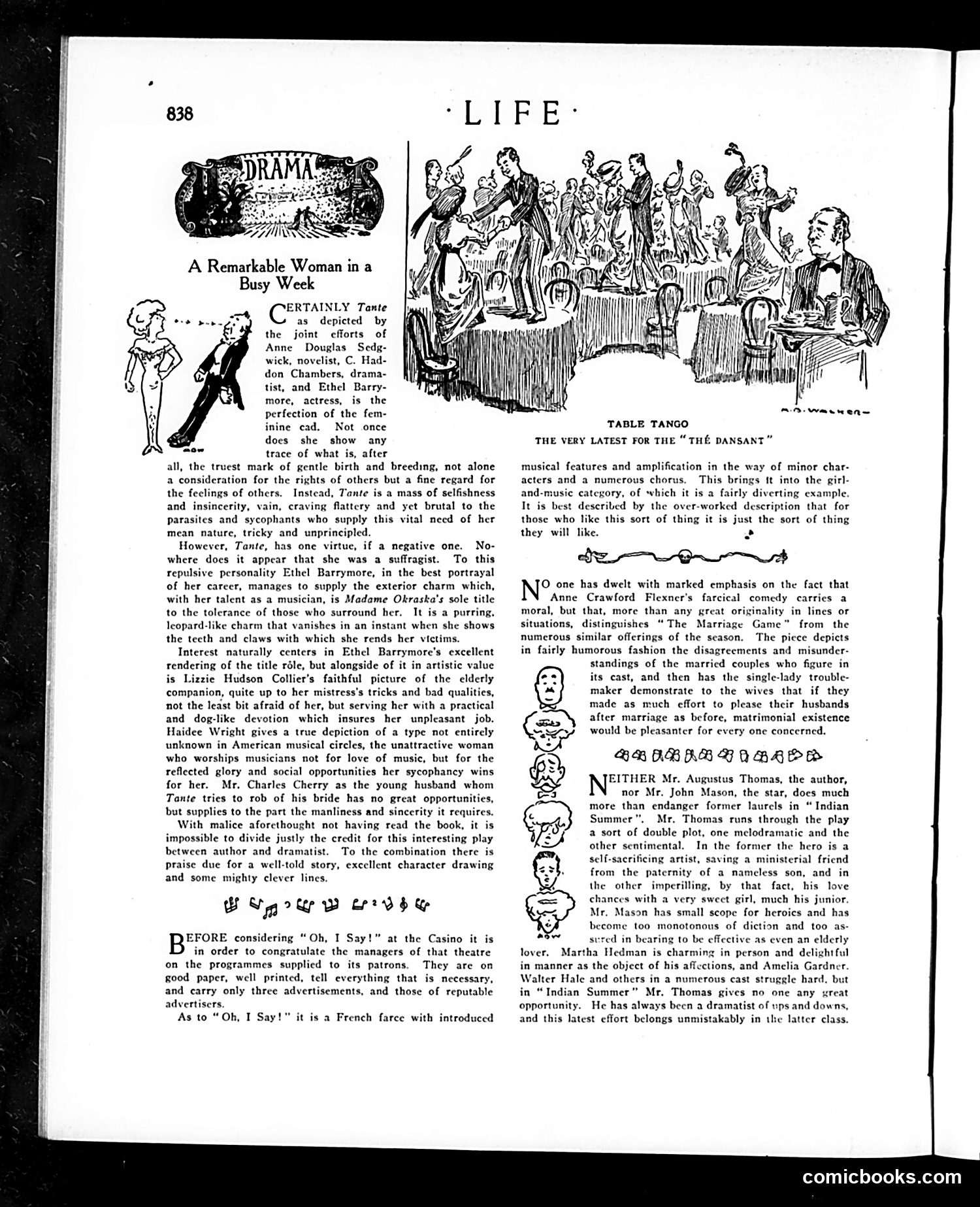
This page contains drama reviews from *Life* magazine's theater section. The main content critiques three Broadway productions: **"Tante"** features actress Ethel Barrymore in a play about a selfish, manipulative society woman—a "feminine cad" who charms others while exploiting them ruthlessly. The reviewer notes approvingly that the character is *not* a suffragist, suggesting contemporary anxiety about women's rights activism. Barrymore's performance is praised for conveying the character's predatory "leopard-like charm." **"Oh, I Say!"** is dismissed as a French farce with musical numbers—entertaining enough for those who enjoy such lightweight fare. **"The Marriage Game"** is a comedy about marital discord, where a single woman demonstrates to wives that maintaining pre-marriage effort keeps husbands happy—a conventional message about women's domestic duty. The illustration "Table Tango" shows a fashionable tea dance, reflecting the era's social scene. Overall, the page reflects early 20th-century theatrical culture and period attitudes toward women, marriage, and feminism.
📄 Transcribed text from this page (OCR, searchable)
Machine-transcribed from the original scan — historical spelling and the odd misread are preserved.
A Remarkable Woman in a Busy Week ERTAINLY Tante as depicted by the joint efforts of Anne Douglas Sedg- wick, novelist, C. Had- don Chambers, drama- tist, and Ethel Barry- more, actress, is the perfection of the fem- inine cad. Not once does she show any trace of what is, after all, the truest mark of gentle birth and breeding, not alone a consideration for the rights of others but a fine regard for the feelings of others. Instead, Tante is a mass of selfishness and insincerity, vain, craving flattery and yet brutal to the parasites and sycophants who supply this vital need of her mean nature, tricky and unprincipled. However, Tante, has one virtue, if a negative one. No- where docs it appear that she was a suffragist. To this repulsive personality Ethel Barrymore, in the best portrayal of her career, manages to supply the exterior charm which, with her talent as a musician, is Madame Okraska's sole title to the tolerance of those who surround her. It is a purring, lcopard-like charm that vanishes in an instant when she shows the tecth and claws with which she rends her victims. Interest naturally centers in Ethel Barrymore's excellent rendering of the title réle, but alongside of it in artistic value is Lizzie Hudson Collier's faithful picture of the elderly companion, quite up to her mistress’s tricks and bad qualities, not the least bit afraid of her, but serving her with a practical and dog-like devotion which insures her unpleasant job. Haidee Wright gives a true depiction of a type not entirely unknown in American musical circles, the unattractive woman who worships musicians not for love of music, but for the reflected glory and social opportunities her sycophancy wins for her. Mr, Charles Cherry as the young husband whom Tante tries to rob of his bride has no great opportunities, but supplies to the part the manliness and sincerity it requires. With malice aforcthought not having read the book, it is impossible to divide justly the credit for this interesting play between author and dramatist. To the combination there is praise due for a well-told story, excellent character drawing and some mighty clever lines. BVgrew ove EFORE considering “Oh, I Say!” at the Casino it is in order to congratulate the managers of that theatre on the programmes supplied to its patrons. They are on good paper, well printed, tell everything that is necessary, and carry only three advertisements, and those of reputable advertisers. As to “Oh, I Say!" it is a French farce with introduced i iii Mt TABLE TANGO THE VERY LATEST FOR THE “ THE DANSANT” musical features and amplification in the way of minor char- acters and a numerous chorus. This brings ft into the girl- and-music category, of which it is a fairly diverting example. It is best described by the over-worked description that for those who like this sort of thing it is just the sort of thing they will like. ~ See Ot ‘O one has dwelt with marked emphasis on the fact that Anne Crawford Flexner's farcical comedy carries a moral, but that, more than any great originality in lines or situations, distinguishes “The Marriage Game” from the numerous similar offerings of the season. The piece depicts in fairly humorous fashion the disagreements and misunder- standings of the married couples who figure in its cast, and then has the single-lady trouble- maker demonstrate to the wives that if they made as much effort to please their husbands after marriage as before, matrimonial existence would be pleasanter for every one concerned. BRIBABBVIBHOR ITHER Mr. Augustus Thomas, the author, nor Mr. John Mason, the star, does much more than endanger former laurels in “Indian Summer", Mr, Thomas runs through the play a sort of double plot, one melodramatic and the other sentimental. In the former the hero is a self-sacrificing artist, saving a ministerial friend from the paternity of a nameless son, and in the other imperilling, by that fact, his love chances with a very swect girl, much his junior. Mr, Mason has small scope for heroics and has become too monotonous of diction and too as- sured in bearing to be effective as even an elderly lover, Martha Hedman is charming in person and delightful in manner as the object of his affections, and Amelia Gardner. Walter Hale and others in a numerous cast struggle hard. but in “Indian Summer” Mr. Thomas gives no one any xreat opportunity. He has always been a dramatist of ups and downs, and this latest effort belongs unmistakably in the latter class. comicbooks.com