
Life, 1913-11-13 · page 23 of 40
Life — November 13, 1913 — page 23: what you’re looking at
What you’re looking at
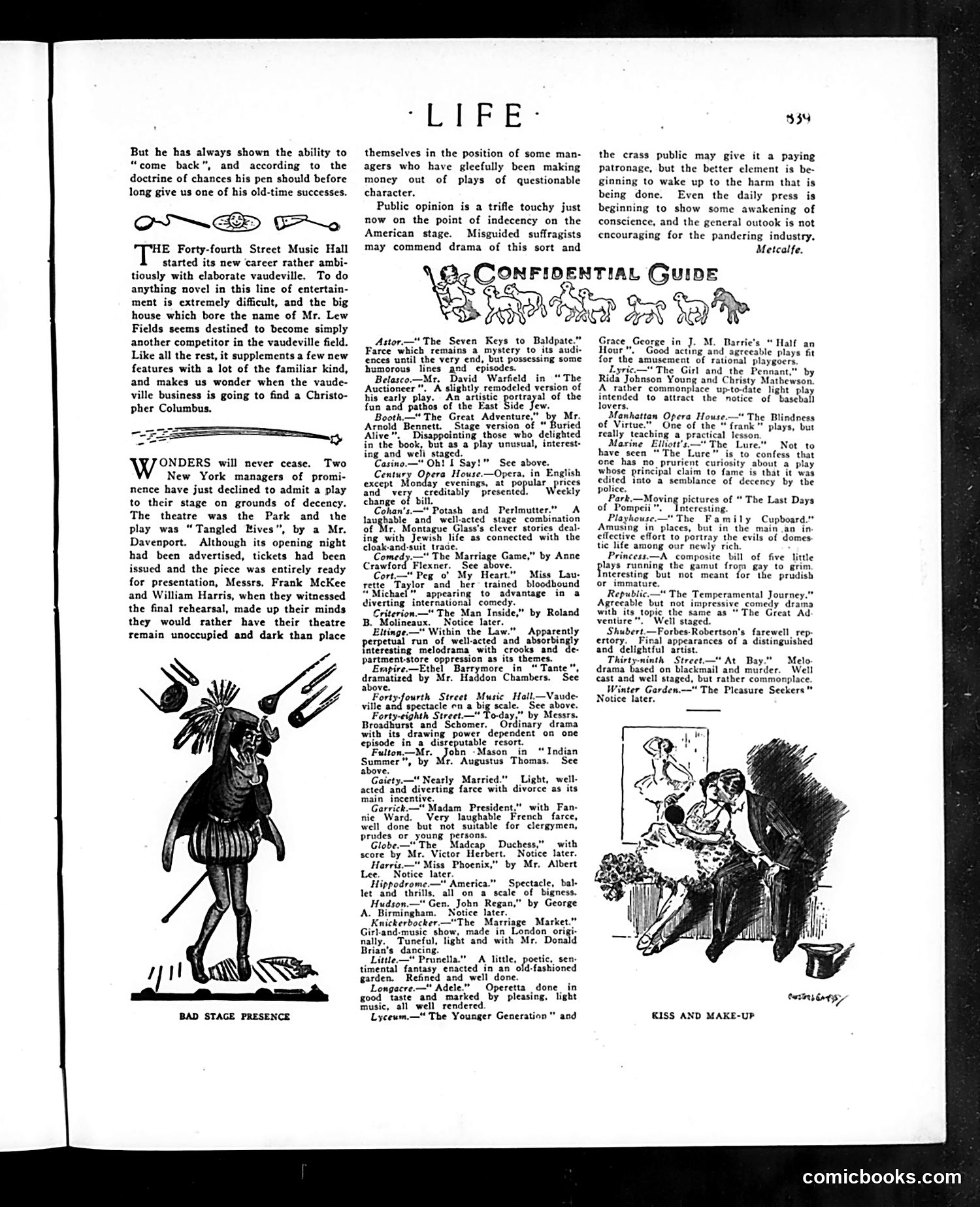
This page contains theatre criticism and listings, not political cartoons. The two illustrations—"Bad Stage Presence" (left) and "Kiss and Make-Up" (right)—are generic theatrical humor rather than specific satire. The main editorial content discusses theatre managers Frank McKee and William Harris rejecting a play called "Tangled Rivers" on moral grounds. The writer sarcastically notes this is unusual, as managers typically profit from indecent plays. The piece criticizes the "pandering industry" while praising the managers' decision, reflecting early 20th-century anxiety about stage morality and Progressive Era sensibilities around "decency." The bulk of the page comprises brief theatre reviews of current New York productions (Astor, Belasco, Booth, etc.), using coded abbreviations to indicate quality and content type. This was standard theatre journalism of the period.
📄 Transcribed text from this page (OCR, searchable)
Machine-transcribed from the original scan — historical spelling and the odd misread are preserved.
But he has always shown the ability to “come back”, and according to the doctrine of chances his pen should before long give us one of his old-time successes. ON ~ED | ~o IE Forty-fourth Street Music Hall started its new career rather ambi- tiously with elaborate vaudeville. To do anything novel in this line of entertain- ment is extremely difficult, and the big house which bore the name of Mr. Lew Fields seems destined to become simply another competitor in the vaudeville field. Like all the rest, it supplements a few new features with a lot of the familiar kind, and makes us wonder when the vaude- ville business is going to find a Christo- pher Columbus. ONDERS will never cease. Two New York managers of promi- nence have just declined to admit a play to their stage on grounds of decency. The theatre was the Park and the play was “Tangled Bives”, by a Mr. Davenport. Although its opening night had been advertised, tickets had been issued and the piece was entirely ready for presentation, Messrs. Frank McKee and William Harris, when they witnessed the final rehearsal, made up their minds they would rather have their theatre remain unoccupied and dark than place BAD STAGE PRESENCE a cll ci themselves in the position of some man- agers who have gleefully been making money out of plays of questionable character, Public opinion is a trifle touchy just now on the point of indecency on the American stage. Misguided suffragists may commend drama of this sort and 334 the crass public may give it a paying patronage, but the better element is be- ginning to wake up to the harm that is being done. Even the daily press is beginning to show some awakening of conscience, and the general outook is not encouraging for the pandering industry. Metcalfe. WES dee 6 Guioe SHS tLe S20 Sa Astor-—""The Seven Keys to Baldpate.” Faree which remains a mystery to its audi- fences until the very end, but possessing some humorous lines and episodes. Belasco.—Mr, David Warfield in “The Auctioneer”. A slightly remodeled version of his early play. An artistic portrayal of the fun and pathos of the East Side Jew. Booth—" The Great Adventure,” by Mr, Arnold Bennett, Stage version of “ Buried Alive", Disappointing those who delighted the book, but as a play unusual, interest- g_and well staged. Casino.—" Oh! I Say!” See above. Century Opera House.—Opera, in English except Monday evenings, at popular prices and. very creditably presented. Weekly change of bill. Cohan's.—" Potash and Perlmutter.” A laughable, and welliacted stage combination of Mr. Montague Glass’s clever stories deal- ing Jewish life as connected with the cloakand-suit trade, Comedy.—" The Marriage Game,” by Anne Crawford Flexner, See above, | Peg of My Heart.” Miss Lau- ‘aylor and her trained bloodhound appearing to advantage in a diverting international comedy. Criterion.—" The Man Inside,” by Roland B. “Molineaux. Notice later. Eltinge—" Within the Law." Apparently perpetual run of well acted and absorbingly Interesting melodrama with crooks and de- partment-store oppression as its themes. Empire.—Ethel Barrymore in “ Tante”, dramatized by Mr. Haddon Chambers. See above. Forty-fourth Street Music Hall.—Vaude- ville and spectacle on a big scale, See above. Forty-eighth Street—" To-day,” by Messrs. Broadhurst and Schomer. Ordinary drama with its drawing power dependent on one episode in a disreputable resort. Fulton.—Mr. Jobn «Mason _in Summer”, by Mr. Augustus Thomas. above. Nearly Married.” Light, well- Gaiety. acted and diverting farce with divorce as its “Indian See Madam President.” with Fan- Very laughable French farce, well done but not suitable for clergymen, prudes or young persons. ; Globe.— The Madcap Duchess," with score by Mr. Victor Herbert. Notice later. Herris.—" Miss Phoenix,” by Mr. Albert Lee. Notice later. Hippodrome.—" America.” Spectacle, bal- let and thrills, all on a scale of bigness. Hudson.—" Gen. John Regan,” by George A. Birmingham. Notice later. Knickerbocker—"The Marriage Market Girl-and-music show, made in London origi nally. Tuneful, light and with Mr. Donald Brian’s dancing. Prunella.” A little, poetic, sen: timental fantasy enacted in an old-fashioned garden. Refined and well done. Longacre.—" Adele.” Operetta done in good taste and marked by pleasing, light music, all well rendered. Lyceum.— The Younger Generation " and Grace, George in J. M. Marrie’s “Half an Hour", Good acting and agreeable plays fit for the amusement of rational playgoers Lyric.—" The Girl and the Pennant,” by Rida Johnson Young and Christy Mathewson. A rather commonplace up-to-date light pla intended to attract the notice of baseball lovers. Manhattan Opera House.—" The Blindness of Virtue.” One of the “frank” plays, but really teaching a, practical lesson Marine Ethott's—"The Lure.” Not to have seen “The Lure” is to confess that one has no prurient curiosity about a play whose principal claim to fame is that it was edited into a semblance of decency by the police. Park. —Moving pictures of “ The Last Days of Pompeii". Interesting Playhouse —" The Family Cupboard.” Amusing in places, but in the main an in, effective effort to portray the evils of domes. tic life among our newly rich. Princess.—A composite Lill of five little lays running the gamut from gay to grim nteresting but not meant for the prudish or immature. Republic.—* The Temperamental Journey.” Agreeable but not impressive comedy drama with its, topic the same as “The Great Ad. venture”. Well staged. Shubert.—Forbes-Robertson's farewell rep- ertory. Final appearances of a distinguished and delightful artist. Thirty-ninth Street,—" At Bay." Melo. drama based on blackmail and murder. Well cast and well staged, but rather commonplace. Winter Garden.—" The Pleasure Seekers" Notice later. KISS AND MAKE-UP comicbooks.com