
A complete issue · 40 pages · 1913
Life — October 23, 1913
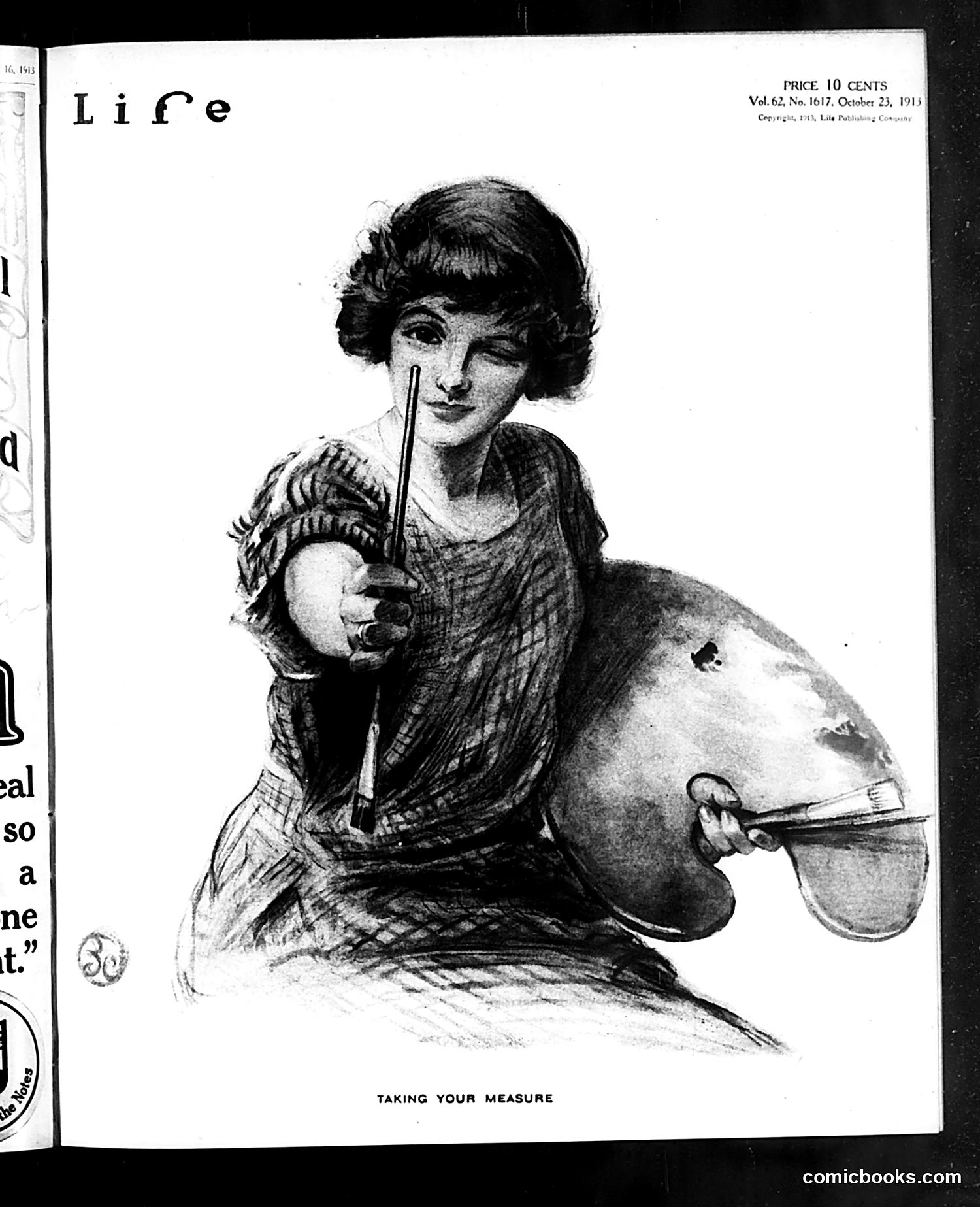
This October 23, 1913 Life magazine cover uses a double entendre. The illustration shows a woman artist holding both a paintbrush and a measuring tool (palette or gauge), apparently "taking the measure" of a subject—both literally measuring dimensions and figuratively assessing or evaluating someone's character or worth. The title plays on the phrase "taking someone's measure," meaning to form a judgment about them. Given Life's satirical nature and the era's gender commentary, this likely comments on women's emerging roles as professional artists and judges of taste or quality, a relatively novel concept in early 20th-century America. The woman's confident pose suggests she's claiming authority in artistic and critical spheres traditionally dominated by men.
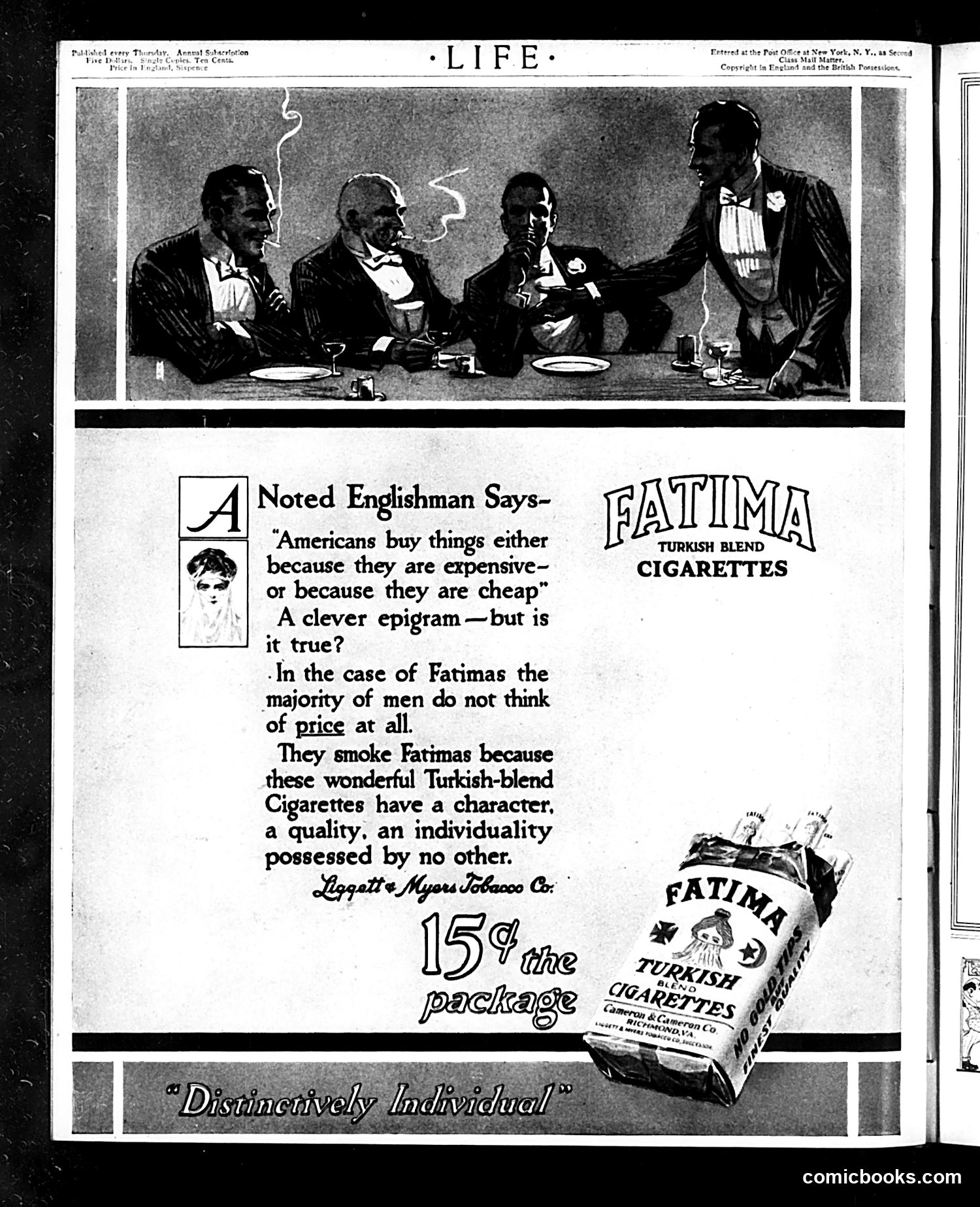
This page is primarily a **Fatima cigarette advertisement** rather than political satire. The upper illustration shows five formally dressed men at what appears to be a formal dinner, engaged in conversation—a scene designed to associate the product with sophistication and upper-class leisure. The ad quotes a "Noted Englishman" making an observation about American consumer behavior: people buy things either because they're expensive or cheap. The advertiser then claims Fatima cigarettes are purchased for neither reason, but rather for their distinctive "character" and "quality." The tagline "Distinctively Individual" emphasizes the product's supposed uniqueness. At 15¢ per package, this appears positioned as a mid-range, quality product. The overall message targets affluent male consumers seeking refined taste and sophistication.
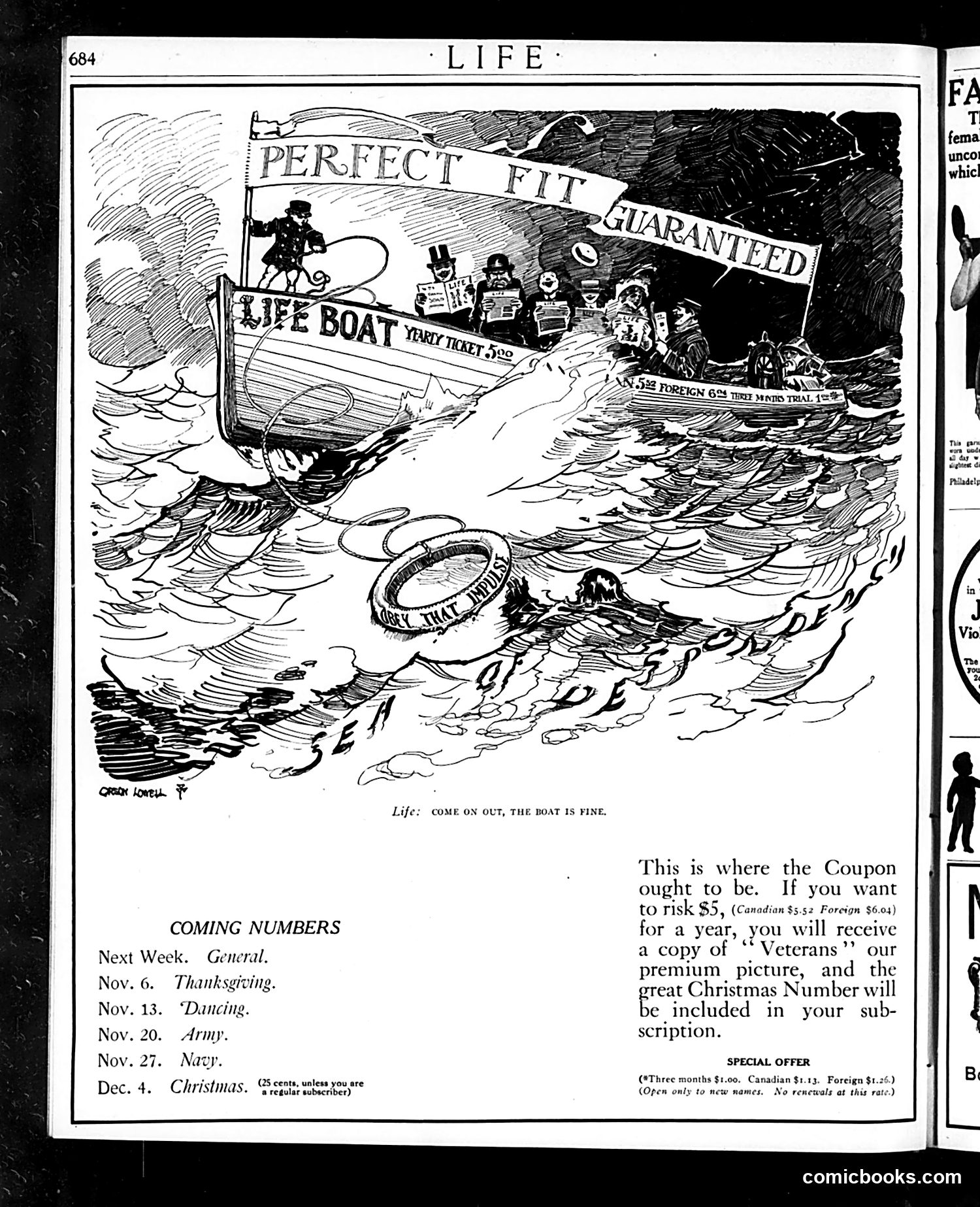
This cartoon satirizes consumer safety and product guarantees. A "Life Boat" advertises "Perfect Fit Guaranteed," but the vessel is clearly sinking in stormy seas while passengers cling aboard. A life preserver floats uselessly nearby—the guarantee itself provides no actual protection. The joke targets companies making bold safety or quality promises that prove worthless when tested. The irony is sharp: a lifeboat, the ultimate safety device, is failing despite its guarantee. The figure at the mast waves the "Perfect Fit Guaranteed" banner defiantly even as the boat goes down. This reflects early-20th-century consumer skepticism about false advertising and unreliable products—a timeless concern. The cartoon mocks businesses prioritizing marketing claims over actual reliability.
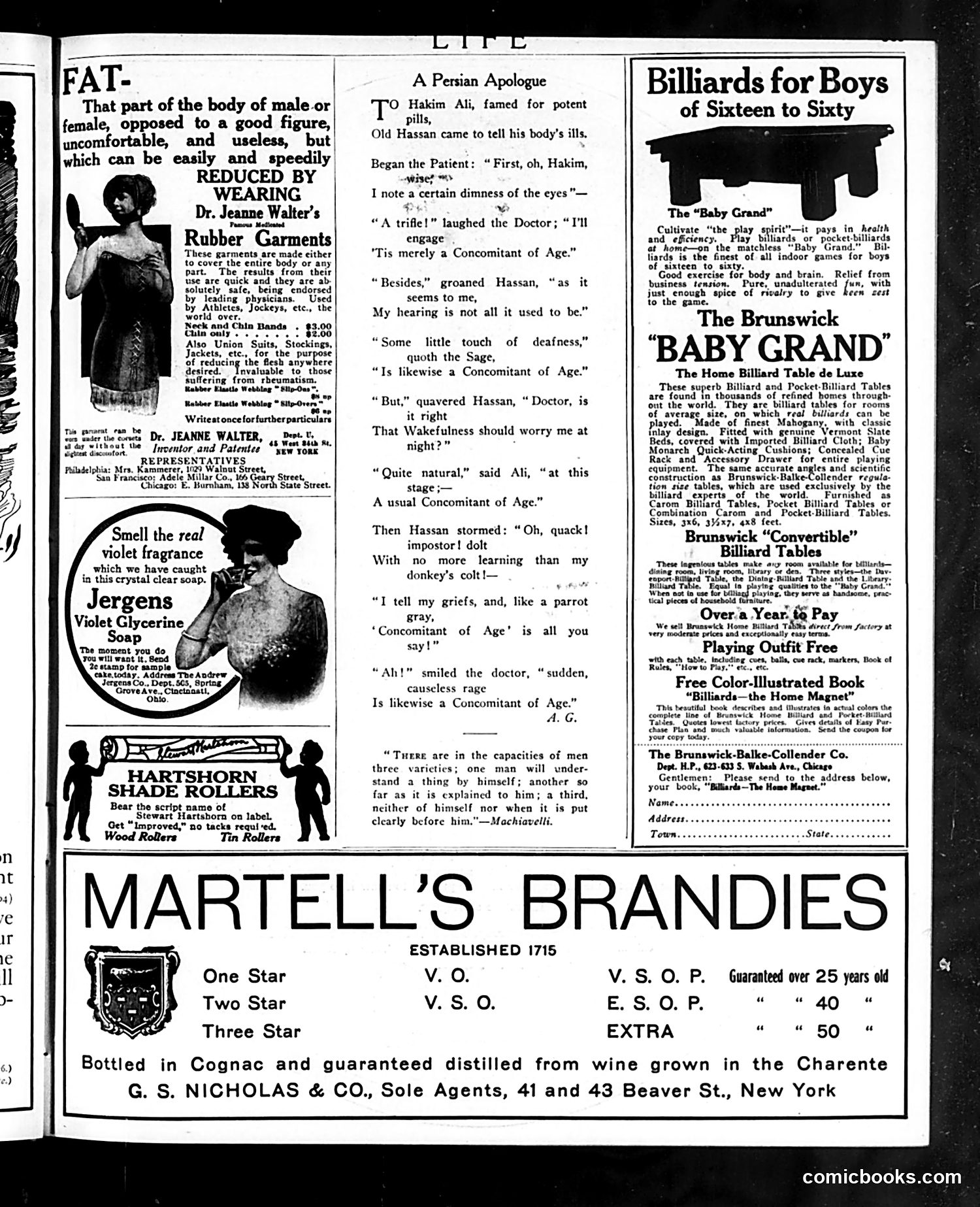
This page is primarily **advertising**, not political satire. It contains: 1. **Dr. Naylor's Rubber Garments** — fat-reduction wear (a weight-loss product) 2. **Jergens Violet Glycerine** — fragrance advertisement 3. **Hartshorn Shade Rollers** — window covering ads 4. **"A Persian Apologue"** — a short satirical story about Hakim Ali consulting a doctor about age-related ailments (dimming eyes, hearing loss, deafness). The joke: the doctor dismisses these complaints as normal aging ("Concomitant of Age") 5. **Billiards for Boys** — "Baby Grand" pool table advertisement 6. **Martell's Brandies** — liquor advertisement The Persian tale is the only satirical content: it gently mocks how we blame age for inevitable physical decline. Otherwise, this is a vintage magazine page selling consumer products typical of the early 20th century.
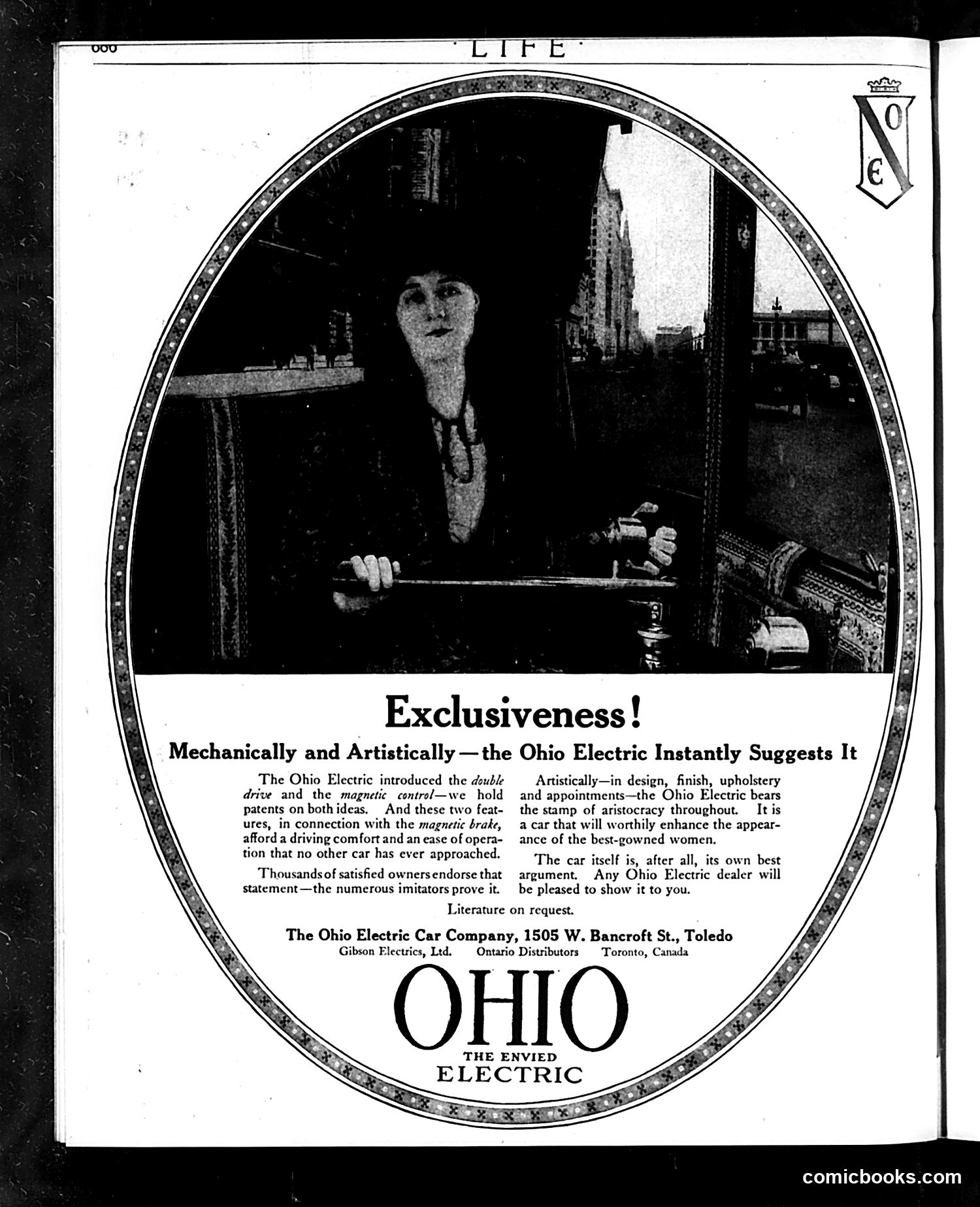
This is primarily a **product advertisement**, not political satire. The Ohio Electric Car Company is marketing their "Ohio" brand electric automobile to women, emphasizing "exclusiveness" through two patented features: a "double drive" and "magnetic control." The image shows a well-dressed woman operating the vehicle, positioned to appeal to female consumers. The ad emphasizes mechanical sophistication and ease of operation—key selling points for early automobiles marketed to women, who were often considered the primary market for electric cars (seen as safer and easier to drive than gasoline vehicles). The text stresses that "thousands of satisfied owners endorse" the product, using social proof to build credibility. This reflects early-1900s automotive advertising targeting middle and upper-class women as buyers or decision-makers.
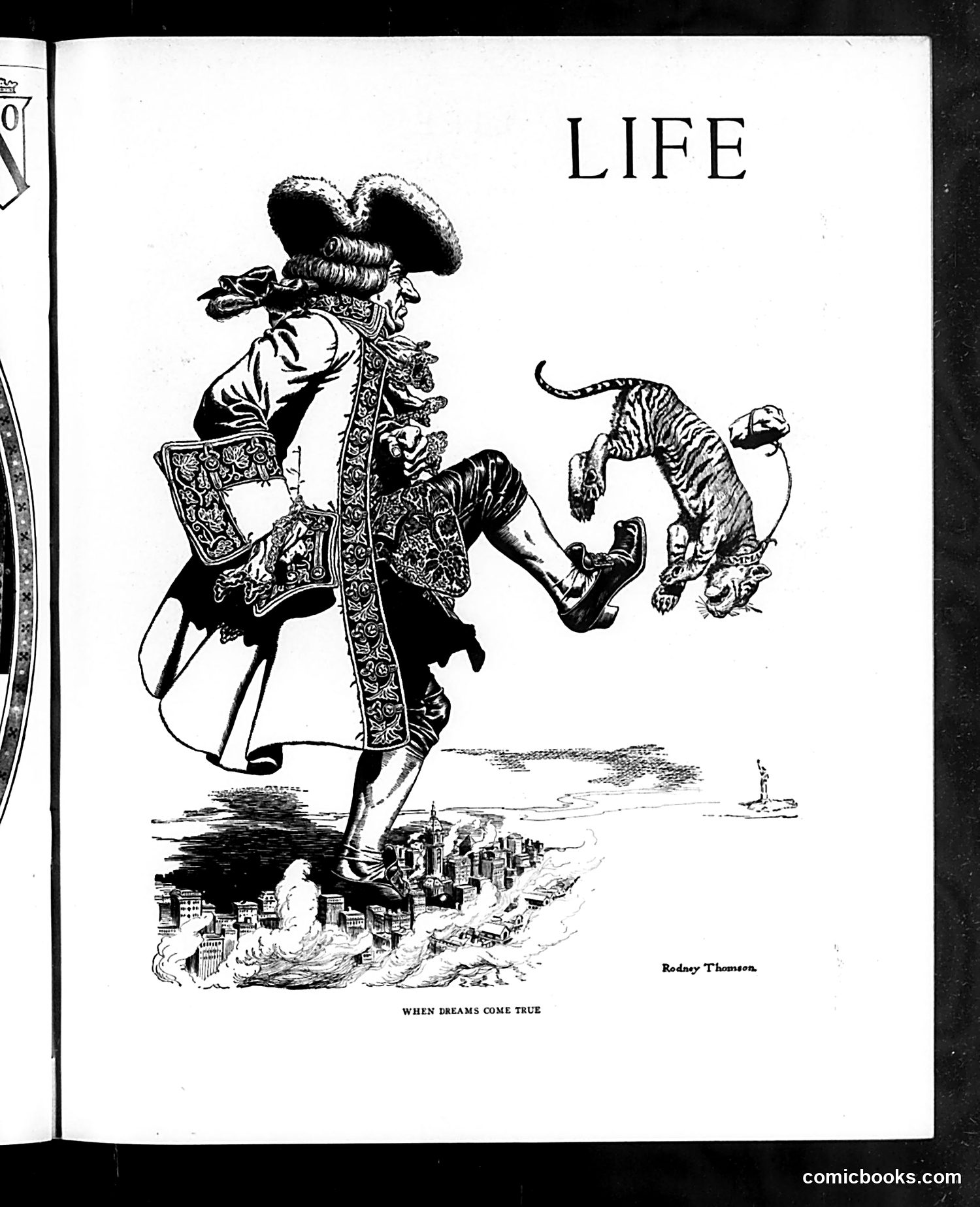
This *Life* magazine cover illustrates a figure in ornate 18th-century aristocratic dress (tricorn hat, embroidered coat) standing giant-like over a cityscape, holding what appears to be a monkey or small creature on a leash. The caption "When Dreams Come True" suggests satire about ambition or delusion. The elaborate costume and exaggerated scale likely mock pretensions to power or grandeur. The monkey may represent foolishness or base nature accompanying the figure's inflated ambitions. The composition—a pompous character looming over civilization—suggests commentary on ego, tyranny, or the danger of unchecked vanity. Without additional context about the publication date, the specific target remains unclear, though the satire targets human folly and inflated self-importance.
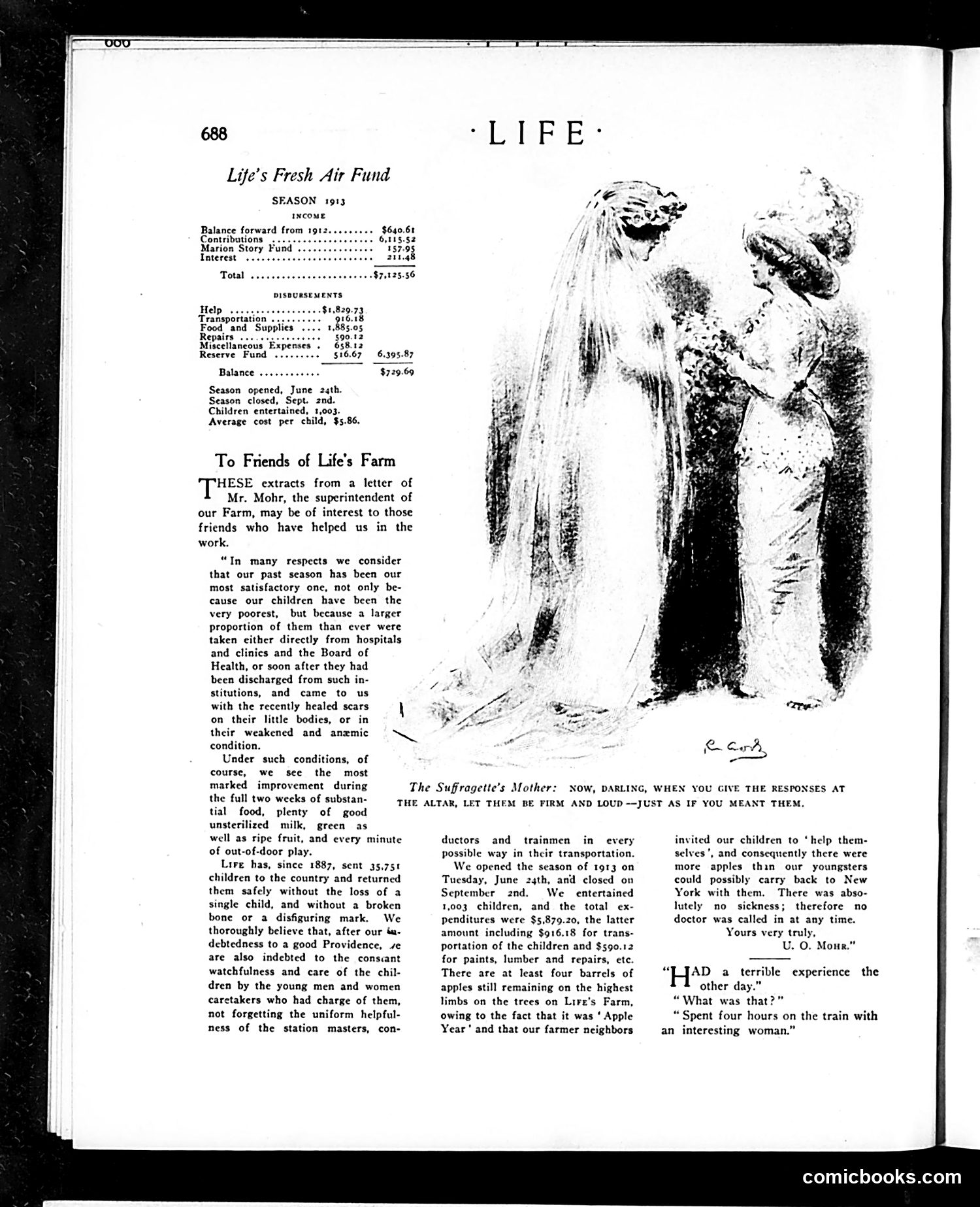
This page from *Life* magazine (1913) documents the "Fresh Air Fund," a charitable program sending urban children to the countryside for health and recuperation. The financial statement shows the fund raised $7,215.36 that season. The illustration depicts two figures—likely a mother and child in worn clothing—representing the urban poor who benefited from the program. The caption "The Suffragette's Mother" appears to reference women's suffrage activism, suggesting a social connection between progressive causes and charitable work. The accompanying text from the farm superintendent praises the program's success, noting improved health outcomes for over 1,000 children. The anecdotal dialogue at page's end ("Had a terrible experience the other day") suggests the lighthearted, human-interest tone *Life* used to promote charitable giving among its readership.
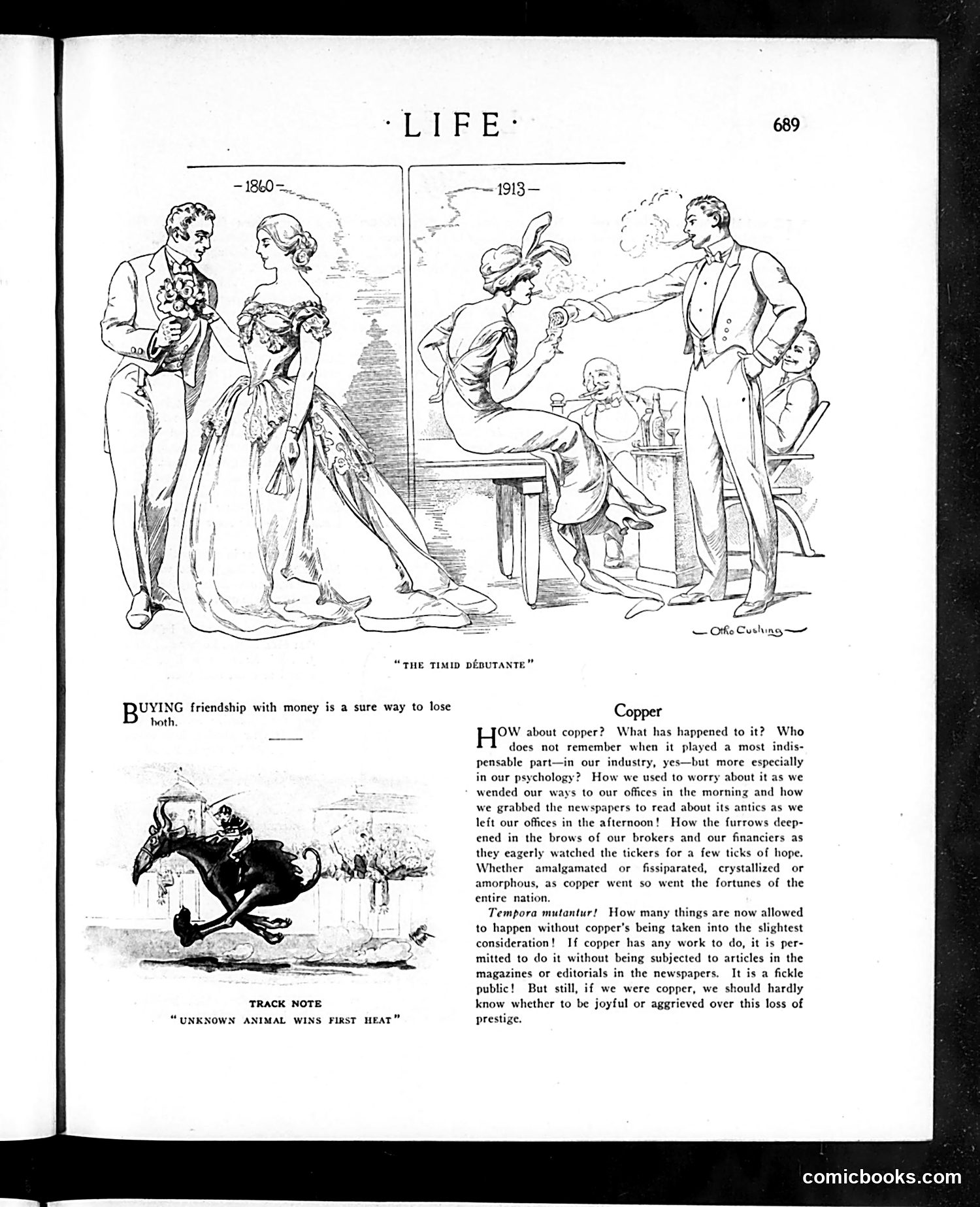
**Top Cartoon ("The Timid Débutante"):** Contrasts 1860 and 1913 social behavior. The left panel shows a formal, modest interaction between a young woman and man. The right panel depicts the same scenario in 1913 with more relaxed propriety—the woman is seated casually while men gesture freely around her. This satirizes how rapidly social conventions changed in the early 20th century, particularly regarding women's freedom and comportment. **Bottom Section:** An essay titled "Copper" laments copper's loss of cultural prominence in American business and psychology. The accompanying cartoon ("Unknown Animal Wins First Heat") shows a chaotic racing scene, sarcastically commenting on how copper's absence from public discourse means it's now forgotten—even displaced by "unknown" concerns in national attention.
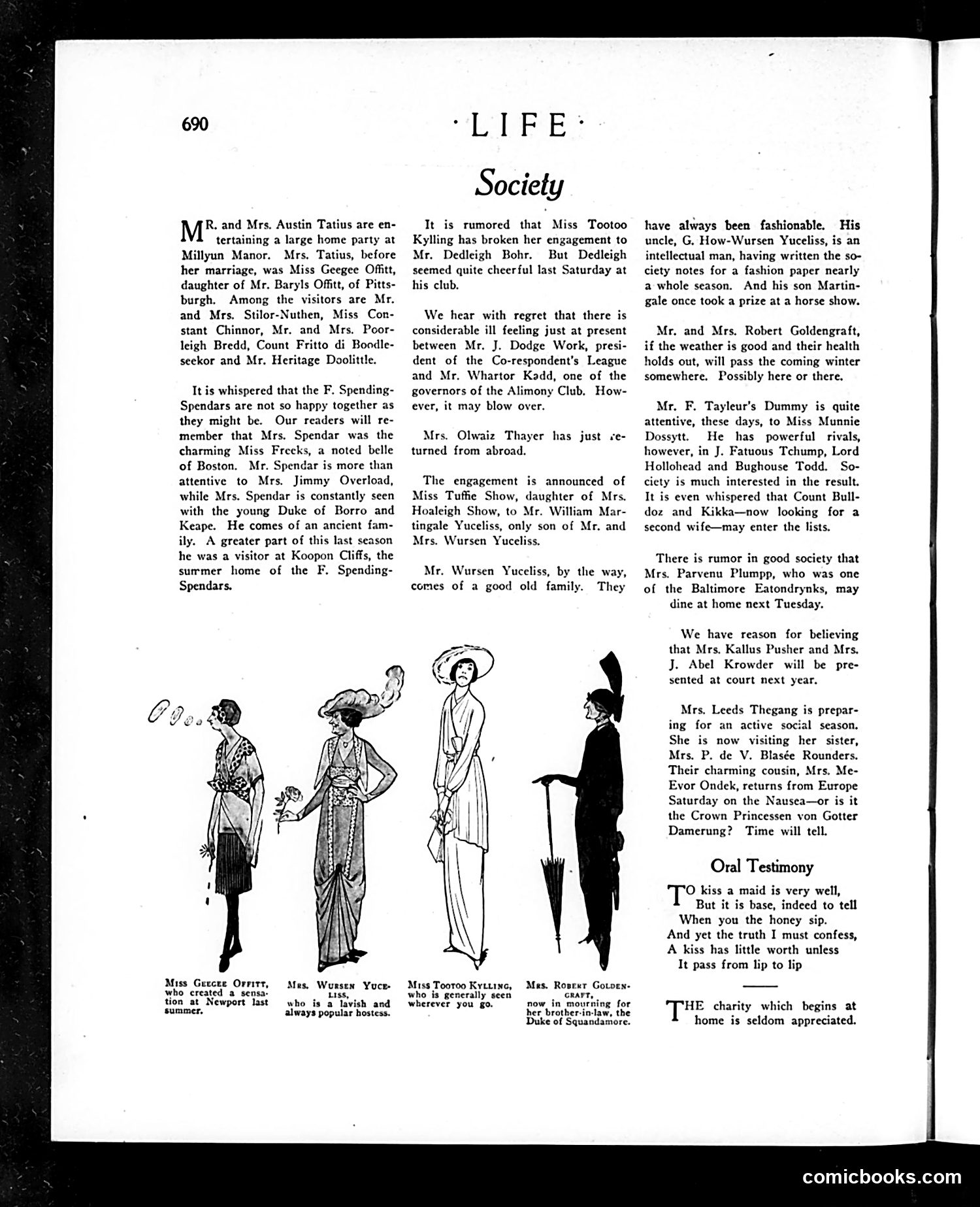
This is a "Society" gossip column page from Life magazine, featuring illustrated fashion commentary rather than political satire. The four illustrated figures showcase 1920s women's fashion styles with captions identifying them by name and social status: - Miss Geese Offitt (described as creating a sensation) - Mrs. Wursen Yuceliss (noted as a Jewish hostess, always popular) - Miss Tootoo Kylling (generally seen wherever you go) - Mrs. Robert Goldengraft (now lounging for her brother-in-law, the Duke of Squadnamere) The accompanying text discusses high-society gossip—engagements, travels, and social gatherings of wealthy New York families. The satire targets upper-class pretension and fashion obsession rather than politics. The illustration style mocks exaggerated 1920s fashion silhouettes and society's fixation on appearance and social hierarchy.
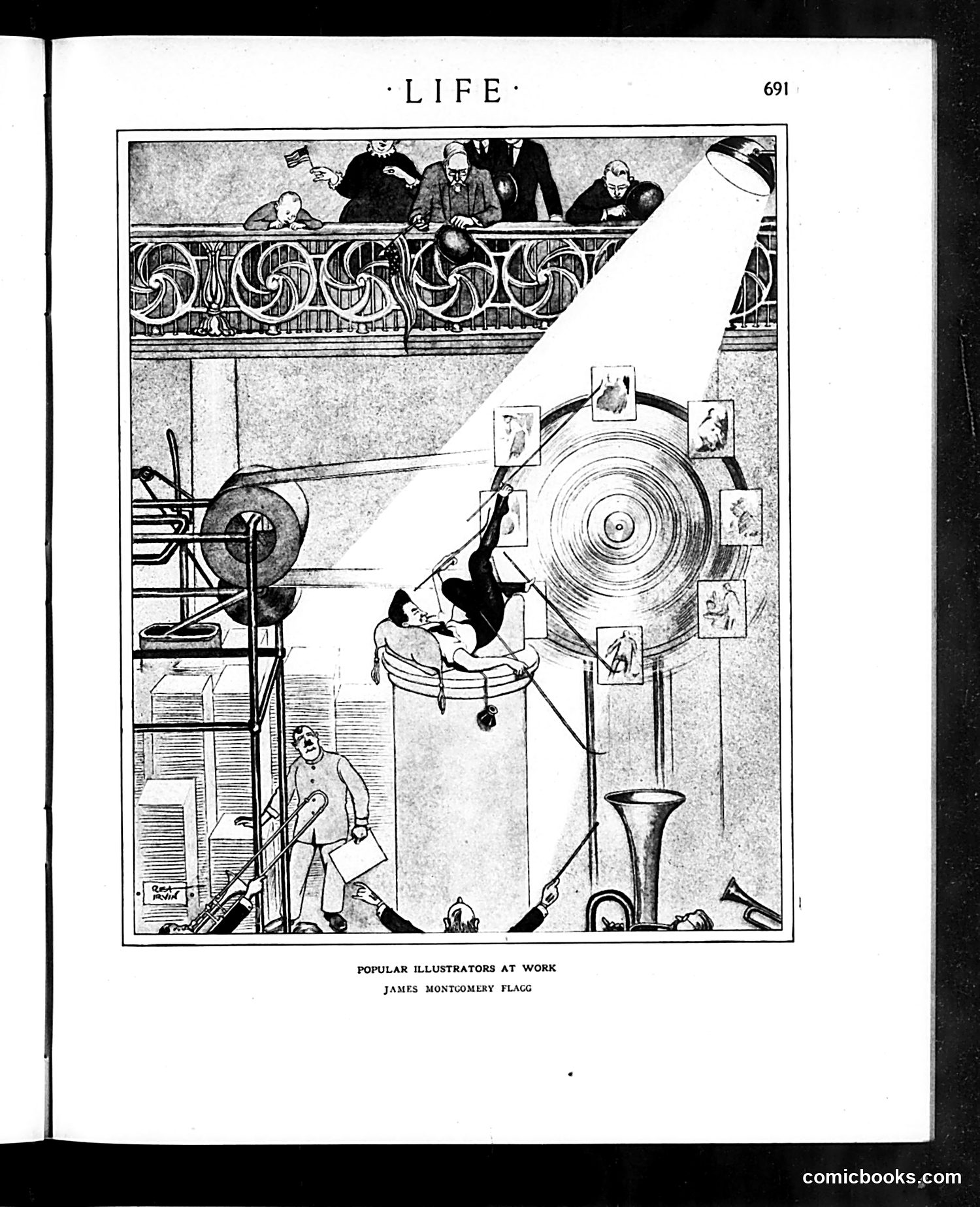
This page showcases an illustration by James Montgomery Flagg titled "Popular Illustrators at Work." The image depicts an artist's studio as a theatrical, fantastical space. A figure (likely representing Flagg or a generic illustrator) reclines in a chair at the center of an elaborate mechanical contraption—a massive wheel decorated with small sketches. Observers peer down from a railing above, treating the artist's creative process as public spectacle. The machinery, props, and staged drama suggest satire about the increasingly commercialized and performative nature of professional illustration in early 20th-century America. The work lampoons both the self-aggrandizement of popular illustrators and the public's fascination with artistic labor as entertainment, positioning creative work as mechanical and theatrical rather than genuinely inspired.
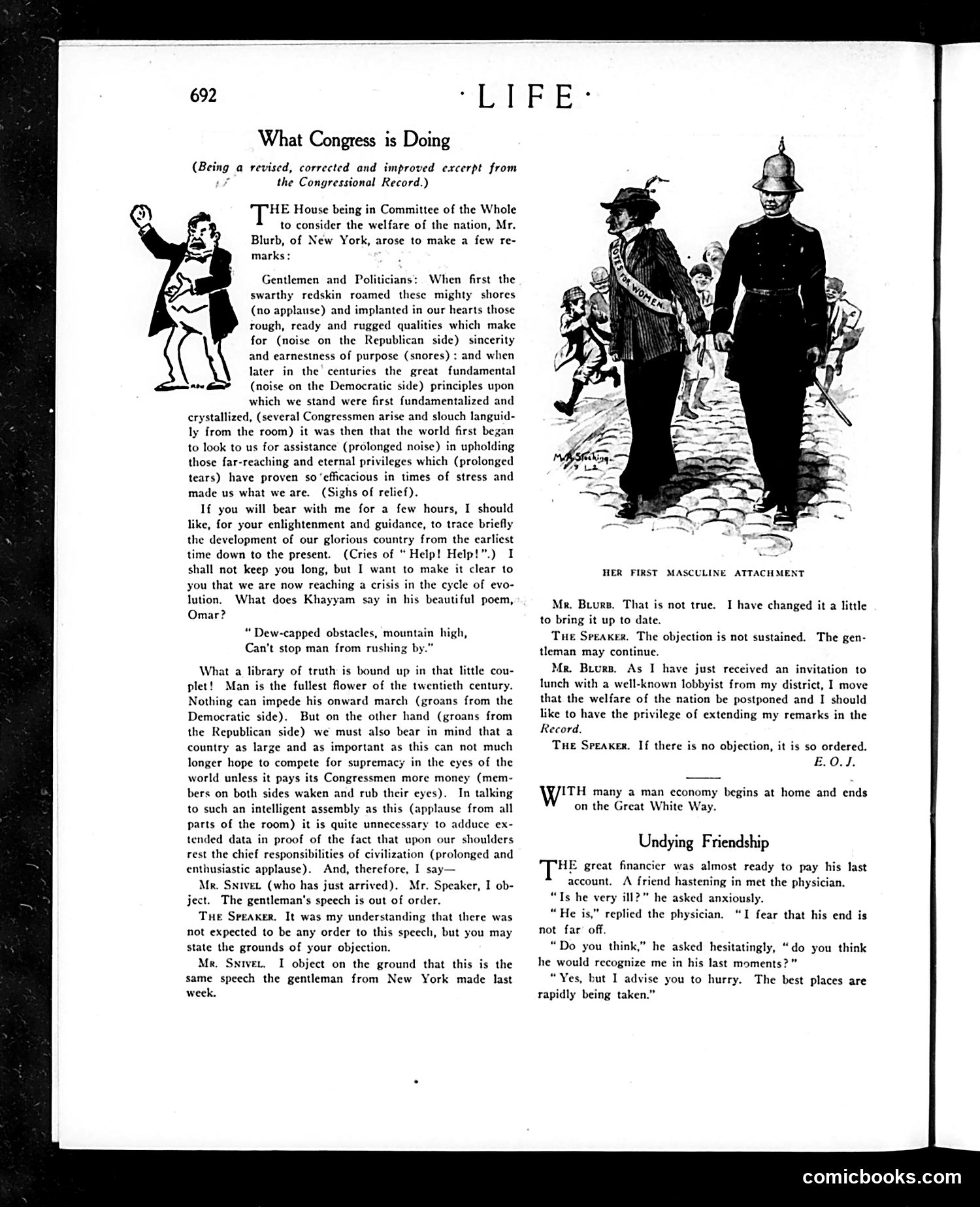
This page satirizes congressional debate. Mr. Blurb of New York speaks about American democratic principles, invoking the nation's foundational strengths. Ms. Snivelson objects that "this is the same speech the gentleman from New York made last week"—mocking repetitive, substance-free political rhetoric. The right cartoon, "Her First Masculine Attachment," shows a woman in formal dress between two men in military/official regalia, likely satirizing romantic or political entanglements. The caption suggests confusion about her "masculine attachment"—possibly mocking women's political participation or suffrage debates of the era by presenting serious civic involvement as equivalent to romantic infatuation. The cartoons together mock both political repetition and women's emerging public roles.
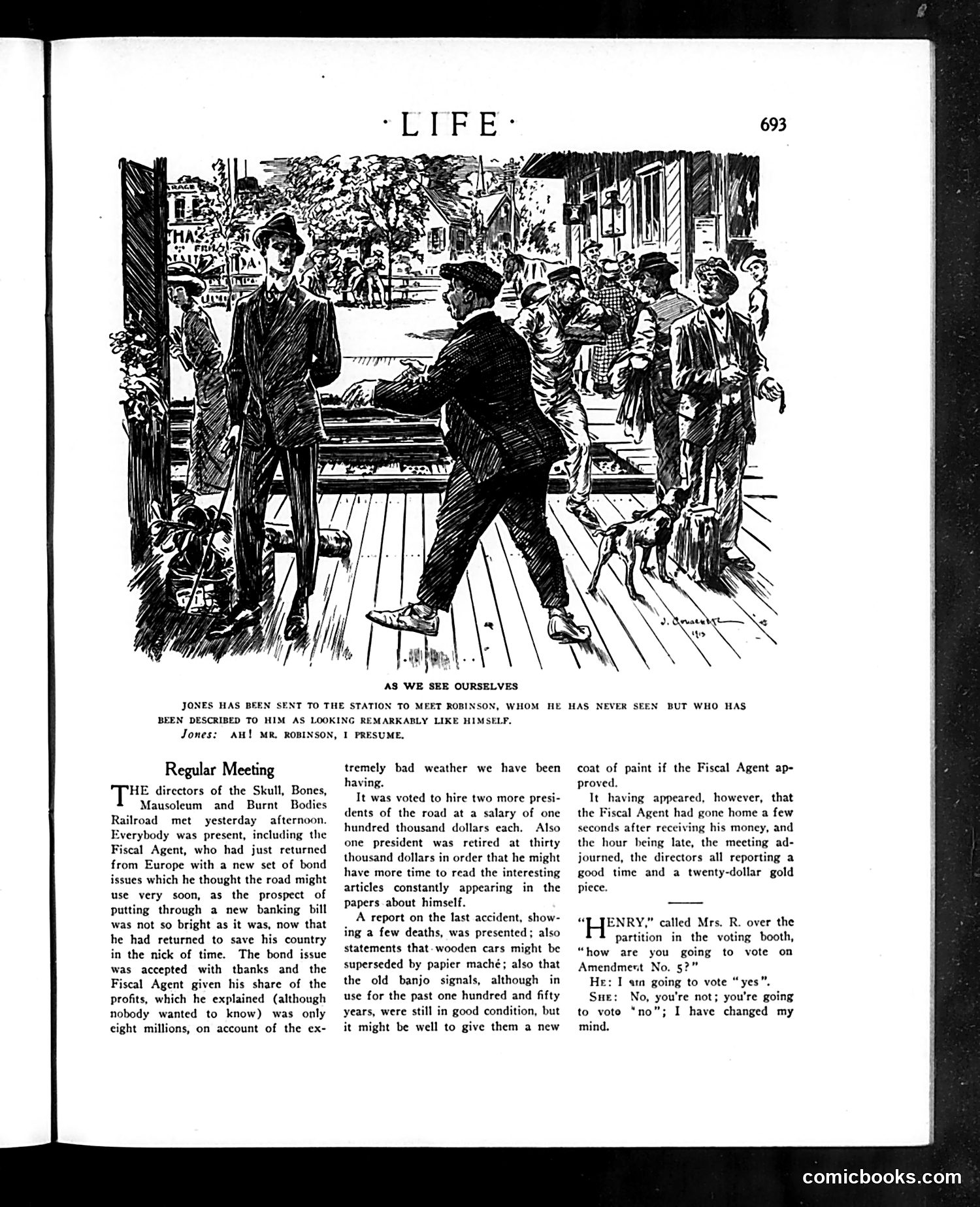
This page contains a satirical sketch titled "As We See Ourselves" depicting a station platform scene. The caption explains that Jones meets Robinson—whom he's never seen but who resembles him—at a train station, leading to the joke "Ah! Mr. Robinson, I presume." The cartoon mocks the human tendency toward self-recognition and vanity: meeting a stranger who supposedly looks like you. The sketch style is typical of Life's early editorial cartoons. Below this is a section titled "Regular Meeting" describing a meeting of railroad directors and a Fiscal Agent returning from Europe. It discusses hiring decisions, accident reports, and voting on Amendment No. 5, with a brief dialogue between Henry and his wife about changing his voting position. The page satirizes corporate bureaucracy and marital influence on political decisions.
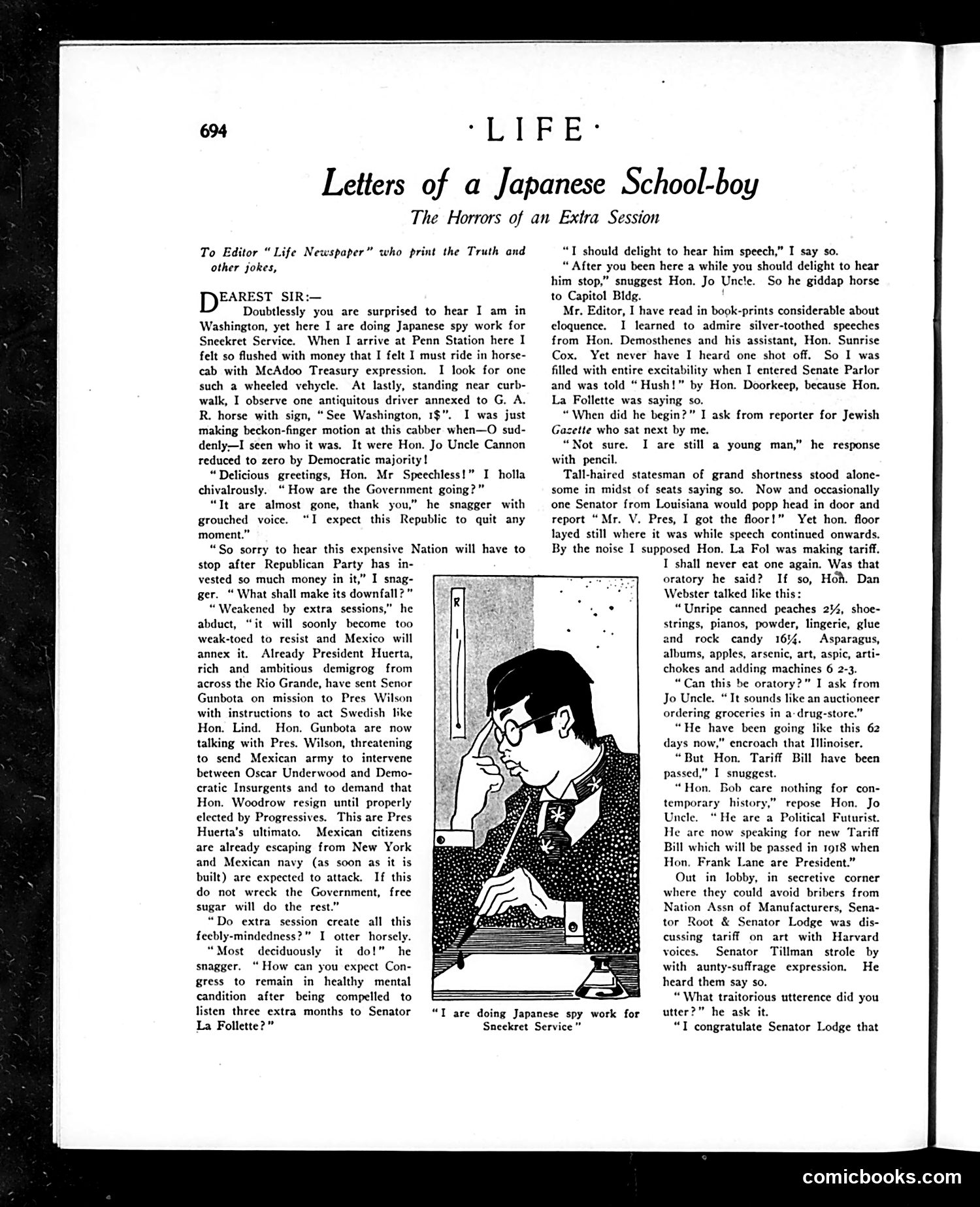
This satirical piece mocks American political figures and their incompetence during what appears to be a period of international tension. A Japanese schoolboy writes to Life's editor, claiming to conduct "Japanese spy work for Seeckret Service" while observing Washington politicians. The satire targets Republican leadership (President Huerta is mentioned), Democratic insurgents, and various senators for their ineptitude. References to Mexico, tariff bills, and suffrage debates situate this in the Progressive Era. The joke's core: American politicians are so chaotic and incompetent that a foreign spy can openly observe and report on their dysfunction without consequence. The illustration shows the "spy" at his desk, suggesting the humor of how easily intelligence could be gathered from America's obvious political disarray.
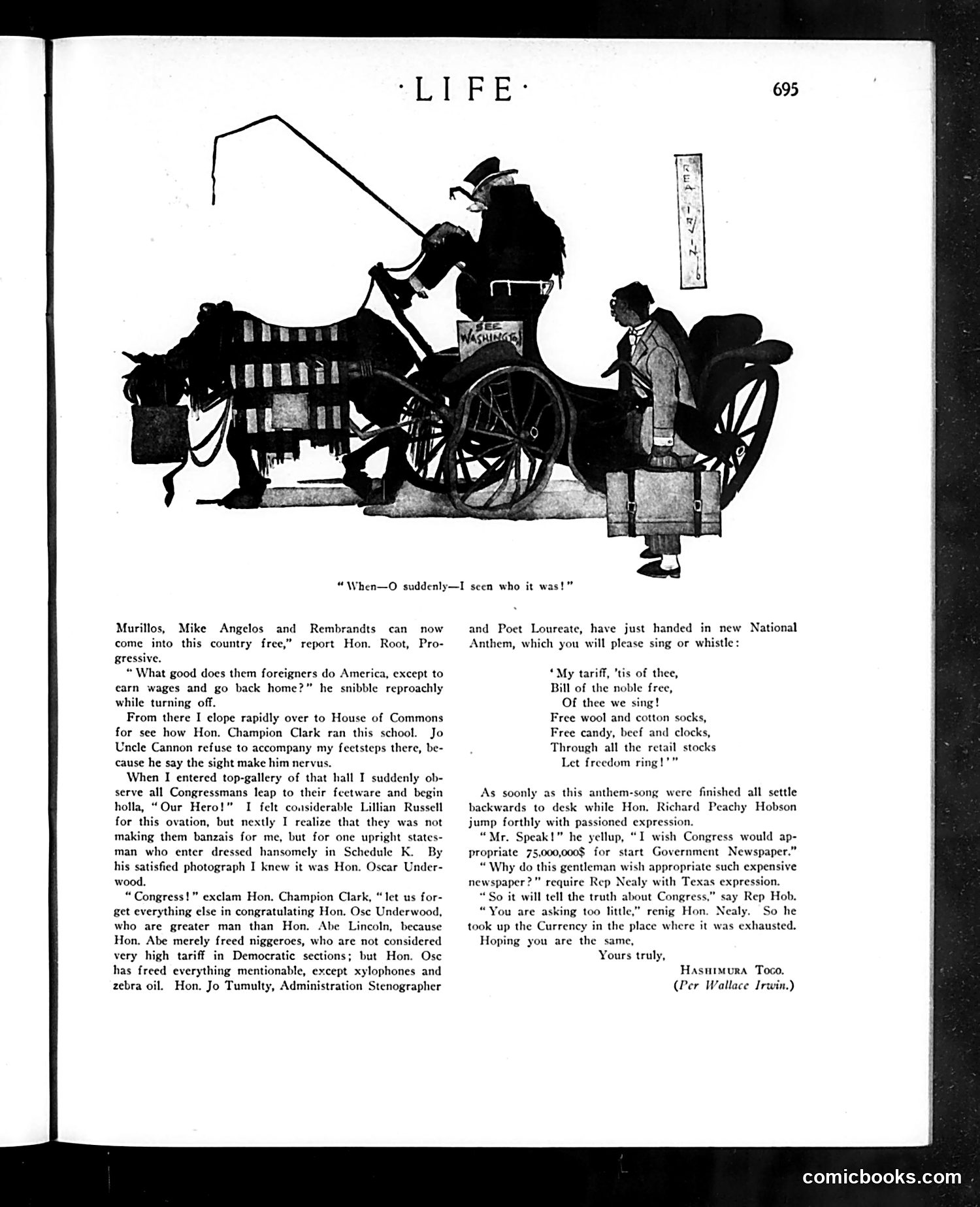
This is a satirical piece from Life magazine, written in deliberately fractured English (appearing to be attributed to "Hashimura Togo," a fictional Japanese character used for social commentary in this era). The cartoon mocks Congressional protectionism and hypocrisy. It depicts figures celebrating Hon. Oscar Underwood, apparently for supporting protective tariffs. The satire targets: 1. **Protectionist hypocrisy**: Politicians condemn foreign artists (Murillos, Michelangelos, Rembrandts) entering duty-free while supporting tariffs on goods, yet celebrate Underwood's tariff policies. 2. **Congressional absurdity**: A proposed $75,000,000 appropriation for a "Government Newspaper" to "tell the truth about Congress"—satirizing both government spending and press freedom concerns. 3. **Underwood's reputation**: He's portrayed as freeing "everything mentionable" through tariffs (contrasted with Lincoln freeing enslaved people)—suggesting tariff policy is treated as more consequential than abolition. The broken English device distances the commentary, allowing sharper political criticism under the guise of foreign observation.
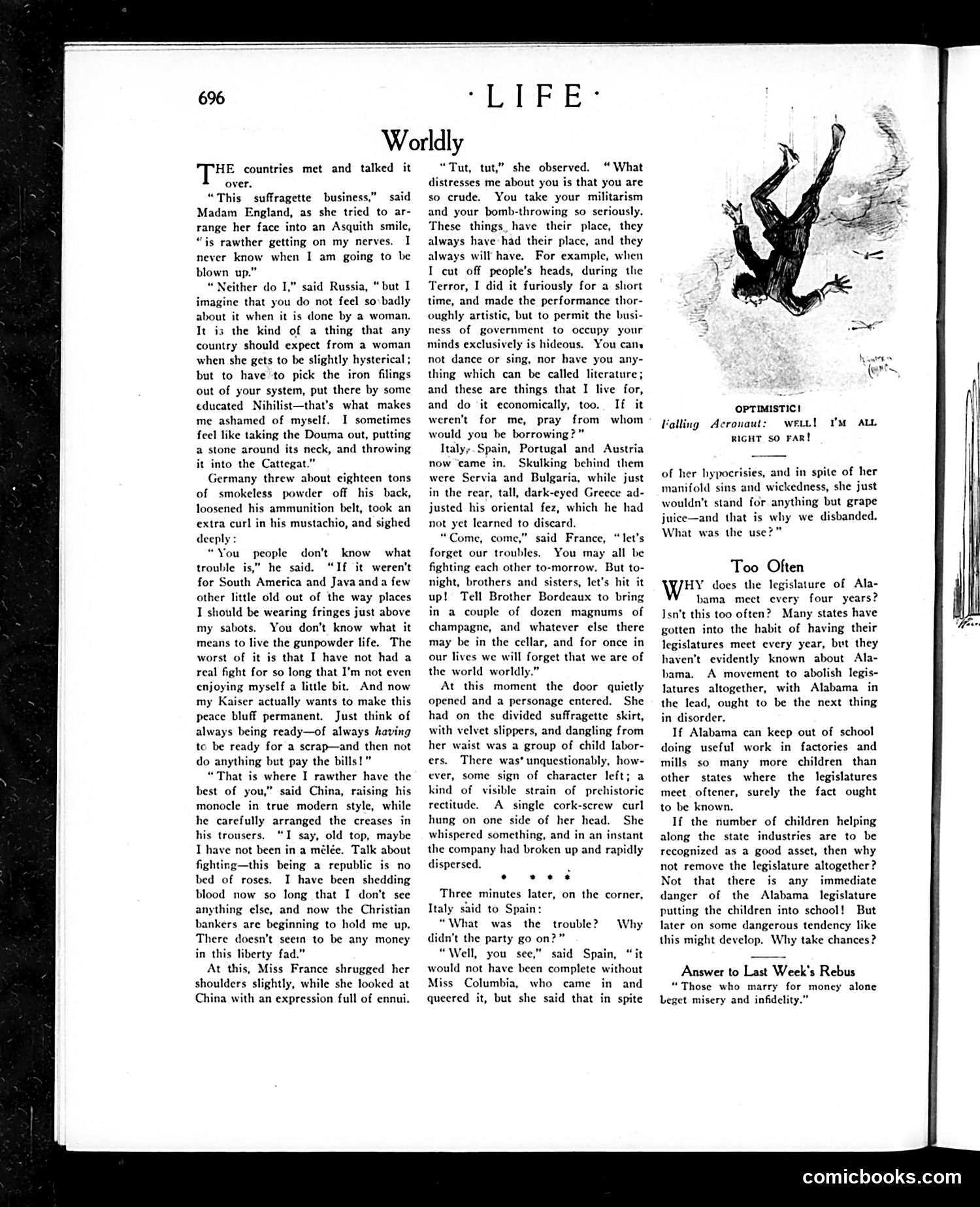
This cartoon depicts European nations (personified as people) meeting to discuss their troubles. England worries about suffragette bombings; Russia complains about Nihilist violence; Germany boasts of military readiness but laments lack of real warfare; China, newly republican, struggles with violence and debt; France adopts a superior, artistic pose while lecturing others on civilization. The satire targets pre-World War I geopolitical tensions: militarism, colonial rivalries, and instability. When a woman in a "divided suffragette skirt" suddenly enters with "child laborers" dangling from her waist, she interrupts their revelry—representing how women's suffrage activism and labor issues are disrupting the old political order these nations take for granted. The humor lies in depicting serious international conflicts through gossip-like banter between stereotyped national characters, while suffrage activism crashes their party as an unwelcome social force.
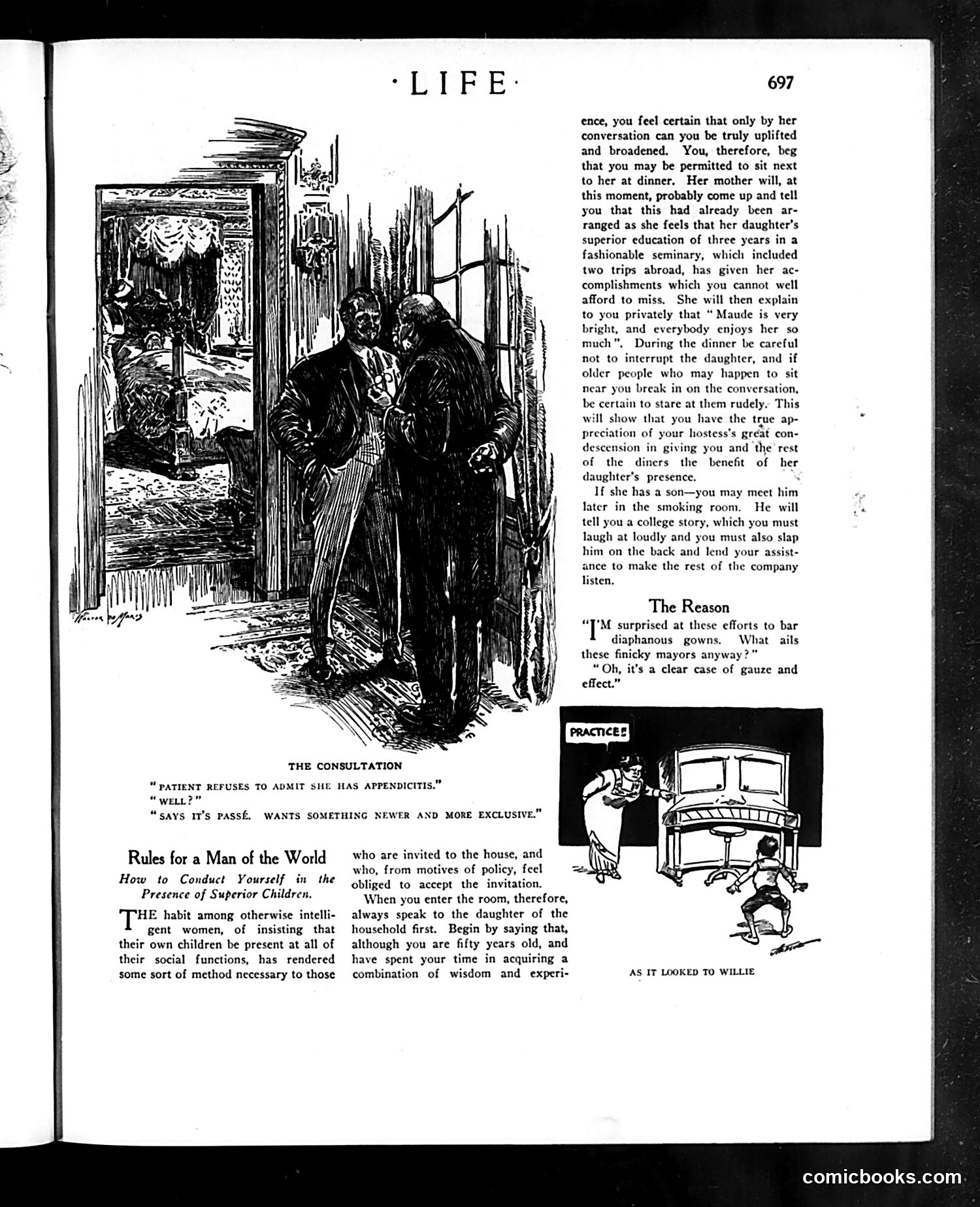
This page satirizes early 20th-century social etiquette and parenting trends. **"The Consultation"** cartoon mocks fashionable hypochondria: a woman refuses to claim she has appendicitis (a serious, potentially fatal condition before antibiotics) because it's "passé"—she wants a more exclusive, trendy illness. This ridicules both the wealthy's obsession with status and their trivializing of medical conditions. **"Rules for a Man of the World"** is satirical advice on navigating social situations where hosts insist their children attend adult gatherings. The humor lies in the exaggerated deference required: grown men must flatter teenage daughters about their "superior education" and three-year seminary training (including foreign trips), while ignoring actual adult conversation. The piece mocks both parental vanity and the social pressure to indulge it. **"The Reason"** puns on "gauze"/"gays"—mayors banning diaphanous (sheer) gowns for what appears to be moral reasons, but the joke suggests it's actually about optical illusion or visual effect rather than genuine moral concern.
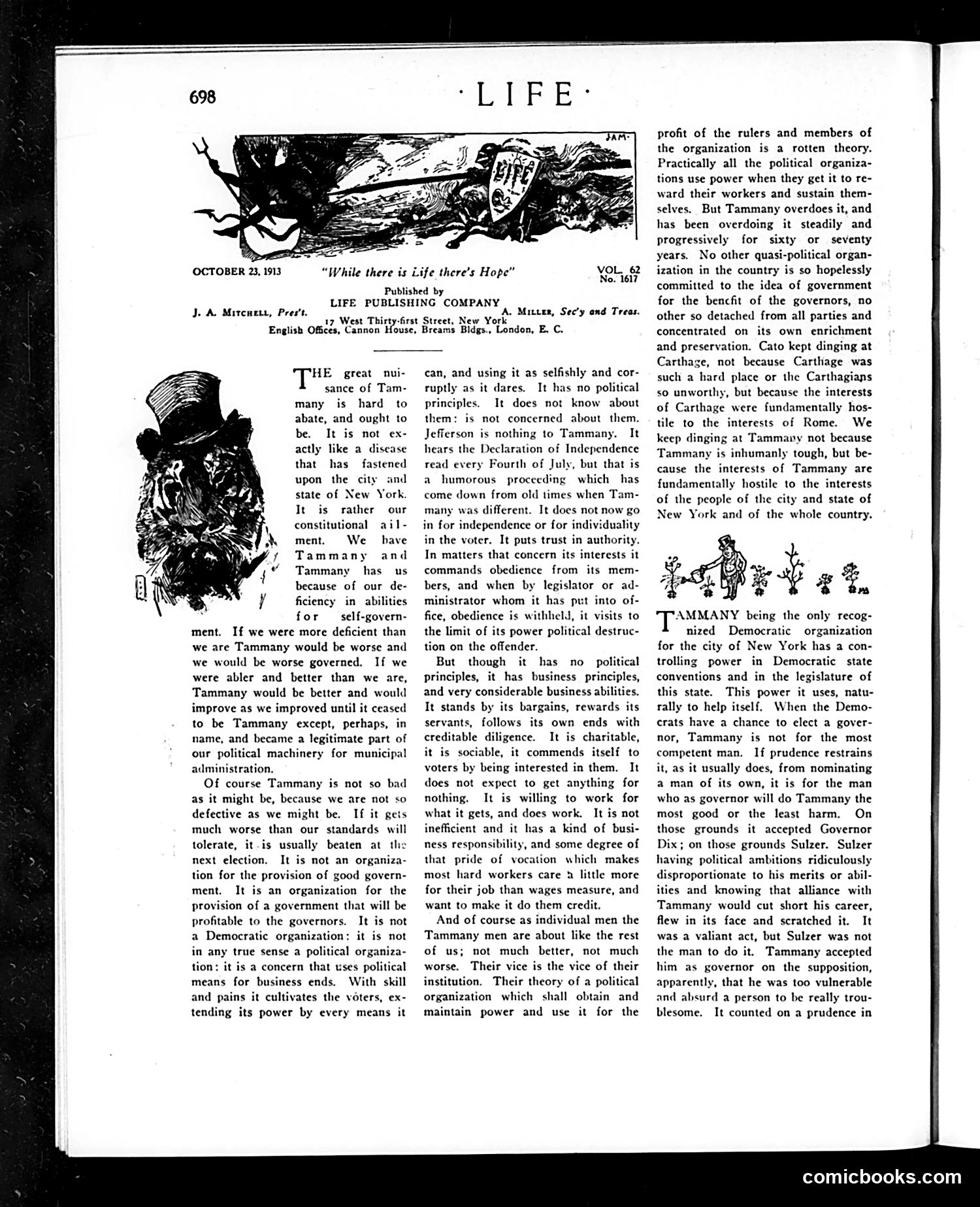
This is a critical essay about **Tammany Hall**, the Democratic political machine that controlled New York City politics. The carved head illustration (left) likely depicts a Tammany leader, shown as brutish and corrupt. The author argues Tammany isn't merely dishonest—it's fundamentally amoral. Unlike parties with ideological principles (referencing Jefferson and the Declaration), Tammany operates purely as a **business enterprise for profit**, using political power to enrich its leaders and operatives. The satire targets Tammany's cynicism: it rewards loyal members, maintains discipline through patronage, and cultivates voters' loyalty through personal favors rather than democratic ideals. The author suggests this corruption persists because voters tolerate it, and that Tammany is uniquely shameless among American political organizations in openly pursuing self-enrichment over good governance. This reflects Progressive Era (1913) anti-corruption sentiment, when reformers attacked urban political machines as obstacles to democracy and honest administration.
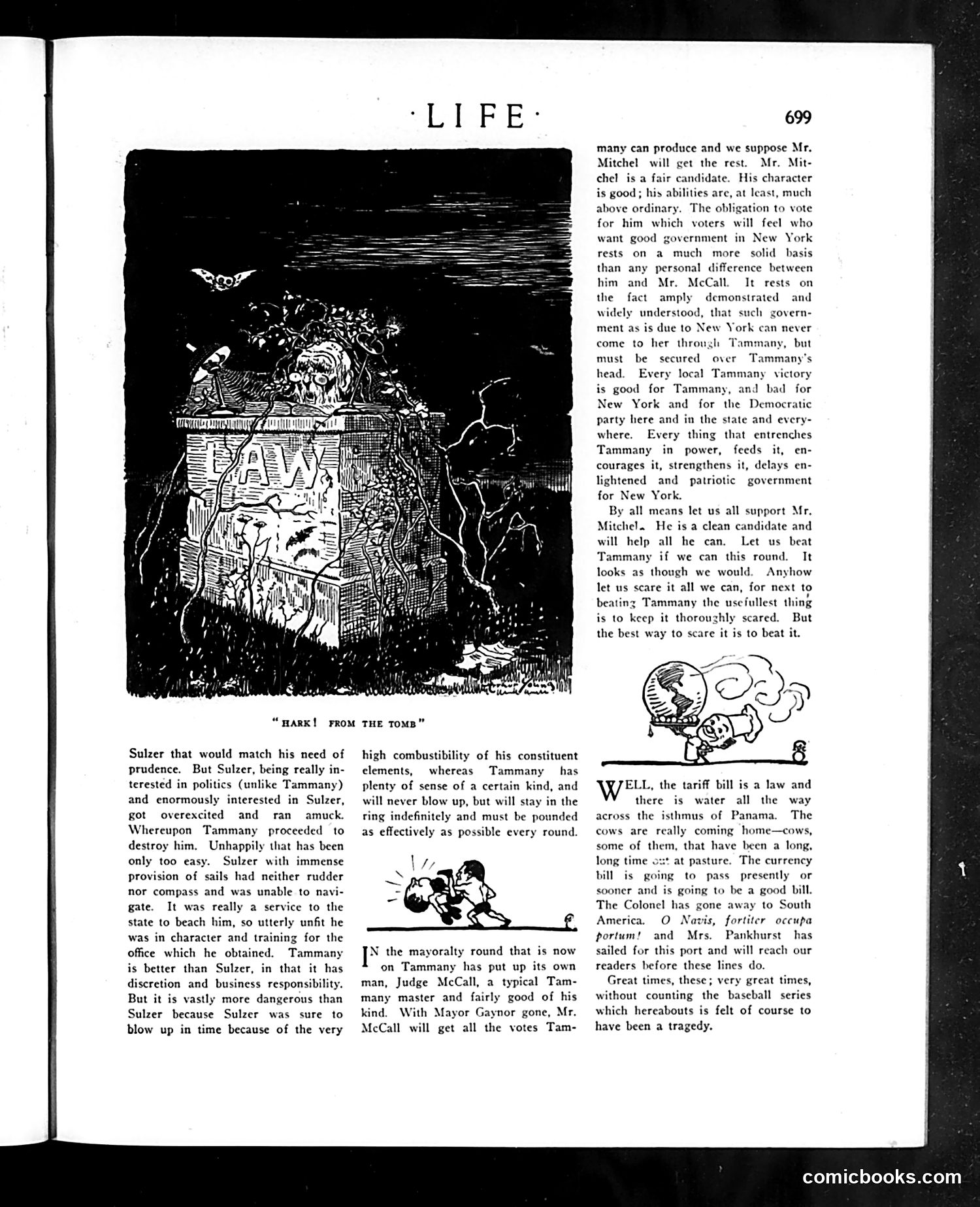
## The Main Political Cartoon ("Hark! From the Tomb") The large left illustration depicts a tomb with ghostly figures emerging—likely representing **Tammany Hall**, New York's Democratic political machine, depicted as undead/haunting. The satire criticizes Tammany's persistent corruption despite repeated scandals. ## Political Context The text discusses **William Sulzer** (former governor, apparently recently destroyed politically by Tammany) versus **Judge McCall** (Tammany's mayoral candidate) and **John Purroy Mitchel** (the reform alternative). The author argues Mitchel deserves support not from personal preference but because Tammany's control inherently produces bad government—it's institutionally corrupt, not just occasionally so. The piece advocates voting **against Tammany** as the priority, treating the political machine as a permanent threat requiring constant electoral "pounding." ## Key Point The satire equates Tammany with death/the undead—a persistent evil that cannot be reformed, only repeatedly defeated at the ballot box. This reflects Progressive Era anti-machine politics.
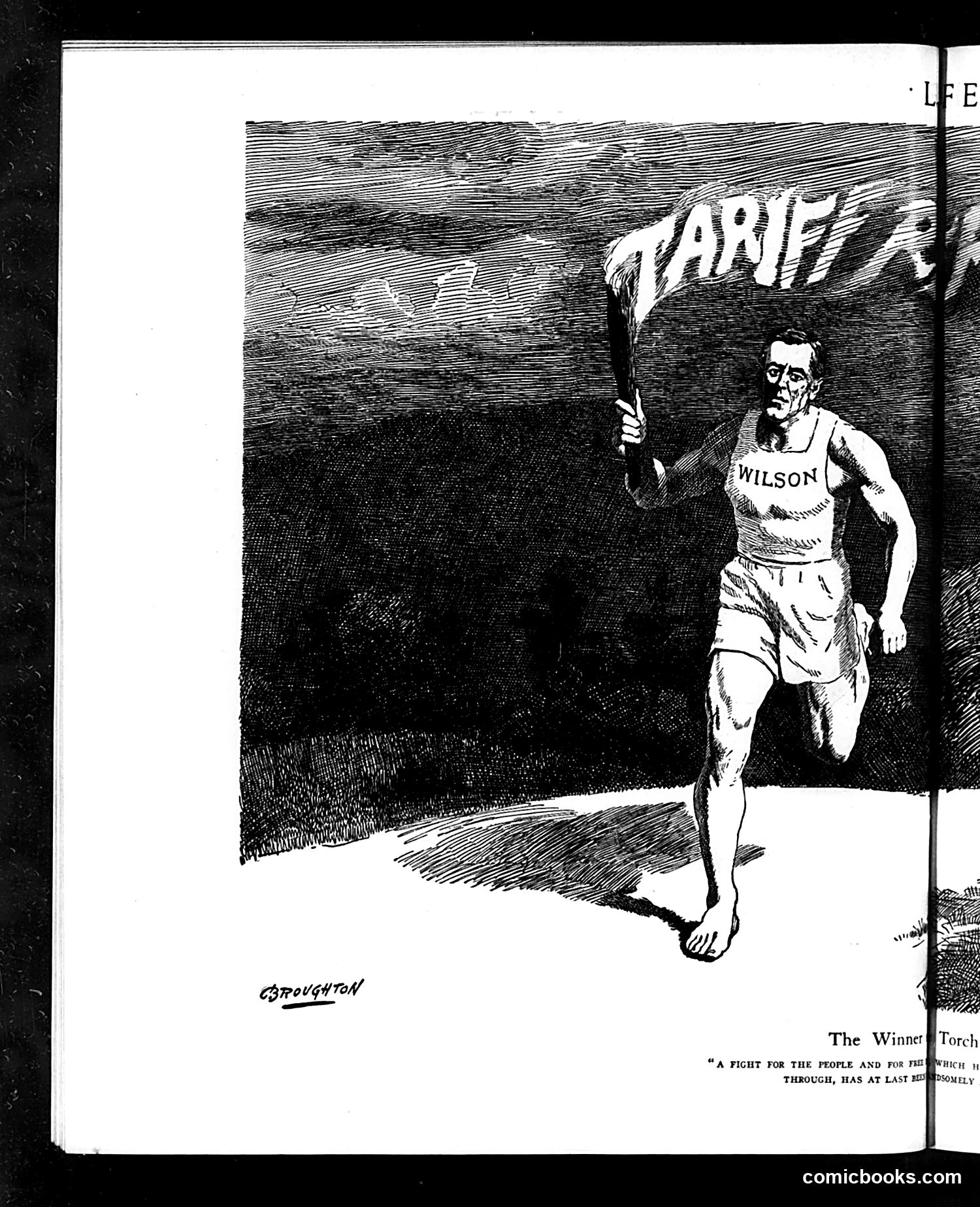
This cartoon depicts a male athlete labeled "WILSON" carrying a flag marked "TARIFF" while running. The illustration appears to reference President Woodrow Wilson and a political campaign or policy initiative related to tariff reform. The satire suggests Wilson is championing tariff policy as a fight "for the people," as indicated by the partially visible caption below. The runner imagery and flag convey momentum and victory in this political struggle. The artist's signature reads "BROUGHTON." Without the complete caption text, the precise historical context remains unclear, though this likely relates to Wilson-era trade policy debates—a significant political issue of the 1910s-1920s period. The overall message appears celebratory of Wilson's tariff position.
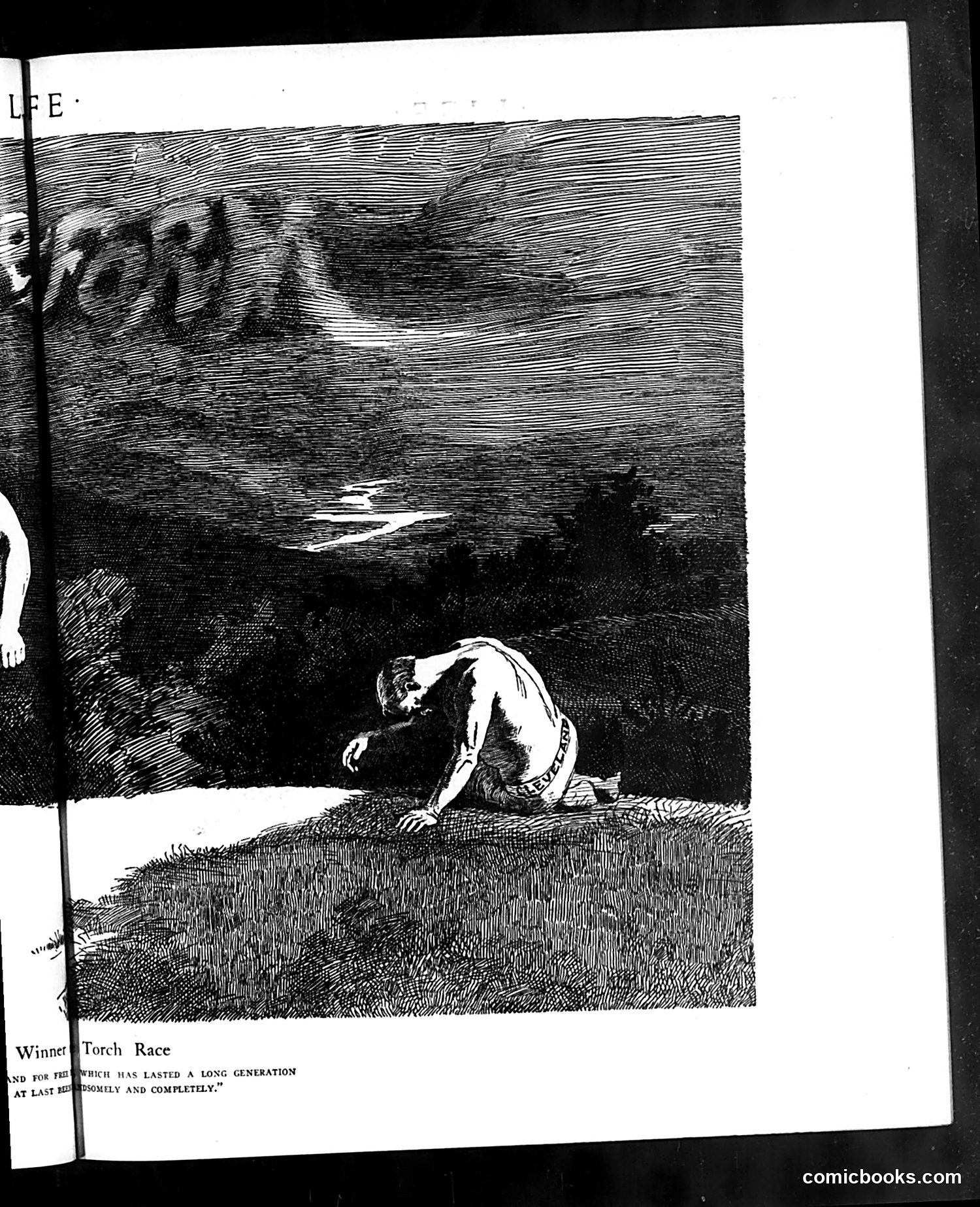
This engraving depicts a figure in a bent, exhausted posture carrying what appears to be a torch, set against a dark landscape. The caption references a "torch race" that has "lasted a long generation" and been "borne...completely." The image likely satirizes the passing of leadership or ideological responsibility across generations. The hunched, struggling figure suggests the burden of carrying forward some cause or movement. Without clearer context about the publication date, it's difficult to identify the specific historical reference—it could relate to political movements, social reform efforts, or ideological struggles of early 20th-century America. The "torch" metaphor commonly represented progressive ideals or political missions in period literature.
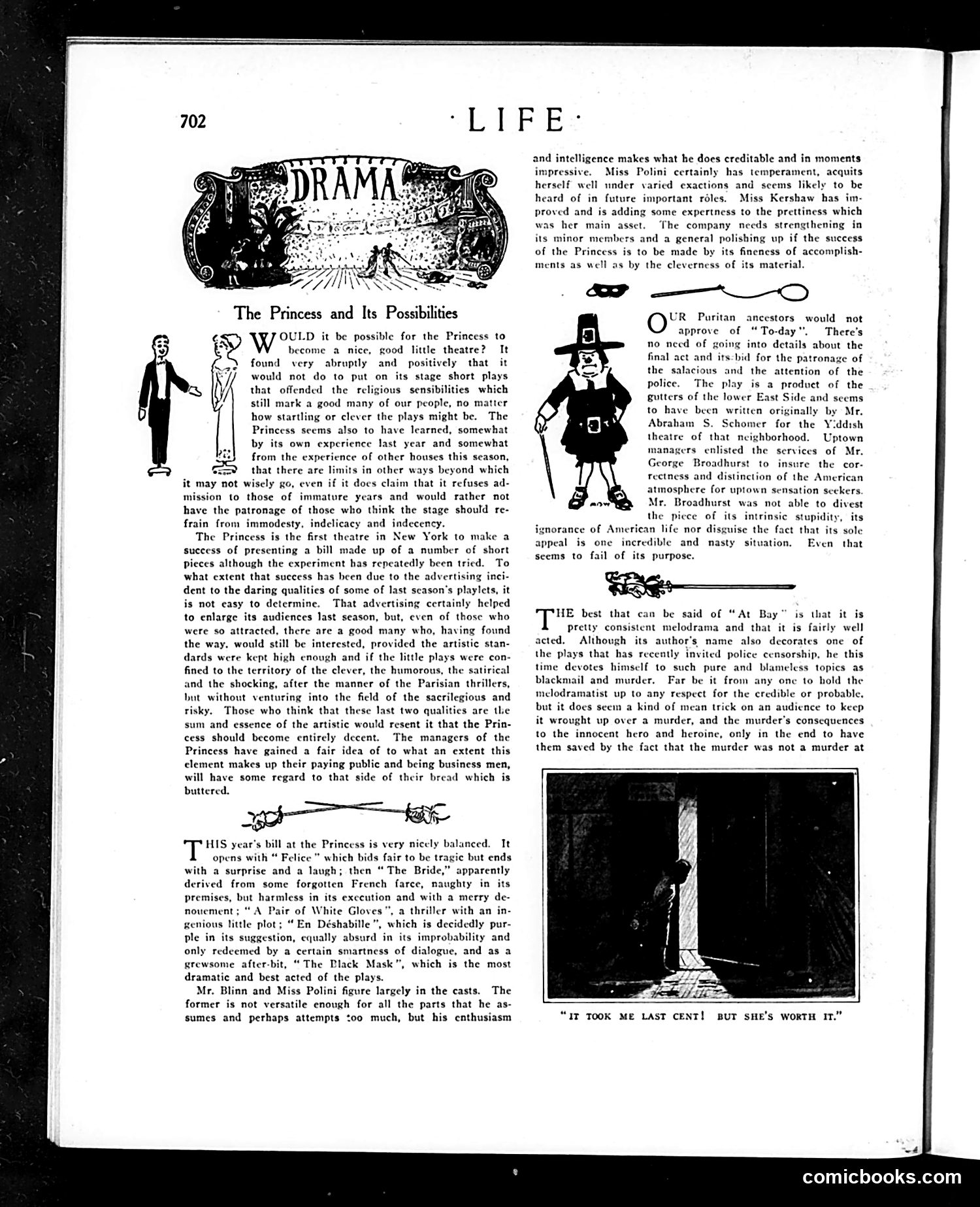
This page reviews the Princess Theatre's programming strategy. The article discusses whether the theater—which had gained attention for edgy, risqué short plays—should become more respectable while maintaining artistic quality. The critic acknowledges the theater's success comes partly from controversy and "daring qualities," but argues it could sustain audiences through clever, satirical material without venturing into "sacrilegious and risky" territory. The review balances this pragmatism: managers understand their paying public includes those attracted to scandal, but quality work could retain audiences too. The review then critiques the current bill's balance—plays like "Felice" and "The Bride" (described as "naughty" but "harmless")—and praises performers Miss Polini and Miss Kershaw while noting actor Blinn overextends himself. A sidebar condemns "To-day," a production pandering to "salacious" interests for police attention, reflecting the Puritan moral anxieties the theater navigates.
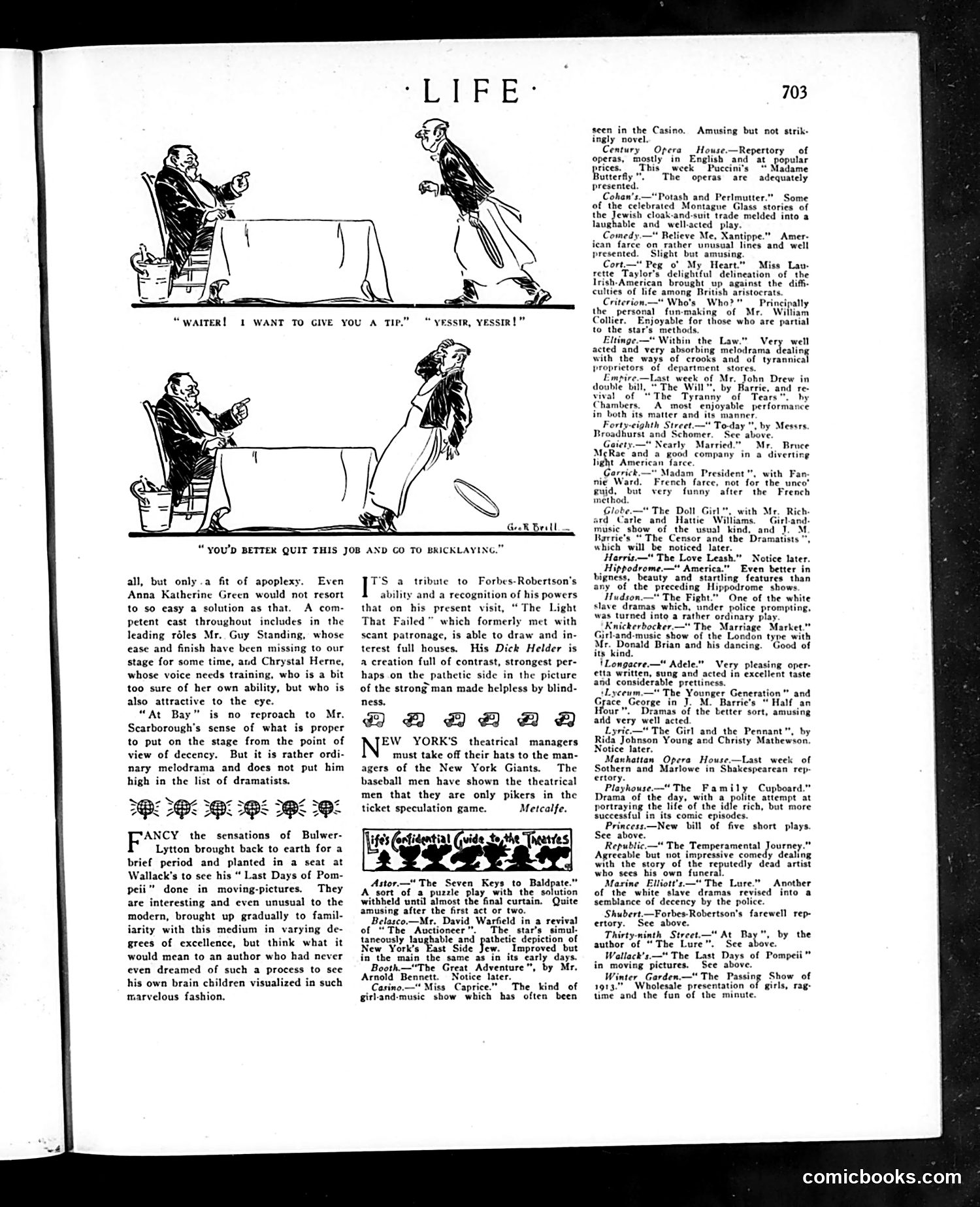
This is a theatrical review page from *Life* magazine (page 703), featuring two cartoon panels at the top that satirize the restaurant tipping custom. **The Cartoons:** The two panels depict a diner attempting to give his waiter a financial tip. In the first panel, the waiter eagerly responds "Yessir, yessir!" In the second, the diner sarcastically suggests the waiter "quit this job and go to bricklaying" instead—implying the tip was insulting or laughably small. The joke mocks the social awkwardness of tipping culture: the diner's embarrassment at offering inadequate compensation, and the waiter's forced politeness despite receiving a pittance. It reflects early-20th-century anxieties about class expectations and wage insufficiency in service work. **Below:** The page continues with theatrical reviews of contemporary Broadway productions, evaluating performances and plays from venues like the Astor, Casino, and Century Opera House.
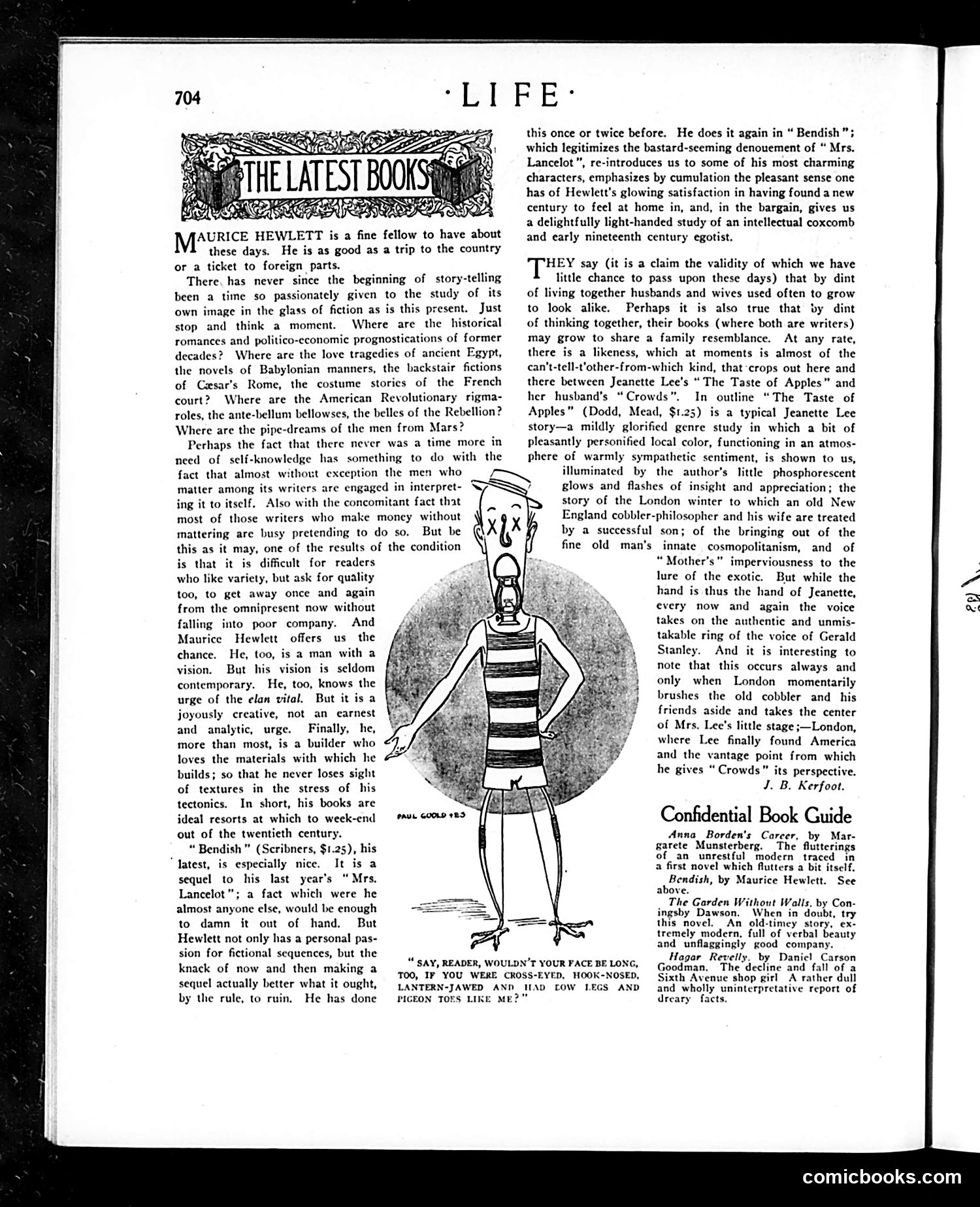
This page from *Life* magazine contains a book review section titled "The Latest Books." The main text discusses Maurice Hewlett's novel *Bendish*, praising his ability to offer escapism from contemporary concerns by setting stories in historical periods. The cartoon illustrates a satirical point: it depicts an extremely unattractive figure with an exaggerated long face, cross-eyes, hook nose, and thin legs. The caption reads: "Say, reader, wouldn't your face be long, too, if you were cross-eyed, hook-nosed, lantern-jawed and had low legs and pigeon toes like me?" The cartoon appears to mock physiognomy—the pseudo-scientific practice of judging character or worth by facial features. It's satirizing those who judge others based on physical appearance, suggesting such judgments are absurd. The figure's self-aware complaint about his grotesque features implies that appearance doesn't determine value or character.
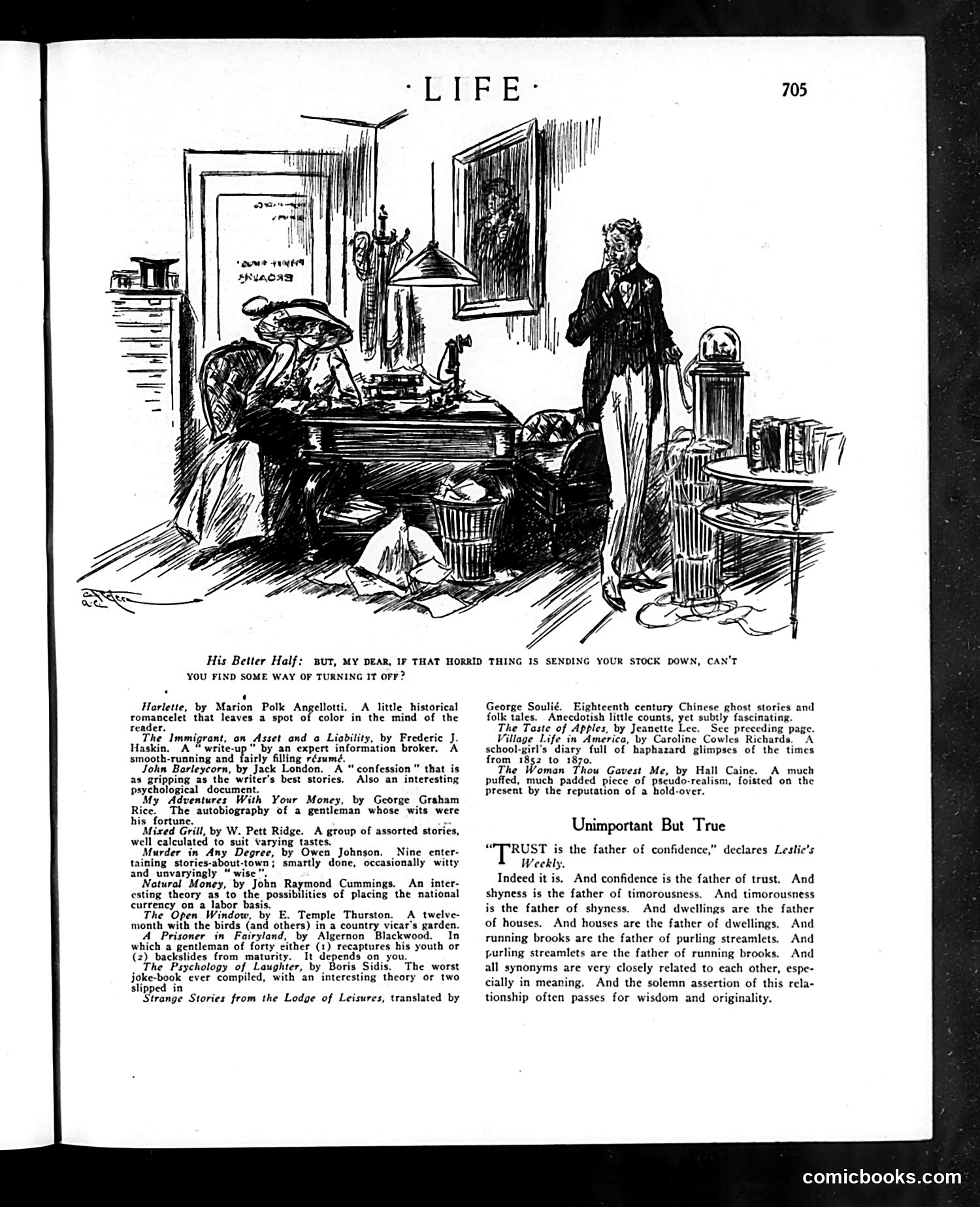
The sketch depicts a domestic scene where a wife asks her husband to find a way to stop "that horrid thing" from sending his stock down. The image shows a man at a desk surrounded by financial papers and what appears to be a ticker tape machine or stock ticker—the "thing" causing market turmoil. ## The Satire This mocks the helplessness of investors during stock market volatility. The wife's naive suggestion that her husband simply "turn off" the market mechanism satirizes both spousal incomprehension of financial matters and the broader public's frustration with forces beyond individual control. The cartoon suggests the absurdity of expecting to control impersonal market forces through personal action. The page also includes a sidebar titled "Unimportant But True" that mockingly tautological definitions (trust causes confidence, confidence causes trust), which appears to satirize pseudointellectual writing—suggesting the magazine critiques both financial anxiety and pretentious analysis.
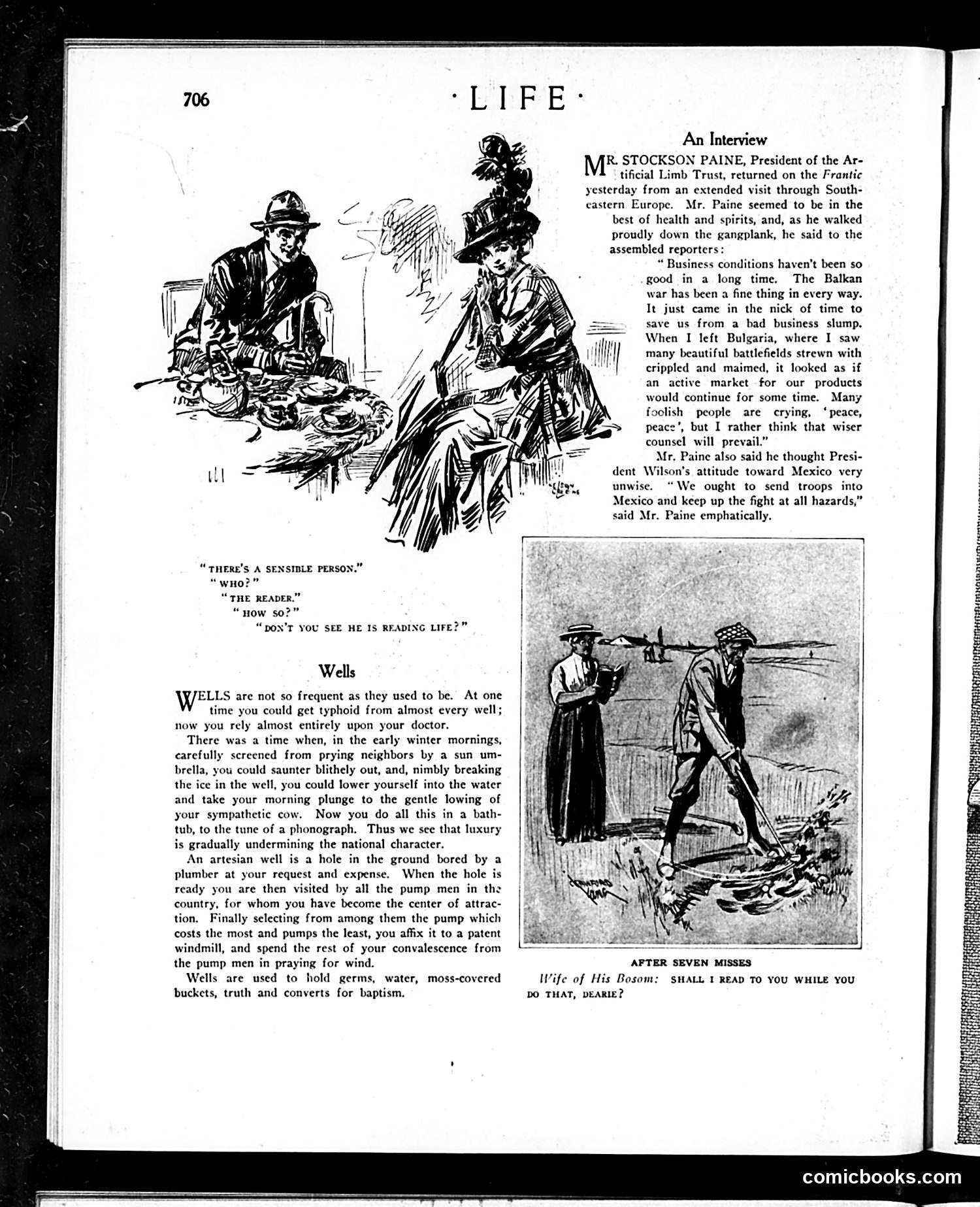
The page contains three distinct satirical pieces: **"An Interview"** depicts a fictional artificial limb manufacturer returning from the Balkans, gleefully profiting from war casualties. The satire mocks war profiteers and cynicism: Mr. Paine celebrates the Balkan conflict as excellent for business, dismisses peace advocates as "foolish," and advocates military intervention in Mexico for profit. This criticizes capitalists who benefit from human suffering and violence. **"Wells"** is a humorous essay mocking how modern plumbing and luxury have "undermined national character." It nostalgically contrasts old-fashioned well-drawing with contemporary bathtubs and phonographs, suggesting comfort weakens virtue—a common early-20th-century social anxiety. **The cartoon above** shows a couple reading Life magazine, with the joke that the reader is "sensible" because he reads *Life*—self-promotional mockery of the magazine itself. The overall page satirizes greed, militarism, and industrial excess while poking fun at nostalgia for simpler times.
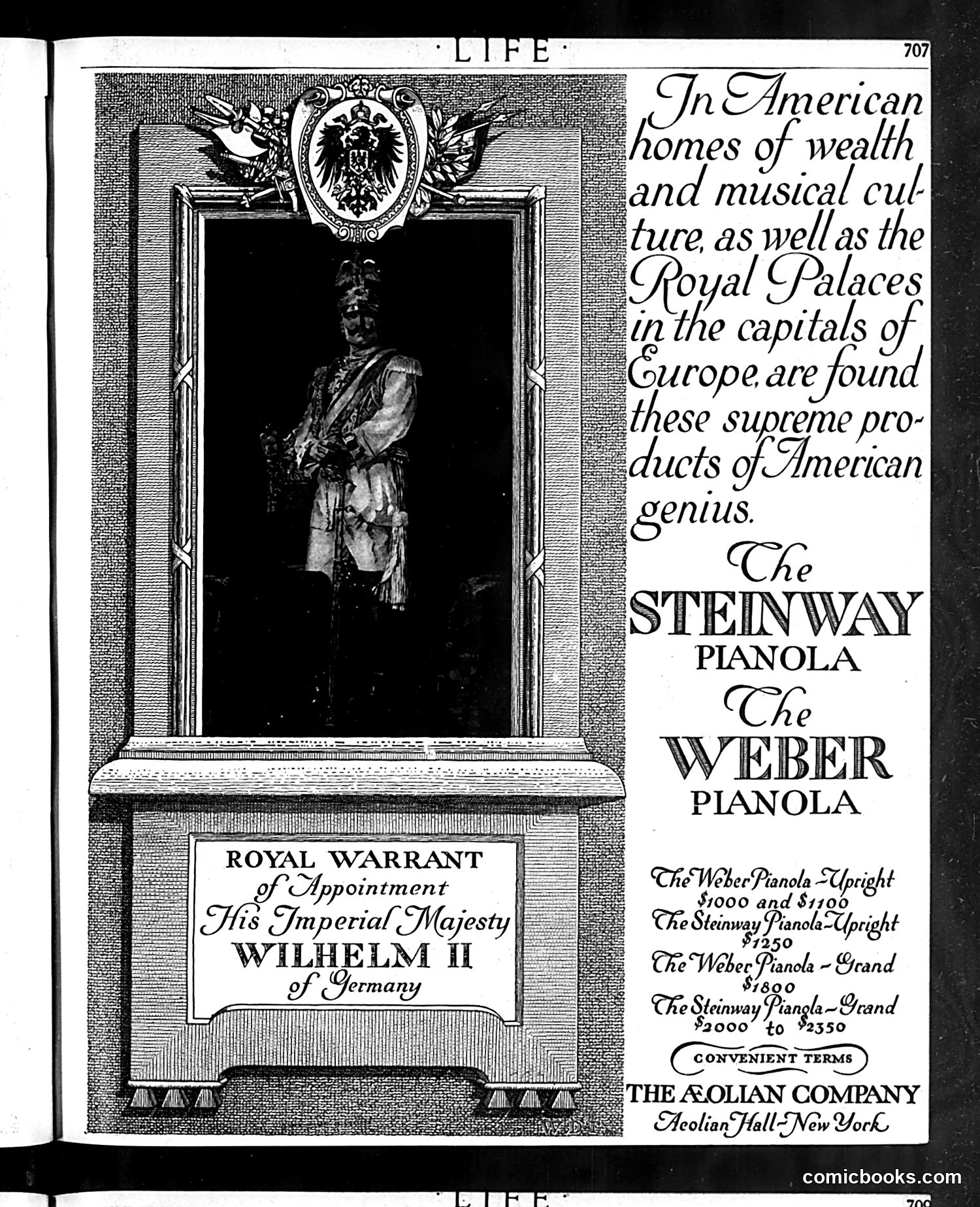
This page is primarily **advertising**, not satire. It showcases piano manufacturers (Steinway and Weber) leveraging a "Royal Warrant of Appointment" from **Wilhelm II of Germany**, the German Emperor, to market their instruments in America. The prestige appeal is explicit: the text claims these American pianos are found in wealthy American homes and European royal palaces, positioning them as products of superior "American genius." The German imperial endorsement—visually emphasized through the portrait and formal heraldic frame—serves as a mark of quality and cultural legitimacy. This advertisement reflects early 20th-century American attitudes: aspiring to European sophistication while asserting American manufacturing excellence. The irony (likely unintended by advertisers) is using a German monarch's approval to sell American products to American consumers seeking to emulate European aristocratic taste.
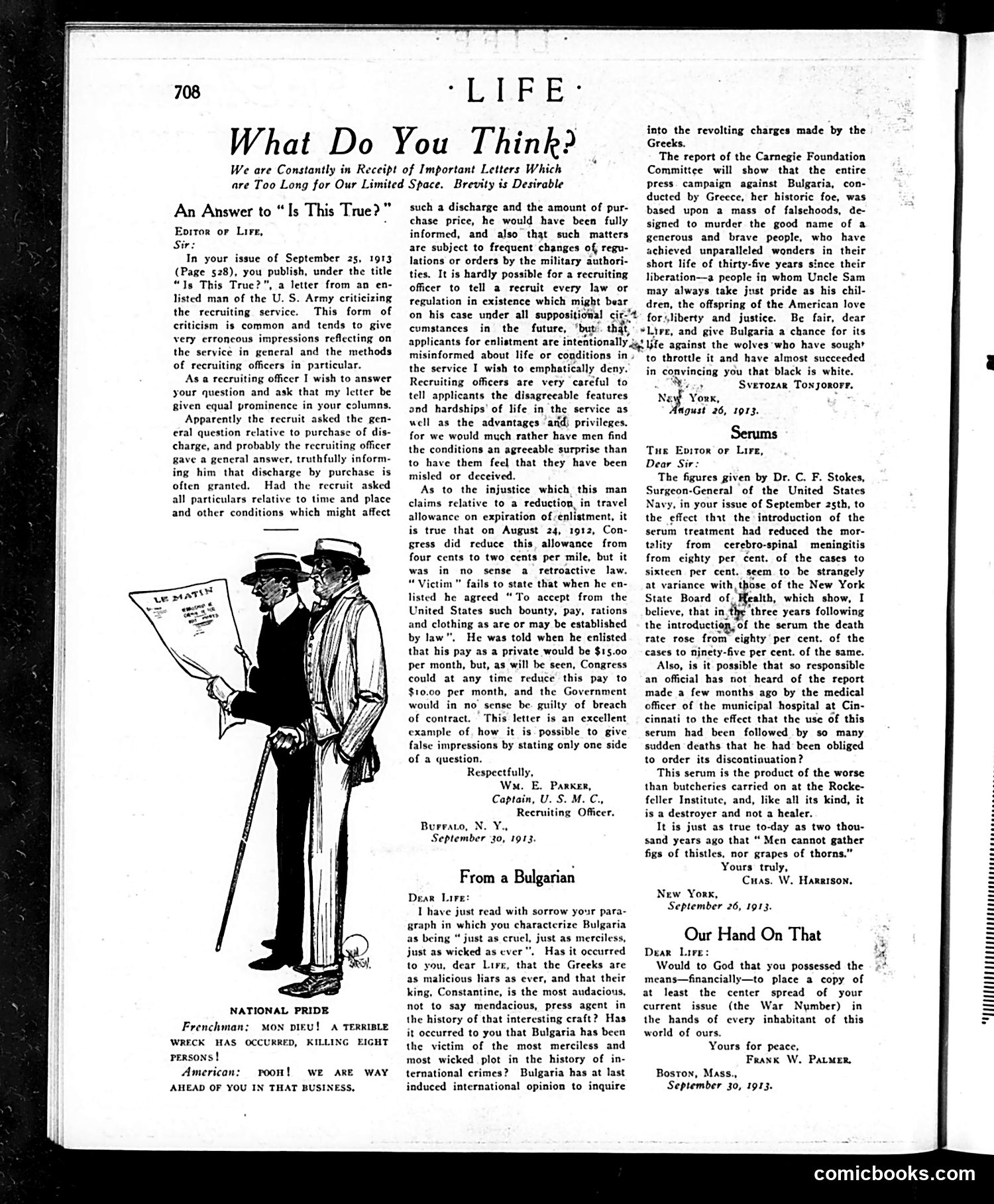
This page contains a "Letters to the Editor" section from Life magazine (October 1913), plus one political cartoon. ## The Cartoon The small cartoon at bottom left depicts a **Frenchman and American comparing railway disasters**. The Frenchman reports eight deaths; the American boasts "We are way ahead of you in that business." This satirizes American exceptionalism and competitiveness taken to absurd extremes—treating even tragic deaths as a competitive ranking. ## The Letters The main content addresses three topics: 1. **Army Recruiting** — A recruiting officer defends the service against claims that recruiters mislead soldiers about pay and discharge procedures, arguing the original complainant asked incomplete questions. 2. **Bulgaria** — A correspondent defends Bulgaria against Greek propaganda, calling accusations "falsehoods" and praising Bulgarians as worthy of American support. 3. **Serums** — A doctor discusses new serum treatments for meningitis, noting mortality reductions. The page illustrates how Life functioned as a forum for public debate on military, diplomatic, and scientific issues of the day.
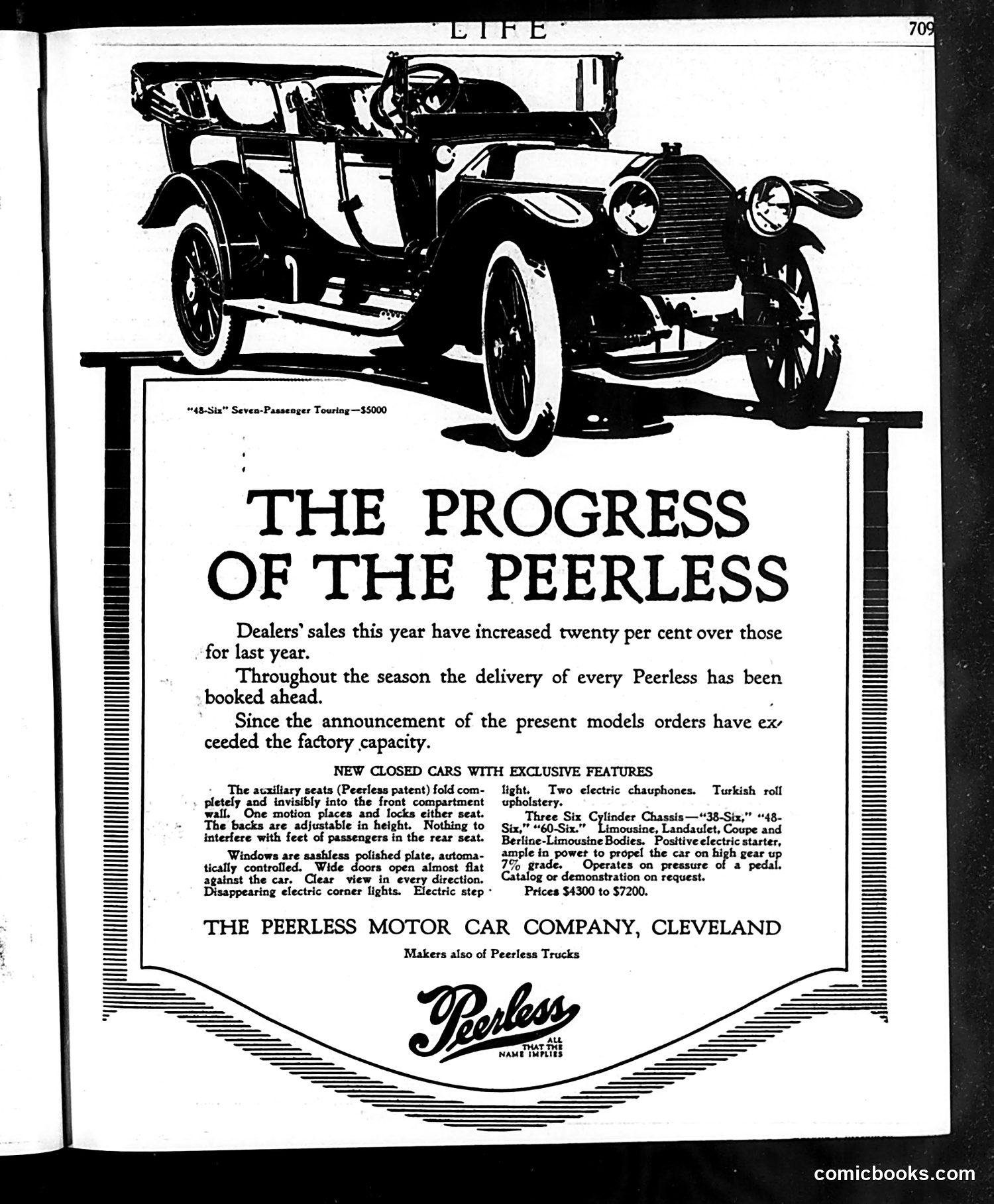
This is **not a cartoon or satire** — it's a straightforward automobile advertisement from Life magazine's advertising pages. The page promotes the Peerless Motor Car Company's vehicles, emphasizing their commercial success: dealer sales up 20%, all deliveries pre-booked, and orders exceeding factory capacity. This was typical marketing language for early automotive advertising. The illustration shows a high-end touring car (the "$48-Six" model priced at $5,000 — substantial money in this era). The text highlights luxury features: folding auxiliary seats, adjustable backs, automatic windows, electric starters, and Turkish roll upholstery. Multiple chassis options and body styles are listed, ranging from $4,300 to $7,200. The company was based in Cleveland and also manufactured trucks. This represents the competitive early automobile market when Peerless was a genuine competitor to manufacturers like Packard. No satire or political commentary is present — this is purely commercial promotion.
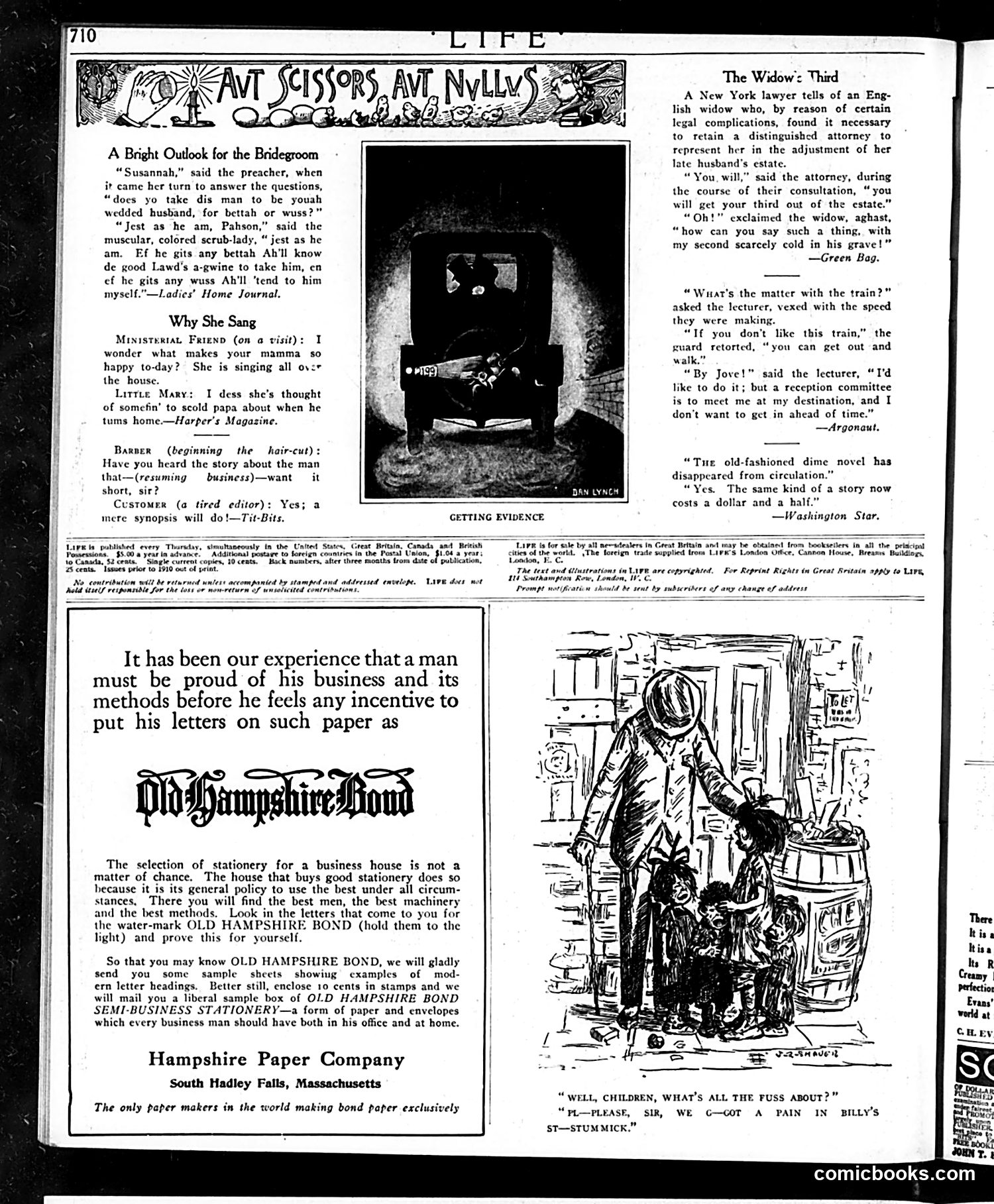
This page contains several brief humorous anecdotes typical of early-20th-century Life magazine, plus advertising. **The cartoons/jokes satirize:** 1. **"A Bright Outlook for the Bridegroom"**: Uses dialect humor (common then, offensive now) featuring a Black woman at her wedding. The joke: she promises to tolerate her husband as-is, but if he improves, God will take him; if he worsens, *she'll* handle it—suggesting darkly comic spousal violence. 2. **"Why She Sang"**: A wife's happiness stems from anticipating scolding her husband later—mocking domestic nagging. 3. **"The Widow's Third"**: A widow, having buried two husbands, reacts with shock to learning she'll receive only one-third of the current husband's estate, implying she's a serial widow expecting to outlive another spouse. 4. **"Getting Evidence"**: A photograph (credited DAN LYNCH) captioned about obtaining legal evidence—unclear without fuller context. The Hampshire Bond paper advertisement dominates the lower half, a typical advertorial format for the era.
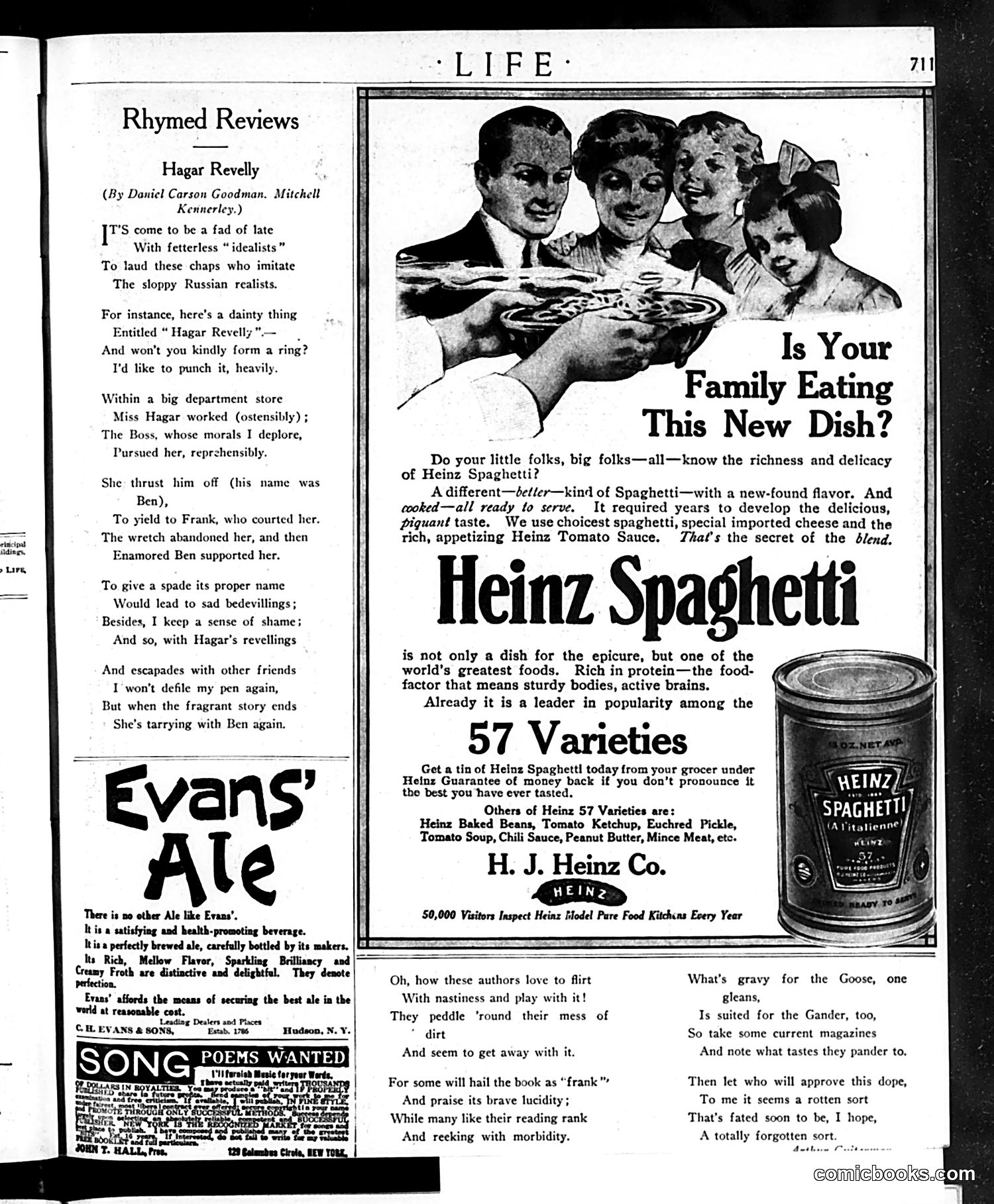
This page contains a **book review in verse** criticizing the novel "Hagar Revelly" by Daniel Carson Goodman. The reviewer mocks the book as representative of a fashionable trend among "fetterless idealists" who imitate "sloppy Russian realists"—likely referring to early 20th-century naturalist literature with morally ambiguous characters and frank depictions of sexuality and social transgression. The plot synopsis describes a department store worker who is sexually pursued by her boss, rejects him for another man (Frank), is then abandoned, and returns to her original pursuer (Ben). The reviewer condemns this as exploitative moral decay dressed up as artistic boldness, sarcastically noting the author "loves to flirt / With nastiness and play with it." The satire targets both the novel's sexual frankness and the literary establishment's celebration of such "realism" as sophisticated—when the reviewer sees it as merely salacious and forgettable. The page also contains period advertisements for Heinz Spaghetti and Evans' Ale.
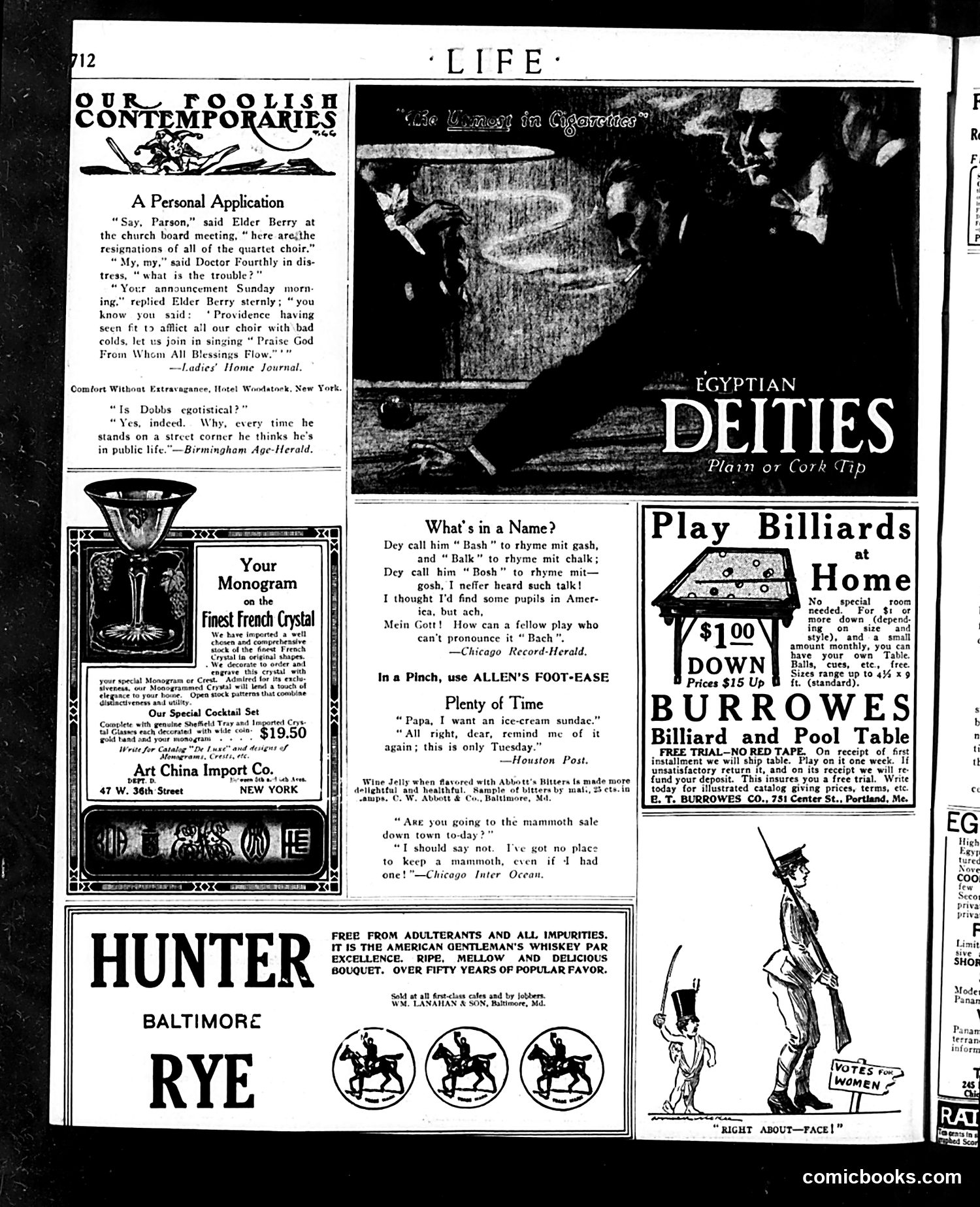
This page contains primarily **humorous short anecdotes and advertisements** rather than political cartoons. The main humor pieces are: 1. **"A Personal Application"** — A joke about a church choir director who, announcing that Providence has afflicted the choir with colds, ironically suggests singing "Praise God From Whom All Blessings Flow"—prompting all choir members to resign. 2. **"What's in a Name?"** — A piece about a foreign musician (German accent implied by dialect) frustrated that Americans can't pronounce "Bach" correctly, calling him "Bash," "Balk," "Bosh." 3. **"Plenty of Time"** — A father dismisses his child's Sunday ice-cream request, saying "remind me Tuesday"—implying parental procrastination. 4. **Mammoth sale joke** — Someone refusing to attend a sale because they have nowhere to store a mammoth. The **bottom cartoon** shows suffragists with "VOTES FOR WOMEN" text, likely referencing early 20th-century women's suffrage advocacy. The remainder is **advertising** for crystal glassware, billiard tables, whiskey, and other consumer goods.
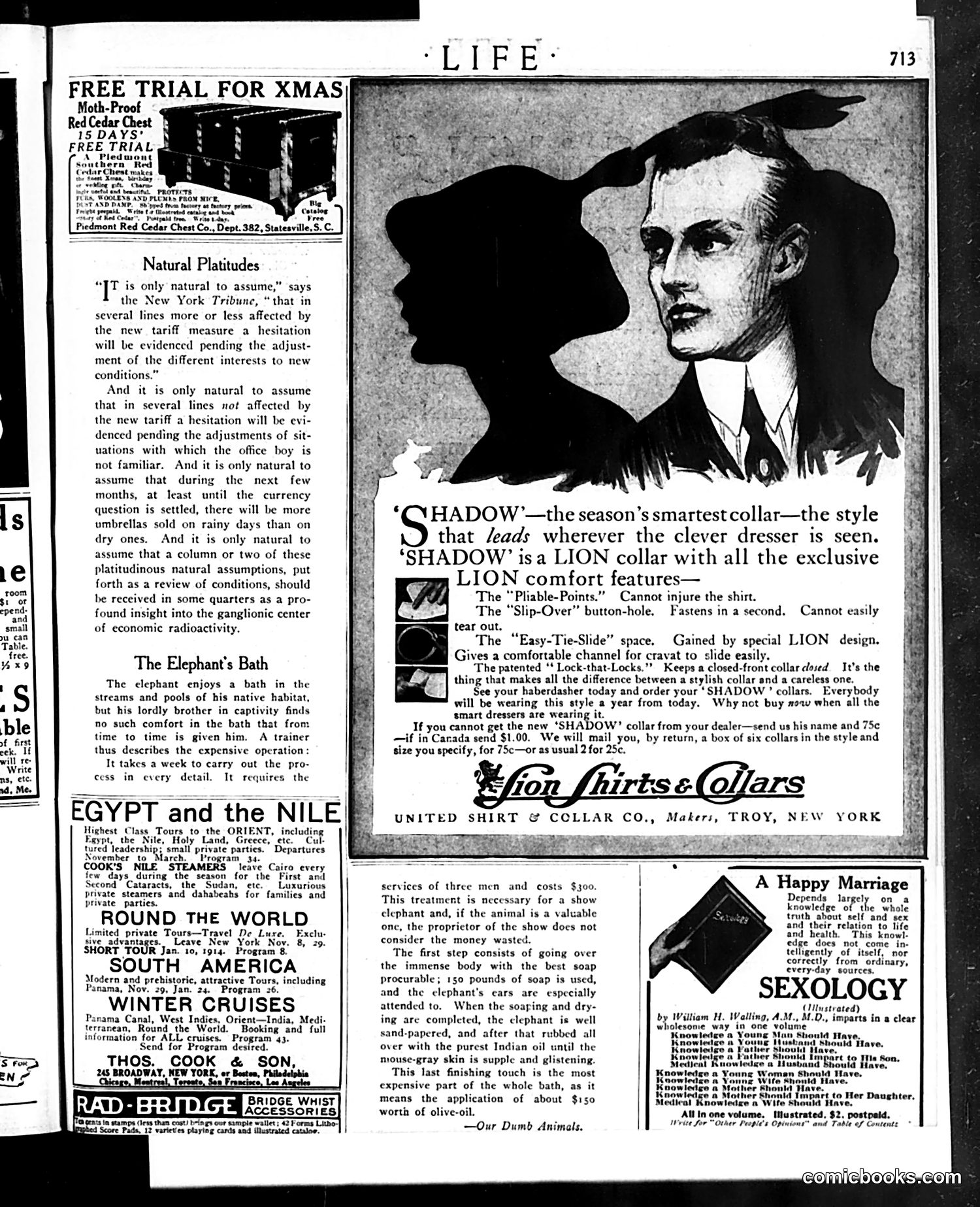
This page is primarily **advertising**, with minimal editorial content. The main features are: 1. **"Natural Platitudes"** — A satirical editorial mocking the New York Tribune's vague, circular economic commentary about tariffs and currency. Life ridicules how newspapers fill space with obvious truisms dressed up as profound analysis ("umbrellas sell better on rainy days"). 2. **"The Elephant's Bath"** — A factual piece describing the costly weekly bathing procedure for captive elephants, requiring three men and $300. 3. **Large advertisement for "Shadow" collar** — A men's shirt collar marketed as the season's smartest style, featuring LION brand exclusive features. The page also contains travel advertisements (Cook's Tours to Egypt/Nile, South America, etc.) and a book advertisement for *Sexology*. No political cartoons or caricatures appear. The only satire is the editorial critique of journalistic banality.
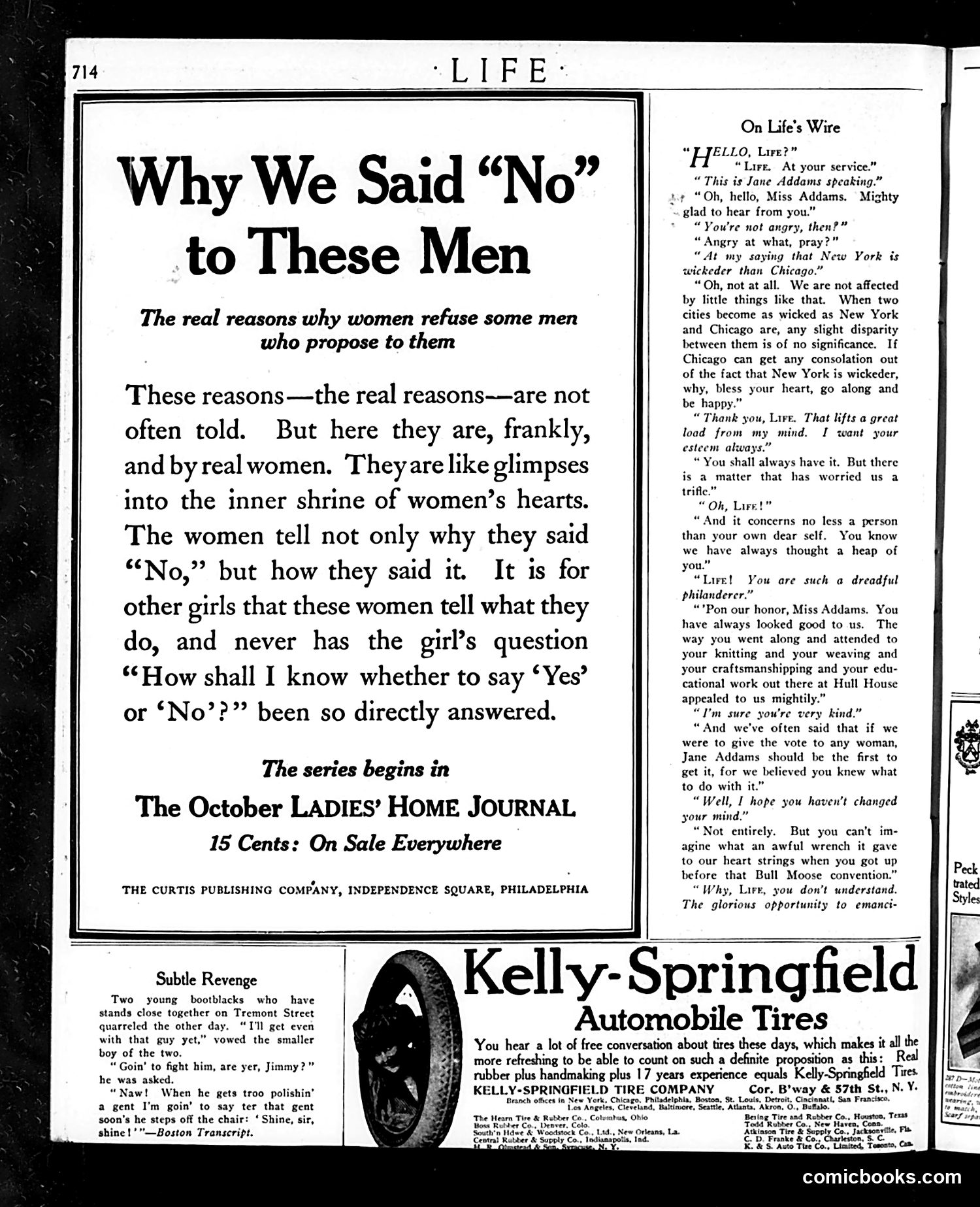
This page contains two distinct pieces: **Main Article**: "Why We Said 'No' to These Men" advertises an upcoming series in *Ladies' Home Journal* about women's reasons for rejecting marriage proposals. The framing suggests these are frank, intimate confessions—insights into "women's hearts"—meant to guide other young women on whether to accept or refuse proposals. **"On Life's Wire" Column**: A humorous phone conversation between "Lire" (Life magazine, personified) and Jane Addams, the famous Progressive Era social reformer. Addams had just stated New York was "wickeder" than Chicago. The joke mocks her activism: Lire teases her about being a "philanderer" and references her controversial support for the "Bull Moose" (Progressive Party) convention, implying her political involvement distresses her admirers who preferred she stick to "knitting and weaving." **Minor Comic**: "Subtle Revenge"—a brief bootblack joke about retaliation. **Advertisement**: Kelly-Springfield automobile tires. The page reflects early 1900s attitudes: patronizing interest in women's marriageability and skepticism toward female political participation.
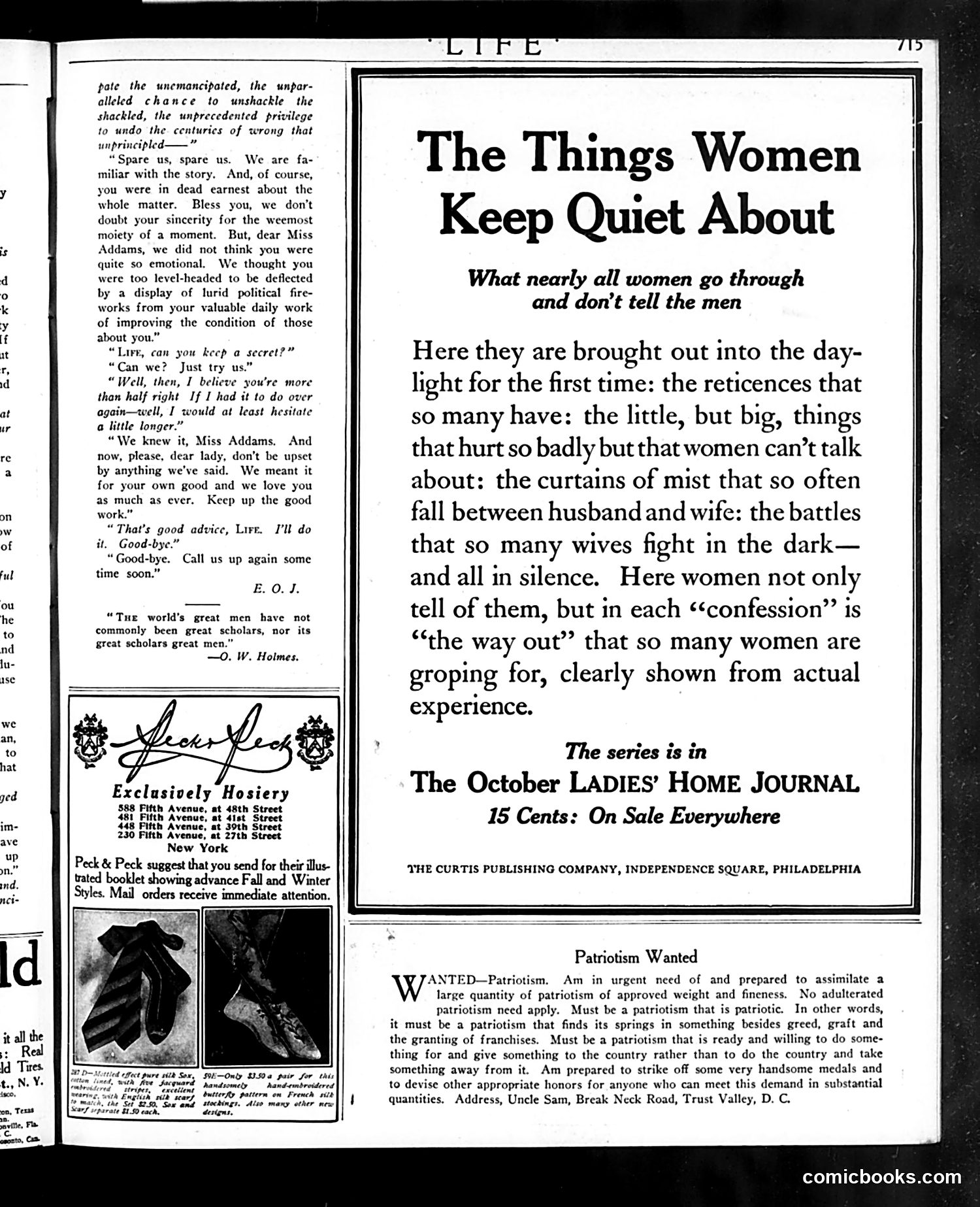
This page contains two distinct pieces: **Main Advertisement/Article**: "The Things Women Keep Quiet About" promotes a series in *Ladies' Home Journal* about women's private struggles—marital conflicts, domestic unhappiness, and unspoken suffering—presented as frank "confessions." The headline frames these as secrets women hide from men, appealing to readers' curiosity about female experiences typically kept private. **"Patriotism Wanted" Advertisement**: A satirical want-ad (bottom right) humorously "seeks" patriotism of high quality, explicitly rejecting patriotism motivated by "greed, graft and the granting of franchises." This appears to critique contemporary American corruption and self-interested nationalism, suggesting "true patriotism" should serve the country rather than exploit it. The offer of medals to whoever can provide genuine patriotism underscores the satire—implying such patriotism is scarce or nonexistent. Both pieces reflect early 20th-century anxieties: women's domestic unhappiness and national moral integrity.
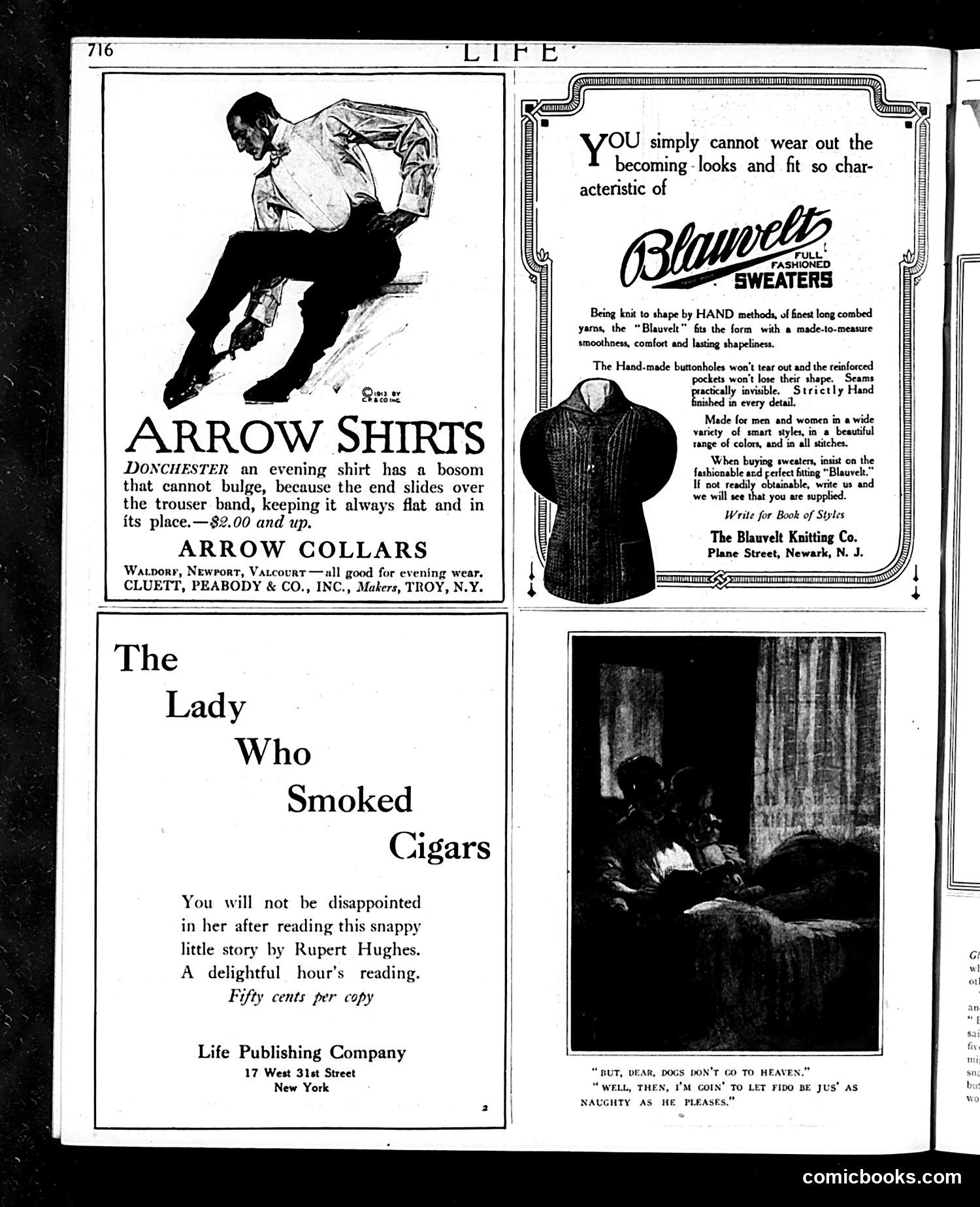
This page is primarily **advertising**, not political satire. It contains four commercial advertisements typical of early 1900s magazines: 1. **Arrow Shirts & Collars** — promotes men's formal evening wear with technical details about non-bulging shirt bosoms 2. **Blauvelt Sweaters** — hand-knitted women's and men's sweaters emphasizing durability and tailoring 3. **"The Lady Who Smoked Cigars"** — promotes a 50-cent novelty story by Rupert Hughes about a woman smoker (likely humorous/scandalous for the era) 4. **Illustration with caption** — shows a silhouetted scene with dialogue where a child argues dogs deserve heaven so he'll misbehave "as naughty as he pleases" The page reflects early 1900s consumer culture and social attitudes (notably, women smoking was presented as novelty entertainment). No political figures or satire are evident.
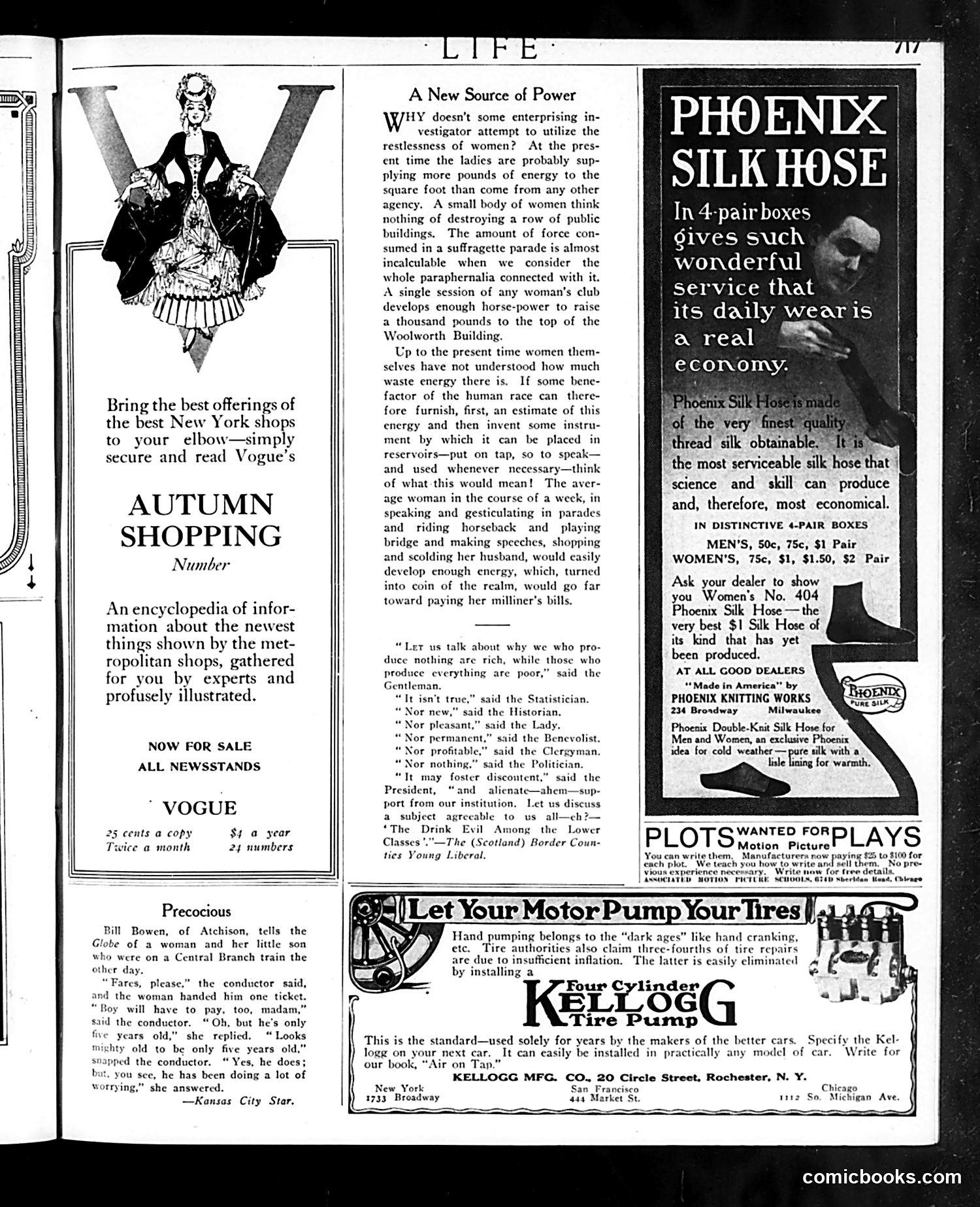
This page primarily contains **advertisements and light humor** rather than political satire. The main cartoon, titled "A New Source of Power," is a **satirical commentary on women's suffrage activism**. The piece mocks suffragettes by suggesting their passionate campaigning and public activism—parades, speeches, bridge-playing, shopping, scolding—generates so much kinetic energy it could theoretically be harvested as electrical power to "pay her milliner's bills." This is clearly tongue-in-cheek ridicule of the women's movement, framing female activism as noisy, excessive busybody behavior rather than legitimate political engagement. The subsequent dialogue parody presents a university or institutional meeting where discussion of class inequality is shut down because it might "alienate support," redirecting conversation to the "safe" topic of "The Drink Evil Among the Lower Classes." The page is otherwise dominated by **period advertisements**: Vogue's autumn shopping guide, Phoenix Silk Hose, and Kellogg Tire Pumps. The "Precocious" anecdote is mild humor about a precocious child worrier.
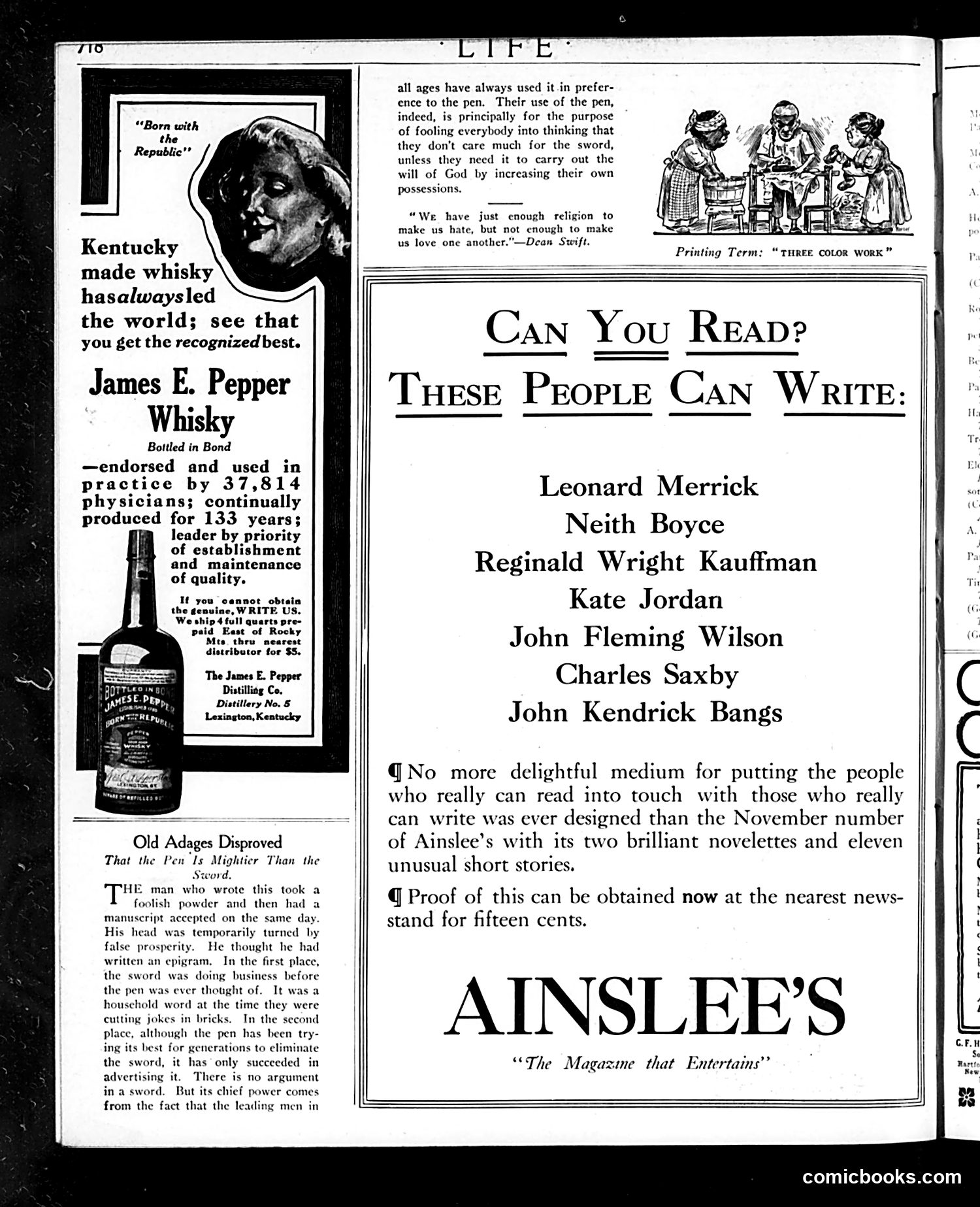
This page combines advertisements with editorial content satirizing power and morality. **The Whisky Ad** (left): James E. Penner Whisky claims Kentucky superiority and endorsement by thousands of physicians—typical early-20th-century patent medicine marketing that exploited unregulated medical claims. **"Old Adages Disproved"** (bottom): A satirical essay arguing that the sword (military/physical power) has always preceded the pen (civilization/writing) in human affairs. It mocks the notion that writing has eliminated violence, claiming the pen merely advertises the sword's power while those in charge maintain control through force. **The Ainslee's Magazine Ad** (center-right): Lists contemporary authors (Leonard Merrick, Neith Boyce, etc.) to promote the magazine's November issue, targeting educated readers who value literary fiction. **The Dean Swift Quote** above sardonically comments on hypocrisy: people use religion to justify hatred and greed rather than genuine love. The page's overall message critiques how civilization uses various tools—religion, writing, advertising—to mask underlying power structures based on force and self-interest.
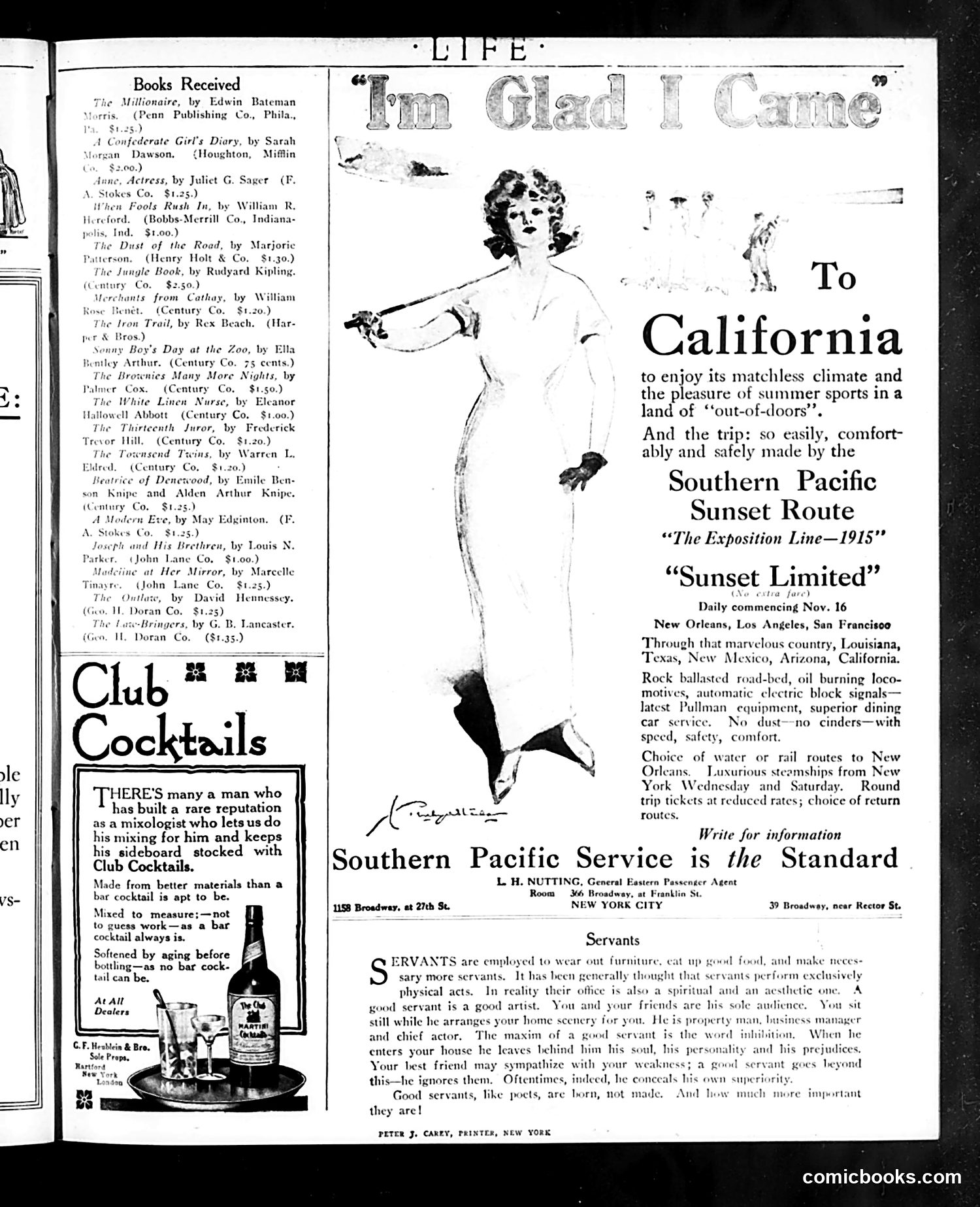
This is primarily an **advertising and literary review page** from Life magazine, not a political cartoon page. The main content consists of: 1. **"Books Received"** section listing recent publications with publishers and prices 2. **"Club Cocktails"** advertisement promoting pre-mixed cocktails as superior to bar-made versions 3. **Southern Pacific Railway advertisement** promoting the "Sunset Limited" train to California, departing Nov. 16, emphasizing comfort and modern amenities for travelers 4. **"Servants" essay** — a satirical piece about domestic servants, arguing they perform aesthetic/spiritual roles beyond physical labor. It suggests good servants are "artists" who suppress personality to create perfect home environments, comparing them to poets as born talents rather than made professionals The page reflects early 1910s leisure culture: wealthy Americans taking train vacations, cocktail consumption, and servant-keeping households. The servants piece offers gentle social satire about class dynamics and the invisible emotional labor expected of domestic workers.
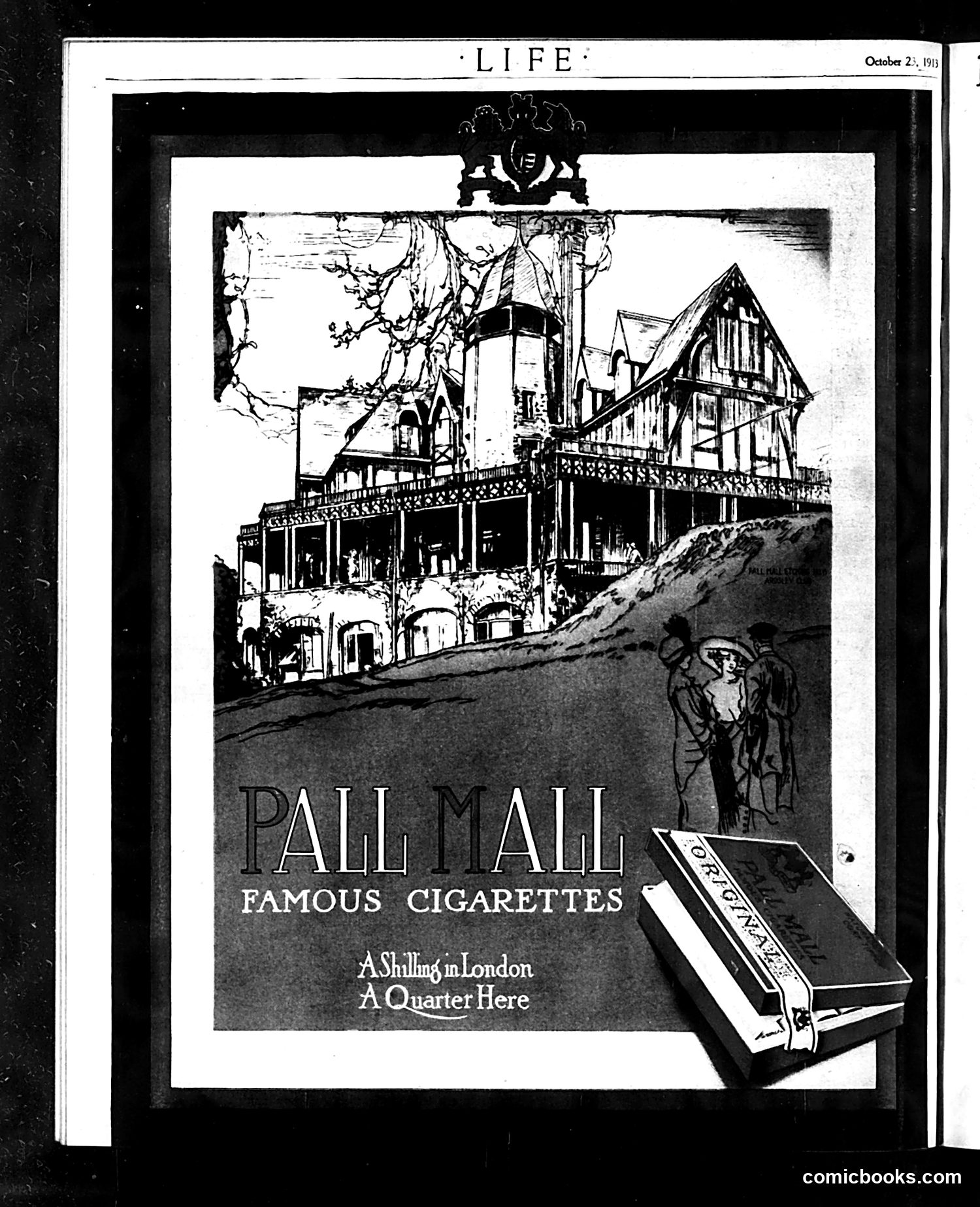
This is a cigarette advertisement from *Life* magazine (October 2, 1911). It features an illustration of an ornate Victorian or Edwardian-era mansion with half-timbered architecture, bare tree branches overhead, and a figure in period dress on the grounds. The ad's tagline compares British and American pricing: "A Shilling in London / A Quarter Here," meaning Pall Mall cigarettes cost one shilling in Britain but only a quarter (25 cents) in America—positioning the product as an affordable luxury import. The elaborate mansion imagery suggests sophistication and Old World elegance, marketing the cigarettes as refined and cosmopolitan. This was typical early-20th-century cigarette advertising strategy.