
Life, 1913-10-23 · page 18 of 40
Life — October 23, 1913 — page 18: what you’re looking at
What you’re looking at
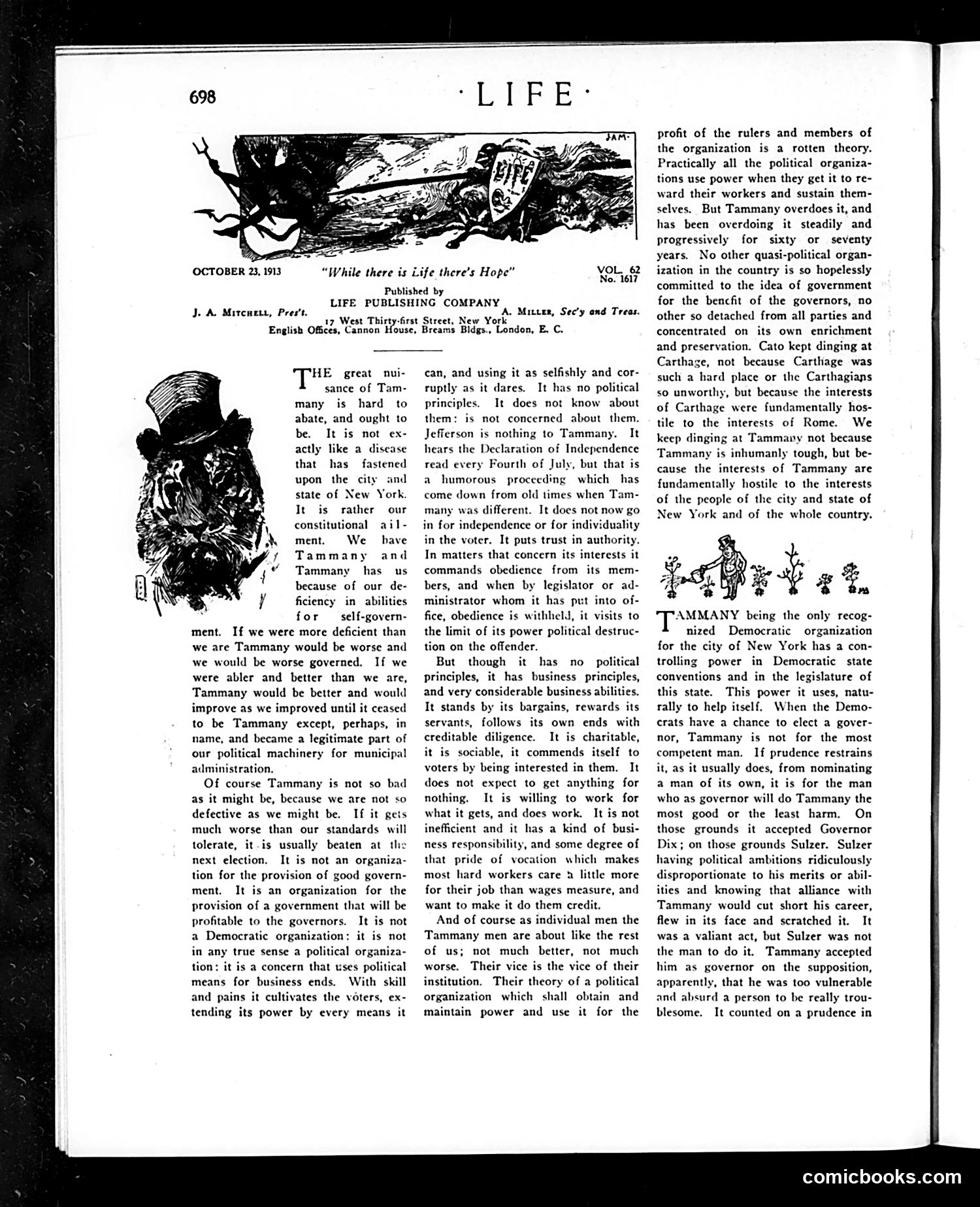
This is a critical essay about **Tammany Hall**, the Democratic political machine that controlled New York City politics. The carved head illustration (left) likely depicts a Tammany leader, shown as brutish and corrupt. The author argues Tammany isn't merely dishonest—it's fundamentally amoral. Unlike parties with ideological principles (referencing Jefferson and the Declaration), Tammany operates purely as a **business enterprise for profit**, using political power to enrich its leaders and operatives. The satire targets Tammany's cynicism: it rewards loyal members, maintains discipline through patronage, and cultivates voters' loyalty through personal favors rather than democratic ideals. The author suggests this corruption persists because voters tolerate it, and that Tammany is uniquely shameless among American political organizations in openly pursuing self-enrichment over good governance. This reflects Progressive Era (1913) anti-corruption sentiment, when reformers attacked urban political machines as obstacles to democracy and honest administration.
📄 Transcribed text from this page (OCR, searchable)
Machine-transcribed from the original scan — historical spelling and the odd misread are preserved.
OCTOBER 23, 1913 “While there is Life there’s Hope” 62 No. 1617 Published by LIFE J. A. Mitcnet, Pres’t. PUBLISHING COMPANY A. Mitten, Sec’y ond Treas. 17 West Thirty-first Street, New York English Offices, Cannon HE great nui- sance of Tam- many is hard to abate, and ought to be. It is not ex- actly like a discase that has fastened upon the city and state of New York It is rather our constitutional ail- ment. We have Tammany and Tammany has us because of our de- ficiency in abilities for _ self-govern- ment. If we were more deficient than we are Tammany would be worse and we would be worse governed. If we were abler and better than we are, Tammany would be better and would improve as we improved until it ceased to be Tammany except, perhaps, in name, and became a legitimate part of our political machinery for municipal administration, Of course Tammany is not so bad as it might be, because we are not so defective as we might be. If it gets much worse than our standards will tolerate, it.is usually beaten at the next election. It is not an organiza- tion for the provision of good govern- ment. It is an organization for the provision of a government that will be profitable to the governors. It is not a Democratic organization: it is not in any true sense a political organiza- tion: it a concern that uses political means for business ends. With skill and pains it cultivates the voters, ex- tending its power by every means it ‘ouse, Breams Bldgs., London, E. C. can, and using it as selfishly and cor- ruptly as it dares. It has no political principles. It does not know about them: is not concerned about them. Jefferson is nothing to Tammany. It hears the Declaration of Independence read every Fourth of July, but that is a humorous proceeding which has come down from old times when Tam- many was different. It does not now go in for independence or for individuality in the voter. It puts trust in authority. In matters that concern its interests it commands obedience from bers, and when by legislator or ad- ministrator whom it has put into of- fice, obedience is withheld, it visits to the limit of its power political destruc- tion on the offender. But though it has no_ political principles, it has business principles, and very considerable business abilities. It stands by its bargains, rewards its servants, follows its own ends with creditable diligence. It is charitable, it is sociable, it commends itself to voters by being interested in them. It does not expect to get anything for nothing. It is willing to work for what it gets, and does work. It is not inefficient and it has a kind of busi- ness responsibility, and some degree of that pride of vocation which makes most hard workers care 4 little more for their job than wages measure, and want to make it do them credit. And of course as individual men the Tammany men are about like the rest of us; not much better, not much worse. Their vice is the vice of their institution. Their theory of a political organization which shall obtain and maintain power and use it for the its mem- profit of the rulers and members of the organization is a rotten theory. Practically all the political organiza- tions use power when they get it to re- ward their workers and sustain them- selves. But Tammany overdoes it, and has been overdoing it steadily and progressively for sixty or seventy years. No other quasi-political organ- ization in the country is so hopelessly committed to the idea of government for the bencfit of the governors, no other so detached from all parties and concentrated on its own enrichment and preservation. Cato kept dinging at Carthage, not because Carthage was such a hard place or the Carthagians so unworthy, but because the interests of Carthage were fundamentally hos- tile to the interests of Rome. We keep dinging at Tammany not because Tammany is inhumanly tough, but be- cause the interests of Tammany are fundamentally hostile to the interests of the people of the city and state of New York and of the whole country. pated a4. 'AMMANY being the only recog- nized Democratic organization for the city of New York has a con- trolling power in Democratic state conventions and in the legislature of this state. This power it uses, natu- rally to help itself. When the Demo- crats have a chance to elect a gover- nor, Tammany is not for the most competent man. If prudence restrains it, as it usually does, from nominating a man of its own, it is for the man who as governor will do Tammany the most good or the least harm. On those grounds it accepted Governor Dix; on those grounds Sulzer. Sulzer having political ambitions ridiculously disproportionate to his merits or abil- ities and knowing that alliance with Tammany would cut short his career, flew in its face and scratched it. It was a valiant act, but Sulzer was not the man to do it. Tammany accepted him as governor on the supposition, apparently, that he was too vulnerable and absurd a person to be really trou- blesome. It counted on a prudence in comicbooks.com