
Life, 1913-10-23 · page 28 of 40
Life — October 23, 1913 — page 28: what you’re looking at
What you’re looking at
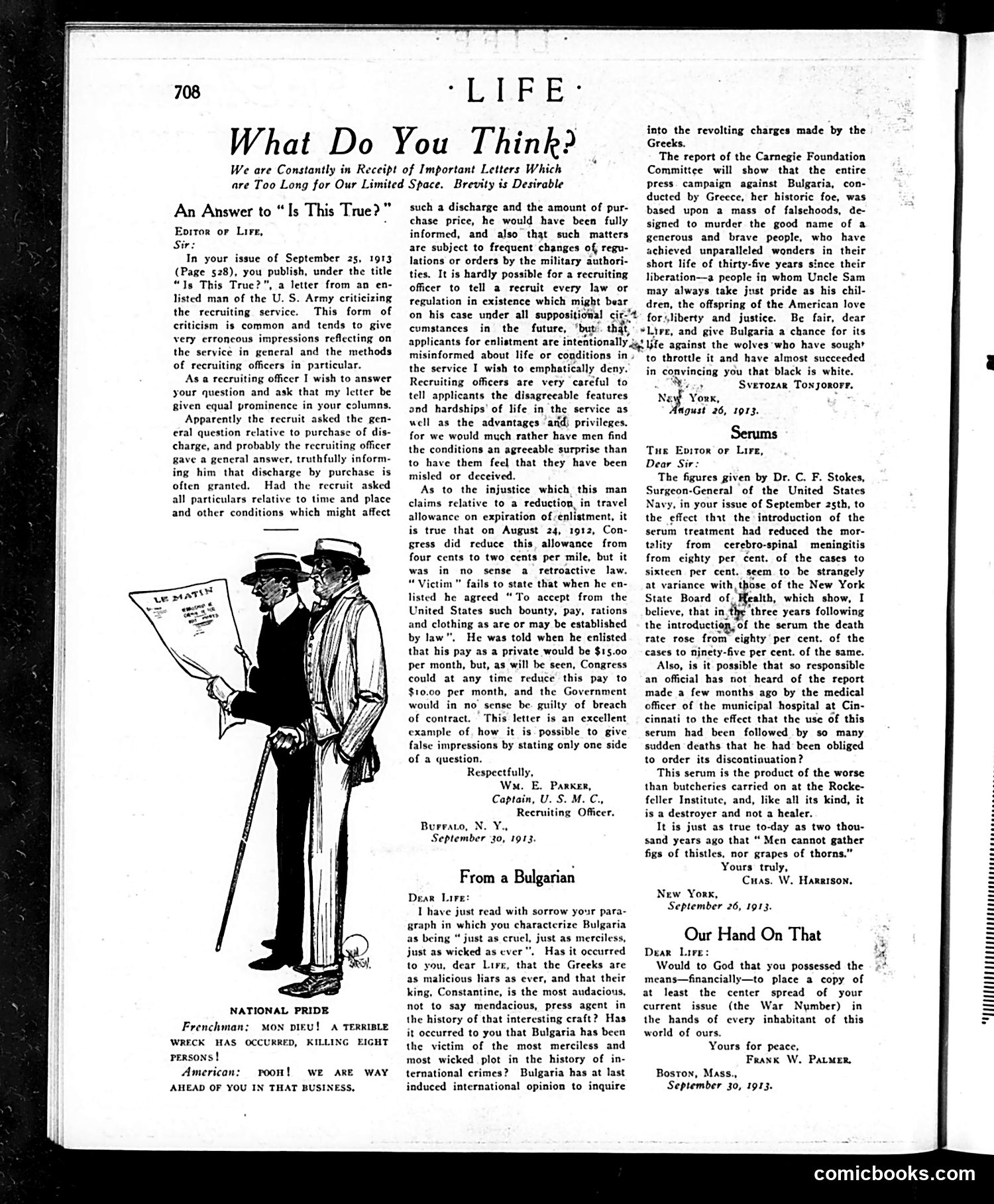
This page contains a "Letters to the Editor" section from Life magazine (October 1913), plus one political cartoon. ## The Cartoon The small cartoon at bottom left depicts a **Frenchman and American comparing railway disasters**. The Frenchman reports eight deaths; the American boasts "We are way ahead of you in that business." This satirizes American exceptionalism and competitiveness taken to absurd extremes—treating even tragic deaths as a competitive ranking. ## The Letters The main content addresses three topics: 1. **Army Recruiting** — A recruiting officer defends the service against claims that recruiters mislead soldiers about pay and discharge procedures, arguing the original complainant asked incomplete questions. 2. **Bulgaria** — A correspondent defends Bulgaria against Greek propaganda, calling accusations "falsehoods" and praising Bulgarians as worthy of American support. 3. **Serums** — A doctor discusses new serum treatments for meningitis, noting mortality reductions. The page illustrates how Life functioned as a forum for public debate on military, diplomatic, and scientific issues of the day.
📄 Transcribed text from this page (OCR, searchable)
Machine-transcribed from the original scan — historical spelling and the odd misread are preserved.
LIFE What Do You Think? We are Constantly in Receipt of Important Letters Which are Too Long for Our Limited Space. Brevity is Desirable An Answer to “Is This True?” Eorror or Lire, Sir: In your issue of September 25, 1913 (Page 528), you publish, under the title “Js This True?”, a letter from an en- listed man of the U. S. Army criticizing the recruiting service. This form of criticism is common and tends to give very erroncous impressions reflecting on the service in general and the methods of recruiting officers in particular. As a recruiting officer I wish to answer. your question and ask that my letter be given equal prominence in your columns. Apparently the recruit asked the gen- eral question relative to purchase of dis- charge, and probably the recruiting officer gave a general answer, truthfully inform- ing him that discharge by purchase is often granted. Had the recruit asked all particulars relative to time and place and other conditions which might affect NATIONAL PRIDE Frenchman; MON DIEU! A TERRIBLE WRECK HAS OCCURRED, KILLING EIGHT PERSONS! American: Poon! WE ARE WAY AHEAD OF YOU IN THAT BUSINESS, such a discharge and the amount of pur- chase price, he would have been fully informed, and also that such matters are subject to frequent changes of regu- lations or orders by the military authori- ties. It is hardly possible for a recruiting officer to tell a recruit every law or regulation in existence which might bear on his case under all suppositional ¢i cumstances in the future, but’ that into the revolting charges made by the Greeks. The report of the Carnegie Foundation Committce will show that the entire press campaign against Bulgaria, con- ducted by Greece, her historic foe, was based upon a mass of falsehoods, de- signed to murder the good name of a generous and brave people, who have achieved unparalleled wonders in their short life of thirty-five years since their liberation—a people in whom Uncle Sam may always take just pride as his chil- dren, the offspring of the American love for, liberty and justice. Be fair, dear “Live, and give Bulgaria a chance for its applicants for enlistment are intentionally ig! iife against the wolves ‘who have sought misinformed about life or conditions in. the service I wish to emphatically deny. Recruiting officers are very careful to tell applicants the disagreeable features ond hardships’ of life in the service as well as the advantages and) privileges. for we would much rather have men find the conditions an agreeable surprise than to have them feel that they have been misled or deceived. As to the injustice which this man claims relative to a reduction, in travel allowance on expiration of-enlistment, it is true that on August 24, 1912, Con- gress did reduce this allowance from four cents to two cents per mile, but it was in no sense a retroactive law. “Victim” fails to state that when he en- listed he agreed “To accept from the nited States such bounty, pay, rations and clothing as are or may be established by law", He was told when he enlisted that his pay as a private would be $15.00 per month, but, as will be seen, Congress could at any time reduce this pay to $10.00 per month, and the Government would in no sense be. guilty of breach of contract. This letter is an excellent example of how it is possible to give false impressions by stating only one side of a question. Respectfully, Wat. E. Parker, Captain, U. S. M. C., Recruiting Officer. Burrato, N. Y., September 30, 1913. From a Bulgarian Dear Lire: I have just read with sorrow your para- graph in which you characterize Bulgaria as being “ just as cruel, just as merciless, just as wicked as ever". Has it occurred to you, dear Lire, that the Greeks are as malicious liars as ever, and that their king, Constantine, is the most audacious, not to say mendacious, press agent in the history of that interesting craft? Has it occurred to you that Bulgaria has been the victim of the most merciless and most wicked plot in the history of in- ternational crimes? Bulgaria has at last induced international opinion to inquire to throttle it and have almost succeeded in convincing you that black is white. ey Svetozar Toxjororr. York, ingust 26, 1913. Serums Tus Evitor or Lire, Dear Sir: The figures given by Dr. C. F. Stokes, Surgeon-General of the United States Navy, in your issue of September 2sth, to the effect that the introduction of the serum treatment had reduced the mor- tality from cerebro-spinal meningitis from eighty per cent. of the cases to sixteen per cent. seem to be strangely at variance with, those of the New York State Board of, Health, which show, I believe, that in,thy ‘three years following the introduction/of the serum the death rate rose from eighty per cent. of the cases to ninety-five per cent. of the same. Also, is it possible that so responsible an official has not heard of the report made a few months ago by the medical officer of the municipal hospital at Cin- cinnati to the effect that the use of this serum had been followed by so many sudden deaths that he had been obliged to order its discontinuation? This serum is the product of the worse than butcheries carried on at the Rocke- feller Institute, and, like all its kind, it is a destroyer and not a healer. It is just as true to-day as two thou- sand years ago that “ Men cannot gather figs of thistles, nor grapes of thorns.” Yours truly, Cutas. W. Hartson. New York, September 26, 1913. Our Hand On That Dear Lire: Would to God that you possessed the means—financially—to place a copy of at least the center spread of your current issue (the War Number) in the hands of every inhabitant of this world of ours. Yours for peace, Frank W. PaLMer. Boston, Mass., September 30, 1913. comicbooks.com MI TTTTTLTTT ATT TTTTTTTTTTT