
Life, 1913-10-23 · page 22 of 40
Life — October 23, 1913 — page 22: what you’re looking at
What you’re looking at
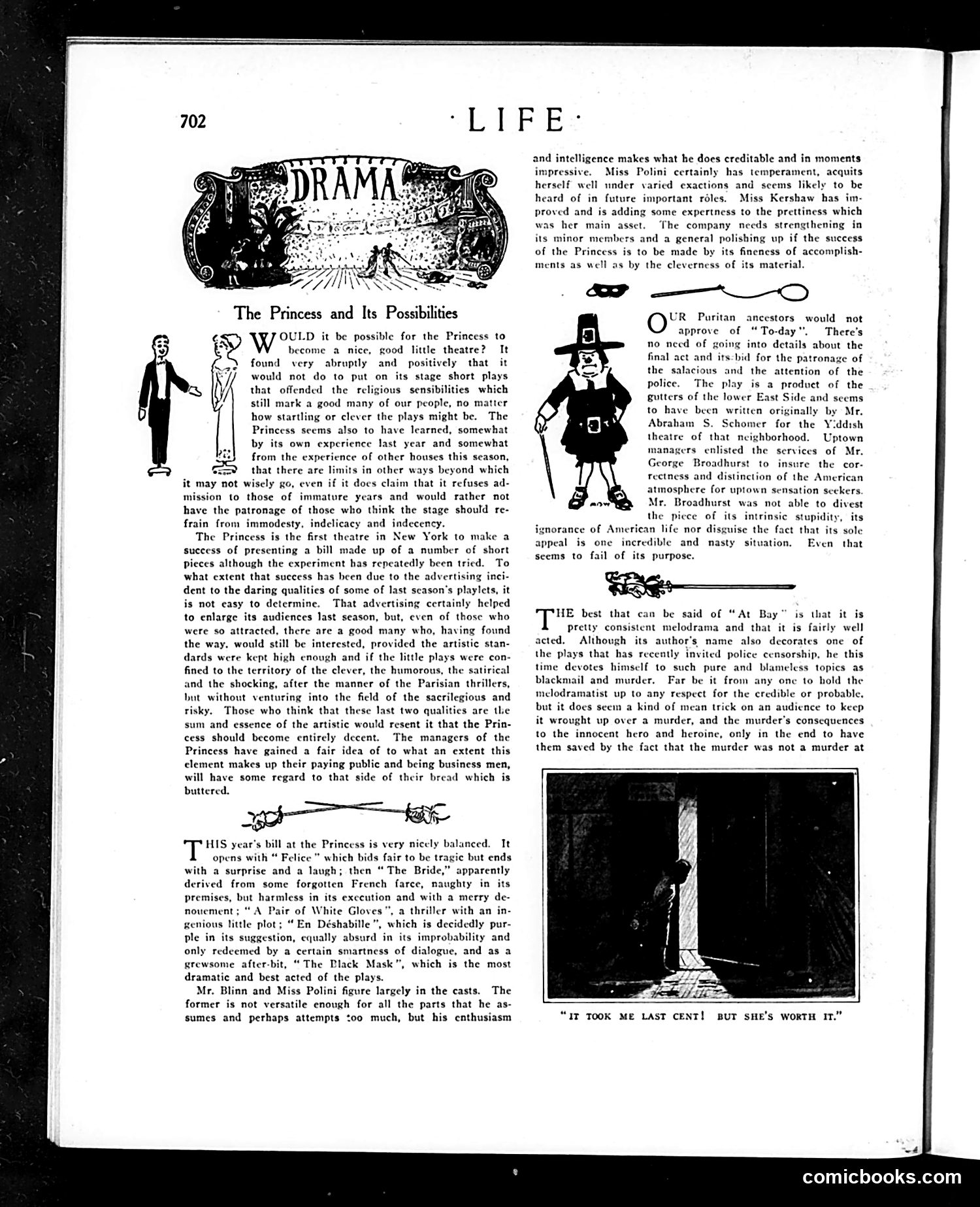
This page reviews the Princess Theatre's programming strategy. The article discusses whether the theater—which had gained attention for edgy, risqué short plays—should become more respectable while maintaining artistic quality. The critic acknowledges the theater's success comes partly from controversy and "daring qualities," but argues it could sustain audiences through clever, satirical material without venturing into "sacrilegious and risky" territory. The review balances this pragmatism: managers understand their paying public includes those attracted to scandal, but quality work could retain audiences too. The review then critiques the current bill's balance—plays like "Felice" and "The Bride" (described as "naughty" but "harmless")—and praises performers Miss Polini and Miss Kershaw while noting actor Blinn overextends himself. A sidebar condemns "To-day," a production pandering to "salacious" interests for police attention, reflecting the Puritan moral anxieties the theater navigates.
📄 Transcribed text from this page (OCR, searchable)
Machine-transcribed from the original scan — historical spelling and the odd misread are preserved.
“LEP Es The Princess and Its Possibilities OULD it be possible for the Princess to y become a nice, good little theatre? It found very abruptly and positively that it would not do to put on its stage short plays that offended the religious sensibilities which still mark a good many of our people, no matter how startling or clever the plays might be. The Princess seems also to have learned, somewhat by its own experience last year and somewhat from the experience of other houses this season, Sse that there are limits in other ways beyond which it may not wisely go, even if it docs claim that it refuses ad- mission to those of immature years and would rather not have the patronage of those who think the stage should re- frain from immodesty, indelicacy and indecency. is the first theatre in New York to make a success of presenting a bill made up of a number of short pieces although the experiment has repeatedly been tried. To what extent that success has been due to the advertising inci- dent to the daring qualities of some of last season's playlets, it is not easy to determine. That advertising certainly helped to enlarge its audiences last season, but, even of those who were so attracted, there are a good many who, having found the way. would still be interested, provided the artistic stan- dards were kept high enough and if the little plays were con- fined to the territory of the clever, the humorous, the satirical and the shocking, after the manner of the Parisian thrillers, but without venturing into the field of the sacrilegious and risky. Those who think that these last two qualities are the sum and essence of the artistic would resent it that the Prin- cess should become entirely decent. The managers of the Princess have gained a fair idea of to what an extent this clement makes up their paying public and being business men, will have some regard to that side of their bread which is buttered. HIS year’s bill at the Princess is very nicely balanced. It opens with “ Felice ” which bids fair to be tragic but ends ith a surprise and a laugh; then “The Bride,” apparently derived from some forgotten French farce, naughty in its premises, but harmless in its exccution and with a merry de- noucment; “A Pair of White Gloves”, a thriller with an in- genious little plot; “En Déshabille”, which is decidedly pur- ple in its suggestion, equally absurd in its improbability and only redeemed by a certain smartness of dialogue, and as a grewsome after-bit, “The Black Mask”, which is the most dramatic and best acted of the plays. Mr. Blinn and Miss Polini figure largely in the casts. The former is not versatile enough for all the parts that he as- sumes and perhaps attempts oo much, but his enthusiasm and intelligence makes what he does creditable and in moments impressive. Miss Polini certainly has temperament, acquits herself well under varied exactions and scems likely to be heard of in future important rdles. Miss Kershaw has im- proved and is adding some expertness to the prettiness which was her main asset. ‘The company needs strengthening in its minor members and a general polishing up if the success of the Princess is to be made by its fineness of accomplish- ments as well as by the cleverness of its material. ET o_O UR Puritan ancestors would not approve of “ To-day". There's no need of going into details about the final act and its-bid for the patronage of the salacious and the attention of the police. The play is a product of the gutters of the lower East Side and seems to have been written originally by Mr. Abraham $. Schomer for the Yiddish theatre of that neighborhood. Uptown managers enlisted the services of Mr. George Broadhurst to insure the cor- rectness and distinction of the American atmosphere for uptown sensation seekers Mr. Broadhurst was not able to divest the piece of its intrinsic stupidity, its ignorance of American life nor disguise the fact that its sole appeal is one incredible and nasty situation. Even that seems to fail of its purpose. ge—__— HE best that can be said of “At Bay” is that it is Pretty consistent melodrama and that it is fairly well acted. Although its author's name also decorates one of the plays that has recently invited police censorship, he this time devotes himself to such pure and blameless topics as blackmail and murder. Far be it from any one to hold the melodramatist up to any respect for the credible or probable, but it does seem a kind of mean trick on an audience to keep it wrought up over a murder, and the murder’s consequences to the innocent hero and heroine, only in the end to have them saved by the fact that the murder was not a murder at “IT TOOK ME LAST CENT! BUT SHE'S WORTH IT.” comicbooks.com