
Life, 1913-10-23 · page 24 of 40
Life — October 23, 1913 — page 24: what you’re looking at
What you’re looking at
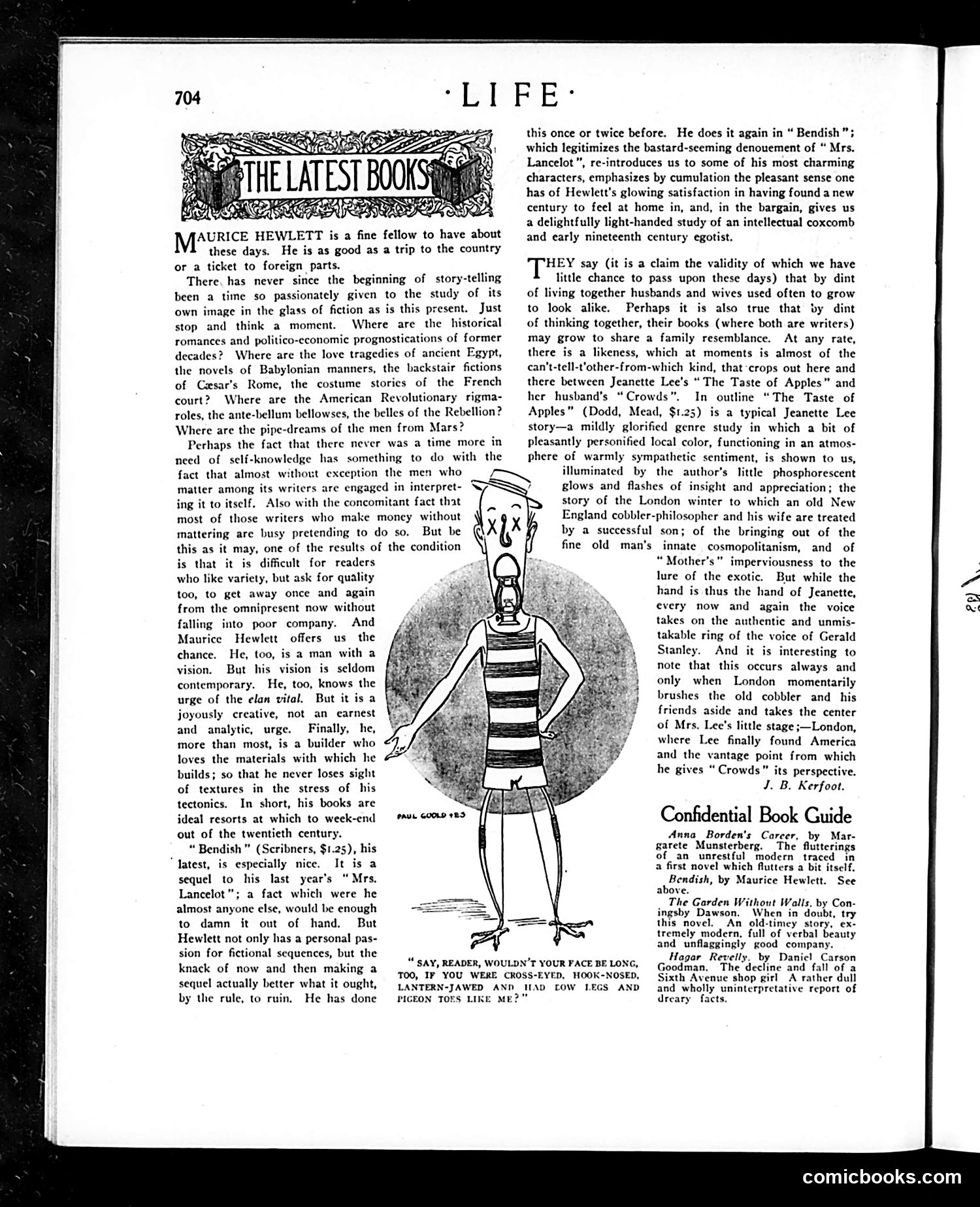
This page from *Life* magazine contains a book review section titled "The Latest Books." The main text discusses Maurice Hewlett's novel *Bendish*, praising his ability to offer escapism from contemporary concerns by setting stories in historical periods. The cartoon illustrates a satirical point: it depicts an extremely unattractive figure with an exaggerated long face, cross-eyes, hook nose, and thin legs. The caption reads: "Say, reader, wouldn't your face be long, too, if you were cross-eyed, hook-nosed, lantern-jawed and had low legs and pigeon toes like me?" The cartoon appears to mock physiognomy—the pseudo-scientific practice of judging character or worth by facial features. It's satirizing those who judge others based on physical appearance, suggesting such judgments are absurd. The figure's self-aware complaint about his grotesque features implies that appearance doesn't determine value or character.
📄 Transcribed text from this page (OCR, searchable)
Machine-transcribed from the original scan — historical spelling and the odd misread are preserved.
MAtRICE HEWLETT is a fine fellow to have about these days. He is as good as a trip to the country or a ticket to foreign parts. There, has never since the beginning of story-telling been a time so passionately given to the study of its own image in the glass of fiction as is this present. Just stop and think a moment. Where are the historical romances and politico-economic prognostications of former decades? Where are the love tragedies of ancient Egypt, the novels of Babylonian manners, the backstair fictions of Czsar’s Rome, the costume storics of the French court? Where are the American Revolutionary rigma- roles, the ante-bellum bellowses, the belles of the Rebellion? Where are the pipe-dreams of the men from Mars? Perhaps the fact that there never was a time more in need of self-knowledge has something to do with the fact that almost withe exception the men who matter among its writers are engaged in interpret- ing it to itself. Also with the concomitant fact that most of those writers who make money without mattering are busy pretending to do so. But be this as it may, one of the results of the condition is that it is difficult for readers who like variety, but ask for quality too, to get away once and again from the omnipresent now without falling into poor company. And Maurice Hewlett offers us the chance. He, too, is a man with a vision. But his vision is seldom contemporary. He, too, knows the urge of the elan vital. But it is a joyously creative, not an earnest and analytic, urge. Finally, he, more than most, is a builder who loves the materials with which he builds; so that he never loses sight of textures in the stress of his tectonics. In short, his books are ideal resorts at which to week-end out of the twentieth century. “ Bendish” (Scribners, $1.25), his “atest, is especially nice. It is a sequel to his last year’s “ Mrs, Lancelot”; a fact which were he almost anyone else, would be enough to damn it out of hand. But Hewlett not only has a personal pas- sion for fictional sequences, but the knack of now and then making a sequel actually better what it ought, 4 LANTERN-JAWED AND by the rule, to ruin. He has done PIGEON TOES LIk “SAY, READER, WOULDN'T YOUR FACE BE LON| T00, IF YOU WERE CROSS-EYED, HOOK-NOSED, EME? FE this once or twice before. He does it again in “ Bendish ”; which legitimizes the bastard-seeming denouement of “ Mrs. Lancelot”, re-introduces us to some of his most charming characters, emphasizes by cumulation the pleasant sense one has of Hewlett’s glowing satisfaction in having found a new century to feel at home in, and, in the bargain, gives us a delightfully light-handed study of an intellectual coxcomb and early nineteenth century egotist. HEY say (it is a claim the validity of which we have little chance to pass upon these days) that by dint of living together husbands and wives used often to grow to look alike. Perhaps it is also true that by dint of thinking together, their books (where both are writers) may grow to share a family resemblance. At any rate, there is a likeness, which at moments is almost of the can't-tell-t’other-from-which kind, that‘crops out here and there between Jeanctte Lee’s “The Taste of Apples” and her husband’s “Crowds”. In outline “The Taste of Apples” (Dodd, Mead, $1.25) is a typical Jeanette Lee story—a mildly glorified genre study in which a bit of pleasantly personified local color, functioning in an atmos- phere of warmly sympathetic sentiment, is shown to us, illuminated by the author's little phosphorescent glows and flashes of insight and appreciation; the story of the London winter to which an old New England cobbler-philosopher and his wife are treated by a successful son; of the bringing out of the fine old man’s innate cosmopolitanism, and of “Mother's” imperviousness to the lure of the exotic. But while the hand is thus the hand of Jeanette, every now and again the voice takes on the authentic and unmis- takable ring of the voice of Gerald Stanley. And it is interesting to note that this occurs always and only when London momentarily brushes the old cobbler and his friends aside and takes the center of Mrs. Lee's little stage ;—London, where Lee finally found America and the vantage point from which he gives “ Crowds” its perspective. J. B. Kerfoot. Confidential Book Guide Anna Borden's Carcer, by Mar- garete Munsterberg. The flutterings of an unrestful modern traced in a first novel which flutters a bit itself. Bendish, by Maurice Hewlett. See above. The Garden Without Walls. by Con- ingsby Dawson. When in doubt, try this novel. An old-timey story, ex- tremely modern, full of verbal beauty and unflaggingly good company. Hagar Revelly. by Daniel Carson Goodman. The decline and fall of a Sixth Avenue shop girl A rather dull and wholly uninterpretative report of dreary. facts, HAD COW 1 AND comicbooks.com