
Life, 1913-10-23 · page 25 of 40
Life — October 23, 1913 — page 25: what you’re looking at
What you’re looking at
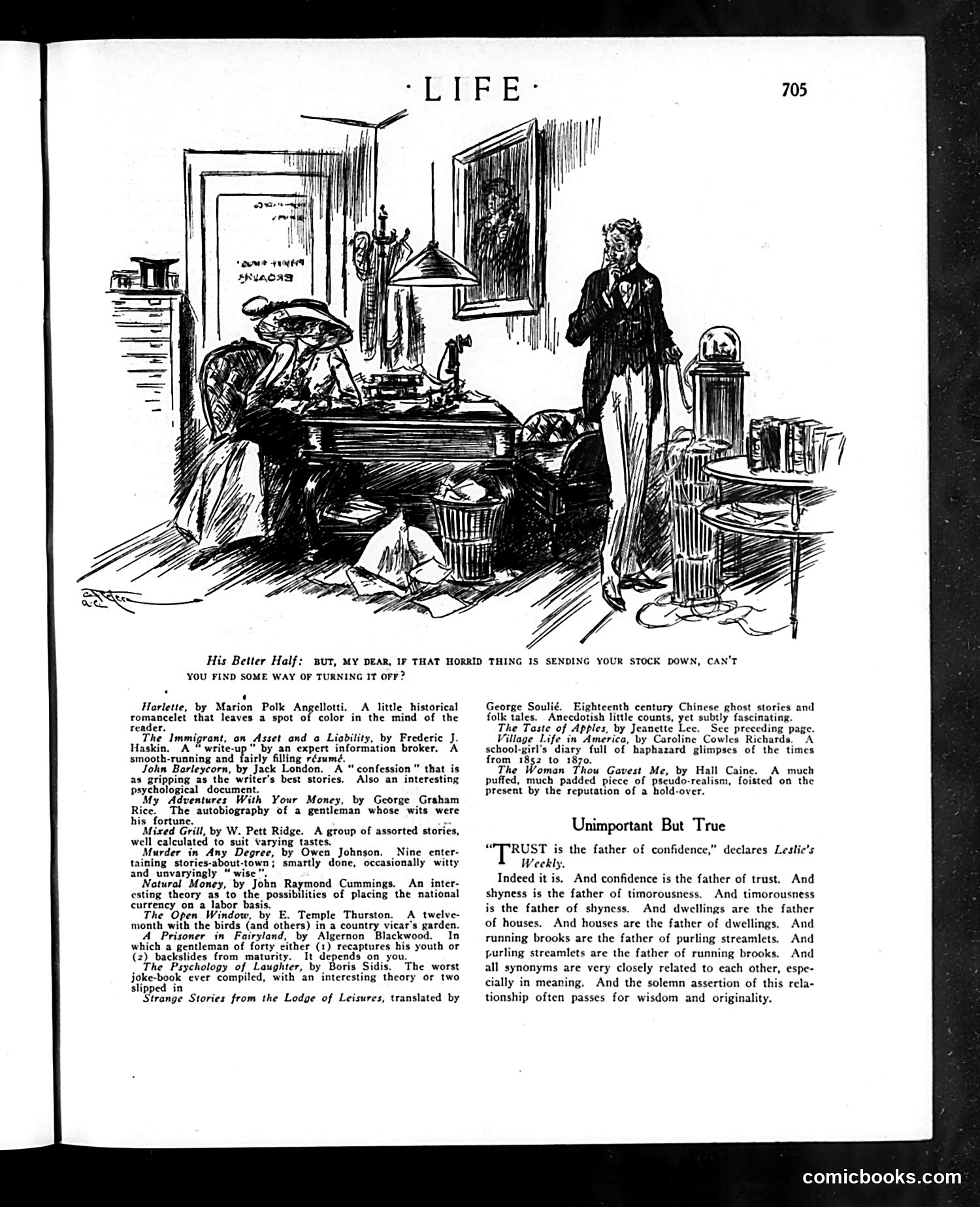
The sketch depicts a domestic scene where a wife asks her husband to find a way to stop "that horrid thing" from sending his stock down. The image shows a man at a desk surrounded by financial papers and what appears to be a ticker tape machine or stock ticker—the "thing" causing market turmoil. ## The Satire This mocks the helplessness of investors during stock market volatility. The wife's naive suggestion that her husband simply "turn off" the market mechanism satirizes both spousal incomprehension of financial matters and the broader public's frustration with forces beyond individual control. The cartoon suggests the absurdity of expecting to control impersonal market forces through personal action. The page also includes a sidebar titled "Unimportant But True" that mockingly tautological definitions (trust causes confidence, confidence causes trust), which appears to satirize pseudointellectual writing—suggesting the magazine critiques both financial anxiety and pretentious analysis.
📄 Transcribed text from this page (OCR, searchable)
Machine-transcribed from the original scan — historical spelling and the odd misread are preserved.
His Better Half: But, MY DEAR, IF THAT HORRID THING IS SENDING YOUR STOCK DOWN, CAN'T YOU FIND SOME WAY OF TURNING IT OFF? ‘ Harlette, by Marion Polk Angellotti. A_ little historical romancelet that leaves a spot of color in the mind of the reader. The Immigrant, an Asset and a Liability, by Frederic J. Haskin. A “ write-up" by an expert information broker. A smooth-running and fairly filling résumé. John Barleycorn, by Jack London. A “confession” that is as gripping as the writer's best stories, Also an interesting psychological document. My Adventures With Your Money, by Gcorge Graham Rice. The autobiography of a gentleman whose wits were his fortune. - Mixed Grill, by W. Pett Ridge. A group of assorted stories, well calculated to suit Varying tastes. Murder in Any Degree, by Owen Johnson. Nine enter- taining stories-about-town; smartly done, occasionally witty and unvaryingly “ wise”. Natural Money, by John Raymond Cummings. An inter- esting theory as to the possibilities of placing the national currency on a labor basis. The Open Window, by E. Temple Thurston. A twelve- month with the birds (and others) in a country vicar's garden. Prisoner in Fairyland, by Algernon Blackwood. In which a gentleman of forty either (1) recaptures his youth or (2) backslides from maturity. It depends on you. The Psychology of Laughter, by Boris Sidis. The worst joke-book ever compiled, with an interesting theory or two slipped in Strange Stories from the Lodge of Leisures, translated by George Soulié. Eighteenth century Chinese ghost stories and folk tales. Anecdotish little counts, yet subtly fascinating. The Taste of Apples, by Jeanette Lee. See preceding page. Village Life in America, by Caroline Cowles Richards. A school-girl’s diary full of haphazard glimpses of the times from ei to 1870. The Woman Thou Gavest Me, by Hall Caine. A much puffed, much padded piece of pseudo-realism, foisted on the present by the reputation of a hold-over. Unimportant But True ““TRUST is the father of confidence,” declares Leslie’s Weekly. Indeed it is. And confidence is the father of trust. And shyness is the father of timorousness. And timorousness is the father of shyness. And dwellings are the father of houses. And houses are the father of dwellings. And running brooks are the father of purling streamlets. And purling streamlets are the father of running brooks. And all synonyms are very closely related to each other, espe- cially in meaning. And the solemn assertion of this rela- tionship often passes for wisdom and originality. comicbooks.com