
A complete issue · 36 pages · 1913
Life — July 31, 1913
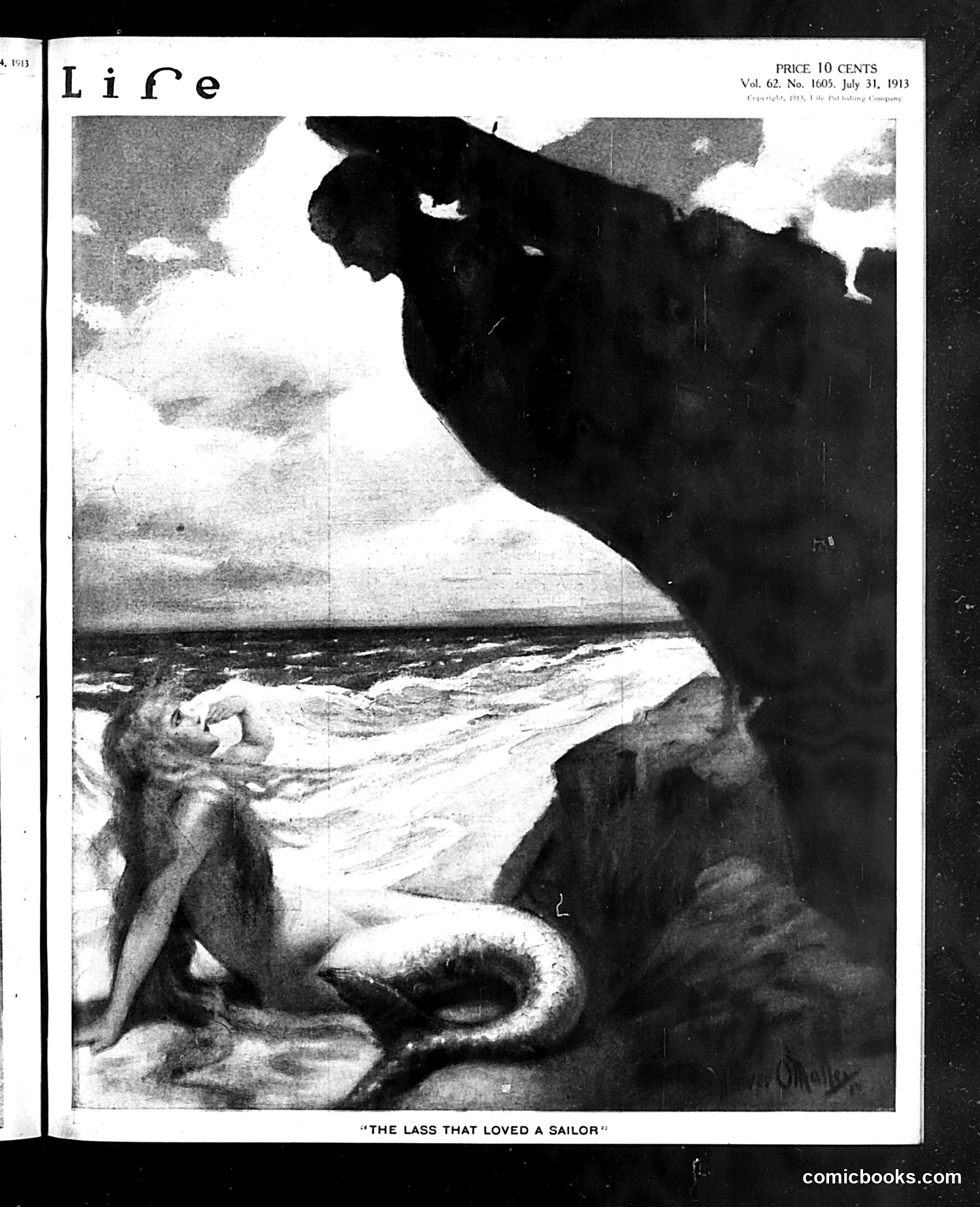
This 1913 Life magazine cover illustrates a romantic/melodramatic scene titled "The Lass That Loved a Sailor." The image depicts a woman in classical or allegorical style reclining on a beach, gazing toward a large ship on the horizon. The composition suggests a sentimental, somewhat tragic romantic narrative—likely commenting on themes of lost love or separation common to sailor-themed narratives of the era. The artwork appears to be a serious illustration rather than political satire, using classical artistic conventions to evoke romantic longing. Without additional context, the specific satirical point remains unclear, though Life magazine typically combined sentimental imagery with subtle social commentary about gender, class, or contemporary maritime affairs.
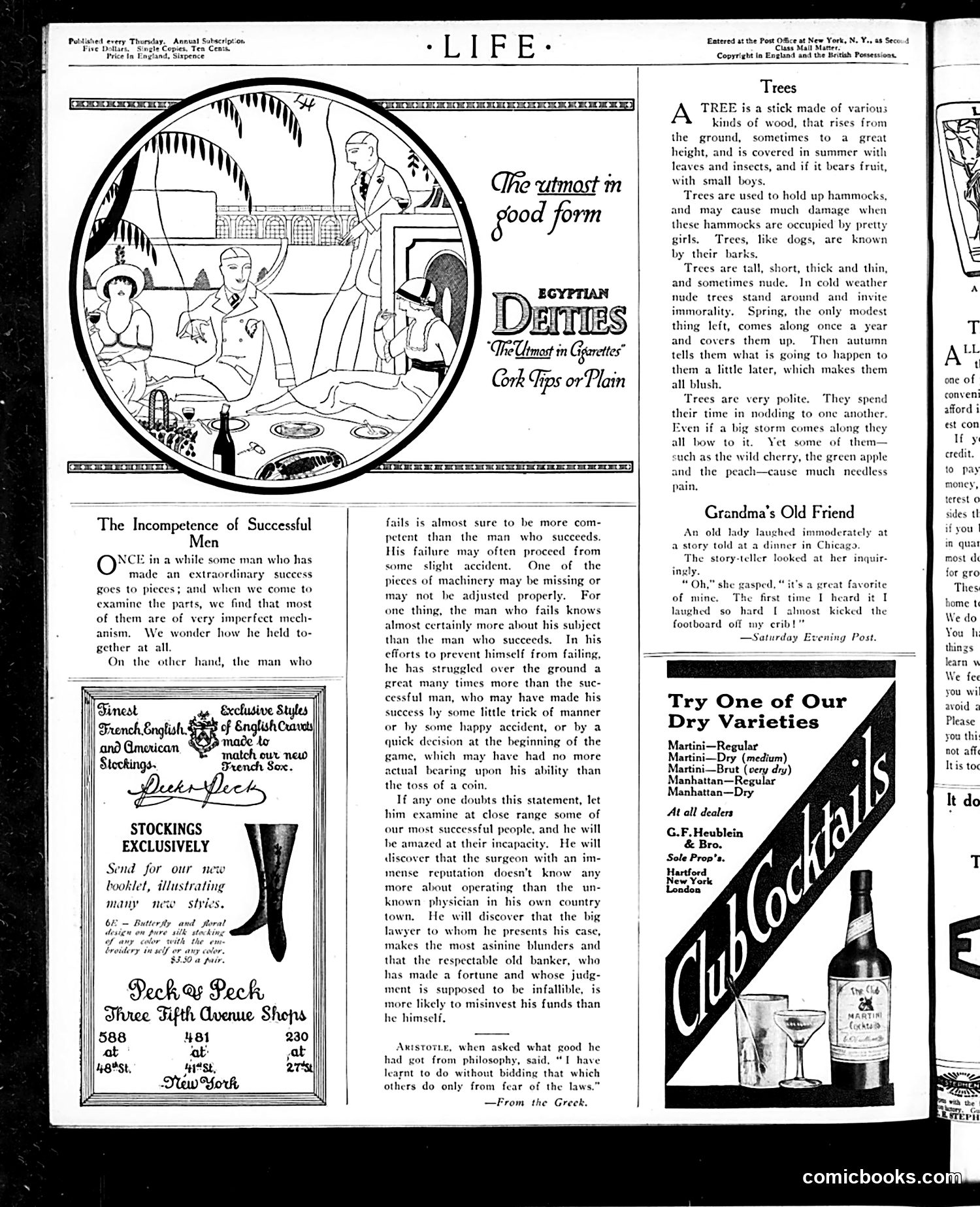
The main cartoon depicts an Egyptian-themed social scene with figures in classical dress. The advertisement reads "Egyptian Deities: The Utmost in Cigarettes, Cork Tips or Plain," using ancient Egypt as a marketing motif—common in the 1920s when Egyptian aesthetics were fashionable following Tutankhamun's tomb discovery (1922). The accompanying article "The Incompetence of Successful Men" argues that failure often teaches more than success, using business examples. It suggests that competent failures understand their mistakes better than successful men who may not comprehend their own operations. The page also advertises stockings by Peck & Peck and Chiclotts beverages. The content reflects 1920s consumer culture and business philosophy rather than explicit political satire.
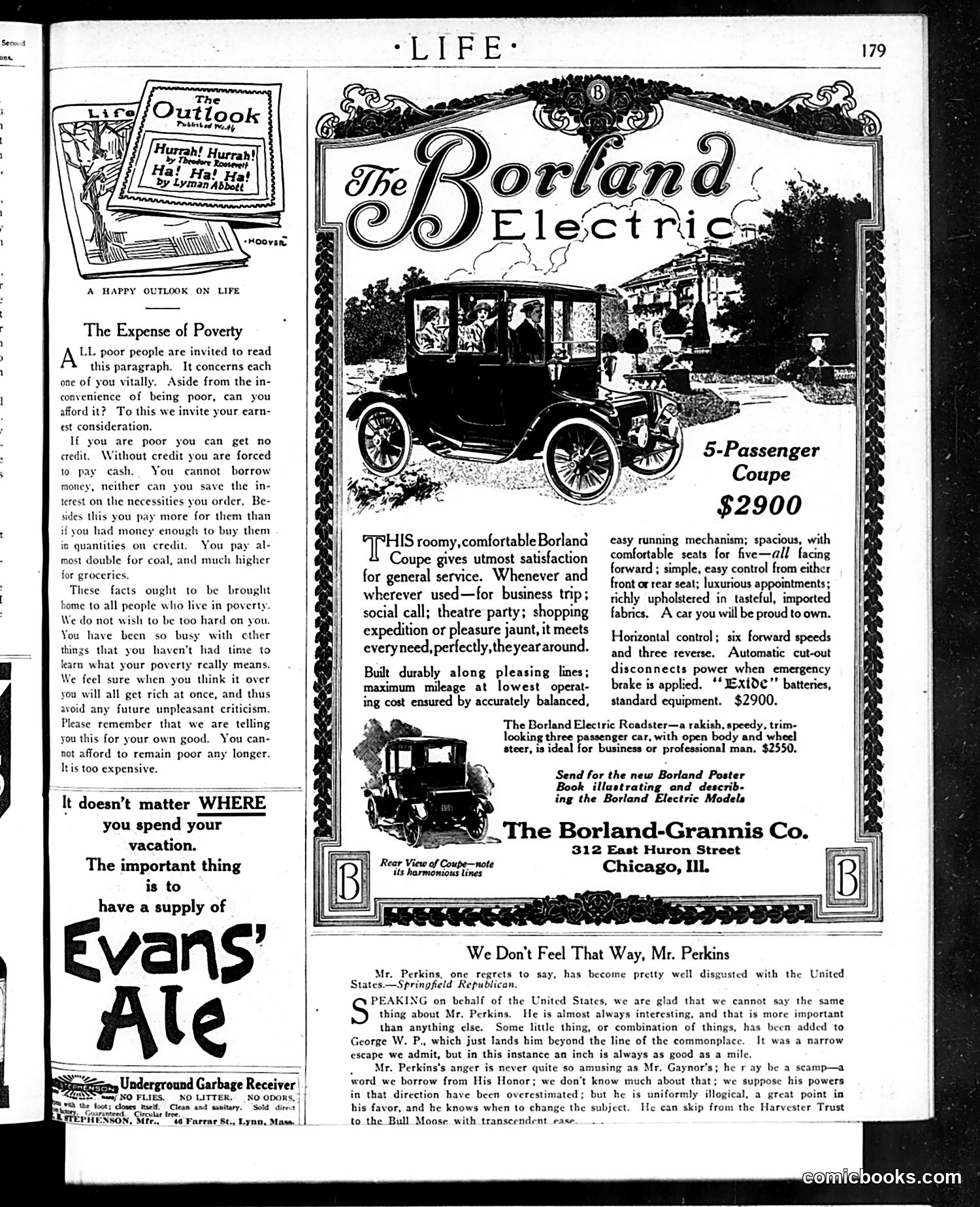
This page is primarily **advertising content** rather than political satire. The dominant feature is a Borland Electric automobile advertisement (5-Passenger Coupe, $2900), which occupies roughly two-thirds of the page. The upper left contains a small cartoon titled "A Happy Outlook on Life" about "The Expense of Poverty," presenting a somewhat patronizing message to poor readers about the advantages of poverty and creditworthiness. Below that is an Evans' Ale advertisement. The bottom article, "We Don't Feel That Way, Mr. Perkins," appears to reference someone named Perkins becoming "well disposed with the United States," though context for this political reference is unclear from the visible text. The page primarily reflects early 20th-century magazine economics: editorial content mixed with substantial advertising.
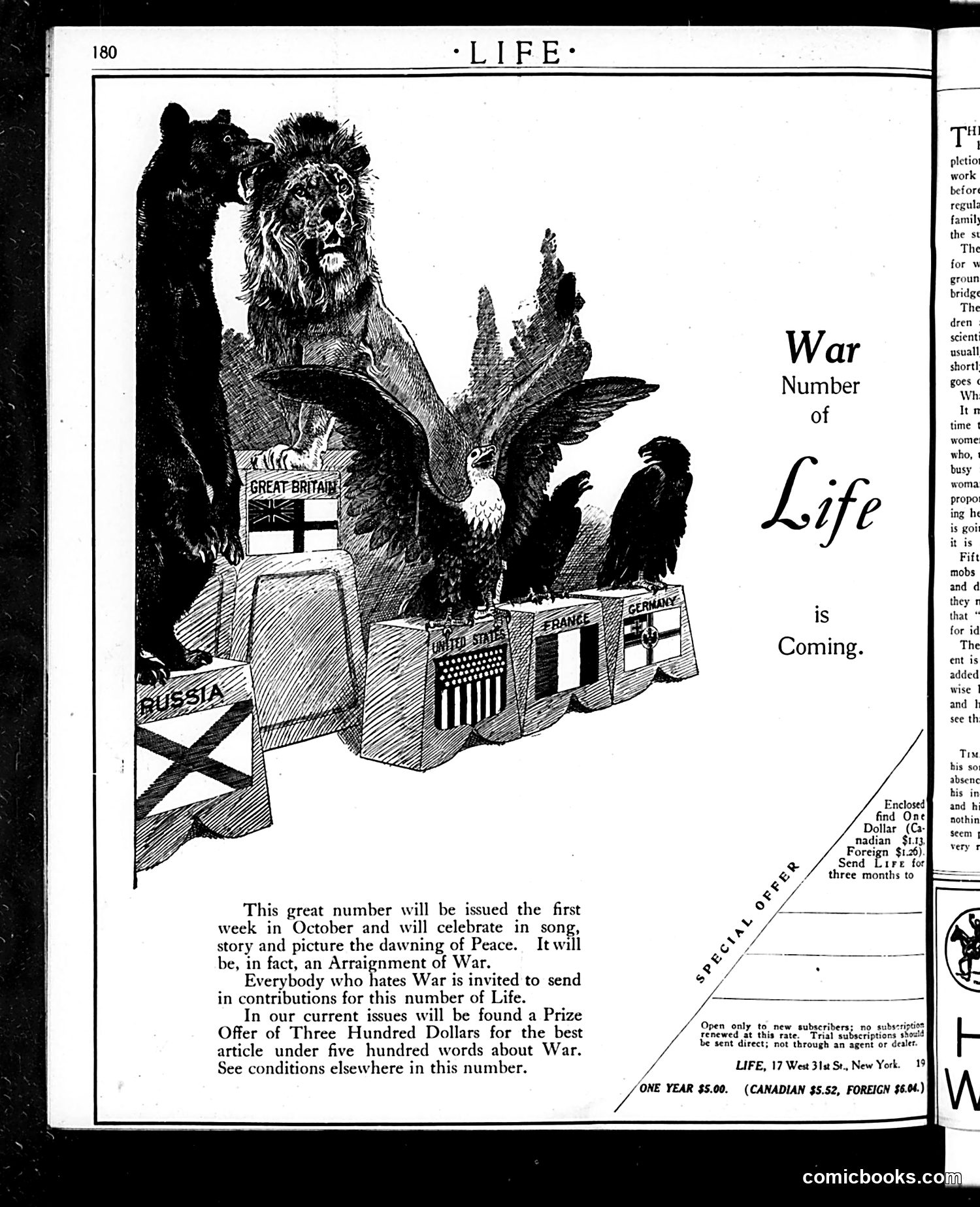
This page announces a special October issue of *Life* magazine devoted to war and peace. The central illustration depicts an allegorical lion (representing Great Britain, marked with its flag) restrained by a bear (likely Russia), while eagles perch nearby. Below them are fortifications labeled with the flags of the United States, Germany, and France, with "RUSSIA" crossed out at the base. The satire warns of impending conflict, presenting major world powers in confrontation. The *Life* editors invite contributions on war themes, offering a $300 prize for the best article under 500 words. This appears to be pre-WWI or WWI-era propaganda, using animal symbolism to visualize geopolitical tensions among European and American powers.
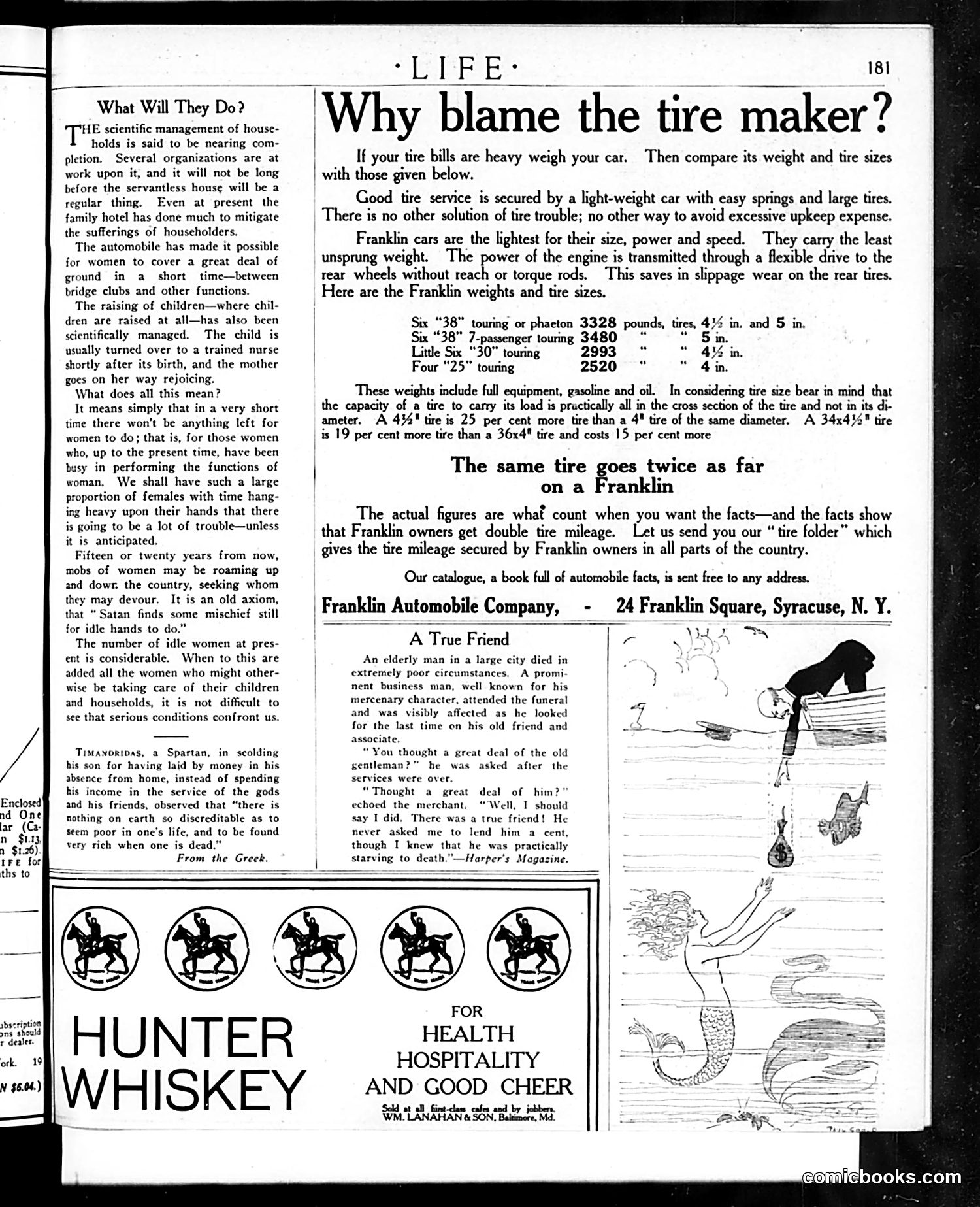
This page mixes advertising with social commentary. The main article "Why blame the tire maker?" is a Franklin automobile advertisement disguised as consumer advice, arguing that tire wear depends on car weight rather than tire quality—a marketing defense of Franklin cars' lightweight design. The left column discusses women's expanding social roles, predicting "mobs of women may be roaming up and down the country" seeking employment and independence. This reflects 1920s concerns about women's changing status post-suffrage. "A True Friend" (lower right) is a sentimental anecdote about loyalty during poverty, appearing to be filler content. The Hunter Whiskey advertisement at bottom uses period iconography (mounted hunter) to market alcohol "for health, hospitality and good cheer"—claims that would become illegal under Prohibition.
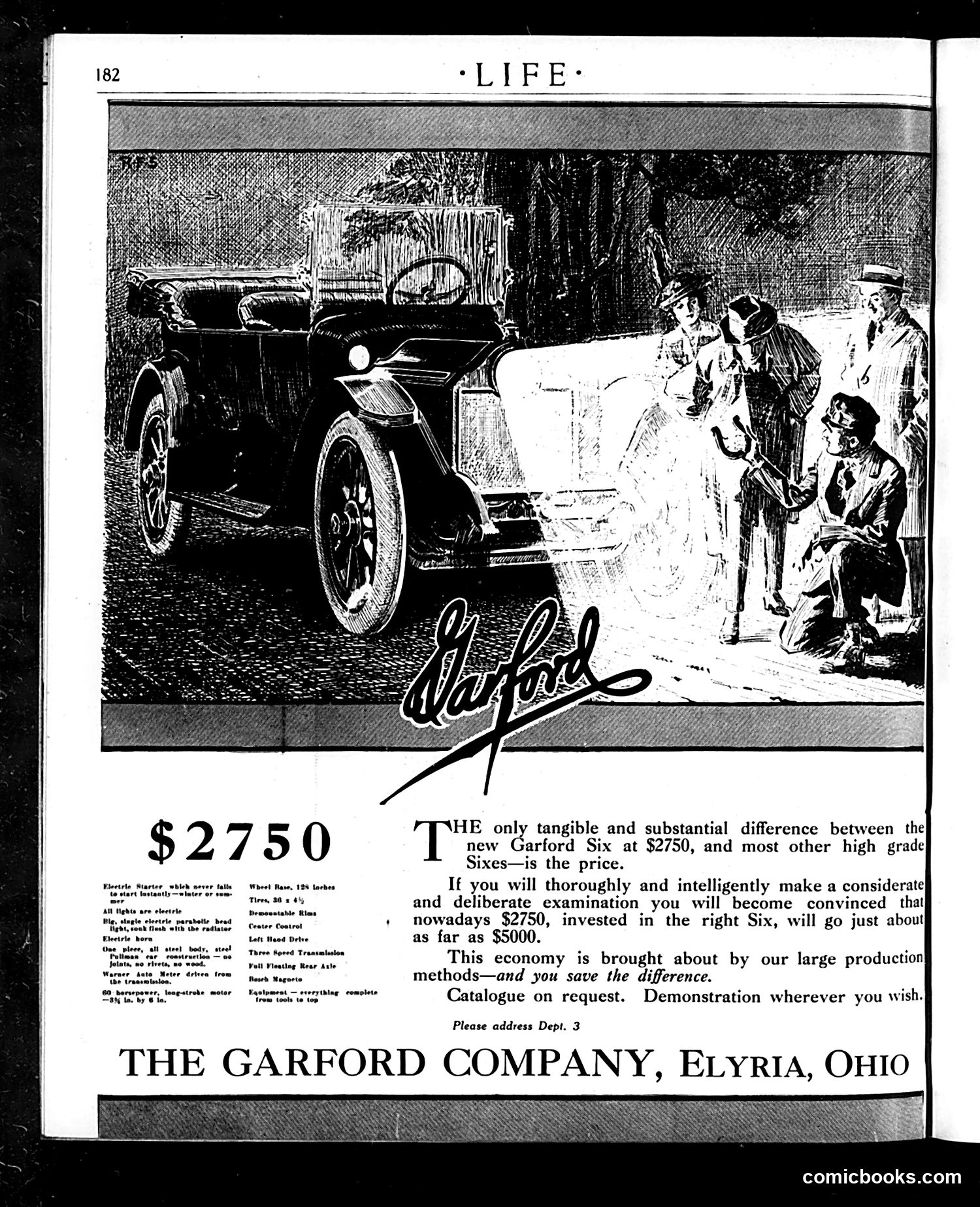
This page is **primarily an advertisement**, not satirical content. It's a full-page ad for the Garford Six automobile, priced at $2,750, published by The Garford Company of Elyria, Ohio. The illustration shows a touring car with well-dressed passengers and onlookers, a common marketing approach for early automobiles. The ad's "satire" is mild—it humorously claims the Garford's main distinction from competitors is simply price, then argues that thorough examination proves the value justifies the cost. The sales pitch emphasizes economy achieved through "large production methods." This reflects early 1910s automotive marketing: positioning mid-range cars as sensible purchases for affluent consumers. The page contains technical specifications in small print and offers demonstration opportunities, typical period advertising tactics.
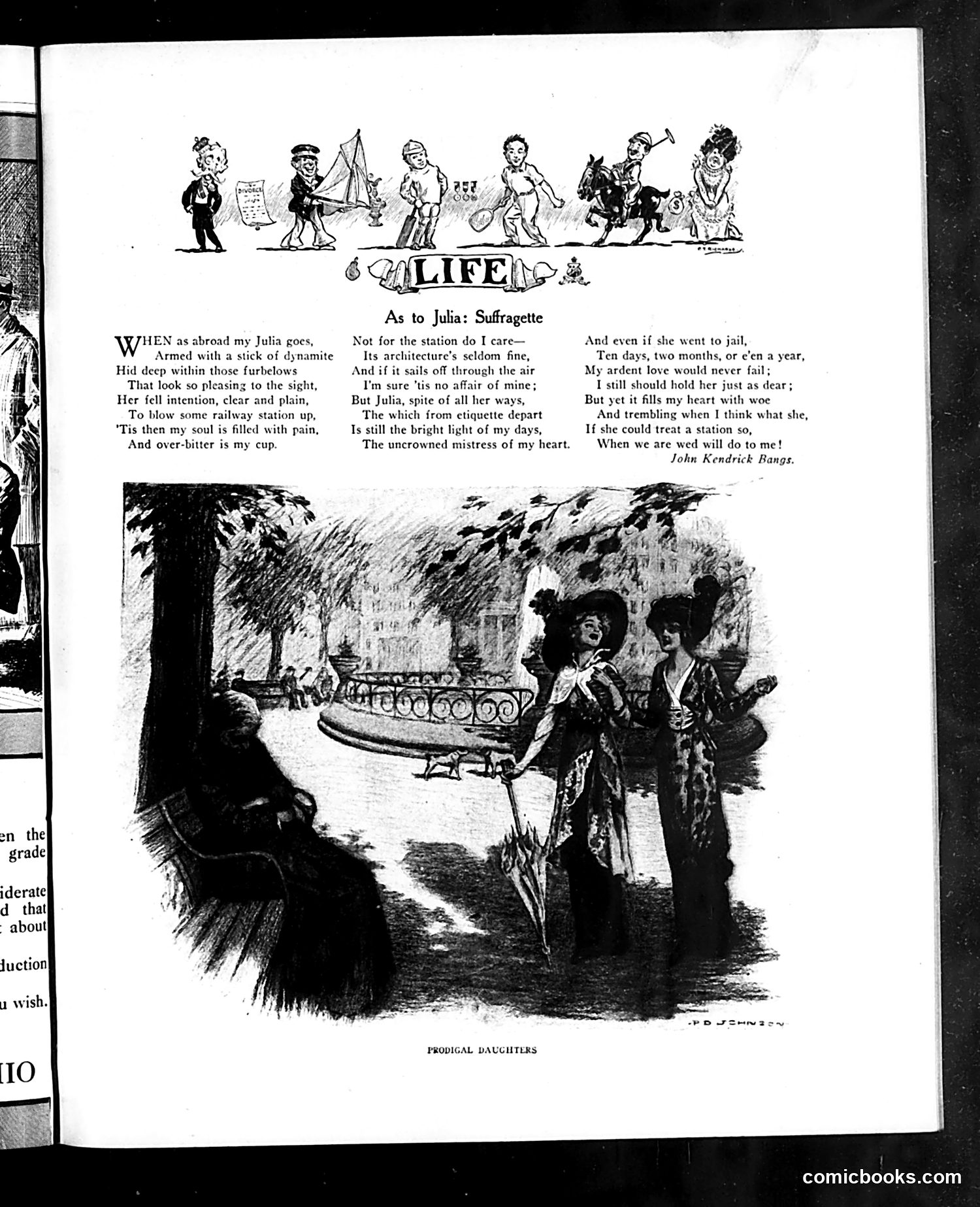
This page presents a poem by John Kendrick Bangs about a woman named Julia who is a suffragette (women's rights activist). The header illustration shows six caricatured figures representing different female stereotypes or roles. The poem expresses a man's conflicted feelings: he disapproves of Julia's suffrage activism and her neglect of traditional "feminine station," yet he cannot help loving her. He worries about her jail time and radical behavior, though he admits her passion "fills my heart with woe." The illustration below titled "Prodigal Daughters" appears to depict fashionable women in what seems a leisure setting, likely satirizing the lifestyle or perceived frivolousness of women activists or the "New Woman" of the early 20th century. The satire mocks both suffragettes and male anxiety about women's independence.
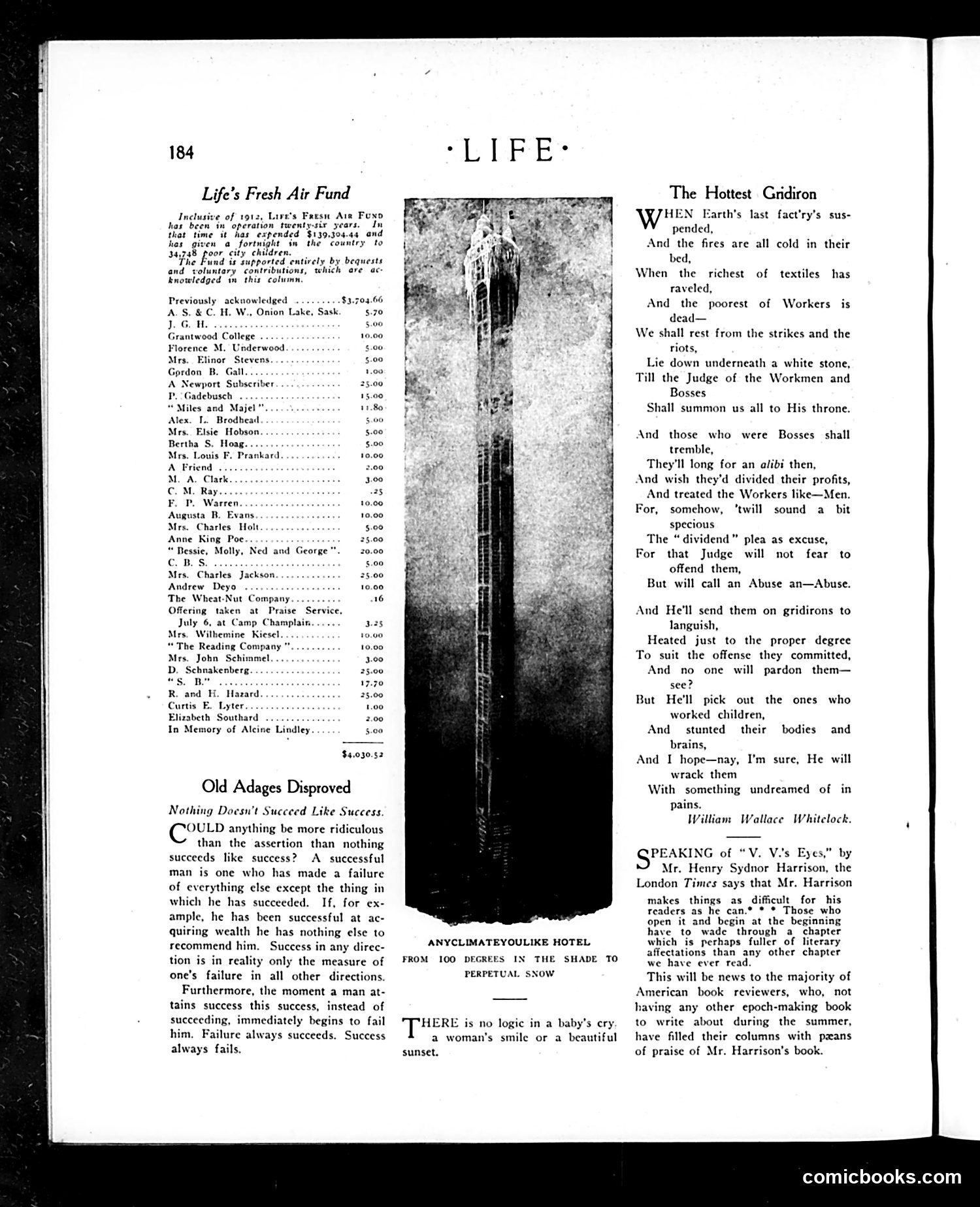
The central image shows the **Anyclimateyoulike Hotel**, described as offering temperatures "from 100 degrees in the shade to perpetual snow." This is a satirical advertisement mocking luxury hotels' claims of climate control and comfort. The page includes **"The Hottest Gridiron,"** a poem by William Wallace Whitlock criticizing factory owners and business "bosses" who exploit workers. The verse calls for divine judgment against those who mistreat laborers, references child labor ("stunted their bodies and brains"), and expresses hope for supernatural retribution—reflecting early 20th-century labor movement sentiment. **"Old Adages Disproved"** offers cynical commentary that "nothing doesn't succeed like success," suggesting life's paradoxes contradict conventional wisdom.
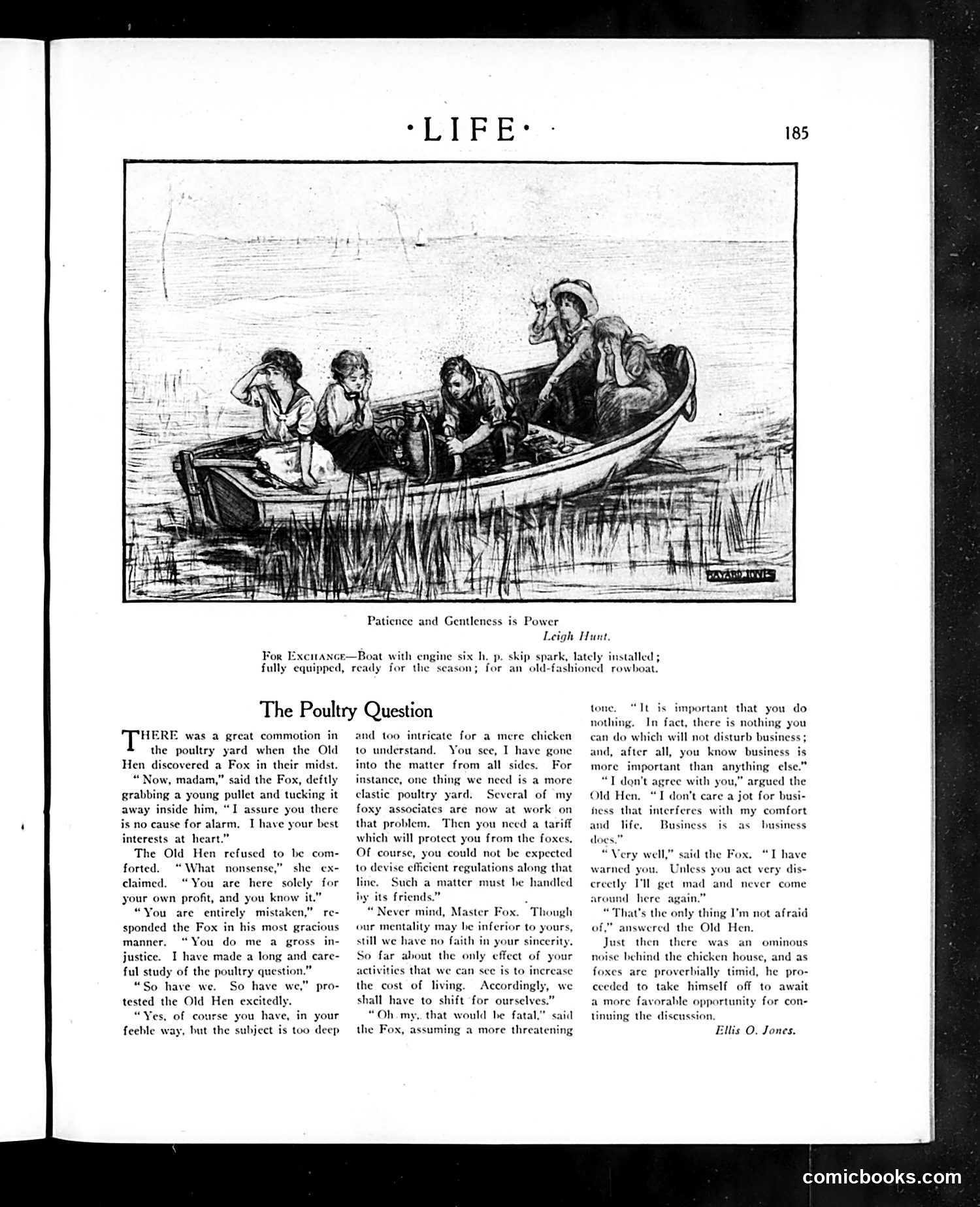
This is a fable illustrated with a sketch of foxes and a hen in a boat. The story, by Ellis O. Jones, uses poultry-yard conflict as allegory. An Old Hen discovers a Fox among her chickens and confronts him. The Fox argues that increased poultry regulations harm *everyone's* interests—his included—by raising living costs. He suggests they're "mentally inferior" to foxes but claims foxes won't succeed anyway, so everyone should cooperate and relax security. The satire likely reflects early 20th-century labor or business disputes, where a threatening party (the Fox) argues that strict protections or regulations hurt all sides economically. The Old Hen remains skeptical but is tempted by the Fox's appeal to "shared interest." The joke exposes manipulative rhetoric that asks the vulnerable to abandon self-protection for supposed mutual benefit.
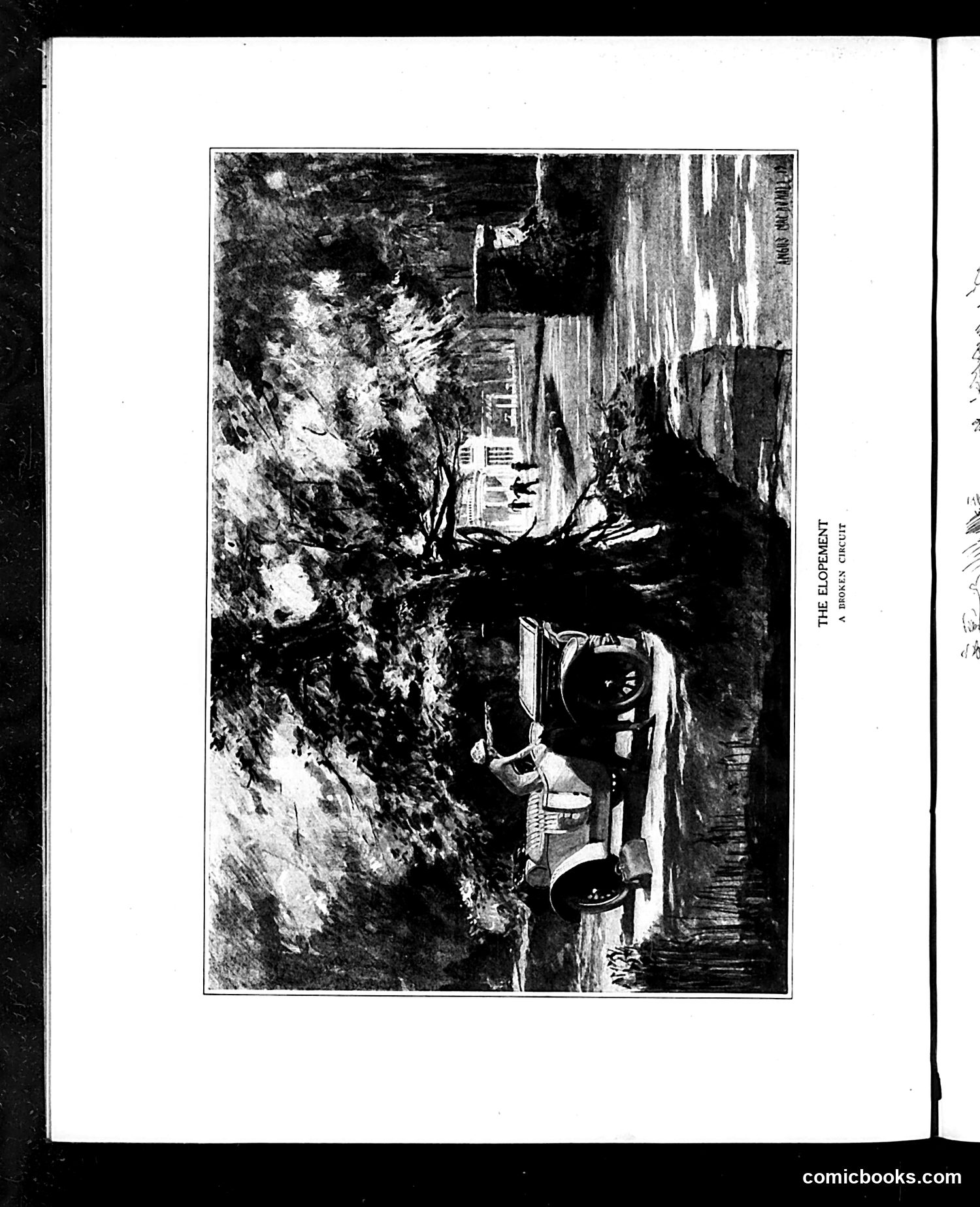
This appears to be a satirical illustration showing a nighttime street scene with a car and figures among bare trees. The title "The Elopement: A Brass Concert" suggests it's mocking a romantic runaway situation, likely treating it as noisy or disruptive ("brass concert" implies loud, brassy behavior). The image is oriented sideways on the page, depicting what appears to be an automobile—relatively modern technology for Life magazine's era—in a somewhat chaotic nighttime setting. Without additional context about the specific individuals being caricatured or the particular elopement referenced, the exact political or social satire remains unclear, though the tone suggests mockery of either the couple's behavior or contemporary automotive culture and romance.
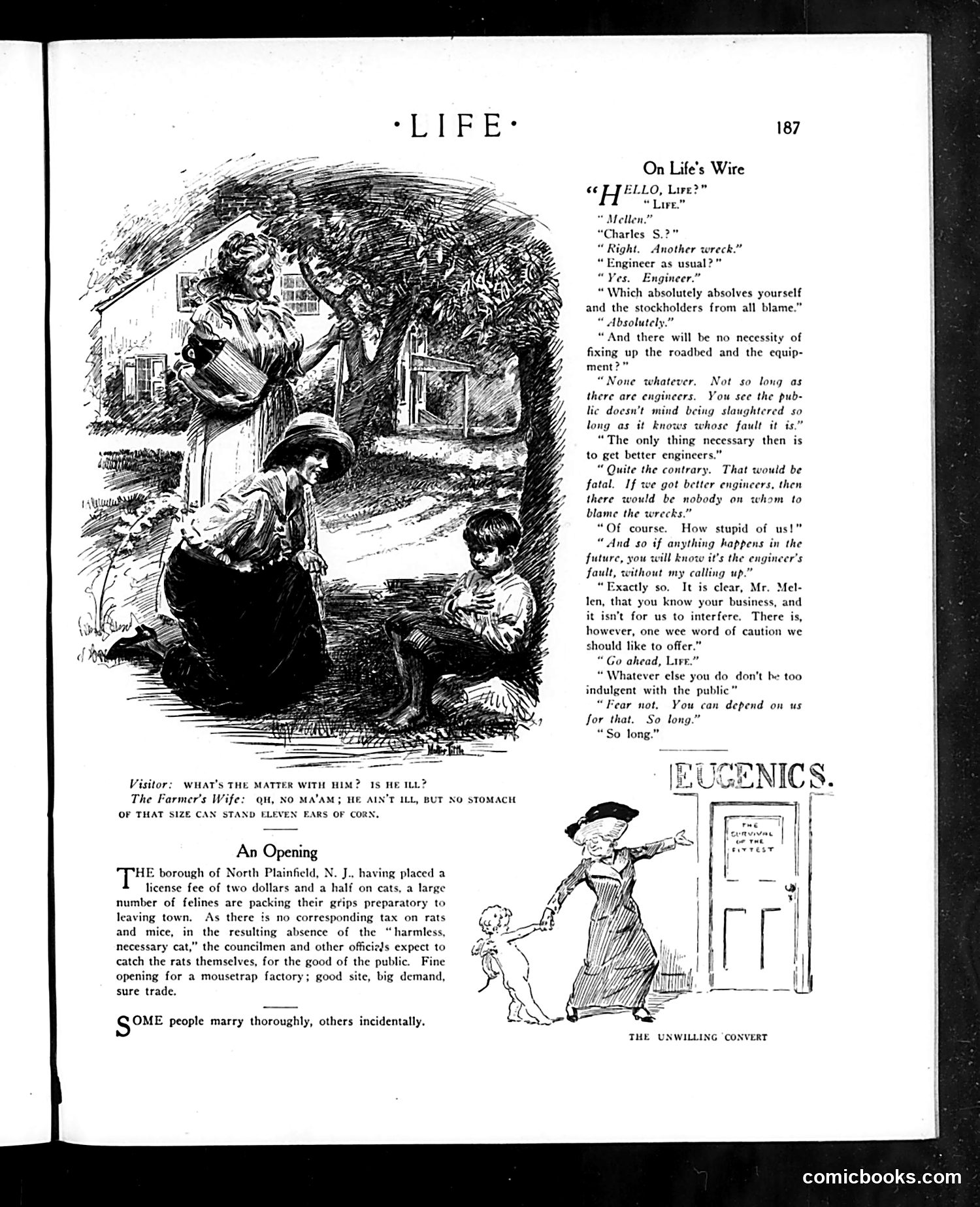
**Top Cartoon ("On Life's Wire"):** This depicts a dialogue between "Life" (personified as a woman) and "Mellен," an engineer discussing corporate liability. The satire critiques how engineers deflect responsibility for industrial accidents—the company blames the engineer, who blames poor colleagues, creating a chain where no one accepts accountability. The conversation warns against being "too indulgent with the public," suggesting corporations prioritize damage control over genuine safety improvements. **Bottom Section:** "An Opening" describes North Plainfield, N.J. licensing cat-killing services to control rodents—presenting this absurdist municipal policy as an entrepreneurial opportunity. The accompanying cartoon "The Unwilling Convert" (labeled "Eugenics") appears to satirize forced eugenic ideology, showing a figure coercing unwilling participation. Both pieces mock institutional evasion of responsibility and questionable "scientific" justifications for harmful policies.
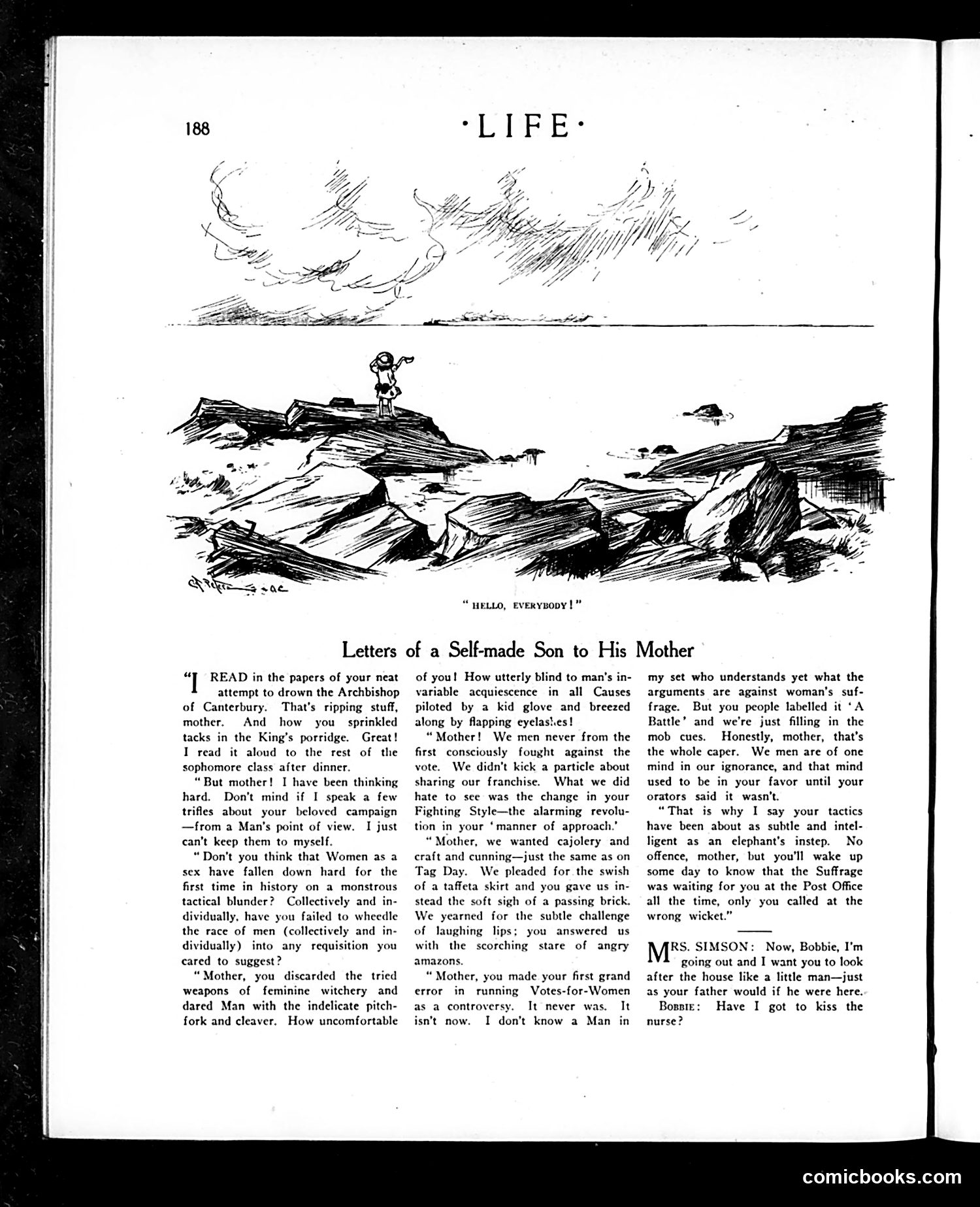
This page features a satirical article titled "Letters of a Self-made Son to His Mother," mocking anti-suffrage arguments. The son criticizes his mother's opposition to women's voting rights, calling her campaign tactics hypocritical and emotionally manipulative. The illustration shows a figure standing on wreckage, saying "HELLO, EVERYBODY!" — likely depicting someone surveying destruction, possibly referencing political or social upheaval. The text sarcastically attacks women opposing suffrage, accusing them of using "feminine witchery" and emotional manipulation ("the sable challenge of laughing lips") rather than logical argument. It references the "Votes-for-Women controversy" and "Fighting Style," suggesting this addresses early 20th-century suffrage debates. A brief dialogue at bottom between Mrs. Simson and Bobbie about a father figure provides comedic domestic counterpoint to the political satire.
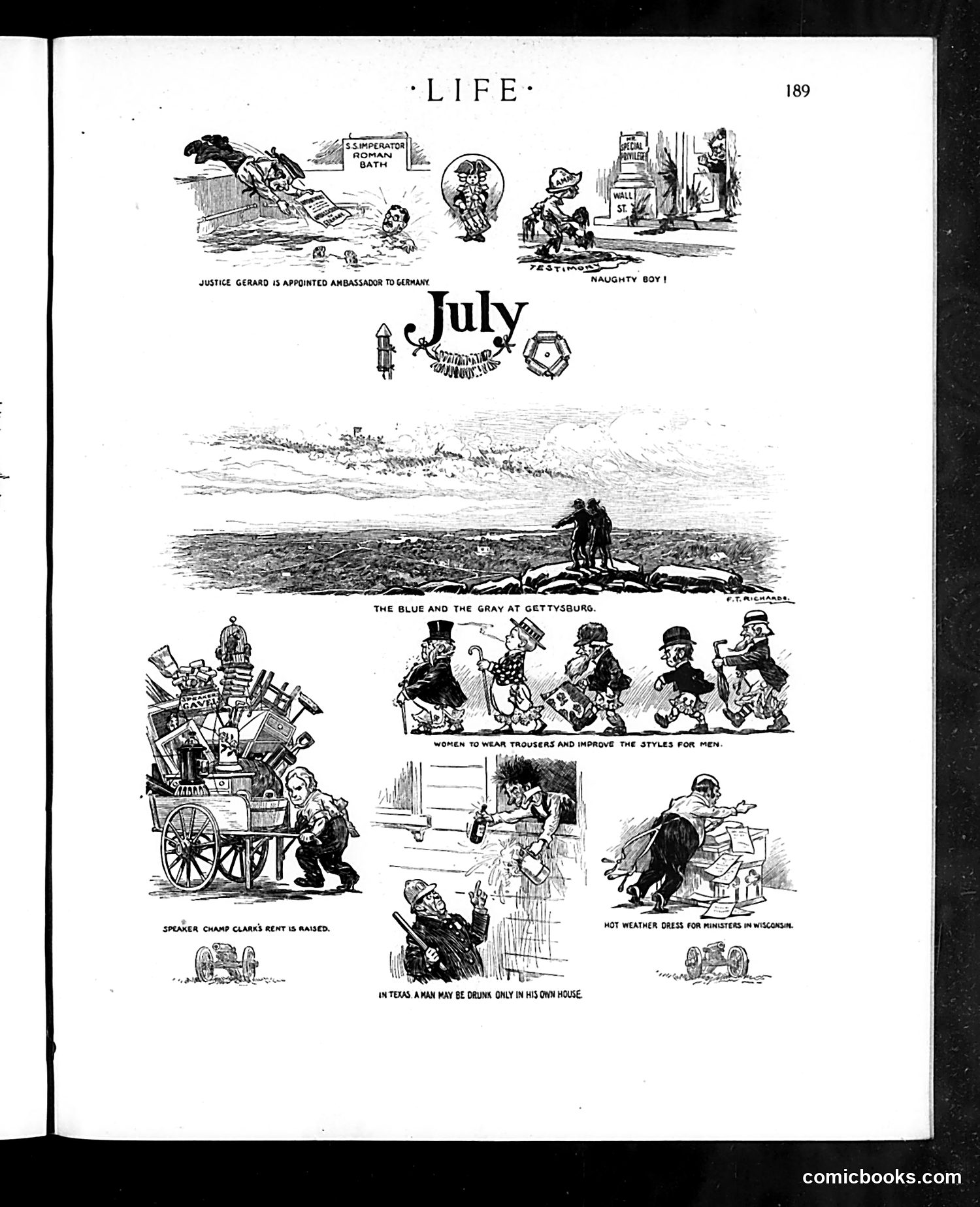
This satirical page presents several political and social commentary cartoons from July (year unclear from image). **Top cartoons** reference: "Justice Gerard is Appointed Ambassador to Germany" and "Naughty Boy I" — likely topical political appointments being mocked. **Central image**: "The Blue and the Gray at Gettysburg" depicts Civil War soldiers, possibly commenting on contemporary North-South relations. **Other cartoons mock**: - "Women to Wear Trousers and Improve the Styles for Men" — satirizing changing women's fashion/roles - "Speaker Champ Clark's Rent is Raised" — targeting a specific political figure's personal finances - "In Texas a Man May be Drunk Only in his Own House" — absurdist take on Texas Prohibition laws - "Hot Weather Dress for Ministers in Wisconsin" — social commentary on religious figures' attire The page uses exaggerated caricature and humorous situations to satirize contemporary politics, social changes, and regional laws.
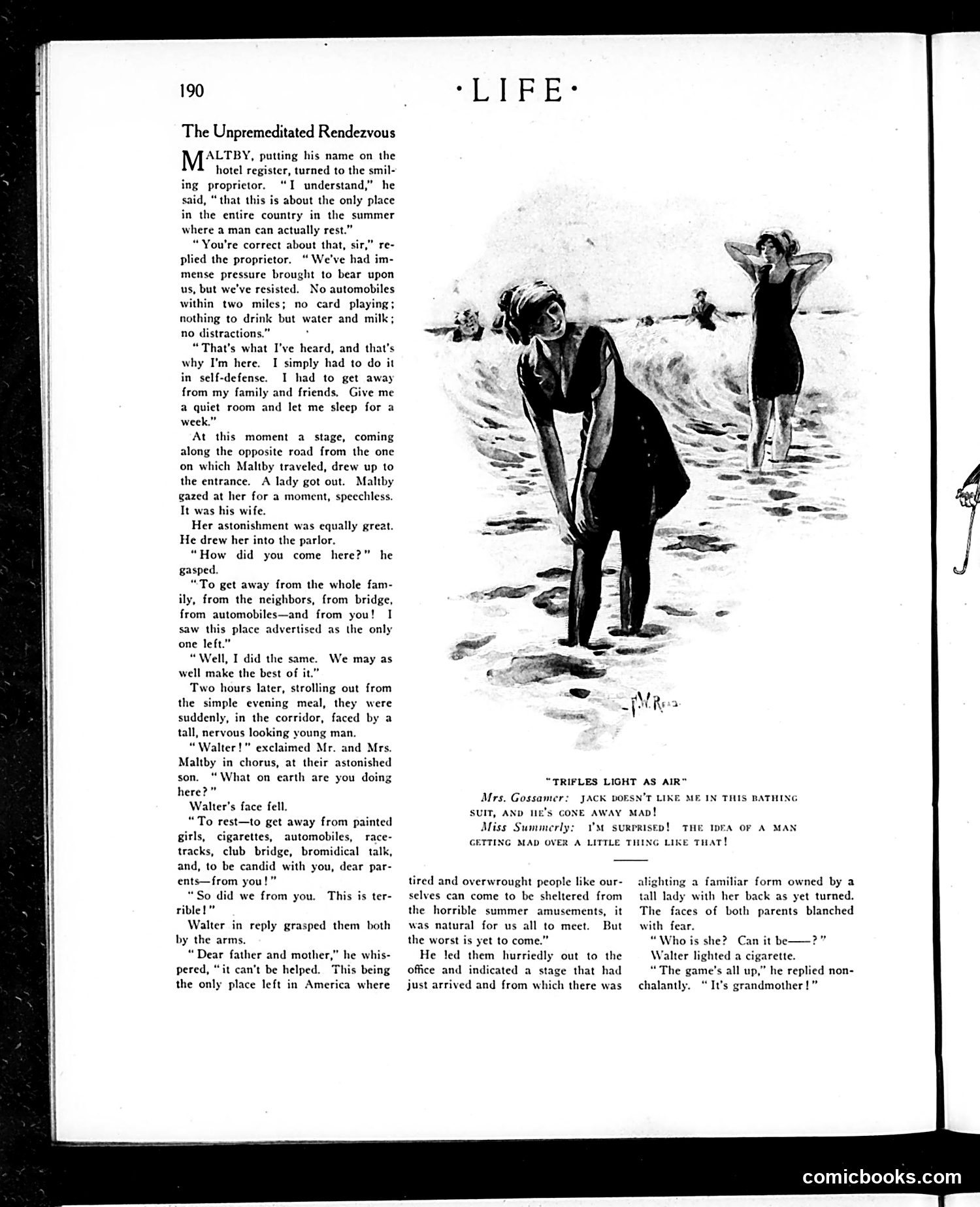
This page presents a short story about a man named Maltby who arrives unannounced at a seaside hotel seeking refuge from society. The proprietor welcomes him, emphasizing the hotel's policy of minimal modern distractions—no automobiles, limited entertainment, only water and milk to drink. The accompanying illustration shows beachgoers in bathing attire, with a caption humorously depicting a woman's complaint about a man's unfashionable swimming costume. The story appears to satirize early 20th-century social anxieties: the desire to escape urban modernity, concerns about proper decorum at leisure destinations, and tensions between tradition and changing social customs. The unexpected arrival of Maltby's family members suggests ironic commentary on the impossibility of true escape from one's obligations.
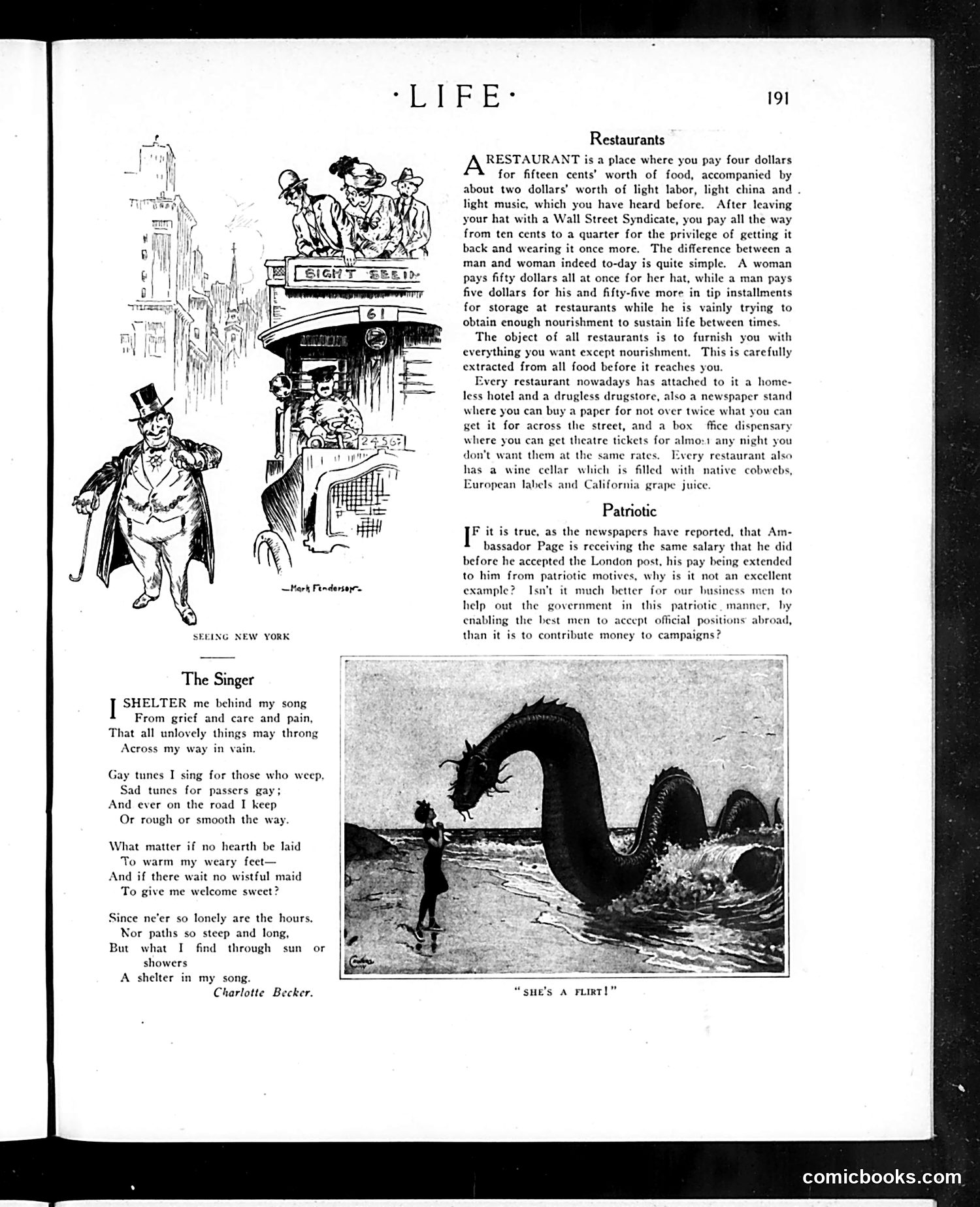
This page contains three distinct pieces of satirical content: **"Restaurants"** section mocks the economics of dining out, claiming restaurants deliberately remove nutritional value from food while charging exorbitant prices for minimal portions, hat-checking fees, and tips. The cartoon by Mark Findersoye (left) depicts a tall, thin man—likely representing the struggling diner—contrasted with an ornate restaurant structure towering above him, visually illustrating how restaurants exploit patrons. **"Patriotic"** section critiques Ambassador Page's acceptance of the London post while maintaining his salary. Life argues this patriotic self-sacrifice by wealthy business leaders should inspire others to support government work rather than contribute to political campaigns—a pointed commentary on how the wealthy use patriotism selectively. **"The Singer"** is a sentimental poem by Charlotte Becker about finding solace in music despite hardship. The illustration captioned "She's a Flirt!" (bottom right) appears unrelated—showing a woman encountering a sea serpent—likely a humorous vignette about a woman's fearless reaction to danger.
This satirical piece concerns **William Jennings Bryan**, Secretary of State under President Wilson, who was lecturing on the Chautauqua circuit for money to supplement his inadequate government salary. The article's tone is **mock-approving**: it sarcastically defends Bryan's unconventional behavior by claiming he's simply a visionary whose non-conformity serves righteousness. The real criticism emerges subtly—Bryan is portrayed as stubborn ("not very teachable"), needing "a road roller" to change his mind, and motivated by his own standards rather than propriety. The satire's key point: **Congress is cheap**. Rather than pay cabinet officials properly, it forces them into embarrassing side work. The author argues Bryan's lecture circuit appearances actually *advertise* Congressional stinginess, potentially shaming it into funding higher salaries. The grape juice reference alludes to Bryan's temperance advocacy (he promoted grape juice instead of champagne). Essentially, Life criticizes both Bryan's questionable judgment and Congress's penny-pinching—using mock praise to highlight the absurdity of both positions.
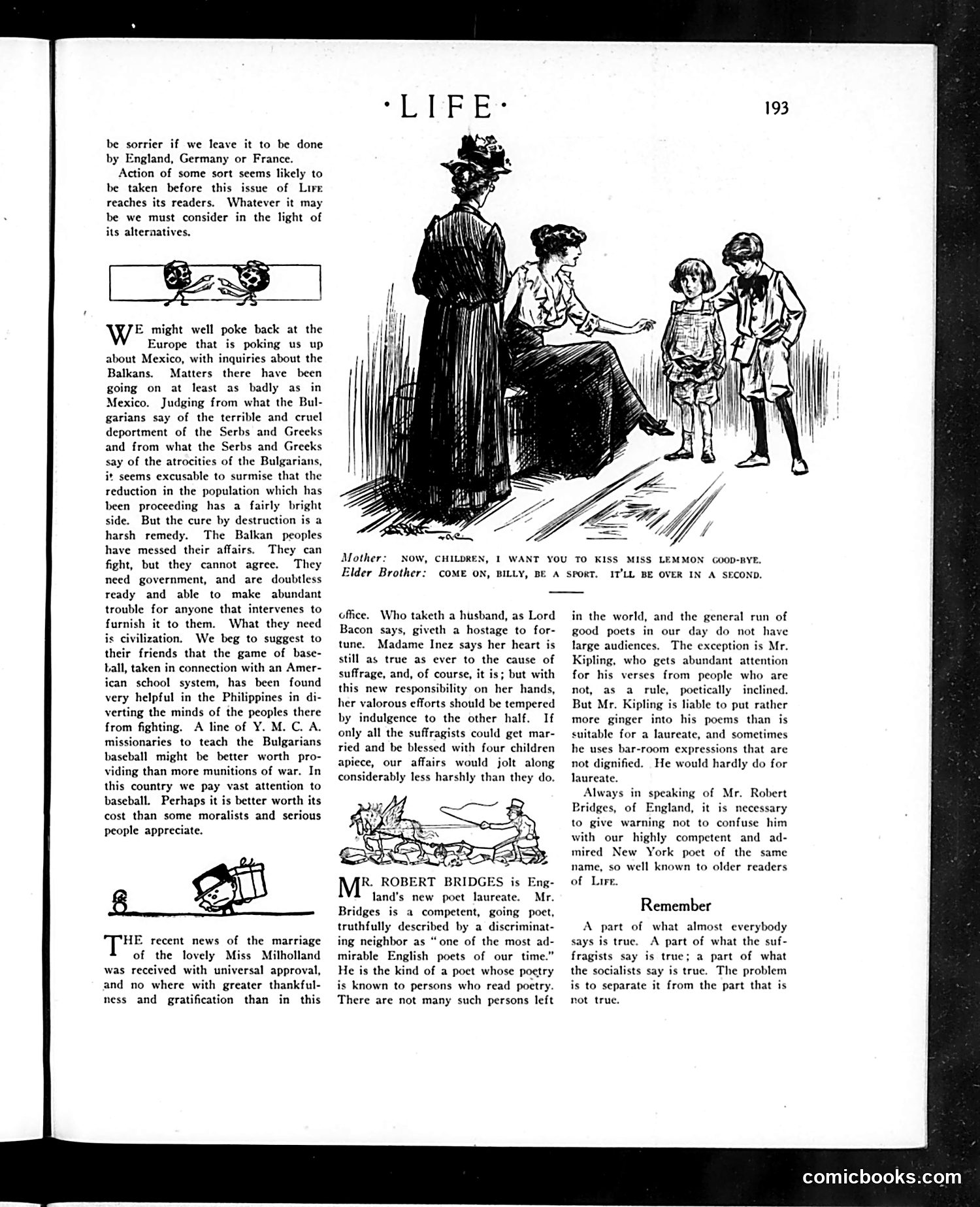
This page from *Life* magazine (likely early 1910s, based on references) contains satirical commentary on contemporary issues: **Main cartoon**: Shows a mother saying goodbye to children, with an elder brother encouraging a younger boy ("Billy") to kiss "Miss Lemmon" goodbye—a humorous domestic scene about childhood reluctance and social propriety. **Text commentary**: The article discusses the recent marriage of "Miss Milholland" (likely Inez Milholland, a famous suffragist), sarcastically suggesting that if all suffragists married and had children, their reform efforts would become "less harsh." This mocks both the suffrage movement and traditional views that women's activism should yield to domestic duties. **Other topics**: The page also addresses Balkan conflicts (comparing them to American problems in Mexico), and praises Robert Bridges as England's new poet laureate while distinguishing him from a similarly-named American poet. The overall tone is characteristically *Life*'s blend of social satire, with particular skepticism toward women's political activism.
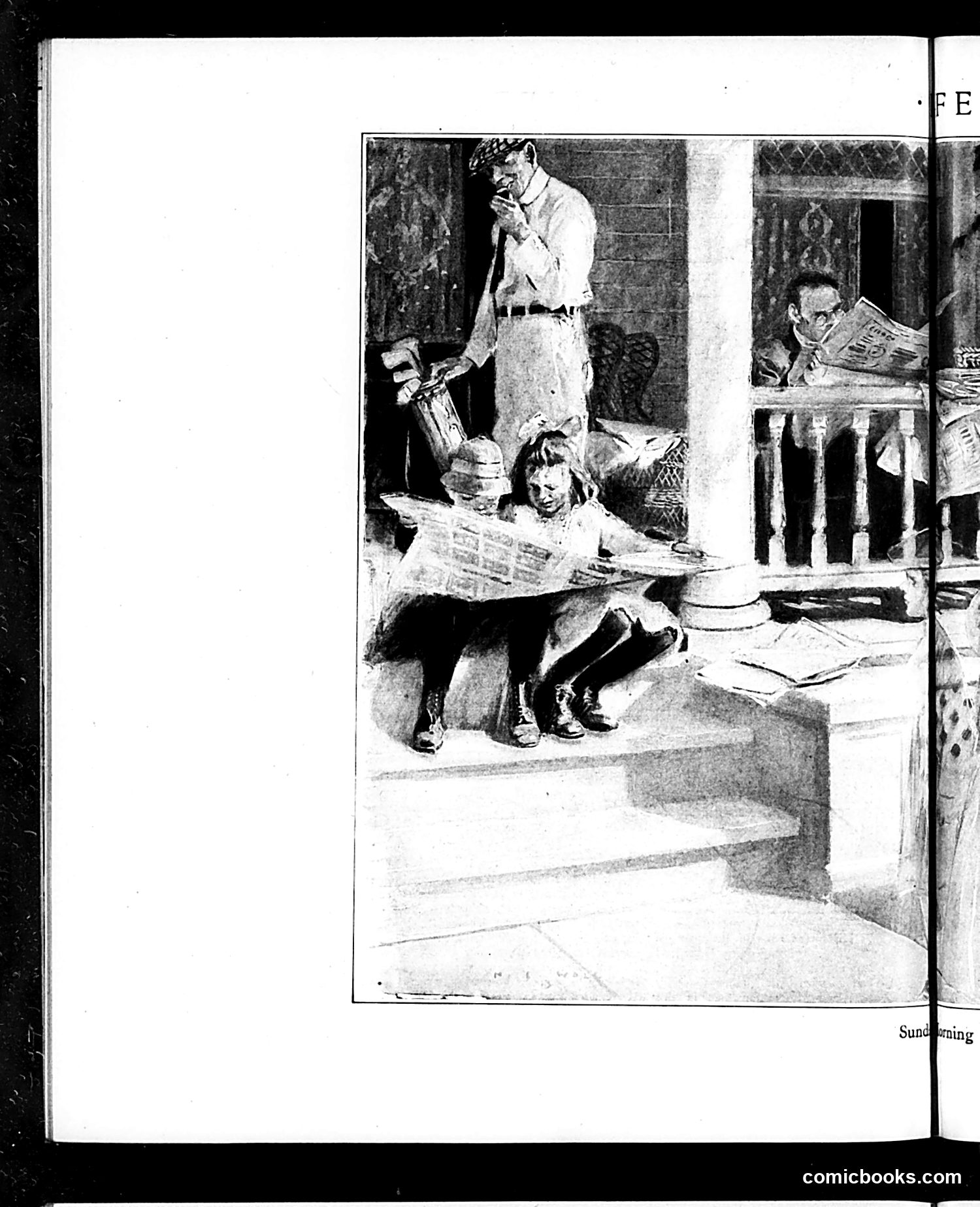
This black-and-white photograph shows a domestic scene with a man standing in the background watching a woman and child seated together reading a newspaper. The word "Subscribing" appears at the bottom, suggesting this illustrates newspaper readership habits. The image appears to be satirical commentary on **family newspaper consumption**, likely from early-to-mid 20th century *Life* magazine. The composition—with an adult male observer and females actively engaged with the paper—may be commenting on **gender roles in news consumption** or **who controls information** within households. The positioning and the title suggest irony about what "subscribing" means: perhaps critiquing passive versus active readership, or commenting on how different family members engage with current events. Without additional context or visible captions, the specific satirical target remains unclear.
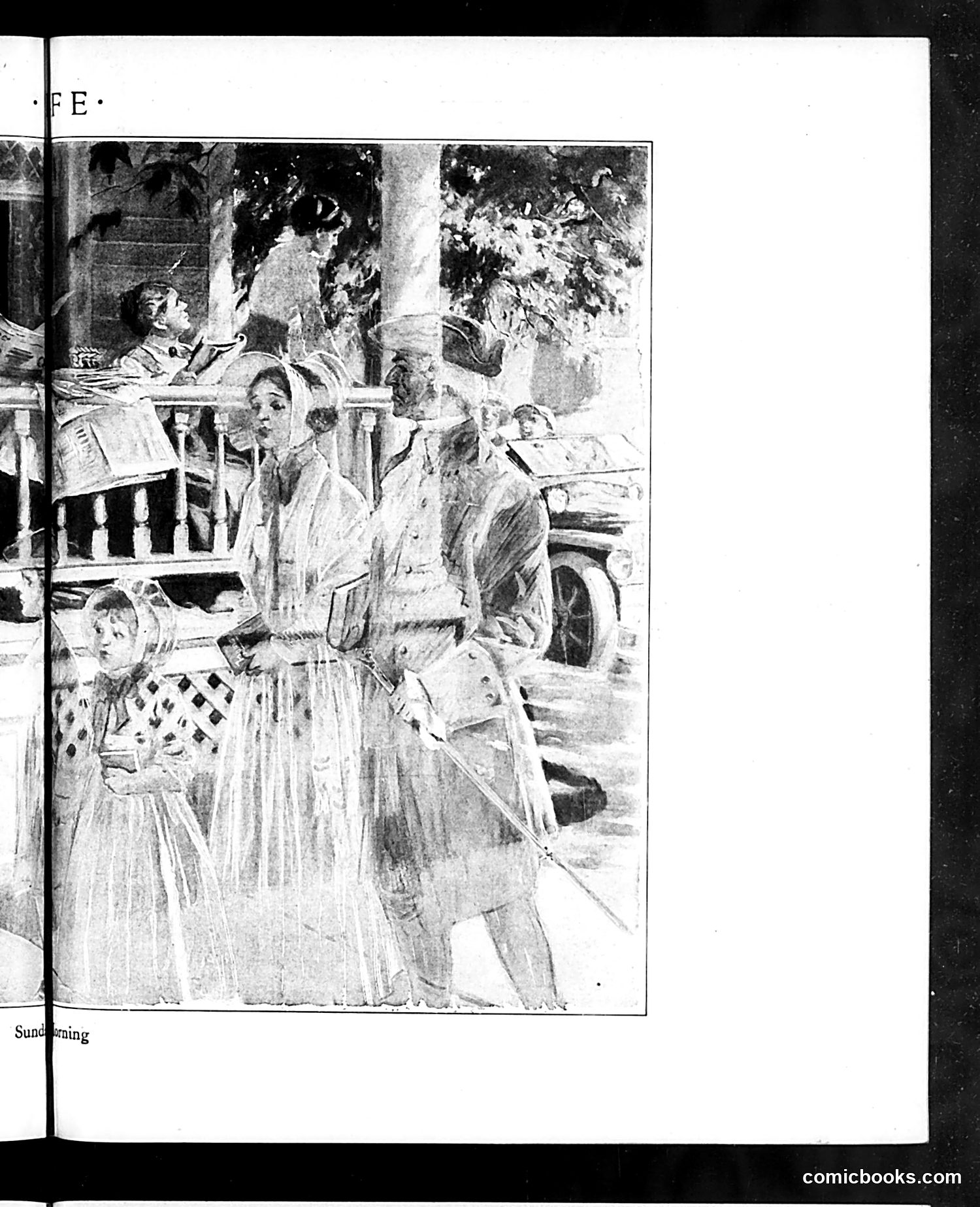
This appears to be a page from *Life* magazine featuring an illustration labeled "Sudsmaking" at the bottom. The sketch depicts women engaged in laundry work—specifically soap-making or washing clothes—in what appears to be a domestic or communal setting. The figures wear period clothing and head coverings typical of early 20th-century working-class dress. The satirical point likely critiques the tedious, labor-intensive nature of household chores, particularly laundry work traditionally assigned to women. The "sudsmaking" title emphasizes the repetitive, unglamorous domestic labor that dominated women's daily lives. Without additional context or byline visible, the specific political message remains unclear, though the subject reflects *Life* magazine's tradition of social commentary on gender roles and domestic work.
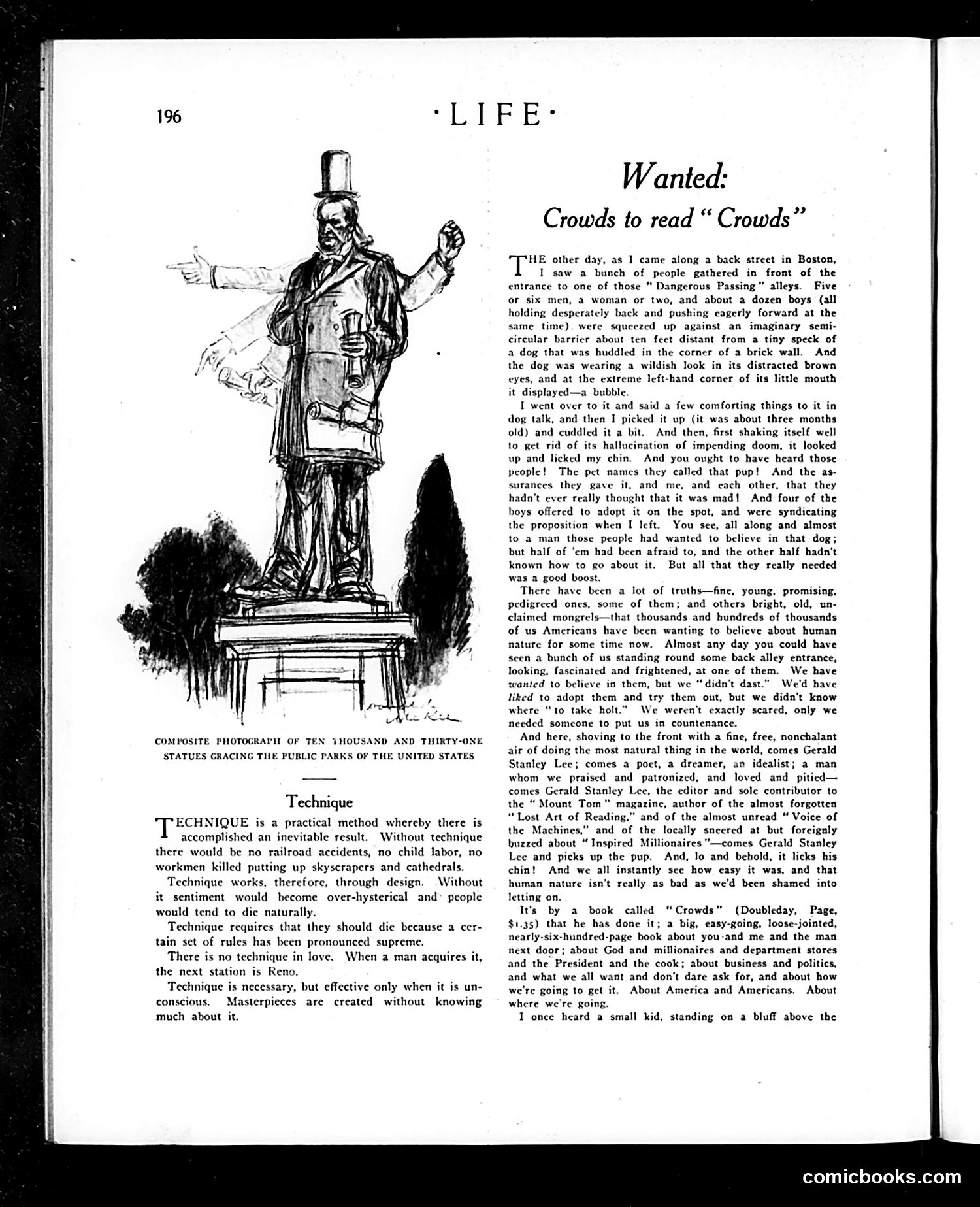
This Life magazine page satirizes American public discourse and belief. The statue illustration mocks the ubiquity of generic monuments cluttering parks—a composite of 10,031 statues representing shallow civic pride. The main article promotes Gerald Stanley Lee's book *Crowds*, arguing it gives Americans permission to believe positive truths about human nature they've been afraid to embrace. The extended dog metaphor suggests people are like a fearful crowd afraid to approach a small dog—they want to believe it's friendly but need someone confident (Lee) to demonstrate it's safe. The satire targets both American timidity and manufactured consensus: Lee functions as the reassuring figure who validates what people already want to believe, making truth-acceptance easier through his authority rather than evidence. The piece critiques how Americans need permission and social proof to accept ideas, and how public opinion follows confident personalities rather than independent reasoning.
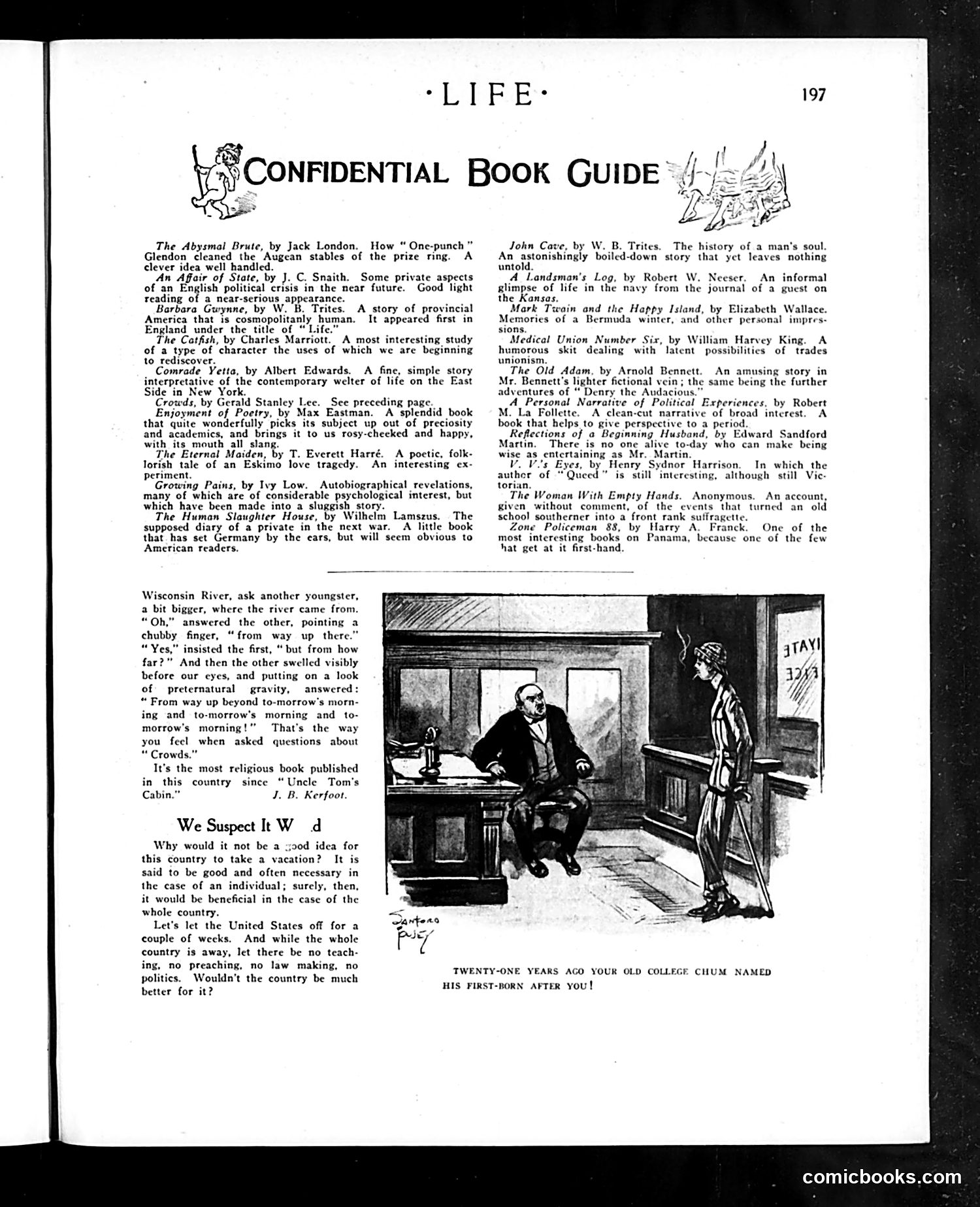
This page is a "Confidential Book Guide"—a book review section from *Life* magazine (approximately early 1900s based on the titles and style). The main cartoon depicts a domestic scene: a man sits at a desk while a woman in a dress stands nearby, with a caption reading "TWENTY-ONE YEARS AGO YOUR OLD COLLEGE CHUM NAMED HIS FIRST-BORN AFTER YOU!" **The joke's point:** The cartoon satirizes the awkwardness of being reminded of youthful friendships and obligations. A college friend apparently named his child after the protagonist two decades prior, creating an uncomfortable social debt or expectation of ongoing connection. The bulk of the page reviews contemporary novels by Jack London, Arnold Bennett, and others. A notable review mentions *The Woman With Empty Hands*, an account of how a Southern woman became a "front rank suffragette"—reflecting early 20th-century debates over women's rights. The page also includes witty commentary on other books, establishing *Life*'s satirical literary voice.
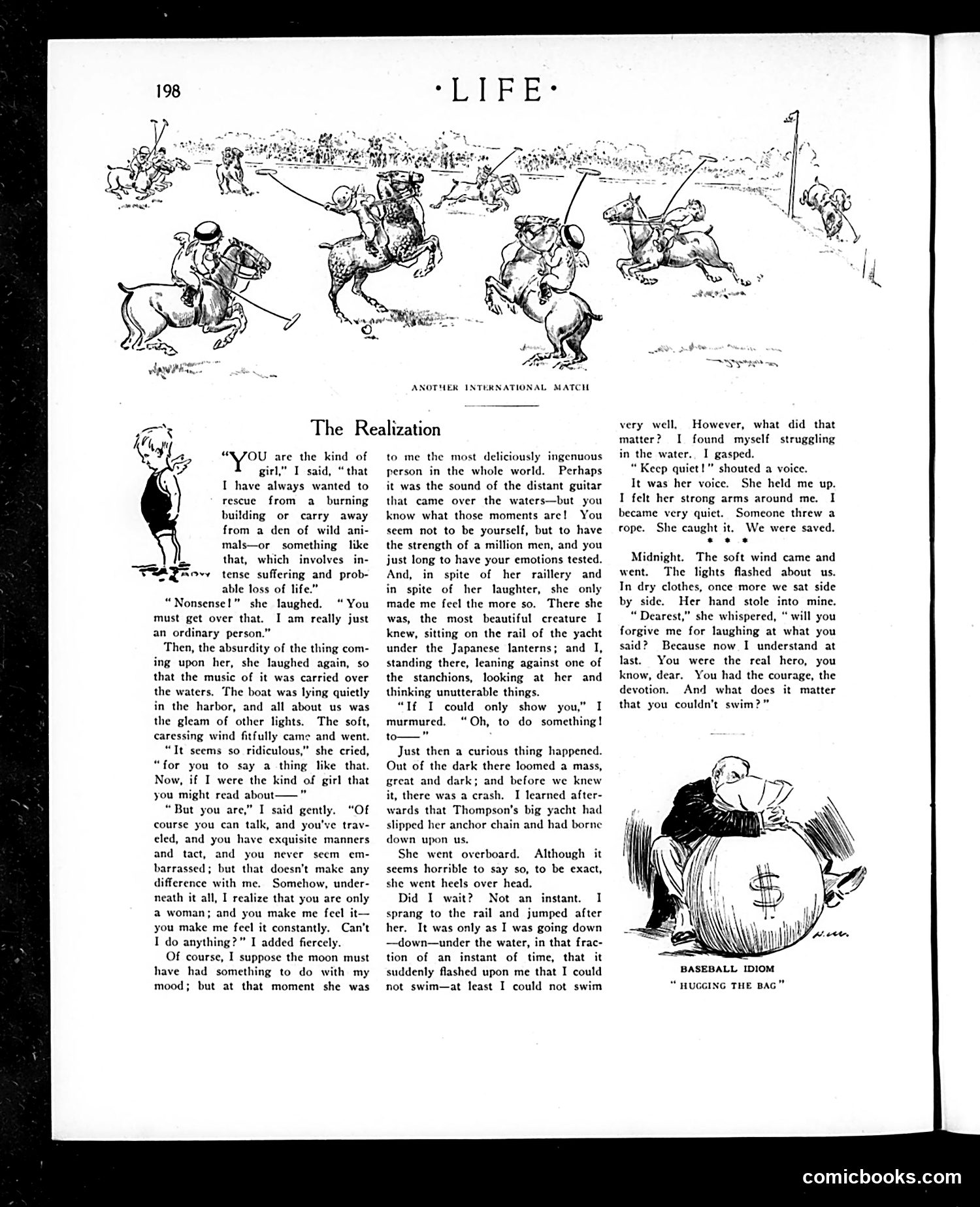
This page contains a romantic short story with ironic humor typical of *Life* magazine's satirical approach to romance and masculinity. **The Story's Setup & Satire:** A man delivers an overwrought romantic monologue to a woman on a yacht, claiming he'd rescue her from danger and emphasizing her helplessness. She dismisses his theatricality as "nonsense" and "ridiculous." **The Joke:** His grand moment arrives—a collision sends her overboard. He immediately jumps in to rescue her, only to realize *he cannot swim*. She rescues *him* instead, holding him afloat while *he* panics. **The Satire:** The story mocks Victorian-era masculine pretensions about heroism and female dependence. The man's romantic fantasies about protecting a delicate woman are literally inverted—she's the capable one. Her final comment ("You had the courage, the devotion") gently patronizes him, suggesting his emotional readiness matters more than actual competence. **The Bottom Cartoon:** "Hugging the Bag" is baseball slang for clinging to first base—a minor-league play. This likely parallels the story's theme of posturing versus reality.
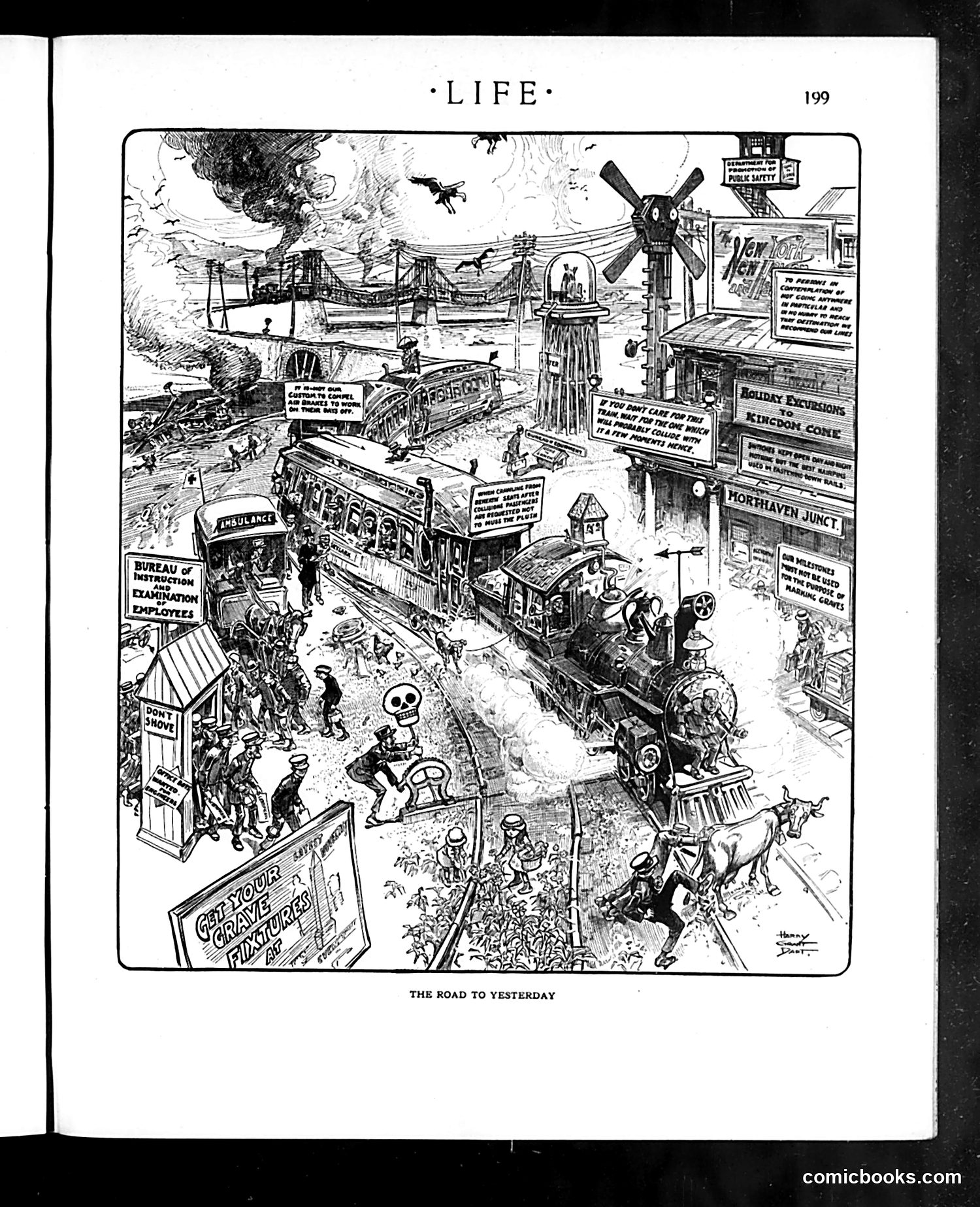
This satirical illustration depicts a fantastical amusement park or fairground themed around nostalgic Americana. Visible attractions include a windmill, trains, an ambulance station labeled "Bureau of Mortality Examination," and various period buildings. The cartoon critiques early 20th-century nostalgia culture—Americans' romanticization of the past. Signs advertise "Holiday Excursions" and reference "Kingdom Come" and "Hopthaven Junction," suggesting visitors travel to idealized versions of "yesterday." The chaotic scene, crowded with figures and cartoon violence (including a skeleton), satirizes how visitors eagerly escape to these fantasy recreations while ignoring present-day realities. The ambulance and mortality bureau hint that this nostalgic retreat has darker consequences—people are literally fleeing modern life, even unto death.
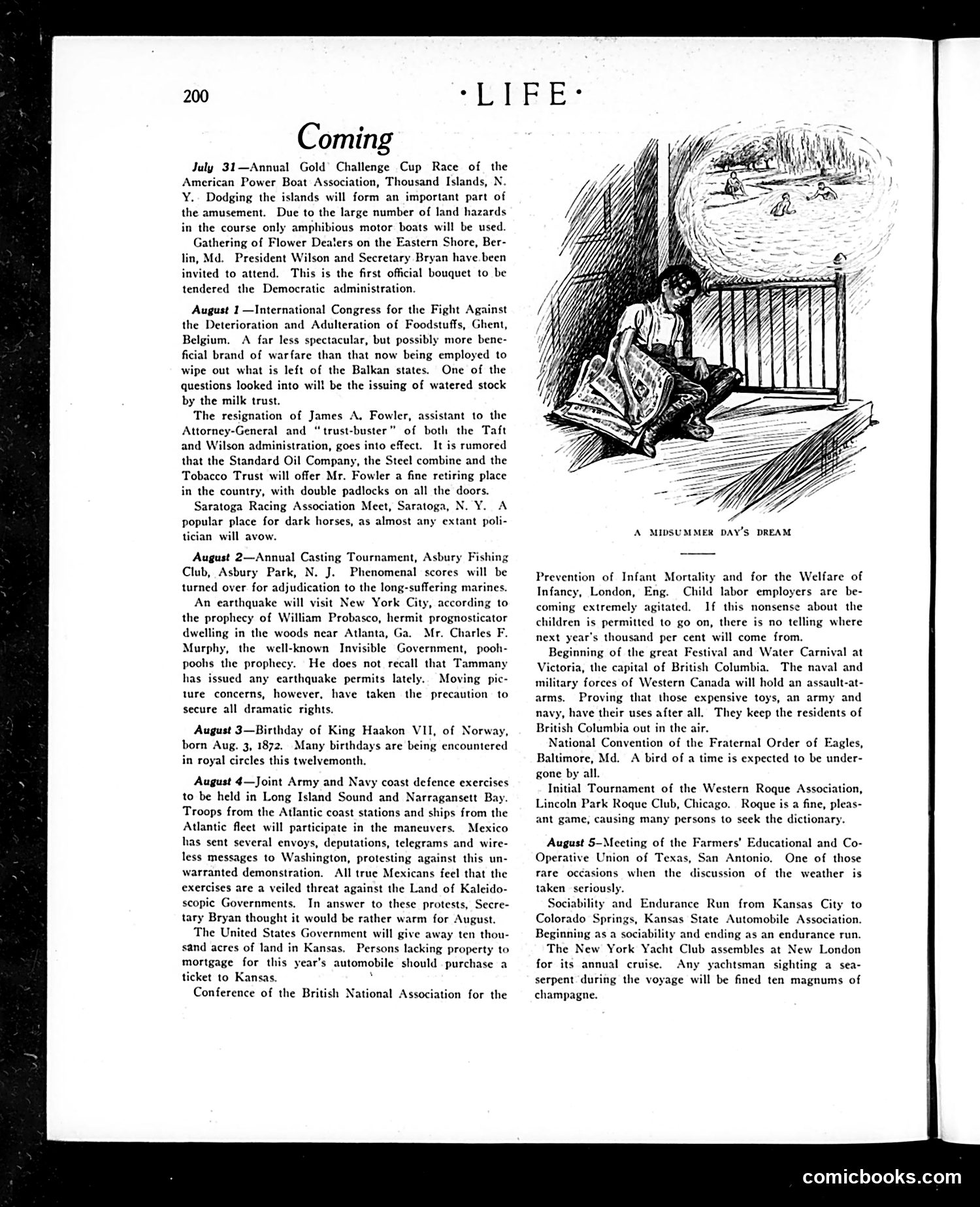
This illustration satirizes labor conditions and child welfare neglect. The sketch shows a sleeping worker dreaming of an idealized scene: a child peacefully in a crib near a window with countryside beyond. The accompanying text mocks British child labor advocates' concerns about industrial child labor. Life's sardonic commentary suggests employers fear welfare reforms will cut into profits ("there is no telling where next year's thousand per cent will come from"). The cartoon's title and pastoral dream image contrast sharply with the grim reality: children working in factories. By depicting the *dream* of childhood innocence and safety, the artist underscores how far removed actual child laborers were from such conditions. The satire targets both exploitative employers and those dismissing welfare concerns as impractical interference with business profits—a common Progressive-era debate about labor reform.
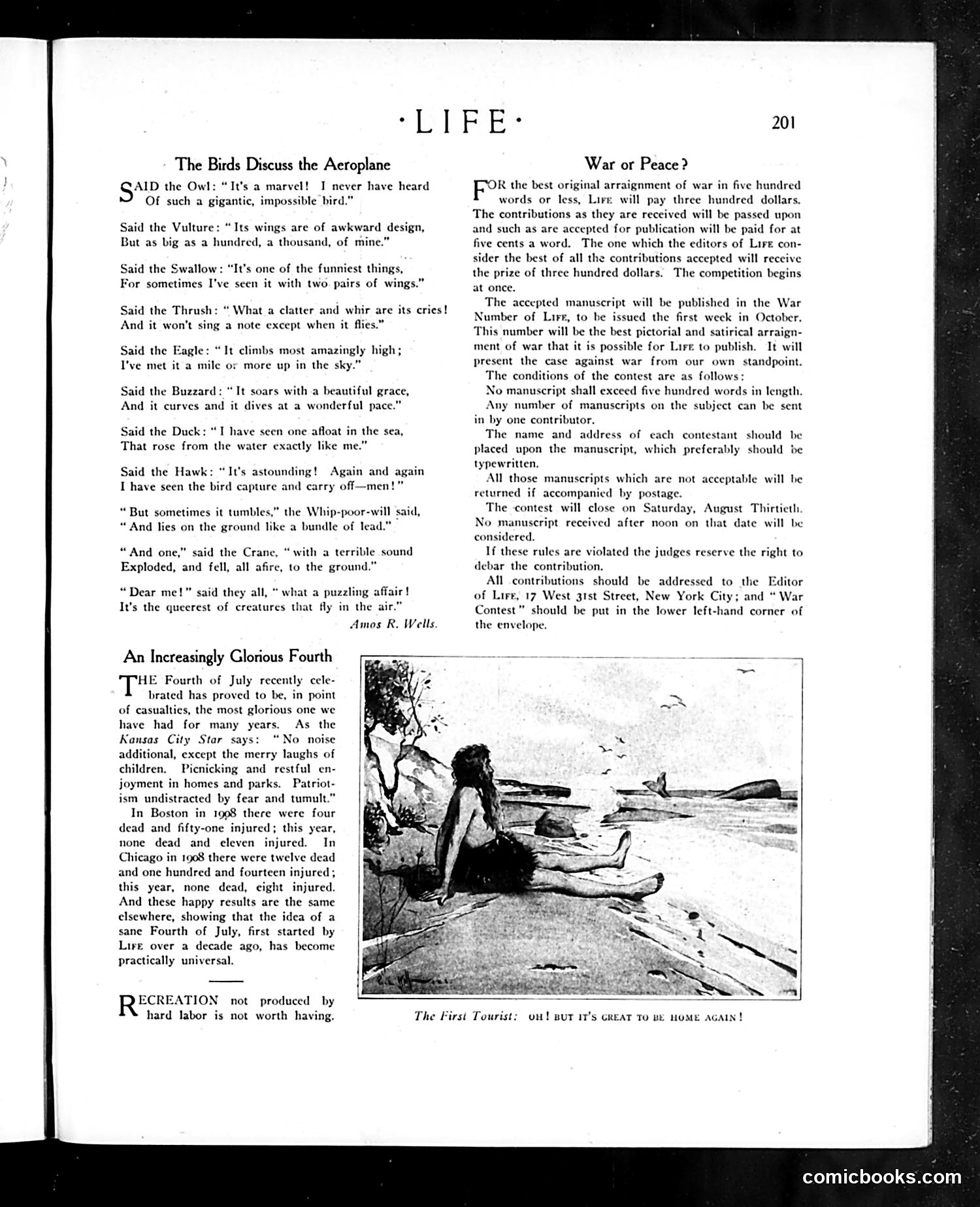
**"The Birds Discuss the Aeroplane"** is a satirical poem about early aviation. Various birds comment on airplanes with bewilderment, each noting specific oddities: the owl calls it an "impossible bird," the hawk observes it "captures and carry off—men," and the crane describes one exploding mid-flight. The poem humorously treats the airplane as a bizarre creature through birds' eyes, likely reflecting public amazement and anxiety about this new technology (circa 1910s). **"An Increasingly Glorious Fourth"** celebrates declining Fourth of July casualties. It contrasts past years—Boston 1908: four dead, fifty-one injured; Chicago 1908: twelve dead, 114 injured—with recent safety improvements (none to eight dead). The piece credits *Life* magazine's decade-long campaign for "sane" celebrations without dangerous fireworks, suggesting editorial pride in reducing holiday violence. The illustration shows a woman resting by a shore, captioned "The First Tourist: oi! but it's GREAT to BE HOME AGAIN!"—likely mocking tourists' complaints despite leisure activities.
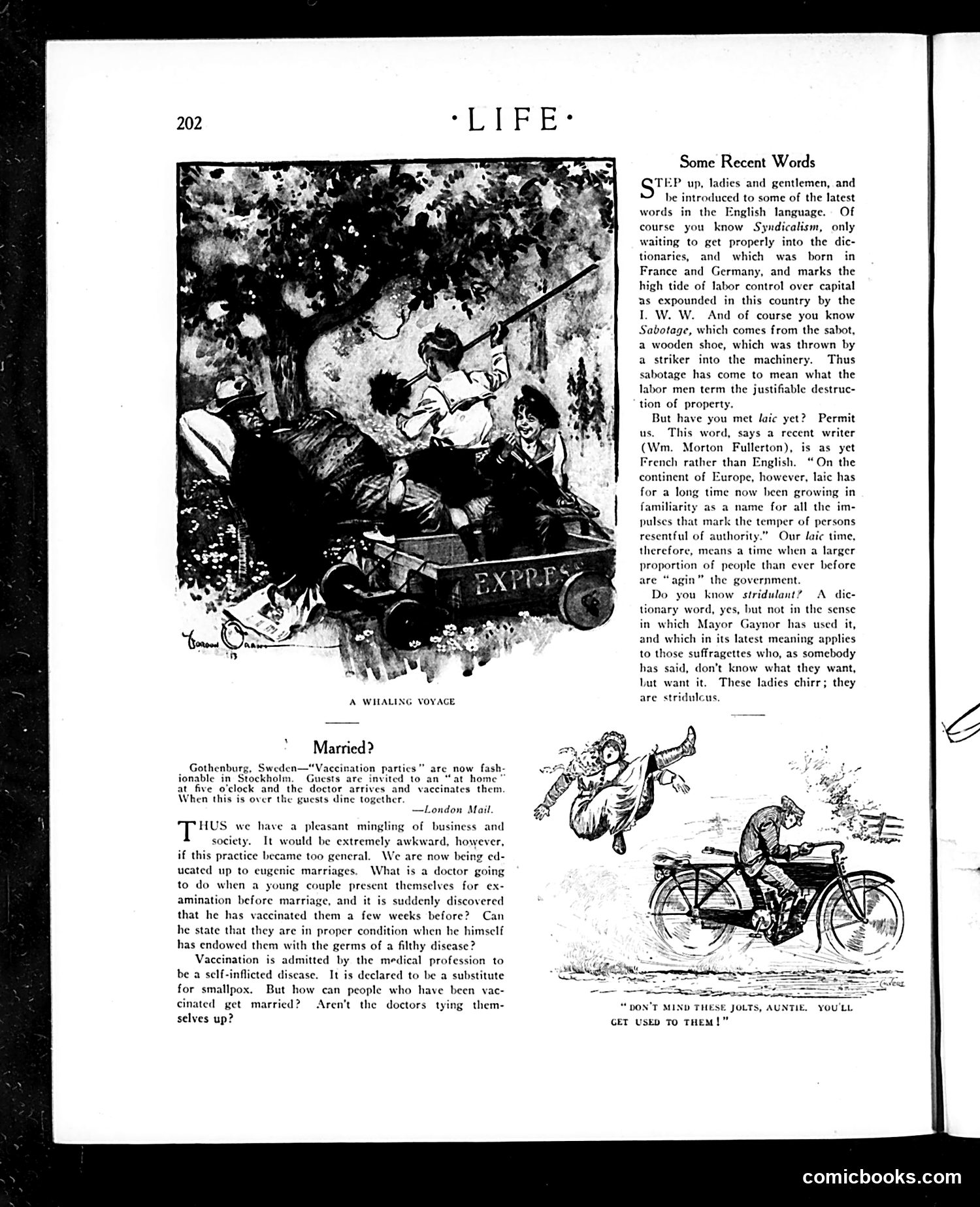
This page contains two distinct satirical pieces: **"A Whaling Voyage"** (top illustration): A darkly comic cartoon depicting what appears to be a whaling expedition, using maritime imagery as a metaphor—likely social commentary, though the specific target is unclear from the image alone. **"Married?"** (main article): Satirizes Swedish "vaccination parties"—fashionable social gatherings where doctors vaccinate guests before dinner. The satire highlights the logical absurdity: if doctors consider vaccination a "self-inflicted disease" (as the medical profession admits), how can vaccinated people pass eugenic pre-marriage examinations? The piece mocks both the trend and medical hypocrisy. **"Some Recent Words"**: A glossary explaining contemporary political terms—*Syndicalism*, *Sabotage*, *laic* (anti-authority sentiment), and *stridulant* (applied mockingly to suffragettes). This reflects early 20th-century anxieties about labor movements, secularism, and women's suffrage. The bottom cartoon shows people on bicycles with the caption about "jolts," humorously suggesting adaptation to modern life's disruptions.
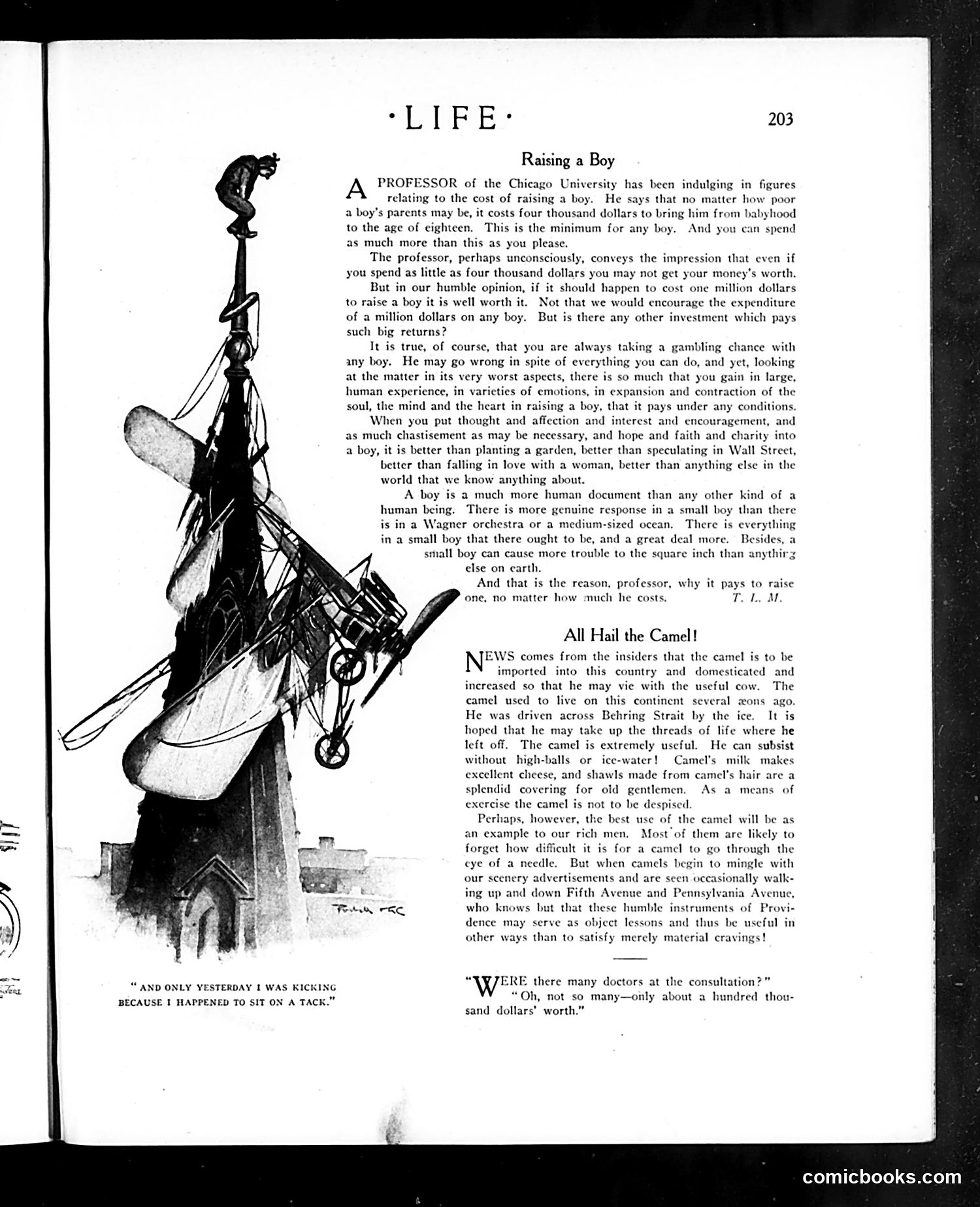
This page contains two satirical pieces reflecting early 20th-century American values and concerns. **"Raising a Boy"** responds to a Chicago University professor's calculation that raising a boy costs $4,000 minimum through age eighteen. The editorial argues this investment is worthwhile despite the gamble, as boys provide immense human and emotional returns—better than gardens, Wall Street speculation, or romance. The accompanying cartoon shows a man perched atop a tall, precarious structure (suggesting life's instability), captioned with a complaint about sitting on a tack—contrasting trivial discomfort with life's larger challenges, reinforcing the editorial's point about perspective. **"All Hail the Camel!"** satirizes a proposal to import camels to America for domestication. The piece mocks wealthy Americans by suggesting camels exemplify humble usefulness and self-denial—a biblical reference to "a camel through the eye of a needle"—implying rich men need moral instruction through observing the camel's austere nature. Both pieces reflect period anxieties about materialism versus virtue.
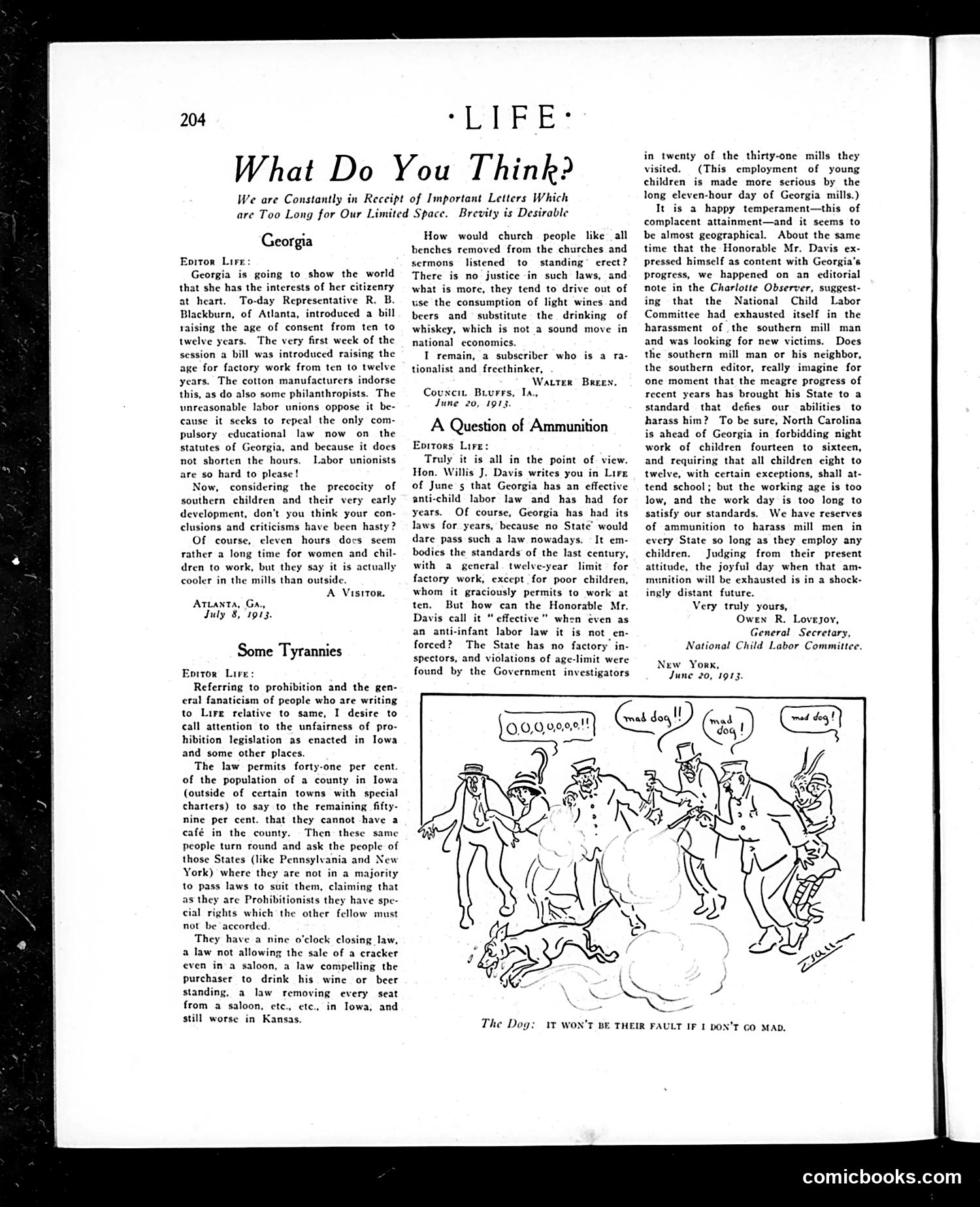
This page presents three reader letters debating social reforms, with a satirical cartoon at bottom. **The Letters:** The "What Do You Think?" section publishes opposing viewpoints on progressive issues. A Georgia visitor defends raising child labor age minimally (10 to 12), claiming southern children are "precocious" and mills are cooler than outside—transparently absurd rationalizations. Walter Breen attacks Prohibition advocates as tyrannical hypocrites, noting Iowa's 41% minority imposing rules on 59% majority, paralleling how prohibitionists demand other states follow their morality. **The Cartoon:** "The Dog: IT WON'T BE THEIR FAULT IF I DON'T GO MAD" shows a dog surrounded by gesticulating men shouting variations of "mad dog!"—they're trying to provoke the dog into madness through harassment. **The Satire:** The cartoon illustrates Breen's point: prohibitionists are like those men, deliberately provoking people into bad behavior through oppressive legislation. Their restrictive laws (9 o'clock closings, standing-only drinking) supposedly drive people toward worse vices (whiskey instead of beer), thus creating the moral chaos they claim to prevent. The dog represents the public being driven mad by their tyranny.
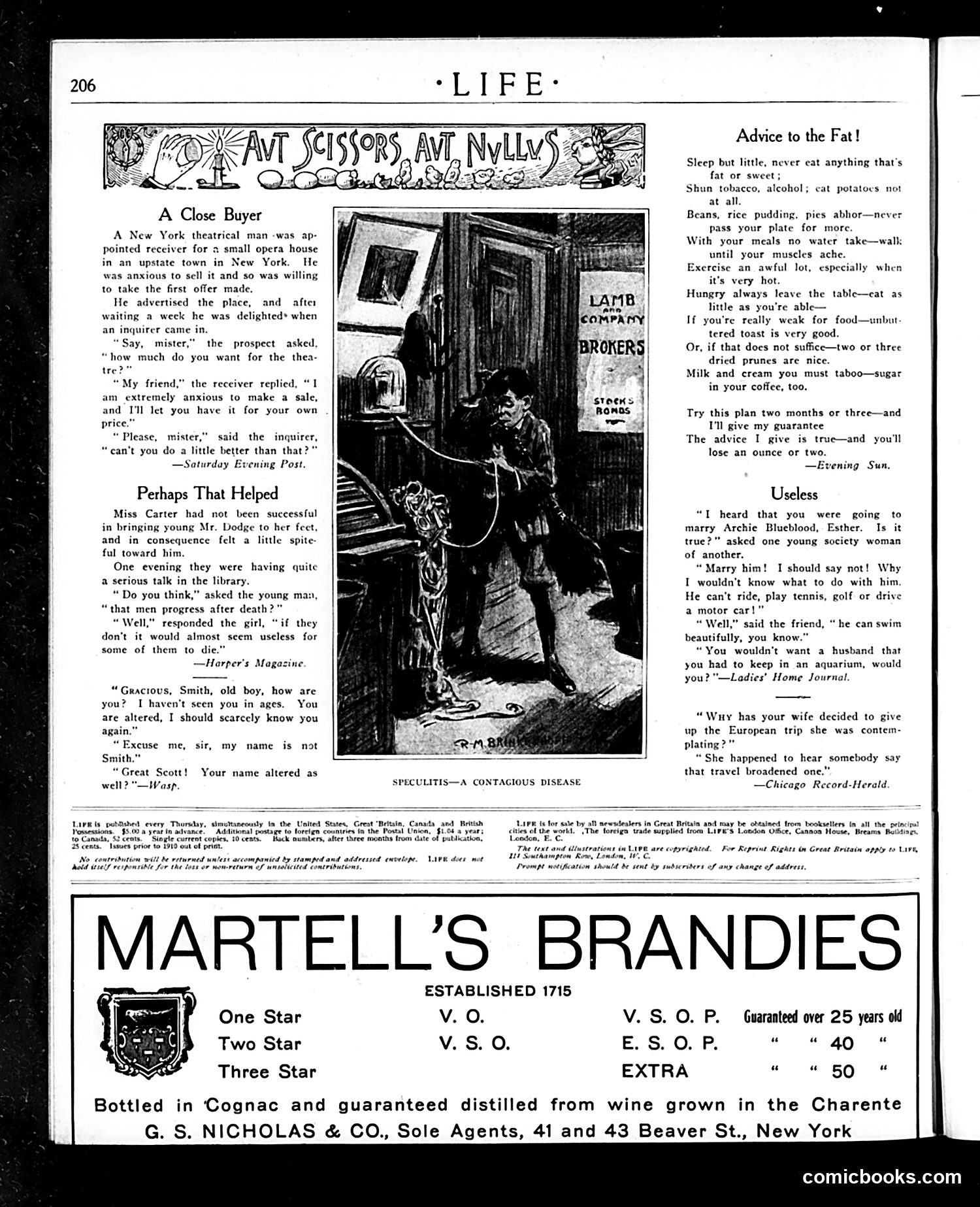
This page from *Life* magazine (circa early 1900s) contains several humorous anecdotes mocking social pretensions and human folly: **"A Close Buyer"** and **"Perhaps That Helped"** are brief comedic stories about negotiation and romance, relying on wordplay and ironic reversals typical of period humor. **"Advice to the Fat!"** presents satirical diet guidance—an exaggerated regimen of deprivation (no food, constant exercise, restricted water) purporting to guarantee weight loss. The joke mocks both fad dieting and the desperation of people seeking quick fixes. **"Useless"** and other short pieces ridicule society women's standards: a prospective husband is deemed worthless because he lacks fashionable skills (tennis, golf, cars), though he can swim—prompting the joke that keeping him would require "an aquarium." The central illustration labeled **"Syphilis—A Contagious Disease"** appears to be a public health warning, contrasting sharply with the lighthearted satire surrounding it. The page emphasizes *Life's* satirical mission: exposing vanity, superficiality, and absurd social values through humor.
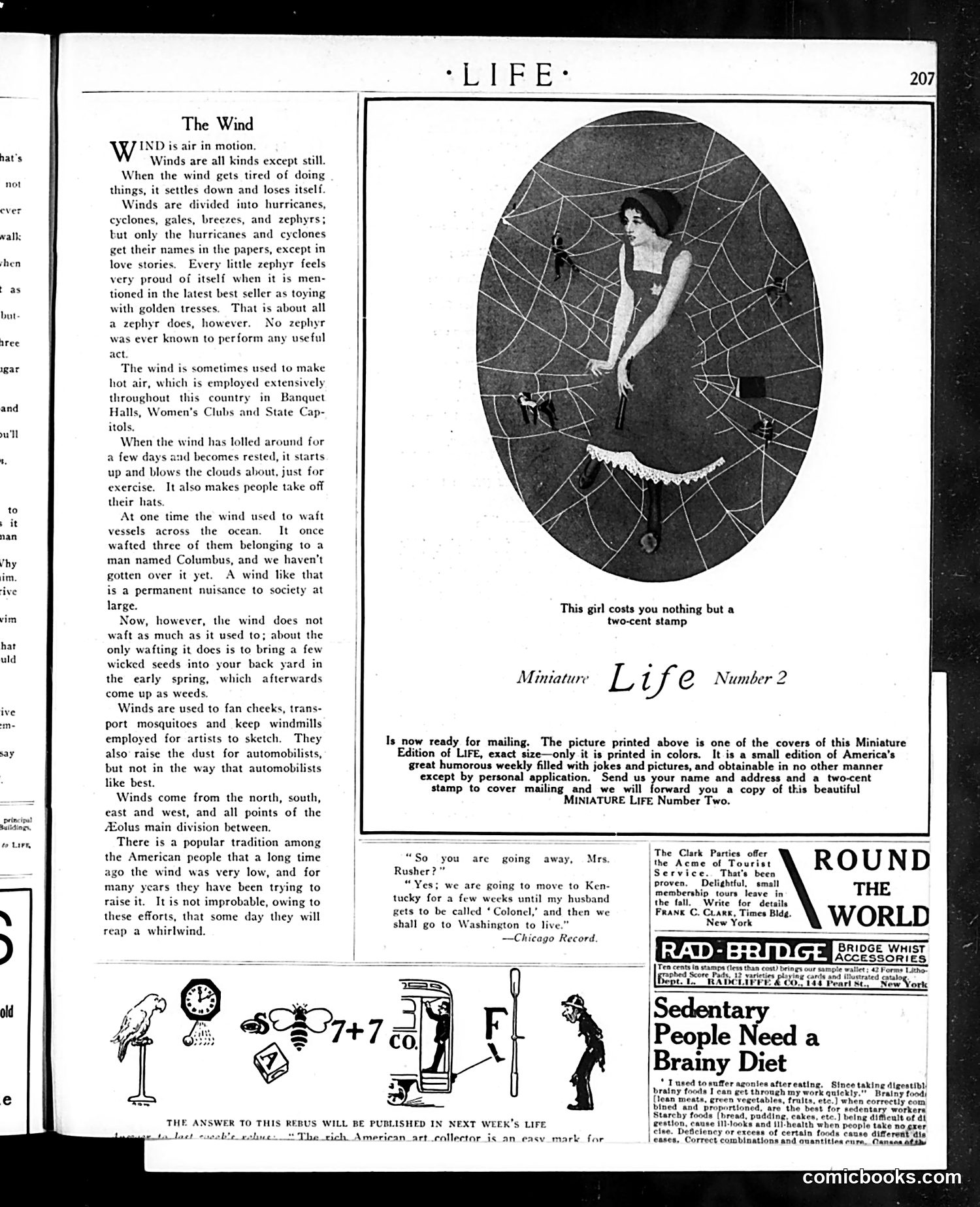
This is a humorous essay mocking American hot air and empty talk. The piece opens with whimsical definitions of wind types, then pivots to satire: wind is "employed extensively throughout this country in Banquet Halls, Women's Clubs and State Capitols" — a jab at verbose public speaking and political rhetoric as mere "hot air." The essay references Columbus's ships to mock America's obsession with past glories while ignoring present usefulness. The closing warning—that efforts to "raise" the wind will "reap a whirlwind"—appears to be social commentary on unintended consequences of American policies or attitudes. The page includes advertisements for a miniature edition of Life magazine and various products (Round the World travel service, bridge accessories, diet advice), typical of the era. A cartoon dialogue jokes about a woman's husband becoming a "Colonel" before moving to Washington—likely satirizing social climbing and political ambition.
This page contains primarily **advertisements and short humor pieces**, with one significant political cartoon. ## "The Suffragist's Dilemma" The main satirical piece mocks women's newly gained voting rights. A female voter attempts to cast her ballot but rejects every candidate based on *trivial personal grievances*—disliking someone's gown, remembering past slights, objecting to outdated fashion choices. She ends unable to vote for anyone. The satire suggests women voters are petty and irrational, prioritizing fashion and social grudges over substantive political judgment. This reflects **anti-suffrage sentiment** common when women's voting rights were still contentious (the 19th Amendment passed in 1920). ## Other Content The page is dominated by period **advertisements** (Calox toothpowder, Kelly-Springfield tires, Carstairs Rye whiskey, travel tours) and brief humor columns ("Impossible," "Undeserving," "Corroboration") typical of Life's format. The overall message: even with the franchise, women supposedly lacked the judgment to use it responsibly—a common anti-suffrage trope of the era.
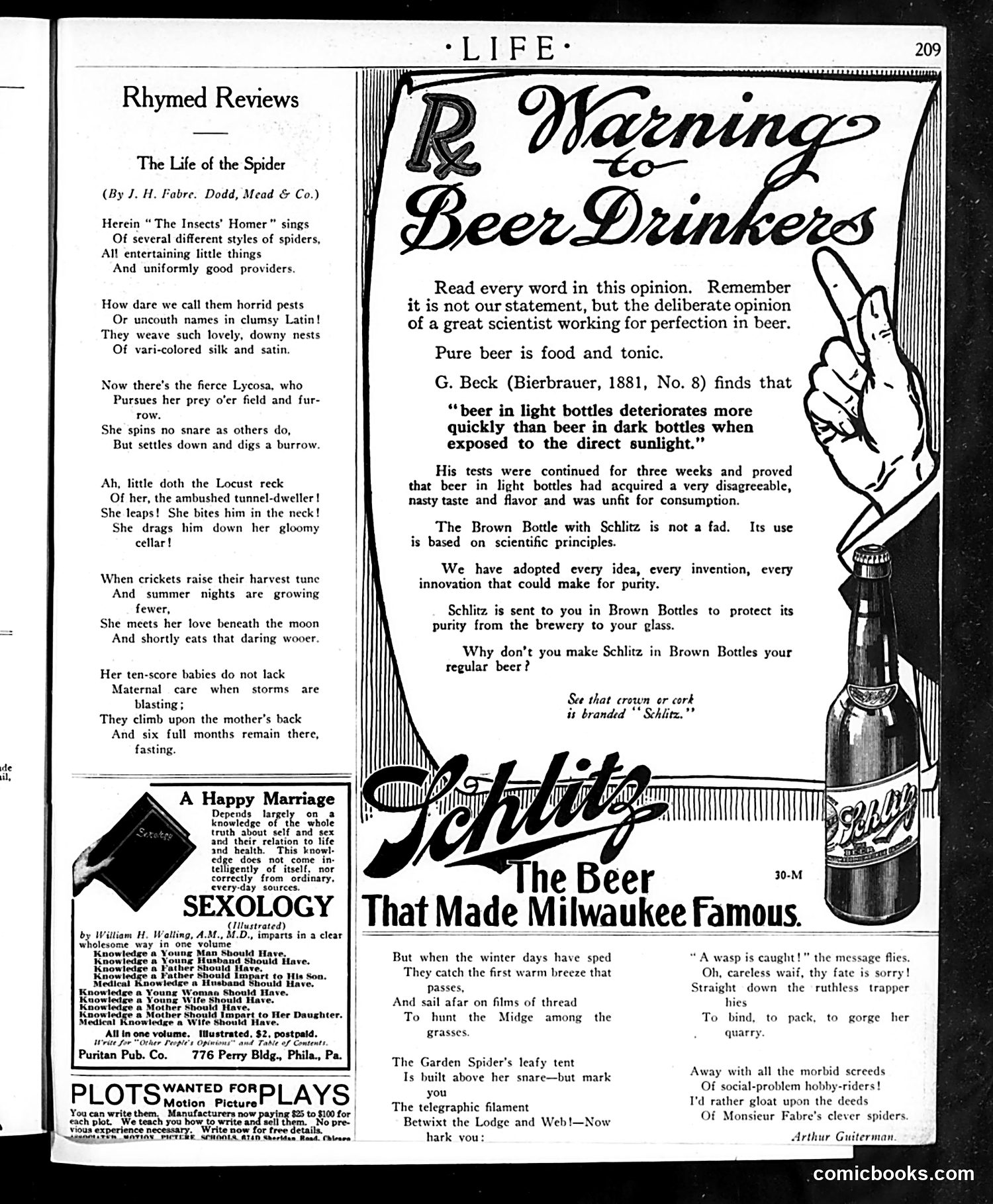
This page combines literary reviews with period advertisements, reflecting early 1900s American concerns. **Left column**: A rhymed book review of J.H. Fabre's *The Life of the Spider* uses humorous verse to defend spiders against negative stereotypes, celebrating their engineering and maternal instincts. The reviewer argues spiders deserve appreciation over moralizing social commentary—a jab at contemporary "problem" literature. **Center/right**: A Schlitz beer advertisement claiming scientific authority. It cites a German brewer (G. Beck, 1881) asserting brown bottles protect beer from light deterioration better than clear ones. The ad positions brown packaging as evidence-based innovation for "purity," attempting to legitimize what was likely a cost-cutting or marketing choice through pseudo-scientific endorsement. **Bottom ads**: Typical period offerings—a sex-education book promoting marital knowledge, and a playwriting course. The page satirizes how advertisers and publishers alike invoke "scientific" authority to sell products or ideas to educated readers concerned with modernity and progress.
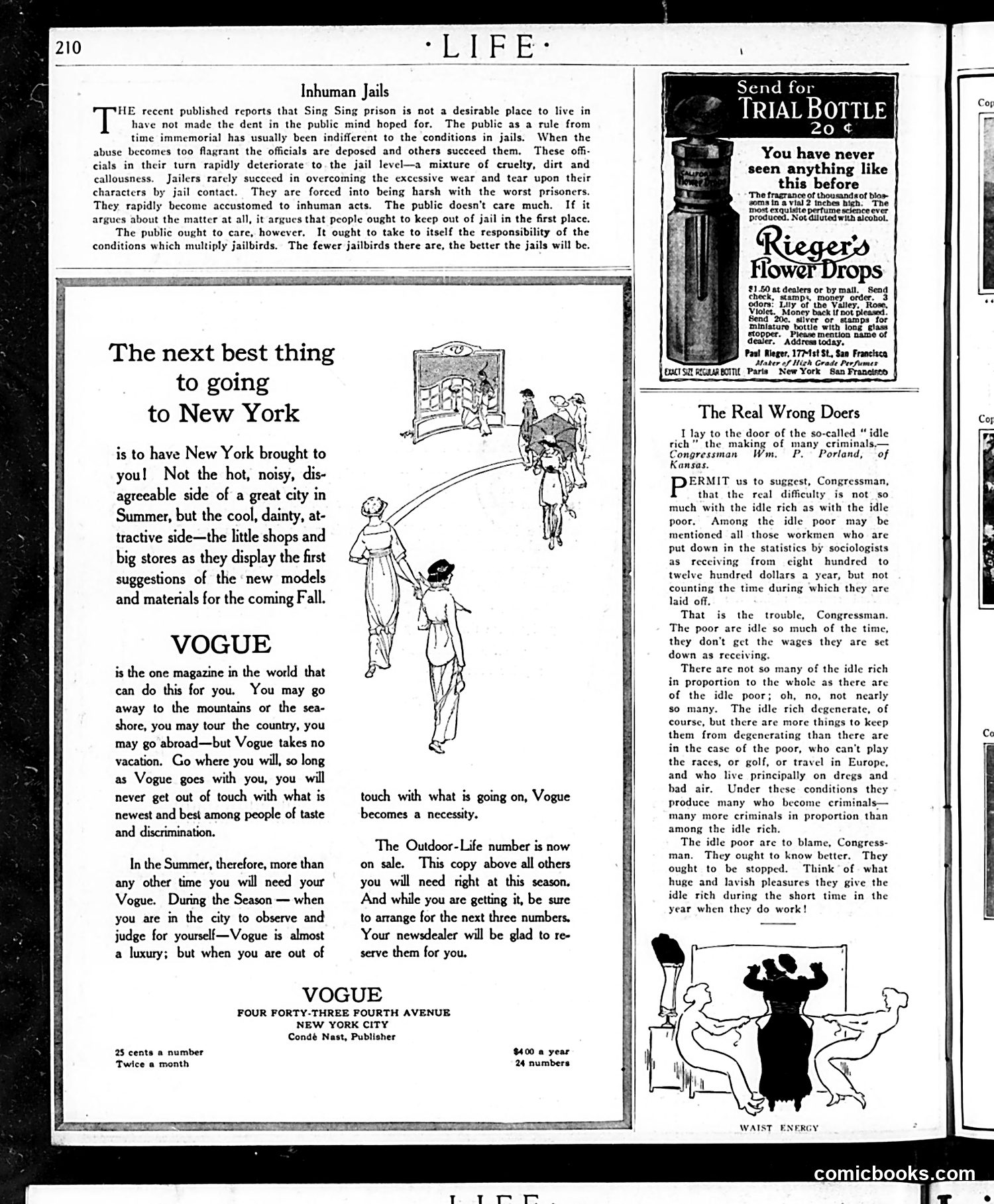
This page contains two main sections: **"Inhuman Jails"** (top): Editorial commentary on Sing Sing prison conditions, arguing the public bears responsibility for jail reform. The piece suggests society's indifference enables systemic abuse. **Vogue Advertisement** (center-left): Promotional copy positioning the fashion magazine as an essential summer companion—a luxury item for people of taste and discrimination. **"The Real Wrong Doers"** (right): A satirical rebuttal to Congressman William P. Portland of Kansas, who blamed "idle rich" for creating criminals. The author argues the *real* problem is idle *poor*—specifically working-class men who experience seasonal unemployment and underemployment, earning $800-1200 yearly but with unpaid layoff periods. The satire inverts the congressman's class-based blame, suggesting poverty and involuntary idleness (not leisure) breed criminality. The accompanying cartoon shows silhouetted "waist energy"—idle, wasted potential.
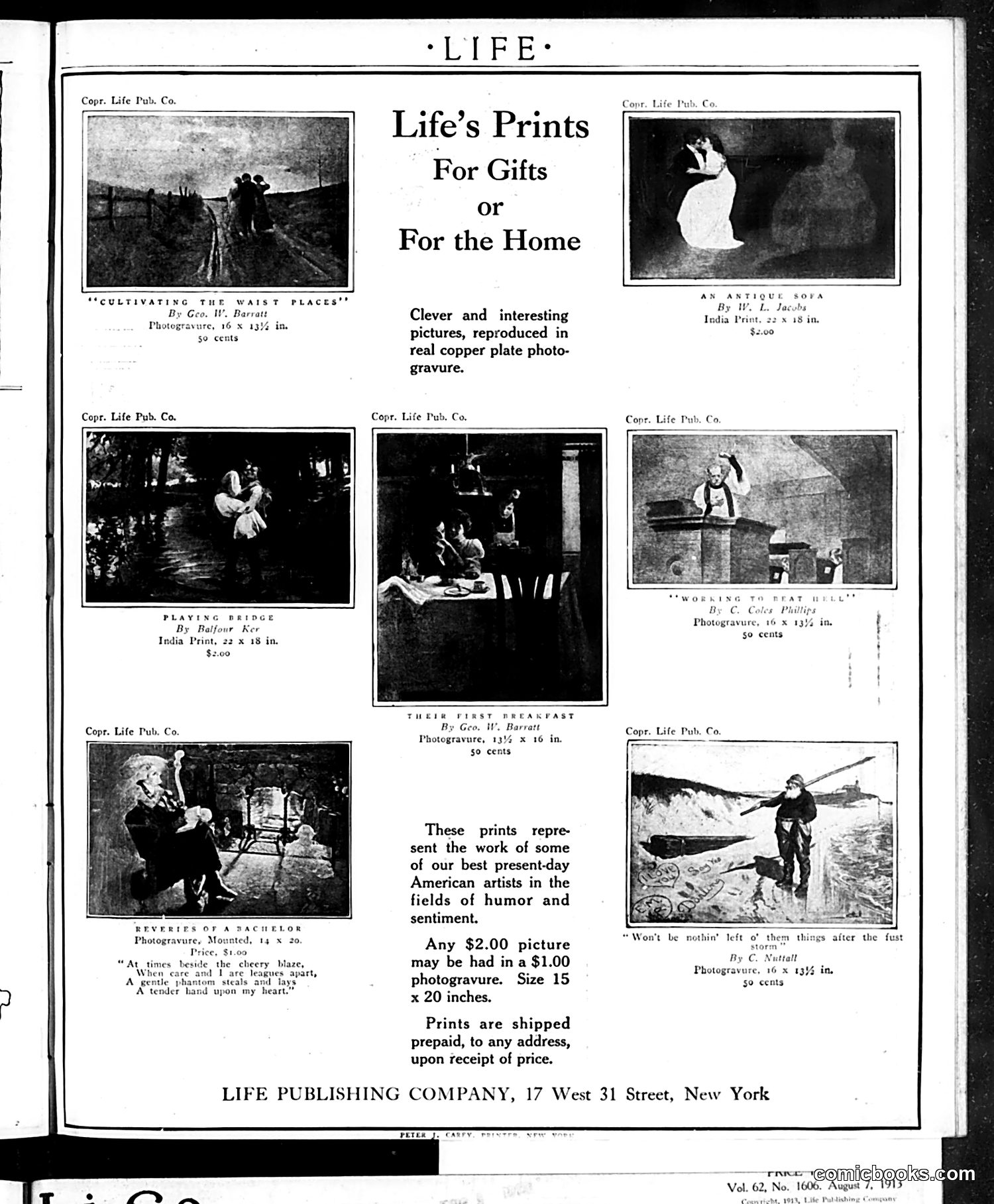
This page is primarily an **advertisement for art prints**, not political satire. Life Publishing Company is selling reproductions of contemporary American artwork by artists like George W. Barratt and Coles Phillips. The six featured prints depict genteel, domestic scenes typical of early 1900s illustrated humor: women playing bridge, a couple's first breakfast together, a woman cultivating plants, and similar sentimental or mildly comedic moments from middle-class life. The satire, if any, is gentle—the images poke fun at romantic situations and domestic life rather than politics. Titles like "Their First Breakfast" and "Reveries of a Bachelor" suggest the magazine's target audience: affluent Americans seeking tasteful home decoration. This represents Life's business model: selling humor-focused artwork to readers who could afford $1-2 prints (substantial money in 1912).
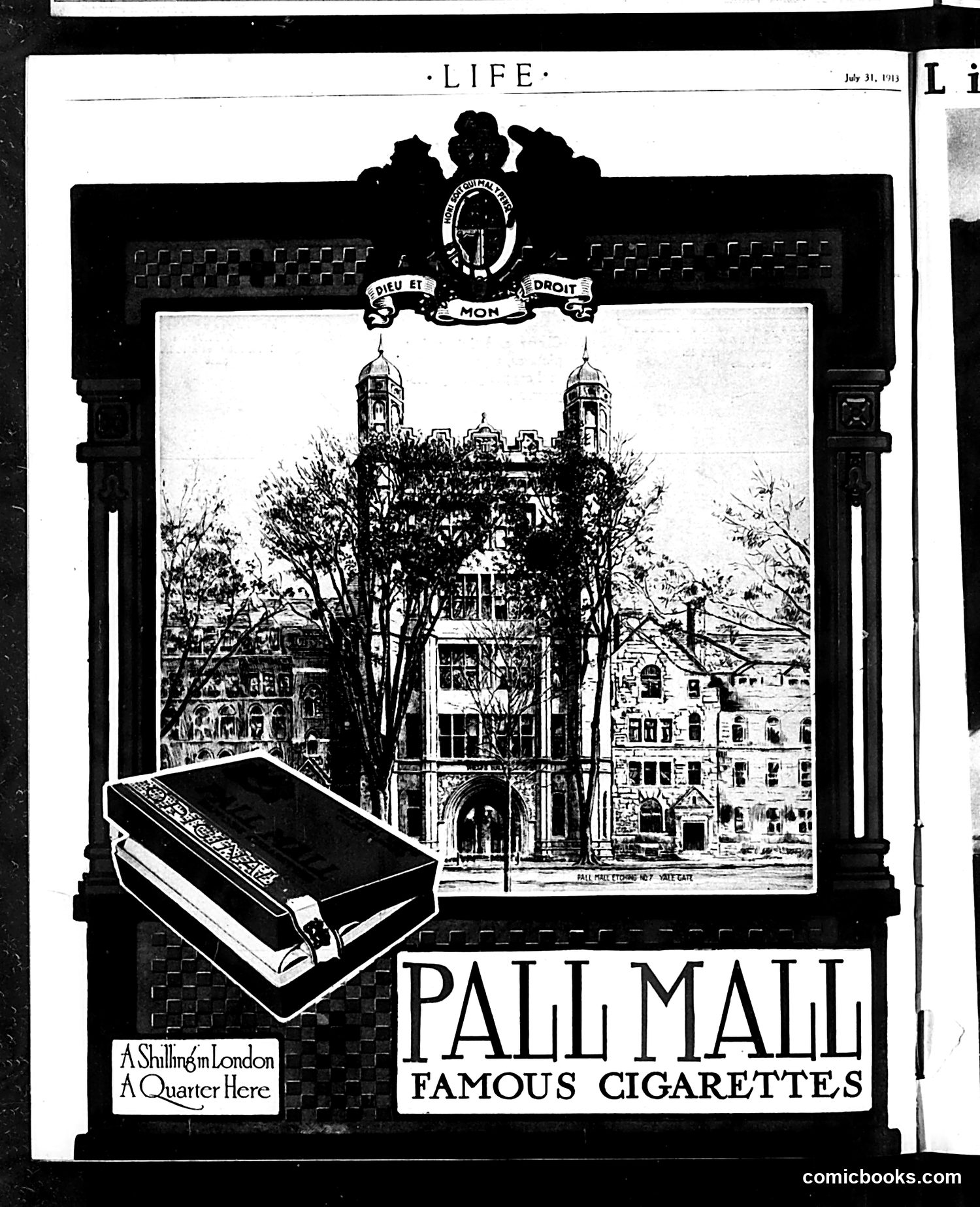
This is primarily a **cigarette advertisement**, not political satire. The image shows an ornate frame containing an architectural drawing of what appears to be a British cathedral or institutional building with twin towers, surrounded by period buildings and bare trees. A cigarette package is displayed prominently in the lower left. The ad's text reads "A Shilling in London / A Quarter Here," emphasizing the product's value proposition—Pall Mall cigarettes cost less in America than their British equivalent costs in London. The heraldic emblem at the top and formal architectural presentation lend the advertisement prestige and sophistication, marketing these cigarettes as upscale products to American consumers in the early 20th century.