
Life, 1913-07-31 · page 28 of 36
Life — July 31, 1913 — page 28: what you’re looking at
What you’re looking at
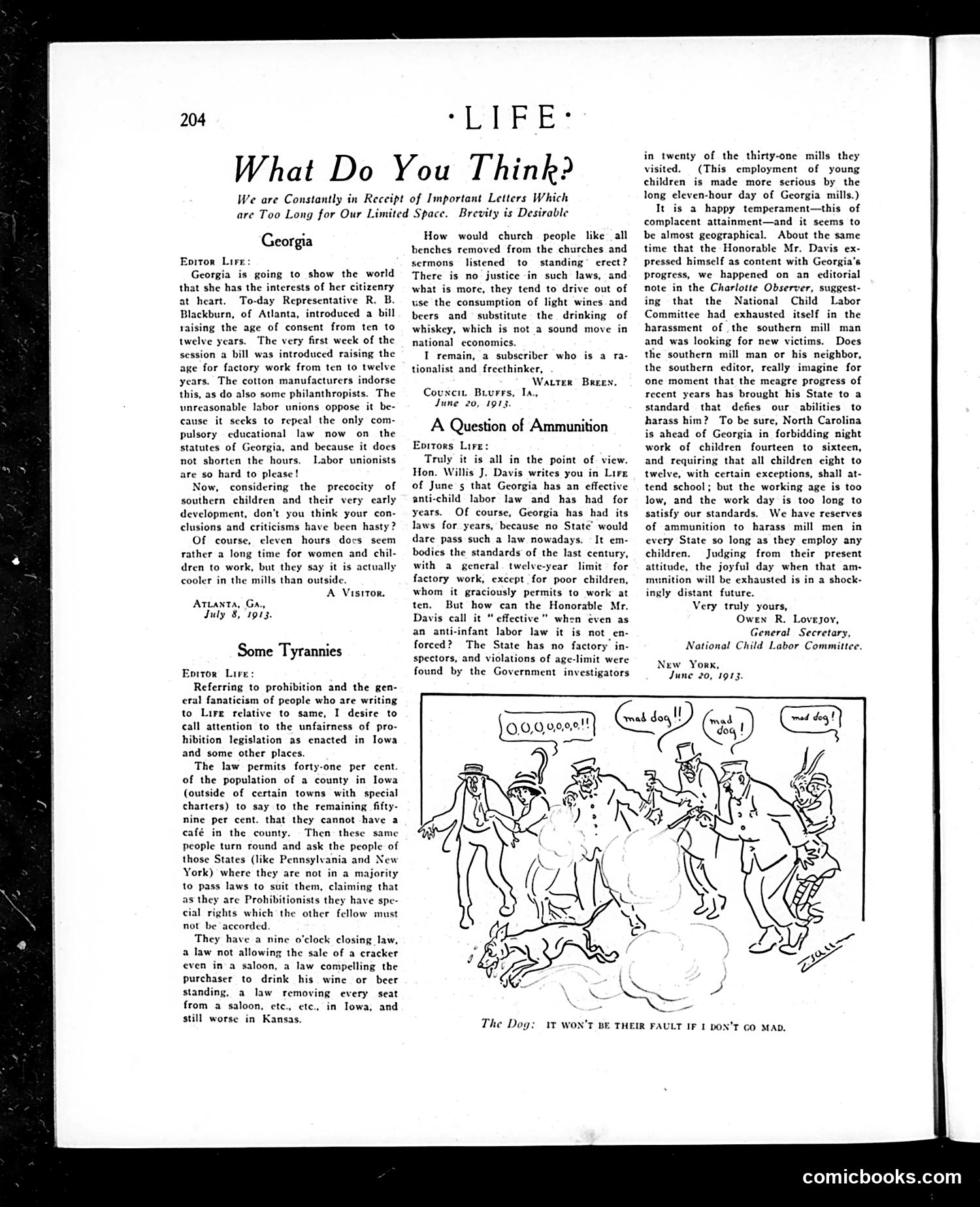
This page presents three reader letters debating social reforms, with a satirical cartoon at bottom. **The Letters:** The "What Do You Think?" section publishes opposing viewpoints on progressive issues. A Georgia visitor defends raising child labor age minimally (10 to 12), claiming southern children are "precocious" and mills are cooler than outside—transparently absurd rationalizations. Walter Breen attacks Prohibition advocates as tyrannical hypocrites, noting Iowa's 41% minority imposing rules on 59% majority, paralleling how prohibitionists demand other states follow their morality. **The Cartoon:** "The Dog: IT WON'T BE THEIR FAULT IF I DON'T GO MAD" shows a dog surrounded by gesticulating men shouting variations of "mad dog!"—they're trying to provoke the dog into madness through harassment. **The Satire:** The cartoon illustrates Breen's point: prohibitionists are like those men, deliberately provoking people into bad behavior through oppressive legislation. Their restrictive laws (9 o'clock closings, standing-only drinking) supposedly drive people toward worse vices (whiskey instead of beer), thus creating the moral chaos they claim to prevent. The dog represents the public being driven mad by their tyranny.
📄 Transcribed text from this page (OCR, searchable)
Machine-transcribed from the original scan — historical spelling and the odd misread are preserved.
“rR E* What Do You Think? We are Constantly in Receipt of Important Letters Which are Too Long for Our Limited Space. Brevity is Desirable Georgia Eprtor Lire: Georgia is going to show the world that she has the interests of her citizenry at heart. To-day Representative R. B. Blackburn, of Atlanta, introduced a bill raising the age of consent from ten to twelve years. The very first weck of the session a bill was introduced raising the age for factory work from ten to twelve years. The cotton manufacturers indorse this, as do also some philanthropists. The unreasonable labor unions oppose it be- cause it seeks to repeal the only com- pulsory educational law now on the statutes of Georgia, and because it does not shorten the hours. Labor unionists are so hard to please! Now, considering the precocity of southern children and their very early development, don't you think your con- clusions and criticisms have been hasty? Of course, cleven hours docs seem rather a long time for women and chil- dren to work, but they say it is actually cooler in the mills than outside. A Visitor. Attanta, Ga., July 8, 1913. Some Tyrannies Epitor Lire: Referring to prohibition and the gen- eral fanaticism of people who are writing to Lire relative to same, I desire to call attention to the unfairness of pro- hibition legislation as enacted in Iowa and some other places. The law permits forty-one per cent. of the population of a county in Iowa (outside of certain towns with special charters) to say to the remaining fifty- nine per cent. that they cannot have a café in the county. Then these same people turn round and ask the people of those States (like Pennsylvania and New York) where they are not in a majority to pass laws to suit them, claiming that as they are Prohibitionists they have spe- cial rights which the other fellow must not be accorded They have a nine o'clock closing law, a law not allowing the sale of a cracker even ina saloon, a law compelling the purchaser to drink his wine or beer standing, a law removing every seat from a saloon, ete., ete, in Iowa, and still worse in Kansas. How would church people like all benches removed from the churches and sermons listened to standing erect? There is no justice in such laws, and what is more, they tend to drive out of use the consumption of light wines and beers and substitute the drinking of whiskey, which is not a sound move in national economics. I remain, a subscriber who is a ra- tionalist and freethinker, Watter Breen. Couxci Biurrs, Ia., June 20, 1913. A Question of Ammunition Eprrors Lire: Truly it is all in the point of view. Hon. Willis J. Davis writes you in Lire of June 5 that Georgia has an effective anti-child labor law and has had for years. Of course, Georgia has had its laws for years, because no State’ would dare pass such a law nowadays, It em- bodies the standards of the last century, with a general twelve-year limit for factory work, except for poor children, whom it graciously permits to work at ten, But how can the Honorable Mr. Davis call it “effective” when even as an anti-infant labor law it is not en- forced? The State has no factory’ in- spectors, and violations of age-limit were found by the Government investigators The Dog: in twenty of the thirty-one mills they visited. (This employment of young children is made more serious by the long eleven-hour day of Georgia mills.) It is a happy temperament—this of complacent attainment—and it seems to be almost geographical. About the same time that the Honorable Mr. Davis ex- pressed himself as content with Georgia's progress, we happened on an editorial note in the Charlotte Observer, suggest- ing that the National Child Labor Committee had exhausted itself in the harassment of the southern mill man and was looking for new victims. Does the southern mill man or his neighbor, the southern editor, really imagine for one moment that the meagre progress of recent years has brought his State to a standard that defies our abilities to harass him? To be sure, North Carolina is ahead of Georgia in forbidding night work of children fourteen to sixteen, and requiring that all children cight to twelve, with certain exceptions, shall at- tend school; but the working age is too low, and the work day is too long to satisfy our standards. We have reserves of ammunition to harass mill men in every State so long as they employ any children. Judging from their present attitude, the joyful day when that am- munition will be exhausted is in a shock- ingly distant future. Very truly yours, Owen R. Lovejoy, General Secretary, National Child Labor Committee. New York, June 20, 1913. IT WON'T BE THEIR FAULT IF I DO: comicbooks.com