
Life, 1913-07-31 · page 20 of 36
Life — July 31, 1913 — page 20: what you’re looking at
What you’re looking at
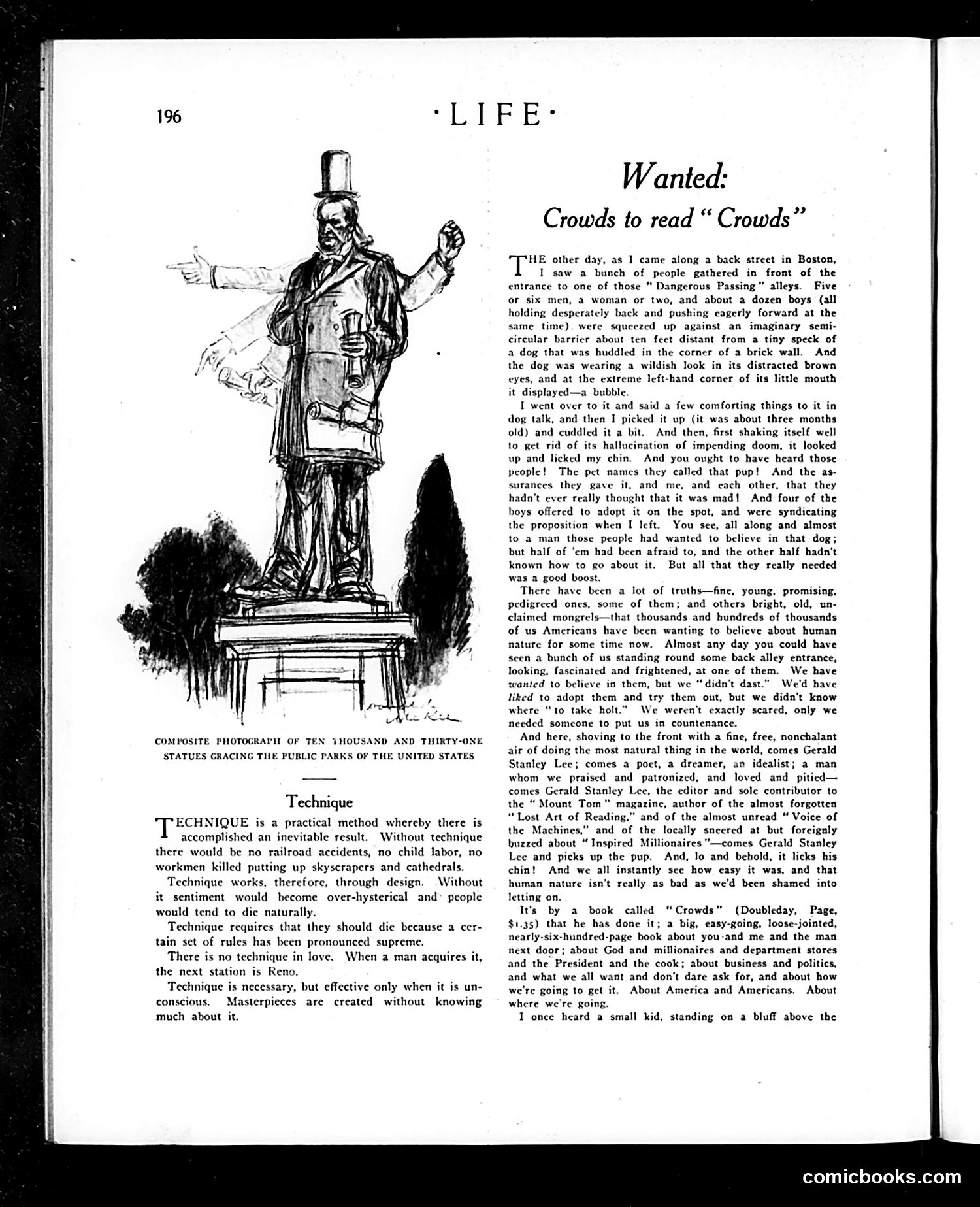
This Life magazine page satirizes American public discourse and belief. The statue illustration mocks the ubiquity of generic monuments cluttering parks—a composite of 10,031 statues representing shallow civic pride. The main article promotes Gerald Stanley Lee's book *Crowds*, arguing it gives Americans permission to believe positive truths about human nature they've been afraid to embrace. The extended dog metaphor suggests people are like a fearful crowd afraid to approach a small dog—they want to believe it's friendly but need someone confident (Lee) to demonstrate it's safe. The satire targets both American timidity and manufactured consensus: Lee functions as the reassuring figure who validates what people already want to believe, making truth-acceptance easier through his authority rather than evidence. The piece critiques how Americans need permission and social proof to accept ideas, and how public opinion follows confident personalities rather than independent reasoning.
📄 Transcribed text from this page (OCR, searchable)
Machine-transcribed from the original scan — historical spelling and the odd misread are preserved.
COMPOSITE PHOTOGRAPH OF TEN 1HOUSAND AND THIRTY-ONE STATUES GRACING THE PUBLIC PARKS OF THE UNITED STATES Technique ECHNIQUE is a practical method whereby there is accomplished an inevitable result. Without technique there would be no railroad accidents, no child labor, no workmen killed putting up skyscrapers and cathedrals. Technique works, therefore, through design. Without it sentiment would become over-hysterical and people would tend to die naturally. Technique requires that they should die because a cer- tain set of rules has been pronounced supreme. There is no technique in love. When a man acquires it, the next station is Reno. Technique is necessary, but effective only when it is un- conscious. Masterpieces are created without knowing much about it. Wanted: Crowds to read “ Crowds” HE other day, as I came along a back strect in Boston, I saw a bunch of people gathered in front of the entrance to one of those “ Dangerous Passing” alleys. Five or six men, a woman or two, and about a dozen boys (all holding desperately back and pushing eagerly forward at the same time). were squeezed up against an imaginary semi- circular bar about ten feet distant from a tiny speck of a dog that was huddled in the corner of a brick wall. And the dog was wearing a wildish look in its distracted brown eyes, and at the extreme left-hand corner of its little mouth it displayed—a bubble. I went over to it and said a few comforting things to it in dog talk, and then I picked it up (it was about three months old) and cuddled it a bit. And then, first shaking itself well to get rid of its hallucination of impending doom, it looked up and licked my chin. And you ought to have heard those people! The pet names they called that pup! And the as- surances they gave it, and me, and each other, that they hadn't ever really thought that it was mad! And four of the boys offered to adopt it on the spot, and were syndicating the proposition when I left. You see, all along and almost to a man those people had wanted to believe in that dog; but half of ‘em had been afraid to, and the other half hadn't But all that they really needed known how to go about it. was a good boost. There have been a lot of truths—fine, young, promising, pedigreed ones, some of them; and others bright, old, un- claimed mongrels—that thousands and hundreds of thousands of us Americans have been wanting to believe about human nature for some time now. Almost any day you could have seen a bunch of us standing round some back alley entrance, looking, fascinated and frightened, at one of them. We have wanted to believe in them, but we “didn’t dast.”. We'd have liked to adopt them and try them out, but we didn't know where “to take holt.” We weren't exactly scared, only we needed someone to put us in countenance. And here, shoving to the front with a fine, free, nonchalant air of doing the most natural thing in the world, comes Gerald Stanley Lee; comes a poct, a dreamer, an idealist; a man whom we praised and patronized, and loved and pitied— comes Gerald Stanley Lee, the editor and sole contributor to the “ Mount Tom” magazine, author of the almost forgotten “Lost Art of Reading,” and of the almost unread “ Voice of the Machines,” and of the locally sneered at but foreignly buzzed about “Inspired Millionaires "—comes Gerald Stanley Lee and picks up the pup. And, lo and behold, it licks his chin! And we all instantly see how easy it was, and that human nature isn't really as bad as we'd been shamed into letting on. It's by a book called “Crowds” (Doubleday, Page, $1.35) that he has done it; a big, easy-going, loose-jointed, nearly-six-hundred-page book about you-and me and the man next door; about God and millionaires and department stores and the President and the cook; about business and politics, and what we all want and don’t dare ask for, and about how we're going to get it. About America and Americans. About where we're going. I once heard a small kid, standing on a bluff above the comicbooks.com