
Life, 1913-07-31 · page 27 of 36
Life — July 31, 1913 — page 27: what you’re looking at
What you’re looking at
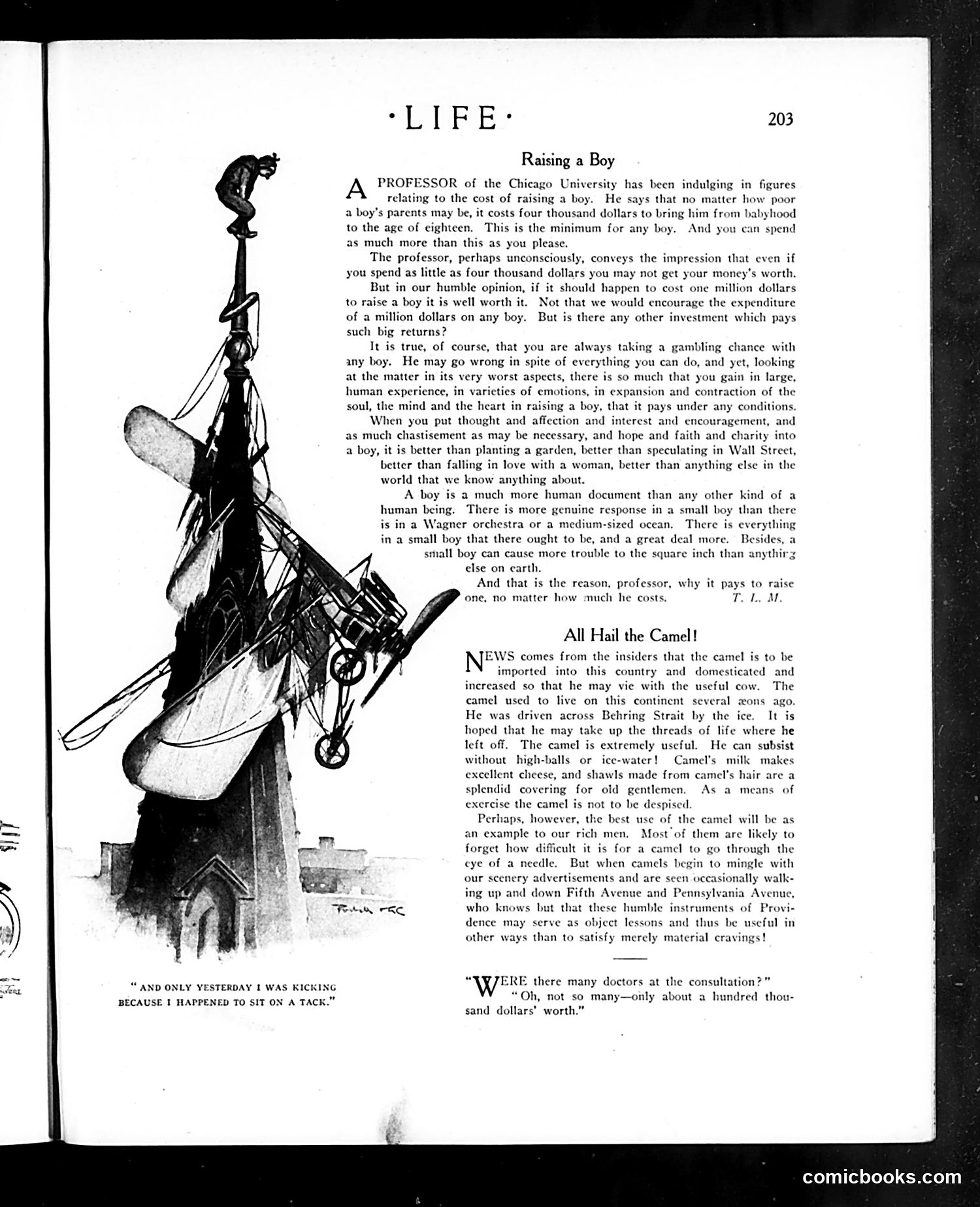
This page contains two satirical pieces reflecting early 20th-century American values and concerns. **"Raising a Boy"** responds to a Chicago University professor's calculation that raising a boy costs $4,000 minimum through age eighteen. The editorial argues this investment is worthwhile despite the gamble, as boys provide immense human and emotional returns—better than gardens, Wall Street speculation, or romance. The accompanying cartoon shows a man perched atop a tall, precarious structure (suggesting life's instability), captioned with a complaint about sitting on a tack—contrasting trivial discomfort with life's larger challenges, reinforcing the editorial's point about perspective. **"All Hail the Camel!"** satirizes a proposal to import camels to America for domestication. The piece mocks wealthy Americans by suggesting camels exemplify humble usefulness and self-denial—a biblical reference to "a camel through the eye of a needle"—implying rich men need moral instruction through observing the camel's austere nature. Both pieces reflect period anxieties about materialism versus virtue.
📄 Transcribed text from this page (OCR, searchable)
Machine-transcribed from the original scan — historical spelling and the odd misread are preserved.
“AND ONLY YESTERDAY I WAS KICKING BECAUSE I HAPPENED TO SIT ON A TACK.’ “DPE; Raising a Boy PROFESSOR of the Chicago University has been indulging in figures relating to the cost of raising a boy. He says that no matter how poor a boy's parents may be, it costs four thousand dollars to bring him from babyhood to the age of eighteen. This is the minimum for any be And you can spend as much more than this as you please. The professor, perhaps unconsciously, conveys the impression that even if you spend as little as four thousand dollars you may not get your money's worth. But in our humble opinion, if it should happen to cost one million dollars to raise a boy it is well worth it. Not that we would encourage the expenditure of a million dollars on any boy. But is there any other investment which pays. such big returns? It is true, of course, that you are always taking a gambling chance with any boy. He may go wrong in spite of everything you can do, and yet, looking at the matter in its very worst aspects, there is so much that you gain in large, human experience, in varieties of emotions, in expansion and contraction of the soul, the mind and the heart in raising a boy, that it pays under any conditions. When you put thought and affection and interest and encouragement, and as much chastisement as may be necessary, and hope and faith and charity into a boy, it is better than planting a garden, better than speculating in Wall Street, better than falling in love with a woman, better than anything else in the world that we know anything about. A boy is a much more human document than any other kind of a human being. There is more genuine response in a small boy than there is in a Wagner orchestra or a medium-sized ocean. There is everything in a small boy that there ought to be, and a great deal more. Besides, small boy can cause more trouble to the square inch than anythir else on earth. And that is the reason, professor, why it pays to raise one, no matter how much he costs. Te Ted, All Hail the Camel! EWS comes from the insiders that the camel is to be imported into this country and domesticated and increased so that he may vie with the useful cow. The camel used to live on this continent several ons ago. He was driven across Behring Strait by the ice. It is hoped that he may take up the threads of life where he left off. The camel is extremely useful. He can subsist without high-balls or ice-water! Camel's milk makes excellent cheese, and shawls made from camel's hair are a splendid covering for old gentlemen. As a means of xercise the camel is not to be despised. Perhaps, however, the best use of the camel will be as an example to our rich men. Most’of them are likely to forget how difficult it is for a camel to go through the cye of a needle. But when camels begin to mingle with our scenery advertisements and are seen occasionally walk- ing up and down Fifth Avenue and Pennsylvania Avenue, who knows but that these humble instruments of Pr dence may serve as object lessons and thus be useful in other ways than to satisfy merely material cravings! ERE there many doctors at the consultation?” “Oh, not so many—only about a hundred thou- sand dollars’ worth.” comicbooks.com